Earlier today, fitness tracker hardware and software company Fitbit filed to go public on the New York Stock Exchange. Since the regulatory filing went public, observers have been scouring the paperwork for information on Fitbit’s financials, sales numbers, and notes about the competition. The Financial Times‘s Tim Bradshaw noticed that that Fitbit cites Apple and the recently-launched Apple Watch as the top billed competitor in the IPO Risk Factors section:
Just when it seemed things couldn’t get any tougher, London’s Financial Times reports that the European Commission is considering launching an antitrust investigation into the service, even before it launches. The Commission has contacted several music labels to ask what deals have been done with Apple, says the FT.
The commission, which also has contacted Apple’s music-streaming rivals, is said to be concerned that the company will use its size, relationships and influence to persuade labels to abandon free, ad-supported services such as Spotify, which depend on licenses with music companies for their catalogues.
The newspaper implies that the investigation may have been triggered by a formal complaint by an existing streaming music service … Expand Expanding Close
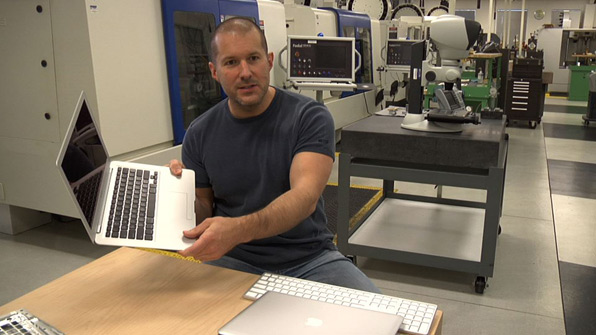
London’s Financial Times today carries a profile of Jony Ive in which he discusses how the Mac changed his dislike of computers, why he is consumed by design and disinterested in sales, the difference between designing a phone (and its slim battery) and designing a smartwatch–and why Apple decided to take a low-key approach on even the top-end Edition watch.
The piece also contained an interesting (if possibly mistaken) estimate on Apple Watch pricing (update: Apple PR has now confirmed to us that the FT is indeed mistaken) … Expand Expanding Close
Financial success and dazzling new technology alone might have been enough to earn Apple’s steely chief executive the FT’s vote as the 2014 Person of the Year, but Mr Cook’s brave exposition of his values also sets him apart.
This was never more powerful than when he talked publicly for the first time about his sexuality.
Not much is known about Apple’s deals with its suppliers, but court filings by former sapphire supplier GT Advanced reveal that the contract included a $50M penalty for any leak of Apple product information, reports the Financial Times.
While the amount of the penalty clause may vary according to the size of the supplier, it seems likely that a substantial leak penalty is a standard condition of supplying product components to Apple – though the number of leaks over the iPhone 6 suggests that such penalties offer limited protection.
Contracts between Apple and its suppliers will undoubtedly be subject to strict non-disclosure agreements, but lawyers for GT Advanced are asking the court to allow details to be made public … Expand Expanding Close
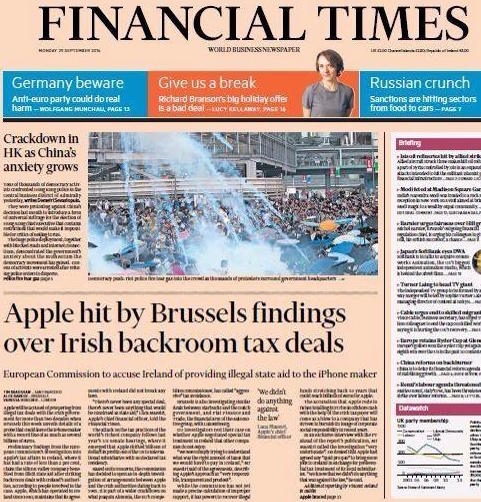
Two days after the Financial Times reported that the European Commission was about to come down hard on Apple’s alleged deal with the Irish government to reduce its tax liabilities, Apple has made a statement to Business Insider claiming that it has received “no selective treatment.”
Apple is proud of its long history in Ireland and the 4,000 people we employ in Cork. They serve our customers through manufacturing, tech support and other important functions. Our success in Europe and around the world is the result of hard work and innovation by our employees, not any special arrangements with the government. Apple has received no selective treatment from Irish officials over the years. We’re subject to the same tax laws as the countless other companies who do business in Ireland.
Since the iPhone launched in 2007, our tax payments in Ireland and around the world have increased tenfold. To continue that growth and the benefits it brings to the communities where we work and live, we believe comprehensive corporate tax reform is badly needed …
It looks like this week’s Apple “xxx-gate” is a big one with the Financial Times reporting that the European Commision is about to come down hard on Apple for its long held tax avoidance strategies in Ireland.
Typically the EU has used its state aid powers to address broader competition issues. But in the past year Brussels has attempted to target the tax affairs of companies such as Apple, Starbucks and Amazon. It is a novel application of the law with far-reaching implications, not just for the companies, or EU countries, but for EU-US relations in general.
This week the European Commission will publish the first findings in the Apple case. The details – including evidence from bygone tax negotiations – are likely to be explosive.
Did Apple apply pressure to Irish authorities in 1991 and again in 2007 when negotiating tax deals and if so were these illegal competitive measures that gave Apple advantages over competitors? Luca Maestri, Apple’s finance chief, of course denies any wrongdoing… Expand Expanding Close
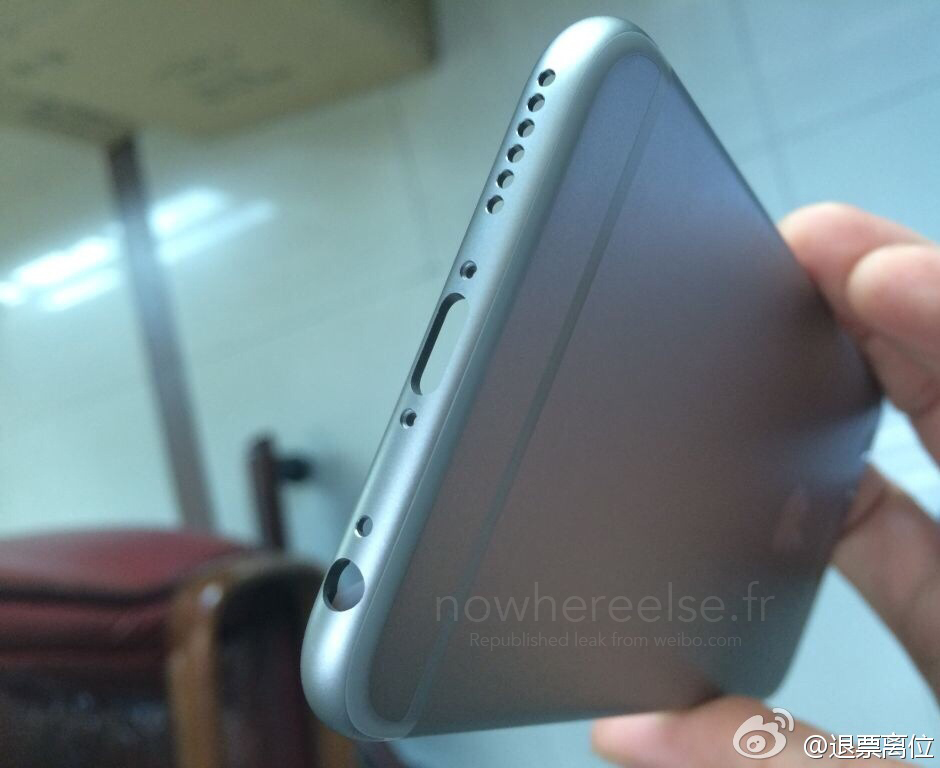
French site NWEclaims to have found photos of a finished production model of the casing of the 4.7-inch version of the iPhone 6, shown in gray.
While not revealing anything new about the overall design of the phone, it does appear to give a much clearer view of how the antenna breaks are handled, with a significantly more subtle appearance than had been suggested by some earlier leaked parts, mockups and renders – as seen in the photo below … Expand Expanding Close
With reports that Apple is in final talks to close a $3.2 billion deal to purchase Beats Electronics, we thought it would be interesting to revisit a recent interview with the company’s co-founder Jimmy Iovine from just before the launch of Beats Music. The interview above was from the D: Dive Into Media conference back in February of 2013 and in it Iovine gives a lot of insight into his view of the music industry leading up to the launch of the company’s new Beats Music subscription streaming service.
You’ll also get a sense of just how important a figure Iovine is in the music industry, which might be why Tim Cook is rumored to be keeping Iovine on as a special adviser on creative matters through the Beats deal. Lots of topics are covered, but the interview as a whole gives great perspective into Beats’ mission with its new streaming music service.
The WSJ reports that more than a billion dollars were wiped off Samsung’s market value today following President Obama’s veto of the decision to ban the import of iPhone 4 and 3G iPad 2 devices into the USA. The fall represented 0.9 percent of the company’s market cap.
While a Presidential veto over-rules the original ITC ruling, the Financial Times reports that Samsung is appealing the ITC decision on the grounds that it only upheld one of the four patents it believes Apple has infringed. The appeal is expected to be held in Q1 2014. Were Apple to lose then, however, the impact would be significantly lower, as Apple is almost certain to have launched new iPhones and iPads by then, with the iPhone 4 and iPad 2 likely removed from Apple’s retail and online stores and seeing only residual sales elsewhere … Expand Expanding Close
As reported by Financial Times, “people familiar with Apple’s plans” for the iWatch are claiming Apple has started a hiring frenzy as they ramp up development of the upcoming product. The article goes on to state that people close to Apple feel that “the timing of the hiring spree implied the iWatch would not be ready for launch until the latter part of next year.”
Update: While it’s hard to read too much into these reports, Foxconn told The Wall Street Journal the freeze on hiring is a result of “a high employee return rate following the Lunar New Year holiday.”
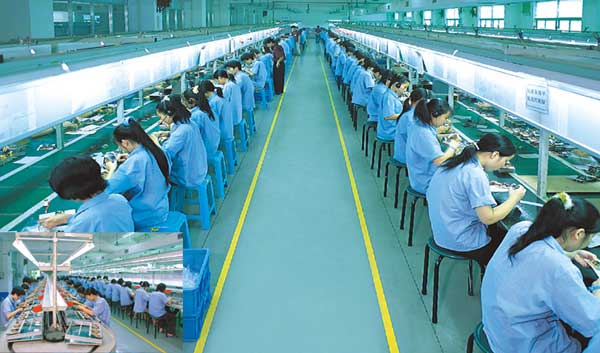
According to the report from Financial Times, Apple’s major assembly partner Foxconn has halted new hiring at its facilities due to a slow down in production for the iPhone 5:
The suspension in hiring by China’s largest private sector employer and the biggest assembler of Apple products, is the first such countrywide move since the 2009 downturn, prompted by the financial crisis. It underscores the weakening demand for some Apple products, which has put pressure on the US company’s battered share price.
Foxconn confirmed it is not currently hiring in its plants located in mainland China, and FT reported the company’s employees were informed that hiring would stop until at least the end of March “in response to reduced orders for the iPhone 5.” While the iPhone 5 doesn’t seem to be experiencing a slow down, according to the latest numbers from Strategy Analytics, the March time frame would line up nicely with rumors of iPhone 5S production beginning in March. Many analysts are calling for a June or July launch of the next-generation iPhone, and Apple could begin initial production as early as next month if true. The decreased production at Foxconn is likely thanks to the expected falloff in new sales in the months following the busy holiday season. Less likely is speculation that Apple could be switching manufacturers.
Recruiters in China told FT that Foxconn has stopped hiring specifically for the iPhone and iPad production lines in many of its factories:
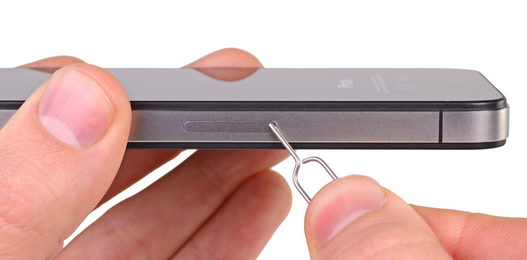
Presented as being designed to slip into the SIM card slot of the iPhone 5, this element seems in turn confirm that the next iPhone indeed adopt this new standard imposed by Apple. I take this article to drag other photos with us in passing a Home button which should equip the iPhone 5 and which is also slightly smaller than previous generations, details of which we heard last Friday.
According to a report from Financial Times, carriers in Europe are stocking up on mini SIM cards designed for Apple’s next-generation iPhone in anticipation of the device’s expected October launch. In June, reports speculated that Apple’s nano-SIM design for the new 4FF standard was selected by the European Telecommunications Standards Institute, while hands-on video of the next-generation iPhone backs, which we first revealed in May, showed what appeared to be a smaller SIM card holder.
Today’s report from FT claimed Apple’s nano SIM card design is indeed the mini SIMs being purchased by European operators:
Operators expect that the iPhone will feature the nano sim in a slimmed down design, according to two sources with knowledge of the situation, and have begun to store millions of the cards in warehouses in anticipation of high demand for Apple’s iPhone. Apple declined to comment[Shocker]…
In a Financial Timesstory about Apple’s Senior Vice President of Industrial Design Jonathan Ive “emerging from [Steve] Jobs’ shadow,”we get a few interesting stories from ex-Apple employees regarding the design guru’s work ethic. While one anonymous ex-Apple employee told the publication Ive’s “main talent was his ability to manage his relationship with Jobs,” Path chief and former Apple employee Dave Morin remembers Ive as a perfectionist.
Morin described a story about Ive spending three months adjusting the MacBook design to ensure it could be easily operated with one finger:
Yesterday we told you that Apple’s lawsuit against Proview regarding the “iPad” trademark was rejected by a court in Shenzhen, which would make Proview the rightful owner until Apple decides to appeal the decision or settle with the company outside of court.
At the time we weren’t sure what exactly would be the next course of action for either company, but according to a new report from Financial Times, it appears Proview is attempting to block iPad sales by suing resellers in Southern China. Starting with the cities of Huizhou and Shenzhen, if the company is successful at blocking sales of the iPad there, they will then go after other Apple resellers throughout China.
Xie Xianghui, a lawyer presenting Proview, discussed the company’s new course of action:
We are starting with these two cities, and if we are successful in getting iPad sales stopped, we will consider going after Apple resellers elsewhere in China.
The Shenzhen Futian District Court will begin hearing one case on December 30, with another slated for January 7. There’s always the possibility that Apple will settle outside of the courts before then, as Proview’s financial troubles are clearly a motivating factor. Expand Expanding Close
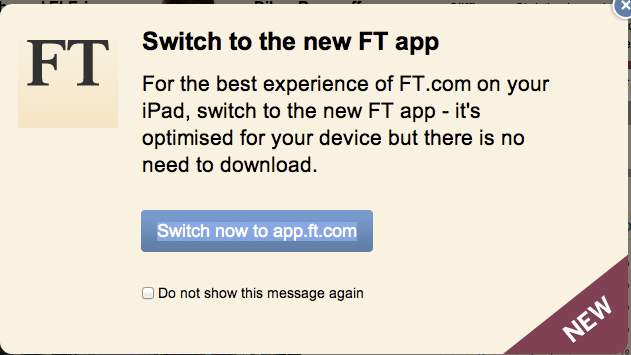
Reuters is reporting that the Financial Time’s web app is more popular than their recently Apple-removed iOS app. You’ll recall that the Financial Times’ iOS app was removed by Apple, due to the publication trying to dodge Apple’s 30% cut regulation. Luckily for Financial Times, they’re not seeing any issues in traffic, getting more than 700,000 users on their newly launched web app. Financial Times is simply drawing in users by displaying a message at the top of their site, linking to their HTML 5 app.
So this draws the question — do publishers really need to have an iOS app on the Store? Maybe not.
The Financial Times has officially been removed from the App Store after failing to comply with Apple’s in-app subscription model that requires payments to be processed through iTunes (giving Apple a 30% cut in the process).
The publication used to have an iPhone and iPad app, which appear to have been removed from the App Store today. Fortunately for FT (not so much for Apple), they also have an HTML5 web app alternative that they’re urging iOS users to use instead.















 According