Apple patent details replaceable back panels for adding lenses and advanced camera features

According to an Apple patent application published by the U.S. Patent and Trademark Office and detailed by PatentlyApple, Apple is at the very least conceptualizing a device that sports a removable back panel for easily replaceable components such as lenses or optical solutions.

While it is unclear whether the invention would be used in a standalone camera, next-generation iPod or iPhone, or a different device entirely, the patent detailed several methods of upgrading a device with supplementary optics:

The digital imaging subsystem is typically enclosed within the case of the device to protect the digital imaging subsystem. The enclosure generally prevents direct access to the lens of the digital imaging subsystem for the purpose of providing any sort of supplementary optics, especially if the supplementary optics must be precisely aligned with the image sensor… It would be desirable to provide a structure for a compact device that allows the end user to reconfigure the optical arrangement of the device while retaining the benefits of assembling the device using a pre-assembled digital imaging subsystem.

Apple detailed several features that could be added through the easily swappable supplementary optics, including: improved zoom capabilities, better shutter control, removable close-up lenses, and the addition of motion sensors, flashes, or a lens baffle. As an example, the report explained a removable IR cut-off filter that would allow “capturing black and white images at very low light levels. Without the IR-cut filter the camera’s light sensitivity may extend to 0.001 lux or lower.” The report also broke down how the removable back panels could be implemented:

Read more

Upcoming Smithsonian exhibit features the patents and trademarks of Steve Jobs

As part of its events for World Intellectual Property Day 2012, the Smithsonian Institution will exhibit over 300 patents and trademarks credited to Steve Jobs and Apple at the Ripley Center Museum starting May 11. Among the items to be on display: a 1985 Apple Macintosh computer, mouse, and keyboard; a NeXT computer; a 2010 Apple iPod; and 312 documents. The Smithsonian and the U.S. Patent and Trademark Office will display the exhibit until July 18.

The World Intellectual Property Organization released a brochure on its website announcing the Jobs exhibit:

Jobs held 317 utility and design patents in the United States. On display are the patent certificates that list him among the inventors involved in the conceptualization of many iconic Apple products, including computer cases, iOS-based devices, packaging, keyboards, mice and power adaptors, and even the glass staircases found in many Apple stores. In addition to his U.S. patents, Jobs is named on some 28 international applications filed under WIPO’s Patent Cooperation Treaty (PCT) system.

Read more

New patent details Apple’s work with high refresh rate LCD technology HDTVs

A ton of recent rumors all but confirm Apple plans to enter the TV market with a full-fledged Apple-branded HDTV, but today a patent published by the U.S. Patent and Trademark Office details an advancement of high refresh rate LCD technology known as “fringe field switching.” As described by PatentlyApple, Apple’s patent offers advancements in the technology that would allow FFS for use with large screen HDTVs. The report noted, “Previous versions of FSS couldn’t accommodate such large displays.” PatentlyApple explained:

Read more

Apple, Steve Jobs posthumously granted patent application for Shanghai Apple Store design

Late last year, the New York Times did a great interactive feature on the 323 Patents that Steve Jobs was granted as CEO of Apple.

From Patently Apple today:

Today, the US Patent and Trademark Office granted Apple a design patent for their flagship Shanghai Apple Store which opened its doors in September 2010. One of the designers credited for this incredible architecture is the late Apple CEO Steve Jobs.

He keeps racking them up… Read more

In the future, hardware accessories play nice with your iOS apps

Apple opened up its proprietary 30-pin dock connector to third-party developers back in 2008, with iOS 3.0 APIs enabling hardware accessories to communicate with your iPhone, iPod touch or iPad via dedicated apps. The way it works today, plugging in your accessory puts up a prompt telling you to automatically download an appropriate app. This is supported only by some accessories so in most cases users are required to navigate their way around the App Store and find that app themselves. But Apple’s penchant for providing simple and seamless solutions once again becomes evident in a new patent application filed in June 2010 with the U.S. Patent & Trademark Office.

Entitled “Method and System for Locating an Accessory and an Application for Use With a User Device”, it describes a plug-and-play system where plugging in your accessory automatically produces a list of multiple compatible apps that go with it – not just that one companion app from your accessory’s vendor. Additionally, the invention would work the other way around to allow easy discovery of hardware accessories compatible with the apps you actually have installed on  your device by utilizing an in-store kiosk, pictured in the above patent drawing.

Speculating further, the proposed solution would pave the way for a new (and lucrative) market where accessories play nice with apps.
Read more

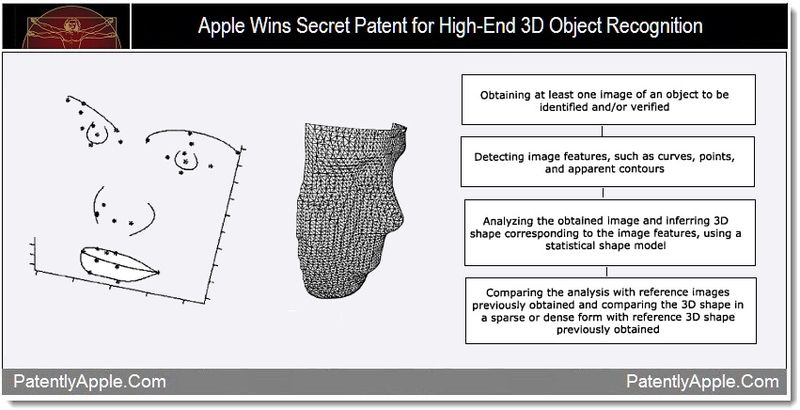
Apple patent details advanced 3D object recognition and verification technology

PatentlyApple point us to a few recently obtained Apple patents published by the US Patent and Trademark Office. Perhaps the most interesting of all is a patent covering 3D object recognition technology that could potentially be implemented in future iPads. While unsophisticated facial recognition tech is already present in consumer mobile devices, Apple’s patent details a method of automated biometric identification to identify or verify an object or face based on a 3D representation compiled by analyzing the curves, points, contours, etc., of a 2D projection. In other words, a three-dimensional “statistical shape model” could be pulled from a 2D image, allowing more accurate detection and verification of 3D objects, such as a face or objects from “airport security X-ray images”, for example. The report explains:

The recovered 3D shape is the most probable shape consistent with the 2D projections, i.e. the images. The statistical model needs a bank of data, denoted training data, where the 3D positions of the image features are known, in order to learn the parameters of the model. Such data sampling could be done using e.g. binocular or multi-view stereo or range scanners. Once the model parameters are learned, the 3D shape can be computed using one or several images. The 3D shape is then used, by means of the presented invention together with the 2D image data, to identify or verify the object as a particular instance of the object class, e.g. the face belonging to a certain individual. A positive (or negative) identification initiate proper action by means of the presented innovation.

It’s unclear when exactly Apple obtained the patent, which lists Professor Kahl Fredrik as the main inventor and dates back to 2005. However, PatentlyApple points out Jan Eric Solem, who owned Polar Rose before they were acquired by Apple in 2010, is also listed as an inventor. Polar Rose technology is currently being used in facial recognition and detection features in the iOS 5 Camera app. The report speculates the next-gen PowerVR GPU from Imagination Technologies will play a role in providing Apple with the juice necessary for advanced 3D rendering, despite the company not yet being confirmed as a licensee:
Read more