The Paradox is an intelligent take on the iPod nano watch meme by a New Brunswick, New Jersey-based college student named Kunal Sheth. His Kickstarter-funded conversion kit turns your miniature music player into a really professional-looking modern timepiece. Keeping style and functionally in mind, the kit contains a case which completely encloses the device into a brushed stainless steel housing with rubber silicone straps. Each case is serialized and has a flap that provides access to the 30-pin dock connector while protecting the music player from dust and dirt.
Kunal told me in an email interview they will be coming out with a Red Edition Paradox Conversion kit provided they reach funding. Also check out the black unit below (click for larger). “It definitely is going to be our top seller”, he tells me. Go past the break for more information and another nice video tour.
Apple’s custom-built A5 chip currently powers iPad 2 and is expected to make its way into next-gen iPhone, iPod touch and Apple TV
Japanese blog Macotakara, which accurately outlined some of the iPad 2 features, in its latest story claims that an A5-powered MacBook Air with Thunderbolt I/O is being tested in Apple’s labs. The machine could be manufactured by Quanta Computer, the story has it. The article quotes a source who allegedly saw an early prototype:
According to this source who saw live A5 MacBook Air actually, this test machine performed better than expected. Though it’s not clear which Mac OS X or iOS is pre-installed on this A5 MacBook Air, iOS seems to have difficulty to use features of Thunderbolt without Finder. And even if Mac OS X is installed, developer should spend time to support A5 on Universal Binary Applications. As considering these situation, this A5 MacBook Air seems to be made just for experiment.
The rumor aligns well with a recent SemiAccuratespeculation that Apple will transition their portables lineup to custom-built chips with ARM-based processing cores. Not that Macotakara’s hit-and-miss record is anything to go by, but we have to ask ourselves what benefits – if any – the iPad 2’s A5 chip would bring to Apple’s ultra-thin notebook. Here’s the big picture…
Remember when Intel sang praises enthusiastically for a certain fruity company, having told the press recently how thrilled they’ve been because Apple has been “pushing us hard”? Intel wasn’t joking and they want the iPhone maker to make another switch. Earlier today, Intel’s finance boss told journalists at a London investor event that his company would absolutely love to build mobile processors for Apple – even if that meant agreeing to custom designs which marry Apple’s silicon blueprints to Intel’s proprietary processor architecture, Reuters reported.
There are certain customers that would be interesting to us and certain customers that wouldn’t. If Apple or Sony came to us and said ‘I want to do a product that involves your IA (Intel architecture) core and put some of my IP around it’, I wouldn’t blink. That would be fantastic business for us. Then you get into the middle ground of ‘I don’t want it to be a IA core, I want it to be my own custom designed core,’ and then you are only getting the manufacturing margin, (and) that would be a much more in-depth discussion and analysis.
Intel is probably looking at Apple’s pending legal battle with Samsung, suspecting it won’t be too long before the Mac maker jumps ship to outsource the A4/A5 production to TSMC. Such a rare moment in time would give Intel a not-to-be-missed opportunity to win the Apple chip account.
The future of e-commerce is here, but it only works for Sprint customers with a Nexus S 4G handset. Our take is that an iPhone app is in the works as we speak. Apple fans are simply too big a market for e-wallet too ignore.
Boom, Google Wallet has gone live at the just-finished presser in Google’s New York office. The search Goliath means business, that’s for sure. They’ve managed to convince the journos like us who have seen it all that Google Wallet is no toy. We have here an end-to-end mobile payment solution which quite possibly marks an inflection point in e-commerce. I ain’t drinking Google’s Kool-Aid, bear with me for a sec.
There are two pieces to it: Google Wallet itself, which runs as a native app on your mobile device equipped with an NFC chip, and Google Offers, a Groupon-like service providing rebates, savings and offers that can be easily redeemed on your device, at the points of sale. One click on an offer on the web sends the coupon over-the-air to your devices authorized for Google Wallet. You can also use your device’s camera to snap the Google Offers icon found on printed marketing materials such as in-store posters, banners, print ads and so forth.
Googlers love Macs. The above screengrab is from the Google Wallet promo shown at the presser (it’s not yet available on YouTube). The highly polished clip has iMacs all over the place.
Paying for goods is a one-tap affair involving waving your device in front of the wireless payment terminal at participating merchants. The transaction is processed within seconds and directly settled with your issuing bank. In addition, your device negotiates with the merchant’s terminal to automatically redeem offers and earn loyalty points for you. Someday, Google boldly proclaimed, stuff like boarding passes, tickets, ID and keys will be stored in your Google Wallet. You will also get electronic receipts that will eliminate bills on paper. Looking good so far. What’s the catch?
The keynote demonstration had Google’s speaker buying a shorts for his daughter. He waived the phone and the clerk’s terminal took into account his loyalty card and automatically deducted his saved coupon. The live transaction was handled successfully in the second try.
Remember Steve Wozniak’s white iPhone 4? Then you remember we discovered it was a do-it-yourself modification. The Woz himself admitted to buying parts from Fei Lam (no relation to Gizmodo’s editor Brian Lam whatsoever), a New York teenager who banked a cool $130,000 selling those sought-after white front and back plates on the web. When the story blew up and Apple presumably sent its legal rottweilers after the kid, he shuttered the whiteiphone4now.com site and disappeared under the radar.
MacRumors discovered that Apple yesterday filed a lawsuit against Lam and his parents who “aided and abetted him” in an alleged infringement and dilution of Apple’s trademarks. They’re seeking damages and demanding that Lam hands over all profits from the sale. At the same time, the company has filed a voluntary dismissal, leaving the door open to a possible settlement. From Apple’s lawsuit:
Beutiful Tima looking, well, beautiful while using sunglasses in northern mounts of Tehran
Two new interesting patents from Apple have surfaced today in the United States Patent & Trademark Office (USPTO) database. The first, entitled “Display that Emits Circularly-Polarized Light”, describes a modified liquid-crystal display for gadgets like iPhones and iPods that lets you interact with it while wearing a polarized sunglasses. What’s wrong with polarized sunglasses, you ask… Well, protecting your eyes from harmful UV rays calls for a vertically vibrating electric field which interferes with linear polarizers found on LCDs, that’s what.
Hence, trying to look at an LCD through your badass-looking polarized sunglasses degrades on-screen images as a result of said interference. Apple’s invention is based on a last year patent that set the basic groundwork. Thew new filing calls for a modified LCD with a layer that “receives the linearly-polarized light on one surface, converts the linearly-polarized light to circularly-polarized light, and then emits the circularly-polarized light from another surface”.
Apple filed the patent under the classification number of 20110124260. The company credited the invention to engineers Wei Chen, Cheng Chen, John Z. Zhong, Shawn R. Gettemy and Victor H.E. Yin. If that was too great a mind job for you, how about pressure-relief battery pouches for mobile devices designed to avoid a potential fire hazard?
File this one under the highly improbable drawer because there’s little chance Samsung will let Apple get their hands on its active-matrix organic LED technology, better known as AMOLED, which is an important differentiating hardware feature of their Galaxy S smartphone series…especially now that Apple has sued them. However, The Korea Heraldheard from sources that Apple is actively courting Samsung to build AMOLED displays for a third-generation iPad. It’s allegedly a high enough priority for Apple’s operations chief Timothy Cook, who has been running the company in Jobs’ absence, to discuss the possibility with Samsung’s top brass during a recent trip to South Korea:
Apple wants to tap into Samsung’s AMOLED technology for an upgraded version of the iPad2, considered as many as the iPad3 that is likely to be launched toward the end of this year. During Cook’s trip last week, Apple seems to have offered Samsung an advance for the AMOLED displays.
Another reason this doesn’t make sense is the publication’s claim of iPad 3 launching in 2011. Android tablets currently don’t pose grave threat to iPad’s dominance so there’s little incentive in rushing out a new iPad mere eight moths following the second-generation iPad’s launch. There are plenty of other reasons, too…
You know you’re in trouble when people write an app with sole purpose of pinging your content network to tell users whether or not it’s up. Touche. Clearly Sony should have released such an app as part of their damage control process. It’s surprising that the idea for the PSN Status app took so long to dislodge. Image iTunes were busted and went down for a month…
I assure you that Apple fans and haters would fall over each other creating a similar app within the first 24 hours of the incident. Not a PlayStation 3 owner? How about i360Emu, a free app for your iPhone and iPod touch (depicted below) that emulates the famous Red Ring of Death which appears when your XBox 360 fails? I know, it’s been a slow news day.
The Apple Store offers a selection of factory-refurbished Apple Mac Pro workstations in its Special Deals section. Plus, all systems receive free shipping. At up to $530 off, each system is at the lowest total price we’ve seen direct from Apple this year. Plus, all are lower than the best price we could find for a new unit, typically by wide margins. Sales tax is added where applicable. A 1-year warranty applies, the same as new systems. Items are removed from Apple’s site when they sell out. Some best bets:
An Apple salesman “convinced” the Securities and Exchange Commission that it would be in their best interest to buy storage gear from both his company and Cloverleaf Communications, another party specializing in data storage solutions for big clients. The agency greenlighted the purchase of a million dollar worth of items from both Apple and Cloverleaf and carried out the transaction in the summer of 2008. The deal was essentially a no-bid contract as SEC didn’t seem fit to seek out alternative bids from more established storage vendors. That’s the gist of an internal investigation by the agency’s inspector general David Kotz who has been snuffling around SEC’s procurement practices, reportsReuters.
According to the investigation, an Apple salesman convinced the agency that Cloverleaf could provide a cheaper solution to the agency’s data storage and backup woes. Kotz also found the SEC improperly shared budget information with Apple and went ahead with purchases before getting proper approval and before performing reviews.
Real problems began when the products arrived. The SEC was “beset with problems” when it tried using the equipment. “Bugs” in the installation were spotted that had not been worked out. As a result, the entire thing “went downhill”, Kotz wrote in his report. However, when SEC employees pointed out that the $1 million gear was literally useless, bosses lashed out at them, warning them that “this information doesn’t leave this room”.
Did the iPhone maker intentionally dump their outdated equipment on the SEC and profit in the process? And what exactly do Apple and Cloverleaf have in common?
Citrix, Online, a division of Citrix Systems Inc. which provides remote-connectivity and online collaboration solutions, is jumping on the iPad bandwagon with the news that it will soon release a free iPad app which they claim will be the “first iPad application designed for real-time, remote support.” Dubbed GoToManage, the program will enable support for single location or multiple sites. Why’s that a big deal?
Well, if you’re an IT administrator, you will have the luxury to work anywhere at any time and thereby assist dispersed workforce of your company even while away. That will no doubt come in handy when you lazy on a Sunday afternoon, sunbath on the beach or enjoy cocktails on your summer holiday. GoToManage for the iPad will be the first iPad application designed for real-time, remote support. Those eager to find out more can register their interest and Citrix will notify them when the program becomes available for download.
With Russia from love. Russian tourist Alex Shumilov camped outside New York’s Fifth Avenue Apple Store to be the first to buy an iPad 2. Image credit: PCMag.com
Fierce competitors Apple and Samsung are once again in each other’s cross-hair as iPhone 4 and Galaxy S II smartphones hit the 1.2 billion people market of India this coming Friday, May 27. According toBusiness Line, Indian carrier Aircel will sell the 16GB iPhone 4 for 34,500 Indian rupees, or about $760 American dollars (40,900 rupees for the 32GB model, or about $900).
Ouch! Those are exorbitant prices to charge in the country with 41.6 percent of the total population living below the international poverty line of $ 1.25 a day. Aircel in its defense will introduce a new pricing model where buyers “will have the opportunity to recover hundred per cent of their upfront iPhone cost in monthly credits on their service plan over 24 months”.
Meanwhile, iPad 2 will also land on store shelves in Russia and Ukraine on Friday. Retailers in Russia, which has population of 142 million, are tipping“unprecedented demand” for the sough-after tablet. Several major electronics retailers should sell the gizmo, including MediaMarkt, Beliy Veter Cifrovoi, M.Video, ION, Technosila, Eldorado, z-Store and Re:Store which has Nokia, Lego and Apple products in its offering.
“Following unprecedented demand from customers in Germany, Denmark and Norway, where the first batch of iPad 2 was sold inside three days, we are expecting all iPad 2’s to be sold even faster in Russia”, said Re:Store’s PR director Ludmila Semushina. The device won’t come cheap, though…
UPDATE : iPad 2 arrives in Brazil on Friday, too, per our tipster. That’s another 200 million people market to you. Another tipster pinged us, telling: “iPad 2 also hits Chilean market, Ripley.cl is already selling the idevice, other stores will do so on Friday at 00:00” Number 3 says Ipad 2 arrives in Argentina this friday to Garbarino and Maxim stores, and don’t forget Taiwan.
AT&T’s president and chief executive John Stankey made some interesting 4G LTE-related announcements this morning at the Barclays Capital Global Communications, Media and Technology Conference. The carrier will roll out fourth-generation LTE technology in Atlanta, Chicago, Dallas, Houston and San Antonio, he promised. Ten additional markets in the US will get LTE by the end of the year, with the ultimate goal of reacing 70 million Americans with LTE by year’s end. He was also quote in AT&T’s press release, included in its entirety below:
Twelve South’s newest case for the MacBook Air looks like something worthy wrapping your notebook in. The BookBook for MacBook Air, ($80 amazon for iPad or Macbook Air) an iteration of their vintage book-style case, is a genuine leather case hand-distressed to ensure that no two are alike. It weighs in at just thirteen ounces so it adds very little bulk to the Air. It’s hand-assembled and sports two hardback covers with extended corners and a rounded spine cushion. More juicy press shots and description below the fold.
Planking, for those uninitiated, is the act of laying flat and faced down with arms to the sides of the body in the strangest (and often dangerous) places and – need I say – snapping a photographic evidence of it. This latest fad has reached the Apple Store where employees have been caught planking on the job. ElectricPig discovered the amusing Apple Store Planking blog where a bunch of problematic images have been posted by Apple Store plankers. Wondering what planking right on the Genius Bar looks like?
Apple has updated its Logic Pro and Logic Express software with the ability to import GarageBand for iPad projects. The welcome enhancement lets you continue perfecting tablet projects on your Mac to edit audio tracks, loops and so forth. The updated Logic Pro 9.1.4 and Logic Express 9.1.4 installers are available for download from Apple’s site.
Apple is reportedly on the verge of adding another supplier to its tablet-making process. Component supplier Coretronic is said to have won the iPad backlight module contract, industry sources tell. trade publication DigiTimes. Coretronic is a Taiwanese firm whose backlight modules are used in a number of products, including LED TVs.
Coretronic has been working with Chimei Innolux to provide backlight modules for iPad panels. However, Chimei was only certified by Apple in May, hence backlight units for 9.7-inch panels for iPad have been shipping to South Korea-based LG Display.
The news suggests Apple is moving aggressively to put an end to those pesky display problems reported by some early iPad 2 adopters…
It’s official, MacBooks are the highest-quality notebooks money can buy. Consumer advocacy group Consumer Reports has awarded the entire lineup of Apple notebooks the highest scores among all contenders, ranking them #1 in nearly every category across the board. For example, Mac notebooks lead the pack in five out of seven spots in the 13-inch category. The paid report, relayed by The Loop, puts the 11- and 13-inch MacBook Air as well as the 15-inch and 17-inch MacBook Pro ahead of other branded machines from first-tier vendors.
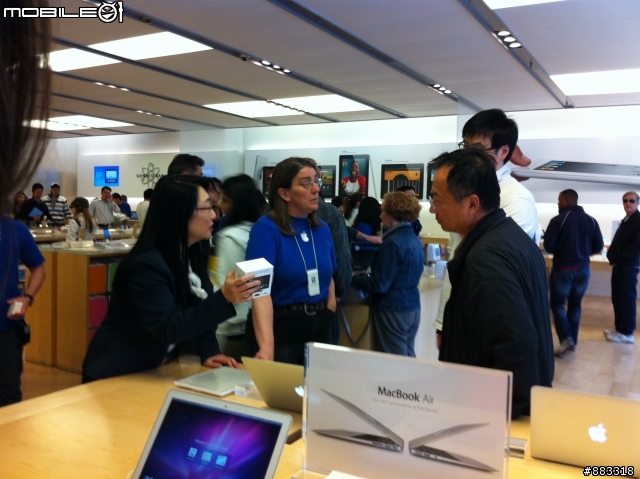
Appeal of Apple’s stylish portables is so strong that even HTC’s boss couldn’t resist getting two MacBook Airs for herself and her spouse (see below). Oh, and let’s not forget that Apple-branded notebooks have consistently been a hit with analysts and media, not to mention Google geeks who showed unconditional love for MacBooks at the company’s developer pilgrimage earlier this month (above). Go past the break to see how MacBooks fared compared to HP, Sony, Asus and others.
Per Apple’s lawsuit against Samsung over an alleged copyright infringement, a federal court is forcing Samsung to hand over samples of the supposedly infringing devices, including packaging. Why? Apple wants to determine whether Samsung’s gear mimics the look and feel of Apple gadgets too closely, CNET reports, quoting a Courthouse News Servicearticle.
Normally, there’d be three months before Samsung had to hand over samples, but San Jose Judge Lucy Koh has decided that Samsung has already been shooting its mouth off about the unreleased phones and can’t claim they’re secret models, Courthouse News reports. Apple points out that Samsung even gave away a Galaxy Tab 10.1 tablet to all 5,000 people at the recent Google I/O developer conference.
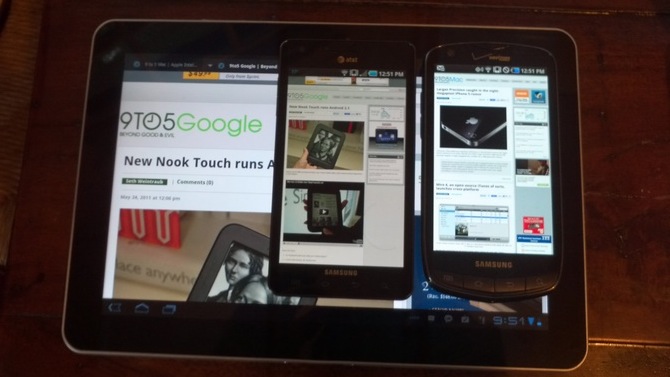
This includes Samsung’s flagship Galaxy S II smartphone, in addition to the Infuse 4G and Droid Charge. The ruling also applies to the Galaxy-branded tablets (8-9 inch and 10.1-inch models), but not to Samsung’s iPod touch lookalike dubbed the Galaxy Player. Notice anything strange about this brouhaha?
Taiwanese trade publication DigiTimes (which has a a hit-and-miss record in the Apple rumors business) is out today with the news that Largan Precision might become the principal supplier of eight-megapixel lens modules for a fifth-generation iPhone:
Taiwan-based Largan Precision currently sees 8-megapixel phone-use lens modules account for nearly 10% of its total lens module shipment volume, but it may see 8-megapixel modules replace 5-megapixel ones to become the mainstream for smartphones in the third quarter of 2011 due to possible orders from Apple, according to industry sources in Taiwan.
A new iTunes version? Close. This is Miro 4, a new feature-packed media player for Mac OS X, Windows and Linux.
Do you feel constrained by the limited media player choices for your Mac? Here’s something completely different. The non-profit Participatory Culture Foundation has just released a brand new cross-platform media player dubbed Miro 4 that “lets you break free”, as the tagline says. The long list of features is pretty impressive. Miro 4 works with your existing media libraries without any copying involved. Just point the application to your music and video folders (including the iTunes music library) and voila – your media automagically appears.
It comes with the Amazon MP3 store and a bittorrent client built-in. Desktop and mobile devices running Miro can share and transfer music and video files to each other effortlessly over the wireless network. They are also working on versions for iPad and other tablets. What else could you ask for? How about this…
For all the talk of HTML5, web developers nowadays are still doomed to hard-coding pretty HTML5 websites. Deciding enough is enough, two engineers left Apple to found Tumult, a Y Combinator-funded startup. Their goal: Address a chronic shortage of decent HTML5 authoring tools. What, you didn’t think Adobe’s Creative Suite is the be all end all of web development?
The result of their undertaking is Hype, a brand new Mac application taking the pain out of creating eye-catching animations on the web that don’t require the Flash plug-in. Jonathan Deutsch, one of the co-founders and former engineering manager for the Mail.app backend, explains in an interview with Paul Hontz’s The Startup Foundry:
At one point after a trip to Europe, I wanted to make a photo website that would be as nice as a beautifully bound photo album, and use lots of effects. Coding this with HTML5 would have been a nightmare. There had to be a better way, and that’s how the idea for Hype was born.
The $30 download (limited introductory pricing) is already the top-grossing program on the Mac App Store. Deutsch also shared interesting anecdotes about the perks of working at Apple…
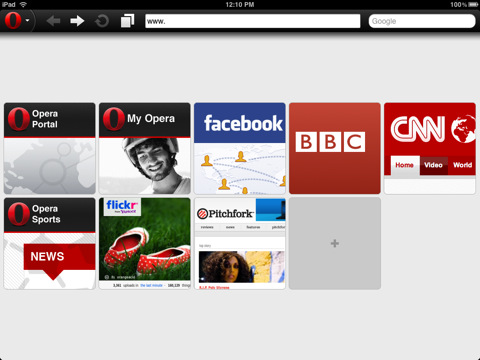
Opera Software has updated the Opera Mini web browser with iPad support this morning. Having spent some time with the app, MacStories praised visual tabs allowing you to switch between multiple pages by tapping their previews, smooth UI animations, background loading of tabs and a handy menu with rich bookmarks, history, settings and sharing options with Facebook and Twitter social integration and My Opera support.
The updated browser also includes the souped up interface with the iPhone 4 Retina Display support. Grab it now, Opera Mini is a universal binary available free on the App Store. When Opera Mini debuted on the iPhone last March, it came down in history as the first major iOS browser from a third-party, following a change of heart from Apple’s previous policy of prohibiting any web browser on the handset other than its own.
Apple in the past received its share of criticism over the lack of data protection prior to iOS 4. It was a big issue for businesses who couldn’t even fathom losing unprotected sensitive information from stolen devices. The iPhone 3GS introduced a chip for hardware-based encryption and iOS 4 brought out the Data Protection feature that secures your data with a 256-bit encryption.
ElcomSoft, a team of Russian forensic experts behind security software used by law enforcement and certain three-letter agencies, has managed to crack both the on-device data protection and backup file encryption. Bright side of newsinterviewed Elcomsoft’s Vladimir Katalov who explained how the GPU-accelerated Phone Password Breaker tool unlocks Apple and BlackBerry backups. The program might also come in handy should you ever forget your backup file password, but there are some caveats.