ZDNet reports that<a href="I
Mac Pro 'hexacore' Xeon Core i7-980x coming Tuesday


ZDNet reports that<a href="I
The most recent iPhone SDK removes those VideoChat files we found in the previous version of the SDK. The big question: Did Apple remove them for the big camera surprise or did they remove them because there ain’t gonna be a surprise? Don’t get your hopes up.

vs. our previous post:
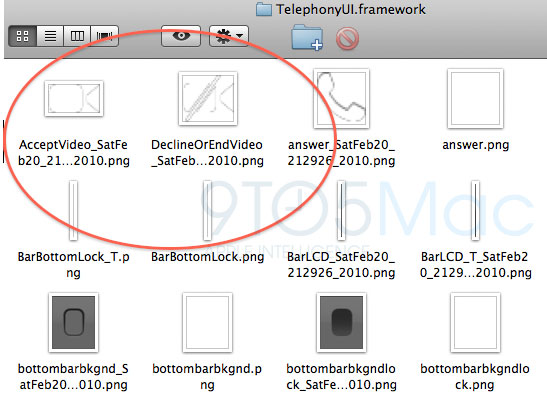
On the surface, the latest iPhone 3.2 Beta 4 SDK didn’t have much new information. Diving a little deeper however, we find some very exciting news.
In the gestures folder, you’ll see two new types of commands (3Tap.plist and LongPress.plist) that are certainly not implemented in the current 3.1 iPhone SDK.
Apple is likely allowing developers to use these capabilities in the next versions of the OS. We might even see these in the shipping version of the iPad. Thanks AL!


This Computerworld article sounds about right. Segmentation is Apple’s friend in this case as all of the competitors are scrambling and confusing consumers to become #2. Even though Apple is the 51st ARM tablet because the A4 is an ARM design, it clearly stands out from the pack as THE tablet. The hype around the iPad is easily bigger than all of the other Joojoos/Slates combined.
I think the tablet game is going to play out like this: You’ll have the other ARM tablets on the low end (Dell, etc) that cost less than the iPad and pick up the audience that can’t justify the $500 entry cost. Then you’ll have the Intel Atom tablets (JooJoo/HP) priced about the same as the iPad but with more “features” (cameras, Adobe Flash, etc.) that may appeal to a select few in the corporate market. You’ll also have the eReaders that will become marginalized because of their lack of important features and color screens.
Apple has a big head start on everyone both in mindshare and in OS maturity. With weeks left until the launch of the “Year of the Tablet”, its hard to see any competitors even coming close to Apple’s iPad.
As a Mifi user already, I’ve decided to forgo the 3G version of the iPad and stick with Wifi. The reason is simple. I already use the Mifi to connect my MacBook Pro to the Internet when I am away from home/Wifi. Why would I get another plan when I already have 5GB of data/ month on a much better wireless carrier (and an iPhone plan with AT&T)? If I didn’t have the Mifi, I’d be tempted to jailbreak my iPhone and use it as a Mifi.
Certainly there have to be a lot of people out there who need wireless data on the go and would rather be able to connect to two (up to five) devices? That’s what Verizon is thinking.

Engadget shows that Verizon is going after people like me with this internal Verizon iPad positioning document.
AT&T’s CEO is thinking people won’t want the 3G iPad. He might be right. (or not)
[youtube=http://www.youtube.com/watch?v=zwGAKUForhM&w=700&h=540]
Fortune reports that Apple is going after handset manufacturers over what it sees at infringement of its IP. In January ’09 Tim Cook said:
“we will not stand for having our IP ripped off and we’ll use whatever weapons we have at our disposal.”
 Jonathan Schwartz (AKA My Little Pony), the recently ousted CEO of Sun, says today in his blog that Steve Jobs threatened to sue Sun for their Project Looking Glass and its graphical effects.
In 2003, after I unveiled a prototype Linux desktop called Project Looking Glass*, Steve called my office to let me know the graphical effects were
Paul Bonanos <a href="http://gigaom.com/2010/03/09/apple
 The WSJ today reports that the big announcement that Cisco’s been hyping all week is actually a faster router. While that may not be as exciting a s a new tablet device (or it may be depending on your tastes), it will hopefully have some effect on Apple customers. The WSJ profiled AT&T and specifically their wireless (read:iPhone) customers who are the major catalyst for new broadband:
AT&T, meanwhile, said the 100-gigabit backbone Internet network would support growing wireless and wired data and traffic “for years to come.” In particular, AT&T has dealt with the explosive growth in wireless data, primarily driven by the Apple Inc. iPhone, among other smart phones. The router “allows us to serve volumes of traffic that we need to serve,” said Keith Cambron, CEO of AT&T Labs.
AT&T has stated that they are working hard on bringing up their wireless speeds but first must upgrade their backhaul. That’s where the Cisco CSR-3 would come in handy, delivering much more data over the same lines.AT&T have also stated that they don’t anticipate much additional traffic from Apple’s iPad – something we’ll start to understand at the end of April.
Apple today released the iPad/iPhone OS 3.2 Beta 4 SDK. The build 10M2144 is 2.5GB and can be downloaded from developer.apple.com/iphone.


The EFF today posts the “iPhone Developer Program License Agreement“. Normally, they wouldn’t be allowed to reproduce the document because of the terms of Apple’s SDK but since NASA created an app, they used the Freedom of Information Act to obtain a copy for publishing. They note that it is more restrictive than before and parts of it may not be enfodceable.
They note their concerns below:
Ban on Public Statements: As mentioned above, Section 10.4 prohibits developers, including government agencies such as NASA, from making any “public statements” about the terms of the Agreement. This is particularly strange, since the Agreement itself is not “Apple Confidential Information” as defined in Section 10.1. So the terms are not confidential, but developers are contractually forbidden from speaking “publicly” about them.
App Store Only: Section 7.2 makes it clear that any applications developed using Apple’s SDK may only be publicly distributed through the App Store, and that Apple can reject an app for any reason, even if it meets all the formal requirements disclosed by Apple. So if you use the SDK and your app is rejected by Apple, you’re prohibited from distributing it through competing app stores like Cydia or Rock Your Phone.
Ban on Reverse Engineering: Section 2.6 prohibits any reverse engineering (including the kinds of reverse engineering for interoperability that courts have recognized as a fair use under copyright law), as well as anything that would “enable others” to reverse engineer, the SDK or iPhone OS.
No Tinkering with Any Apple Products: Section 3.2(e) is the “ban on jailbreaking” provision that received some attention when it was introduced last year. Surprisingly, however, it appears to prohibit developers from tinkering with any Apple software or technology, not just the iPhone, or “enabling others to do so.” For example, this could mean that iPhone app developers are forbidden from making iPods interoperate with open source software, for example.
Kill Your App Any Time: Section 8 makes it clear that Apple can “revoke the digital certificate of any of Your Applications at any time.” Steve Jobs has confirmed that Apple can remotely disable apps, even after they have been installed by users. This contract provision would appear to allow that.
We Never Owe You More than Fifty Bucks: Section 14 states that, no matter what, Apple will never be liable to any developer for more than $50 in damages. That’s pretty remarkable, considering that Apple holds a developer’s reputational and commercial value in its hands
HP has a new product called the Slate that will be released “sometime this year”. Steve Ballmer briefly showcased the device at CES running the Kindle application. It didn’t impress many people, and that was before the iPad was announced.
Clearly, the one obvious advantage that it has over the iPad is its ability to play Adobe Flash and Air media. This isn’t lost on HP or Adobe which have put together this video: [youtube=http://www.youtube.com/watch?v=-p-RZAwQq0E&w=700&h=400] Here’s the HP Slate techno remix:
[youtube=http://www.youtube.com/watch?v=Q3MSjwUrxT0&w=700&h=400]
They couldn’t even get the gestures to work properly using CG.
CBS Interactive today released the 2010 March Madness application ($9.99 app store). Big difference over last year? 3G streaming of games! It is just a shame that the iPad won’t be out until April. Press Release from CBS below…

CBS SPORTS MOBILE ANNOUNCES NCAA

After the initial screengrabs of Mac user interface elements and the subsequent blatant teasers, we’ve known this was coming for quite awhile. Now a Mac version of Valve’s Steam gaming platform is official with today’s press release, below:
Left 4 Dead 2, Team Fortress 2, Counter-Strike, Portal, and the Half-Life series will be available in April
March 8, 2010

Also, TUAW noticed a NYTimes Best Seller list button at the bottom.
During Apple’s iPad commercial last night, we caught a glimpse of iBookstore pricing. The prices seem to fall below hardcover books, audiobook, paperback prices and even Kindles’s pricing. For instance, Ted Kennedy’s memoir, True Compass costs $23 for the hardcover, $19.25 for the B&W Kindle version and $14.95 for the iPad version. Other books show similar price lines.

Also, Apple looks to store documents on the iPad in a “My Documents” folder in iWork touch. This was touched on briefly after the launch event but it is interesting that Apple chose this nomenclature. This, perhaps to make it easier on the PC people to understand the storage architecture? You can see that and some more of the interface from the screenshot below:

And finally, for you conspiracy theorist/Art Bell types, we have a smudge/iR sensor/CIA hidden camera three seconds in:

Thanks to everyone who sent these in!
Apple ‘s latest patents detailed by Patenly Apple, show an app that acts as a universal remote control. Obviously, somewhere in between the iPhone and the A/V equipment needs to be some sort of iPhone –> IR converter such as the recent RedEye Mini. The patents also show home automation features like multi-room “Fireplaces and lamps”
Perhaps most interesting however: The iPhone-IR converter may actually be the AppleTV, which has both networking (to communicate with the iPhone) and IR (to use the Apple Remote).
These patents also show the Apple TV running applications beyond the current FrontRow interface, such as “email, web browsers, programming guide applications or game networks”.
As these patents show, it is clear that Apple has big plans in the home with Apple TV and the iPhone. It’s only a matter of time before we start to see some of this functionality in shipping products.

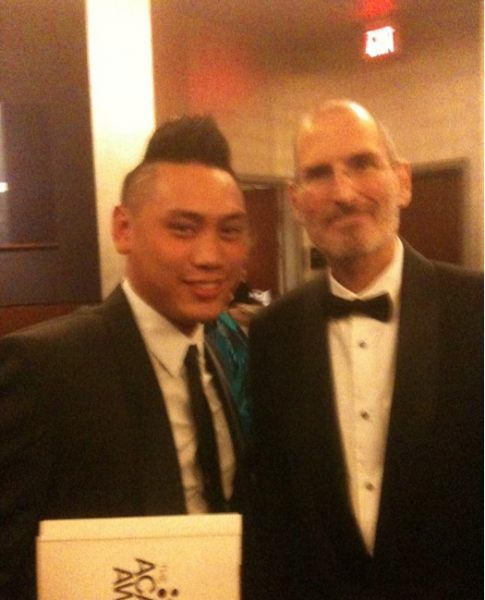
From the AP, some better pictures of Steve Jobs at the Oscars (more below).


via

Flickr user Karmagrrl got this one
Steve Jobs, of course, is no stranger to the bowtie:
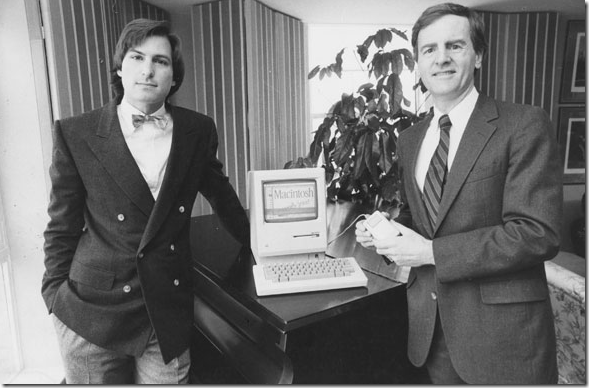

Also available on Apple’s Website. The song is There Goes My Love by The Blue Van. We’ve embedded a slow motion version with snarky comments below[youtube=http://www.youtube.com/watch?v=M0f4KRobss8&w=700&h=420]
[youtube http://www.youtube.com/watch?v=bGEcYtVBxGc&hl=en_US&fs=1&]
The iPad commercial aired at 8:53pm EST during the Oscars. Also, Steve Jobs is in attendance and was spotted on the Red Carpet(below).

How about a nice thick wooden case for that upcoming iPad? While it does double the width of the iPad and make it significantly more unwieldy, it does look nice. This is certainly a “case” of form over function. Har.
To each, their own. $79.99 at Versaudio

There must be something about knowing the exact date of a launch. AAPL closed at an all time high today of almost 219, which puts Apple’s market cap near $199Billion dollars. http://s.wsj.net/media/swf/main.swf

John Gruber of Daring Fireball says that Apple’s pushback of the iPad release one week isn’t because of hardware, but really because of software:
My sources suggest that Misek is wrong. It was the software, not the hardware, that took a week or two longer to finish than they
If you are designing apps for the iPad or just want to find out what goes into the design of iPad apps, check out Matt Legend Gemmell’s fascinating guide/tutorial.