
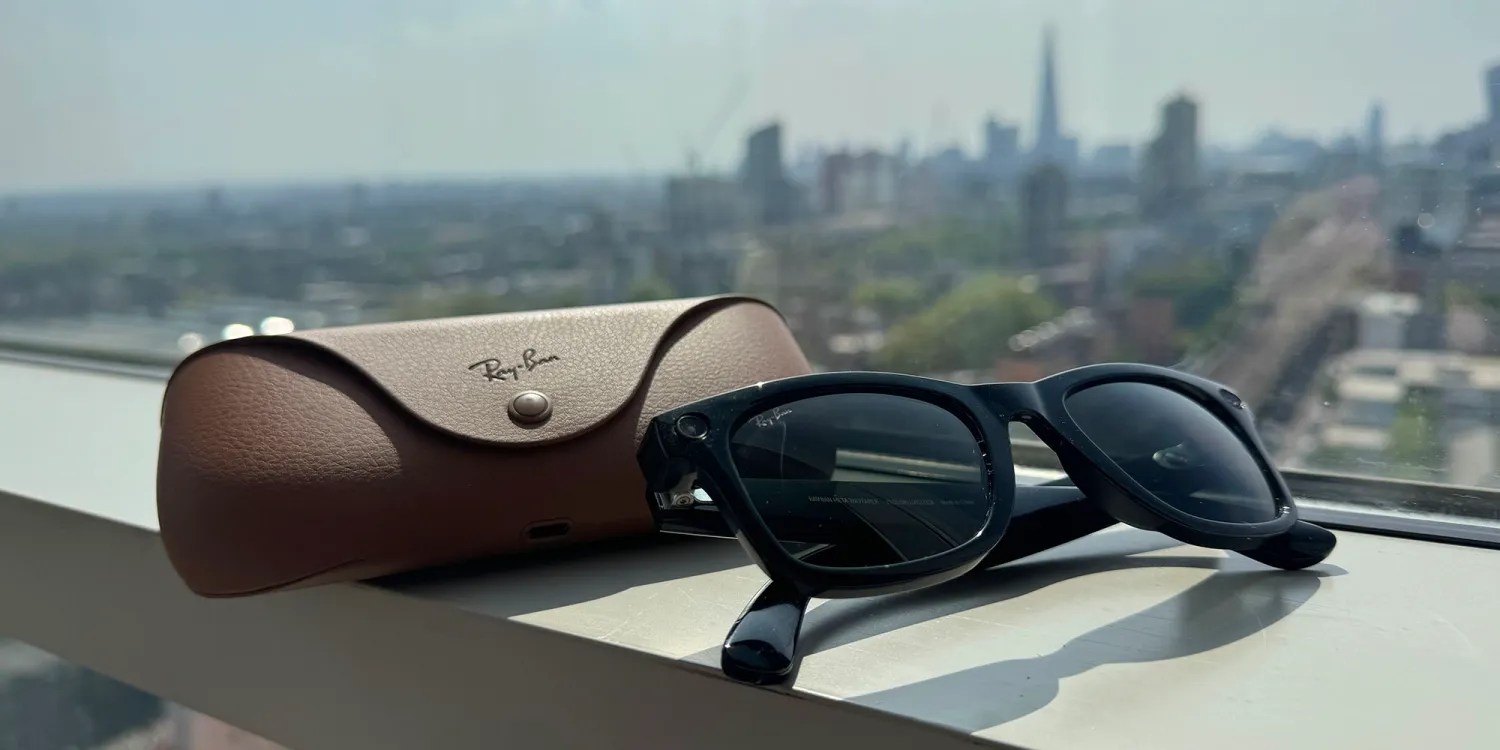
Counterpoint Research says global AI glasses shipments surged 263% during the first half of 2026, with Meta comfortably leading the display-less segment amid growing privacy concerns. Here are the details.
Meta dominates an increasingly controversial market
While Meta’s first-generation smart glasses, launched with Ray-Ban, failed to gain much traction, its second-generation devices have been far more successful.
Earlier this year, Francesco Milleri, CEO of Ray-Ban owner EssilorLuxottica, said the two companies had sold more than 7 million AI glasses in 2025, putting a 10-million annual sales target within reach for the end of 2026.
Throughout the last year, Meta has largely had the display-less AI glasses market to itself, while most major rivals are still developing their own hardware.
Apple, for instance, is rumored to be developing its own display-less smart glasses to compete with Meta’s Ray-Bans, with a launch currently targeted for 2027. The glasses are expected to rely heavily on Siri and Apple Intelligence, with cameras, microphones, and speakers built into the frame, while a more advanced version with an AR display is reportedly still several years away.
In recent months, however, Meta’s camera-equipped smart glasses have faced increasing scrutiny, with the “perv glasses” label gaining traction as reports of non-consensual filming and harassment have drawn wider attention.
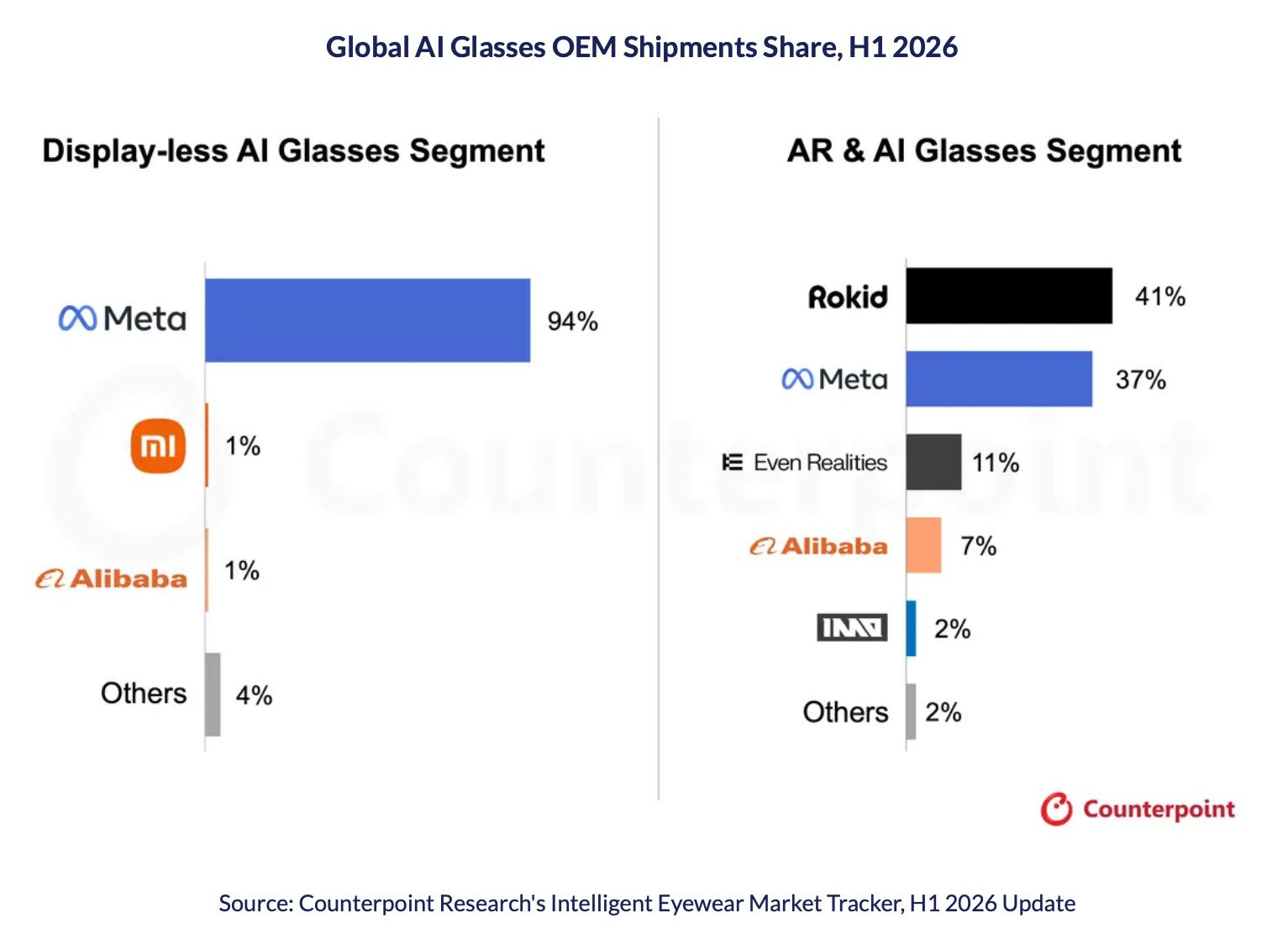
That said, Counterpoint Research says Meta still accounted for 94% of global display-less AI glasses shipments in the first half of 2026, with its volumes growing 260% year over year. Xiaomi and Alibaba came in at 1% each, with other brands accounting for the remaining 4%.
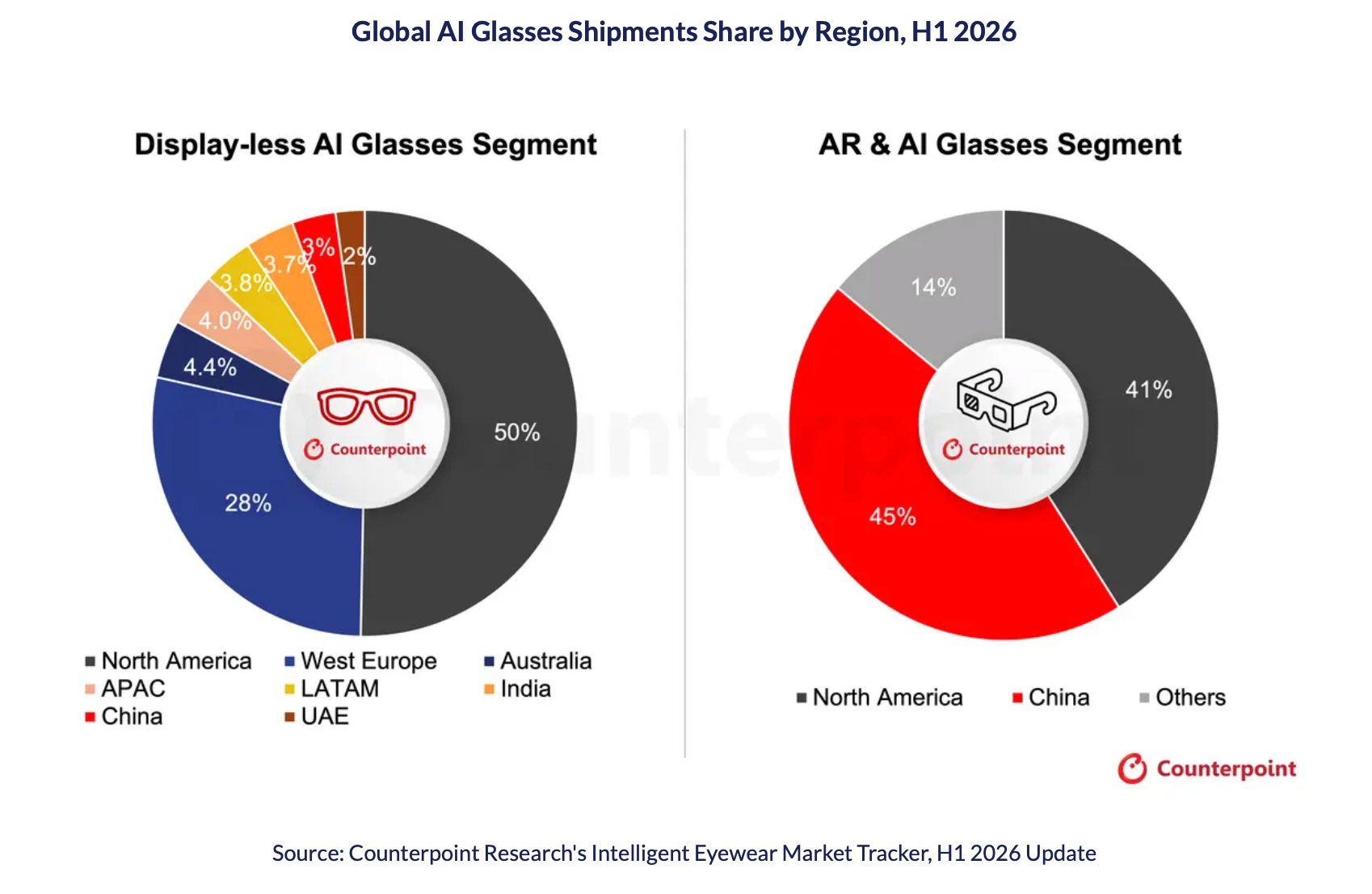
North America reportedly accounted for 50% of total shipments of display-less AI glasses, with Western Europe accounting for 28%, Australia for 4.4%, followed by the Asia-Pacific region with 4%, Latin America with 3.8%, India with 3.7%, China with 3%, and the UAE with 2%.
Here’s Counterpoint on how it sees this market going forward:
“Despite near-term challenges, we expect the AI glasses market to maintain its strong growth trajectory as Meta, Google, Samsung and Apple intensify their investments and competition. The next phase of growth will be driven by agentic AI glasses offering more proactive, context-aware experiences, enabled by advancements in agent-integrated software, operating systems, voice interaction, and ultra-low-power sensing and computing technologies. These developments are expected to create new growth opportunities for component vendors in the AI glasses ecosystem. We also expect a wider range of AI glasses form factors to emerge to address privacy concerns associated with cameras, including camera-free AI audio glasses and AI glasses equipped with cameras primarily for contextual understanding rather than photo or video capture.”
Counterpoint’s report also detailed the AR & AI glasses segment, which they define as “AI glasses equipped with the necessary display(s) and optical components to enable an optical see-through experience.”
According to the report, shipments in this segment surged 449% year over year, with Rokid accounting for 41% of the market, followed by Meta at 37%, Even Realities at 11%, Alibaba at 7%, INMO at 2%, and other brands collectively accounting for the remaining 2%.
Region-wise, China accounted for 45% of total shipments in this market, followed by North America at 41% and the rest of the world at 14%.
To read Counterpoint’s full report, follow this link.
Worth checking out on Amazon
- Apple Watch Series 12
- Apple Watch Ultra 4
- AirPods Pro 3
- AirPods 5
- AirTag (2nd Generation) – 4 Pack
- MacBook Neo
- Logitech MX Master 4


FTC: We use income earning auto affiliate links. More.



Comments