
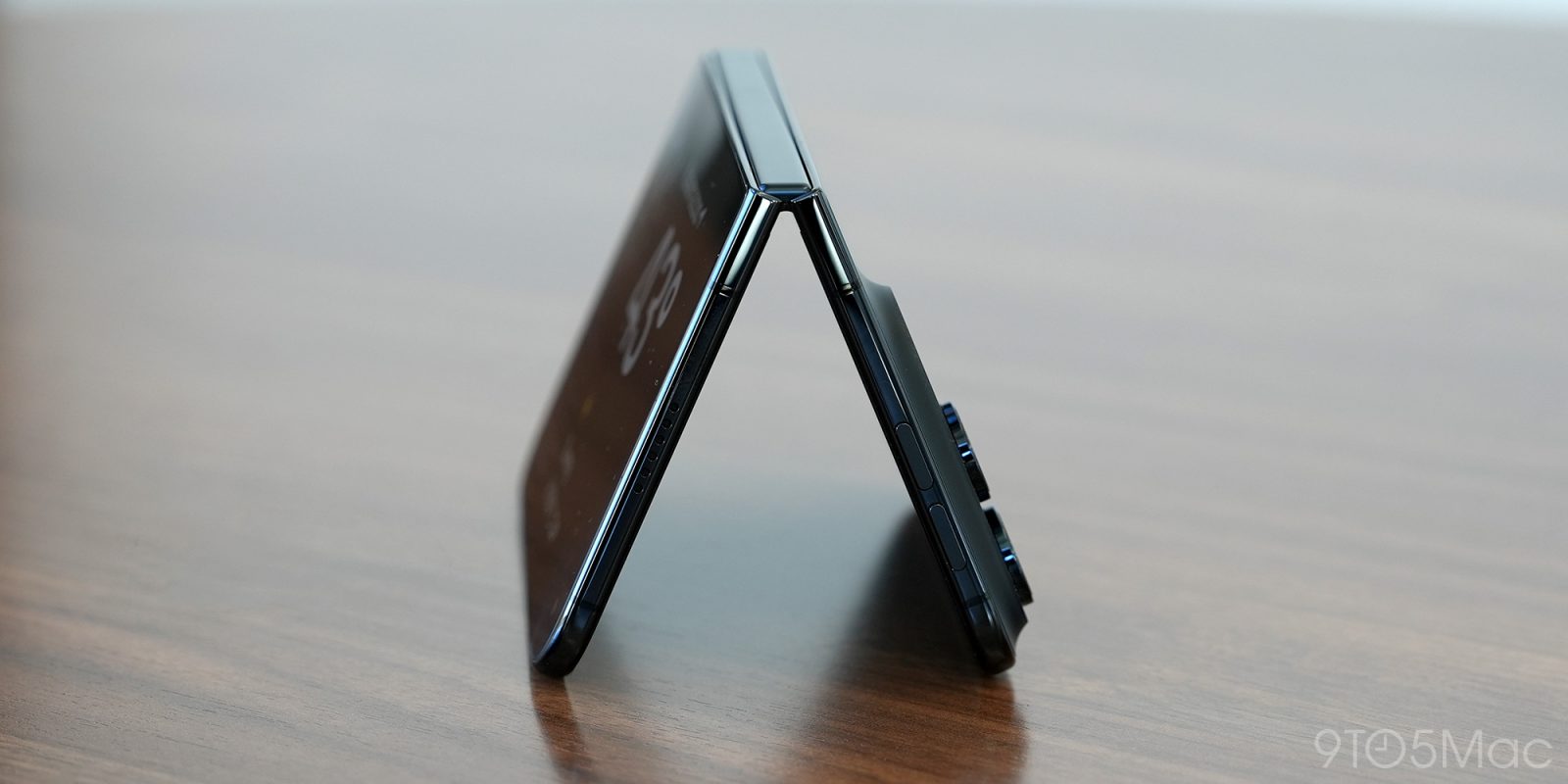
We posted our own review of the iPhone Duo yesterday, and Chance Miller was left convinced that “this form factor represents the future of the iPhone,” while acknowledging that the first-gen iPhone Duo comes with trade-offs.
I think what surprised me most is the degree of consensus found across the reviews, given the generally polarized appeal of foldable phones. That’s not to say reviewers think everyone should buy one, but there is widespread agreement on the pros and cons – starting with five key takeouts …
Five key takeouts
First, all the reviews I’ve read and watched say that the iPhone Duo is hands-down the best foldable phone on the market. Apple waited a very long time before joining the foldable party, and it seems clear that it was absolutely right to do so.
Second, this phone is absolutely not for everyone. Even leaving aside the high purchase cost, the form factor currently involves compromises that would rule it out for some. If you expect to use the outer screen most of the time and only unfold it a few times a day, then the trade-offs of the heavy weight when held in one hand and the unusual display shape are just too big a drawback. This phone really only makes sense if you expect to make frequent use of the larger unfolded screen in your day-to-day use.
Third, Apple hasn’t made the crease invisible, and indeed has made no claims to do so. You can see it in certain lights at certain angles, and you can feel it when running your finger across the screen. But everyone agrees that this is the least intrusive crease ever seen on a foldable, and that it’s simply not an issue in real life use. More on this in a moment.
Fourth, a great many apps haven’t yet been updated, and in the worst case that means seeing an iPhone screen layout stranded in the middle of a mostly black inner display. The optimistic view is that this will rapidly change, but be prepared for some disappointments with third-party apps in early usage.
Finally, going back to Touch ID is a significant compromise after being used to Face ID. We do have to bear in mind that reviewers have only had a chance to use the device for a week, but certainly in that time most say they didn’t really get used to it and would absolutely prefer Face ID.
Fold testing
A couple of reviewers used machines to subject the iPhone Duo to thousands of folds and unfolds to test two things. Does the crease become significantly more visible over time, and how does the hinge hold up?
In both cases, there is a measurable impact. Joanna Stern’s tests found that the hinge is affected across tens of thousands of folds, but interestingly becomes stiffer rather than looser – the opposite of what we would expect. However, while this change was measurable using a strain gauge after 32,000 folds, she said she couldn’t feel it in normal use.
HTX Studio did the most scientific testing of the impact of thousands of folds on the crease. The depth of the crease when new was measured at just 48 microns, about half the thickness of a sheet of paper, while the slope of the crease measured at less than 0.1 degrees – both markedly better than competing foldables. After 3,000 folds, the depth of the crease increased to 167 microns and the slope increased to 1.24 degrees. That brings it more in line with the measurements of other foldables after the same number of tests.
The bottom line
There are links to the full reviews, but here is the bottom line from each …
After 20 years of iPhones that look mostly the same, it’s exciting to see Apple chart a new course. But the Duo is still one of the most early adopter Apple products I’ve tested in a long time. It’s easy to imagine what Gen 2 will look like. It’s lighter, there’s Face ID, a better camera inside, and hopefully a lower price. Also, it’s got a telephoto camera, and it’s no longer a hand warmer.
The good news is most of my other frustrations can be fixed with software updates and developers figuring out how to make great apps for two very different screen sizes. Sure, early adopters have to navigate some choppy waters, but as Apple developers catch up, I can see smoother sailing ahead.
Apple’s first attempt [at a foldable] brings plenty of fresh ideas with real purpose behind them that deserves credit. But think about it: these ideas mostly fix flaws built into the folding design rather than pushing the phone experience forward.
[Will this make foldables mainstream?] I still doubt it because this design has two fundamental conflicts at its core. First, the [aspect ratios] of two screens work against each other. Improve the outer screen and the inner screen becomes a big empty square. Favor the inner screen [as Apple has done] and the outer screen becomes a passport that’s hard to grip. It’s a zero-sum game. More importantly, whatever the balance, you get a makeshift phone outside and a cut down tablet inside. Neither delivers the best
experience.Second, the benefits are occasional, but the cost are constant. To fit a hinge and the big screen, it sacrifices weight, battery life, cooling, performance, cameras, and most importantly, price. But use one or watch other people do and you’ll see they mostly use the outer screen […] You enjoy the benefits some of the time but pay the price all the time.
If you really want to do something, or sit back and read or watch something, the big display is fantastic. But that Duo-as-tablet experience is so cumbersome compared to the “just look at it” experience of using a regular iPhone uno that you simply cannot do it every time you use the Duo. You will use the outer display quite a bit. And using the outer display delivers the worst iPhone experience ever. I mean, some iPhone has to be the one that offered the worst iPhone experience ever. That iPhone is the outer half of the iPhone Duo […]
If you’d rather trade your iPhone for an iPad Mini that you can fold in half to carry around, the iPhone Duo might be the form factor for you. Even if that’s the case, though, this first iPhone Duo might not suit you, for all the various irritations and shortcomings I’ve documented […] It’s been a lot of fun trying the Duo out for a week, but it feels like I’ve gotten to use an extraordinarily polished prototype — not a finished product that I’d want to buy and carry.
CNET:
Aside from some minor shortcomings, Apple appears to have stuck the landing with its long-awaited foldable. Hopefully, future iterations will add elements such as Face ID while improving the camera capabilities, either by adding a telephoto lens or bolstering the inner screen’s FaceTime camera. It would be nice to see multitasking become more dynamic in the future, too.
[But] most people just don’t need a phone that doubles as a tablet. [While the Duo] is a foldable experience that feels cohesive, intuitive and genuinely useful, which could help win over more people to foldables in general, I think that broader appeal is still a ways off.
Whether you’re an iPhone fan, foldable evangelist, or Android user who’s just been waiting to see what Apple offers, I think we can all agree that the iPhone Duo has already achieved what competing foldables have not been able to in seven years: generate considerable buzz for foldable phones […] This is what we’ve been waiting for after more than a decade of matured bar-style phones. Finally, phone hardware and software are genuinely exciting again, which is something to celebrate […]
As for whether you should get the iPhone Duo—that depends on if you can afford it, either buying it outright, paying in installments, or leasing it through the Apple Upgrade program. Do you want a foldable phone, and why? Will you use the larger screen often, and how much value will you get from it? Will the weight bother you? Do you need better cameras? There are so many personal factors to consider before you decide. The iPhone Duo isn’t the “definitive” iPhone to own. Apple’s iPhone lineup now caters to every budget and every type of user. Only you can be honest with yourself about your needs.
The iPhone Duo is the best designed foldable phone I’ve ever tested, with a sturdy and premium build and a nano-texture display that hides the crease. I also like the multiple usage modes and split-screen multitasking. However, while fully updated apps for the Duo look great, non-optimized apps do not. And the lack of a telephoto zoom is a bummer for a $2,000 phone […]
I like the iPhone Duo’s nano texture display in that it greatly reduces glare outdoors and minimizes the crease better than any foldable I’ve tested. But you give up perfect blacks with this matte panel and more saturated colors versus the iPhone 18 Pro Max. You also sacrifice a telephoto lens and Face ID. I can live with those trade-offs, but that doesn’t mean I like them.
In a way it’s a good thing that the iPhone Duo is backordered for many until December or January. That will give developers plenty of time to update their offerings for this foldable. I don’t think it will take that long, though, based on the high demand.
Overall, though, I think the iPhone Duo is the best designed foldable yet with the most polished, intuitive and fun software experience.
This is often the case with first-generation products, but it may be prudent to wait for the Duo 2—not because there are glaring issues but because I suspect Apple may tackle the weight problem with the next version, just as Samsung did on its latest iteration.
Folding phones will never be for everyone. Some people do not care for the bigger screen. Others have durability concerns, and a device with more moving parts will never be as repairable or robust as its single-slab counterpart. Price is a barrier for others—but, on that note, the Duo is surprisingly on par with its competitors (though still expensive).
But the folding category is here to stay. I know people who swear by the fold and won’t buy anything else. I’m starting to convert, especially with the newer passport-style shape. Now if only someone could figure out how to put a real zoom camera on there.
There’s a lot of potential in the Duo, but right now it is a first-gen device in every possible way. It is expensive, it’s full of compromises, and it can be incredibly frustrating to use. Switching from the Duo back to one of our standard slab phones to get something done often felt like a relief […] But all of the risk and weirdness of the Duo is also fun, in the way the best early adopter devices are fun. It’s incomplete as a product, but complete enough as an idea that you can see where things are going […]
We’ll see what happens with the Duo, but as it stands, it is very much an open question whether Apple made the right choices about the Duo’s screen sizes and aspect ratios. Most Duo owners will find that the cover display is simply too small to use all the time […] Apple also made some very real compromises around the camera […]
But the Duo is a more cohesive idea about foldables than most of its Android competition, precisely because Apple has a better app and developer story to lean on. Right now the problem for most Android foldables is that the inner screens aren’t that useful so there’s no super compelling reason to open them. The problem with the Duo is that the outer screen isn’t useful enough, so you want to open it all the time […] The real answer is somewhere in the middle — for both screens to be interesting and useful. Someone’s going to get there, and we’ll see if Apple can be the first.
What’s your take after reading the review conclusions? Have the reviews made you more or less interested in the iPhone Duo? Please share your thoughts in the comments.
- iPhone Duo cases
- Beats Woven USB-C cables
- Certified refurbished Apple products 15% off at apple.com
- Discounted AirPods Pro 3
- Wireless CarPlay adapter
- 10-year AirTag battery case
- Logitech MX Master 4 for Mac


FTC: We use income earning auto affiliate links. More.



Comments