

9to5Mac is brought to you by Memoket: Memoket Gem is a 0.4 oz AI wearable that slots beside your Apple Watch. One press captures a conversation, and KITE memory connects it to what you said weeks ago. 20-hour battery. Available now from $168.99 on memoket.ai and Amazon.
While it is great that Siri AI can finally deliver Apple’s promise of an actually useful, personal assistant for the age of AI, expectations surrounding agentic assistants are quickly shifting. But Apple is showing it might not watch from the sidelines again.
Siri AI is great, but it’s also very 2024
Now that Siri AI (which is still officially designated as a beta) has been out for a little more than a month, it seems fair to say that its two defining characteristics are that it’s finally useful, but it can be painfully slow to answer even simple queries.
And while I had spent the better part of the past few months mocking Silicon Valley’s obsession with AI assistants that can book flights and hotels, I hate to admit that the first time Siri AI actually impressed me was when I asked how much I’d paid for a hotel room for an upcoming trip to San Francisco and how far it was from my first appointment in the city. It got both answers exactly right.
Could I have looked this up myself? Sure. But setting aside the fact that I was in the middle of a 10K run at the time, finding that information on my own would undoubtedly have taken longer than it took Siri to give me the answers.
As a result, over the past few months, I’ve found myself increasingly relying on Siri AI for questions like “What was the contact information for that plumber who fixed the kitchen sink leak a couple of years ago?” or “What was the name of that PR person who introduced me to so-and-so?”
Information I know I have somewhere, be it an iMessage conversation or an email receipt, and that although I could just search for it, I’d now rather have Siri AI do it for me.
And for the first time in 15 years, I can ask these questions without already expecting Siri to fail halfway through asking them, only to get frustrated when it inevitably gets it wrong and proves me right.
That’s all well and good. The problem is that Apple has only now caught up with what AI assistants could do in 2024.
Apple’s next AI challenge: Building an agent harness for Siri
Particularly over the past few months, the frontier AI market has increasingly shifted toward agentic assistants, with products from OpenAI, Anthropic, Meta, and xAI (among many others) moving beyond answering questions to actually carrying out tasks on users’ behalf.
I subscribe to ChatGPT, and I’ve been using Codex and ChatGPT Work extensively for everyday tasks involving files and information scattered across my Mac and various cloud services.
And it still feels like magic every time I ask one of these tools to do something that involves opening, creating, editing, or organizing files on my computer, as well as interacting with websites and services I’m logged into, and it actually pulls it off.
The flipside of this is that every time ChatGPT completes one such task, the new Siri AI starts to feel like the old Siri all over again.
It is still early days, for sure, but it already feels like this is yet another area where Apple seems to be falling increasingly behind, as AI labs continue to improve their agentic capabilities, sometimes rolling out major updates just weeks apart, while Apple remains largely tied to its annual software release cycle.
But there’s one important limitation to today’s agentic assistants that I think Apple is particularly well positioned to address.
As impressive as tools like Codex, Dots, and ChatGPT Work can be, they still depend heavily on the user to provide the permissions and the context behind whatever task they’re supposed to accomplish. They can access files, search through emails, and interact with websites, but they generally don’t know what you’re doing, what you’ve been discussing with other people, or what you might need next unless you explicitly tell them.
And as these tools become increasingly capable of operating our computers and phones on our behalf, I suspect the next big leap in their usefulness will come not just from improving what they can do, but from improving their proactive understanding of the user’s context in real time.
That’s where Apple could have an advantage.
Apple has recently shown that it’s finally willing to capitalize on the trust it has spent years building around privacy, even if it means testing the boundaries of what users are comfortable sharing with an AI assistant.
Last month, it introduced two Apple Watch features: Siri Recap, which can automatically generate summaries of conversations throughout the day, and Live Rewind, which lets users retrieve the last 15 seconds of a conversation they may have missed.
Both features rely on the Apple Watch’s microphone to capture information about what’s happening around the user, potentially giving Siri access to an entirely new source of personal context.
Of course, the privacy implications are enormous, particularly because conversations involve other people who haven’t necessarily agreed to have their words processed by an AI assistant.
And while those concerns are certainly worth discussing at length (and are probably why these features have yet to roll out), Apple has repeatedly shown that it’s willing to go to extraordinary lengths to address the privacy challenges that come with giving technology access to sensitive personal information. Just look at the lengths it went to in developing its Reference Image system.
As agentic assistants become more capable, I suspect their biggest limitation will increasingly have less to do with what the underlying models can do, and more with how much we’re willing to let them know about us.
Imagine an assistant that doesn’t just wait for you to ask it to find a document or complete a task, but already understands what you’re working on. One that can gather information in the background so it’s ready when you need it, or even take action on your behalf based on what’s happening around you.
That’s the kind of assistant that could make today’s agentic tools feel as limited as the old Siri (and, increasingly, the new Siri AI) does now.
And while Apple still has plenty of catching up to do when it comes to actually building these capabilities, it is in a much better position to compete in this next phase of AI than it was when the generative AI race first began.
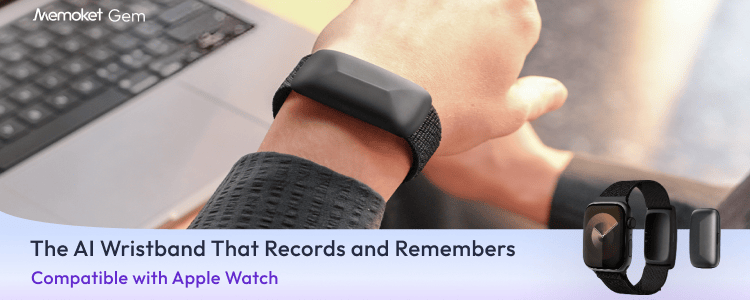
9to5Mac is brought to you by Memoket:
Apple just added voice recording and note-taking to iPhone and Apple Watch. Useful, but check your battery at 2pm. Dedicated recording is one of the fastest ways to drain a Watch, and your iPhone needs to be out and unlocked to do it. More importantly, neither device connects what was said in today’s meeting to a decision you made three weeks ago. They capture moments. They don’t build memory.
Memoket Gem was built to do more. A 0.4 oz wearable AI agent that slots alongside your Apple Watch on the same wrist. One button, one press, 20 hours of battery. Gem captures conversations and connects them across time using KITE, a long-term memory engine that links what was said today to what mattered weeks ago. When a topic comes back up, Gem surfaces the original conversation automatically. Everything flows into ChatGPT, Claude, Slack, and Notion.
153 languages supported. Available now on memoket.ai and Amazon from $168.99.


FTC: We use income earning auto affiliate links. More.

Comments