Tech Industry

See All Stories

Apple's tablet means more education as e-Books prepare for a big-screen future

Site default logo image

UPDATE: Our notions on this took a definite uptick this morning on reports pointing out that eBooks are now the second-biggest category on the App Store, just after games.

With a solid one-in-four (27.3 per cent) of computers going into schools and other educational institutions across Europe being Apple-made, it’s no surprise that education’s a key market for the company. 

Apple isn’t just the largest in Europe.  Apple passed Dell last year to become the biggest supplier to education in the US in portables sales as well.  With Amazon’s Kindle DX aiming square at the education textbook market we don’t see Apple handing this market over to Amazon.  We think an Apple tablet will at least partially be aimed at that market.

Strike one today comes on news that e-textbook provider, CourseSmart, intends releasing all its 7,000 titles in a format that’s accessible on an iPhone or iPod touch. And it’s no stretch of sanity to think the true target here is to make this content available on the heavily rumored media-centric Apple tablet.  Just like the larger Kindle DX tablet is aimed at Textbooks, a tablet Mac would be a big player in this area more so than a smaller iPod touch or iPhone ever could ever be.

The new applications, free for subscribers, will let students access their full electronic textbooks, read their digital notes and search for specific words and phrases.

"Nobody is going to use their iPhone to do their homework, but this does provide real mobile learning," said Frank Lyman, CourseSmart’s executive vice president. "If you’re in a study group and you have a question, you can immediately access your text."

CourseSmart aren’t the only people working to get their materials onto Apple’s burgeoning mobile platform. We spoke with ScrollMotion (who presented at WWDC), who are developing Iceberg Reader 3.0 to offer iPhone/iPod touch support.

“With the release of the iPhone OS 3.0 this summer, Iceberg will offer powerful, new functionality that will give readers improved ways to enjoy their favorite books, magazines and newspapers. And we look forward to announcing more features in the months to come,” the developers explain.

While the company is reticent to discuss any features, we can imagine they could include improvements in the existing capacity to annotate texts on your mobile device…just a shame the devices are so small and awkward for full book reading…if only these e-books were sold at higher resolution for use on other devices running the same essential OS. Like a Mac, for example, or, erm, an Apple tablet, maybe?

ScrollMotion currently offer over 500 best-selling books in the App Store, and will soon be bringing over a million books, as well as more than 50 major magazines and over 170 daily newspapers to the iPhone. (Publishers include the big names: Harper Colllins, Random House, Pearson, Simon and Schuster, etc…)

Look, it may seem strange to shift from books to e-books, but for school districts there’s real savings which hopefully can be passed into other sectors (assuming budget making chiefs don’t simply claw that book money back). But we’re dealing with a new generation of kids today, already immersed in use of technology in the home, from computers to catch up TV shows to the Nintendo DS and more, we have a new generation of “digital natives”.

Apple has a host of one-on-one deals with education districts on a global level, indeed, the company frequently says education is “in its DNA”.

We’re also moving away from software-based solutions to solutions based on content already available online, perhaps even to the eventual disappearance of the OS, some argue (pointing at the MSFT v GOOGLE v AAPL affair)…

Simplicity counts – and what could be simpler for children in class than to be able to access their e-Books on a nice big touch-driven display, which also offers them access to the multimedia existence they’re used to? It’s an education tool in the day, a gaming machine at night, a music machine in the evening and last thing at night they can throw in their assignements, also made on the device.

Sure, we could equally well be talking about the Mac, but we’ve moved into a new platform paradigm here, and Apple isn’t about to give up its Unibody-led ascendancy in the sales of laptops. It’s simply going to change the category, or at least, attempt to.

If our theorising’s correct, apart from making toast of Kindle , the new tablet device isn’t a product looking for a market, but a solutions-led affair that will fit snugly in lots of markets.

When it comes to the education markets, Apple already knows the score. “We teach teachers not just about Apple solutions, but also how to create content that’s suitable for digital learning,” Apple’s director of EMEA education markets, Herve Marchet, told Macworld UK. "If you want to play in the education market, you need to be a solutions provider. You aren’t just bringing in the machine, you must also offer appropriate software, content and models for best practise in content creation.”

"Apple’s technology gives students access to things that excite and interest them," Brit School head Nick Williams says, conceding that the best way to help children learn is to give them tools they like, software they enjoy and are familar with, making them receptive by ensuring the medium and the message are in sublime convocation. Apple’s tablet (if it ever appears) is a child of its times, matching the cybernetic, loop-inspired vision of Marshall McCluhan.

We’d love to sign an NDA and play with one of these. We suspect at least one veteran Wall Street Journal writer already has…well, on previous form, it’s likely.
 

BeOS Gass

Site default logo image

We’ve been banging on about how your iPhone will be your wallet one day, and we’ve taken many a look at credit card processing systems preparing themselves for launch for the device – but now it looks like we may have missed a trick, at least according to former leader of Mac development and founder of the Be OS, Jean-Louis Gassée.

In his latest report on CBS, Gassée notes that with the iPhone and, to a lesser extent, the Apple TV, Apple has moved toward a whole different business plan, as a service provider rather than hardware maker. Bear with us, we know this is hard to see, and this is the tech exec’s opinion.

“Until recently, Apple’s profits were built on hardware sales. Everything else, system software or iTunes music revenue only mattered as a way to buttress hardware profits. For example, when iTunes came out, analysts expressed concern that music margins were thin or negative. So what? iTunes’s sole role is to prop up iPod and iPhones margins. Apple talks up its software, operating system and applications, spends hundreds of millions of dollars in development and generates modest or no direct revenue from it. It’s all in the service of Mac and iPhone sales and profit margins. That’s the picture so far, fast becoming the past,” he writes.

“With the iPhone, Apple hasn’t just broken into a new product category, it has shouldered its way into a new world of service revenues.” The former Mac chief then breaks out a few numbers, revealing that iPhone sales generate in the region of $850 in service revenue.

Gassée then moves to look at the micropayment systems which already underline iTunes. “Apple has developed an infrastructure,” he writes, observing that a future Apple tablet could be developed into becoming the “channel of choice” for entertainment.

“Apple could become a distributor and micro-payment agent for goods and services going way beyond you can get on an iPhone, think screen size, or a MacBook, think everyday mobility/ubiquity, weight and size,” he writes.

Gassée also observes that former Apple ally and now new competitor, Google, is moving into the same direction, hoping its Chrome/Android OS for netbooks and smartphones (respectively) will help it pump its intelligence into these devices, and hopeful it will then be able to gain business through the offering of similar services.

The former Apple executive also slams Google CEO, Eric Schmidt, to resign from Apple’s board last week, saying it’s long overdue – he should have gone when Google introduced Android…

It’s a fascinating read – go get it….

Your Snow Leopard versus Windows 7 price comparison guide

Site default logo image

Mac OS X 10.6 ‘Snow Leopard’ already occupies two of the top three spots in Amazon’s software sales lists, but battle between Microsoft and Apple isn’t solely over technological superiority, but also over price.

Apple has already told Leopard users it will sell them Mac OS X version 10.6 Snow Leopardfor just $29, rising to just $49 for Snow Leopard Family Pack (5-User).

There’s no introductory offer, not complex licensing arrangements – the price is what you see.

Not so for Microsoft, who appears to be hoping Windows 7 will be better-received than its previous attempt at a modern OS, Vista. Industry insiders pointed to Vista’s tiered and complex pricing system as rationale for poor market reception of the software, but it looks like Microsoft plans to repeat its own mistake – once again too many prices and bundles will complicate the buying experience.

Windows 7 Home Premium edition upgrade will cost $50 on launch; while the Professional edition costs $100. However, those prices were introductoryblink twice and you missed them – order now and  the full price of the Windows 7 Home Premium Upgrade is $120 while Windows 7 Professional Upgrade will be $200 as standard.

Will upgrade pricing and the widely-anticipated launch of Apple’s 10-inch tablet computer be sufficient to persuade another batch of Windows users to make a different upgrade?

Walt Mossberg offers a handy chart, below, for those about to upgrade to Windows 7.  Notice that, unless you are in one of the few green areas, you’ll be starting completely over:

Apple and Google had employee non-poaching agreement. That's over now.

Site default logo image

TechCrunch’s sources at Google have informed them that Apple and Google had a no-poach employee agreement going on over the years that Google’s Eric Schmidt was on the board of directors at Apple.  "This was not a written agreement, and was considered non-official, but it was well-known and followed within the recruitment division of Google, we’re told."

Google and Apple have been investigated by the DOJ for sharing board members which could theoretically have the byproduct of this type of behavior.

Interestingly, now that Schmidt is off of Apple’s board, the "gentleman’s agreement" may now be off, according to MG Siegler.

He continues:

To be clear, this unwritten agreement was that Google would not go after Apple employees, and vice versa. However, employees of both companies were free to apply to the other company on their own, we’re told. That’s a small, but important difference as the practice of going after other company’s talent, also known as “poaching”, is considered to be an important component of healthy competition in the market. That’s why the Justice Department is looking into it.

There has been a flurry of events over the past year which indicate that Google and Apple’s relationship, while strong, might be deteriorating.  Eric Schmidt mentioned that Google kept multi-touch off of the Android G1 "At Apple’s request".  They also didn’t seem to mind too much when their Latitude and Voice applications for iPhone got pulled and simply said that they’d build web versions.  The Voice application rejection also got the FCC involved again, sending requests to Apple, Google and AT&T for clarification.

For what it is worth, the Feds have indicated that Eric Schmidt stepping down from Apple’s board would not stop their investigations.

Update: they’ve recieved the email below seeminglyconfirming such an agreement was in place.


From: XXXXX XXXXX <XXXXX@google.com>
Date: XXXXXXX XX, 2008 X:XX:XX AM PDT
Subject: Re: Google Opportunities- Follow up email…

Thanks for getting back to me.  I don’t believe that we have been in
contact previously – apologies if I am wrong about this.

From your reference to the [APPLE DIVISION], I take it that you are
currently working there.  If this is the case, we will not be able to
proceed with your application.  Google has an agreement with Apple
that we will not cold call their staff.  If you are not currently
working at Apple and are interested in learning more about [A GOOGLE DIVISION]
please let me know and I would be happy to chat with you.

Thank you again for returning my email.


Bad NVIDIA chips continue to plague Apple and other PC manufacturers

Site default logo image

The Inquirer reports that NVIDIA is taking a $120 million hit again this quarter on charges related to a faulty die and weak packaging material which was used in its graphics chips.  NVIDIA had previously taken a write-down of almost $200 million to cover warranty and product replacement costs on bad GPUs it supplied to Apple and other PC manufacturers.

NVIDIA is the GPU maker on all but a handful of Macintosh systems.

The trouble kicked off last July when it was reported that some Nvidia graphics chips were overheating. Nvidia said it was all down to weak packaging materials then. Later the INQ discovered that there was a problem with the soldering on the chips, although Graphzilla [NVIDIA] denied it.

The chips had been used by Dell, HP and Apple. They had to change BIOS settings to run laptop fans continuously and replace PCs that failed due to the faulty chips. The costs of those programmes were shared between Nvidia and the manufacturers.

Nvidia said that the costs were higher than originally anticipated, and would not estimate whether the company would incur further charges related to the flaws.

Apple, for its part, has issued an unprecedented three year free replacement if the NVIDIA parts go bad in MacBook Pros.  Many, however, think Apple is pursuing alternatives including building their own GPUs in light of the quality issues with NVIDIA.


Apple takes a chunk of the gaming industry

Site default logo image

Games are the most popular applications sold through the App Store, fresh research claims, dominating Apple’s sales lists and proving the company has become a games industry force at long last.

July’s Distimo report contrasts both the Apple and Android smartphone application markets. They reflect the popularity of games on the iPhone platform (though we shouldn’t ignore the contrast may be specious, as the iPhone platform also includes the iPod touch, which is more widely used as an entertainment, rather than communication, device).

Curiously, ten of the top 15 paid apps sold through the App Store are games, with utlities occupying three spots at the top.

The new findings in this report are:
       
– A negative trend can be identified in the total price of the Overall Top 100 for the Apple App Store. This however was influenced by the turn-by-turn navigation apps MobileNavigator Europe and MobileNavigator America, which were both published by NAVIGON AG. Turn-by-turn navigation apps are still popular.

– Pricing of applications in the Apple App Store and Android Market is quite similar, except for the Reference category which has a much higher average price on Google Android Market.

– The most popular games on Android Market cost between $0.99 and $5.95, with most going for $2.99, while for the Apple App store, most are priced very low ($0.99), and a few higher at $6.99- $9.99

– Games are still the most popular applications in the Apple App Store, with slightly more apps in the monthly paid Top 15 than in the free Top 15.

– Classic games on Android Market are more popular than in the Apple App Store, with even 3 out of the 15 most popular games for Android being emulators. These types of emulators are not allowed in the Apple App Store.

– Tools are very popular paid apps for Android, with 7 apps from the application category bvery different, there are no productivity/utilities apps for Apple in the overall Top 15.

Apple, Google seem set for smartphone battle in China

Site default logo image

With Google CEO Eric Schmidt stepping down from the Apple board this week, reports suggest new levels of competition between the two formerly friendly firms.

This may be true, and the battlefield between the two past partners could come down to a smartphone war in the world’s growing superpower, China. There, Apple’s soon-to-ship iPhone is likely to do battle with Android-driven devices from numerous manufacturers.

Don’t just take that from us – the world’s leading business market titles are all looking at the future tousle between the two, seeing this battle as one that one of the firms must win to secure dominance of the high-end smartphone market in China.

China Mobile – the world’s largest mobile carrier – plans to launch a range of Android-powered smartphones, perhaps as early as next week. And these will compete directly with Apple’s iPhone in a market nowhere near as saturated by Apple’s masterly grip on the news agenda.

China Mobile could launch a third-generation (3G) smart-phone called the OPhone, made by Lenovo Mobile, it will also introduce the Magic range of smartphones made by Taiwan’s HTC.

Apple’s response may be delayed – China Unicom, Apple’s purported iPhone China launch partner – isn’t expected to introduce the iPhone until September or October, when it launches its own 3G service in the country.

China Unicom last week denied reports that it had sealed a deal with Apple, but said there had been progress in the talks. A senior team of Apple executives is known to be in China now for talks with the carrier.

There’s a lot to play for in this territory. China is the world’s largest mobile phone market with 700 million subscribers, with smartphones accounting for 10 per cent of all handsets sold.

The Chinese market is extremely diverse, according to Citigroup analyst, Michael Meng, who notes that much of the business currently comes from middle-aged businessmen who don’t use a lot of data but talk incessantly into their mobiles, night and day.

With the Russian experience – where demand for the iPhone has failed to meet supply – smarting in Apple execs minds, Meng also offers a warning, “The average revenue per user [per month] in the Chinese mobile market is Rmb60, and for China Mobile’s customers it’s Rmb85. For the iPhone, the target is Rmb300. That’s a big gap,” he says. “So the potential subscribers we’re looking at need to be young, wealthy, well-educated, probably English-speaking, since the iPhone still has some English-language applications.”

It’s certainly an unusual situation that Google will effectively now be competing with Apple in perhaps one of the world’s key emerging smartphone markets. Particularly in view of comments from Schmidt last week – before his resignation – when he said, "I’ll talk to the Apple people – at the moment, there’s no issue."

While on the board, he once said, “From my perspective, I don’t think Google sees Apple as a primary competitor.” Despite which the Google CEO would recuse himself from discussions related to the iPhone.

“Eric has been an excellent Board member for Apple, investing his valuable time, talent, passion and wisdom to help make Apple successful,” said Steve Jobs, Apple’s CEO, announcing Schmidt’s withdrawal.

“Unfortunately, as Google enters more of Apple’s core businesses, with Android and now Chrome OS, Eric’s effectiveness as an Apple Board member will be significantly diminished, since he will have to recuse himself from even larger portions of our meetings due to potential conflicts of interest. Therefore, we have mutually decided that now is the right time for Eric to resign his position on Apple’s Board.”

The Apple/Google relationship has now become a Chinese puzzle.

Massive memory leak threatens to derail Windows 7 launch

Site default logo image

Infoworld is reporting that there is a very significant memory leak in Windows 7 involving the chkdsk.exe utility which appears when…

you attempt to run the program against a secondary (that is, not the boot partition) hard disk using the "/r" (read and verify all file data) parameter. The problem affects both 32- and 64-bit versions of Windows 7 and is classified as a "showstopper" in that it can cause the OS to crash (Blue Screen of Death) as it runs out of physical memory.

Randall Kennedy tested the bug against a variety of different builds of the RTM Windows 7.  The bug appeared in VMs, 32-bit Netbooks and 64-bit laptops.  The bug also appears in Windows Explorer when you run the integrated disk check utility.

In each case, the utility executed the first three stages of the test correctly using modest amounts of memory (several hundred megabytes). Then, when it entered the fourth stage (a read test), the chkdsk.exe utility’s memory consumption started to climb rapidly until several gigabytes had been allocated to its process and the test systems in question began to run out of memory.

Kennedy goes on to say that Microsoft is blaming chip components and recommending that users buy new machines.  However, the appearance of the bug in VMWare refutes that hardware is the issue.  VMWare virtualizes the chip components.

The bottom line: A file system-level bug, at this late stage in the development cycle, should be considered a showstopper by most IT organizations. Worse still, user comments suggest that Windows Server 2008 R2 suffers from the same flaw. So while the act of running chkdsk.exe under Windows 7 might not be a common occurrence for most users, it is in fact something that server administrators do quite regularly to ensure volume integrity….

What this latest episode has taught me is that no major release of Windows –- not even one that is more or less a supersized patch of the previous version –- deserves a pass, and that the old wisdom of “wait for the first service pack” still applies with Windows 7.

This is, after all, a Microsoft product.

Windows 7 is currently scheduled to be formally released in October, a month after Apple’s latest generation Snow Leopard OS is slated to hit the market.

The iPod is dying, long live the iPod….

Site default logo image

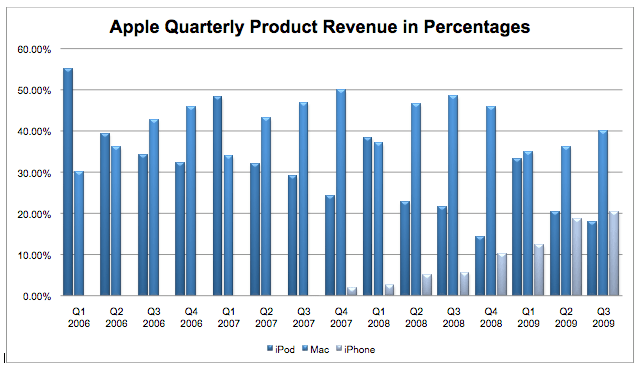
How much is the iPod line faltering – – or how well is the rest of Apple’s line doing in comparison?  It turns out that after GAAP accounting is taken out of the equation, the iPod line, which once was Apple’s profit leader is now #3 in profitability, beating only Apple’s AppleTV line.

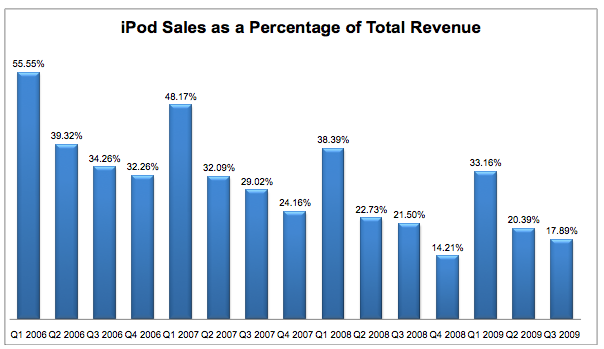
As this graphic shows, iPod sales have been contributing a shrinking amount of revenue to Apple’s general performance, skip past the break to see another graph which shows us in clearer terms the shrinkage of iPod revenues.

These attractive stats come from Philip Elmer-DeWitt over at Fortune. He notes that as recently as 2006, iPod sales accounted for 55.5 per cent of Apple revenue. Now that’s shrunk to under 18 per cent.

He cites day trader, Andy Zaky, who says, “Many Apple critics have argued that Apple would essentially fall off the earth because at some point in time the iPod’s growth would collapse.”

Zaky points out that this is happening as MP3 players head toward becoming commodity items.

(That point at which everyone has one, and brand and features become much of a muchness…incidentally, we think that’s what Microsoft’s betting on with its Zune. We think Microsoft just hopes to sell more Zunes to a market which doesn’t care about features or brand any more. Kind of like a supermarket own brand. We also think Apple has its own low-cost MP3 player plan for that point of market development).

Right now, these shrinking iPod sales don’t matter so much, as Zaky notes, “Apple is still firing on all cylinders thanks to the explosive growth of the iPhone.”

Apple management have been planning to manage the market change, Apple admitted in July. Chief financial officer Peter Oppenheimer said, “We expect our traditional MP3 players to decline over time as we cannibalize ourselves with the iPod touch and the iPhone.”

Notions that Apple’s developing its next brood of iPods are reinforced by the company’s recent half-billion dollar deal with Toshiba for the supply of flash memory chips, as used in iPhones, most iPods and many of its laptops. The deal means Apple’s secured “about one quarter’s worth” of flash memory for use in future products.

Rumours that Apple will add video cameras and other potential new features (WiFi?) to future generations of iPod nano and iPod touch also remain. If true, these moves will be proof positive that Apple is extending the versatility of these devices in order to extend the reach of its market.

Pacific Crest analyst, Andy Hargreaves, recently notes, “iPhone‘s superior mobile internet experience and the ability to create valuable custom applications will continue to drive gains.”

Soulcalibur, Tekken, making move to iPhone, iPod touch, new Namco Apple gaming chief reveals

Site default logo image

More news from Namco Bandai’s recently formed Apple Games Division, which is now looking to bring in some legendary classic arcade titles including Soulcalibur and Tekken to the iPhone, iPod touch and other similar devices (iProd, anyone?)

Interviewed by Kotaku, Namco’s newly-hired Apple games chief, Jonathan Kromrey, talks the talk, saying the company is looking into how to make its heavyweight console classics work using Apple’s control UI’s. Might we see voice controlled titles soon?

“My charge is to make games that are the best for the iPod touch and iPhone," explains Kromrey. "There is a gold rush to do Apps for the App store and Namco is at the forefront of that movement."

In future the company plans to introduce a huge range of titles for Apple’s platforms, ranging from casual gaming titles to action and adventure titles.

“In the past Namco’s been known for its depth of arcade experience, games like Pac-Man, Galaga, Soulcalibur and Tekken," he said. “I’m here to champion new things, new IP, to discover what the new Pac-Man is for the iPhone."

He also talked a little about price, and from what he said it suggests Namco titles will be available at prices up to around $5, with some classics offered for slightly more.

‘Course, what we think may happen here at 9to5Mac is that Apple will open up a new Pro games store on the App Store. Here it will offer titles in higher resolution than their iPhone/iPod touch equivalents. These titles will be sufficiently high res to run on your TV using an Apple TV, on your iTablet/iProd/Apple’s biggest secret ever that everyone is talking about/whatever...will they also run on Mac?

We hope so. Apple’s serious about gaming these days…

Palm hires in yet more Apple talent as battle intensifies

Site default logo image

Yet more intensity in the spat between Apple and Palm, with the latter company recruiting yet another Apple-experienced staffer, Jeff Zwerner.

Zwerner joins Palm as its Senior Vice President of Brand Design. The new exec has worked with Apple for two short sessions, once between 95-96 as Senior Art Director and again between 2001-2003, when he was Apple’s Creative Director for Packaging.

Additional experience includes stints at numerous big brands, including Coca-Cola, Disney, The Gap, HP and Nike.

He joins a growing coterie of Apple’s exes, not least Palm’s current CEO, Jon Rubinstein as the smaller company attempts to unseat the dominance of the iPhone with its Palm Pre.

The man seems to have some strong talents. In 2007, Zwerner was nominated for a National Design Award by the Cooper-Hewitt, National Design Museum, Smithsonian Institution. He’s also received numerous national and international awards from the Type Directors Club, AIGA, American Center for Design, Graphis, Communication Arts, Print, Red Dot, International Forum Design Hanover and How, among others.

He takes his place at the company as battle between Apple and Palm seems firmly joined, with the latter complaining the former company’s move to block iTunes synching on its Palm Pre device to be in violation of the terms and conditions of use of the USB standard.

Reason #35 for Eric Schmidt departure: Apple to make iTunes a Google Checkout/Paypal competitor

Site default logo image

Silicon Alley Insider is reporting (Wall Street gossip) that Apple may be building an online payment platform similar to Google Checkout, Paypal and the also-rumored Facebook’s "Pay with Facebook". 

It really isn’t that big of a stretch, Apple already plays that role for in-app purchases on the iPhone platform.  They also already have millions and millions of global account holders tied to credit cards (Jobs noted 65 million active iTunes accounts just last year). 

The infrastructure is already there in iTunes. A first stop?  Perhaps you’ll be able to make purchases at the Apple Store with your iTunes account.  Maybe they’ll build an app for that to ease the transition.  Then, they’ll add a few more retailers and all of a sudden, you have the Bank of Apple.


We took a look at the fast-paced and competitive development of solutions which allow you to use your iPhone to take credit card payments, replacing POS credit card processing machines just yesterday. Today’s claim that Apple plans to introduce its own PayPal-competing payment system simply extends the paradigm.

What it comes down to at its simplest level is: What if 65 million (or more) iTunes users could point their iPhone at a cash terminal in a shop and pay for their goods via their iTunes account? Apple has the micropayments sorted, has your details, you have a password, and with Remote Wipe it’s probably a lot safer than a credit card and a PIN number. Imagine, if you will, a situation in which you pay for your coffees in your local Starbucks with your iTunes account. The advantage being the lack of a minimum charge, as Apple’s used to handling small transactions.

Look – we’re not imagining the situation: Apple has patented the notion of using your iPhone as a device to access and purchase food in restaurants and more…


Consider this: Visa last year confirmed plans to develop a mobile payments-related services for Google’s Android platform. This will let users check their accounts, make payments, and more, using an Android phone. Does Apple want to miss that party? We doubt it.

If there’s one sticking point it’s profit margins. Apple currently takes 30% of in-app purchases.  That figure will have to come a lot closer to the 1-2% that Paypal and Google Checkout charge if they want to bring more retaillers on board.


Pre-release Snow Leopard tops Amazon 'Software' sales charts

Site default logo image

Scant days since the operating system was made available for pre-order on Amazon US, Mac OS X 10.6 Snow Leopard has shot to the top two slots on the online retailer’s Software sales chart.

Amazon UK last night opened  an email announcement list for UK Mac users who’d like to be told when Snow Leopard is made available for sale there, though UK pricing hasn’t yet been announced.

The single user version of Snow Leopard, ($29), is top of the charts with the second place taken by the five-user family version ($49). Both prices are aggressive when you consider the OS has traditionally cost in the region of $129 for each release.

Apple is also selling a Box Set (Snow Leopard including iWork and iLife):$169
for $169 or $229 for five users. The server edition of Snow Leopard, called Mac OS X Server version 10.6, costs $499.

Some key caveats: the OS will only be available for Intel-based Macs as it requires this hardware because it’s the first Apple OS to be truly 64-bit. Mac users still on a PowerPC Mac may be motivated to purchase an Intel Mac, though, as Snow Leopard promises hugely significant performance gains.

The OS is expected to ship next month.

Apple and gaming – the new growth story…

Site default logo image

They’re saying games matter more to Apple than ever before, and this new spark’s confirmed today by former senior iPods and iPhone Apple staffer, Jonathan Kromrey.

"While working at Apple, I was amazed by the renewed passion for gaming that seemed to grow by the day," he said. "The gaming community has never been broader, both in terms of the types of games being played and the audience. This is a great time to be developing games for Apple’s devices."

Until now, Kromrey has been an iPods and iPhone games producer and designer at Apple, responsible for the research, design and development of products/applications on iPod, iPhone, iPod touch and Apple TV platforms.

He was also involved in identifying and planing strategies to support continued growth and showcase new hardware of these products on their release. Now he’s taken a new job at games developer, Namco, where he holds the new post of general manager of Apple Games.

This key hire clearly underlines the renewed depth of interest games publishers now hold in developing for Apple’s platforms.

He’ll be working at Namco to create new franchise opportunities, oversee research, manage design and production and developing new and original content that make best use of what can be done with Apple devices, including the iPhone and iPod touch. Naturally, this suggests Namco’s ready to invest significantly in seizing a slice of Apple’s growing market.

"It’s an exciting time at Namco. We are preparing to usher in a new generation of games that capitalize on changing consumer preferences, like anywhere’ gaming and social games," said Kromrey.

"With the iPhone and iPod touch, Apple has provided truly innovative platforms and is challenging developers to push these devices to their limits. I’m going to ensure that Namco answers that challenge and exceeds consumers’ expectations."

There’s new breeds of socially-connected, web-savvy, internet-friendly games in preparation, or so it appears. Namco’s going to be exploring ways to implement voice recognition, peer-to-peer game play and accelerometer controls in future games. It’s also looking to upgrade existing titles to exploit new features in iPhone 3.0, such as access to iTunes and Facebook Connect.

Kromrey’s not merely an Apple ex-staffer. He has a serious background in the games industry, before Apple he managed production at iPlay, creating games for sundry mobile platforms. Before this, of course, he held various management and production roles at Eidos Interactive, Namco Bandai Games, Mattel Interactive and Strategic Simulations.

With the mention of the Apple TV, it really is enough to make one wonder if games developers know something about that product we don’t – yet – know for sure….

iPhone, App Store bigger than iPod and iTunes, iFund manager reckons

Site default logo image

http://static.slidesharecdn.com/swf/ssplayer2.swf?doc=kpcbiphonedevcamppresentationfinal-090801021040-phpapp01&stripped_title=kleiner-perkins-ifund-presentation-at-iphonedevcamp-3


Chi-Hua Chien of the Kleiner Perkins’ iFund gave a talk at iPhoneDevCamp 3 this weekend, leaving developers full of promise, even as Microsoft begins a flirtation with the same.

Among other nuggets, the slideshow presentation attached reveals that the rate of growth of iPhone sales and of subsequent App Store purchases already eclipses the early stage growth of iTunes and the iPod. The slides also reveal Kleiner Perkins iFund has funded seven companies from among 4,000 ideas reviewed so far, while two firms in receipt of funding have yet to be revealed.

At the end of the three day event, 54 iPhone applications and related projects were demonstrated to developers and a series of iPhone app developer prizes were given.

Nintendo admits iPhone threat as devs say Wii is 'less powerful' than Apple handheld

Site default logo image

Nintendo has at last admitted the iPhone (and iPod touch ) are direct competitors to its Nintendo DS Lite and DSi handheld gaming consoles – even as a Nintendo games developer admits there’s more processing power packed into an iPhone than you’ll find inside a Wii.

A developer, Yare, from Telltale Games, (who built Tales of Monkey Island, among others) explains: “The Wii is just not a powerful console. An iPhone is much more powerful than a Wii, even… The Wii and DS are extremely underpowered and their popularity doesn’t remove the hardware limitations.”

The developer was defending the company against some complaints concerning “frame-rate issues” in the recently released WiiWare version of Tales of Monkey Island.

That Apple now poses stiff competition in the games market has also been confirmed by Nintendo itself. In its latest earnings report this week, Nintendo revealed a 66 per cent decline in operating profit, citing “slowing demand for its Wii console and a stronger Yen,” as cause.

The company also admitted DS sales are slowing down, and pointed the finger directly at Cupertino, saying the slow-down was attributable to, “increased competition in the handheld business from Apple’s iPhone.” (We’d add the iPod touch to your list there, Nintendo).

This doesn’t mean it’s doom and gloom for Nintendo. It still aims to sell 26 million Wii consoles this financial year, along with a total of 30 million DS and DSi handhelds.

We’d speculate that Nintendo may be driven to upgrade its product range in the near future, in order to compete in the long term the company will have to close the processor speed gap its devices have in comparison to Apple.

This could be a much tougher target than most realise. Apple’s invested heavily in chip production talent in recent months, ever since its PA Semi purchase. This means Apple now has the kind of world class expertise it requires to design its own low power yet ultra-high performance processors, based in theory on the ARM processors presently used inside its handheld range.

Apple may, in the future, also pose some threat to Wii. After all, if the premium App Store does emerge to be a shop front for sale of high res versions of existing games and media for use on the much-anticipated 10-inch iTablet; and if these games are also offered for sale to Apple TV owners, then Apple will have some kind of play at Wii’s home market.

Should it be technically possible to link an Apple TV up with an iPod touch or iPhone for use of the handheld devices as motion sensing controllers for gaming on the Apple TV, then Wii – and Nintendo – will have one helluva fight on their hands.

Piper Jaffray’s Gene Munster now anticipates sales of 6.6 million Apple TV’s by the end of this year. Munster also expects launch this year of new Apple TV hardware equipped with a TV input and DVR functionality.

Wait and see how this game goes. And don’t forget, Nintendo is one of the companies commentators occasionally cite as a potential takeover target for Apple. With Apple on its current trajectory into the gaming market, such a purchase could make more sense now than ever before – assuming Nintendo has any technologies or patents Infinite Loop may consider worth bringing into the Apple fold.

Outlandish Rumor of the day: Apple preps OS X for Windows

Site default logo image

A columnist for PC Retail magazine has launched what could become today’s biggest rumor – speculation that Apple may soon allow OS X to be run on PCs from other manufacturers.

Robert Peckham notes, “The Dell Mini 7 and 9 (and probably the 10 also) can be easily modified with a small software download, which allows the user to install and run Apple’s Mac OS X v10.5.”

He points out the software to enable installation of the superior OS is made available by Dell itself, and asks “why is Apple allowing this?”

In a second report on the same site, the Mac Technology Association is reported as suggesting “Apple may be preparing to open up OS X to the PC channel…”

However, that second report also points out that Robert Peckham (who penned the original report) is actually executive director of the association.

We have to say, while we know millions of Windows users would welcome the chance to run a decent user-focused OS on their machines, we’re not completely convinced Apple wants the hassle of providing support services to so may different machines with so many different components.

Plus, with Mac sales at new heights and Apple making so much cold hard cash from its hardware sales, we don’t truly believe there’s fire inside the smoke here….

What do you think?

Apple iTablet component suppliers named

Site default logo image

The clamor greeting the potential September debut of the as yet completely unannounced Apple tablet device has already gathered to a crescendo, and now a Taiwanese newspaper’s grabbing its share of attention by naming some of the component suppliers for the product.

Taiwan’s Apple Daily declares that Wintek will provide the tablet’s touch-sensitive display (didya Google "EE-1044-IN-W5C" yet?); Dynapack International Technology Corp. is providing the batteries; the whole device is to be manufactured by Foxconn. (Could the reason for all the recent cafuffle be that it was a prototype of this still non-existent device which went missing?  iPhone 2010 Prototypes aren’t due until Xmas).

The Financial Times this week confirmed Apple intends releasing this device, which is like a giant iPod touch. Equipped with a touch-sensitive screen, the new iBook is thought to be intended for use as a gaming machine, fully-functioning computer, eBook reader and media manager. Some speculate it will also offer all the features of an Apple TV, saying the latter product may even be retired.

“The talks come as Apple is separately racing to offer a portable, full-featured, tablet-sized computer in time for the Christmas shopping season, in what the entertainment industry hopes will be a new revolution,” wrote the FT.

With Verizon much discussed as a potential network carrier for the device, it’s interesting how the carrier recently inked a WiFI deal for its customers – is it preparing to match AT&T’s offering?

Meanwhile major book publisher Barnes & Noble appears to be slowly ramping up its digital push, following this year’s acquisition of a company which facilitates sale of electronic books via a range of devices, including the iPhone.

Flash memory lawsuit hassles iPod, iPhone, Mac supply

Site default logo image

Supply of flash memory as used in iPhones, some iPods and some Macs seems under legal threat under a new lawsuit bought by the US subsidiary of UK-based patent licensing company BTG International.

The company has filed suit in the patent holder friendly US District Court of Texas accusing Apple, Dell, and Sony of infringing five of its patents related to flash memory technology by using chips from Samsung Electronics.

The patents relate to electronically alterable non-volatile memory cell chips used in consumer electronics products. The company is seeking treble damages and a permanent injunction preventing imports of devices using these chips, including a ban on the import of iPhones and the BlackBerry Storm.

Also targeted are computers by Asustek Computer, Dell and Lenovo Group, and flash-memory cards by PNY Technologies and Transcend Information.

Allegedly infringing products include the iPod, iPhone, MacBook Air, Dell D630 Laptop, ThinkPad Laptop, Cyber-Shot digital cameras and various flash memory sticks and cards.

BTG doesn’t make products itself, simply making its money through licensing of technology patents it owns. It filed a first patent-infringement complaint against Samsung in federal court in Marshall, Texas, in December.

Why is Apple blocking Macintosh AR9281 Atheros Wifi drivers?

Site default logo image

Here’s one that might take a bit of crowd-sourced sleuthing from the community to solve:

Atheros, a maker of tiny, low cost Wifi modules for Netbooks and MIDs (amongst other things) has product called the AR9281 (PDF Link).

The product lives in a variety of higher-end netbooks like the EeePC 1000HE.  "Higher-end" because the Atheros card supports 802.11N.  These machines are often used to make Hackintoshes (guilty!) because they are the fastest inexpensive netbook you can buy.  However, to get the Wifi working properly, you’ve needed to swap out the Atheros Wifi PCIe card and replace it with a $10 card from Dell or others because there are no Apple-Atheros drivers.

Apple doesn’t make any hardware with Atheros equipment (yet).

Recently, news has popped up that Snow Leopard includes the KEXTs for this card (unverified atm).

Interestingly, the PDF from above now lists Apple as one of the platforms it supports

This is where it get’s interesting….

A netbook user, citing Atheros’ claim of Macintosh compatibility, wrote in to the company to see why he couldn’t download the drivers from the site.  The response he got was:

Re: AR9281 driver support
From: Atheros Information <info@atheros.com>
To: d00c4@***.com
Date: Fri, 13 Feb 2009 12:00 am
Sorry for the confusion. We are under legal agreement with Apple not to provide the requested drivers to anyone. For issues regarding driver support or customer service related to your wireless card, please contact Apple. We suggest you refer to the Apple’s website, as they typically offer online technical support pages where software drivers, updates, and other related information can be obtained.

Thank you for your understanding.
Atheros Communications, Inc.

On Wed, 11 Feb 2009 12:10:50 -0500
<d00c4@***.com> wrote:
> Thank you for fast response, but I couldn’t find drivers >for OS X (and drivers for 9281 at all) on that page.
> D.K.
> > —–Original Message—–
>From: Atheros Information <info@atheros.com>
> To: d00c4@***.com
> Sent: Tue, 10 Feb 2009 1:50 am
> Subject: Re: AR9281 driver support
> > Please refer to our website’s Chip Driver Downloads.
> >
http://partner.atheros.com/Drivers.aspx
> > Thank you for purchasing an Atheros-enabled product.
> ATHEROS Communications, Inc.
> > > > > On Mon, 9 Feb 2009 17:21:48 -0500
> <d00c4@***.com> wrote:
>> Recently I bought AR9281 wireless card for my Mac. But,
>>I can’t find
>> any driver for your AR9281 chip (altough there’s
>>document that says there’s a driver support for Macs:
>>http://www.atheros.com/pt/bulletins/AR9281Bulletin.pdf).
>>Can you help me somehow, or I’ll need to replace wifi
>>card (again)?
>> Thanks.
>>
> > >

The question has to be asked: Why is Apple forbidding these drivers to get out?

The boring answer would be that it is trying to protect its software from Hackintosh makers.  However, it isn’t illegal to build drivers for the Mac Platform and as a company that doesn’t (currently) do business with Apple, Atheros wouldn’t necessarily have legal agreements.  What if you wanted to use this chip to replace a faulty Wifi card in an old MacBook?  Does Apple really not want you to have these drivers for that purpose?  Blocking software drivers from being released would be a new step that we’re not sure Apple has taken before.

Then other scenarios come up.  Is Apple releasing some sort of device with this hardware in the near future…a device that will run Snow Leopard (hence the purported included kexts)?

Or even more insane scenarios: Is Apple going nuclear by releasing Snow Leopard to run on Non-Apple hardware one month ahead of Windows 7?

Who wants to debunk our outlandish assumptions?


New Quicktime player, backgrounds and kernel in Snow Leopard (Updated)

Site default logo image

Quicktime 10.0 (51) arrived today with a new look icon. Yeah, it is just an icon but we like! (feel free to snap it up for yourselves). You can also scrub through Quicktime movies by scrolling left or right on the trackpad, just like on iPhone OS 3.0.

Also in this release, some new backgrounds  (Thanks OSXNerd).  These include actual Snow Leopard (the animal) pictures from Steve Winter:


And the 10.0.0 Darwin Kernel is finally out of beta


 Also new Expose behavior for minimized windows  above and below the "fold"(thanks commenter)


Did we miss anything?