
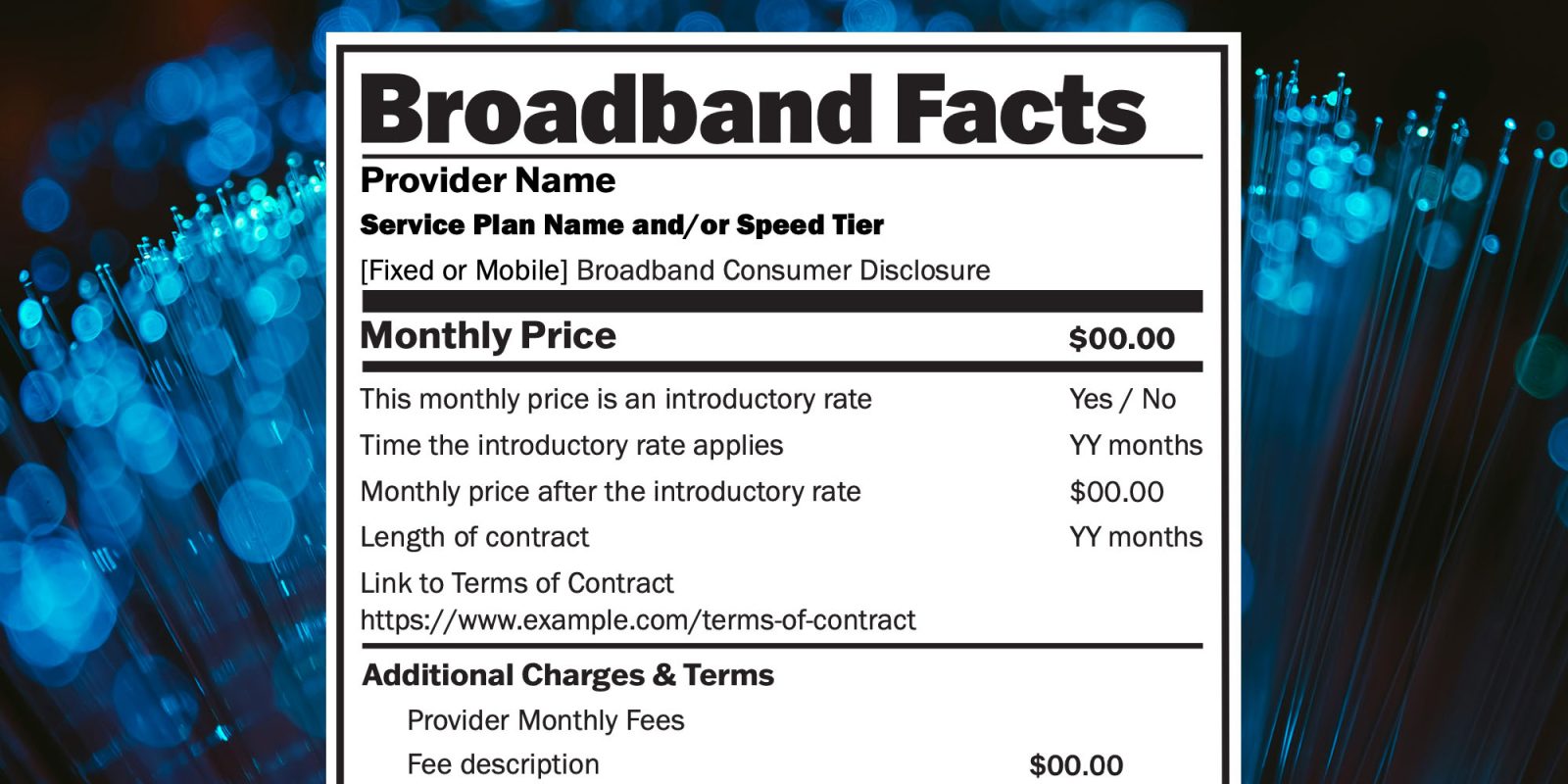
Internet service providers (ISPs) now have to display broadband ‘nutrition’ labels, being upfront about the true costs, speeds, and data allowances offered,
The rule was introduced in response to growing consumer complaints about hidden fees, data caps, and other misleading marketing of broadband packages – and takes effect today. You can see below full details of the information which must be provided …
There’s a saying that the headline giveth, and the small print taketh away – and never has that been more true than with ISPs.
Broadband companies tempt consumers with attractive-looking pricing and ‘up to’ speeds, while real-life speeds turn out to be significantly slower, and all-in costs far higher.
The Federal Communications Commission (FCC) has now has enough of this. As of today, all ISPs with more than 100,000 subscribers will have to use a label with a standard format.
Overview section
One common tactic is to advertise a price which only applies for an introductory period, and then switches to a significantly higher one. The label requires this information to be disclosed in the top section.
- Monthly Price $
- This monthly price is an introductory rate Yes / No
- Time the introductory rate applies YY months
- Monthly price after the introductory rate $
- Length of contract YY months
A link to the contract must also be provided.
Additional charges & terms
The second section has to set out all hidden feels, whether one-off or monthly, as well as the cost of ending the contract early.
- Provider Monthly Fees
- Fee description $
- One-Time Purchase Fees
- Fee description $
- Early Termination Fee $
- Government Taxes Included/Varies by Location $
Discounts & bundles
Consumers have also complained that ISPs don’t tell them about better deals on offer, through discounts and bundles with services like mobile plans. Available offers must now be disclosed, and links provided.
Real-life speeds
Top comment by Atlas
It’s sad that it has to be this complicated. In Europe you go in the store, you pay the price they show you clearly, which is the same for everyone of course, and then you always pay that same amount monthly, period.
When I lived in the US every colleague of mine and me paid different amounts for internet even if we all went to the same TWC store. In the store when I asked how much it would cost me, the vendor had to do many calculations on his computer just to tell me an approximate amount, and that amount changed after one year. And if I had insisted maybe I could have gotten a rebate. It’s all so ridiculously complicated and opaque.
No more BS about speeds of ‘up to’ whatever: ISPs must now list the speeds typically seen by their customers.
- Typical Download Speed in Mbps
- Typical Upload Speed in Mbps
- Typical Latency in ms
Data caps and surcharges
Finally, if data is capped, or surcharges applied above a certain amount, this must be explicitly stated.
- Data Included with Monthly Price in GB
- Charges for Additional Data Usage $/GB
The FCC has previously asked consumers for real-life speed data to create its own maps, after ceasing to distrust numbers provided by broadband providers.
Image: 9to5Mac composite from FCC and Sander Weeteling on Unsplash


FTC: We use income earning auto affiliate links. More.



Comments