

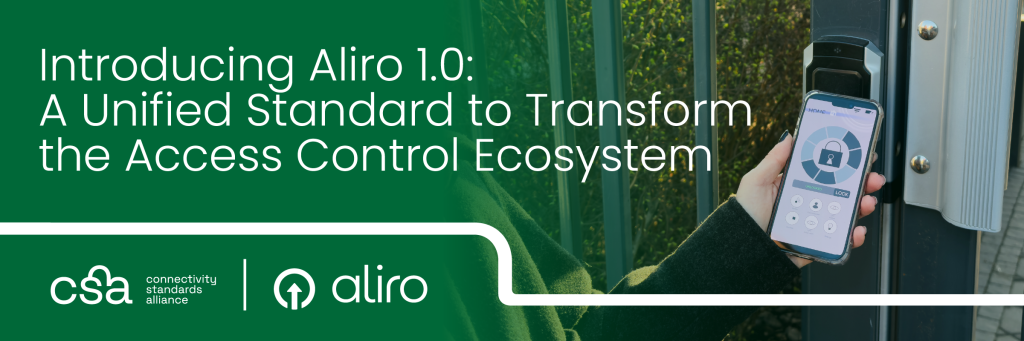
Enterprise access control is what I would consider “legacy” technology. A lot of the systems are Windows-based and look like a fancy Access database. On top of that, you are still dealing with physical cards. It is a fragmented mess for users and an onboarding nightmare for IT departments as well. Today, the Connectivity Standards Alliance is stepping in to fix that with the official release of the Aliro 1.0 specification aiming to create a standard for how mobile devices unlock doors, badge in, etc.
What is Aliro?
If the Connectivity Standards Alliance sounds familiar, it is because they are the governing body behind Matter, which was backed by the major players in the technology industry. While Matter was designed to unify smart home devices so users were never locked into a specific platform, Aliro is built specifically for physical access control for enterprise, government, healthcare, apartments, and even homes. This covers things like how Home Key works, but also how you will badge into your office.
Instead of relying on a vendor-specific app to create and manage a digital keycard, Aliro builds a universal communication protocol that all companies can build on. It dictates exactly how a smartphone or wearable device securely authenticates with a door reader. The standard supports Near Field Communication for traditional “tap to access” entry, Bluetooth Low Energy for longer range communication, and Ultra-Wideband for secure, hands-free unlock.
“Aliro is solving the fragmentation that has held back digital key adoption, replacing it with a single interoperability standard built through Alliance Member collaboration. By connecting the access control industry directly to leading mobile wallet ecosystems, it delivers a secure, frictionless experience that goes well beyond the front door. Lower integration complexity means faster innovation and shorter time to market. This is how the future of access control gets built,” said Tobin Richardson, President and CEO, Connectivity Standards Alliance.
Companies supporting the Aliro standard include Apple, ASSA ABLOY, Google, Infineon Technologies AG, Last Lock, Inc., Samsung, and STMicroelectronics, who pooled technologies, expertise, and innovations to build the Aliro 1.0 specification. Looking ahead, Apple, Allegion, Aqara, Google, HID, Kastle, Kwikset, Last Lock, Inc., Nordic Semiconductor, Nuki Home Solutions, NXP Semiconductors, Qorvo, Samsung, and STMicroelectronics are expected to be the first companies to achieve Aliro 1.0 certification in actual products.
The Apple Wallet advantage
The most significant part of the Aliro 1.0 launch is the backing of the major mobile wallet providers, specifically Apple, Google, and Samsung. Up until now, the i Apple Home Key experience has been mostly limited to residential smart locks. Aliro is aiming to bring that simplicity to the enterprise, healthcare, governments, and multi-dwelling units.
With Aliro, the credential lives natively in Apple Wallet on iOS. This means your employees can use the exact same method they use to buy coffee with Apple Pay or board a plane to unlock the office door. Because it integrates Apple’s Ultra-Wideband technology, an employee could simply walk up to a secured door with their iPhone in their pocket or their Apple Watch on their wrist, and the door will unlock automatically based on precise spatial positioning.
9to5Mac’s take
From an IT infrastructure perspective, Aliro solves the vendor lock-in problem for physical access control while moving the industry away from legacy technology. Historically, if you installed readers from a company, you were entirely tied to their software ecosystem. Aliro acts as a universal protocol so you are never locked in. Lock manufacturers, access control companies, and mobile platforms are building on the same specs. This standard is going to pull this industry forward to a digital experience.
As someone who manages a legacy access control system with physical key cards, this new standard has me more excited than I was for the Matter standard by leaps and bounds. I believe this protocol will lead to a lot of companies modernizing their access control systems. For home users, it is going to create a Home Key-like experience across the entire industry. The Aliro 1.0 certification program is officially open, and we should expect to see the first wave of compatible enterprise hardware hitting the market later this year.
Simply put, protocols are a win for consumers.


FTC: We use income earning auto affiliate links. More.

Comments