Author

Avatar for 9to5 Staff

9to5 Staff

CrunchPad turns into JooJoo, doubles price, seems sketchy

Site default logo image

We just finished watching the Fusion Garage press conference where they announced the CrunchPad JooJoo.  Besides not really showing it in action (a few seconds of stalled-stutter scrolling of a green screened device didn’t get your mouth watering?) the company seems a bit on the sketchy side, even if you don’t consider Michael Arrington’s legal threats a big deal. 

On that, most of the presentation was devoted to jabs at Arrington rather than wowing us with the technology.

The specs: 12-inch capacitive touch screen, 5 hour battery, $499 price tag, Wifi. 

We love the idea of a browser-only tablet and at $200-$300 might have taken a look, but at $500, it is a lot to risk on a company that may or may not be around next year and a product thats demo was as poor as we’ve seen.

iTunes Videos competitor Vevo launches tomorrow

Site default logo image

Vevo, a joint venture between Sony and Universal Music, claims to be the “Hulu for music videos”.  That remains to be seen.  However, the site did get a big boost today by announcing that a third (of the big four) music label, EMI, would be adding their content to the site.

The site launches tomorrow and is powered by Youtube.  Coincidentally, Warner, the only major label not in Vevo, has a partnership with Google to do videos on their own.  Vevo has put out their sloppy version of Video Killed the Radio Star below, with 50 Cent.

[youtube=http://www.youtube.com/watch?v=p03Z1qmxJ5g&w=600&h=385]

VEVO ANNOUNCES AGREEMENT WITH EMI MUSIC
 
New Premium Music Service to Launch on December 8
with Content from Universal Music Group, Sony Music Entertainment
and EMI Music
 
NEW YORK December 7, 2009 — VEVO, the new premium music video and entertainment service, today announced an agreement in which EMI Music will join Universal Music Group and Sony Music Entertainment in providing music fans with professionally-created video content when the service debuts on December 8 in the United States and Canada.
 
As part of this agreement, music fans will be able to view professionally-created video content from artists on EMI’s labels including Astralwerks, Blue Note, Capitol and Virgin, as well as the independent artists and labels represented by EMI Label Services and EMI

AT&T 'Mark the Spot' app is a step in the right direction

Site default logo image

Today AT&T has released and iPhone app (iTunes link) that lets customers tell them where they drop calls and experience other general network failings.  The app, dubbed ‘Mark the Spot’, allows you to choose what kind of failures the iPhone is having and lets you plot against frequency of the outage. 

Good for them for at least listening at this point, though we’re not sure how you submit your issue if you have ‘no service’ or ‘data failure’.  We’re also hoping they have some pretty serious data centers lined up to take the submissions.

We’re also wondering if there could be some sort of built-in app that could log this for you.  Apparantly there is an internal log taken by the iPhone of dropped call.  If that could be allowed to use GPS to…oh wait, that is an invasion of privacy.

iPod touch takes kids along the path to iPhone

Site default logo image

While everyone talks about the iPhone, the mobile device’s non-telephone sibling the iPod touch continues to grow its market share at a clamorous rate, leading mobile analytics firm, Flurry, to call it Apple’s “weapon of mass consumption”.

Flurry estimates that of 58 million iPhones and iPod touches sold by Apple up to September, 24 million are iPod touches.

“The iPod touch is quietly building a loyal base among the next generation of iPhone users, positioning Apple to corner the smartphone market not only today, but also tomorrow,” Flurry

Apple's Macintosh takes reliability prize according to Rescuecom

Site default logo image

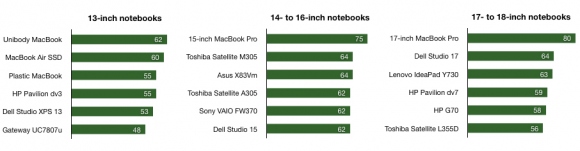
Reliability rankings are fairly subjective and there is always a wide variance on results in these studies.  That being said, Apple’s products (not necessarily their wireless network provider) usually end up on top.  That’s why it was a bit strange to find netbook manufacturer ASUS on top of Syracuse, N.Y.-based Rescuecom’s study earlier this year.

According to Computerworld, however, the stars are back in alignment and Apple is back on top.

Apple’s Macs, which led all rivals in Rescuecom’s rankings during 2007 and 2008, ceded first place to PCs sold by Asustek Computer (better known as Asus) in the first half of 2009, falling as low as third in the first quarter, behind both Asus and Lenovo. But Apple recaptured the top ranking for the third quarter with a reliability score of 374. Behind Apple were Lenovo and Asus with 320 and 166, respectively, followed by Toshiba and Hewlett-Packard in fourth and fifth place.

ASUS plummeted from a first-quarter high of 972 to 166 in the third quarter. 

SquareTrade last month also put Lenovo and Toshiba ahead of Apple’s laptops, which perennially are at the top of most reliability lists, illustrating the wide variance in these studies.

Apple Takes out 3,000 word ad on the front page of the Sunday NY Times Biz section

Site default logo image

Two things we love: The New York Times and Apple. However, today’s gushing front page Business Section App Store article reads more like a PR piece than actual information.  Let’s keep it real here.  Apple granted interviews with Phil Schiller and Eddie Cue to get some positive spin on the App Store which has been getting some significant negative press lately.  The news that the App Store is a “game changer” is not new, people were calling it such in 2008.

Somewhere, buried in the 3,000 words, is the downside of the App Store which is the actual news:

Apple offers statement on LaLa.com deal

Site default logo image

Apple has confirmed reports the company has acquired small digital music service, lala.com.

Terms of the deal weren’t disclosed by Apple, which closed the deal Friday.

Lala currently enables users to stream any song in its 8-million song catalogue for free and purchase them for 10 cents a piece.

ITunes is the leading music service in the United States with more than 70 percent of all digital music sales and it is the leading music retailer overall.

A brief statement from Cupertino: “Apple buys smaller technology companies from time to time and we generally do not comment on our purpose or plans,” Apple spokesman Steve Dowling said.

An anonymous source familiar with the matter told Reuters Apple is looking to ways to expand iTunes beyond its existing status as a download service for media.

“Apple recognizes that the [business[ model is going to evolve into a streaming one and this could probably propel iTunes to the next level,” said the person.

The move follows July reports suggesting Apple plans a move into music streaming services.

The lala.com website continues to function as this story hits the wire.

Apple buys Lala for a song

Site default logo image

So the New York Times‘ Brad Stone seems to have the inside scoop on the Lala purchase reported earlier by Bloomberg and just after by CNET.  It looks like Apple has bought Lala, not to bring their platform to iTunes, but more as a piecemeal purchase to bring their engineers and experitise with cloud computing into the iTunes music (Movies?  TV?) group. 

Here are some reasons for that:  Lala’s business has to get shut down.  Apple won’t be able to use any of the current licensing schemes that Lala’s customers have signed up for.

Lala

Steve Jobs advised on the OLPC project, MS tried to Thwart

Site default logo image

The OLPC project hasn’t been the success that Nicolas Negroponte, its creator, had hoped.  That’s not because of the lack of good advice that Apple’s CEO gave along the way.

Interestingly, Jobs did advise founder Nicholas Negroponte at several points along the design process even though his advice wasn’t well received..

“I got an email from Steve Jobs (the night the laptop was revealed) he said you can’t build it for a hundred dollars, and my answer was oh yes I can,” Negroponte said as part of a lecture at the University of Pennsylvania, Thursday night.

It turns out he couldn’t and he had to double the price…even though some Netbooks cost less than $200.  And by most accounts the OLPC is a POS.

“He was actually a very good critic, and each time we got to a point, I did talk to him,” Negroponte added. Negroponte also mentioned his displeasure with Microsoft, both in terms of Windows 7 performance, and Microsoft’s attempts to thwart the OLPC initiative.

How will FakeSteve reconcile this story?

Via CoM, Image via Gizmodo

Apple beefs up Mac Pro and Xserve options

Site default logo image

In case that Speedy Core i7 iMac was making you Mac Pro shoppers’ eyes wander a bit, Apple has beefed up the top end of their lineup.  The Mac Pro can now be configured with a 3.33GHz Quad-core Xeon Processor (strangely the 3.33GHz processors aren’t available in Octo-Core configs). 

Also, Apple has upped the build to order option to 8TB of Hard drive space (4x2TB) from 4TB. 

3.33GHz Xeons processors and 2TB hard drives have been out for quite awhile, so this isn’t a big surprise.  In fact, 2TB hard drives have reached commodity status (two generations of iMacs) with prices falling below $200 for consumer level versions.


Apple’s Xserves also get the 2TB hard drive (x3 slots=6TB).  Apple has thrown in a build-to-order RAM update as well.  Apple now stocks 4 GB RAM modules, doubling the build to order capacity of the quad-core Xserve to 24 GB and the 8-core Xserve to 48 GB.

Interestingly, Apple states that the total capacity of the Dual Processor Xserves is 96GB, but only with with Snow Leopard.  That means that 8GB modules will work in this machine.

The 3.33GHz Processor will add $1200 to the base configuration.

Each additional  2TB hard drive is $550.


Apple Inc. faces patent abuse over the iPhone's digital camera

Site default logo image

Apple faces a court room struggle against IP firm, St. Clair Intellectual Property Consultants, which has filed a lawsuit claiming the computer company has violated several of its digital camera patents.

The case was filed in October in the US District Court in Delaware and has reached the scheduling conference stage, which begins January 13 2010.

The Loop informs us that the lawsuit alleges Apple

I Am T-Pain gets festive update

Site default logo image

Yet another slice of I Am T-Pain action, with developer Smule offering a series of Christmas tracks for download and use within the application.

Seasonal fayre includes: O Holy Night, Jingle Bells and The Twelve Days of Christmas, all three of which are now available within the game’s download catalogue. If you

Forbes breaks down Apple's iPhone mis-steps in China

Site default logo image

Shaun ReinForbes has a pretty no-nonsense article about the iPhone’s fortunes in China written by Shaun Rein of the China Market Research Group

Background: Apple had only sold 5,000 legitimate iPhones in China after a week of being on sale and one of China’s biggest online retailers had only sold five in two weeks.   That of course is swayed by the fact that millions of cheaper, unlocked phones from Hong Kong and elsewhere have been selling without a contract in the mainland for years.   Oh, and the gray market iPhones have Wifi – which Apple was forced to remove for the legit China launch.

Rein offers additional factors which have slowed Apple’s official launch:

1. Local Consumer preferences weren’t being taken into consideration.  Most Chinese are Pay-as-You-Go customers.  It takes Hours/Days to fill out the paperwork to go pre-paid vs. 30 seconds for an unlocked SIM. Also, typical Chinese consumers spend less than $12 a month, choosing texting over voice calls.  Early adopters change phones often and don’t want to be tied into a contract.

2. Apple chose the weaker partner.  China Unicom only has 30% of the market and less coverage and quality than China Mobile (70% of the market).  There is also no number portability so China Mobile customers didn’t want to lose their number.

3.China’s launch was over two years after the US’s.  Getting technology last is buzzkill.  It is hard to build excitement for a launch over two years after the original.

Our conclusion?  Apple should learn from the black market.  Sell them direct to consumers and unlocked.  They’ve already sold millions this way indirectly, it seems to be working. 

Heck, why not try that in the US?

Apple ending click-wheel games?

Site default logo image

Is the click wheel iPod (Classic, Nano) on the way out?  A new report from Joystiq (via MR) seems to suggest that Apple has ended support for click-wheel games. 

Rather than being a simple touchscreen-enabled port of the original click wheel game, the iPhone Song Summoner contains both Song Summoner and Song Summoner 2, which was never released due to Apple ending support for click wheel games.

If true, one would have to wonder why Apple is ending support for the format.  New iPods aren’t due for another nine months but might Apple be preparing for the end of the click-wheel?  Mini touches?  It is all specualtion at this point but curious.