Wow…just Wow. Jobs, Gates, Macintosh dating game
We’re amazed this hasn’t been burned.
Western Digital is heading the relentless progression of Hard Drive technology by unleashing their new 2TB "Green" monster. (sorry Sox fans). Hot Hardware got their hands on one and ran it through the Windows NTFS ringer. Results? It held its own speed-wise against other 7200 RPM drives. WD says they’ll retail at $299 but with 1.5TB Drives hitting $129 routinely, we expect to see these guys at around the $200 range very soon. Specs below.
Microsoft missed Q2 revenue and earnings forcasts. Revenue was $16.63 billion versus $17.08 billion expected. EPS was $0.47 a share, below $0.49 expected. So what to do?
Microsoft today announced they’d be laying off 5,000. Cuts will come across all divisions, including: "R&D, marketing, sales, finance, legal, HR, and IT" which Microsoft hopes will save it $1.5 Billion/year.
In light of the further deterioration of global economic conditions, Microsoft announced additional steps to manage costs, including the reduction of headcount-related expenses, vendors and contingent staff, facilities, capital expenditures and marketing. As part of this plan, Microsoft will eliminate up to 5,000 jobs in R&D, marketing, sales, finance, legal, HR, and IT over the next 18 months, including 1,400 jobs today. These initiatives will reduce the company’s annual operating expense run rate by approximately $1.5 billion and reduce fiscal year 2009 capital expenditures by $700 million.
For some more interesting stuff check what makes Microsoft tick here:
Statements in this release that are "forward-looking statements" are based on current expectations and assumptions that are subject to risks and uncertainties. Actual results could differ materially because of factors such as:
— challenges to Microsoft’s business model;
— intense competition in all of Microsoft’s markets;
— Microsoft’s continued ability to protect its intellectual property
rights;
— claims that Microsoft has infringed the intellectual property rights of
others;
— the possibility of unauthorized disclosure of significant portions of
Microsoft’s source code;
— actual or perceived security vulnerabilities in Microsoft products that
could reduce revenue or lead to liability;
— government litigation and regulation affecting how Microsoft designs
and markets its products;
— Microsoft’s ability to attract and retain talented employees;
— delays in product development and related product release schedules;
— significant business investments that may not gain customer acceptance
and produce offsetting increases in revenue;
— changes in general economic conditions or the availability of credit
that affect the value of our investment portfolio or demand for
Microsoft’s products and services;
— adverse results in legal disputes;
— unanticipated tax liabilities;
— quality or supply problems in Microsoft’s consumer hardware or other
vertically integrated hardware and software products;
— impairment of goodwill or amortizable intangible assets causing a
charge to earnings;
— exposure to increased economic and regulatory uncertainties from
operating a global business;
— geopolitical conditions, natural disaster, cyberattack or other
catastrophic events disrupting Microsoft’s business;
— acquisitions and joint ventures that adversely affect the business;
— improper disclosure of personal data could result in liability and harm
to Microsoft’s reputation;
— outages and disruptions of online services if Microsoft fails to
maintain an adequate operations infrastructure;
— sales channel disruption, such as the bankruptcy of a major
distributor; and
— Microsoft’s ability to implement operating cost structures that align
with revenue growth.
Maybe Apple ran out of the old motherboards?
Apple, a few days ago (sneaky little bastards), updated the polycarbonate white MacBook’s specs pretty significantly.
No one noticed.
Strangely, even with the NVIDIA 9400M chipset, the White MacBook still uses the Mini DVI Port from the look of the side. Also, while the RAM has been upgraded to 2GB (joy!) it is DDR2 and not DDR3 like the Unibody MacBook. Bluetooth moves from 2.0 to 2.1.
These won’t be able to power a 30 inch screen like the Unibodies as well because Mini DVI only supports resolutions of 1920×1200.
Oh, and don’t worry, Firewire is still there.
How rich is he? He’s "I don’t give a FSCK about what my hair looks like" rich.
(Try to keep your eyes on the right left..)
The Mini has always been a compromised machine. With very limited expansion capabilities, it was designed to allow addition of memory and external storage, but little else. The lack of upgrade path made it a limited machine by design. It was designed to be hedged in at the bottom end to be attractive as a switcher’s machine and low cost mac desktop. Speed wasn’t a prime design consideration.
At first glance, the Atom/Ion Mini rumor doesn’t make much sense. Why would Apple put a hole in their line-up by making such a large gap between a Mini and a Mac Pro?
The landscape now is very different to six months ago. There’s a recession in full swing. Desktop and laptop sales are sliding across the board, and we can anticipate some sour notes when Apple’s Q4 results come out on January 21st. Combine this with the market trend toward laptops, and you can predict some big changes as Apple reacts to the marketplace and the recession.
PCs reached commodity status many years ago, and Macs are there now – anyone who would buy a Mac as a first computer probably already has. The main reason to buy a new Mac is designed obsolescence – a style change to make us want to trade up. It works – I recently bought a 2.33 C2D MacBook Pro for $1,015 because someone wanted a unibody version. They paid $2,000 for a 2.4GHz C2D with better graphics. With the loss they took on their MBP, they paid about $3,000 for appearance. Designed obsolescence works.
Many Mac Mini switchers buy laptops, but few go on to buy the iMac or the Mac Pro. Some people like the traditional display, keyboard and CPU 3-box set-up. Apple is looking to do well in a bad economy by gaining more switchers, but they also need these switchers to trade up to a more expensive machine. I believe Apple is going to target these switchers now.
In light of this, what does this rumor mean if it’s true?
If the Mini is getting an Atom 330, it is going down market. It could not sell for $599 and up. Even allowing the Apple premium we’re looking at a $399 device with 2GB and a DVD burner, miniDVI and DisplayPort out, ethernet and WiFi. This would make a good switcher, kid’s room or office machine, but it does leave Apple with a very large hole in their product lineup. Apple could make the Mac Pro more affordable, but it does not make sense to compromise their flagship product. This isn’t a Mac Mini, it’s a Mac Nano.
What makes sense to me is a new Mac Mini – not too big, not too small, but just right. This would be a Core 2 Duo or i7-powered machine with integrated graphics and a single 16x PCIe slot for upgraded graphics, or other PCIe card. It might have a couple of 3.5" drive bays. Suddenly, it’s an expandable machine that’s worth $999, and doesn’t really compete in the Mac Pro space.
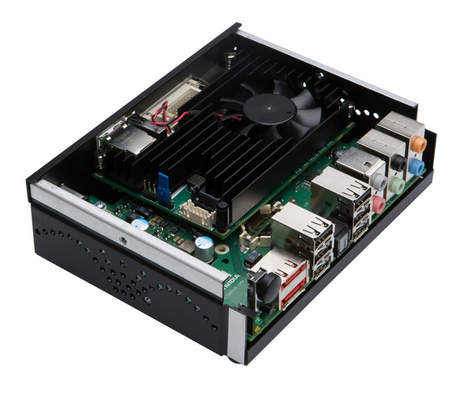
Some have speculated this Atom/Ion combo might be used in a netbook, but if you look at the size of the heatsink on that thing – I don’t think so. Some have also speculated that this may be for AppleTV, but why would Apple use such a short-life design in one of their embedded products when they have a fantastic new embedded device coming?
Maybe it’s just wishful thinking on my part, but I hope it happens this way, and we get a cheaper low end Mac Nano and a more capable Mac Mini.
Want an update on Snow Leopard (besides torrent information)? We’ve just gotten word that 10A250 is the most recent build floating around Cupertino while 10A246 is the most recent stable build. Apple will be sending out a big developer seed before the end of the month. At that point, Apple should have an announcement on further developer seeding.
The rumor du jour coming out of Tom’s Hardware is that Apple is going to replace the current Mac Mini’s Core2Duo with a dual core Atom 330-type processor. This is kinda like going to the garage and having having your BMW 328 engine replaced with that of a Toyota Corolla. The 1.6GHz Atom 330 Processor which is in the ION platform is slower than even the current Mac Mini.
So, unless Apple is going to be turning the Mini line into a low priced Net-top set of devices, it wouldn’t make sense to put a slower, cheaper processor under the hood. Even with dedicated NVIDIA 9400N graphics and all kinds of tricks, that thing would chug.
Check the benchmarks, the Duallie Atom 330 is rated at less than 2/3rds the speed of the Pentium D circa 2005-2006 for most tasks. This is great when sold at $30/chip and put into a $300 Netbook to run a browser on XP or Linux, but definitely not aimed at the $600-$800 Mac DESKTOP market. A Pentium D isn’t even as fast as the current Mac Mini’s chip so the slowdown would certainly be noticeable.
They are backtracking a bit saying that this could go into the AppleTV. While this makes a lot more sense (with NVIDIA/ION we might see full 1080P capable AppleTVs) we aren’t sure we expect to see this any time soon. Plus, we expect the AppleTV to move to the ARM platform soon.
Or a netbook.
The day after he’s been put in charge of the day-to-day work at Apple, Tim Cook is getting a lot of media attention. Here’s a quick rundown:
The genius behind Steve Jobs – Fortune
Is interim CEO on a trial run at Apple? MSN
Apple’s Cook Pushes Staff in Lieu of Jobs’s Magic – Bloomeberg
Tim Cook: A Steady Go-To Guide for Apple – Businessweek
When Steve Jobs Met Tim Cook – WSJ
Why Apple is in safe hands with Tim Cook – TechRadar
According to the NYTimes:
Two people who are familiar with Mr. Jobs’s current medical treatment said he was not suffering from a recurrence of cancer, but a condition that was preventing his body from absorbing food. Doctors have also advised him to cut down on stress, which may be making the problem worse, these people said.
Looks like a prescription for R&R. Be on the lookout for a fattening man in a black mock turtleneck in Tahiti.
Update: WSJ concurs. Can we stop the cancer talk now? Enjoy your time off Stevo.
Macrumors today reignited the long standing and falling rumor that Apple was readying a interface overhaul. If you want to know what 10.6 Snow Leopard interface elements will look like, all you have to do is look at iWork.com.
Apple will be merging the look and feel of the MacOS with the Touch/iPhone look and feel. UI is evolutionary, not revolutionary (move to OSX from OS9 notwithstanding)
and you, of course, will love it…More below…


New System Preferences vs. old. You can even see some of the enhancements in the iWork Applications. These aren’t Leopardy feeling elements.


I like reading the rumors of a quad core iPhone coming soon, but I don’t really believe them. If we ignore the problems with ARM’s roadmap, and quad core Cortex processors in 2009, there are still many other issues that ruin the party. If there was an imaginary iPhone with a quad core ARM, it would need amazing power efficiency.
Instead of the tens of watts drawn by the Atom and supporting chipset, we’re looking at something like a single watt using currently available ARM cores. Going by ARM’s figures for their 2010 products, we can see 4 cores drawing 10 mw each (40 mw) in "average" use, and nothing in sleep states. However, the graphics chip on this device has to be very efficient too. nVidia, who have been ARM-licensees since 2005, have done wonders with their Tegra line, particularly in terms of battery life. Apple has licensed Imagination’s ultra-low-power graphics processor to embed into this new device, and it is likely superior to nVidia’s Tegra 650.
The problem is that it will take time for Apple’s team at PA Semi to refine their ARM cores, incorporate a highly advanced graphics block, add in the usual cellphone, bluetooth and miscellaneous "stuff" that goes together to make a cellphone. Shoe-horning the contents of five or six discrete ICs into a single die, with groundbreaking power consumption, takes time.
Then you have to make engineering samples and qualify them, design the phone hardware, port the OS, qualify those, then arrange production. Remember this is based around a core component that isn’t expected to appear even as engineering samples until late 2009.
The Cortex-A9 isn’t a requirement, but it is common to all the rumors. ARM11 cores would have similar throughput with a power efficiency penalty. The risk there is that the chip will draw too much power. Doubling the power doubles the size of the battery to maintain the same standby time.
From the hardware point of view, the final rule of the semiconductor business is that first you get it to work, then you get it to work fast, and then you make it power efficient by evolving the fabrication process.
Apple is a design company. When you look at the iPhone one thing is clear: they aim for capable hardware, and implement all the features they want in software. It is obvious they are developing a general purpose hardware platform with capabilities well beyond the needs of even the most powerful cell phone. It seems smart for them to take the longer view and invest the time to come to market with a well-developed platform that has multiple uses, which leads into the other rumors and discussions of games platforms and convergence devices.
Even with a thorough Hackintoshing, the Dell Adamo doesn’t look to be a serious competitor to the MacBook Air. Shots from Engadget liveblog.
TUAW caught up with David Pogue, top technology writer for the New York Times. Strangely, they didn’t ask him about his little John Lennon musical.
[blip.tv http://blip.tv/play/AeWLaYSUSw]
They also caught up with Twitterriffic’s Craig Hockenberry below
[blip.tv http://blip.tv/play/AeWEFISUSw]
If there was ever any doubt that there is, in fact, a market for matte screen MacBooks of the 13 and 15 inch variety, Techrestore is validating. For $199 (Apple’s $50 matte-grade doesn’t seem so steep now does it?) and a 24 hour turnaround time, they will replace your mirror screen with a matte screen. No word yet what happens to the MacBook Logo – maybe they’ll laser etch your name in there for another Benny.
From their site:
Don’t like the shine? Think your MacBook Pro screen is like looking in a mirror? We can help!
This service is for the "Unibody" MacBook Pro systems with 15.4-inch screens that were released by Apple in late 2008. Only fully functional screens qualify for this replacement service. If your screen is defective and you need to schedule a repair, please click here.
What this service includes: Replacement of the super glossy, super shiny LCD screen on your MacBook Pro with a matte finish, non-glossy screen. We also remove the shiny glass cover on your MacBook Pro and replace it with a black bezel that surrounds the matte finish screen. The replacement screen will be brand new and include a 1-year TechRestore warranty. We will perform the service within 24-hours (M-F) of receipt of your Mac.
A Trusted Source with a Proven Track Record
Like you, thoughts of being without our Macs for an extended time period is downright scary. The good news is that we only need your Mac for 24-hours (Monday – Friday) to install a brand new LCD screen and with our nationwide overnight courier service, you’ll have your Mac back before you know it. In addition to the fast turnaround time, we provide you with our exclusive 1-year warranty on parts and labor.
Quick & Easy with no Surprises
Our flat-rate LCD screen replacement includes everything you need to get your trusty Mac back up and running as quickly as possible. Just add this item to your shopping cart and complete your order online, or call 1-888-64-Restore (888-647-3786) to schedule your repair via phone. Choose from our famous Overnight Door-to-Door pickup service, Local Drop-Off at any FedEx location near you or send your laptop to us on your own and get Free return shipping. During the repair process, you’ll be provided with email updates and you can check your repair status online at anytime.
Choose from four shipping options for your repair:
1. Door-to-Door Overnight Pickup for $99
2. Local FedEx Drop-Off with Overnight Delivery for $49
3. Self-Ship with Return Overnight Delivery for $29
4. Self-Ship with Return Ground (3-5 Day M-F) Delivery: Free
Three options include return Overnight shipping back to your location when your repair is completed. Click here for an illustrated view of your shipping options. The Free Ground return option is valid with any approved repair.
Customers outside the U.S., in Canada, Hawaii & Alaska select the Self-Ship shipping option below. An additional charge of $20 will be added to your order for return overnight shipping.
Don’t take our word for it – take a gander at what our customers have to say about our services.
More Questions? Give us a call at 1-888-64-Restore and speak to an actual human being or contact us via email.
This might be a first (and a last). HP’s MediaSmart Server EX485 has walked away with one of Macworld Magazine’s coveted best of show awards. The Windows Home Server based product (!) does offer a lot of services for the Mac platform. You can do Time Machine backups to the device. You can store your iTunes online on a central server. You can also share files/folders with anyone in your house or small office. With some extra SATA drives, you can have this thing up to 9TB. Competition for this device includes DLink’s DNS-323 line, Linksys‘s NAS, the Drobo line and (our fav) Netgear’s ReadyNAS. The others run Linux but the HP runs Windows.
The Apple Competitor? None for quite awhile. We’ve heard the only functionality to be added to Time Capsule in the near future is Software Update caching. If you want to pick one of these HP’s up, head over to Amazon and save over $100 off of retail for the 750GB version.
Macworld said:
HP’s MediaSmart Server is a server for the home. The idea is that it gives you one place to store all your family’s shared libraries of photos, music, and video, and provide a backup drive for every computer in the house.
It looks like a mini-tower. It’s got four drive bays. You can buy it with one or two of those bays full, for 750GB or 1.5TB of storage. You can plug any SATA drive into the remaining bays if you need more storage.
The MediaSmart Server isn’t new, but the latest version adds improved Mac compatibility. For one thing, it now works as an iTunes Server. You can copy your iTunes libraries to it, then access those combined libraries from any computer in the house. (Unfortunately, the media collection tool, which can go out and find all those libraries and do the copying on its own, only works with Windows PCs for now.)
The MediaSmart Server can also work as a centralized backup drive for everyone on the network. The key addition there: Unlike other network-attachable drives, it’s compatible with Time Machine.
The HP MediaSmart Server is specifically designed for homes with a mix of Macs and Windows PCs. It requires a PC for the initial installation—in large part because the server itself runs on the Windows Home Server OS. But once you’ve done that set-up, the MediaSmart is fully accessible from your Mac.
All in all, it’s a really promising solution for any home that has both Macs and Windows machines and no central place to store and protect the family’s digital media assets.
The HP EX485 makes backing up your home’s PCs and streaming media a breeze, and it comes with 750 GB of storage. |
Centralize your iTunes music libraries on the MediaSmart Server for playback to any networked Mac or PC running iTunes. The HP Media Collector conveniently schedules the MediaSmart Server to copy and centralize digital files and libraries from networked PCs. The pre-installed HP Photo Publisher software enables you to easily upload photos to Facebook, Flickr, Picasa Web Albums and Snapfish. and the MediaSmart Server provides peace of mind with effortless backups of your Windows-based PCs via the Windows Home Server backup feature and Macs running Leopard using Apple Time Machine software.
The EX485 MediaSmart comes with 750 GB of storage right out of the box and four drive bays that allow you to add optional off-the-shelf SATA I or II hard drives–up to a maximum capacity of 9 TB (terabytes). Additionally, the MediaSmart includes four USB 2.0 ports and one eSATA port for connecting an attached external hard drive, and it provides capabilities for offsite backup via automatic upload to Amazon’s S3 service.
The sleek, streamlined micro-tower design is perfect for use in the home office or the living room, with perforated steel exterior panels that provide cool, quiet operation. A Sleep Mode conserves energy and saves you money in more ways than one. The built-in sleep mode consumes only 1W of power, and the server can take on many of your PC’s responsibilities, enabling you to turn off your individual computers to further save energy and money.
Software Features
Satisfy all your backup and media storage needs with four internal hard drive bays, four USB 2.0 ports, one eSATA port, and access to Amazon S3 online backup. |
PC Operating System Support
Hardware Specifications
![]() |
What’s in the Box
HP EX485 MediaSmart Home Server, power cable, Ethernet cable (RJ45), PC restore disc, server recovery disc, software installation disc, printed documentation. The MediaSmart Server is backed by a one-year limited warranty and dedicated software technical support both online and by phone.
Product Description
The HP MediaSmart Server is a home server that can automatically backup and protect your digital memories, centralize your media and content for sharing with friends and family, and enable you to enjoy your digital media while at home or away.
Yes, this is an Apple Blog and of course we love to focus on Apple products but it never hurts to look around the technology landscape just a bit. ASUS, the company that invented the Netbook category, this year may have invented the "Keybook" category. They’ve stuffed a whole PC, including small touch screen monitor into a slightly oversized keyboard (Apple // be damned!). Specs haven’t been given but surely it carries your garden variety Netbook 1.6ish GHz Atom processor and too little RAM and hard drive to run Vista. If you look below you’ll see a lot of ports including HDMI for 1080P goodness.
Nice work ASUS, we like this concept even if it doesn’t find its way into our homes. Oh, and then there is the Sony P. It is so good to see that Apple has some competition in the innovation department. From Giz:
That 17-inch MacBook Pro is a thing of beauty, no doubt. But we have some reservations. First of all, the five years of battery charges couldn’t have been tested (this new tech/form factor didn’t exist five years ago). Lithium Polymer might age poorly or differently in real world conditions and differently than in testing. We are willing to give Apple the benefit of the doubt but know we have been dealt a bit of a wild card there. Also we know the five hour batteries typically last three hours, so should we expect these 7/8 hour batteries to last 5/6 hours?
Next, that enclosure doesn’t just enclose the battery but it also encloses the hard drive (see no seams in video below). And you only have a few (Apple only) options out of the box. The biggest drive you can walk away with is a 320GB. You can easily replace an Apple drive on a 13 or 15 with one of the many 500GB 2.5 inch SATA drives out there. Hrmmmph.
Apple also offers SSD drives in 128 and 256 GB sizes for $500 and $900 respectively. We’d also like to replace the SSD if/when we choose to. In a couple of years into that five year battery life, bigger SSDs will cost much much less. It would be nice to be able to upgrade without major surgery. (more below)
RAM. We love the ability to go to 8GB of RAM but $1200 is pretty steep. Especially when RAM prices have fallen so sharply over the past few years. Even if you could easily get into the case, that type of RAM isn’t cheap from 3rd parties. Oh, and since the 17 inch can go to 8GB with the exact same memory, can we now upgrade our 13 and 15s? Not yet.
We are waiting for the iFixit disassembly videos to show us the way to do the surgery.
Frankly we like to see a little more hardware at events but the 17 inch MacBook was pretty close to our description last week. The $50 matte version should make people both happy and sad – as wil lthe internal long life battery. We’d be lying if we said we didn’t want one…with 8Gb (will we be able to up our smaller MacBooks to 8Gb)? No Mini or iMac however was rough. We have a feeling they are coming.
iLife and iWork are both looking pretty exciting. iWork.com is pretty close to what we envisaged. There were lots of gray areas where we missed some stuff but we think we got the major gist of it across. GarageBand learn-to-play is exactly what we had heard. And the Magic hint? Cool transitions in iWork. They are Fun!
iTunes. The end of the DRM era. Now we don’t have to visit Amazon (but probably will continue for the dealz). Amazon still beats Apple on price but iTunes is more convenient.
Apple Stock isn’t really reacting (update – whoops – it is tanking).
Overall however, we were left….wanting…although the Macrumorslive (best feed out there) getting hacked was entertaining. And obviously we have an Apple Mac hardware event coming up.
We’ll put up Apple’s videos as they become available. What did you think?
We are firin’ up the livepanel again this year with Engadget, Macrumors, Gizmodo and Computerworld sites all set to be included. If any go south, we’ll hook up a few backups. As a bonus, we are hoping to get some Qik live camera feeds but are wary of the bandwidth in the hall during the event. The show starts at noon eastern time, 9am pacific but stop in early to see the pregame show.
Remember, this page refreshes automatically so your trigger finger won’t be bloodied refreshing pages. It is also big and works best on a 24 inch screen or bigger.
iWork.com, a domain that Apple has owned for a long time is set to go live this week with a public beta of the new iWork collaboration package. We went over this briefly before but need to clarify our previous statements a bit.
iWork.com will be a online site where you can share and view (but not yet edit) iWork documents online. Workgroups will be alowed to share documents, comment on documents and view them to a certain extent in the browser window. We haven’t recieved clarification of how well this will work and how many capabilities this will have. Somewhere between reading a Pages document and viewing a full multimedia Keynote presentation we’d guess.
We expect it to go live tomorrow.
iWork.com Whois:
Domain Name: IWORK.COM
Registrar: MARKMONITOR INC.
Whois Server: whois.markmonitor.com
Referral URL: http://www.markmonitor.com
Name Server: NSERVER.APPLE.COM
Name Server: NSERVER2.APPLE.COM
Name Server: NSERVER3.APPLE.COM
Name Server: NSERVER4.APPLE.COM
Status: clientDeleteProhibited
Status: clientTransferProhibited
Status: clientUpdateProhibited
Updated Date: 07-oct-2008
Creation Date: 22-aug-1995
Expiration Date: 21-aug-2010