Tech Industry

See All Stories

Carbon fiber rumor debunked

Site default logo image

MacBlogz is echoing some of what we’ve been hearing from our sources.  The recent rumors of a carbon fiber MacBook not only don’t make sense from an aesthetic standpoint, they also don’t make sense from a materials standpoint.  Our source said that anyone who knows materials science will know it is made up.  Real carbon fiber can’t be used in a laptop effectively – while it is strong, it can’t be fastened to aluminum or other metals effectively.  MacBlogz echoes this sentiment:

As an engineer who designs carbon fiber parts, I know it’s an amazing material, but it has its limitations. Ultra light and strong organically shaped structures: Yes! Small intricate parts: No. Laptops from Sony and VooDoo claim to be made from carbon fiber, but it’s not the woven type you see on a Formula 1 car. Its merely injection molded plastic with tiny little pieces of carbon fiber in it. One could call it a marketing ploy.

Why aluminum beats carbon fiber in Apple’s notebooks:

– Anodized aluminum is many times harder than carbon fiber in epoxy, thus very scratch resistant.
– You can easily tap screw holes into aluminum, not into carbon fiber.
CNC machined aluminum has tolerances down to a few microns, carbon fiber is much less exact.
– Aluminum can be cast, milled and forged into almost any geometry. Carbon fiber cloth is limited by the geometries it can fit around and there can be no sharp corners.
– Carbon fiber cloth must be laid up by hand before curing – aluminum cutting and forming is automated.
– Aluminum is easily recyclable, carbon fiber less so.

Bottom line…  Don’t expect a carbon fiber laptop from Apple or trust anyone who says one is in the works.

Blackberry Bold, the 'Buick of Smartphones'

Site default logo image

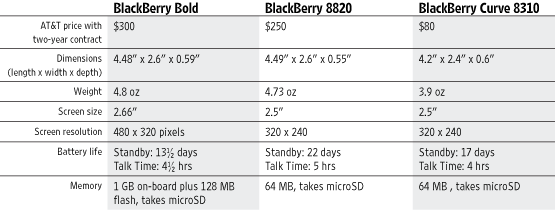
AllthingsD (which means automatically blessed by Walt) does a review of the Blackberry Bold.  It pretty much meets expectations…for a Blackberry.  Big, beautiful screen, great physical keyboard, fast internet and email access and more bells and whistles all around.  But we can’t help but feel the dissapointment in the size and feel of the thing.

‘the Bold reminded me of my grandparents’ new Buick: handsomely polished and luxuriously comfortable, with plenty of extra bells and whistles. As much as I like the plush feel of this ride, it can feel as big as a boat when I need to park or navigate narrow city streets. Likewise, the Bold’s large size affords mobile extravagances like a keyboard I could use without looking down and a leatherette-covered back panel. But when tossed in a bag or even held in my hand, the BlackBerry Bold simply feels too heavy and too big.’

Sounds like somebody has been using an iPhone for too long and is having trouble with going to other devices wethinks.

http://services.brightcove.com/services/viewer/federated_f8/452319854

6GB of RAM for unibody MacBooks

Site default logo image

NVidia says 8GB, Apple says 4Gb…how much RAM can you put into the new unibody MacBook and MacBook Pros?  Longtime 9to5Mac sponsor RAMJET has found the sweet spot offering up 6GB kits.

MacBook Aluminum:
The MacBook Aluminum uses a new high speed form of memory called DDR3-1066. The system maximum is 6Gigs with the installation of one 2Gig and one 4Gig SO-DIMM.

Non-Stacked IC’s: Ramjet uses a Non-stacked module for the 2GB and 4Gig module for the MacBook. The cheaper stacked IC variety of 2GB and 4GB SO-DIMM runs hotter and draws more power, which hurts performance and decreases battery life. Ramjet ONLY uses premium non-stacked chips.

That being said, the 4GB modules currently run at $600 a pop so this isn’t for the faint of wallet.  If that doesn’t scare you, why not upgrade that hard drive to 500GB while you are at it?

 Via Macrumors

IBM PowerPC chip designer heads to Apple..but not without a fight

Site default logo image

In case anyone thought that Apple wasn’t serious about designing its own chips, some news today might put another nail in that coffin.  According to Tom Krazit over at C|Net, Mark Papermaster, former chip guru at IBM and Vice President of Development, IBM BladeCenter, left IBM to take on a role at Apple. 

Apple’s former PowerPC partner, IBM, isn’t letting Papermaster go without a fight..

Mark Papermaster, until recently IBM’s vice president of microprocessor technology development, plans in early November to join Apple in a position that will see him working closely with Apple CEO Steve Jobs in what IBM believes is an attempt to expand Apple’s presence in the markets for servers and chips for handheld devices, according to the copy of a lawsuit filed by IBM against Papermaster. IBM is suing Papermaster to prevent him from joining Apple and divulging trade secrets related to IBM’s Power chips and server products, according to the complaint filed in the U.S. District Court for the Southern District of New York.

IBM issued this statement: "Mr. Papermaster’s employment by Apple is a violation of his agreement with IBM against working for a competitor should he leave IBM. We will vigorously pursue this case in court."


While Krazit thinks that Papermaster is heading to Apple for its Xserve products (which frankly would be nice), it is interesting to note that while his latest job was with the blade server division, he has a long history of chip development and authoring many papers on PowerPC architecture.

This chip knowledge would be much more valuable to IBM than his blade server management role.  Keep in mind that before PA Semi got bought by Apple a few months back, they were specialists in…wait for it…PowerPC designs.  Could Apple be bringing back the ultra-low power PowerPC for iPhone type equipment?  Why Apple is snapping up all of this PowerPC talent?  We checked his background.. Papermaster has very little to no experience in ARM design.


Apple will feel recession's pinch, but emerge with a smile – analysis

Site default logo image

 ChangeWave has issued a warning that Mac sales may feel the credit crunch in the coming quarters – but once again expressed the research firm’s confidence Apple will come out of the dip with a smile on its face.

ChangeWave’s Paul Carton writes, "Apple CFO Peter Oppenheimer estimated Apple’s sales would come in between $9-10 billion for the December quarter – well under the $10.7 billion that had been anticipated. He also said earnings per share would fall between $1.06 and $1.35 – also far less than the Street’s $1.67 consensus estimate.

In our September PC spending survey of 4,262 consumers, we found Apple’s real problem wasn’t Mac sales over the previous 90 days – sales looked good. The problem was the outlook for Macs going forward."

Carton warns that consumer electronics sales may bear the brunt of tightened belts and economic malaise across Christmas this year, and Apple’s conservative guidance may – for once – be completely accurate. Peter Oppenheimer characterized Apple’s reduced outlook as being "prudent" for these difficult economic times.

“We may get buffeted by the waves a bit, but we’ll be fine,” said Steve Jobs. “Apple just reported one of the best quarters in its history, with a spectacular performance by the iPhone—we sold more phones than RIM…We don’t yet know how this economic downturn will affect Apple. But we’re armed with the strongest product line in our history, the most talented employees and the best customers in our industry – and $25 billion of cash safely in the bank with zero debt.”

ChangeWave warns that Mac sales are Apple’s Achilles Heel: "Mac visibility is the number one issue for the company and that’s where our survey results show Apple is most vulnerable – caught in the fierce headwinds of the accelerating economic downturn – Apple investors can expect a continued bumpy ride for the stock until consumers start spending again," Carton warns.

Despite such concerns, the researcher refuses to lose sight of the long-term positive for the computer company. "Once the economy does start coming back, our ChangeWave surveys are clear about the long term outcome. Apple will continue to expand its already dominating lead over the rest of the consumer electronics industry," the researchers warn.


iMac, Mac Pro upgrades loom?

Site default logo image

With the MacBook range upgrade under our belts the Mac web is beginning to consider Apple’s next move, and it looks like iMac customers may choose to defer their next purchase for a few weeks – as some claim an upgrade to the system’s due to debut in November.

Veteran Mac industry watcher Dennis Sellers at Macsimum News speculates: "I’m pretty sure that we’ll see an iMac and Mac mini update on Tuesday, Nov. 11."

He also suggests Apple will introduce a powerfully-upgraded Mac Pro and a revamped range of Cinema Displays in January. The latter systems will offer LED screens, built-in speakers and iSight cameras, he surmises – not unreasonably given Apple’s recently introduced display for its laptops.

Naturally, his suggestions generated immediate conversation, with one reader suggesting Seller’s has the dates right, but the products wrong – new Mac Pro for November? We have seen Apple upgrade its pro machines in November before, admittedly – and Xserve seems to need a little love at this point…

The Mac Pro is long overdue for an update. It’s been 294 days since the last one. The iMac on the other hand, is well under the average time for an update. We’ll see how this plays…

Power Computing all over again…Psystar out-features Apple desktops

Site default logo image

Upstart, questionably legal, Psystar is now shipping Mac clones with built-in Blu-ray and NVIDIA 9800GT graphics cards.  For those of us with some gray hairs, this might bring back the memory of Power Computing, the Texas-based original Mac clone maker that vexed Apple over and over again back in the 1990’s by releasing computers that out-specced Apple’s own. 

Power Computing was also able to utilize technologies like VGA connectors and off the shelf power supplies and cases to sell lower prices than Apple’s own computers.  At the same time, they were also able to get the fastest PowerPC chips into the machines months ahead of Apple’s.   Therefore, their machines constantly out-performed Apple’s and cost less.

The company never realized their full potential.  Unfortunately, they were really a victim of their own success.  The conventional wisdom at the time was that half of Power’s customers were new to the Mac platform.   The downside of that is that the other half were cannibalizing Apple’s sales.  This obviously wasn’t sitting too well with Apple.  Was Apple’s hardware team to blame?  Was there too much bureaucracy at Apple to beat the streamlined Power Computing cloners?  Was Apple R&D not properly being accounted for in the licensing scheme?

Then Apple aquired NeXT to build the new MacOS…and we all know what happened..erm…next….

Apple and new interim CEO Steve Jobs ended the cloning in September 1997 when they bought Power Computing for $100 million in Apple stock.

So does this leave Apple in a similar situation now?  Will they have to buy out Psystar? Not really…

Although there are some similarities between then and now, there are also significant differences.  First of all, you can get a BluRay drive for your Mac Pro as well as adding a 9800GT video card…which is about as easy as buying a clone and setting up the Mac OS on it.  Psystar isn’t going to hit the high end customer like Power Computing did.

Also, since the Mac platform is now run on Intel based chips, just about any PC can run the MacOS.  You don’t really need a special Psystar box if you have some technology skills.  You can shop around or build your own Hackintosh that will blow away any Mac Pro for less than Apple, and even Psystar, charges.  But it takes time, skill and effort.

The market that Psystar could serve isn’t that big.  The low end, low tech skills crowd that Apple has little interest in servicing may find some usefulness in Psystar’s offerings.  At the same time, these customers will of course have to hope that Apple doesn’t release updates that kill Psystar’s EFI workaround or that their hard drive doesn’t need reformating or replacing.  With Apple threatening lawsuits and threatening to change EFI so that Psystar’s machines no longer work, most of the low tech crowd will probably stay away.

Apple could kill the clone makers by sending their expensive army of lawyers after them (like they have) or they could kill them by offering a midrange Mac at a price point that makes sense based on the platform.  Don’t expect a change of gameplan anytime soon.


Power Computing‘s farewell ad.


Red's Big Scarlet and Epic programs announcement – November 13

Site default logo image

We know a lot of you out there are big Red (as in the camera) fans.  You’ll be pleased to know that Ja(nard)Red is starting the hype around the new Red product which will be the best camera that has or ever will exist.

Scarlet and Epic updates…
We will announce the new Scarlet and Epic programs on Thursday Nov. 13th. I want to say that no one has any idea how incredible this announcement will be.

Call this hype… please. I am quite sure that the announcement will be called a "scam". Should be a lot of fun to hear the reactions. I can’t wait.

Jim


What do you think it will be? 

Intel reverses course. 'ARM smokes us in power consumption'

Site default logo image

From the "who is who’s bi-…lapdog" category, comes a nice little apology from Intel for recent comments made by some of their own.  Remember last week, two Intel execs (Shane Wall and Pankaj Kedia) slammed the iPhone for not having an adequate browser due the the ARM platform being inferior to Intel.  Today, those executives’ boss, Anand Chandrasekher, issued the following apology:

Anand Chandrasekher issued a correction on comments made by members of his team yesterday at Intel’s Developer Forum in Taiwan. As general manager of the Group responsible for Intel’s ultra-mobility products, he acknowledged that Intel’s low-power Atom processor does not yet match the battery life characteristics of the ARM processor in a phone form factor; and, that while Intel does have plans on the books to get us to be competitive in the ultra low power domain – we are not there as yet. Secondly, Apple’s iPhone offering is an extremely innovative product that enables new and exciting market opportunities. The statements made in Taiwan were inappropriate, and Intel representatives should not have been commenting on specific customer designs.

Wow.  This leads us to believe that you sure could make a much better netbook with a ARM processor than an Intel one …we think.


More from Tom Krazit

Apple Tablet caught searching the web?

Site default logo image

Read my lips.  John Markoff brings back the worst kept secret in the Valley.  Apple is working on something between an iPhone and a MacBook.  If it is let out on the interwebs, that certainly means it is moving beyond prototype. 

"That would seem to confirm findings that a search engine company shared with me on condition that I not reveal its name: The company spotted Web visits from an unannounced Apple product with a display somewhere between an iPhone and a MacBook. Is it the iPhone 3.0 or the NetMac 1.0?"

Our sources say there are a few different prototypes running around Cupertino, and "frankly, there have been for years.  Jobs won’t make a move until the timing/technology is exactly right"

Frankly, you could run a MacOS on a random EEE Hackintosh with any screen size and name you’d like.  So, it could all be hot air.

Just the facts: Ingram Micro lists 17-inch MacBook Pro as End of Life (get your last matte MacBook Pro ASAP!!)

Site default logo image

EDIT: woops…we forgot Apple entered a new Part number for the essentially the same 17 inch MBP

Ingram Micro, one of the nation’s largest computer wholesalers, is listing the 17" MacBook Pro as EOL.  Could be a mistake.  Could be something else.  Might not mean anything.  We’re just sayin’  Huger picture after…


Free-to-view digital TV coming to iPhone

Site default logo image

Elgato is developing new technologies that will allow Mac users to stream digital free-to-view channels directly to their iPhone.

Television and the iPhone are twin stories, certainly in the UK, and the technology to bring mobile TV to Apple’s global audience of iPhone users is already in place, to an extent.

Elgato currently enables users of its digital tuner systems to encode recorded shows for streaming via WiFi – but the new scheme should see more automation and suggests more efficient compression to help boost these tasks.

Electric Pig reports (via Distorted Loop)a chat with Elgato’s marketing chief, Lars Felber, who stressed the importance of developing such solutions to the world-famed firm.

Felber dismissed physical solutions for direct receptiun using an iPhone as likely to be too demanding of electrical power, indicating that the company plans to enable a hybrid scheme in which a Mac at home receives the channels, automatically compresses the ones a user wants and then makes them available for streaming.

Farewell Firewire, launch video here

Site default logo image

 We’re all aware that FireWire’s on the way out – at least on the consumer Macs. Seems a shame – we like Target FireWire Disk, we use video cameras, but here’s a chance to watch Jobs introduce FireWire in 1999 at the January Mac event.

"What is FireWire? Think of FireWire as USB, but rather than running at 12 megabits-per-second it’s running at 400 megabits-per-second," said Jobs then. "And it’s already an established industry standard," he added.

[youtube http://www.youtube.com/watch?v=xP5aLoRozt8&hl=en&fs=1]

Steve Jobs offers Apple's 2008 Green Update

Site default logo image

Apple today published an update on its environmental plans.

"For the past several years, Apple has made a concerted effort to be more transparent about the steps we are taking to protect the environment and make our business more sustainable. In this environmental update, I’d like to inform you of our recent progress and introduce you to a groundbreaking system of reporting that we believe is unmatched in our industry," the open message, signed by Apple CEO, Steve Jobs, explains.

"Last year we announced the unprecedented goal of eliminating polyvinyl chloride (PVC) and brominated flame retardants (BFRs) from Apple products by the end of 2008. We also pledged to remove mercury from our displays and arsenic from our display glass as we transition to more efficient light-emitting diode (LED) technology.

"The greatest of these challenges has been eliminating PVC and BFRs, which many other companies have only promised to phase out of certain parts like enclosures or printed circuit board laminates. In contrast, we are removing all forms of bromine and chlorine throughout the entire product, not just PVC and BFRs. Apple has qualified and tested thousands of components and mechanical plastics as bromine and chlorine free, and we are in the final stages of developing and certifying PVC-free power cables."

There’s lot’s more – you can read it in full right here.

(Big tick from me to this, BTW).


On MacBooks, Nvidia, OpenCL and Snow Leopard

Site default logo image

There appears some fuss and bother over the inability of the MacBook Pro (not pictured, incidentally) to harness the power of both its installed graphics processors simultaneously, but these complaints are missing a crucial point.

Inclusion of the Nvidia’s powerful GeForce 9400M isn’t just a performance enhancing move, but a critical future-proofing step. It is manufactured using the 65-nanometre process – comparison – a human hair is about 100 micrometres thick, over a thousand times thicker than the structure used in the GPU.

(There’s a nice – but old – description of silicon manufacture right here).

As it is, this chip promises performance many times better than the graphics chip used in even the most recent MacBook Pros, and it’s vastly better than the Intel GMA 950 Apple used in last-gen MacBooks. 

The relatively small GPU has sixteen graphics pipes and can generate 54 Gigaflops of processing power. To put this in perspective, in 2002 Apple introduced its 1GHz Power Mac, which it declared could achieve an "amazing" 15 billion floating-point operations per second. Which put the computer in supercomputer territory, apparently. Is the Nvidia GPU like having a second supercomputer in your Mac, destined to spend its whole life rendering iMovie sequences and playing fast-paced RPGs?

Short answer: no. The Nvidia GeForce 9400M is compatible with Nvidia’s Hybrid SLI system. Apple’s implementation of this is what allows you to switch between the two GPU’s installed in the MacBook Pros, though this does require you log-out, for some reason. 

Nvidia says: "Apple’s Macbook Pro (Late 2008) does feature both the NVIDIA GeForce 9400M motherboard GPU for everyday computing and the NVIDIA GeForce 9600M GT discrete GPU for high graphics performance. You can switch between the Geforce 9400M motherboard GPU (called energy saver mode) and the Geforce 9600M GT discrete GPU (called performance mode), but you cannot use both GPU’s at once in this implementation."

(Pure speculation based on guessing alert: This conceivably reflects the Unix roots of OS X, which means it’s unforgiving of system elements which aren’t initiated by a user when they launch the system, unless these elements are connected by an external I/O. But that’s a guess.)

The main rationale behind choice of the GeForce 9400M is that the chip is happy to be used to transact general computing tasks using its spare processing cycles. And this means Apple’s not just inventing new manufacturing processes – did we mention Brick? – but also engaged in refining its system and technology road-map for the next few years.

As Jonathan Ive says in the now-famous video in which he describes the manufacturing process for the new Macs, "we take our innovation and apply it to the most popular Macs." Thinking back this innovation was seen in successive generations of iMac, and now, with laptops becoming ever more popular, it’s also clear to see in the new MacBook range. So it’s no surprise Apple’s preparing its most popular systems for Snow Leopard now.

Snow Leopard will support an Apple-proposed standard called Open CL (Open Computing Language). Operating systems and devices that support OpenCL can perform data and task parallel computing across both graphics and system processors. Which means your Mac will use not just the  dual cores inside the Intel Core 2 Duo processor it has inside, but will, in a deft maneuver of mind expansion, also harness the Nvidia processor to broaden its mind.

Better still, another Snow Leopard technology called ‘Grand Central’ makes the OS incredibly capable of supporting multi-core processors. And also makes it far easier for developers to add multi-core support to their applications. As the Blu-ray story sometimes proves though the notion that "build it and they will come" doesn’t always work itself out – there’s still too many apps that aren’t fully capable for multi-core. That’s the problem Apple’s set out to solve.

One Snow Leopard improvement that doesn’t seem to be in the frame for this generation of laptops is support for 64-bit computing. Both the GPU and system are 32-bit (we think), which is why the new laptops carry a memory maximum of 4GB. We reckon this means you can expect a fully 64-bit Mac Pro, likely boasting two or more user-replaceable GPU’s and support for up to 16TB of RAM to appear at some auspicious point – though we must once again warn that’s speculation based on guessing. Hey – we can make wild guesses all by ourselves, we don’t even need an analyst!

Finishing up (for now – we’re optimistic readers here will add to this debate), you can’t underestimate the importance to Open CL to Apple – and beyond Apple, project partners including 3Dlabs, ATI Technologies, Discreet, Evans & Sutherland, Intel Corporation, NVIDIA, Silicon Graphics (SGI), and Sun Microsystems – on the future of computing.

That’s why the Khronos Group is working to create a broad industry standard for OpenCL, this will create a rich environment for these devices, and usher in an interesting moment for PC performance.

Incidentally, the Khronos Group is holding an OpenCL-focused event at its November 17 meeting  where OpenCL’s evolution will be discussed, along with, "heterogeneous CPU-GPU computing and its anticipated adoption. This is an informal gathering designed to educate as well as introduce developers to OpenCL architects and other community members."

Interestingly, this event was announced on October 14, MacBook family day.

Apple, Asus, netbooks on the mind

Site default logo image

You got to admit it, one person you never want to take on in a Poker game would have to be Apple CEO, Steve Jobs, surely?

Think about it. 

This man is one of the most accomplished truth deflectors in the business – we’re not saying he doesn’t tell the truth, he does, he’s pretty much always honest, he’s just good, really, really good at saying truthful things which make listeners think they hear the opposite of what he says

Remember Steve Jobs on enabling video playback for iPods, when he was so often heard to say, “the iPod is for listening to music, it’s not designed for video.”

He was telling the truth – the iPod that existed then wasn’t and isn’t designed for video. The unreleased product (which Jobs seems to file mentally into a box in the mind marked, ‘does not yet exist’) sitting in the Apple r&d Lab, well, that did video fine. It’s just not having been announced yet, it did not exist. So he was honest, gave an answer to the question, and sent all the media scurrying on a path of their very own surmise.

Think back to 2004, when Jobs responded to Detroit Free Press correspondent Mike Wendland’s question about video for the Pod, and other features with the wise-crack, “We want it to make toast, we’re toying with refrigeration, too.” (Interestingly the G5 Power Mac did possess a water based cooling system to keep it cool, so perhaps that was on Jobs’ mind). "One of the things we say around Apple, and I paraphrase Bill Clinton from the 1992 presidential race, is ‘It’s about the music, stupid,’” Jobs added. 

His observation then was that there’s a difference between the way we listen to music and watch video – video demands more attention while music is a background process. “We’re focused on music,” he said.

Flash forward to D:All Things Digital last year, when Walt Mossberg pulled him up on those earlier statements about iPod video. That’s when Jobs said he was skeptical, but customers have proved him wrong, and changed his tune, “People have watched a lot of video on iPods. Video is here to stay on portable devices.” 

Here’s the D video to refresh your memory.

http://services.brightcove.com/services/viewer/federated_f8/452319854

These are a few threads suggesting the Apple leader’s talent for misdirection. Any of us who watched the debate about handheld devices  before Apple introduced the iPhone should have similar anecdotes, Jobs seemed dead against them, describing the market as “not a happy place”.

Flash forward to today, and you have Jobs’ scathing turn down on Blu-ray support in Macs, “It’s a bag of hurt”; and his denial of any plans for an Apple netbook…

Except it’s not a denial, is it? "In terms of netbooks, that’s a nascent market that’s just getting started. We’ll see how it goes,” Jobs explained in the (expurgated from the finally released official Apple event video) Q&A session which followed this week’s MacBook family values launch. 

This has been widely reported as Apple nixing the idea, at least for now.

I don’t think that’s the case – the company is already working on devices that will accomplish such tasks, I think, but once again it’s assembling the building blocks.

– I don’t believe we can expect to see an Apple netbook this side of the release of Snow Leopard.

– I think Apple’s plans call for adding industrial grade strengths to Mobile Me – so your netbook will have full access to all your information and media…iPhone shows the way.

It’’s not Apple’s netbook time yet, but this is one “nascent market” the company can jump right into. Indeed, the market’s going to be nascent until the company does.

Quite like John Gruber’s articulation of that last thought, “Apple may well go there eventually, but it won’t be for another year or two, and then when they do, it will drive the PC press nuts because Steve Jobs will announce it in such a way that makes it seem as though Apple invented the entire product category.”

How true. 

Asus has two years, max. 

(Or I’m wrong, of course – bear in mind that this entire report is an opinion piece).

Come, take a look inside the new MacBook and MacBook Pro

Site default logo image

 iFixIt have struck again, tearing apart retail models of the all-singing, all-dancing new MacBook and MacBook Pro laptops from Apple, all in the cause of research, natch…And there’s some notes of interest there, for those of us saving our pennies, cents or Yen toward a purchase.

MacBook

On the MacBook, the intrepid tear-down daredevils admit, “this may be the most beautiful laptop we’ve disassembled. Apple has a right to be proud of their engineers and manufacturing team.” Good praise.

They note the battery indicator light is now mounted on the side of the Mac (with the other I/O ports) which makes it a lot more useful. The battery can be removed by the touch of a latch.

iFixIt’s tear-down revealed the hard drive to be the same as the last black MacBook, a 250GB SATA running at 5,400rpm. They also found the battery to be a 45-watt hour version, rather than the 55-watt hour shipped in the previous version, however it still offers 5 hours of “wireless productivity” and is 200g lighter. On the whole when taking apart the MacBook the engineers said, “It looks like the only really hard part to replace will be the upper case and keyboard.” The processor is a Penryn Intel Core 2 Duo mobile Processor, while there’s also a Cypress USB controller and mixed-signal array. The HD audio codec comes from Realtek. Oh – and the speakers are much, much better. 

MacBook Pro

Moving on to the MacBook Pro, they’ve published a host of images of the exterior and the interior. iFixIt also inform: “We’re noticing a lot of hardware similarities between the MacBook Air, new Macbook, and this MacBook Pro.Apple has taken their new manufacturing approach to heart, and is using the flexibility it provides to standardize as much of their design as possible.” They also call it an “incredible machine”.

Additional notes (MacBook Pro):

– Keyboard repair is more challenging than before;

– The Mac features a new, rounded bottom

– Hard drive replacement is much easier on this model than the preceeding one.

– “The interior is cleaner and flows together better than the previous Pro.”

– SuperDrive is SATA, not ATA

– There are 56 screws on the keyboard.

Now go take a look at iFixIt’s report:

MacBook

MacBook Pro


MacBooks, monitors and DisplayPort: a primer

Site default logo image

Apple yesterday introduced a 24-inch LED Cinema Display and a range of MacBooks equipped with a Mini DisplayPort, and the company indicated this was a first step in transitioning all its products to DisplayPort. So what is it?

DisplayPort isn’t an Apple technology – it’s an emerging I/O standard that’s designed for video – effectively in the running against HDMI.

DisplayPort was originally developed for computers in order to replace those horrid VGA connectors. It was introduced by the Video Electronics Standards Association in 2006. 

We’ve been doing a little reading about it, and came across this excellent article on Electronics Design Strategy News we’d like to tell you about.

Unlike HDMI, DisplayPort is royalty-free. It’s also open, which is probably why Apple like it. HDMI demands manufacturers pay a $5,000-$10,000 annual fee for use of it and a 4 cent per device royalty, despite this you’ll see HDMI in consoles, TVs, DVD players, even the Apple TV. 

DisplayPort offers a few advantages though: for example, while HDMI sends each colour over a separate data channel, with another channel for the TMDS clock and two more for device management and control; DisplayPort combines all the a/v and control information into packets, just like a data network. If you like, HDMI is based on old RGB type thinking, while DisplayPort is more like the internet – and therefore more potentially extensible.

Apple has chosen to deploy what it calls Mini DisplayPort, as noted by Electronics Design Strategy News: "DisplayPort enables thinner, smaller-form-factor monitors because the signal can go directly from the PC to the glass in the monitor in direct-drive, end-to-end configurations that replace LVDS with DisplayPort. In addition, the LVDS auxiliary channel is one-way, whereas DisplayPort’s bidirectional channel provides the ability to perform additional functions, such as notebook-backlight control."

So, in other words, the reason the new Macs don’t have HDMI is because it is expensive to deploy and just isn’t as flexible in its deployment as Apple required. DisplayPort is also easier than HDMI to integrate and implement in silicon.

Doug Bartow, strategic-marketing manager for the advanced-TV segment at Analog Devices, who participated in DisplayPort standards development said: "In our view, there are no consumer features in DisplayPort that distinguish it over HDMI,” he says. “As an engineer, I think that DisplayPort is a well-constructed display standard, and, if it were available three to four years ago, we’d all be using it. But HDMI is already here, and it will provide significant headwinds for market penetration of DisplayPort.” 

Critics are already muttering disappointment that Apple didn’t include an HDMI port on the new Macs, but perhaps it’s fair to say they haven’t yet familiarized themselves with DisplayPort, which is expected to appear as a port (as HDMI does) by 2010.


Apple takes 10% share US PC market

Site default logo image

Gartner’s latest figures reveal Apple achieved a 10 per cent slice of the US in Q3 2008 – no wonder Microsoft’s running scared.


Meanwhile, worldwide PC shipments reached 80.6 million units in the third quarter of 2008, a 15 percent increase from the third quarter last year, the analysts said.

The news is that Apple’s share of quarterly US PC shipments shot to 9.5 per cent, up from 7.7 per cent in Q3 ’07. And US shipments increased 29.4 per cent, year-on-year – far, far, far – look really far ahead of total industry shipment growth of four-point-six percent (4.6%).

So, Apple’s global computer shipments grew six times faster than the industry.

Remarkable.

(Incidentally, some may note that this period includes the release of Vista, which was, erm, meant to boost computer sales, which kind of proves Apple COO Tim Cook’s point, we think).

The rest of the news is a little more lackluster – Apple hasn’t yet jumped into the top five slot for worldwide PC shipments, lagging slightly behind Toshiba with its 4.6 per cent share.