Tech Industry

See All Stories

10.5.1 Outtie

Site default logo image

The Leopard 10.5.1 update for client and server is out y’all.  We’re installing it now – how did it go for you?  We’re noticing that Time Machine is now fixed for NTFS partitions.  Head to the comments for more.

From Apple:

The 10.5.1 Update is recommended for all users running Mac OS X Leopard and includes general operating system fixes that enhance the stability, compatibility and security of your Mac.

For detailed information on this update, please visit this website: http://docs.info.apple.com/article.html?artnum=306907.
For detailed information on security updates, please visit this website: http://docs.info.apple.com/article.html?artnum=61798.

The following improvements for both PowerPC and Intel-based Macs are included in this update

AirPort

  • Allows password-protected accounts on AirPort Disks to show up on in the Finder’s Shared Sidebar.
  • Resolves an issue with saved passwords for wireless networks.

Back to My Mac

  • Improves the reliability of Back to My Mac-enabled Macs appearing in the Finder’s Shared Sidebar.
  • Improves compatibility with D-Link NAT gateways.

Disk utilities

  • Restores the functionality of the progress bar during permission repairs in Disk Utility.
  • Addresses an issue that could produce an alert when creating disk images using Disk Utility or Terminal.
  • Improves disk partitioning when multiple RAID sets are created on the same disk.

iCal

  • iCal alarms are now more reliably delivered via email.
  • Resolves an issue when inviting attendees via a CalDAV account.

Mail

  • Improves stability when resizing columns in the message viewer or switching between Stationery templates in email messages.
  • Addresses an issue in which attachments enclosed inside an HTML link may not be clickable in email messages.
  • Fixes an issue with email accounts added using the "Simple Setup" feature in which messages cannot be sent due to an SMTP connection failure.
  • Improves Smart Mailboxes compatibility with .Mac Sync, and addresses an issue with To Do’s disappearing when using Smart Mailboxes.
  • Resolves an issue with syncing Mail accounts with .Mac in which multiple On My Mac folders appear in the Mailbox pane.

Networking

  • Addresses an issue in which Microsoft Windows shared folders may be read-only when connected via SMB.

Printing

  • Resolves an issue in which user-selected values on Paper Feed PDE are reset to default while saving a custom preset.

Security, Firewall

  • Addresses a code signing issue; third-party applications can now run when included in the Application Firewall or when whitelisted in Parental Controls.
  • In Security preferences’ Firewall tab, the "Block All" option is now called "Allow Only essential services"
  • Includes recent Apple security updates.

System and Finder

  • Addresses a potential data loss issue when moving files across partitions in the Finder.
  • Resolves an issue with login after turning off FileVault for a specific user account.
  • Improves compatibility with Adobe Flash-based uploaders used by .Mac Web Gallery and certain other websites and applications.
  • Resolves a potential text drawing issue with certain Adobe Flash-based websites and applications.

Time Machine

  • Addresses formatting issues with certain drives used with Time Machine (specifically, single-partition MBR drives greater than 512 GB in size as well as NTFS drives of any size and partition scheme).
  • Resolves an issue in which files restored in Time Machine may be restored to the backup hierarchy rather than the folders to which they belong.

Singapore's MobileOne phone operator eyeing iPhone

Site default logo image

Hot on the heels of the  announcement that China’s largest Telecom, China Mobile, was in talks to acquire the iPhone, Singapore’s MobileOne phone operator is also announcing it is in talks to bring the iPhone to Asia.

Singapore, a tiny nation-state, is almost completely saturated with mobile phone users.  MobileOne sees the iPhone as a way to differentiate and upsell current mobile subscribers.  MobileOne also is in talks to acquire other Mobile carriers throughout the world.

From AP:

M1, Singapore’s No. 3 telecommunications company by subscribers behind Singapore Telecommunications Ltd. and StarHub Ltd., also wants to diversify its revenue base by offering wireless and fixed-line broadband services in its domestic market and branching out into new areas such as mobile advertising.

It’s starting to feel like Europe all over again.

New Computerworld Blog, Apple Ink

Site default logo image

Hey y’all.  I am honored to be writing a new  daily blog over at Computerworld called Apple, Ink.  Yeah, the hardcore enterprise technology media is getting hip to the Apple world and what better place to jump in than one of the heavyweights at IDG?  Of course, Computerworld and its IDG sibling Macworld have been doing fantastic Macintosh coverage for years.

I am hoping to bring more (cowbell) Apple perspective to all of the great writing on big iron and the general IT landscape.  Check it out.

Or grab the feed here

Today I did a quick overview of Bento, Filemaker’s new database application for Leopard. 

Don’t worry dear fanboys, I will still have some time to annoy you over here with both pro- and anti-Apple viewpoints.

iPhone Goes to China

Site default logo image

According to the IDG News Service, Apple is in talks with China Mobile to sell the iPhone to the World’s most populus country.  While Apple has already announced that it will sell iPhones in Asia starting mid 2008, no formalized partners or locations have been discussed.  China Mobile’s 350 Million(!!) subscribers would go a long way in reaching the goal of 10 million iPhones by the end of 2008 however.

From the story:

China Mobile is in talks with Apple to sell the iPhone in China, the company’s CEO said on Tuesday. But he’s not keen on the type of revenue-sharing model that Apple has insisted on elsewhere in the world.

Who is?

"Our customers like this kind of fashionable product," Wang Jianzhou, China Mobile’s CEO, on the sidelines of the GSM Association’s Mobile Asia Congress in Macau."

Who doesn’t?

As you may recall, China Mobile was also present at the unveiling of the Google Android platform that will likely be bearing some fruit about the time iPhones hit Asia.  It will be interesting to see what develops.

Intel releases first 45nm Xeon CPUs. All dressed up and nowhere to go?

Site default logo image

Intel has released their new 45nm Penryn chips.  Yet, as of this morning there are no manufaturers listed as takers of the new chip.  Obviously if you are reading this here you aren’t expecting HP or Lenovo announcements.  So, ahem… Apple, what are you waiting for?

If you are into that sort of thing, we have some CPU porn after the break:

 Quad-Core Intel® Xeon® processor 5400 series based server platforms 


Key messages on performance, energy-efficiency, virtualization & scalability
Key message Compared to Supporting data Comparison basis
Extending performance leadership for main stream servers on the current stable platform Dual-Core Intel® Xeon® processor 5100 series Up to 119% (2.19x) higher performance Intel® Xeon® processor X5460 vs Intel® Xeon® processor 5160 – published/measured results on SPEC*jbb2005 – November 11, 2007.
Quad-Core Intel® Xeon® processor 5300 series Up to 21% (1.21x) higher performance Intel Xeon processor X5460 vs Intel® Xeon® processor X5365 – published/measured results on SPECjbb2005 – November 11, 2007.
New platform optimized for performance demanding HPC segment Quad-Core Intel Xeon processor 5300 series Up to 30% (1.30x) higher performance for most HPC applications and up to 50% higher performance for optimized applications Intel® Xeon® processor E5472 vs Intel Xeon processor X5365 – published/measured results on SPECfp*_rate2006 (30% claim) and Black-Scholes* (50% claim) – November 11, 2007.
Energy efficiency leadership with 45nm high-k & metal gates technology Dual-Core Intel Xeon processor 5100 series Up to 104% (2.04x) higher perf/watt Intel® Xeon® processor E5450 vs Intel Xeon processor 5160 – published/measured results on SPECjbb2005 – November 11, 2007.
Quad-Core Intel Xeon processor 5300 series Up to 38% (1.38x) higher perf/watt Intel Xeon processor E5450 vs Intel® Xeon® processor E5345 – published/measured results on SPECjbb2005 – November 11, 2007.
Built for virtualization Dual-Core Intel Xeon processor 5100 series Up to 118% (2.18x) higher performance Intel Xeon processor X5460 vs Intel Xeon processor 5160 – published/measured results on VMmark* benchmark – November 11, 2007.
Quad-Core Intel Xeon processor 5300 series Up to 20% (1.20x) higher performance Intel Xeon processor X5460 vs Intel Xeon processor X5365 – published/measured results on VMmark benchmark – November 11, 2007.
Exceptional scalability Single-Core 64-bit Intel® Xeon® processor 3.80GHz Up to 441% (5.41x) higher performance Intel Xeon processor X5460 vs Intel Xeon processor 3.80GHz – published/measured results on SPECint*_rate_base2006 – November 11, 2007.


New Samsung solid state drives perfect for next generation Apple portables

Site default logo image

Samsung has announced wicked-fast solid state drives that come in both 1.8 (ipod-ish) inch and 2.5(laptop) inch sizes.  These are 30% faster than the fastest solid state drives to date and come in sizes up to 64Gb. 

Yes of course we are thinking what you are thinking.  This would be the planets aligning.  Expect Apple to have a Macworld announcement.  This would be too good not to be true.


FEATURE COMPARISON (HDD/ PATA/ SATA2)

Product


1.8" HDD


1.8" SDD (PATA)


1.8" SSD (SATA2)

Density


60GB


64GB


64GB

Weight


61 g


40g/ 15g(Slim)


40g/ 15g(Slim)

Performance


Read/Write: 22~48MB/s


R: 64MB/s, W: 45 MB/s


R: 100MB/s, W: 100MB/s

Power (Active)


1.4 W


0.4 W


0.7 W

Vibration (Operating)


1.0G (22~500Hz)


20G (10~2000Hz)


20G (10~2000Hz)

Acoustic Noise


22dB


0dB


0dB

Endurance


MTBF: <300K hours


MTBF: 2M hours


MTBF: 2M hours


From the horses mouth:

SEOUL, Korea–(BUSINESS WIRE)–Samsung Electronics Co., Ltd., the world leader in advanced memory technology, has become the first in the industry to sample 1.8-inch and 2.5-inch 64Gigabyte (GB) solid state drives (SSD) with a super-fast SATA (Serial ATA) II/native SATA interface. With a sequential write speed of 100Megabyte per second (MBps) and sequential read speed of 120MBps, the SATA II SSD is poised to expand the market for solid state drives from notebook PCs to corporate servers and other high-performance storage applications.

The 64GB SATA II SSD is based on Samsungs cutting-edge NAND technology with dramatically improved performance specs that are taking system performance to a whole new level of efficiency, said Jim Elliott, director, NAND flash marketing, Samsung Semiconductor, Inc.

Samsungs SATA II SSD combines a 50 nm-class, single-level-cell (SLC) 8Gb flash chip with a Samsung proprietary, high-speed SATA controller and supporting software.

The new SATA II SSD has a 3.0 gigabit-per-second (Gbps) interface speed which is twice as fast as its SATA I predecessor. Moreover, the SATA II SSD requires only half as much power as the 1.9 watts consumed by hard drives now used in notebook PCs and only one-tenth the power consumed by enterprise-class 15,000rpm hard drives in servers.

Tablet Mac in the works?

Site default logo image

Everybody and their brother is talking about ASUS and their supposed new Tablet Mac contract.  While it is entirely possible that they are making a device for Apple. – they would be in DEEP DODO for leaking that information.  So, more than likely, they aren’t.  Well at least the guy from C|Net doesn’t know if they are.

The first rule about making products for Apple is you don’t talk about making products for Apple.  Steve Jobs has pulled whole product lines for much much less.  That reputation is well known from Cupertino to Shanghai.  And if you’ve been building stuff for Apple for more than a few years (Like ASUS has), you know – even if it has to be translated to Mandarin – that you don’t say ANYTHING about future Apple products.  EVER.  Especially not to an English bloke that works for C|Net.

This is probably a just a rumor – taken from other rumors which could very well end up being true.  So more than likely, at some point in the future, there will be a Mac Tablet with a unique form factor.  If they want to get creds, I think we need to see some spyshots – or some specs – or something specific that shows they aren’t just guessing.


Fake Steve on Fake Google Phone

Site default logo image

Popular Steve Jobs satirist FakeSteve posted a nice piece on the percieved threat of the Google Open Handset Alliance on Apple and its iPhone franchise.  Google’s stock is up and all of the alliance members are getting plenty of publicity.  But in the end what have we really got?

  • No devices for a year (!!) which is forever in technology terms.  The 6 months wait for the iPhone was eternity.
  • An SDK – which is based on Linux.  Let’s reserve judgment until next week.  No news yet.
  • Device manufacturers like HTC will build the equipment.  However, in hardware terms, since it is an open platform, they are already going to be building the same hardware anyway.  Its like Dell saying we are going to build Linux compliant computers now.  They already do and have for years.  They just usually install Windows on them.  It is a low risk for HTC because, if the OHA fails, they just sell the devices with WM6.  In fact, it would not surprise us to see the same devices running WM6 and OHA – just like Palm sells similar devices running PAlmOS and WM6.  Also – Rubin mentioned the low end processor for the OHA phone would be a 200Mhz ARM processor.  Something that has been out for a few years already.  IT was introduced in an iPaq about 4 years ago.
  • Carriers like Tmobile and China Telecom and Sprint which say they are into interoperability and openness but when questioned had to rescind their open stance and say "yeah we are still going to lock these things down and milk our customers for features."  Its obvious that the carriers are not going to play ball with the customers unless they are forced to by law or competition.
  • Qualcom: yeah we’ll build chips for this thing and any other handset that is out there.  Drivers?  sure.  No problem.  No real news here.  Sounds like they have some exciting chips lined up but they’ll continue to try to sell them to Apple and WM6 devices as well.
  • Fake Steve makes note that alliances never work.  Indeed Symbian is an alliance and it is the very OS that OHA is competing with.  This is, however, Google and the OHA is fully open source which should give it some credibility in the developer community and some legs in the cash category.
  • This alliance seems to be in RESPONSE to the iPhone – which of course is a huge compliment.  Obviously all of these companies are rightfully worried about the iPhone taking a large chunk of their future marketshare.  FakeSteve makes a great point that companies don’t form alliances when they are on the offensive – probably the reason why they rarely succeed.  Another great parallel.  Google’s OpenSocial – taking all of the losing Social networks and pitting them against Facebook – which seems to be winning bigtime in that space.
  • Another great point – if the best way to acomplish something is by committee, why isnt Google forming an open search consortium to further its search and advertising goals?

Money quote Money quote:

The Journal kind of nails the problem with this story. Money quote: Tech consortia for decades have been notorious for failing to live up to their promise. Google Director of Mobile Platforms Andy Rubin acknowledged the troubled history of previous consortia, but said that Android was different because "we’re actually releasing in one week this software."

But the issue isn’t about when the software ships. Consortia don’t work because nobody can ever agree on anything and everyone always wants to push the group in ways that advantage themselves and disadvantage everyone else. Reason #2 — the only companies that join consortia are the ones who are too stupid or shitty to make a great product on their own. It’s like, Hey, we’ve got forty spazzo companies that can’t fuck their way out of a paper bag; let’s put them all together and maybe they’ll magically become some kind of big bad powerhouse. More likely it’ll just be some scary ass Frankenstein monster, walking around drooling and tripping over its own tongue.

Think of what a customer wants. When you’re redoing your kitchen, and you’re choosing appliances, do you go out looking for some consortium devoted to food temperature management and environmental control technology? No. You go looking for a refrigerator. And you look for the coolest, best-looking, best-designed refrigerator, made by a company that put loads of effort and genius into making something mindblowing. That’s why iPhone has taken off. Because it’s beautiful. It’s amazing. It works. It restores a sense of childlike wonder to people’s lives. It wasn’t made by a consortium. It couldn’t be created by a committee. It is the product of one vision, one man, one genius — that would be me — with, to be sure, a bit of help from a few other people who played minor roles.

Finally, has anyone else noticed the way Google is kind of desperately grasping at straws lately? They spend years trying to do something other than search and nothing works. Then, despite their big brains and IQ tests, they get totally blindsided by Facebook and have to gin up this ridiculous OpenSocial thing. Just like with this phone thing, they round up all the losers in that social networking space to form some dumbass alliance. You know how it looks? It looks weak. Companies don’t form alliances and consortia when they’re winning. Also, whenever you see companies start talking about being "open," it means they’re getting their ass kicked. You think Google will be forming an OpenSearch alliance any time soon, to help also-rans in search get a share of the spoils? Me neither.

Apple fans, the industry is afraid of the iPhone and competition for this space is going to be great – which should make the products in the next few years that much greater.  These are very exciting times to be gadget freaks.

Google Announcement liveblog

Site default logo image

EDIT – the call is over – you can treat this as notes – not much really to see – we’ll check back next week when we see the SDK!

Ed Shaig – welcome who is here:

Eric Schmidt: Overview

3 blliion users.  Getting Google on there.

Want to create a new experience with android platform.

Not a Gphone.  There is no suuch thing – there will be many devices.  (Obviously reading this from a script)

Major platform change

Consumers have access to desktop type applications and new applications we can’t even imagine

Renee Olberman from T-Mobile

Mobile Web and Walk throughout Europe

Social Networks

Launch a device on Android in US and Europe in 2008

better than Internet experience.

details coming in coming months

engage with developers

social networking

things that haven’t been invented

Peter Chow CEO of HTC 

HTC – is focussed on delivering

One size doesn’t fit all

quick and easy fuctionality

HTC and google share vision integration of Hardware and software – Android.

New category of mobile device

2nd 1/2 of 2008 releasing a line of Mobile devices on the platform

Paul Jacobs CEO of Quallcom

has been in Android for over a year

optimizing multimedia on 7000 series chipsets

Snapdragon chipset fast and efficient

3d Graphics, Mobile TV, GPS, etc etc all in one chipset

Usergenerated content

seamlessly integrated.  Wireless is about experience, not carriers or hardware. 

Ed Zander CEO of Motorola

20 years ago talked with Eric Schmidt about this

announcement is about OPEN everything

organically connected to each other and the Internet

Product and applications for OHA

Effort will drive innovation.

Bill Wang from China Mobile in Bejing

Will develop co branded Android headsets – 340million subscribers

 Seregy Brin – Founder of Google

10 years ago in a cubicle at Stanford

Tools allowed them to build Google

Linux, Python, Apache etc

allowed them to do innovative things

Today, new open system

Todays mobile devices are more powerful than the big iron they used to found Google on with faster connections available

Q&A

to handset manufacturers – are you going to discontinue using other systems?

HTC- no – we will use other OSes(MSMobile 6) – will drive industry

Motorola – Zander – we luv Linux.  we still have commitments but Linux is where are heart is

Qualcom – growth is in Linux but will support all.

Competition? 

 Andy Rubin – software is available in 1 week.  IT is wide open for everyone to play with

WSJ – Google takes it from here?  Advertising/Services/Google Brand?

 No advertising for awhile – will be similar

Financial Times – GPhone?

no

FAZ Germany – did you ask Apple, RIM etc to join alliance?

Google: IT is an open alliance

RCR News – just for smartphones or regular phones as well

HTC – no details to give – but no reason to have regular phones anymore

Qualcom – smartphone will be sthe same price

Chicago Tribune – what is different about apps

Eric Schmidt – special engineering – Browser is the Platform.  Other apps as well

"Android" Name – Lifeless?

Rubin – that was the name of my company.

openhandsetalliance.com

Google Phone ever?

skirts issue.  Will be 100s of Gphones – the SDK is available next week?

Wireless Week: more detail on OS?  Relation to existing community

next week we’ll make announcements next week – it is linux based

Mr. Schmidt board of Apple – conflict – specs of Mobile Phone that android will need

not just phones – other stuff too

200mhz Arm 9 processor.  all different screens and input devices

Seattle Times – differences between this and WM9/Symbian – worried about fragmentation


Open Open Open.  We think that open will trump others

test will be developers emerge

Washington Post – Carriers can modify capabilities?  Minimum capabilities

Apache V2 license.  Skirts issue

Reuters – How many phones will ship?

Too early to make the decision…

PC Mag – Open Source protects users from the Manufacturers and carriers

Industry will decide

Locked devices will be unlikely because of competition

NYTimes – Advertising will change?

Tmobile – no

Daily Telegraph – iPhone in UK – to unsurp iPhone?

its open for everyone

Gphone?

no announcement


 Look and Feel?

Amazing – shown next week.  SDK – early look – Hosted services will make this easy

Bloomberg – Open Social coincidence?

Eric Schmidt – yes it is coincidence – but these 2 things are monstrously compatible.

Thanks everyone – http://www.openhandsetappliance.com


Google "phone" is on. High Noon EST

Site default logo image

Google will announce their "phone" today.  At noon.   We use quotes because people aren’t going to be buying – or leasing it as the case may be – it for its phone features – nor will it be available until the second 1/2 of 2008.  It will be a mobile browser platform and more.  Think Nokia Tablet type devices but smaller.  As for carriers, T-Mobile will certainly be one of the carriers taking it on but many othes will be jumping on.  Also think WiMAX.

This year and next will be known as the time that the desktop (or laptop as it were) moved to the palmtop.  Every major advancement is occurring in this space.  Vista and Leopard are evolutions, not revolutions…

Google’s phone will most likely be light on phone features but heavy on Linux OS and Firefox browsing capabilities.  This is a very exciting time indeed!

Google Announcement Page

Fun Details below (you think many people will join the conference call?)

Google, T-Mobile, HTC, Qualcomm and Motorola to Discuss New Open Platform for Mobile Devices

–(BUSINESS WIRE)–Google Inc. (NASDAQ:GOOG):

WHAT:

Industry leaders hold conference call to discuss the development of Android, the first truly open and comprehensive platform for mobile devices, and the announcement of the Open Handset Alliance, a multinational alliance of more than 30 technology and mobile industry leaders.

WHEN:

Monday, November 5, 2007, 9:00am pacific / 12:00 pm eastern

WHO:

The following executives will participate in the call:

Eric Schmidt, Chairman and CEO of Google Inc.

Andy Rubin, Director of Mobile Platforms, Google Inc.

René Obermann, CEO of Deutsche Telekom, parent company of T-Mobile

Peter Chou, CEO of HTC Corp.

Paul Jacobs, CEO of Qualcomm

Ed Zander, Chairman and CEO of Motorola, Inc.

WHY:

With nearly 3 billion users worldwide, the mobile phone has become the most personal and ubiquitous communications device. However, the lack of a collaborative effort has made it a challenge for developers, wireless operators and handset manufacturers to respond as quickly as possible to the ever-changing needs of savvy mobile consumers. Through Android, developers, wireless operators and handset manufacturers will be better positioned to bring to market innovative new products faster and at a much lower cost. The end result will be an unprecedented mobile platform that will enable wireless operators and manufacturers to give their customers better, more personal and more flexible mobile experiences.

CONFERENCE CALL DETAILS:

Toll-free: 800-817-2743

Toll: 913-312-1295

Confirmation Code: Google 8747527

The names of companies and products mentioned herein may be the trademarks of their respective owners.

Contacts
Google Inc.
Erin Fors, 1-650-930-3555
press@google.com


Thoughts on Wireless Access – part 2

Site default logo image

Apple Statement – Steve Jobs -February 6, 2007 9to5Mac Revised Apple Statment for use with iPhones
With the stunning global success of Apple’s iPod music player and iTunes online music store, some have called for Apple to “open” the digital rights management (DRM) system that Apple uses to protect its music against theft, so that music purchased from iTunes can be played on digital devices purchased from other companies, and protected music purchased from other online music stores can play on iPods. Let’s examine the current situation and how we got here, then look at three possible alternatives for the future. With the stunning success of Apple’s iPhone and AT&T wireless data service, some have called for Apple to “open” the SIM Lock system that Apple uses to protect its iPhone from obtaining data purchased from other online wireless data providors so that it can be used on iPhones. Let’s examine the current situation and how we got here, then look at three possible alternatives for the future.
To begin, it is useful to remember that all iPods play music that is free of any DRM and encoded in “open” licensable formats such as MP3 and AAC. iPod users can and do acquire their music from many sources, including CDs they own. Music on CDs can be easily imported into the freely-downloadable iTunes jukebox software which runs on both Macs and Windows PCs, and is automatically encoded into the open AAC or MP3 formats without any DRM. This music can be played on iPods or any other music players that play these open formats. To begin, it is useful to remember that all iPhones can use wireless data that is free of any SIM Lock and encoded in “open” data formats such as GSM and EDGE. iPhone users can and do acquire their wireless data from many sources, including home Wifis they own. Wired data on home Wifis can be easily used to provide downloadable data which runs on both Macs and Windows PCs, and is automatically encoded to support TCP/IP formats without any SIM Lock. This Wifi data can be used on iPhones or any other wireless data devices that use these open formats.
The rub comes from the music Apple sells on its online iTunes Store. Since Apple does not own or control any music itself, it must license the rights to distribute music from others, primarily the “big four” music companies: Universal, Sony BMG, Warner and EMI. These four companies control the distribution of over 70% of the world’s music. When Apple approached these companies to license their music to distribute legally over the Internet, they were extremely cautious and required Apple to protect their music from being illegally copied. The solution was to create a DRM system, which envelopes each song purchased from the iTunes store in special and secret software so that it cannot be played on unauthorized devices. The rub comes from the wireless data Apple sells from AT&T. Since Apple does not own or control any wireless data itself, it must license the rights to distribute wireless data from others, primarily the “big four” wireless data companies. These four companies control the distribution of over 90% of America’s wireless data. When Apple approached these companies to license their wireless data to distribute legally over the Airwaves, they were extremely cautious and required Apple to protect their wireless data from being overly used. The solution was to create a SIM Lock system, which envelopes each phone purchased from the AT&T store in special and secret software so that it cannot be used on other services.
Apple was able to negotiate landmark usage rights at the time, which include allowing users to play their DRM protected music on up to 5 computers and on an unlimited number of iPods. Obtaining such rights from the music companies was unprecedented at the time, and even today is unmatched by most other digital music services. However, a key provision of our agreements with the music companies is that if our DRM system is compromised and their music becomes playable on unauthorized devices, we have only a small number of weeks to fix the problem or they can withdraw their entire music catalog from our iTunes store. Apple was able to negotiate landmark usage rights at the time, which include allowing users to use their SIM Lock protected iPhones to get unlimited wireless data. Obtaining such rights from the wireless data companies was unprecedented at the time, and even today is unmatched by most other digital wireless data services. However, a key provision of our agreements with the wireless data companies is that if our SIM Lock system is compromised and iPhones can use data on unauthorized wireless providors, we have only a small number of weeks to fix the problem or they can withdraw their entire wireless data agreement from our AT&T deal.
To prevent illegal copies, DRM systems must allow only authorized devices to play the protected music. If a copy of a DRM protected song is posted on the Internet, it should not be able to play on a downloader’s computer or portable music device. To achieve this, a DRM system employs secrets. There is no theory of protecting content other than keeping secrets. In other words, even if one uses the most sophisticated cryptographic locks to protect the actual music, one must still “hide” the keys which unlock the music on the user’s computer or portable music player. No one has ever implemented a DRM system that does not depend on such secrets for its operation. To prevent illegal access, SIM Lock systems must allow only authorized devices to use the protected wireless data. If a copy of SIM Lock breaking software is posted on the Internet, it should not be able to used on a downloader’s computer or portable wireless data device. To achieve this, a SIM Lock system employs secrets. There is no theory of protecting content other than keeping secrets. In other words, even if one uses the most sophisticated cryptographic locks to protect the actual wireless data, one must still “hide” the keys which unlock the wireless data on the user’s computer or portable wireless data device. No one has ever implemented a SIM Lock system that does not depend on such secrets for its operation.
The problem, of course, is that there are many smart people in the world, some with a lot of time on their hands, who love to discover such secrets and publish a way for everyone to get free (and stolen) music. They are often successful in doing just that, so any company trying to protect content using a DRM must frequently update it with new and harder to discover secrets. It is a cat-and-mouse game. Apple’s DRM system is called FairPlay. While we have had a few breaches in FairPlay, we have been able to successfully repair them through updating the iTunes store software, the iTunes jukebox software and software in the iPods themselves. So far we have met our commitments to the music companies to protect their music, and we have given users the most liberal usage rights available in the industry for legally downloaded music. The problem, of course, is that there are many smart people in the world, some with a lot of time on their hands, who love to discover such secrets and publish a way for everyone to get unlock the wireless data source access. They are often successful in doing just that, so any company trying to protect content using a SIM Lock must frequently update it with new and harder to discover secrets. It is a cat-and-mouse game. Apple’s SIM Lock system is called iPhone Updates. While we have had a few breaches in iPhone Updates, we have been able to successfully repair them through updating the AT&T SIM lock, the iTunes software and software in the iPhones themselves. So far we have met our commitments to the wireless data companies to protect their wireless data, and we have given users the most liberal usage rights available in the industry.
With this background, let’s now explore three different alternatives for the future. With this background, let’s now explore three different alternatives for the future.
The first alternative is to continue on the current course, with each manufacturer competing freely with their own “top to bottom” proprietary systems for selling, playing and protecting music. It is a very competitive market, with major global companies making large investments to develop new music players and online music stores. Apple, Microsoft and Sony all compete with proprietary systems. Music purchased from Microsoft’s Zune store will only play on Zune players; music purchased from Sony’s Connect store will only play on Sony’s players; and music purchased from Apple’s iTunes store will only play on iPods. This is the current state of affairs in the industry, and customers are being well served with a continuing stream of innovative products and a wide variety of choices. The first alternative is to continue on the current course, with each manufacturer competing freely with their own “top to bottom” proprietary systems for selling, playing and protecting wireless data. It is a very competitive market, with major global companies making large investments to develop new wireless data devices and online wireless data stores. Apple, Microsoft and Sony all compete with proprietary phone OS’s. Wireless data purchased for Microsoft’s WM6 devices will only used on WM6 devices; wireless data purchased from Sony’s Symbian devices will only be used on Sony’s devices; and wireless data purchased from Apple’s AT&T store will only useon iPhones. This is the current state of affairs in the industry, and customers are being well served with a continuing stream of innovative products and a wide variety of choices.
Some have argued that once a consumer purchases a body of music from one of the proprietary music stores, they are forever locked into only using music players from that one company. Or, if they buy a specific player, they are locked into buying music only from that company’s music store. Is this true? Let’s look at the data for iPods and the iTunes store – they are the industry’s most popular products and we have accurate data for them. Through the end of 2006, customers purchased a total of 90 million iPods and 2 billion songs from the iTunes store. On average, that’s 22 songs purchased from the iTunes store for each iPod ever sold. Some have argued that once a consumer purchases a wireless data contract from one of the proprietary wireless data stores, they are forever locked into only using wireless data devices from that one company. Or, if they buy a specific device, they are locked into buying wireless data only from that company’s wireless data store. Is this true? Let’s look at the data for iPhones and the AT&T store – they are the industry’s most popular products and we have accurate data for them. Through the end of 2007, customers purchased a total of 1.5 million iPhones.
Today’s most popular iPod holds 1000 songs, and research tells us that the average iPod is nearly full. This means that only 22 out of 1000 songs, or under 3% of the music on the average iPod, is purchased from the iTunes store and protected with a DRM. The remaining 97% of the music is unprotected and playable on any player that can play the open formats. It’s hard to believe that just 3% of the music on the average iPod is enough to lock users into buying only iPods in the future. And since 97% of the music on the average iPod was not purchased from the iTunes store, iPod users are clearly not locked into the iTunes store to acquire their music. And since 97% of the wireless data on the average iPhone was not purchased from the AT&T wireless, iPhone users are clearly not locked into the AT&T wireless to acquire their wireless data.
The second alternative is for Apple to license its FairPlay DRM technology to current and future competitors with the goal of achieving interoperability between different company’s players and music stores. On the surface, this seems like a good idea since it might offer customers increased choice now and in the future. And Apple might benefit by charging a small licensing fee for its FairPlay DRM. However, when we look a bit deeper, problems begin to emerge. The most serious problem is that licensing a DRM involves disclosing some of its secrets to many people in many companies, and history tells us that inevitably these secrets will leak. The Internet has made such leaks far more damaging, since a single leak can be spread worldwide in less than a minute. Such leaks can rapidly result in software programs available as free downloads on the Internet which will disable the DRM protection so that formerly protected songs can be played on unauthorized players. The second alternative is for Apple to license its SIM Lock technology to current and future competitors with the goal of achieving interoperability between different company’s devices and wireless data stores. On the surface, this seems like a good idea since it might offer customers increased choice now and in the future. And Apple might benefit by charging a small licensing fee for its SIM Lock. However, when we look a bit deeper, problems begin to emerge. The most serious problem is that licensing a SIM Lock involves disclosing some of its secrets to many people in many companies, and history tells us that inevitably these secrets will get hacked. The Internet has made such hacks far more damaging, since a single hack can be spread worldwide in less than a minute. Such hacks can rapidly result in software programs available as free downloads on the Internet which will disable the SIM Lock protection so that formerly protected phones can get unauthorized data.
An equally serious problem is how to quickly repair the damage caused by such a leak. A successful repair will likely involve enhancing the music store software, the music jukebox software, and the software in the players with new secrets, then transferring this updated software into the tens (or hundreds) of millions of Macs, Windows PCs and players already in use. This must all be done quickly and in a very coordinated way. Such an undertaking is very difficult when just one company controls all of the pieces. It is near impossible if multiple companies control separate pieces of the puzzle, and all of them must quickly act in concert to repair the damage from a leak. An equally serious problem is how to quickly repair the damage caused by such a hack. A successful repair will likely involve enhancing the wireless data software, the itunes software, and the software in the devices with new secrets, then transferring this updated software into the tens (or hundreds) of millions of Macs, Windows PCs and devices already in use. This must all be done quickly and in a very coordinated way. Such an undertaking is very difficult when just one company controls all of the pieces. It is near impossible if multiple companies control separate pieces of the puzzle, and all of them must quickly act in concert to repair the damage from a hack.
Apple has concluded that if it licenses FairPlay to others, it can no longer guarantee to protect the music it licenses from the big four music companies. Perhaps this same conclusion contributed to Microsoft’s recent decision to switch their emphasis from an “open” model of licensing their DRM to others to a “closed” model of offering a proprietary music store, proprietary jukebox software and proprietary players. Apple has concluded that if it licenses Sim lock others, it can no longer guarantee to protect the wireless data it licenses from the big four wireless data companies. Perhaps this same conclusion contributed to Microsoft’s recent decision to switch their emphasis from an “open” model of licensing their SIM Lock to others to a “closed” model of offering a proprietary wireless data store, proprietary jukebox software and proprietary devices.
The third alternative is to abolish DRMs entirely. Imagine a world where every online store sells DRM-free music encoded in open licensable formats. In such a world, any player can play music purchased from any store, and any store can sell music which is playable on all players. This is clearly the best alternative for consumers, and Apple would embrace it in a heartbeat. If the big four music companies would license Apple their music without the requirement that it be protected with a DRM, we would switch to selling only DRM-free music on our iTunes store. Every iPod ever made will play this DRM-free music. The third alternative is to abolish SIM Locks entirely. Imagine a world where every online store sells SIM Lock-free wireless data encoded in open licensable formats. In such a world, any device can use wireless data purchased from any carrier, and any carrier can sell wireless data which is usable on all devices. This is clearly the best alternative for consumers, and Apple would embrace it in a heartbeat. If the big four wireless data companies would license Apple their wireless data without the requirement that it be protected with a SIM Lock, we would switch to selling only SIM Lock-free wireless data on our iPhones. Every iPhone ever made will use this SIM Lock-free wireless data.
Why would the big four music companies agree to let Apple and others distribute their music without using DRM systems to protect it? The simplest answer is because DRMs haven’t worked, and may never work, to halt music piracy. Though the big four music companies require that all their music sold online be protected with DRMs, these same music companies continue to sell billions of CDs a year which contain completely unprotected music. That’s right! No DRM system was ever developed for the CD, so all the music distributed on CDs can be easily uploaded to the Internet, then (illegally) downloaded and played on any computer or player. Why would the big four wireless data companies agree to let Apple and others distribute their wireless data without using SIM Lock systems to protect it? The simplest answer is because SIM Locks haven’t worked, and may never work, to halt wireless data piracy. Though the big four wireless data companies require that all their wireless data sold online be protected with SIM Locks, ISPs continue to sell billions of home Wifis a year which contain completely unprotected wireless data. That’s right! No SIM Lock system was ever developed for the home Wifi, so all the wireless data distributed on home Wifis can be easily be used on any computer or device.
In 2006, under 2 billion DRM-protected songs were sold worldwide by online stores, while over 20 billion songs were sold completely DRM-free and unprotected on CDs by the music companies themselves. The music companies sell the vast majority of their music DRM-free, and show no signs of changing this behavior, since the overwhelming majority of their revenues depend on selling CDs which must play in CD players that support no DRM system. The ISPs sell the vast majority of their wireless data SIM Lock-free, and show no signs of changing this behavior, since the overwhelming majority of their revenues depend on selling home Wifis which must usein home Wifi devices that support no SIM Lock system.
So if the music companies are selling over 90 percent of their music DRM-free, what benefits do they get from selling the remaining small percentage of their music encumbered with a DRM system? There appear to be none. If anything, the technical expertise and overhead required to create, operate and update a DRM system has limited the number of participants selling DRM protected music. If such requirements were removed, the music industry might experience an influx of new companies willing to invest in innovative new stores and players. This can only be seen as a positive by the music companies. So if the wireless data companies are selling over 90 percent of their wireless data SIM Lock-free, what benefits do they get from selling the remaining small percentage of their wireless data encumbered with a SIM Lock system? There appear to be none. If anything, the technical expertise and overhead required to create, operate and update a SIM Lock system has limited the number of participants selling SIM Lock protected wireless data. If such requirements were removed, the wireless data industry might experience an influx of new companies willing to invest in innovative new stores and devices. This can only be seen as a positive by the wireless data companies.
Much of the concern over DRM systems has arisen in European countries. Perhaps those unhappy with the current situation should redirect their energies towards persuading the music companies to sell their music DRM-free. For Europeans, two and a half of the big four music companies are located right in their backyard. The largest, Universal, is 100% owned by Vivendi, a French company. EMI is a British company, and Sony BMG is 50% owned by Bertelsmann, a German company. Convincing them to license their music to Apple and others DRM-free will create a truly interoperable music marketplace. Apple will embrace this wholeheartedly. Much of the concern over SIM Lock systems has arisen in European countries. Perhaps those unhappy with the current situation should redirect their energies towards persuading the wireless data companies to sell their wireless data SIM Lock-free. Convincing companies to license their wireless data to Apple and others SIM Lock-free will create a truly interoperable wireless data marketplace. Apple will embrace this wholeheartedly.
   

Thoughts on Wireless Access

Site default logo image

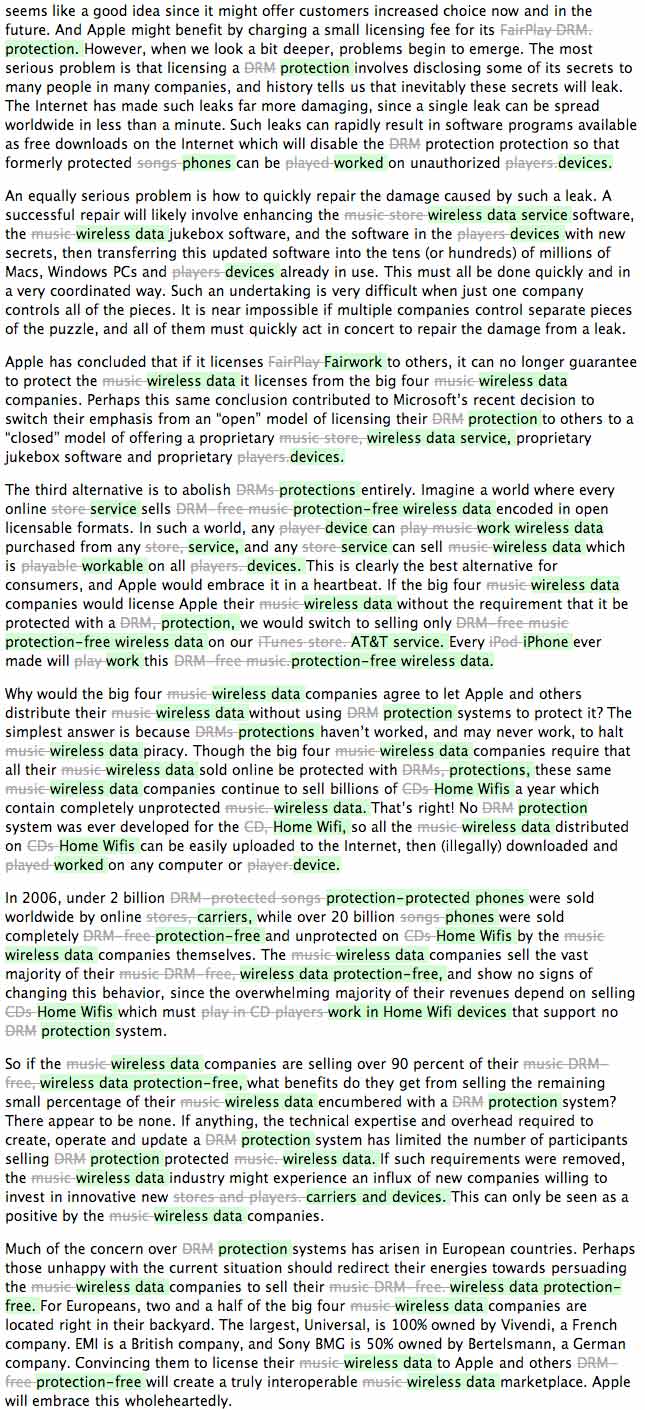
We were Inspired by Steve Wozniak’s comment the other day on Apple’s stance on SIM Locking vs. DRM locking.  We decided to do something about it.  What if we took Apple’s position on DRM for music and applied it to the SIM locking of the iPhone?  Does Apple stand up to its own scrutiny on the locking in of content and services?  For this experiment we did the following: 

  1. We took Steve Jobs Open Letter to the Music industry
  2. Copied it verbatim
  3. Did a Text Edit – Find/Replace on it using the following:
    cd -> Home Wifi
    iPod -> iPhone
    music -> wireless data
    iTunes -> AT&T
    MP3 -> GSM
    AAC -> EDGE
    leak -> hack
    DRM -> SIM lock
    copied -> used
    song -> phone
    Screen
    Capture
  4. Then we cleaned it up and removed iTunes specific data.

Below you will find the results of this experiment.  Notice how just exchanging a few words turns everything around on Apple.

Apple Statement – Steve Jobs -February 6, 2007 9to5Mac Revised Apple Statment for use with iPhones
With the stunning global success of Apple’s iPod music player and iTunes online music store, some have called for Apple to “open” the digital rights management (DRM) system that Apple uses to protect its music against theft, so that music purchased from iTunes can be played on digital devices purchased from other companies, and protected music purchased from other online music stores can play on iPods. Let’s examine the current situation and how we got here, then look at three possible alternatives for the future. With the stunning success of Apple’s iPhone and AT&T wireless data service, some have called for Apple to “open” the SIM Lock system that Apple uses to protect its iPhone from obtaining data purchased from other online wireless data providors so that it can be used on iPhones. Let’s examine the current situation and how we got here, then look at three possible alternatives for the future.
To begin, it is useful to remember that all iPods play music that is free of any DRM and encoded in “open” licensable formats such as MP3 and AAC. iPod users can and do acquire their music from many sources, including CDs they own. Music on CDs can be easily imported into the freely-downloadable iTunes jukebox software which runs on both Macs and Windows PCs, and is automatically encoded into the open AAC or MP3 formats without any DRM. This music can be played on iPods or any other music players that play these open formats. To begin, it is useful to remember that all iPhones can use wireless data that is free of any SIM Lock and encoded in “open” data formats such as GSM and EDGE. iPhone users can and do acquire their wireless data from many sources, including home Wifis they own. Wired data on home Wifis can be easily used to provide downloadable data which runs on both Macs and Windows PCs, and is automatically encoded to support TCP/IP formats without any SIM Lock. This Wifi data can be used on iPhones or any other wireless data devices that use these open formats.
The rub comes from the music Apple sells on its online iTunes Store. Since Apple does not own or control any music itself, it must license the rights to distribute music from others, primarily the “big four” music companies: Universal, Sony BMG, Warner and EMI. These four companies control the distribution of over 70% of the world’s music. When Apple approached these companies to license their music to distribute legally over the Internet, they were extremely cautious and required Apple to protect their music from being illegally copied. The solution was to create a DRM system, which envelopes each song purchased from the iTunes store in special and secret software so that it cannot be played on unauthorized devices. The rub comes from the wireless data Apple sells from AT&T. Since Apple does not own or control any wireless data itself, it must license the rights to distribute wireless data from others, primarily the “big four” wireless data companies. These four companies control the distribution of over 90% of America’s wireless data. When Apple approached these companies to license their wireless data to distribute legally over the Airwaves, they were extremely cautious and required Apple to protect their wireless data from being overly used. The solution was to create a SIM Lock system, which envelopes each phone purchased from the AT&T store in special and secret software so that it cannot be used on other services.
Apple was able to negotiate landmark usage rights at the time, which include allowing users to play their DRM protected music on up to 5 computers and on an unlimited number of iPods. Obtaining such rights from the music companies was unprecedented at the time, and even today is unmatched by most other digital music services. However, a key provision of our agreements with the music companies is that if our DRM system is compromised and their music becomes playable on unauthorized devices, we have only a small number of weeks to fix the problem or they can withdraw their entire music catalog from our iTunes store. Apple was able to negotiate landmark usage rights at the time, which include allowing users to use their SIM Lock protected iPhones to get unlimited wireless data. Obtaining such rights from the wireless data companies was unprecedented at the time, and even today is unmatched by most other digital wireless data services. However, a key provision of our agreements with the wireless data companies is that if our SIM Lock system is compromised and iPhones can use data on unauthorized wireless providors, we have only a small number of weeks to fix the problem or they can withdraw their entire wireless data agreement from our AT&T deal.
To prevent illegal copies, DRM systems must allow only authorized devices to play the protected music. If a copy of a DRM protected song is posted on the Internet, it should not be able to play on a downloader’s computer or portable music device. To achieve this, a DRM system employs secrets. There is no theory of protecting content other than keeping secrets. In other words, even if one uses the most sophisticated cryptographic locks to protect the actual music, one must still “hide” the keys which unlock the music on the user’s computer or portable music player. No one has ever implemented a DRM system that does not depend on such secrets for its operation. To prevent illegal access, SIM Lock systems must allow only authorized devices to use the protected wireless data. If a copy of SIM Lock breaking software is posted on the Internet, it should not be able to used on a downloader’s computer or portable wireless data device. To achieve this, a SIM Lock system employs secrets. There is no theory of protecting content other than keeping secrets. In other words, even if one uses the most sophisticated cryptographic locks to protect the actual wireless data, one must still “hide” the keys which unlock the wireless data on the user’s computer or portable wireless data device. No one has ever implemented a SIM Lock system that does not depend on such secrets for its operation.
The problem, of course, is that there are many smart people in the world, some with a lot of time on their hands, who love to discover such secrets and publish a way for everyone to get free (and stolen) music. They are often successful in doing just that, so any company trying to protect content using a DRM must frequently update it with new and harder to discover secrets. It is a cat-and-mouse game. Apple’s DRM system is called FairPlay. While we have had a few breaches in FairPlay, we have been able to successfully repair them through updating the iTunes store software, the iTunes jukebox software and software in the iPods themselves. So far we have met our commitments to the music companies to protect their music, and we have given users the most liberal usage rights available in the industry for legally downloaded music. The problem, of course, is that there are many smart people in the world, some with a lot of time on their hands, who love to discover such secrets and publish a way for everyone to get unlock the wireless data source access. They are often successful in doing just that, so any company trying to protect content using a SIM Lock must frequently update it with new and harder to discover secrets. It is a cat-and-mouse game. Apple’s SIM Lock system is called iPhone Updates. While we have had a few breaches in iPhone Updates, we have been able to successfully repair them through updating the AT&T SIM lock, the iTunes software and software in the iPhones themselves. So far we have met our commitments to the wireless data companies to protect their wireless data, and we have given users the most liberal usage rights available in the industry.
With this background, let’s now explore three different alternatives for the future. With this background, let’s now explore three different alternatives for the future.
The first alternative is to continue on the current course, with each manufacturer competing freely with their own “top to bottom” proprietary systems for selling, playing and protecting music. It is a very competitive market, with major global companies making large investments to develop new music players and online music stores. Apple, Microsoft and Sony all compete with proprietary systems. Music purchased from Microsoft’s Zune store will only play on Zune players; music purchased from Sony’s Connect store will only play on Sony’s players; and music purchased from Apple’s iTunes store will only play on iPods. This is the current state of affairs in the industry, and customers are being well served with a continuing stream of innovative products and a wide variety of choices. The first alternative is to continue on the current course, with each manufacturer competing freely with their own “top to bottom” proprietary systems for selling, playing and protecting wireless data. It is a very competitive market, with major global companies making large investments to develop new wireless data devices and online wireless data stores. Apple, Microsoft and Sony all compete with proprietary phone OS’s. Wireless data purchased for Microsoft’s WM6 devices will only used on WM6 devices; wireless data purchased from Sony’s Symbian devices will only be used on Sony’s devices; and wireless data purchased from Apple’s AT&T store will only useon iPhones. This is the current state of affairs in the industry, and customers are being well served with a continuing stream of innovative products and a wide variety of choices.
Some have argued that once a consumer purchases a body of music from one of the proprietary music stores, they are forever locked into only using music players from that one company. Or, if they buy a specific player, they are locked into buying music only from that company’s music store. Is this true? Let’s look at the data for iPods and the iTunes store – they are the industry’s most popular products and we have accurate data for them. Through the end of 2006, customers purchased a total of 90 million iPods and 2 billion songs from the iTunes store. On average, that’s 22 songs purchased from the iTunes store for each iPod ever sold. Some have argued that once a consumer purchases a wireless data contract from one of the proprietary wireless data stores, they are forever locked into only using wireless data devices from that one company. Or, if they buy a specific device, they are locked into buying wireless data only from that company’s wireless data store. Is this true? Let’s look at the data for iPhones and the AT&T store – they are the industry’s most popular products and we have accurate data for them. Through the end of 2007, customers purchased a total of 1.5 million iPhones.
Today’s most popular iPod holds 1000 songs, and research tells us that the average iPod is nearly full. This means that only 22 out of 1000 songs, or under 3% of the music on the average iPod, is purchased from the iTunes store and protected with a DRM. The remaining 97% of the music is unprotected and playable on any player that can play the open formats. It’s hard to believe that just 3% of the music on the average iPod is enough to lock users into buying only iPods in the future. And since 97% of the music on the average iPod was not purchased from the iTunes store, iPod users are clearly not locked into the iTunes store to acquire their music. And since 97% of the wireless data on the average iPhone was not purchased from the AT&T wireless, iPhone users are clearly not locked into the AT&T wireless to acquire their wireless data.
The second alternative is for Apple to license its FairPlay DRM technology to current and future competitors with the goal of achieving interoperability between different company’s players and music stores. On the surface, this seems like a good idea since it might offer customers increased choice now and in the future. And Apple might benefit by charging a small licensing fee for its FairPlay DRM. However, when we look a bit deeper, problems begin to emerge. The most serious problem is that licensing a DRM involves disclosing some of its secrets to many people in many companies, and history tells us that inevitably these secrets will leak. The Internet has made such leaks far more damaging, since a single leak can be spread worldwide in less than a minute. Such leaks can rapidly result in software programs available as free downloads on the Internet which will disable the DRM protection so that formerly protected songs can be played on unauthorized players. The second alternative is for Apple to license its SIM Lock technology to current and future competitors with the goal of achieving interoperability between different company’s devices and wireless data stores. On the surface, this seems like a good idea since it might offer customers increased choice now and in the future. And Apple might benefit by charging a small licensing fee for its SIM Lock. However, when we look a bit deeper, problems begin to emerge. The most serious problem is that licensing a SIM Lock involves disclosing some of its secrets to many people in many companies, and history tells us that inevitably these secrets will get hacked. The Internet has made such hacks far more damaging, since a single hack can be spread worldwide in less than a minute. Such hacks can rapidly result in software programs available as free downloads on the Internet which will disable the SIM Lock protection so that formerly protected phones can get unauthorized data.
An equally serious problem is how to quickly repair the damage caused by such a leak. A successful repair will likely involve enhancing the music store software, the music jukebox software, and the software in the players with new secrets, then transferring this updated software into the tens (or hundreds) of millions of Macs, Windows PCs and players already in use. This must all be done quickly and in a very coordinated way. Such an undertaking is very difficult when just one company controls all of the pieces. It is near impossible if multiple companies control separate pieces of the puzzle, and all of them must quickly act in concert to repair the damage from a leak. An equally serious problem is how to quickly repair the damage caused by such a hack. A successful repair will likely involve enhancing the wireless data software, the itunes software, and the software in the devices with new secrets, then transferring this updated software into the tens (or hundreds) of millions of Macs, Windows PCs and devices already in use. This must all be done quickly and in a very coordinated way. Such an undertaking is very difficult when just one company controls all of the pieces. It is near impossible if multiple companies control separate pieces of the puzzle, and all of them must quickly act in concert to repair the damage from a hack.
Apple has concluded that if it licenses FairPlay to others, it can no longer guarantee to protect the music it licenses from the big four music companies. Perhaps this same conclusion contributed to Microsoft’s recent decision to switch their emphasis from an “open” model of licensing their DRM to others to a “closed” model of offering a proprietary music store, proprietary jukebox software and proprietary players. Apple has concluded that if it licenses Sim lock others, it can no longer guarantee to protect the wireless data it licenses from the big four wireless data companies. Perhaps this same conclusion contributed to Microsoft’s recent decision to switch their emphasis from an “open” model of licensing their SIM Lock to others to a “closed” model of offering a proprietary wireless data store, proprietary jukebox software and proprietary devices.
The third alternative is to abolish DRMs entirely. Imagine a world where every online store sells DRM-free music encoded in open licensable formats. In such a world, any player can play music purchased from any store, and any store can sell music which is playable on all players. This is clearly the best alternative for consumers, and Apple would embrace it in a heartbeat. If the big four music companies would license Apple their music without the requirement that it be protected with a DRM, we would switch to selling only DRM-free music on our iTunes store. Every iPod ever made will play this DRM-free music. The third alternative is to abolish SIM Locks entirely. Imagine a world where every online store sells SIM Lock-free wireless data encoded in open licensable formats. In such a world, any device can use wireless data purchased from any carrier, and any carrier can sell wireless data which is usable on all devices. This is clearly the best alternative for consumers, and Apple would embrace it in a heartbeat. If the big four wireless data companies would license Apple their wireless data without the requirement that it be protected with a SIM Lock, we would switch to selling only SIM Lock-free wireless data on our iPhones. Every iPhone ever made will use this SIM Lock-free wireless data.
Why would the big four music companies agree to let Apple and others distribute their music without using DRM systems to protect it? The simplest answer is because DRMs haven’t worked, and may never work, to halt music piracy. Though the big four music companies require that all their music sold online be protected with DRMs, these same music companies continue to sell billions of CDs a year which contain completely unprotected music. That’s right! No DRM system was ever developed for the CD, so all the music distributed on CDs can be easily uploaded to the Internet, then (illegally) downloaded and played on any computer or player. Why would the big four wireless data companies agree to let Apple and others distribute their wireless data without using SIM Lock systems to protect it? The simplest answer is because SIM Locks haven’t worked, and may never work, to halt wireless data piracy. Though the big four wireless data companies require that all their wireless data sold online be protected with SIM Locks, ISPs continue to sell billions of home Wifis a year which contain completely unprotected wireless data. That’s right! No SIM Lock system was ever developed for the home Wifi, so all the wireless data distributed on home Wifis can be easily be used on any computer or device.
In 2006, under 2 billion DRM-protected songs were sold worldwide by online stores, while over 20 billion songs were sold completely DRM-free and unprotected on CDs by the music companies themselves. The music companies sell the vast majority of their music DRM-free, and show no signs of changing this behavior, since the overwhelming majority of their revenues depend on selling CDs which must play in CD players that support no DRM system. The ISPs sell the vast majority of their wireless data SIM Lock-free, and show no signs of changing this behavior, since the overwhelming majority of their revenues depend on selling home Wifis which must usein home Wifi devices that support no SIM Lock system.
So if the music companies are selling over 90 percent of their music DRM-free, what benefits do they get from selling the remaining small percentage of their music encumbered with a DRM system? There appear to be none. If anything, the technical expertise and overhead required to create, operate and update a DRM system has limited the number of participants selling DRM protected music. If such requirements were removed, the music industry might experience an influx of new companies willing to invest in innovative new stores and players. This can only be seen as a positive by the music companies. So if the wireless data companies are selling over 90 percent of their wireless data SIM Lock-free, what benefits do they get from selling the remaining small percentage of their wireless data encumbered with a SIM Lock system? There appear to be none. If anything, the technical expertise and overhead required to create, operate and update a SIM Lock system has limited the number of participants selling SIM Lock protected wireless data. If such requirements were removed, the wireless data industry might experience an influx of new companies willing to invest in innovative new stores and devices. This can only be seen as a positive by the wireless data companies.
Much of the concern over DRM systems has arisen in European countries. Perhaps those unhappy with the current situation should redirect their energies towards persuading the music companies to sell their music DRM-free. For Europeans, two and a half of the big four music companies are located right in their backyard. The largest, Universal, is 100% owned by Vivendi, a French company. EMI is a British company, and Sony BMG is 50% owned by Bertelsmann, a German company. Convincing them to license their music to Apple and others DRM-free will create a truly interoperable music marketplace. Apple will embrace this wholeheartedly. Much of the concern over SIM Lock systems has arisen in European countries. Perhaps those unhappy with the current situation should redirect their energies towards persuading the wireless data companies to sell their wireless data SIM Lock-free. Convincing companies to license their wireless data to Apple and others SIM Lock-free will create a truly interoperable wireless data marketplace. Apple will embrace this wholeheartedly.
   

Macintosh OS Virtualization right around the corner?

Site default logo image

Tidbits is reporting that the new license agreement with MacOSX Leopard SERVER allows for Virtualization of the MacOS

From the Leopard Server License:

This License allows you to install and use one copy of the Mac OS X Server software (the "Mac OS X Server Software") on a single Apple-labeled computer. You may also install and use other copies of Mac OS X Server Software on the same Apple-labeled computer, provided that you acquire an individual and valid license from Apple for each of these other copies of Mac OS X Server Software.

While this change only applies to Leopard Server, the implications are that it will be easily possible for the 10.5 client OSX to run as well.  Paralles and VMware are the two main vendors of virtualization solutions on the Mac platform and are both involved in this new development.  While Parallels market is mostly Macintosh machines, VMWare also runs on Windows or Linux. 

More from Tidbits who got a chance to talk to people at Parallels and VMWare:

Ben Rudolph, Director of Corporate Communications for Parallels, told me, "Enabling Leopard Server to run in a virtual machine may take some time, but we’re working closely with Apple on it and will make it public as quickly as possible."

Pat Lee, Senior Product Manager at VMware, concurred, saying "We applaud Apple for the exciting licensing changes implemented in Leopard Server. Apple customers can now run Mac OS X Server, Windows, Linux and other x86 operating systems simultaneously on Apple hardware so we are excited about the possibilities this change presents."

Virtualization is not only hot on the Mac platform for running Windows and Linux, it is also blowing up in the Enterprise.  In fact, many enterprise software vendors are turning out their products as virtual machine images instead of software that runs on an operating system.  This way the vendor has more control of the operating environment and has less to worry about in terms of incompatibility with hardware or other installed applications on the machine.

Rogue copies of OSX tiger have been running on VMWare for awhile but because most of the drivers are unsupported and not optimized, it is a dog on performance.  An Apple blessed and supported version of this would allow a huge leap forward in speed ad performance.  It would also mark a big change of direction for the company who has always had a zero tollerance policy for Virtualizing OSX.

And of course, the next logical step – Apple sanctioned Leopard Virtual Machines able to run on any Intel hardware.  Will we see Leopard Client running on PCs anytime soon?  The next step in that evolution has just been taken.

Apple "Analysts" don't seem to be very good

Site default logo image

So doing the last post, we had to do some research on Shaw Wu an Analyst for American Technology Research who had made a bad call on the numbers of iPhone unlocking. Thankfully, MacRumors has put together a list of Shaw’s predictions and their subsequent  "truthieness".  He’s riding about 15% correct…which is like picking horses at the track based on their names.   Given all of this, he has a 4/5 star rating from Yahoo and many people make investment decisions based on his guidance.   Some of the better ones (from Macrumors):

  • Bigger monitors or TV sets are pending: "We are not certain on timing but our analysis indicates that AAPL is beyond prototype on large-screen technologies". [1] Status: unknown. 
  • A second Apple phone with "iChat mobile" instant messaging is in the works, timetable unknown. [2] [3] Status: unknown. 
  • Apple seriously considering $50-$150 rebate on iPhone. [4] Status: False – no rebates came with the iPhone introduction.
  • "Our sources indicate that Apple’s latest [Leopard] beta build has made noticeable improvements in stability and functionality from previous builds and that Apple is likely one or two upcoming builds away from reaching ‘final candidate’ stage to be released for manufacturing." [5] Status: False – Apple delayed Leopard until October.
  • An Apple cell phone is coming, as all the pieces are in place for it. Quoted as saying "The design will be an iPod nano-like candy bar form factor and come in three colors ." to AppleInsider [6] [7] Status: False – while it is a candy bar, the product does not resemble the nano and no case options are offered.
  • Claims more Motorola iTunes phones will come. Status: False – With the introduction of the [iPhone], additional Motorola-based iTunes phones are highly doubtful. June 2006
  • iPod nanos will be given a magnesium enclosure, and are expected by October 2006.
  • …and of course iphone hacking…"immaterial," representing "only a small group of users, namely hackers."

Its unfair to call out just Shaw.  Looking at the list of Analysts for someone who might have a clue yields very little.  Even Gene Munster (Piper Jaffray) whose full time job (and huge budget and crew of at least 4) it is to gather information on what Apple is up to, is not even 33% right.  Even worse, most of his "correct" "information" is weeks behind some of the better Apple blogs – like Appleinsider, Ars Technica, and MacRumors.   Heck, we even call a thing or two right once in awhile.  His numbers for the iPhone sales were way too optimistic – all of the smarter blogs knew that (Gizmodo, Engadget, etc.).

These are the same guys at the Apple sales calls that ask the same stupid, meaningless questions when given the chance to get information out of Apple.  For instance, Apple almost showed it’s hand in regards to the AT&T kickback pricing.  They stated that:

Total revenue recognized during the quarter from sales of iPhones, iPhone accessories, and payments from AT&T was $118 million.

Damn!  You know the price of the iPhone (generally).  You know the amount they sold.  They are giving you two more variables and a sum.  ASK HOW MUCH REVENUE FROM IPHONE ACCESSORIES!  It is on a piece of paper right in front of them.  If they give that you you, you know the AT&T kickback amount.

Nope.  Nothing.  Wasn’t someone taking notes?  So we are still guessing.

These "analysts" who work for huge Wall St. firms have huge budgets to do large amounts of research, take polls, time/ travel money to network with Apple employees, suppiers and contacts, yet can’t come up with one bit of credible information.  Nearly all of them strike out all of the time.  It is uncanny.

Of course these guys have been at B-Schools and investment banks behind IBM Thinkpads their whole life, listen to music on the Hifi, not over wifi and have absolutely no idea about anything related to the Mac culture. 

They also tend to give broad generalizations like one of Gene Munster’s latest:

Billing the subject its "Hot Topic of the Month," investment bank Piper Jaffray said Monday it believes there’s a "high" likelihood Apple will announce an ultra-portable Mac sometime in the next 4 to 6 months.

"The move could take place in the form of an smaller laptop and/or a tablet device using the iPhone’s multi-touch technology," Sr. Analyst Gene Munster explained in a report issued to client investors. "Although we do not have firm evidence, either product would be a strategic extension of Apple’s current technology base."

So basically Apple MIGHT release a device between a macbook and iPhone in size within a half year.  That’s pretty bold.  How could they not?

Also, there is the case of Scott Moritz from TheStreet who basically read recent blog intel verbatim and blindly guessed that new Macbooks would be released next week (don’t worry they are still coming).  Many people think that Scott and others at TheStreet are shorting Apple stock and making quick cash on their public rumor-mongering.  So much for TheStreet cred.

So the point we are trying to make here is this:  Hire us!  We’ll give you much better info than your current analysts.  If not that’s cool, keep visiting our website.  We might throw a few Google ads your way but at least you know we aren’t shorting Apple and trying to make a quick buck off of investor ignorance.


Jobs drops hints on NYTimes

Site default logo image

The NY Times has a great piece on all things Apple and got a gold nugget of information from Mr. Jobs about upcoming devices:

Indeed, many of the new features in the Leopard operating system version are incremental improvements. But Mr. Jobs said he was struck by the success of the multitouch interface that is at the heart of the iPhone version of the OS X. This allows a user to touch the screen at more than one point to zoom in on a portion of a photo, for example.

“People don’t understand that we’ve invented a new class of interface,” he said.

He contrasted it with stylus interfaces, like the approach Microsoft took with its tablet computer. That interface is not so different from what most computers have been using since the mid-1980s.

In contrast, Mr. Jobs said that multitouch drastically simplified the process of controlling a computer.

There are no “verbs” in the iPhone interface, he said, alluding to the way a standard mouse or stylus system works. In those systems, users select an object, like a photo, and then separately select an action, or “verb,” to do something to it.

This actually jibes with what we’ve been hearing about upcoming devices.  Multitouch. Multitouch. Multitouch.

Mobile Micro Wifi Router

Site default logo image

Just a random observation here but I can’t help myself. Why in the world doesn’t some company come out with a PAN (Personal Area Network) device that turns 3G wireless to Wifi? Something that would take a mobile signal and turn it into a very low powered (enough for maybe 6 foot radius) Wifi zone for all of my devices.  

It doesn’t have to be 802.11G or N – it could be the incredibly low powered 802.11b electronics that are pervasive in super-small mobile phones like the iPhone.  The bottleneck in speed isn’t going to be the Wifi.  At least not this year.  Cost-wise, an unlimited data plan is about $80/month these days.  I can handle that.

Think of it.  You get to use all of your wifi devices, computer, cell phone, tablet etc anywhere you go.  It is always on and is very small.   It would only sign on when you tried to access the net and could have different levels of security to protect you from getting hacked.

Who could make such a device?  Novatel would be a good candidate as the make a great deal of SIM Card wireless devices.  So could Nokia or any of the other handset providers.  In fact, they could make one out of the N95 and throw in GPS to boot.  The hardware is there.  Just write the software.

Larger variants like Junxion boxes already exist and the even less expensive DLink variant can be had for under $200.  You can technically make one out of a Sony UX series or OQO device but thats overkill and still too big and too little battery.

But there is no reason why these things can’t be made way way smaller.  Perhaps the size of a deck of cards.  About 1/2 of that deck of cards is battery which should last 24 hours.  If you need more, you get an extended battery that is another deck of cards in size.  Now you have a whole 3 day weekend worth of broadband network in your pocket.  Or your briefcase or car or whatever.

Then you can start adding things like (SAN) memory, GPS receiver and bluetooth.  All things you don’t need in your hand – things you can leave in your briefcase.  The new hand gadgets (like iPhone) would pick up on this  device and use it for all kinds of fun stuff.  You could even share it with your friends and colleagues.

With VOIP, the traditional telecoms are all but dead in terms of phone service.  Skype, SIP variants and Vonage could all use this device to have an always on mobile phone.  The telecoms could focus on their strong points – delivering packets quickly, efficiently and everywhere.

This device that doesn’t exist?  It will.  The future will be begging for them.

btw – I hope I am wrong and something like this already exists.  If so, please point me to it so I can join the future.

Update: Cradle has answered our prayers

Techmeme Leaderboard

Site default logo image

Techmeme has released their latest Leaderboard. It ranks the top 100 most influential technology blogs/websites. Obviously all things of this nature are biased in one way or another but most of our favorites sites are on there – including our VERY favorite coming in at #73.

Check it out. There is a wealth of information even if it is just to pop into your feedreader.

Will Apple Soon be Forced to Unbrick All iPhones?

Site default logo image

As the current iPhone 1.1.1 locking proves, there is a VERY dangerous flaw in the current iPhone and iPod touch software. A malformed TIF file can be used to get root access to the device. Obviously that is good if you want to install some useful applications on your iPhone/iPod, however that is extremely bad if you are worried about someone taking over your iPhone. Ironically, this might be a good thing for those who accidentally let Apple Brick their iPhones – try to stay with us here…

Theoretically, the malformed TIF file could be used for more nefarious tasks than updating than installing useful apps or updating the modems firmware…stuff like making a 900-number dialer($$ cha – ching $$), a bot installer (iPhone Spam-bot?), a baseband modem crippler or just good old-fashioned bricking the iPhone….

Hypothetically, one of these malformed tif files could even have the same effect as the “bricker” 1.1.1 update. However, this time Apple’s Safari security will be to blame, not the users who are trying to assert their legal right to move the phone to other carriers. The only recourse Apple will legally have is to unBrick all of the iPhones that their update has caused and reset the baseband modem to factor settings.

One has to wonder if the malformed tif file vulnerability would have been discovered and applied to the iPhone had Apple not closed the Intaller.app development community out of the iPhone originally. Perhaps it is better to have these incredibly intelligent people on your side?

iPhone version 1.1.1 vs. Hacked Version

Site default logo image

Apple, as expected released the iPhone 1.1.1 software update today.   Initial reactions are that it breaks the anySIM hack and Installer.app so this is a one way street.  We know it is tempting to hit the red button and download and install but hold on just one second while we let you take a gander at the pluses and minuses.

Listed on the 1.1.1 updates page is the following: 

  • iTunes Wi-Fi Music Store;
  • Louder speakerphone and receiver volume 
  • Home Button double-click shortcut to phone favorites of music controls 
  • Space bar double-tap shortcut to intelligently insert period and space 
  • Mail attachments are viewable in portrait and landscape 
  • Stocks and cities in Stocks and Weather can be re-ordered 
  • Apple Bluetooth Headset battery status in the Status Bar 
  • Support for TV Out 
  • Preference to turn off EDGE/GPRS when roaming internationally 
  • New Passcode lock time intervals 
  • Adjustable alert volume

Not bad for a incremental update but nothing earth shattering.  We think Apple could have called this 1.0.3 but when you juxtapose (triple word score) these features with what you get in the 1.0.2 HACK version you may want to pause..at least until everything becomes clearer..

Read on for the full comparison between the two OS’s.

iPhone Features per software version

Apple+hackers 1.0.2HAX Apple 1.1.1
Phone Carriers? Any GSM Providor in the World including AT&T and TMobile in the US AT&T ONLY
Roaming? Just stick in a SIM card from the country you go to to get local rates. Insane roaming rates BUT you can turn off EDGE
Instant Messaging Apollo AOL IM and MSN(Yahoo), Jabber(GoogleTalk) Coming No
Games Any NES or Mame (1000’s) plus 100s of other native apps like iPhoneDoom. Online web games like Scrabble Online web games like Scrabble
RSS yes native app or Google Reader Google reader
Terminal app? Yes No
Remote Desktop? Yes (VNSea) No
GPS? Soft GPS by Navizon – not quite as accurate as real GPS but faster No
Voice Recorder? Yes No
Offline Dictionaries and references Dozens No
IRC client Yes No
eBook Reader? Yes No
send songs and full res picts via email? Yes No
Ability to delete menu items Yes No
Ability to browse iPhone’s File system Yes No
Full iTunes integration for Music, TV Shows Movies Audiobooks Yes Yes
Ringtones? Free $.99/ea after you buy the song
Mobile Music store? Amazon DRM Free coming iTunes

EDIT: ActuallyWired’s excellent artists have made a mockery of our HTML Table skillz and put up a much better graphic.  Check it:

What is Santamonica.corp.apple.com?

Site default logo image

Every once in awhile we like to go through our logs here and see where our traffic is coming from.  Ususally it is the same sites but sometimes we stumble upon something interesting.

A few months ago, we noticed we were getting a lot of traffic from “santamonica.corp.apple.com”.  At the time, I did a Google search and noticed nothing came up.  Strange.   One would think it would come up in someone’s logs out there somewhere or some webmaster would come across it somehow.   Recently it has come up again a few times.

We then checked DNS and found that there was no name resolution for this particular site from Apple’s domain servers.  Specifically We got this error:

[ERROR: The parent servers say that the domain santamonica.corp.apple.com does not have any NS records (although they may have some other information on that zone). We can not do a DNS report on a hostname (such as mail.example.com) or a domain name that does not have its own zone.]

We get a lot of hits from the 17.x.x.x namespace (Apple’s Own Class A Subnet) and we pay particular attention to where they go on the site – especially how they vote on the polls ;-)

So the question begs to be asked: What is santamonica.corp.apple.com?  Our guess is that it is some sort of internal Intranet that get’s loaded with Apple news around the web.  It could also be an internal webmail system where people get emails to sites and click directly from their browser.  It might also be a web based news reader in beta?

Anyone have any ideas?

Edit: One of our sources thinks that it is an internal Apple Press Intranet site that pulls the digg.com/apple RSS feeds (amongst many others).  Still…interesting. Why “santamonica”? Apple doesn’t have any big offices there?  And if they did do they have a webserver that links to us?

Also a commenter points out that santamonica.corp.yahoo.com DOES get a lot of hits on Google….perhaps Yahoo has built this Intranet?

How Come No One Noticed There Was No Mention of DVD in the New MacBook?

Site default logo image

So when we got the news from Cleve and his source about the new laptops, the first thing we asked ourselves was how is Apple going to  squeeze all of the laptop internals into such a thin Package?  Battery optimization?  Couldn’t hurt.  Making the boot drive into NAND RAM?  Possible but still very expensive.  Motherboard optimization?  Yeah sure but you can only save so much space doing that.  Then it hit us: was the MacBook DVD going the way of the dodo?

When you consider the facts, it is a no-brainer.  What is the largest  part of the internals of a laptop and at the same time (as trends go) is used less and less – not to mention its status as a powerhog.  What could the average laptop certainly do without on a daily basis?  Without a doubt, it is the DVD player.  Why? 

  • Optical disks are used infrequently for software installs because of speedy (and frequently updated) Internet software downloads  
  • Huge USB sticks replace the need for offline storage
  • Online backup systems replace needs for DVD-R backups
  • Music and video are downloaded far more over the Internet than put on DVD and CD anymore (you think Apple and any interest in this?!)

If Apple takes this route, likely expect the laptops to be bundled with external bus-powered Firewire or USB DVD drives to compliment the package and do software reinstalls.  Either that or huge thumb drives!

Edit: We are getting a lot of comments with people screaming “what about huge software installs!” or “What about ripping music/Movies” or “I am a photographer and I need it to burn DVDs for my clients!!”
Read the post. The scenario we’ve put forth calls for an EXTERNAL DVD drive. IF you need it, take it with you!
Plus Apple will probably do it up in a fresh, unique way like magnetized to the back of your screen or a lanyard around your neck.

Take that Flavor Flav!!