
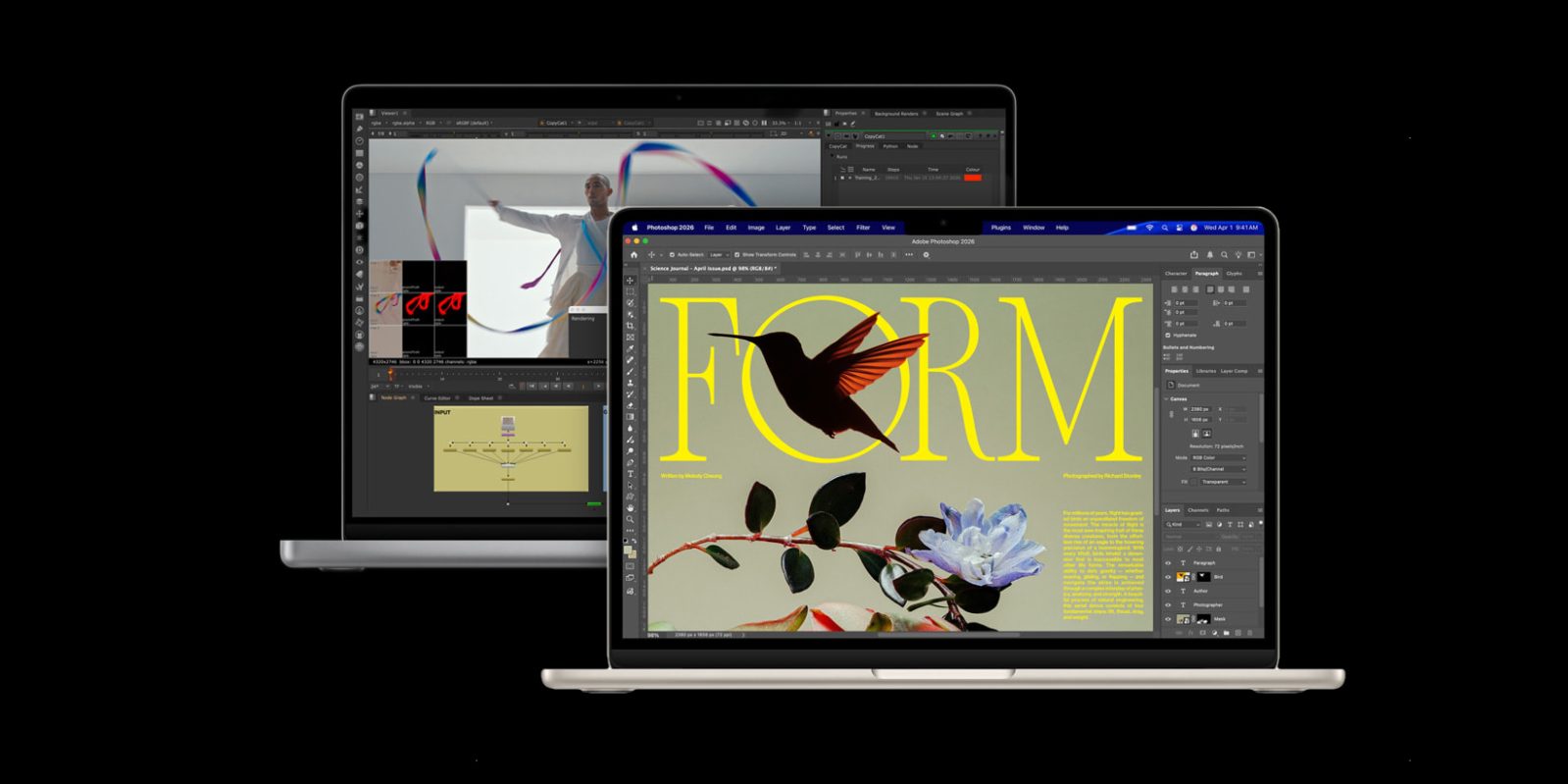
Apple just launched the new generation MacBook Air and MacBook Pro, which was an opportunity for the company to give us some insight into how the recent surges in memory, storage and other PC components are impacting its pricing.
The answer is somewhere in the middle. The entry price into the Air and Pro has been bumped up, but the much-feared jump in RAM upgrade pricing did not happen. RAM costs for consumers remain the same …
In detail, the new MacBook Air with M5 starts at $1099. This a $100 increase compared to the outgoing M4 MacBook Air, which held the $999 price point. One mitigating factor is that starting storage is now doubled, so you get 512 GB rather than 256 GB as standard. On a like-for-like basis, that means the price compare is the same, but of course the bar for entry has increased all the same.
It’s a similar story with the MacBook Pro. The lowest-end 14-inch MacBook Pro with M5 Pro chip starts at $2199, compared to $1999 for its M4 Pro counterpart. But again, you get 1 TB storage instead of 512 GB, so that $200 jump is somewhat offset.
In both cases, buyers wanting to upgrade to higher RAM configurations will not see a sticker shock, or at least not any more so than they did with the M4 generation. This is because Apple has kept the RAM upgrade costs the same. Going from 24 GB to 48 GB on the 14-inch is a $400 upgrade, the same as the previous gen.
Similarly, the jump from 48 GB to 64 GB is $200 more, and going to 128 GB is $1000 more. These RAM options are only available with the higher end CPU config. This is the exact same pricing matrix as the M4 Pro series.
Simultaneously, Apple has also done the same trick with the M5 MacBook Pro, a product that debuted in October 2025. The original 512 GB $1499 base model is no longer available. Instead, the M5 MacBook Pro starts at $1699 with 1 TB storage.
Overall, the fear-mongering that MacBook prices was about to skyrocket has not really come to pass. It costs $100-$200 more to get the base MacBook model now, but if you were planning on upgrading the storage anyway, the pricing works out even. And RAM upgrades do not cost anymore than they did before.
It probably helps that Apple’s RAM pricing was so extraordinarily high initially, that despite recent increases in component costs, Apple still has sufficient margin to eat these incremental costs. Fast forward to the present and Apple’s RAM pricing actually looks reasonable; it has stayed constant while the rest of the market has had to increase prices by two or three times over the course of the last year.


FTC: We use income earning auto affiliate links. More.


Comments