Author

Avatar for 9to5 Staff

9to5 Staff

Apple defines gravitas, owns location data on iOS (so long Google)

Site default logo image

Here’s hugely interesting: seems that in April, Apple dumped its previous location service partners, Google and Skyhook, preferring instead to use its own location databases.

Now, if you think about it, these databases must constitute at least in part some of the intellectual property Apple acquired with its Quattro purchase. That naturally boosted by iTunes and iPhone data gathering.

Apple’s move to control its own harvest of location-based data makes complete sense too from the pov of a company tryiung to get iAds off the ground.

In a letter from Apple’s chief legal beagle, Bruce Sewell, AAPL confirmed the changes (kudos to TechCrunch).

To provide the high quality products and services that its customers demand, Apple must have access to comprehensive location-based information. For devices running iPhone OS versions 1.1.3 to 3.1, Apple relied on (and still relies on) databases maintained by Google and Skyhook Wireless (

French carrier SFR warn users that iOS4 'significantly slows down' older iPhones?

Site default logo image

iPhone headaches continue, this time French carrier, SFR, is warning iPhone 3G users that iOS 4 significantly slows down their device, while Apple promises to fix the speed flaw and potential fixes emerges from out of the chatter.

SFR Info: updating of the iPhone 3G to software slows significantly iOS 4 navigation menus. Any update is irreversible.
This information concerns only the iPhone 3G and not the iPhone 3G.

In brief: story is that 3G and 3GS iPhone owners have seen their device speed slow considerably on upgrading to iOS 4. Apple is preparing a patch for this...

Various tip sites say to clean out the Spotlight options, but according to our commentors, that doesn’t work so well.  Others have had luck with Hard Resets every few days.

Apple's white iPhone light leak is another nightmare

Site default logo image

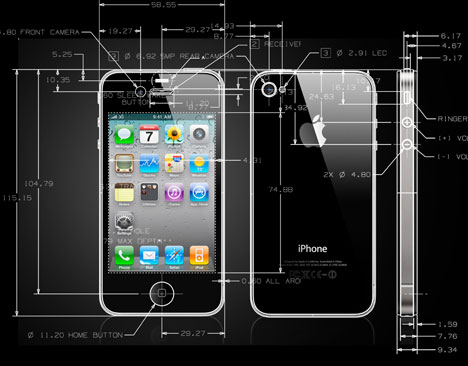
Delays delivering those white iPhone 4 models may be related to light leakage problems, according to Scott Moritz at The Street.

Apparently, the back light from the iPhone display screen is leaking out around the edges of the glass and seeping through the back of the white phone, according to a person familiar with the manufacturing process,” he writes.

Apple last week said the white models were proving to be, “more challenging to manufacture than we originally expected.”

The Street continues to tell us that Apple’s iPhone 4 is made like a “glass sandwich”. The company uses Corning’s Gorilla glass on the front and back of the iPhone and there’s that metal antenna (shhh) running around the outside.

But the light leakage problem is a biggie. “As the source described it, if it were a metal or plastic material, a simple coating would fill in the gaps and block the internal light. Glass is an entirely different issue.”

I’ve a feeling about this….

iPad: Apple's missing links

Site default logo image

The iPad is everything I actually enjoy doing on my computer, boosted by apps which do more than I ever could have done. The iPad really does seem able to do anything, but there’s some features it really is missing. I pick three. And dream up solutions to each one.

read more

Motorola lays the smackdown on Apple with Droid X ad attack

Site default logo image

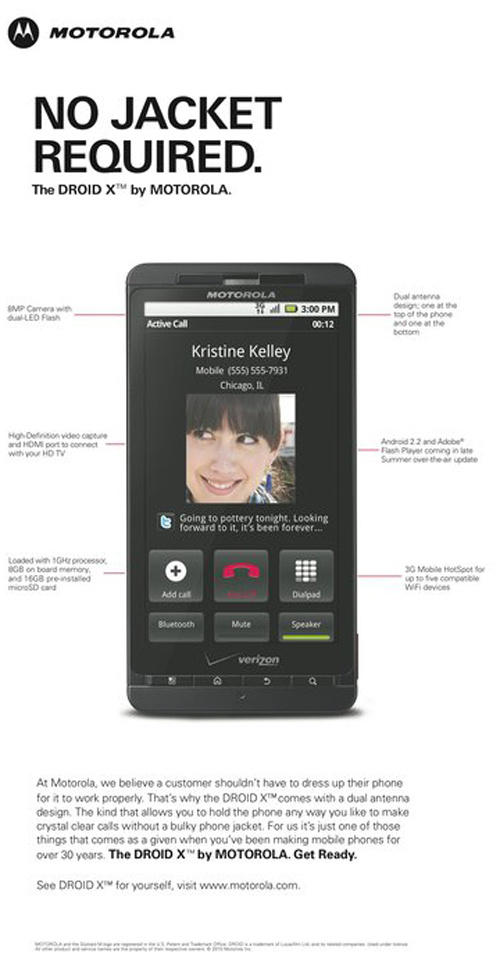
Motorola has got deeply personal within its latest Droid X ad in the New York Times this morning, laying the smack down against Apple and antennagate with the slogan, “No jacket required” (above).


“At Motorola, we believe a customer shouldn’t have to dress up their phone for it to work properly. That’s why the DROID X comes with a dual antenna design. The kind that allows you to hold the phone any way you like to make crystal clear calls without a bulky phone jacket. For us it’s just one of those things that comes as a given when you’ve been making mobile phones for over 30 years.”


Apple updates Safari, switches on Extensions site, patches Address Book bug

Site default logo image

Apple today introduced Safari 5.0.1, the latest version of its browser which introduces the Safari Extensions Gallery. (Oh look, Google, Bling is among the highlighted extensions, there’s a big surprise!) The release also patches last week’s nasty Address Book bug.

(Which likely puts paid to the short career of Safariextensions.org).

Apple introduced extensions support in Safari 5 in June so developers could begin creating extensions with HTML5, CSS3 and JavaScript web standards.

Safari Extensions Gallery lets users find the extensions they want, from toolbars that display live web feeds to sophisticated programmes that filter web content.

Apple partner Foxconn now making half the world's output of OEM electronics devices

Site default logo image

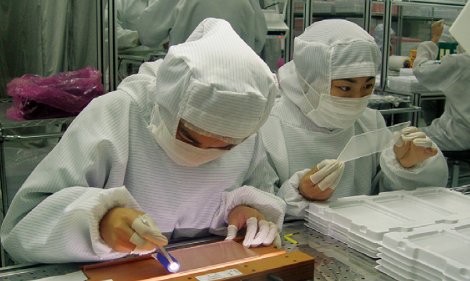
Apple’s position as the world’s leading computing device company has driven manufacturing partner, Foxconn, to seize an astonishing 50 per cent of the world’s electronic manufacturing services market, said iSuppli today. Half of the world’s production of consumer electronics devices come from a Foxconn factory, with Apple’s production demand driving this record, iSuppli explains. This is now an Apple world.

“Foxconn’s customers are some of the hottest companies in the electronics business today, most notably Apple,” said Thomas Dinges, iSuppli associate. “As Apple and others have gained share, so has Foxconn.”

With revenue of $17.1 billion, Taiwan’s Foxconn, aka Hon Hai Precision Industries, was the dominant EMS provider in the first quarter of 2010, dwarfing No. 2 player Flextronics International, which posted revenue of $5.9 billion during the same period. Apple represents the fastest-growing customer for Foxconn, which manufactures products including the iPad and the iPhone 4.

iSuppli last week noted that Apple had issued increased production targets for the iPad to its Asian suppliers. iSuppli now predicts Apple will ship 12.9 million iPads in 2010, an amount that will nearly triple to reach 36.5 million in 2011.

Meanwhile, global iPhone shipments are expected to rise to 53.5 million in 2011, more than double the 25.1 million in 2009.

By 2011, Apple will become the world’s second-largest purchaser of semiconductors through direct and indirect channels.

Your iPod touch becomes a call-anywhere phone thanks to the Apple Peel 520!

Site default logo image

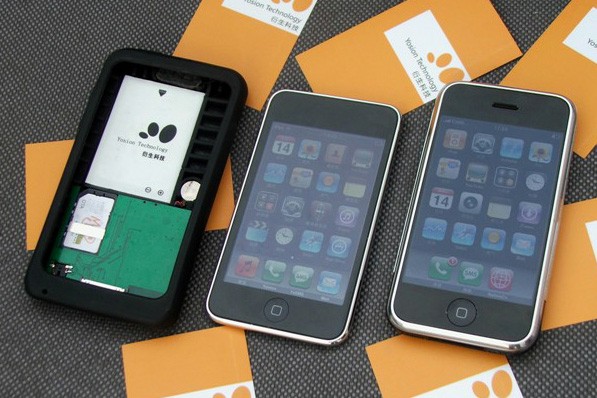
Got an iPod touch and want to turn it into a phone? No problem (perhaps) if this particular slice of vaporware emerges, blinking, into reality. See, this add-on gizmo has got what it takes to turn your iPod touch into a no-VoIP phone, cool.

This thing comes from Yosion and is called the Apple Peel 520. Effectively it is a case which contains a SIM card and an Infineon baseband chip so you can use iPod touch for calls and SMS messaging. You also get a built-in battery in this device, which might cost $44-$74, if it ever emerges at all.

Via: Engadget

iPad will be 'number one gift' this Christmas, says Dixons

Site default logo image

Just in case you were hoping the iPad hubbub would quieten down, take heed for major UK high street retailer, the Dixon’s International, (DSGi), where senior figures fully expect iPad will be the gift of the year.

DSGi) owns 670 Currys and PC World stores in the UK. The company’s Jeremy Fennell at DSGi said:

“There is no doubt the iPad is going to be the number one Christmas gift this year… with even more accessories launching it’s only going to make a must-have technology even more attractive.”

This reflects the pattern as the giant iPod touch proves itself to be far more than many critics expected it to be — a book to some, a games console to another, a newspaper, a film, a magazine.

“Surging popularity of Apple’s iPad temporarily cannibalised mini-notebooks, as well as consumer notebook sales to some degree,” she said, but cautiously questioned whether this will continue given how much more expensive such media-centric tablets are in comparison to netbooks,” said Gartner principal analyst Mikako Kitagawa, in what seems to be a plea for the netbook industry.

“My phone is ringing off the hook with calls from people who want more supply,” said Apple COO, Tim Cook, last week.

iSuppli pegs 2010 iPad sales at 12.9 million units.

Adobe promotes new suits to lead the war for the future of Flash

Site default logo image

Facing the collapse of its Flash empire under weight of Apple’s move to abandon the once useful multimedia standard, Adobe has taken assertive action — it has promoted a few executives to shoulder the burden.

The new suits have been put in place in order to “align and strengthen the company’s focus on major customer segments and enable these customers to create, deliver and optimize digital experiences across a wide range of media and devices,” the company said.

(Some may remark that perhaps Adobe should have had people at executive level doing this for a long time, but this may be unfair).

David Wadhwani, who has served as vice president and general manager of Adobe’s Platform Business Unit since 2008, has been promoted to senior vice president and general manager of the newly formed Creative and Interactive Solutions business unit (CISBU), reporting to Shantanu Narayen, Adobe president and CEO. The CISBU will include the Creative Suites, the Flash Platform, digital publishing and rich media solutions.

Narayen says, “By combining these products and solutions in one business unit, we can deliver faster on our vision of multi-screen publishing, and drive innovation and support for both Flash and HTML5 authoring. Wadhwani’s expertise in cross-platform content solutions will benefit our publishing, media and enterprise customers, helping them more quickly move from print and single screen workflows to the digital and multi-screen world of the future.”

Senior Vice President John Loiacono, who has led Adobe’s Creative Solutions BU (CSBU) since 2006, has been appointed to lead the newly-created Digital Media Solutions BU (DMSBU), also reporting to Narayen. The unit will focus on innovation and expanding market opportunities for Adobe’s “core digital imaging franchise” (Photoshop et al).

Apple finds a solution to its Taiwan Mac Mini pricing conundrum

Site default logo image

Apple will sell customers who ordered a Mac mini via the company’s online store in Taiwan their purchased computers at the price the machines were briefly advertised at — around a third normal price.

An error on Apple’s retail store meant 41,500 Mac mini orders were made at the price advertised, as we explained, Apple Taiwan Mac Mini price boo-boo makes a big brouhaha, Apple originally attempted to raise the cost to the normal price but got in hot water from Taiwan regulators for this.

Naturally, the deep discount (from NT$47,000 to an astonishingly good value NT$19,900) attracted plenty of attention, with numerous customers making orders (well, at that price?).

The pricing error occurred only in Apple’s online store for educational purchasers in that country. Apple will be verifying the eligibility under its educational purchase scheme for all customers who ordered at the lower price.

New 27-inch iMac has two drive bays

Site default logo image

/p>

If you look at your configure options on the new high end iMac, you see that you have options for HDDs, SSDs and combinations there of.  That means there are two places for hard drives in the new models, one likely being a smaller 2.5-inch SSD bay. 

That also means that if you buy a new iMac with just one drive, you can install another aftermarket drive (SSD/HDD opposite) inside.

 Thanks JoeR!

10 ways the iPad is transforming healthcare

Site default logo image

[youtube=http://www.youtube.com/watch?v=uj5w9YqEAJM&w=700&h=415]

In passing I figured some may be interested in this ten-point list over at FutureMedica (“The future of healthcare and biotechnology”) which tells us all about ten different ways in which the iPad is changing healthcare.

The list pretty much underlines how the iPad is taking a chunk out of the tablet/netbook market.

It is also offering a much more user-focused way in which to navigate tasks you may once have engaged in using a notebook.

Take a look at the collection to find out about apps to help predict the risk of heart surgery, networked devices to assist in medical records; solutions for home doctor visits…

Want more?

Sure there’s more.

iPads are also seeing service as: Patient consultation devices; money-saving for hospitals; paperless doctor’s practices; tools for people with diminished motor skills; info apps for patients; X-ray image checking; patient monitoring and health education.

Oh, and the video up above (which could do with improving)? It shows iTriage, a free mobile healthcare app which lets you look up your symptoms, find diseases and medical procedures.

Quite a lot there, huh?

Certainly with so many flexible and useful uses it fully explains just how come Gartner and IDC don’t count the iPad as a PC sale (that’s a position those firms shouldn’t even attempt to maintain).

After all, where healthcare goes, the enterprise is bound to follow

Roxio ships Retrospect 8.2 for Mac

Site default logo image

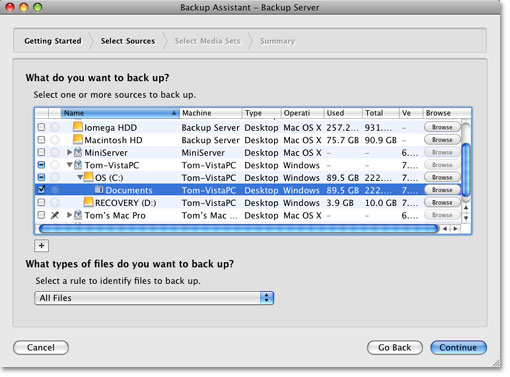
We figured we should probably let you know about the latest update to veteran Mac backup and recovery package, Retrospect, which today reached v. 8.2, the first release under new ownership.

Roxio says the software
now delivers as much as three-times faster network backup performance, adds 64-bit addressing to enable the backup of volumes containing tens of millions of files, and includes user interface enhancements that simplify workflow and management tasks.
 
You can also now restore from backups created with Retrospect 6. This feature addresses a key request from users who wanted to upgrade to the Retrospect 8 platform, but didn

Apple ships superpowered Mac Pro — SSD options too!!

Site default logo image

I’ve been looking for a computer with the muscle to handle hardcore NLE video editing while working on a couple of musical compositions, checking the email, running an IM session and handling the hassle of Flash crashing in the browser, and I think Apple deliverd this very machine this morning — the new Mac Pro, a supercalifragilistic speed demon with up to 12 (yeah, count them) processing cores.

Apple promises the new Mac Pro will deliver 50 percent greater performance than the previous generation. You get: quad-core and 6-core Intel Xeon processors, all-new ATI graphics and the option for up to four 512GB solid state drives (SSD).

(Apple’s getting pretty serious about SSD, right? Wonder what the chances are for a fully solid state iPod classic come September?)

“The new Mac Pro is the most powerful and configurable Mac we’ve ever made,” said Phil Schiller, Apple’s senior vice president of Worldwide Product Marketing. “With up to 12 cores, the new Mac Pro outperforms our previous top-of-the-line system by up to 50 percent, and with over a billion possible configurations, our customers can create exactly the system they want.”

These professional desktops are driven by next-gen quad-core and 6-core Intel Xeon processors running at speeds up to 3.33 GHz.

Apple has a few interesting details on these chips, explaining these multi-core processors use a single die design “so each core can share up to 12MB L3 cache to improve efficiency while increasing processing speed.”

The tech specs are a wet dream to anyone who ever spent time trying to tweak power out of a G3 Power Mac, listen up: “These systems feature an integrated memory controller for faster memory bandwidth and reduced memory latency; Turbo Boost to dynamically boost processor speeds up to 3.6 GHz; and Hyper-Threading to create up to 24 virtual cores.”

The Mac Pro now comes with the ATI Radeon HD 5770 graphics processor with 1GB of memory and customers can configure-to-order the even faster ATI Radeon HD 5870 with 1GB of memory.

For the first time, Mac Pro customers have the option to order a 512GB SSD. Now, you can install up to four of these inside the internal drive bays. This means you can expect ultra high-speed disk bandwidth and random disk performance to deliver speeds twice as good as the average performance of a standard disk drive.

Display:  two Mini DisplayPorts and one dual-link DVI port. Wanna do video? Just connect up to two LED Cinema Displays without an additional graphics card or adapter. The dual-link DVI port supports legacy DVI-based displays up to a resolution of 2560 x 1600 pixels.

Like the iMac, the Mac Pro meets stringent Energy Star 5.0 requirements and achieves EPEAT Gold status.

Pricing & Availability

The new Mac Pro will be available in August through the Apple Store, Apple’s retail stores and Apple Authorized Resellers.

The new quad-core Mac Pro, with a suggested retail price of $2,499 (US), includes:

  • one 2.8 GHz Quad-Core Intel Xeon W3530 processor with 8MB of fully-shared L3 cache;
  • 3GB of 1066 MHz DDR3 ECC SDRAM memory, expandable up to 16GB;
  • ATI Radeon HD 5770 with 1GB of GDDR5 memory;
  • two Mini DisplayPorts and one DVI (dual-link) port (adapters sold separately);
  • 1TB Serial ATA 3Gb/s hard drive running at 7200 rpm;
  • 18x SuperDrive

Magic Trackpad gets real, costs $69

Site default logo image

Apple has just released their Magic Trackpad which has been anticipated since October ’09. It’s just like the spy shots from June, and packs all the features of the MacBook/MacBook Pro trackpads, except it’s larger. It’s ergonomic and is the same height as the wireless keyboard for ease of use. It requires 2 AA batteries, includes preferences, and ships today. 

Apple ships latest iMacs: superfast speed demons — they rock

Site default logo image

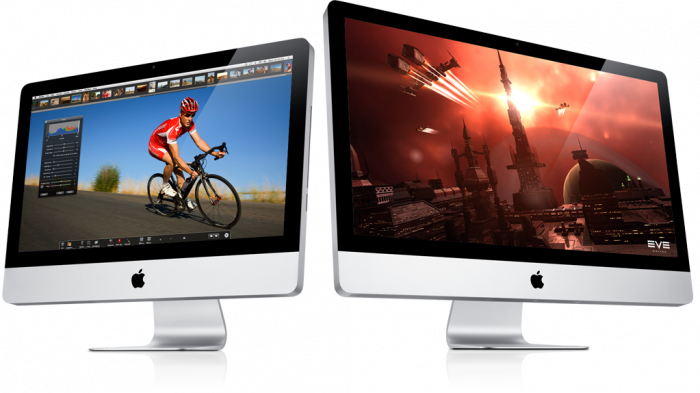
Ladies and gentlemen, we have lift-off. Apple this morning has introduced new supercharged iMacs, an all-new Mac Pro, new displays and — finally at last taken the wraps off of the much-expected ‘Magic TrackPad’.

That’s quite a morning.

To the iMac: This is a significant update. You’re seeing these machines get the latest Intel Core i3, Core i5 and Core i7 processors and powerful new graphics.

Good prices too: starting at $1,199, the new iMac line is the fastest ever with dual-core processor speeds up to 3.6 GHz, quad-core speeds up to 2.93 GHz.

“We took the world’s best all-in-one and made it even better,” said Philip Schiller, Apple’s senior vice president of Worldwide Product Marketing. “With the latest processors, high-performance graphics and signature aluminum and glass design, customers are going to love the latest iMac.”

The processors feature an integrated memory controller to access the system memory directly, allowing the new iMac to take full advantage of its faster 1333 MHz memory. New discrete ATI Radeon HD processors promise some of the best graphics performance yet seen on an iMac, with an accent on 3D notablein the press release (we sense more things ahead).

IPS technology means a wide 178 degree viewing angle. There’s an SD card slot which now supports the SDXC format. Oh, and if you never want to endure a lengthy start-up again, you can order a 256GB solid state drive (SSD) as a primary or secondary drive on the 27-inch models. That supports up to 215 MB/s data transfer rates. Don’t blink or you’ll miss it.

The iMac meets stringent Energy Star 5.0 requirements and achieves EPEAT Gold status. Greener than ever, I’m pleased to note, as I kind of like this planet. The iMac features LED-backlit displays that are mercury-free and made with arsenic-free glass. iMac uses PVC-free components and cables, contains no brominated flame retardants, uses highly recyclable materials and features material-efficient system and packaging designs.

Hidden among the product releases, the new Apple Battery Charger ($29) will power up your Magic Trackpad, Magic Mouse and Wireless Keyboard and ships with six long life batteries.

Pricing and schizzle:

The new 21.5-inch 3.06 GHz Intel Core i3 iMac, for a suggested retail price of $1,199 (US), includes:

  • 21.5-inch 1920 x 1080 LED-backlit display;
  • 3.06 GHz Intel Core i3 processor with 4MB shared L3 cache;
  • 4GB 1333 MHz DDR3 SDRAM expandable to 16GB;
  • ATI Radeon HD 4670 discrete graphics with 256MB GDDR3 SDRAM;
  • 500GB Serial ATA hard drive running at 7200 rpm;
  • slot-load 8x SuperDrive