iOS Devices

See All Stories

The devices that run the world’s most advanced mobile operating system

Check out our top stories on iOS Devices:

iOS devices refer to any of Apple’s hardware that runs the iOS mobile operating system which include iPhones, iPads, and iPods. Historically, Apple releases a new iOS version once a year, the current version is iOS 10. Here is the complete list of iOS 10 compatible devices.

New iPhone models spotted in iPhone 3.0 OS, "iProd" and "iFPGA"

Site default logo image

What have we here?  It was only a matter of time (and it almost seems like Apple is leaking this on purpose at this point), but Ars found some extra little bits of code in the 3.0 OS that indicate that there will be not one but two new iPhones, a new iPod touch and two mysterious new products that will run this OS called "iProd" and "iFPGA".

Just FYI FPGA stands for Field-programmable gate array – you can learn more than you ever wanted to know about that here.

We don’t know about you but, we’ve wanted the iProd since forever and will be buying 4 of them the second they are released.

 The new codes:

iPhone2,1 – 0×1294
iProd0,1 – 0×1295
iPod2,2 – 0×1296
iPhone3,1 – 0×1297
iFPGA – 0×1298
iPod3,1 – 0×1299″

The old codes:

iPhone First Gen – 0×1290
iPod touch 1G – 0×1291
iPhone 3G – 0×1292
iPod touch 2G – 0×1293

Also, congrats to me.

Rainbow Shuffles for $50 premium

Site default logo image

While we certainly aren’t in the target market for this kind of Shuffle debauchery, we know some people will be.  $50 extra buys you a shuffle in your favorite rainbow color.  Add a few bucks more for your favorite fake metal.  Specs below.


  • Standard Color Anodized 4GB Shuffle (pictured above): $129 USD
  • Polished Color Anodized 4GB Shuffle: $159 USD
  • Plating
    • Chrome 4GB Shuffle $149 USD
    • Copper 4GB Shuffle: $169 USD
    • Black Nickel 4GB Shuffle: $169 USD
    • 24kt Gold 4GB Shuffle: $179 USD
    • White Gold 4GB Shuffle: $199 USD
    • Rose Gold 4GB Shuffle: $199 USD
    • Platinum 4GB Shuffle $199 USD

iPhone Video hopes aren't dead yet…

Site default logo image

Engadget spied a certain strange typo in the iPhone 3.0 development kit. Apple, who we know doesn’t yet want video capabilities on the iPhone, forgot about that for a second and looks to have a screen to upload video to your MobileMe account.  Perhaps this is the reason that Apple hasn’t allowed the awesome Qik application to get accepted on the iPhone.  Will Apple let third party video applications like Qik on the iPhone or will this be another MobileMe-only feature?  We hope the former.

Oh, and you can choose between Chicago and New York…

AT&T second line iPhone to clear out iPhone 3G inventory

Site default logo image

BGR’s AT&T Ninjas got their mitts on an AT&T internal presentation which seems to indicate that they are going to be unloading some 3G iPhones at $599 and $699 no commitment pricing (which is much lower than their previous no commitment prices) starting on March 26th.  Don’t take our word for it, but it looks like this might be an inventory clearing measure.  For…say…Junish?

More iPhone 3.0 features: Tethering and Find my iPhone

Site default logo image

The onslaught of iPhone 3.0 features continues: 

A developer has found that that tethering both via USB and Bluetooth is possible under the 3.0 beta developer release (of course, those of us with Jailbroken iPhones won’t be too impressed with this).  It isn’t immediately clear how AT&T and the other carriers will be able to distinguish who is tethering and who isn’t.   Apple will have to coordinate the locking and unlocking with the carriers.

Additionally, some features we’ve heard about including: "Find My iPhone" are bearing fruit.  Along with what Appleinsider has found, we’ve heard that this feature will use the iPhone’s GPS to locate the device for the user.  While this would be super cool for stolen iPhones, it would even be cool if you can’t find your iPhone and want to know the general area to look.  This remote opening of the GPS via background push notification is a novel use of the iPhone’s new capabilities.

Additionally, there will be a mobile wipe feature in MobileMe that will allow you to clear your iPhone remotely, like Exchange Administrators can do.


Very nice!


The Register thinks Imagination's SGX543MP video chip may go into a tablet

Site default logo image

Those pesky tablet rumors won’t die.  Today’s entry is from The Register who are reporting (via MR) on Imagination’s new multi-core graphics chips.  Imagination PowerVR chips are the video chips currently inside Apple’s iPhones and iPod Touches.   Apple, of course, is also an investor in Imagination Technologies, as is Intel.

The speculation is that the new multi-core chips, originally announced in January, would go inside future Apple mobile products.  Tablet deniers would say those chips are bound for future iPhones and iPods – and they probably are right.   But, why would a 320×480 pixel device that already does some pretty good OpenGL /3D graphics need 2-16 cores of desktop quality graphics power?  With OpenCL, those cores could certainly help the overall processing speed and enable a much richer application experience on the iPhone/iPod Touch.  However, the performance boost just seems like overkill for these devices alone.

We still like the Tablet idea and think those 9-10 inch touch screens have to go somewhere.  We’re hoping to find out at WWDC where that is..

To get an idea of what the older model PowerVR SGX single core chip can do, take a look at a Pandora board running one on this Youtube video:


New Imagination Chip specs below:

Imagination Technologies launches advanced, highly-efficient POWERVR™ SGX543MP multi-processor graphics IP family

Truly scalable multi-processing graphics technology offers ‘super-high’ performance points extending POWERVR’s market reach into new segments
Imagination Technologies, the multimedia chip technologies company, announces further details of the first POWERVR SGX graphics IP core with multi-processor (MP) core support. The technology, henceforth POWERVR SGX543MP, is being delivered to customers in SGXMP2 (two-core) to SGXMP16 (16-core) variants.

With the POWERVR SGX543MP family Imagination continues to extend its leadership of the embedded graphics acceleration market with blistering POWERVR solutions which address the rapidly growing demands for high performance graphics in a wide range of consumer electronics segments.

Imagination’s graphics IP cores now range from SGX520, the world’s smallest OpenGL™ ES 2.0 mobile core, to SGX543MP16 for high-performance console and computing devices.

Some of the innovative technology behind POWERVR SGX543MP is being revealed in a keynote presentation at the 4th annual Multicore Expo (March 16 – 19 2009, Santa Clara, USA.)

Tony King-Smith, VP marketing Imagination Technologies says: “The performance delivered by our latest POWERVR SGX543MP family is the ultimate statement of the highly linear scalability of our unique Series5XT architecture. With the ability to combine up to 16 SGX543 GP-GPU* cores on a single SoC, we are now able to deliver capabilities to our licensing  partners previously only thought the domain of the discrete GPU chipset vendors, while maintaining our unrivalled power, area and bandwidth efficiency.”

One of the unique features of the recently announced POWERVR Series5XT architecture is that it enables highly linear scaling of all aspects of GPU performance, specifically vertex shading, pixel shading, primitive setup and overall GP-GPU functionality, whilst maintaining full software compatibility and with virtually no overhead in bandwidth usage.

The POWERVR SGX543MP family enables up to sixteen cores of POWERVR SGX543 programmable GP-GPU logic to be integrated in a high performance, multi-processor graphics solution without performance or silicon area compromises. Taking the already high-performance four-pipe POWERVR SGX543, and then scaling that performance up to between eight and 64 pipelines, POWERVR SGX543MP delivers performance comparable to many desktops, laptops and games consoles.

At 200MHz core frequency an SGX543MP4 (four cores) will deliver 133 million polygons per second and fill rates in excess of 4Gpixels/sec**. Higher frequencies or a larger number of cores each deliver more performance. At 400MHz core frequency an SGX543MP8 (eight cores) will deliver 532 million polygons per second and fill rates in excess of 16Gpixels/sec.

POWERVR SGX543MP features:

maintains the highest performance per mW of any embedded graphics core, a key benefit of POWERVR SGX
highly linear scaling (over 95% efficiency) of performance in both geometry (vertex processing) and rasterisation (pixel/fragment processing)
dynamic load balancing and on-demand task allocation at the pipeline level
no fixed allocation of given pixels to specific cores, enabling maximum processing power to be allocated to the areas of highest on-screen action
scalable GP-GPU compute power, which can be fully utilised through all Khronos APIs including OpenGL ES 2.x, OpenVG™ 1.x and OpenCL™
use any number of cores from 2-16, even or odd
no additional work for software developers; using one driver stack for all SGX cores means applications see a common SGX architecture via the standard APIs regardless of number of cores used
no additional CPU load when using multiple cores or loss of performance
Continues King-Smith: “This multi-core extension to the scalability of the POWERVR SGX architecture, beyond the existing POWERVR SGX520 and SGX53x and 54x families, takes our highly efficient technology into new market segments. Additionally the leading and ever-growing ecosystem of POWERVR Insider, which is of great value to our licensing partners and their OEM customers, will both benefit from, and further develop with, this significant expansion of the family.”

Inside POWERVR SGX543MP
The highly efficient POWEVR SGX543MP family delivers linear progression in vertex and pixel processing performance, unlike competitive solutions which scale only pixel performance. An SGX543MP2 delivers effectively twice the performance of a single SGX543 without compromise. And for a given workload the same bandwidth is required no matter how many cores are deployed – SGX543MP delivers faster performance by dividing the work on –demand, dynamically load balanced in parallel between cores.

The POWERVR Series5XT architecture builds on the highly efficient Series5 architecture, which ensures that maximum performance is achieved across a wide range of applications, regardless of whether the content is dominated by polygon throughput, pixel processing, high fill rate or any combination of these. Other architectures that use separate polygon and pixel processing units cannot achieve the sustained throughput or silicon utilisation of POWERVR SGX graphics cores.

Part of POWERVR Series5XT, USSE2 (Universal Scalable Shader Engine2), the main programmable processing unit within each POWERVR SGX543 pipeline, incorporates a major upgrade of the data path to deliver vastly improved vector processing performance and overall throughput. This datapath upgrade is one of the key reasons why SGX543 delivers up to 2x the performance for ‘vector-heavy’ applications compared to earlier POWERVR SGX cores

USSE2 is a scalable multi-threaded GPU shader processing engine that efficiently processes graphics as well as many other mathematically-intensive tasks. These tasks are automatically broken down into processing packets which are then scheduled across a number of hardware multi-threaded execution units for maximum processing efficiency.

Editor’s Notes
* GP-GPU stands for General-Purpose computation on Graphics Processing Units.
** All fill rate figures stated assuming a scene depth complexity of x2.5

About Imagination Technologies
Imagination Technologies Group plc (LSE:IMG) – a global leader in multimedia and communication silicon technologies – creates and licenses market-leading processor cores for graphics, video, multi-threaded embedded processing/DSP and multi-standard communications applications. These silicon intellectual property (IP) solutions for systems-on-chip (SoC) are complemented by strong array of software tools and drivers as well as  extensive developer and middleware ecosystems. Target markets include mobile phone, handheld multimedia, home consumer entertainment, mobile and low-power  computing, and in-car electronics. Its licensees include many of the leading semiconductor and consumer electronics companies. Imagination has corporate headquarters in the United Kingdom, with sales and R&D offices worldwide. See: www.imgtec.com.

Press Contact
David Harold
david.harold@imgtec.com

Apple iPhone 3.0 Event roundup

Site default logo image

Well, the event is over, you can now smoke a cigarette or dip your fingers in ice if you were blogging the event like some of us.  Apple’s got their page up and we’ll post the video as soon as it becomes available.

What this event said to us more than anything is that Apple is about executing.  Sure, they are late to the game with many of these features, but they are executing them really well.  Push notifications could have come a few months earlier.  They could have sacrificed battery life for background applications but it wouldn’t be the experience they wanted to deliver.  Cut/copy/paste and search both seem to be done right.

They are also delivering most (sans stereo Bluetooth and MMS) of these features onto what will be 2+ year old original iPhones.  Most phones don’t even last 2 years but buying an original iPhone ($599 at the time) means that you will have a 2 year old phone that is pretty on par with everything else out there currently.    Not a bad price to pay IOHO – especially considering you can still sell that iPhone for $200.

Not everything was roses though.  We are seeing some mixed reactions throughout the blogosphere.  Vote below on your thoughts.

Also can anyone see what is in the writing on the iPhone 3.0 logo below?


iPhone 3.0 Event Liveblog

Site default logo image

We’re rolling out our good ol’ fashioned 9to5mac Livepanel which will be circulating different feeds throughout today’s iPhone 3.0 announcement.  As you might remember, this framed page shows four of the best feeds at once and is refreshed every 15 seconds so your mouse button finger doesn’t have to bleed.  It works best on large (24"+) monitors and uses 1990’s html frames technology to bring sweet, sweet iPhone 3.0 information to your eyes as quickly as possible. 

Will we see MMS, copy/paste, tethering, landscape email typing, wireless synching, push notification or maybe even a TabletTune in to find out.

Update: Apple Stock already up almost 3 points in early trading


Tablet announced tomorrow?

Site default logo image

Here’s the post.  It basically goes like this:  Apple has said it is increasing its embedded device list this year.  Ten-inch touch screens seem to be flying around Asia en route to Apple for late Summer. 

If there is a tablet with higher resolution/independence, developers are going to need a few months to tweak their apps for launch.   What if that $20 minimum Premium App Store happens to be for higher resolution apps?

Also, ARM’s new line of Cotex A8 architecture processors are tablet-worthy

Plus, I need something to look forward to…So here’s why we might see a tablet intro tomorrow.

Speaking of which, we’ll have the 9to5mac LivePanel open for the iPhone 3.0 Event.  Stop by to see all information sources in one page.


What is the 8A83E3 chip inside the iPod Shuffle headphones?

Site default logo image

Update: it appears to be a chip that Apple will license out as part of its "Made for iPod" licensing scheme.

There seems to be a lot of brouhaha over at iLounge and Boingboing over the revelation that the iPod Shuffle’s new headphones contain a special new chip that could be some sort of hardware DRM.  Of course we haven’t figured out what the 8A83E3 chip does yet., many think it is a multiplexer. 

Unfortunately, Apple has been known to be a little bit "closed" when it comes to iPod and iPhone connectors (see video out cable). 

But maybe it is a just controller chip for the Shuffle’s headphone buttons?   It also may be a way to communicate with Aliens…no one is sure yet. 

We hope it isn’t some sort of DRM that controls what headphones or charger the Shuffles can use, but until someone with knowledge of the situation can sort it out, we’re going to just sit by and watch..

O2 plans to give away free iPhones (with cheeeep plan) in anticipation of new device in June

Site default logo image

The Telegraph is reporting that O2 will now be giving away free iPhones with their lower cost plans in order to clear out inventory for the new iPhones which will be released this summer:

O2, which has exclusive rights to sell the iPhone in the UK, is believed to planning to give the eight gigabyte (GB) 3G iPhone away for free on £34.26 pay monthly tariffs from May.

At present the 8GB device costs £96.89 on the cheapest tariffs and is only free on £73.41 and £44.05-a-month contracts. The operator is also said to be planning to give away the 16GB on £44.05 per month contracts.

O2, who was contacted by the Telegraph, said that any pricing changes would have to be approved by Apple. The Telegraph speculated that the iPhone Nano will appear this summer. 

O2 is also rumored to be the sole carrier of the Palm Pre, which its parent company, Telefonica, may have scored an exlusive agreement to distribute throughout Europe and Latin America.


Wireless synching

Site default logo image

We haven’t heard anything specific, but we’d like to see something very much in the iPhone 3.0 update next week.  It isn’t cut and paste or tethering or even push notifications, though we’d really like to see all of these features.  

How bout Wifi/Bonjour synching?  This would make a

Premium App Store en route for iPhone 3.0

Site default logo image

The iPhone is likely to get a premium App Store if rumors from Wired are true (and previously from Pocketgamer).  They say game developers, enterprise developers and other premium vendors will soon have  a place to sell their wares free from all of the free and $.99 drivel that pollutes the regular app store. 

They put the $20 price point as the barrier for entry into the new "velvet rope area" premium App Store.  No game developer would, of course, corroborate their story.

This, of course is a rehash of January’s Pocketgamer.biz’s story of the same subject matter

iPod Shuffle teardown reveals amazingly tight design

Site default logo image

Not that you didn’t know it already from all of the hoopla, but the new iPod Shuffle is smaaallll. And the technology inside is even smaller. The fine folks at iFixit did what they do best and ripped apart a new Shuffle for everyone to see:

Step 1 — First Look 

  • Here it is, in all its magnificent glory — the new Shuffle! We’ll post updates on twitter about interesting things that we discover as we go.

  • The box is as dainty as its contents.

  • According to Apple, the Shuffle has a "true volume" of 4,326 cubic millimeters and weighs in at 10.7 grams. A single MacBook Pro 17" weighs as much as 286 of these Shuffles.

Step 2

  • Contents of the box:

    • iPod Shuffle

    • Apple Earphones (with in-line remote)

    • USB Cable

    • Quick Start guide

  • We gave it a quick listen before tearing it apart…

  • The controls are not as awkward as we expected, but we still prefer pushing buttons.

  • Compatibility does not appear to be this iPod’s strong suit. We tried this iPod with a Shuffle 2nd Generation dock, but it doesn’t fit. We tried the cable with a Shuffle 2nd Generation, and that didn’t work either.

Step 3

  • The usual suspects.

  • Can you pick the Shuffle out of this lineup?

  • The Shuffle does not say iPod (or Shuffle) anywhere. As far as we know, this is the first iPod that Apple didn’t label.

Step 4

  • Upon connecting the shuffle to a computer, we learned that the voice-over feature must first be downloaded via iTunes.

  • Interestingly enough, normal headphones can still be used to listen to music. The only drawback: without Apple’s proprietary headphone playback control, you will not be able to change songs or adjust the volume.

  • The headphone playback control offers two buttons for volume control and a center button for playback control. The center button can be clicked once to play, twice for the next track, and three times for the previous track.

Step 5

  • On to the dismemberment…

  • Apple hasn’t made their iPods easy to open lately, and unfortunately we don’t expect things to change with this iPod.

  • We begin by inserting a metal spudger into a crevice between the rear cover and the rest of the shuffle.

  • Inserting the metal spudger creates a gap big enough to insert an iPod opening tool. We slide the iPod tool across the length of the gap to dislodge the left side of the rear cover.

  • Now that one side of the rear cover is fully dislodged, it’s easy enough to use the iPod opening tool to dislodge the right side as well.

Step 6

  • We’re in. That wasn’t too bad, but the shuffle isn’t going to win any awards for easy serviceability.

  • It’s fairly easy to bend the rear cover even though it is made out of aluminum.

  • There is a retaining tab on the top of the shuffle that prevents the rear cover from being pulled apart on the top side. The rear cover should be pulled apart from the iPod on the bottom side first.

Step 7

  • Is this the future? A single IC, a battery, and some user interface components.

  • Amazingly, at least on our scale, both halves weighed 5 grams. That means the entire functional half of the iPod weighs only about 10% more than a single sheet of letter size paper.

Step 8

  • Remove the small Phillips screw. We won’t waste our time circling it — there’s only one.

  • We get lots of requests to add more screw guides. Fortunately we don’t need to make one for this iPod. Just don’t drop the screw, and you’ll be fine.


Formatting Help

BGR: iPhone 3.0 to have MMS and Tethering via Bluetooth and USB

Site default logo image

Yes, this isn’t a lot of exciting news (most smartphones have had these features forever) but we know there have been a few of you clamoring for these two features for years. 

Will the iPhone 3.0 have MMS and Tethering (USB and Bluetooth)? 

Maybe. 

Will AT&T reach into your pocket and take some more of your cash? 

Of course they will… sucker.


We’ll take some cut and paste too while you are at it…

iPhone OS 3.0 introduced on March 17th!

Site default logo image

You think maybe we’ll see some cool new Pre busting stuff? How about some push notifications? Copy/paste?  MMS multimedia?  Tethering?  Are you excited?

Join us at an invitation-only event to learn about the new SDK and get a sneak peek at the iPhone OS 3.0 software. The event takes place at Apple, Building 4, Town Hall on March 17 at 10:00 a.m.

Engadget just got the announcement.

We just got the announcement, iPhone OS 3.0 is coming. Set your clocks, mark your calendars. It’s going down March 17th. Apparently, we’ll get a sneak peak at the new OS, as well as a look at a brand new version of the SDK. Exciting stuff indeed, and we’ll be there live at 10am PST (1pm PST) with the liveblog. Apple’s calling this an "advance preview of what we’re building," so we’re not expecting anything ready to go as of the 17th, but hopefully this will allow developers to start building toward future functionality (hey, how about some push notifications?), and presumably users won’t have too many months to wait after that for the real deal.

iTunes 8.1 to include voice rendering of music titles

Site default logo image

The iPod shuffle’s new voice feature is a great navigation tool for screenless browsing of your music collection.  But how does that little device read all of your music titles/artist/genre, etc. to you?  That takes a lot of CPU power for a device the size of a tie clip. 

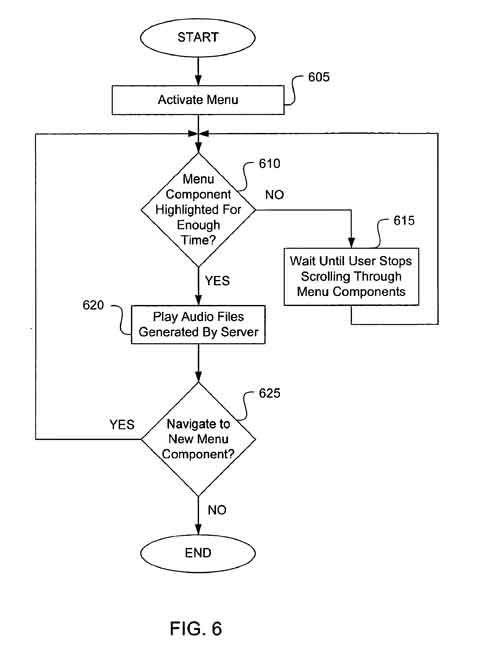
The answer?  It doesn’t.  All of the voice rendering will be done on the PC or Mac in iTunes 8.1.   That’s why the PC voice will be a woman (built in voice system) and the Mac will be a man’s voice.  iTunes 8.1 will put some extra voice data in your music files (see below) to include the name of the band and title of the song.  While this will be relatively small in size, the space changes will take up more space than before, thus growing the size of your library.  Eventually, Apple might include this audio data in itunes downloads.  Heck, they might even have Jimmy Page’s voice tell you the next song is Led Zepplin.  A value add!

Apple filed a patent for this a few years ago as well…see more  below


digg_url = ‘http://9to5mac.com/itunes-8-1’;

voicemenu2.jpg

voicemenu.jpg

From the Patent Application

In order to achieve portability, many hand-held devices use user interfaces that present various display screens to the user for interaction that is predominantly visual. Users can interact with the user interfaces to manipulate a scroll wheel and/or a set of buttons to navigate display screens to thereby access functions of the hand-held devices. However, these user interfaces can be difficult to use at times for various reasons. One reason is that the display screens tend to be small in size and form factor and therefore difficult to see. Another reason is that a user may have poor reading vision or otherwise be visually impaired. Even if the display screens can be perceived, a user will have difficulty navigating the user interface in “eyes-busy” situations when a user cannot shift visual focus away from an important activity and towards the user interface. Such activities include, for example, driving an automobile, exercising, and crossing a street.

It is noted that text strings that correspond to standard text strings can have pre-recorded audio files. Such text strings may correspond to common user interface controls, such as “play”, “stop”, “previous”, etc., and to common menu items such as “Music”, “Extras”, “Backlight.” These audio files can be created using a voice talent or speech synthesized from the voice talent’s recordings. The other text displayed as part of the media player user interface that is usually user specific, such as contacts and customized playlist names can all be synthesized by building a voice from the voice talent recordings. This provides consistency by having the same voice for all textual data to be presented to the user.


More from Hrmph