Nvidia
Nvidia is best known as a designer of GPUs (Graphics Processing Units) for gaming and professional industries. Its well-regarded GeForce GTX line of gaming GPUs continue to set the benchmark for graphics performance on PCs.
Nvidia is best known as a designer of GPUs (Graphics Processing Units) for gaming and professional industries. Its well-regarded GeForce GTX line of gaming GPUs continue to set the benchmark for graphics performance on PCs.


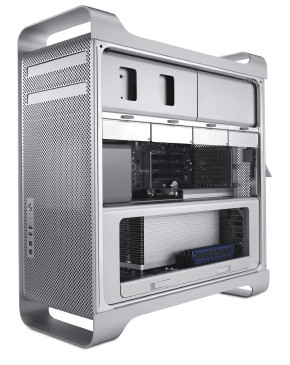
It looks like Apple could (again) select the graphics giant Nvidia as the primary GPU provider for the upcoming Mac Pro hardware refresh. According to a mostly speculative story by MIC Gadget based on unnamed industry sources, new Mac Pros will feature Intel’s upcoming Ivy Bridge chipset fabbed on the chip maker’s latest 22-nanometer Trigate transistor technology (no surprise there). According to Intel, 22nm Ivy Bridge silicon claims a 37 percent speed jump and lower power consumption compared to the chip giant’s 32 nanometer planar transistors. ‘Trigate’ Ivy Bridge chips can feature up to eight processing cores and are more power-savvy, so they should help scale frequency, too. On a more interesting note, MIC Gadget speculates Apple could switch back to Nvidia as the primary supplier of next-generation GPUs for the new Mac Pros.
Nvidia has their “Kepler” platform due out around the same time as Intel is making their changes, and our sources within the company indicate that they have chosen to have Nvidia lead the charge so to speak on the graphics front.
Eagle-eyed readers could mention that AMD recently released the Radeon HD 7970 graphics card powered by the Tahiti GPU (its nearest rival is Nvidia’s GeForce GTX 590), with observes deeming it Apple’s go-to graphics card for future Mac Pros. Indeed, traces of support for Tahiti-driven AMD GPUs are found in Mac OS X Lion 10.7.3, at least indicating people might be able to upgrade their future Mac Pro with this card. Oh, and it’s great for Hackintosh builders, too.
Also indicative is a March 2011 Snow Leopard 10.6.7 update that enabled support for a bunch of AMD/ATI Radeon HD 5xxx and 6xxx cards, not all of which were in Macs at the time. On the other hand, a speculative switch to Nvidia would not be out of character as California-based Apple is known for frequently switching between Nvidia chips and those manufactured by rival AMD…

As Apple transitions its line from NVIDIA graphics cards to AMD (and opens up the OS to much more variety), we’re noting some strong words coming out of each camp on who makes the fastest graphics card in the world. On the 8th of this month, AMD announced it had released the fastest Graphics card on the market, the AMD Radeon HD 6990.
NVIDIA fired back this week and said they had the fastest Graphics card. Now it is getting real.
Dave Erskine, Senior Public Relations Manager for Graphics Desktop at AMD just fired this off:
We combed through their announcement to understand how it was that such a claim could be made and why there was no substantiation based on industry-standard benchmarks, similar to what AMD did with industry benchmark 3DMark 11, the latest DirectX® 11 benchmark from FutureMark.
So now I issue a challenge to our competitor: prove it, don’t just say it. Show us the substantiation. Because as it stands today, leading reviewers agree with us here, here, here, and here that the AMD Radeon HD 6990 sits on the top as the world’s fastest graphics card.
What’s new in iTunes 10.1.1?
This release provides a number of important bug fixes, including:
• Addresses an issue where some music videos may not play on Macs equipped with NVIDIA GeForce 9400 or 9600 graphics.
• Resolves an issue where iTunes may unexpectedly quit when deleting a playlist that has the iTunes Sidebar showing.
• Fixes a problem where iTunes may unexpectedly quit when connecting an iPod to a Mac equipped with a PowerPC processor.
• Addresses an issue where some music videos may not sync to an iPod, iPhone, or iPad.