VIDEO: Philly opens its first Apple Store

The Line for a New Apple Store from John Gruber on Vimeo.
Philadelphia Apple Store opening (via: John Gruber) “A sensation,” he wrote.
The Line for a New Apple Store from John Gruber on Vimeo.
Philadelphia Apple Store opening (via: John Gruber) “A sensation,” he wrote.
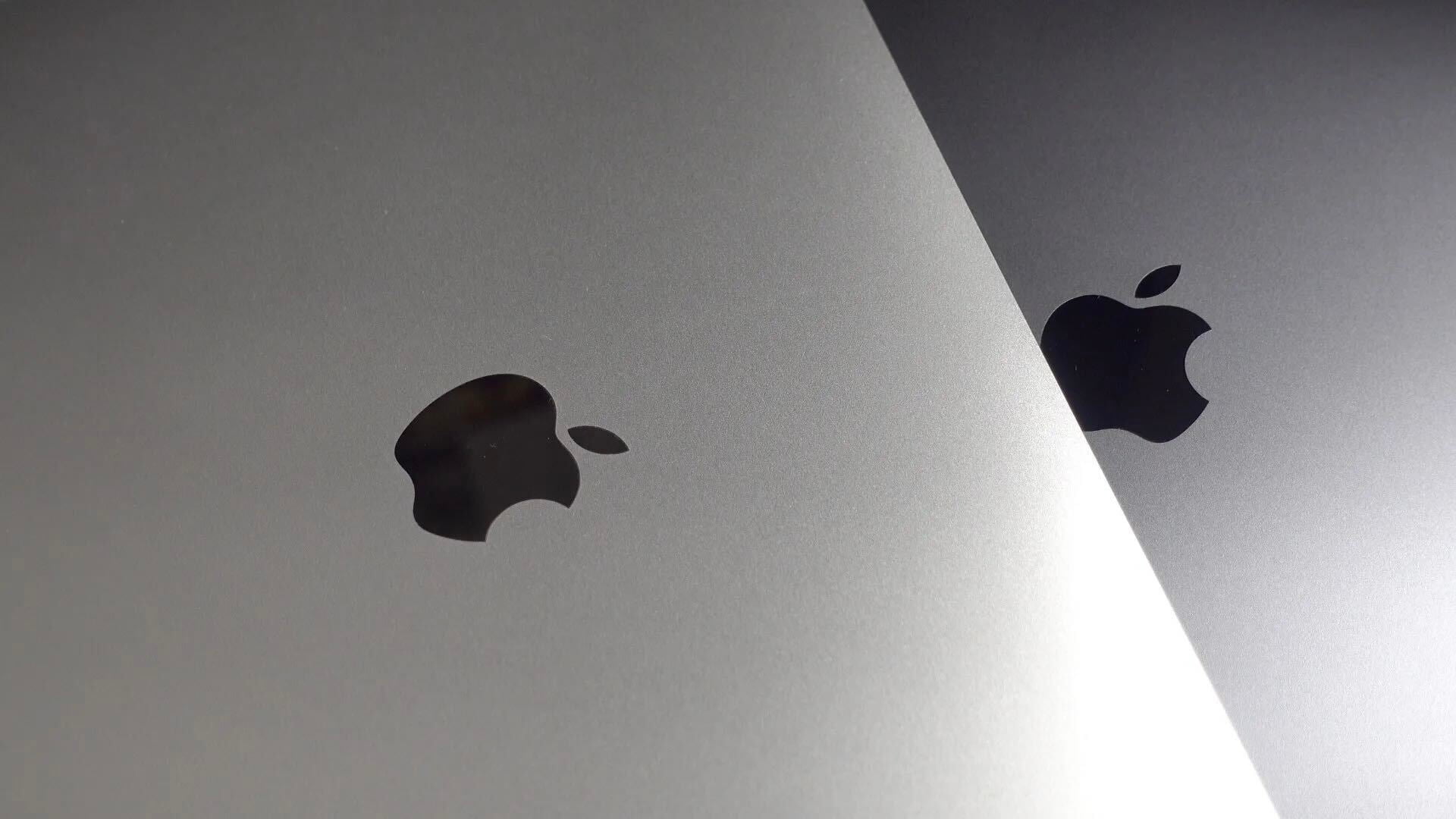
Some good news from the folks at NetApplications for Apple. It turns out that the iPhone gained significant market share in July.
Yeah… not really much to say, except that Apple’s videos about their competitors antenna performance have seemed to pull a Criss Angel, and disappear from the company’s website. It probably has to do with their unhappy rivals or maybe they want to pull Antennagate back into the spotlight for another round of press.
You can still try to find a glimpse of the videos at their official YouTube channel here.
via Tech Crunch

Is Apple’s iPhone honeymoon over? Well, some analysts reckon so in a slice of wish fulfilment fantasy — meanwhile others see the growing threat of Android powered gadgets as something to worry about, but perhaps not quite as much as you might believe…
Looks like Microsoft boss Steve Ballmer has woken up to smell the same coffee I’m smelling — that Apple is chasing HP to become the world’s biggest PC maker, and now the MSFT top man has said he’s gunning for the tablet market.
As the world waits for Ballmer’s words to materialize as something with somewhat more than Zune’s 1 percent marketshare, and iMac maker Quanta confirms it will make twice as many iMacs as it will make all-in-on PCs for HP, let’s look at Ballmers wordage…
On Apple’s storming uber-succesful iPad, Ballmer said, with great grace, “Apple has done an interesting job of putting together a product — they’ve certainly sold more than I’d like them to sell.”
Enchantee. Also enchanting is Microsoft’s determination that Windows 7 tablets will become relevant once the company delivers a credible machine (assuming it can get hold of the components).
“They’ll be shipping as soon as they are ready,” Ballmer said. “It is job one urgency. No one is sleeping at the switch.”
“We have got to make things happen. Just like we had to make things happen on netbooks, we have to with Windows 7 on slates. We’re in the process of doing that as we speak.”
Translation: Now Apple’s shown us how, we’re firing up the photocopiers. Or is that unfair?
 Fortune caught up with the Boy Genius (Jonathan Geller) and got some interesting details out of the Mobile phone leak king. Here’s a breakdown:
Apple’s position as the world’s leading computing device company has driven manufacturing partner, Foxconn, to seize an astonishing 50 per cent of the world’s electronic manufacturing services market, said iSuppli today. Half of the world’s production of consumer electronics devices come from a Foxconn factory, with Apple’s production demand driving this record, iSuppli explains. This is now an Apple world.
“Foxconn’s customers are some of the hottest companies in the electronics business today, most notably Apple,” said Thomas Dinges, iSuppli associate. “As Apple and others have gained share, so has Foxconn.”
With revenue of $17.1 billion, Taiwan’s Foxconn, aka Hon Hai Precision Industries, was the dominant EMS provider in the first quarter of 2010, dwarfing No. 2 player Flextronics International, which posted revenue of $5.9 billion during the same period. Apple represents the fastest-growing customer for Foxconn, which manufactures products including the iPad and the iPhone 4.
iSuppli last week noted that Apple had issued increased production targets for the iPad to its Asian suppliers. iSuppli now predicts Apple will ship 12.9 million iPads in 2010, an amount that will nearly triple to reach 36.5 million in 2011.
Meanwhile, global iPhone shipments are expected to rise to 53.5 million in 2011, more than double the 25.1 million in 2009.
By 2011, Apple will become the world’s second-largest purchaser of semiconductors through direct and indirect channels.
Facing the collapse of its Flash empire under weight of Apple’s move to abandon the once useful multimedia standard, Adobe has taken assertive action — it has promoted a few executives to shoulder the burden.
The new suits have been put in place in order to “align and strengthen the company’s focus on major customer segments and enable these customers to create, deliver and optimize digital experiences across a wide range of media and devices,” the company said.
(Some may remark that perhaps Adobe should have had people at executive level doing this for a long time, but this may be unfair).
David Wadhwani, who has served as vice president and general manager of Adobe’s Platform Business Unit since 2008, has been promoted to senior vice president and general manager of the newly formed Creative and Interactive Solutions business unit (CISBU), reporting to Shantanu Narayen, Adobe president and CEO. The CISBU will include the Creative Suites, the Flash Platform, digital publishing and rich media solutions.
Narayen says, “By combining these products and solutions in one business unit, we can deliver faster on our vision of multi-screen publishing, and drive innovation and support for both Flash and HTML5 authoring. Wadhwani’s expertise in cross-platform content solutions will benefit our publishing, media and enterprise customers, helping them more quickly move from print and single screen workflows to the digital and multi-screen world of the future.”
Senior Vice President John Loiacono, who has led Adobe’s Creative Solutions BU (CSBU) since 2006, has been appointed to lead the newly-created Digital Media Solutions BU (DMSBU), also reporting to Narayen. The unit will focus on innovation and expanding market opportunities for Adobe’s “core digital imaging franchise” (Photoshop et al).
Back in the olden days Dell had a much bigger market share than Apple and offered products at prices Apple couldn’t match — those days are gone. Today, Apple announced it will be offering a superbly specced 27-inch LED display for just $999 — and that’s cheaper than the Dell dude, dude.
See, Dell offers its own UltraSharp U2711 27-inch monitor. It costs $1,099. It’s a good display (if you don’t like curves) and it has the same LG hardware inside, but doesn’t offer what Apple does in its new monitor — which costs $100 less!
Apple gives you:
2,560-x-1,440 res screen
A powered USB hub (Dell haz this)
iSight camera and mic
MagSafe connector
Integrated speakers
“With its massive 2,560 x 1,440 resolution, the new 27-inch LED Cinema Display is a perfect fit with our powerful new Mac Pro, and it gives iMac users an easy way to double their screen real estate,” said Philip Schiller, Apple
I’ve been looking for a computer with the muscle to handle hardcore NLE video editing while working on a couple of musical compositions, checking the email, running an IM session and handling the hassle of Flash crashing in the browser, and I think Apple deliverd this very machine this morning — the new Mac Pro, a supercalifragilistic speed demon with up to 12 (yeah, count them) processing cores.
Apple promises the new Mac Pro will deliver 50 percent greater performance than the previous generation. You get: quad-core and 6-core Intel Xeon processors, all-new ATI graphics and the option for up to four 512GB solid state drives (SSD).
(Apple’s getting pretty serious about SSD, right? Wonder what the chances are for a fully solid state iPod classic come September?)
“The new Mac Pro is the most powerful and configurable Mac we’ve ever made,” said Phil Schiller, Apple’s senior vice president of Worldwide Product Marketing. “With up to 12 cores, the new Mac Pro outperforms our previous top-of-the-line system by up to 50 percent, and with over a billion possible configurations, our customers can create exactly the system they want.”
These professional desktops are driven by next-gen quad-core and 6-core Intel Xeon processors running at speeds up to 3.33 GHz.
Apple has a few interesting details on these chips, explaining these multi-core processors use a single die design “so each core can share up to 12MB L3 cache to improve efficiency while increasing processing speed.”
The tech specs are a wet dream to anyone who ever spent time trying to tweak power out of a G3 Power Mac, listen up: “These systems feature an integrated memory controller for faster memory bandwidth and reduced memory latency; Turbo Boost to dynamically boost processor speeds up to 3.6 GHz; and Hyper-Threading to create up to 24 virtual cores.”
The Mac Pro now comes with the ATI Radeon HD 5770 graphics processor with 1GB of memory and customers can configure-to-order the even faster ATI Radeon HD 5870 with 1GB of memory.
For the first time, Mac Pro customers have the option to order a 512GB SSD. Now, you can install up to four of these inside the internal drive bays. This means you can expect ultra high-speed disk bandwidth and random disk performance to deliver speeds twice as good as the average performance of a standard disk drive.
Display: two Mini DisplayPorts and one dual-link DVI port. Wanna do video? Just connect up to two LED Cinema Displays without an additional graphics card or adapter. The dual-link DVI port supports legacy DVI-based displays up to a resolution of 2560 x 1600 pixels.
Like the iMac, the Mac Pro meets stringent Energy Star 5.0 requirements and achieves EPEAT Gold status.
Pricing & Availability
The new Mac Pro will be available in August through the Apple Store, Apple’s retail stores and Apple Authorized Resellers.
The new quad-core Mac Pro, with a suggested retail price of $2,499 (US), includes:
You know one reason the PC platform doesn’t match the Mac for gaming (tongue in cheek) is its slavish devotion to DirectX 11, but perhaps this will change now Open GL has been updated to become a much better spec.
The Khronos Group today shipped an updated version of Open GL (v.4.1), which can do everything DirectX 11 can do, and adds a few other lovely features, too. Not least seamless enhanced integration with OpenCL for “seamless visual computing”.
(Sure am looking forward to the 3D computing age, just you wait. Apple’s working on it, promise).
OpenGL 4.1 is the sixth update to OpenGL specification in two years, continuing the rapid evolution of this royalty-free specification. This new version continues to maintain full backwards compatibility.
New functionality in the core OpenGL 4.1 specification includes:
Khronos has simultaneously released a set of ARB extensions to enable as much OpenGL 4.1 core functionality as possible on previous generation GPU hardware; providing maximum flexibility and platform coverage for application developers.
Just in case residents of:
…Australia, Austria, Belgium, Canada, Denmark, Finland, Hong Kong, Ireland, Italy, Luxembourg, Netherlands, Norway, New Zealand, Singapore, Spain, Sweden and Switzerland….
…had forgotten about it, Apple today told us once again that the iPhone 4 arrives in 17 more countries this Friday in a press release cunningly entitled, ‘iPhone 4 Arrives in 17 More Countries This Friday’.
(We’d like to observe that what this means is that people in 17 more countries can hope to get one of the few available units in sales channels as demand continues to exceed supply).
Here’s what the folks from Apple is saying:
iPhone 4 Arrives in 17 More Countries This Friday
CUPERTINO, California

Google’s attempt to build an iTunes-killer is gaining momentum with the search giant now speaking to publishing companies after successful discussions with record labels.
Led by Android chap, Andy Rubin, talks between Google and the Byzantine world of music rights are accelerating, with at least one report speculating the search results-linked service may open for business by Christmas.
Google is in talks with the Harry Fox Agency to find out what deals and what rights it can get. The fact these conversations are taking place lends weight to the notion that negotiations are advanced.
The music industry is in a strange place.
On the one hand it feels some sense of gratitude that Apple was able to create a popular digital music service, on the other, labels feel Apple has far too much control over their business. As such they broadly support contenders including Google and Amazon.
Google Music is expected to offer some form of cloud-based music service for Android devices. Its recent recruitment of digital music rights lawyer, Elizabeth Moody, lends substance to this notion.
Moody previously worked at US legal firm Davis Shapiro Lewit & Hayes, where clients include Spotify, MySpace Music and MOG.
Music Week writes: “Rumours have been growing in the past few weeks about Google
If you are looking for a way to display your love for the Google vs. Apple war, have a look at these Chis Bishop T-Shirts sent in by a faithful reader. They come in both mens and ladies T-Shirts or posters and sell for $19 plus a few more bucks for shipping.
Windows Phone 7 will be about the only major mobile platform not using a Webkit browser. And it shows. While Google and Apple are taking turns being the fastest (and Blackberry’s new Webkit browser showing promise), Windows Mobile, based on IE’s engine is…well…watch:
[youtube=http://www.youtube.com/watch?v=ffsMteF6Ktk&w=690&h=385]
While Windows Phone 7 is still in beta, other platforms aren’t standing still. A fast browser is one of the most important parts of a Smartphone. It will be interesting to see if Microsoft can overcome this disparity. via Redmond Pie
Apple, (keeping Antenna-gate in the news!) today is hoping to squash their latest competitor, Motorola, with their already popular Droid X by releasing a video showcasing its antenna performance. The video is in identical format to the previous set of Apple’s antenna videos and the Droid X drops from 3 to 0 bars.
Is this a good strategy? Especially when the issue around the iPhone 4 isn’t the “death grip” but that spot on the lower left side that reduces signal upon flesh touching it (that’s why Apple is giving out bumpers?!). Maybe dropping Antennagate now would be a good strategy?
[youtube=http://www.youtube.com/watch?v=YJG7pbSRvJ8&w=640&h=385]
via MacRumors.
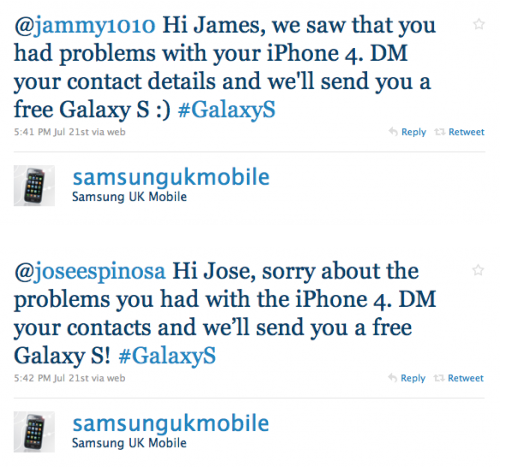
Apple’s iPhone 4 processor manufacturer, Samsung in the UK is offering free Galaxy S handsets to unhappy iPhone 4 owners in a Twitter campaign.
This is a funny kind of competition. Samsung makes a pile of cash — at least an estimated $2 billion — from making components for the iPhone. (chip, flash, memory). The money really isn’t peanuts: Samsung makes $50 on a 16GB iPhone, and $75 on a 32GB iPhone.
Samsung also has its own eerily similar Galaxy S Series smartphone (soon to be joined by a — gasp — tablet) to sell. Samsung’s UK Twitter team today began offering free Samsung Galaxy S series phones to iPhone 4 owners unhappy that they might have to get a free case.
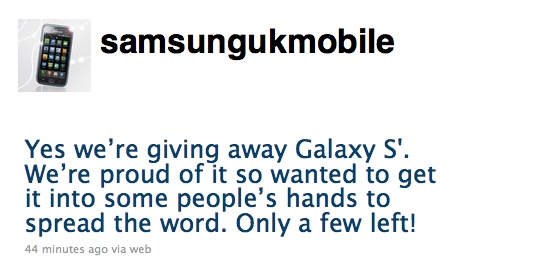
One recipient of the free largesse told Wired,
OK, so we know that Microsoft has guaranteed the first 90,000 Windows 7 phone sales (by buying them for its own people), now the Redmond copycat has hitched up its skirts to make a deal with ARM [Ed: Insert Better Analogy Here], and has plans to take the world’s richest corporation back to the garage by encouraging its own staff to, erm, make Win 7 Phone apps.
Nice.
So, if you work for Microsoft you’re going to be asked to develop for the future phone (wonder if this means Micorosft will spew some stat touting just how quickly it managed to build a developer ecosystem?)
As part of the free phone deal, employees are being asked to evangelize the device to their friends and family.
They also get access to “Develop! A new employee developer programme which makes it much easier for you to develop apps for Marketplace in your spare time.”
Ah, but AAPL’s decision to make its own A4 processor sure will prove a long-sighted on. After all, it wasn’t so long ago that forward momentum on its computing platform was held back by slow processor development on part of IBM and Motorola. The company won’t repeat that one twice. Not in the new and oh-so-important mobile field.
Microsoft’s new deal with ARM confirms that company as a follower. But it also underscores the depth with which Apple management analysts potential threats and the evolution of threats as they laid down their plans for the A4 and other future mobile processors.
Which is to say they saw it coming, and have put together a route to market for proprietary sillicon to give their devices a competitive edge.
(Also consider this: because Apple owns the OS and has control over the processor design used in the mobile devices it makes, it can ensure efficiencies, such as power or graphics management and so on, which cannot possibly be replicated by any competitor — such as Android or Windows 7 Phone — that is attempting to deliver an OS for use on a variety of differently-specced devices. This will serve as a huge advantage in the mobile space, much more so than on the desktop).
The ARM/MSFT deal, then:
“ARM and Microsoft Corp. today announced that they have signed a new licensing agreement for the ARM architecture. The agreement extends the collaborative relationship between the two companies. Since 1997 Microsoft and ARM have worked together on software and devices across the embedded, consumer and mobile spaces, enabling many companies to deliver user experiences on a broad portfolio of ARM-based products.
Apple really has had a terrible time with the launch of its most succesful product ever, the iPhone 4 — this morning the company has been forced to admit that white models of the iPhone 4 won’t ship until later this year, citing manufacturing problems.
White models of Apple
Looky-look, Apple’s changing the game once again — and analysts are having to swiftly change their ideas of how the market works.
Take major market research firm, Forrester, who today admitted the immediate success of the iPad will force it to change its entire tablet computer market forecasts….
In a blog post, analyst Sarah Rotman Epps writes that the iPad is
Apple has trained its users well — we’re good and dutiful and ready to update our machines – this will be why nearly half of all iPhone users (and let’s not forget those first-gen users who can’t upgrade) have already updated to iOS 4 — less than one month after release.
These claims come straight out of the research people at Chitika Research. They also reckon 10 per cent of current iOS 4 users have jumped over to 4.0.1.
The survey results are based on a statistically useful nine million iPhone page impressions — that’s people dancing onto a Chitika served ad page.
Founded in 2003, Chitika (pronounced CHIH-tih-ka), is a full-service on-line advertising network serving over 2 billion monthly impressions across more than 80,000 websites.
“Looking more deeply, iOS 4.0
You know all those iPad-killers we’re told are waiting in the wings ready to eat Apple’s lunch when they ship later this year? They may not make it to market in time...
See, Apple’s got a huge success on its hands, as Apple COO, Tim Cook put it,
Microsoft has a new plan to stop its thousands of iPhone-wielding employees using their Apple smartphone — it intends giving all 90,000 MSFT staff a free Windows 7 phone (hear the wo0ts).
So there’ll be no excuse not to drink at Microsoft’s water fountain any more.
The good news here is that this means whichever firms throng to license the Windows 7 phone OS are guaranteed a slice of 90,000 sales, but you only really need to ponder the success (or lack of it) of the Microsoft Zune to see what a mind share war Ballmer’s boys are battling.
May even mean Microsoft CEO, Steve Ballmer, can be a little less passionate on his feelings about the iPhone.
Your thoughts?