
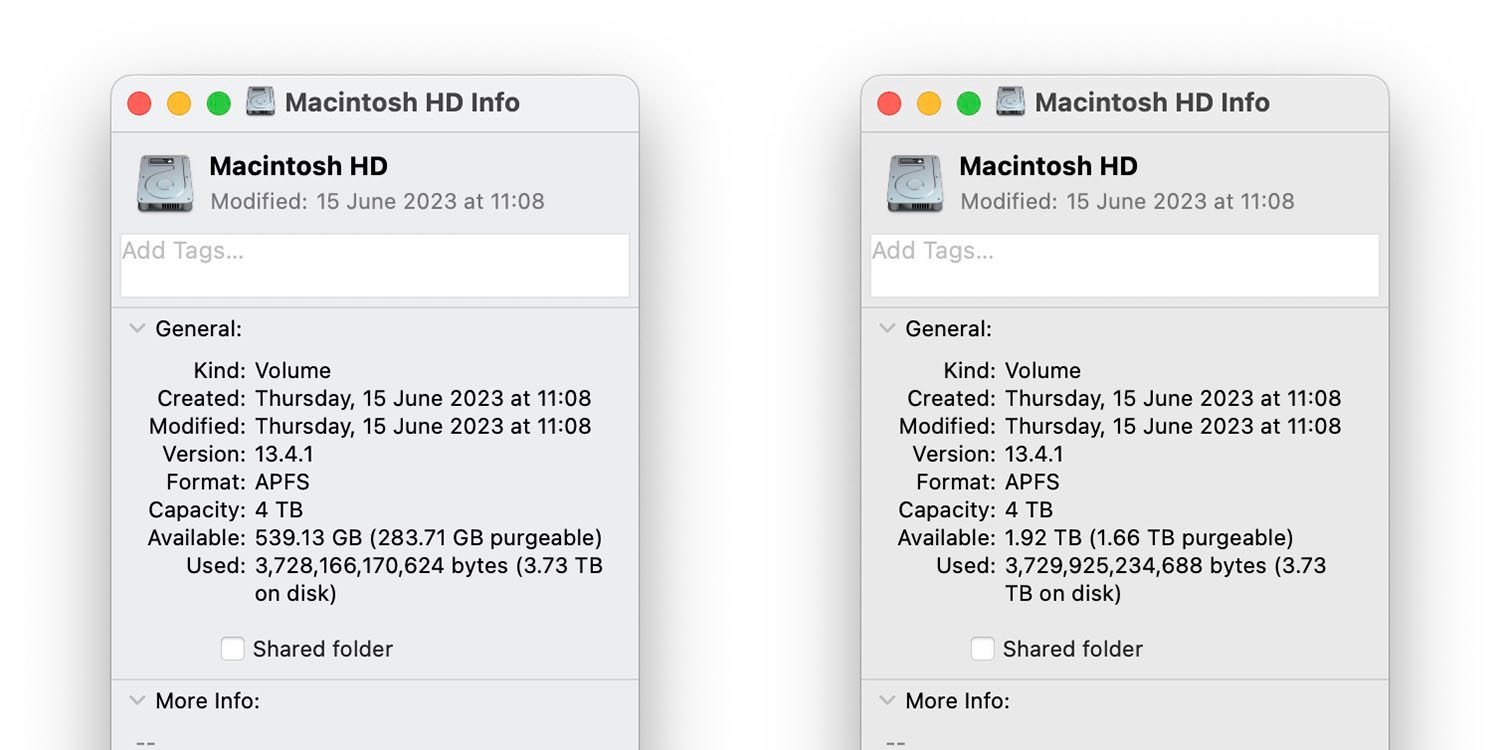
This may be something of an edge case, but as it caused me to waste a considerable amount of time Googling ‘Recovering Mac storage’ before the problem solved itself, I thought I’d share.
Having recently completed a 16-minute micro documentary, one of the things that shocked me was just how much drive space is eaten up! While the final cut was around one minute of interview per person, and a similar amount of dance footage, I of course shot more …
I shot around 20 minutes of interview footage with each person, and about 12 minutes of dance footage. Everything was shot in 4K, to have some framing flexibility in the 1080p edit, and the dance footage was also shot at 50fps for retiming to 24fps slo-mo. There was also music, a few bits of graphics, and separate audio files for the interviews.
In all, the total drive space occupied was 1.4TB!
Sure, there are workarounds for this, including keeping the files on external drives and working with proxy media, but I’m pretty paranoid when it comes to backups. By keeping everything on the internal drive during the project, it meant I’d always have a Time Machine backup, as well as an off-site copy on Dropbox, and both would be up to date without me having to do anything. (I also did manual backups of all the files onto two external SSDs.)
I was very much looking forward to recovering that space once the project was finally complete!
So, having triple-checked that I had copies of the latest versions of everything on external drives, I finally dragged the entire folder to the bin, did a final check, then emptied the bin. I checked the info on my internal SSD, looking forward to seeing an extra 1.4TB of storage space available, and found … nothing!
Top comment by CT
This behaviour is intentional. APFS doesn’t do in-place updates of blocks since that isn’t a thing with SSDs at the physical layer anyway. Updates are instead done by writing fresh blocks and marking them as the “newest version”. Features like Time Machine, Document Version, and duplicated files heavily rely on this functionality. Time Machine, for example, sees a single, consistent version of a filesystem while it’s making a backup.
Cleaning old versions is a rather expensive operation though: the APFS driver needs to go through its indices and be absolutely certain no running process needs them (locks are expensive). It does this housekeeping when the system has been idling for some time and doesn’t have energy constraints. It also does it when space gets really tight but your Mac will be noticeably slower during that time.
One way to trigger an APFS clean-up is to cause lots of old blocks to be no longer needed. If you use Time Machine, deleting local snapshots (sudo tmutil deletelocalsnapshots) will do the job. Watch the kernel_task process hog all the CPU while you get gigabytes of disk space back in mere seconds!
Like many things in macOS and iOS: don’t try to manage the system; let the system do it for you. Just like iOS chooses which app to kill when it needs the memory, macOS will clean up its disks whenever it has the time and energy (i.e., connected to power) unless it’s urgent. Free space in RAM and SSD is there to be used anyway.
For both used and available storage, the numbers hadn’t changed at all! I did a restart. Still nothing. I looked in Disk Utility; no enlightenment. Then started Googling.
Most solutions suggested deleting caches in the Library, but there was only 20Gb of Final Cut Pro caches. I zapped those, but that was all it recovered. I tried MacClean; nada.
The next troubleshooting step for any Brit is to make a cup of tea. This, it turned out, solved the problem! My 1.4TB space was back!
What apparently happens when deleting very large files or folders is that it takes macOS some time to actually realise that the space is available. So if you find yourself in a similar situation, recovering Mac storage may just mean waiting a while – though making tea is probably advisable, just in case.


FTC: We use income earning auto affiliate links. More.




Comments