
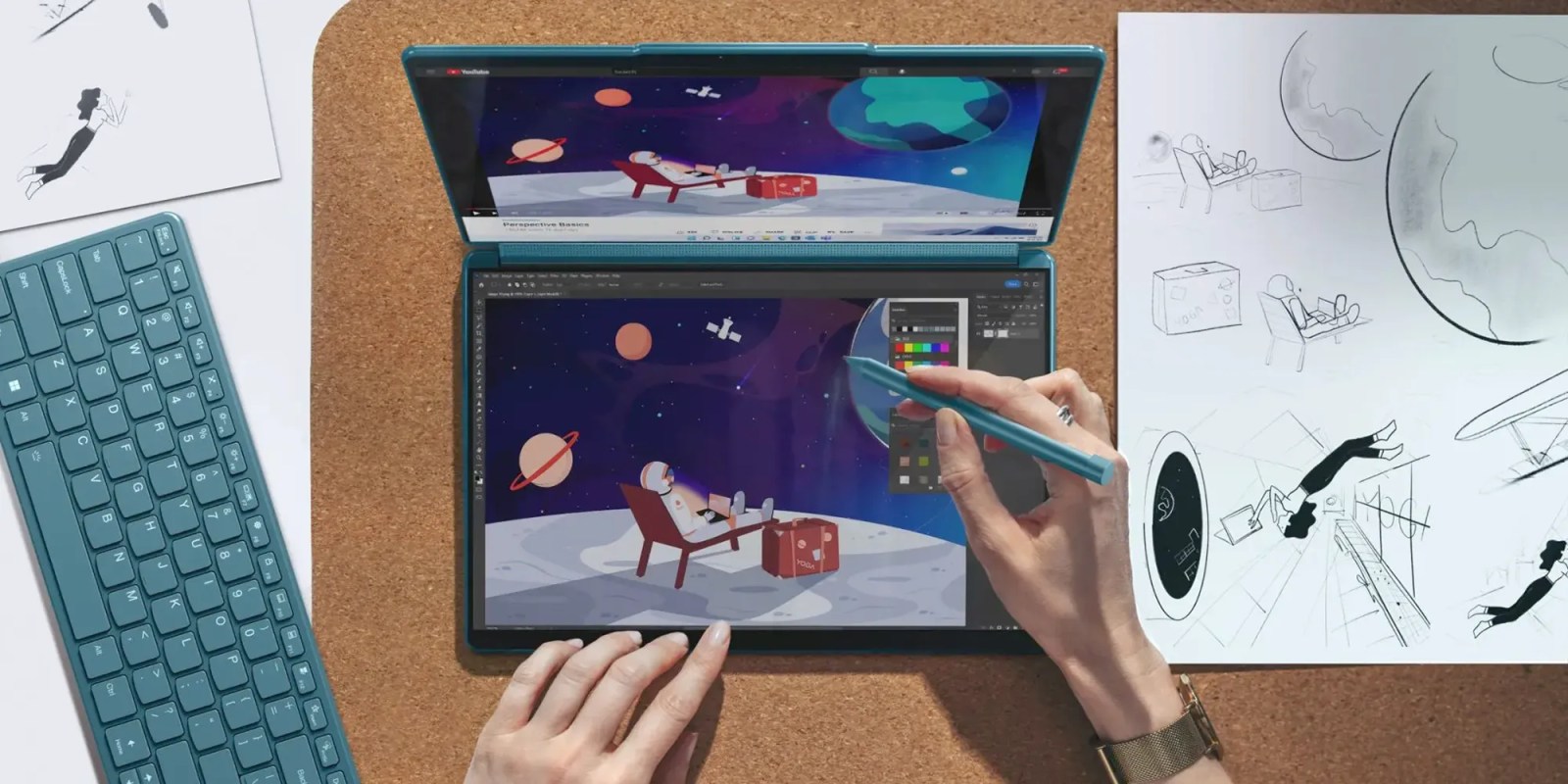
There have long been reports and rumours about Apple working on a foldable clamshell device that is either an iPad, a Mac, one of each, or a hybrid of the two.
A recent report said that although this was once a priority for new CEO John Ternus, the project had been cancelled – but I don’t think that’s entirely accurate …
Personally, I think the concept of a hybrid Mac and iPad has essentially been superseded by events. There are iPhone and iPad apps that will run on today’s Macs, and for many of us, iPhone mirroring is another tool we can use to achieve the same thing. We’re also seeing increasing convergence between the operating systems, and I’m sure that will continue: we’re now long past the point where Apple was arguing that we would be converging a toaster and a fridge.
But I do think we will eventually end up with an all-screen foldable Mac once the technology exists to make a soft keyboard a viable replacement for a hard one. That isn’t going to happen anytime soon, but it will happen.
The intermediate step of dynamic keyboards
The reason I think it is still a long way off is my belief that there will be an interim step in the form of dynamic hardware keyboards. It’s literally a decade since I talked about why I think these are the future, and while this type of tech is in use today for niche applications, they still haven’t yet hit the mainstream.
The Sonder Keyboard was one early attempt, using miniature e-ink displays to remap the labels and functions of the keys.

For example, a QWERTY keyboard is almost irrelevant to someone who spends all day video editing in Final Cut Pro, which is why there’s a market for both physical keyboards and overlays.
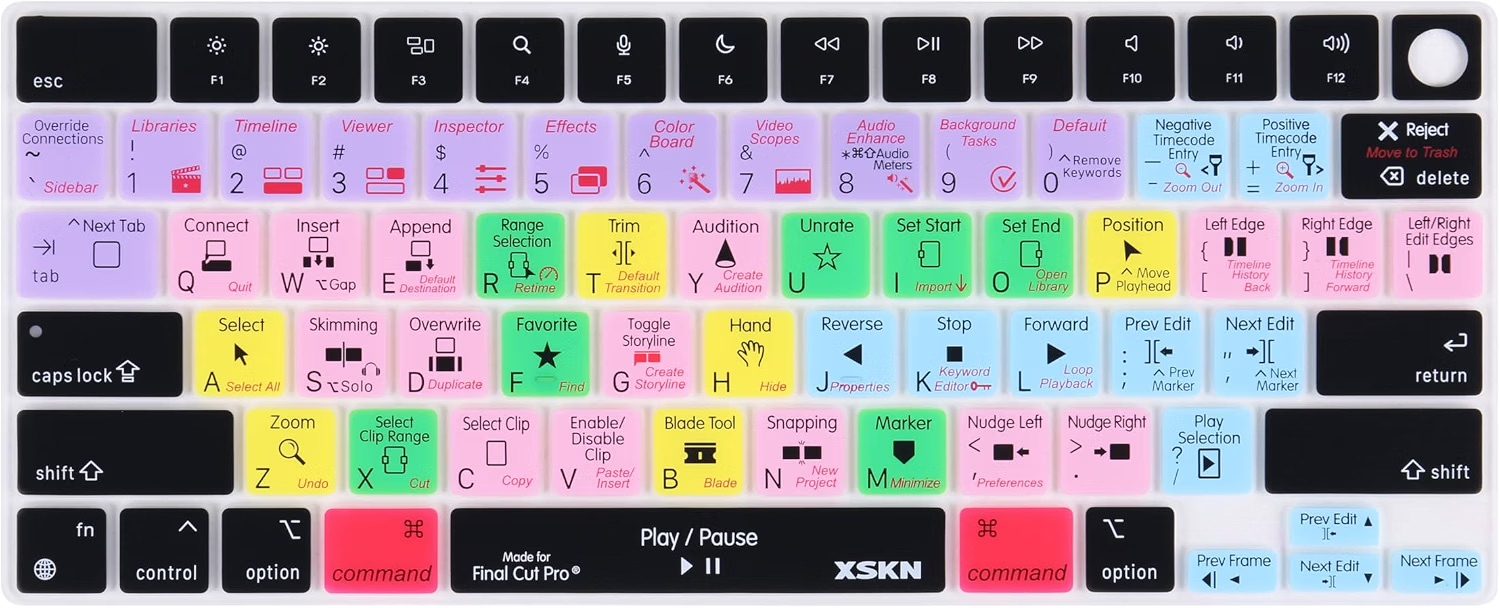
How much smarter would it be if our MacBook keyboard or desktop Magic keyboard could adapt its labels to match the app we are using at the time?
Soft keyboards that feel like hard ones
The longer term goal, however, is entirely soft keyboards. I said back in 2016 that the very same argument Steve Jobs laid out then for virtual keys on a smartphone when introducing the iPhone could be applied equally to a Mac keyboard.
What’s wrong with their user interfaces? They all have these keyboards that are there whether you need them or not. And they all have these control buttons that are fixed in plastic and are the same for every application. Well, every application wants a slightly different user interface, a slightly optimized set of buttons, just for it.
There are, of course, three problems with a soft keyboard:
- Glass keyboards are uncomfortable to type on
- We rely on key movement for feedback as well as comfort
- Touch typists need to be able to feel the keys before pressing them
Apple already has patents to address each of these. First, using a flexible display rather than conventional glass can allow for deformation when a virtual key is pressed. The second problem can be solved using a combination of this movement and haptic motors. Finally, there are two ways of addressing the issue of being able to feel physical keys beneath our fingers.
Apple’s patent was for an electrostatic charge that is perceived as a change in surface texture. In other words, charges can be applied to the surface of the display to make it feel like physical keys are present even though the surface remains flat. And in 2023, researchers at Carnegie Mellon University came up with another approach.
The FIG researchers have succeeded in creating embedded electroosmotic pumps (EEOPs)—capable of moving liquids by applying electrical fields instead of using moving parts—that measure just 1.5 millimeters thick. They can be paired with an equally thin liquid reservoir beneath them, and a flexible surface structure on top, to almost instantaneously create pop-up buttons (the process takes about a second) measuring almost five millimeters in height with enough pressure and rigidity to make them feel solid when pressed.
It’s ‘when’ not ‘if’
Of course, all of this tech is still at a very early stage, but we have only to look at Mac trackpads for precedent. These still sound and feel like they are mechanical devices, but they have for years been solid-state devices that use haptics to simulate physical clicks – and they are incredibly convincing.
Soft keyboards will eventually reach that same level of sophistication. They will solve all three of the issues listed above, whether using the approaches Apple has postulated so far or new technologies that have yet to emerge.
Top comment by RDW
I'm pretty sure my Macbook Pro already folds, but let me go double check - Oh yes, it does.
When that happens, Steve’s arguments will apply equally to the Mac. In clamshell form, the keyboard will take whatever form makes sense for the task we are carrying out at the time. When all we need is a single giant display, be that for viewing movies or sketching using an Apple Pencil, then we will simply unfold it into a screen that is twice the size.
So I fully accept that the first generation product may have been put on the back burner for now, but that is absolutely not the same as saying it has been cancelled. This is technology whose time will come.
Those are my thoughts; what about yours? Please share in the comments.
- Certified refurbished Apple products 15% off at apple.com
- Official Apple Store on Amazon
- Discounted AirPods Pro 3
- Wireless CarPlay adapter
- 10-year AirTag battery case
- Logitech MX Master 4 for Mac
Photo shows an early Lenovo Yoga Book courtesy of Lenovo


FTC: We use income earning auto affiliate links. More.




Comments