
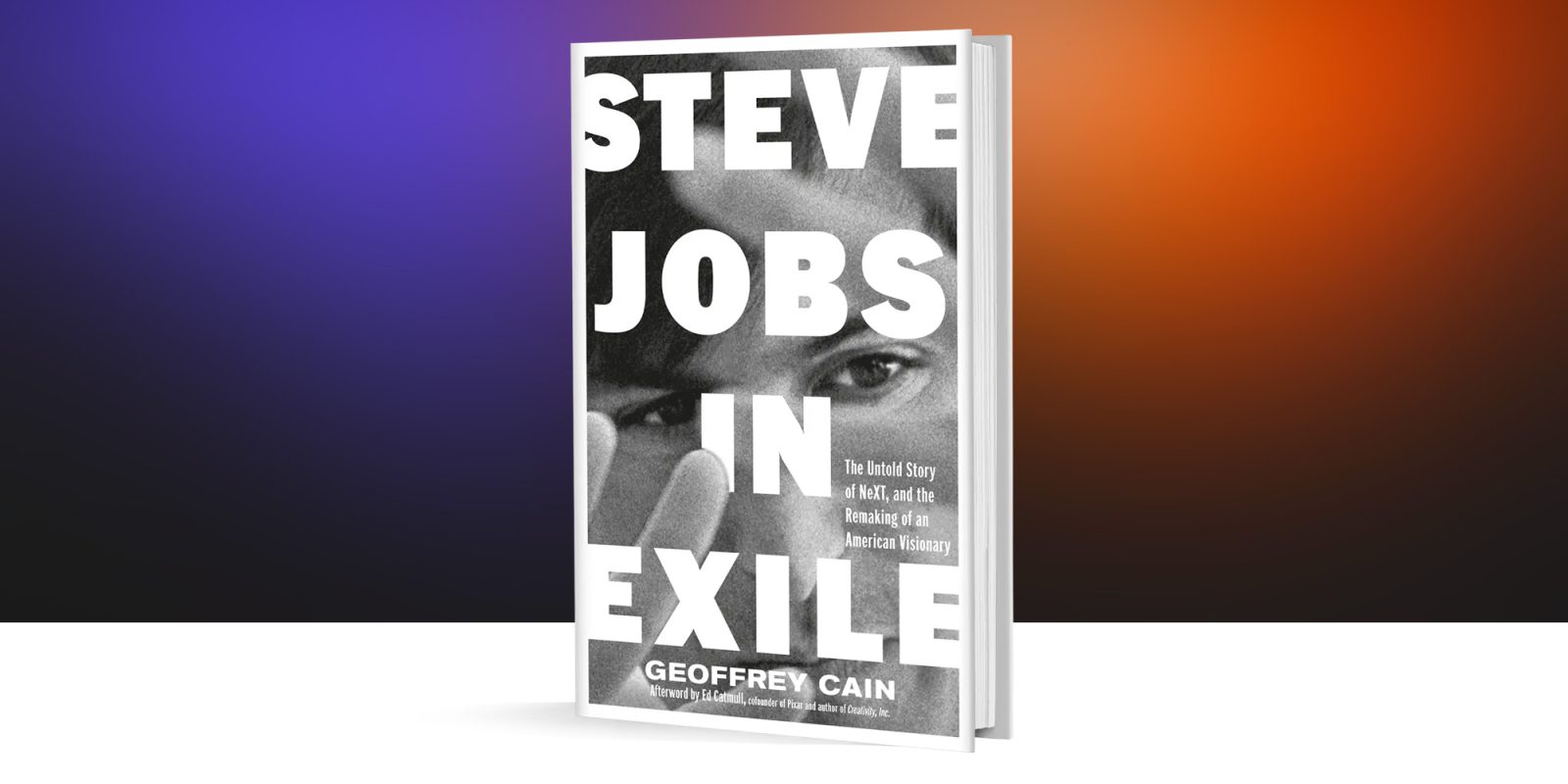
This week marked the release of ‘Steve Jobs in Exile: The Untold Story of NeXT and the Remaking of an American Visionary,’ by author Geoffrey Cain, a deliciously thorough book that dives deep into the years that most people overlook when retelling the Apple co-founder’s famous redemption story.
‘Steve Jobs in Exile’ adds interesting layers to what you think you knew about Steve Jobs
There is a scene in Kevin Smith’s ‘Dogma,’ where Rufus, the forgotten 13th apostle played by Chris Rock, notes:
In the Bible, Jesus goes from twelve to thirty. That’s some pretty bad storytelling.
And while Steve Jobs was no Jesus Christ by any stretch, I kept coming back to this notion of lost memory as I devoured Geoffrey Cain’s new book, Steve Jobs in Exile: The Untold Story of NeXT and the Remaking of an American Visionary.
As Cain notes in the book’s acknowledgments, Steve Jobs in Exile is the fruit of years of research, greatly expanded by interviews with “111 individuals who gave their time,” and shared their lived experiences before, during, and after Steve Jobs’ wilderness years.
That includes NeXT cofounders such as Dan’l Lewin, Susan Barnes, Rich Page, George Crow, and Bud Tribble, Pixar cofounder Ed Catmull, NeXT alumni turned (former) Apple executives Jon Rubinstein and Bertrand Serlet, photographer Doug Menuez, and former Apple executive Jean-Louis Gassée, to name a few.
Split into three parts containing 28 chapters and an epilogue, plus a foreword by Lewin and an afterword by Catmull, the book tackles the challenging task of telling a story that most people know how it ends, presenting new information taken directly from personal archives, and from the memories of the key people who were in the room for discussions and events that otherwise would have been completely lost to time.
Steve Jobs in Exile also treads the line of presenting just the right amount of technical details as to not overwhelm less technically-inclined readers who might be interested in Jobs’s “lost years,” but never underestimating the reader.
From the relevance and the technical aspects of WebObjects, to the minutiae of bookkeeping and stock compensation, the book never treats the reader as if the hard parts need to be dumbed down or glossed over. Cain even cooks up an analogy for object-oriented programming that I’ll absolutely be using from now on.
Another interesting aspect of Steve Jobs in Exile is just how much today’s main themes in tech are just repetitions of past dramas, issues, and overall politics.
From the appeal of an all-American computer, to no-code development, to skepticism over transformative new technologies, to uncomfortable deals with the military, to the government’s issue with cryptography, and even Steve Jobs’s desire for NeXT users “to have access to a complete creative studio,” in contrast with Apple’s recent launch of the subscription-only Creative Studio suite, revisiting Steve Jobs’s “lost” years at NeXT felt surprisingly contemporary throughout.
As for Steve Jobs himself, there is a familiar element of the person most Apple watchers are probably well versed in by now: vindictive and mercurial, but also generous and indecisive. That is to be expected. After all, he was still the same man. But Steve Jobs in Exile adds a new layer to those contradictions, showing Jobs as far more a reluctant leader than the myth often allows, as he coped with the lives he was giving up to live the one he was living, to paraphrase the man himself.
Perhaps more importantly for anyone interested in the real history of Apple, Steve Jobs, and NeXT, Steve Jobs in Exile helps demystify and debunk some of the misconceptions that have permeated the broader zeitgeist in recent years, particularly the ones reinforced by Aaron Sorkin and Danny Boyle’s Steve Jobs. (I love them both, but that wasn’t their finest hour.)
Steve Jobs in Exile begins and ends in very familiar territory. But it introduces details, great quotes, even greater anecdotes, and just the right amount of cinematic intrigue to make you wonder how some of these stories remained untold for so long, and be thankful as I was that they weren’t lost to time.
You can buy Steve Jobs in Exile on Amazon. And be sure to check out the most recent episode of 9to5Mac’s Apple @ Work Podcast, where host Bradley Chambers interviews author Geoffrey Cain about the book.
Worth checking out on Amazon
- Geoffrey Cain – ‘Steve Jobs in Exile’
- David Pogue – ’Apple: The First 50 Years’
- MacBook Neo
- Logitech MX Master 4
- AirPods Pro 3
- AirTag (2nd Generation) – 4 Pack
- Apple Watch Series 11
- Wireless CarPlay adapter


FTC: We use income earning auto affiliate links. More.


Comments