Author

Avatar for 9to5 Staff

9to5 Staff

Fingerworks.com shut down ahead of Tablet launch

Site default logo image

Fingerworks.com (Internet Archive) has been shut down, five years after Apple purchased the company. MacRumors postulates that the closing might have to do with the upcoming tablet (+multi-touch pad peripheral?) device that Apple has planned.  They note the following from an old press release that may perhaps be relevant:

The MacNTouch Gesture Keyboard is a complete user interface that serves as mouse, standard keyboard, and powerful multi-finger gesture interpreter. Mouse operations like point, click, drag, scroll, and zoom are combined seamlessly with touch-typing and multi-finger gesture everywhere on the MacNTouch’s surface.
….
People are amazed by all the things a hand gesture user interface provides. We have a large number of easy- to-use gestures that cover just about every common computer operation. Users don’t have to reach for hot-keys because gestures are faster and easier to do.

Adobe originally wanted to build printers, was partially owned by Apple

Site default logo image

Some fun facts via Jon Nack that put into perspective how Apple and Adobe have been connected since “the beginning”…

I’ve heard Drs. Warnock & Geschke talk about how they started Adobe with the intention of selling printing hardware, and how they shopped this idea around and around until they finally agreed to do what customers wanted: just sell them the software. They depict it as something of a forehead-slapping moment that changed everything.

Adobe’s first big break came when [Adobe Founders] Geschke and Warnock convinced Apple Computer Inc. to use Post-Script with its LaserWriter printer. As part of the deal, Apple purchased a 19-percent stake in Adobe. The first printer using the PostScript language was made available for sale in 1985. Texas Instruments Inc. began using PostScript in its IBM-compatible PCs in 1986. That year, Adobe conducted its initial public offering (IPO).

It will be interesting to see if Apple invites Adobe Flash to be on the future iPhone or the tablet or if Adobe’s products get any better on the Mac platform.

Some more interesting stuff:

The hands-on nature of the [Adobe] startup was communicated to everyone the company brought on board. For years, Warnock and Geschke hand-delivered a bottle of champagne or cognac and a dozen roses to a new hire’s house. The employee arrived at work to find hammer, ruler, and screwdriver on a desk, which were to be used for hanging up shelves, pictures, and so on. “From the start we wanted them to have the mentality that everyone sweeps the floor around here,” says Geschke, adding that while the hand tools may be gone, the ethic persists today.

Apple shopping tablet around hospitals?

Site default logo image

Remember when Steve Jobs couldn’t figure out what a tablet would be good for?  He told his engineers,”what are they good for besides surfing the Web in the bathroom?”

Maybe Jobs’ liver transplant ordeal gave him the final answer.  During his stay in the hospital, he had to have seen what an absurd nightmare of a bureaucracy the US health care system was and at the same time what benefit a tablet could bring to the whole operation.  Doctors often use bulky, three pound tablets to do their work. 

Can you imagine Jobs in the hospital seeing people running around with an unreliable Windows Vista tablet.  “So let me get this straight.  You pay $3000/apiece for that and there are 10,000 employees here and there are thousands of hospitals like this all over the world?  And it runs Windows?”

This isn’t just conjecture according to Jason Wilk at TinyComb. Apple has spent the last 6 weeks courting doctors at Cedars Sinai in Los Angeles…

Apple has been going around targeting their first major paying customer for the device, which is not the average consumer, but the Healthcare industry (sorry fanbois, you

iPhone, Droid, Nexus One, and Eris capacitive touch screens compared

Site default logo image

So smartphone hardware is smartphone hardware right?  They probably all use the same capacitive touch screen parts from the same suppliers in China right? 

Actually no.  And this test from MOTO proves it.  According to their (frankly a bit unscientific) tests, the capacitive touch screens from Motorola and HTC aren’t nearly as accurate as the one that Apple uses in the iPhone.  Whether this is related to software or hardware isn’t certain, but it is clear that Apple’s iPhone has a distinctive lead in touch screen accuracy, which in turn leads to a better touch and typing experience.  Perhaps this is yet another example of Apple’s hardware/software integration proving to be an advantage.

http://vimeo.com/moogaloop.swf?clip_id=8569827&server=vimeo.com&show_title=1&show_byline=1&show_portrait=1&color=ffffff&fullscreen=1


The results, you can see below, favor the iPhone pretty significantly, with Motorola’sDroid doing the worst of the four and HTC’s being middle of the road.

via TechChrunch

US digital sales boom – and vinyl comes for the ride!

Site default logo image

Vinyl sales hit a historical high last year as US music purchases climbed 2.1 percent year on year and digital sales accounted for 40 percent of total US music purchases, Nielsen SoundScan confirmed today, up from 32% in 2008.

The news follows an August 2009 NPD Group report which confirmed iTunes-purchased songs now account for 25 percent of the overall music market–both physical and digital – in the U.S..

(During the first half of 2009, iTunes itself snagged a 69 percent share of the overall digital music arena, trailed far behind by Amazon.com with 8 percent – this may have changed but we haven

Tablet will have 'aluminium' casings, Q2 launch says Reuters

Site default logo image

According to Reuters, the pieces are literally coming together for Apple’s new Tablet.  Kelvin Soh says two ‘sources familiar with the situation’ expect a Q2 launch — which has been reported before.  He does, however, say that the casings will be made of aluminum (or the British: aluminium) which would imply that they might be more ‘Unibody’ looking than current iPhones which have plastic backsides.

Suppliers for Apple Inc’s new tablet computer have begun shipping touchscreen panels and will start delivering aluminium casings for it next month, sources said, implying a second-quarter product launch.

AVY Precision Technology Inc, a Taiwanese manufacturer of covers for electronic products, will begin production of the cases in February, two sources familiar with the situation said on Friday.TPK Solutions, an unlisted touch screen panel maker also based in Taiwan will also supply panels for the product, a third source said, on top of those already being manufactured by another Taiwan company, Wintek Corp.

“Production of the cases will begin in February, so everything points to a second-quarter launch right now,” said one of the sources. “It doesn’t take that long for the company to assemble the PC together, but a second-quarter shipment date is what we’re looking at now.”

We know Apple has patented the Unibody construction for iPods and iPhones.

CES: Imagination announces POWERVR SGX545 graphics core, potentially next iPhone graphics chip

Site default logo image

Imagination Technologies, a partially Apple (and Intel)-owned UK firm that has been providing the graphics chips for every iPhone to date, announced their latest graphics core today.  The POWERVR SGX545 ups output capabilities to 40 million polygons/sec (up from previously 26 million) and resolution to 1080P with high framerates (60FPS?) and 3G graphics.

SGX545 will also deliver OpenGL ES 2.x and OpenGL 3.2 to deliver class leading 3D graphics performance, and will also support OpenCL 1.0 full profile capability which will enable mobile and embedded applications to take maximum advantage of the capabilities offered by these GPU APIs for both 3D graphics and general purpose applications.

POWERVR SGX545 is available for licensing now. The IP is already proven in silicon in a test chip from Imagination and licensed by a lead partner.

There is every possibility that the “lead partner” is Apple, as they are part owners in the company and have recently upped their percentage ownership significantly.   Imagination also makes graphics cores for other devices including the Palm Pre, however.

Also, as you might have guessed, this processor might find its way into Apple’s tablet as well.

Apple developing new atrium-style retail store (with trees!) concept

Site default logo image

We’re beginning to think Apple never sleeps, as news comes in claiming the company is about to revise the already extremely successful retail formula it has been running on high streets worldwide.

Mercury News tells us the company intends construction of a new prototype store in downtown Palo Alto, where it is about to move its existing store to a larger space – and there’ll be trees inside the shop.

In a company filed planning application, project developers called the shop “a new prototype for the company.” The report claims, “The facade will be entirely transparent at ground level, vast skylights will flood the store with natural light, and trees will grow inside, fed by the sunlight from above, according to a proposal submitted to the city’s architectural review board.”

Located at 340 University Ave. the building is 86-years old. The architectural review board approved Apple’s plan 3-0, we learn, though the company wasn’t named in the meeting. However, Mercury News sources have confirmed it is Apple making the tree-friendly move.

CES: Boxee beta ships, Apple TV version to follow

Site default logo image

Fresh from the CES introduction of the D-Link Boxee box and the all new and quite lovely remote control which accompanies it, the Boxee team last night announced the Boxee Beta is officially out, reports Distorted Loop.

The Beta is available for Mac, Windows and Ubuntu (including 64bit). The version is still not available for Apple TV, yet, but Boxee is working with the atv-creator community, and

Google delivers extensions support for Mac version of Chrome (developer channel)

Site default logo image

[youtube http://www.youtube.com/watch?v=P3AsjP-UzMA&color1=0xb1b1b1&color2=0xcfcfcf&hl=en_US&feature=player_embedded&fs=1]

Google has introduced support for extensions within the Google Chrome for Mac dev channel edition.

Google Chrome already supports extensions on Windows, while the currently circulating public beta version of Chrome for Mac does not yet support the Chrome extensions. Now, as support has reached developers we speculate it

Apple – now Greenpeace's Number One green computer/electronics company

Site default logo image

Apple has worked hard on its environmental record, and today Greenpeace confirmed this with news that Apple is now the world’s greenest computer and consumer electronics company, as confirmed in the latest edition of its rankings guide.

As follows: “Our ranking guide, published since 2006, shows clearly how the 18 top consumer electronics companies line up. This new chart shows which of those companies have eliminated the most harmful chemicals from their product ranges.

“Gold stars represent products free of the worst hazardous substances. Smaller stars mean there are lmited products free of worst hazardous substances. A grey star means none of the products made by this company in these product categories are free of worst hazardous substances. And finally, a dash means that the company doesn’t make that kind of product.

“APPLE: Apple is leading the way on eliminating toxic PVC and BFRs from all it’s new products with the new iMac and MacBook being the first PC’s copmpletely free of PVC and BFRs.”

Core i5 and Core Duo compared by Intel at CES

Site default logo image

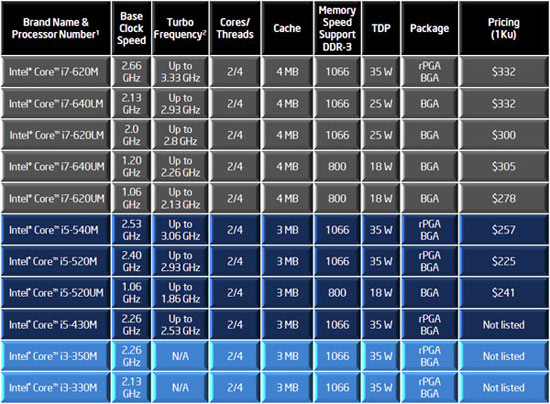
The likely successor to the Intel Core 2 Duo in MacBook Pros is the Core i5 processor which Intel introduced this week at CES.  Engadget caught a video of Intel comparing their old tech to new tech.  The first test was a iTunes rip which was about twice as quick.  The second encode shows the advantage of virtual cores that the i5 have. 

http://www.viddler.com/simple_on_site/b6846c36

As Macrumors reports, Intel Exec Sean Maloney was asked to confirm whether or not i5s will be heading into MacBooks.  His response?

 “I do not pre-announce our partners’ products and I certainly don’t pre-announce Apple’s products.”

Apple is generally thought to be readying these chips for MacBook Pros, though it isn’t certain whether they will jump on the first version or wait for a more efficient i5s expected mid year.  Intel’s product matrix is below:


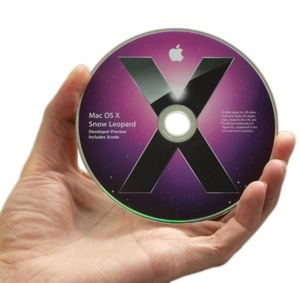
Apple seeds Mac OS X 10.6.3 Build 10D522 to testers

Site default logo image

Apple has reportedly begun seeding Build 10D522 of Mac OS X 10.6.3 to a limited set of developers, marking the first official beta version of the third maintenance release for Mac OS X Snow Leopard, MacRumors informs.

Apple has addressed approximately 225 issues in the update, which reportedly weighs in at roughly 666 MB. The company is asking developers to focus their efforts on around 90 system components.

Somewhere on the Internet we picked up the seed note which warns of four unresolved known issues:

– Applications may not be updated if they had been moved from the default location.
– Displays Preferences may show duplicate profile entries.
– iTunes may hang when playing a web stream.
– The ColorSync Utility Filters tab may cause unexpected results.

Focus Areas (Changes in 10D522):

Account Preferences
– Fixes an Accounts Preferences issue when there is more than one account.

Address Book
– Fixes an issue with Review Duplicates when updating cards.
– Resolves importing issues with vCards.
– Resolves an issue when resizing cards.
– Resolves finding people with birthdays via an automator action.

Address Book Framework
– Resolves crashes in Mail when using the Address Book Framework.
– Resolves a Mail issue where the wrong name is displayed.

AppKit
– Resolves a copy and paste issue.
– Resolves an NSFileWrapper issue.
– Fixes some AppKit crashes.
– Resolves an autocorrect spelling issue.
– Improvements to spellchecking.
– Resolves some graphics corruption issues when converting a PICT to a TIFF.

AppleWWANSupport
– Resolves some crashes in WWANd.
– Resolves some issues when establishing connections with a WWAN device.

Applescript
– Resolves a crash in Applescript when running in 32-bit mode.
– Resolves an issue with BBEdit recording of scripts.

Apple Software Restore
– Resolves an Apple Software Restore crash.

ATS
– Resolves Font issues after log-out or reboot.

CarbonCore
– Resolves an issue with applications with # or & symbols in its filename.
– Resolves coreservicesd crashes.
– Resolves TextEdit permissions issues.
– Performance improvements with save panels.

CFNetwork
– Addresses compatibility issues with Wiki Server.
– Resolves crashes related to canceling a request in progress.
– Cookie fixes to broken websites.
– Resolves Exchange account authentication issues.

ColorSync
– Resolves a crash when a PDF document uses DeviceRGB.
– Resolves an issue where Displays Pref with Color selected unexpectedly crashes.

configd
– Improvements to USB Ethernet adaptor behavior.

CoreAudio
– Resolves issues with AudioUnit metering.
– Resolves some CoreAudio crashes when opening AUNetSend in 64-bit mode.
– Resolves some crashes in SpectralBandReplication when playing HTTP live stream.

CoreData
– Resolves CoreData model-store mismatch issues.
– Resolves crashes in GarageBand.
– Fixes an issue in MPEG surround handler.

Core Foundation

– Resolves some Photo Booth, iChat, and Safari crashes.

CoreMedia
– Resolves issues with audio streaming.
– Resolves a number of crashes in CoreMedia.
– Resolves some playability issues of movies in Safari.
– Addresses compatibility issues with MTS formatted files.
– Addresses compatibility issues with MPEG4 files with AC3 tracks.
– Resolve export issues to .m4v movies.
– Resolve screen recording issues.
– Fix subtitle rendering issues with figplayL.
– Fixes an H264 decoder issue with video_range bit.
– Resolves an iMove image through built-in iSight stuttering/tearing issue.
– Improvements to CoreMedioIO graph topology.
– Resolves some display resolution and screen recording issues.

CorePDF
– Performance improvements when opening large PDF files in Preview.

CoreText
– Resolves some crashes with iMovie in CoreText.
– Resolves some crashes with PhotoBooth in CoreText.
– Addresses issues with variation font support.

CoreServices, CFNetwork
– Resolves a crash in CoreServicesUIAgent.
– Resolves a Safari issue with SSL certificates.

CoreVideo
– Resolves a crash when creating pixel buffers simultaneously.
– Resolves some crashes in CVPixelBuffer.

CUPS
– Resolves some cupsd crashes.
– Fixes an issue with the “Resume” button when printing.
– Resolves some supply levels crashes.
– Resolves some side-channel request issues.

Date & Time Pref
– Resolves an issue with clock ticking after daylight savings.
DataDetectors
– Resolves some crashes in DataDetectors.

Desktop Services
– Resolves hangs with NSOpenPanel in Desktop Services.
– Resolves a Flash CS4 hang when clicking the “browse” button.
– Resolves some hangs and crashes in Finder and Folder Actions Setup.
– Resolves home folder issues in the Go To window of the open/save panel.
– Resolves last opened folder issues.
– Resolves Spotlight query issues.
– Resolves Time Machine search issues.
– Resolves a copy file issue with error -36.
– Resolves an error -47 issue when user is doing a move replace of a bundle.
– Resolves UI layout issues for language specific settings.

Dictionary Application
– Resolves some crashes when using Dictionary.
– Resolves some Dictionary Panel issues.

Directory Service
– Resolves deadlock issues.

Disk Management
– Resolves some diskutil errors.
– Resolve diskutil unmount issues.

Disk Utility
– Resolves restoring disk image issue with checksum.
– Resolves a crash in Disk Utility with a missing external drive.

Dock
– Resolves momentum scrolling issues.
– Resolves some dock crashes.
– Resolves some Expos