Author

Avatar for 9to5 Staff

9to5 Staff

Apple now offering anti-glare display option with MacBook Pro

Site default logo image

Apple has begun offering a matte display (antiglare) screen as a build-to-order option on the 15-inch MacBook Pro.

Previously only available as an option on the 17-inch MacBook Pro, Apple has been expected to widen availability of this element.

Customers purchasing a 15-inch MacBook Pro can order one with a matte screen directly from Apple. There’s a cost, though, this sets you back $50 in the US and £40 in the UK.

The matte screen is listed under the configuration options and is available for all three 15-inch MacBook Pro models.

Apple makes a point of saying the hi-gloss screen  "lets you view graphics, photos, and videos with richer colors and deeper blacks".  However, we know more than a few people who will forgo that for less shiny.


Display

The 15-inch MacBook Pro comes with a 1440-by-900-pixel LED-backlit display. Choose a standard glossy display that lets you view graphics, photos, and videos with richer colors and deeper blacks, or an optional antiglare display.

About glossy and antiglare
Choose the glossy widescreen display to make your graphics, photos, and videos appear with richer colors and deeper blacks — great for watching DVD movies. If you prefer a display with antiglare coating for a matte rather than glossy viewing experience, choose the antiglare widescreen display.

Important note:The actual size of the display is the same (15-inch diagonal) on both models. The antiglare display has a silver frame (border) around the display.
The actual size of the display is the same (15-inch diagonal) on both models. The antiglare display has a silver frame (border) around the display.


Cupertino city chiefs bless Apple's number two campus

Site default logo image

Driven by Apple and HP, business is booming in the two firms’ home city of Cupertino, and a grateful city council has made available near half a million square feet of office space in the city for use by the big companies there.

The city council voted 3-2 on July 21 to allocate an additional 483,053 square feet of office space, and this space is exclusively reserved for big companies in Apple’s league.

“We live in a pretty rich city,” councilwoman Dolly Sandoval told Cupertino Courier, “and I don’t mean rich as in wealthy, I mean rich with people and active companies. I want to encourage growth of these major companies.”

Apple and HP are the biggest sales tax producers and employers for the city, and reps from both firms thanked the city council for considering allocating oout more office space.

Apple’s Steve Jobs visited the council in 2006 to say the company hoped to build a second Cupertino campus. Release of this new space seems set to encourage development of that second area as Apple’s business grows.

To get a general idea as to just how much Apple’s business has grown in the last few years, why not flash back to July 16, 2003, when the company’s third quarter results revealed a net profit of $19 million on revenue of $1.545 billion.

This was the period when iPods reached their third generation build, the iTunes Music Store opened for business and Mac OS X 10.3 Panther had reached its developer preview.

July 21, 2009, and the company revealed revenue of $8.34 billion and a net quarterly profit of $1.23 billion. This suggests that in revenue terms alone, Apple’s business has increased five-fold.

And while we looked to iPod 3Gs then, we’re expectant on iPhone 3GS, Apple tablets and a new range of iPods soon, coupled with the release of Snow Leopard.

With Apple now inarguably a top employer and tax payer in Cupertino, it is no surprise the companies won this extra real estate after its long lobbying for the same. "I think this council is sending a strong message that we do appreciate having Apple and HP in our city and wanting them to be here," councilman Mark Santoro said.

SlingPlayer 1.1 does 3G streaming…not in the US

Site default logo image

Sling has submitted a refresh of its popular iPhone application(iTunes Link) with some nice extras.  Both native DISH support and Widescreen 16:9 (full iPhone) viewing are on the version 1.1 list but something that will get tounges wagging is also being submitted.  Sling 1.1 is gearing up to work over 3G networks …as long as that network isn’t AT&T in the US.  It isn’t certain whether you’ll be able to take your AT&T-locked iPhone overseas to get your Daily Show fix, but with AT&T’s absurd international roaming rates, who’d want to even test this?

(ahem FCC? Anyone home? Think AT&T had anything to do with this App Store decision?)


Taking underwater iPhone usage to a new level

Site default logo image

Far from just accidentally dropping an iPhone 3GS into a pool, Sterling Spenser took his (assumingly waterproofed) iPhone for a little ride, filming the whole adventure with the built-in video camera.  Another one bites the dust.

http://vimeo.com/moogaloop.swf?clip_id=5835424&server=vimeo.com&show_title=1&show_byline=0&show_portrait=0&color=ffffff&fullscreen=1

Sterling Spencer was chatting on his waterproof cell phone while sitting on his board and waiting for waves in Mexico, when a set came in. He had the phone in his hand, so he went ahead and filmed himself on the wave. Via Elgan


Twin UBS analysts agree Apple inks Verizon for 'future data-centric product' – anyone need a tablet?

Site default logo image

There’s always a danger when dealing with rumour that far-fetched tales begin to sprout their own wings; but when a leading analyst’s firm has two separate analysts referring to the same rumour in different reports, then you know the heat’s turning up.

The analysts at UBS clearly think the Apple tablet rumour has legs. UBS analyst Phillip Huang today downgraded RIMM stock to Neutral from buy and cut his target price, albeit by just two dollars.

Over at the next desk, analyst Maynard Um today issued a  short term buy rating on Apple stock

What’s got these two men all jiggy? Why, it’s the Apple tablet rumour, of course, boosted by their perspective that the company will launch a “data-centric product at Verizon,” (Um), while his colleague (Huang) expanded the point, warning that a new relationship between Apple and Verizon may threaten AT&T.


A potential launch by Verizon Wireless of a data-only Apple device later this year "may raise some concern that an iPhone may be coming" by virtue of the fact that Apple Inc. and Verizon Wireless would then have a direct business relationship, he notes.

With the iPhone currently available only through AT&T – who changed their terms and conditions in order to make it harder to complain about its services just the other day – the analysts think RIMM may be under threat as Apple expands iPhone reach.

The upshot of all this activity is that Apple’s stocks are now at ‘Buy’ while RIMM’s stand at ‘neutral’, according to UBS. And the financial markets clearly believe Cupertino plans to drop a tablet on our laps.

Dell to beat Apple to China Smartphone market?

Site default logo image

Techcrunck says that Dell is about to enter the Chinese smartphone market with its own super-secret gadget.  Arrington notes:

A source with knowledge of the situation tells us that Dell is launching (or at least announcing) a mobile phone in China in the next day or two.

Dell’s smartphone has been rumored for awhile now with different reports coming every few months.  AT&T wireless CEO Ralph de la Vega even let it slip that they were looking at a device from Dell. 

Apple isn’t asleep at the wheel however.  They are closing in on having a deal with China Unicom, the second largest phone provider in the country of 1.3 Billion potential customers. 

 (image via Engadget)

Apple's tablet means more education as e-Books prepare for a big-screen future

Site default logo image

UPDATE: Our notions on this took a definite uptick this morning on reports pointing out that eBooks are now the second-biggest category on the App Store, just after games.

With a solid one-in-four (27.3 per cent) of computers going into schools and other educational institutions across Europe being Apple-made, it’s no surprise that education’s a key market for the company. 

Apple isn’t just the largest in Europe.  Apple passed Dell last year to become the biggest supplier to education in the US in portables sales as well.  With Amazon’s Kindle DX aiming square at the education textbook market we don’t see Apple handing this market over to Amazon.  We think an Apple tablet will at least partially be aimed at that market.

Strike one today comes on news that e-textbook provider, CourseSmart, intends releasing all its 7,000 titles in a format that’s accessible on an iPhone or iPod touch. And it’s no stretch of sanity to think the true target here is to make this content available on the heavily rumored media-centric Apple tablet.  Just like the larger Kindle DX tablet is aimed at Textbooks, a tablet Mac would be a big player in this area more so than a smaller iPod touch or iPhone ever could ever be.

The new applications, free for subscribers, will let students access their full electronic textbooks, read their digital notes and search for specific words and phrases.

"Nobody is going to use their iPhone to do their homework, but this does provide real mobile learning," said Frank Lyman, CourseSmart’s executive vice president. "If you’re in a study group and you have a question, you can immediately access your text."

CourseSmart aren’t the only people working to get their materials onto Apple’s burgeoning mobile platform. We spoke with ScrollMotion (who presented at WWDC), who are developing Iceberg Reader 3.0 to offer iPhone/iPod touch support.

“With the release of the iPhone OS 3.0 this summer, Iceberg will offer powerful, new functionality that will give readers improved ways to enjoy their favorite books, magazines and newspapers. And we look forward to announcing more features in the months to come,” the developers explain.

While the company is reticent to discuss any features, we can imagine they could include improvements in the existing capacity to annotate texts on your mobile device…just a shame the devices are so small and awkward for full book reading…if only these e-books were sold at higher resolution for use on other devices running the same essential OS. Like a Mac, for example, or, erm, an Apple tablet, maybe?

ScrollMotion currently offer over 500 best-selling books in the App Store, and will soon be bringing over a million books, as well as more than 50 major magazines and over 170 daily newspapers to the iPhone. (Publishers include the big names: Harper Colllins, Random House, Pearson, Simon and Schuster, etc…)

Look, it may seem strange to shift from books to e-books, but for school districts there’s real savings which hopefully can be passed into other sectors (assuming budget making chiefs don’t simply claw that book money back). But we’re dealing with a new generation of kids today, already immersed in use of technology in the home, from computers to catch up TV shows to the Nintendo DS and more, we have a new generation of “digital natives”.

Apple has a host of one-on-one deals with education districts on a global level, indeed, the company frequently says education is “in its DNA”.

We’re also moving away from software-based solutions to solutions based on content already available online, perhaps even to the eventual disappearance of the OS, some argue (pointing at the MSFT v GOOGLE v AAPL affair)…

Simplicity counts – and what could be simpler for children in class than to be able to access their e-Books on a nice big touch-driven display, which also offers them access to the multimedia existence they’re used to? It’s an education tool in the day, a gaming machine at night, a music machine in the evening and last thing at night they can throw in their assignements, also made on the device.

Sure, we could equally well be talking about the Mac, but we’ve moved into a new platform paradigm here, and Apple isn’t about to give up its Unibody-led ascendancy in the sales of laptops. It’s simply going to change the category, or at least, attempt to.

If our theorising’s correct, apart from making toast of Kindle , the new tablet device isn’t a product looking for a market, but a solutions-led affair that will fit snugly in lots of markets.

When it comes to the education markets, Apple already knows the score. “We teach teachers not just about Apple solutions, but also how to create content that’s suitable for digital learning,” Apple’s director of EMEA education markets, Herve Marchet, told Macworld UK. "If you want to play in the education market, you need to be a solutions provider. You aren’t just bringing in the machine, you must also offer appropriate software, content and models for best practise in content creation.”

"Apple’s technology gives students access to things that excite and interest them," Brit School head Nick Williams says, conceding that the best way to help children learn is to give them tools they like, software they enjoy and are familar with, making them receptive by ensuring the medium and the message are in sublime convocation. Apple’s tablet (if it ever appears) is a child of its times, matching the cybernetic, loop-inspired vision of Marshall McCluhan.

We’d love to sign an NDA and play with one of these. We suspect at least one veteran Wall Street Journal writer already has…well, on previous form, it’s likely.
 

More 8GB iPhone 3GS leakage from Rogers

Site default logo image

Update: Rogers has gone in and changed the graphics.  Whooopsie!

The below 8GB iPhone 3GS reference would seem like a normal web designer slip-up if BGR hadn’t found some more 8GB iPhone 3GS information last week.  Taken together, this all but confirms that there will be an 8GB iPhone 3GS, soon.  It would also be surprising if Apple didn’t kill the iPhone 3G line altogether once this is released for real.  You $99 iPhone buyers might want to sit back and wait a spell before heading out to buy that low end iPhone.

Rogers via Macrumors via BGR


Apple and Google had employee non-poaching agreement. That's over now.

Site default logo image

TechCrunch’s sources at Google have informed them that Apple and Google had a no-poach employee agreement going on over the years that Google’s Eric Schmidt was on the board of directors at Apple.  "This was not a written agreement, and was considered non-official, but it was well-known and followed within the recruitment division of Google, we’re told."

Google and Apple have been investigated by the DOJ for sharing board members which could theoretically have the byproduct of this type of behavior.

Interestingly, now that Schmidt is off of Apple’s board, the "gentleman’s agreement" may now be off, according to MG Siegler.

He continues:

To be clear, this unwritten agreement was that Google would not go after Apple employees, and vice versa. However, employees of both companies were free to apply to the other company on their own, we’re told. That’s a small, but important difference as the practice of going after other company’s talent, also known as “poaching”, is considered to be an important component of healthy competition in the market. That’s why the Justice Department is looking into it.

There has been a flurry of events over the past year which indicate that Google and Apple’s relationship, while strong, might be deteriorating.  Eric Schmidt mentioned that Google kept multi-touch off of the Android G1 "At Apple’s request".  They also didn’t seem to mind too much when their Latitude and Voice applications for iPhone got pulled and simply said that they’d build web versions.  The Voice application rejection also got the FCC involved again, sending requests to Apple, Google and AT&T for clarification.

For what it is worth, the Feds have indicated that Eric Schmidt stepping down from Apple’s board would not stop their investigations.

Update: they’ve recieved the email below seeminglyconfirming such an agreement was in place.


From: XXXXX XXXXX <XXXXX@google.com>
Date: XXXXXXX XX, 2008 X:XX:XX AM PDT
Subject: Re: Google Opportunities- Follow up email…

Thanks for getting back to me.  I don’t believe that we have been in
contact previously – apologies if I am wrong about this.

From your reference to the [APPLE DIVISION], I take it that you are
currently working there.  If this is the case, we will not be able to
proceed with your application.  Google has an agreement with Apple
that we will not cold call their staff.  If you are not currently
working at Apple and are interested in learning more about [A GOOGLE DIVISION]
please let me know and I would be happy to chat with you.

Thank you again for returning my email.


First Live Broadcast to iPhone

Site default logo image

Update: We checked in for a few minutes but guess what? No bars on AT&T.   Here’s the video that we missed.

Tonight, Apple will produce its first-ever live event streamed to the iPhone: a concert by the electronica band Underworld.  Head to iphone.akamai.com or underworldlive.com to queue up. The show starts at midnight Eastern US time and the stream is free

The broadcast is thought to be a test/showcase for Apple’s new HTTP streaming protocol which uses adaptive bitrates to deliver a continuous smooth stream in varying network conditions.  "Varying conditions" are often the case when on 3G networks like AT&T’s.  Speaking of which, don’t expect to be able to make a call during the show tonight if the word gets out (Retweet!). 

Underworld’s Karl Hyde and Rick Smith profess to being huge Apple fans and recently released their entire catalog on iTunes. Apple is using partners at Inlet Technologies and Akamai to power tonight’s show.

Underworld – Born Slippy Nuxx
http://mediaservices.myspace.com/services/media/embed.aspx/m=4476241,t=1,mt=video

Bad NVIDIA chips continue to plague Apple and other PC manufacturers

Site default logo image

The Inquirer reports that NVIDIA is taking a $120 million hit again this quarter on charges related to a faulty die and weak packaging material which was used in its graphics chips.  NVIDIA had previously taken a write-down of almost $200 million to cover warranty and product replacement costs on bad GPUs it supplied to Apple and other PC manufacturers.

NVIDIA is the GPU maker on all but a handful of Macintosh systems.

The trouble kicked off last July when it was reported that some Nvidia graphics chips were overheating. Nvidia said it was all down to weak packaging materials then. Later the INQ discovered that there was a problem with the soldering on the chips, although Graphzilla [NVIDIA] denied it.

The chips had been used by Dell, HP and Apple. They had to change BIOS settings to run laptop fans continuously and replace PCs that failed due to the faulty chips. The costs of those programmes were shared between Nvidia and the manufacturers.

Nvidia said that the costs were higher than originally anticipated, and would not estimate whether the company would incur further charges related to the flaws.

Apple, for its part, has issued an unprecedented three year free replacement if the NVIDIA parts go bad in MacBook Pros.  Many, however, think Apple is pursuing alternatives including building their own GPUs in light of the quality issues with NVIDIA.


Some apps being pirated at rates as high as 95%

Site default logo image

While this is in no way indicative of the App Store in general, one app developer is seeing his application pirated an astounding 95% of the time.  Bram Stolk‘s ‘the little tank that could’(iTunes) has been downloaded only 45 times but over 1000 users have shown up on his leaderboard.

My game has an online leader board. The players with the best times show up on a ranking. The leader board is consulted when you play the game, so that it can be displayed on the phone. When I took a look at my server logs, I was absolutely astonished. There were 1114 different people in the logs!

So how can a game that sold 45 copies, have 1114 players? That does not make any sense? I have no reason to believe that Apple’s sales reports are faulty, so the answer is piracy. Very quickly after the release of ‘the little tank that could’ the game got cracked, and distributed via torrents. Those crackers are a weird bunch, even taking pride in their work. Proudly tagging my game with ‘cracked by Hexhammer’.

Might want to turn the sound down if you are at work

This information comes as more and more iPhone users and developers are heading into the Jailbroken Cydia Store for seemingly benign apps like Cycorder for video recording on pre 3GS models and Google Voice Apps like GVMobile.  

Cydia’s developer claims that about 4 million, or 10 percent of the 40 million iPhone and iPod Touch owners to date, have installed Cydia. On a recent day, he said 470,000 people were connecting to the Cydia store, up from 350,000 per day just a few months ago. Among many free apps, there are also 15 paid apps in Cydia, and the store has earned $220,000 in overall sales in just five months.

Apple believes Jailbreaking is illegal under the DMCA.

Does iProd (tablet?) Ethernet interface hint at 3G and tethering?

Site default logo image

Tucked away in the iProd product UBDeviceConfiguration.plist file, we see information that seems to imply that this product is going to have an USB-Ethernet interface from the following string:

<string>standardMuxPTPEthernet</string>

The iPod Touch doesn’t have the same Ethernet string in their USB configuration file.  They have this (and so did the original prototype iProd):

<string>standardMuxPTP</string>

Does this Ethernet reference mean iPhones and the new iProd are going to have the ability to plug into an Ethernet wall jack?  Technically…sort of.  It is a USB to Ethernet interface similar to the MacBook Air’s 10/100 USB-Ethernet adapter. 

However, the purpose of this Ethernet interface for Apple in the iPhone is the wired USB tether (that AT&T still doesn’t support but you can enable here).  The iPod touch doesn’t have this Ethernet interface because it doesn’t need to tether.  It, like the iPhone, has a separate interface for its Wifi connection.

So I think it is logically safe to conclude that this "iProd" is also going to have the ability to do the same wired USB tether, making 3G Internet access a necessity.  The only other reasonable alternative is that you’ll be able to use the iPhone to tether to this device.  (Unless Apple’s plan is to have a wired tablet experience?)

We are hopeful that Apple allows its users to have a choice between carriers perhaps using something like Qualcomm’s Gobi 3G Chipset.


Gene Munster talks $1.2 Billion Apple tablet

Site default logo image

Piper Jaffray senior analyst Gene Munster issued another guestimate report today on Apple’s forthcoming Tablet, somewhat hedging his earlier 2010 forecasts to late 2009/early 2010.  

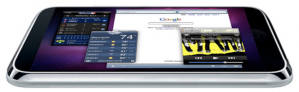
He even went out and had a computer-generated rendering of what he envisions the tablet looking like.  (Above right).  This isn’t unlike many other Apple Tablet renderings we’ve seen.

He also laid out these points:

  • It will  be similar to an iPod touch, only larger, capable of running most of the 70,000 applications on the iPhone App Store plus a new category of apps designed for the bigger screen.
  • Will be used primarily for Web surfing, e-mail, and digital media, competing with netbooks without being a netbook.
  • Will be priced between an iPhone and a MacBook — between $500 and $700.
  • Is likely to include a 3G cellular modem and could be subsidized by a carrier — either AT&T (T) or Verizon (VZ).
  • Will sell better than Apple TV did its first year (1.2 million units).
  • Could in fact sell 2 million units at $600 each to generate $1.2 billion and add about 3% to Apple’s revenue stream in calendar 2010.

“Last week we spoke with an Asian component supplier that has received orders from Apple for a touch-screen device to be fulfilled by late [calendar year] 09,” he writes. “This data point underscores our thesis that a tablet will likely launch in early [2010].”

iPhone success drives digital music sales – Warner Music boss

Site default logo image

Apple’s iPhone is “substantially expanding” digital music markets on a global scale, Warner Music boss, Edgar Bronfman confirmed yesterday during the major label’s financial results call.

Bronfman said strong sales of the iPhone (and conceivably, the iPod touch) are acting to “raise the profile of music in the mobile world,” delivering on a mobile music promise the majors have been praying for for a very long time.

“For example, iTunes was launched in Mexico earlier this week – the first new territory addition to the iTunes footprint in nearly three years,” Bronfman said, adding, “This launch is indicative of the opportunity Apple and its content partners have to follow the expansion of the iPhone into additional mobile-oriented countries.”

The effect of Apple’s device success has helped the label raise digital revenues by 11 per cent, despite the impact of the credit crunch.

The Warner Music chief exec also said the initial impact of tiered pricing in iTunes has been “very positive” so far. He pointed out that sales haven’t been much impacted, and indeed they are beginning to raise more revenue, a manifestation he described as a “net positive impact” on his company’s digital revenues.

“The download business remains the primary driver of our global digital business today and we remain very positive on Apple’s April introduction of variable pricing for single track downloads on iTunes. It’s early days but the variable pricing strategy is beginning to show a net positive impact on our top line digital revenue results. More importantly, this model gives us the flexibility to offer consumers more choice and provides us an opportunity to differentiate our offering,” he said.

Otherwise, things remain bleak, with an 11 per cent fall in CD sales, tough currency markets and more, leading the company to file net losses of $37 million (up from $9 million in the same period last year) on total revenues of $769 million.

Bronfman also hinted that merger negotiations between Warner and EMI may be back on the agenda, suggesting regulators may be open to such consolidation among recorded music businesses, but not likely among music publishers.

Apple takes a chunk of the gaming industry

Site default logo image

Games are the most popular applications sold through the App Store, fresh research claims, dominating Apple’s sales lists and proving the company has become a games industry force at long last.

July’s Distimo report contrasts both the Apple and Android smartphone application markets. They reflect the popularity of games on the iPhone platform (though we shouldn’t ignore the contrast may be specious, as the iPhone platform also includes the iPod touch, which is more widely used as an entertainment, rather than communication, device).

Curiously, ten of the top 15 paid apps sold through the App Store are games, with utlities occupying three spots at the top.

The new findings in this report are:
       
– A negative trend can be identified in the total price of the Overall Top 100 for the Apple App Store. This however was influenced by the turn-by-turn navigation apps MobileNavigator Europe and MobileNavigator America, which were both published by NAVIGON AG. Turn-by-turn navigation apps are still popular.

– Pricing of applications in the Apple App Store and Android Market is quite similar, except for the Reference category which has a much higher average price on Google Android Market.

– The most popular games on Android Market cost between $0.99 and $5.95, with most going for $2.99, while for the Apple App store, most are priced very low ($0.99), and a few higher at $6.99- $9.99

– Games are still the most popular applications in the Apple App Store, with slightly more apps in the monthly paid Top 15 than in the free Top 15.

– Classic games on Android Market are more popular than in the Apple App Store, with even 3 out of the 15 most popular games for Android being emulators. These types of emulators are not allowed in the Apple App Store.

– Tools are very popular paid apps for Android, with 7 apps from the application category bvery different, there are no productivity/utilities apps for Apple in the overall Top 15.

Campbell on Jobs: "There is not a thing he does that is not perfect."

Site default logo image

Chairman and former CEO, Intuit, Bill Campbell (and current Apple board member)  had some awfully kind works for Apple CEO Steve Jobs.

He spoke at a conference this week where he discussed the nature of innovation, business management and made a few candid statements concerning Apple CEO, Steve Jobs.

A quick background – before his time at Intuit, Campbell was president and chief executive officer of GO Corp., a pen-based computing software company. Previously, he founded and served as president and chief executive officer of Claris, which was purchased by Apple in 1990.

Before starting Claris, Campbell was Apple’s executive vice president, group executive of the United States. He joined Apple in July 1983 as vice president of marketing and added the title of vice president of sales in January 1984. In September 1984, his duties were expanded to include distribution, service and support when he was promoted to executive vice president. In June 1985, Campbell was named group executive of the United States.

Campbell joined Apple from Eastman Kodak Co. where his last assignment was general manager of consumer products for Kodak Europe. Prior to joining Kodak, he was vice president of J. Walter Thompson, a New York-based advertising agency.

And now? Now a renowned Silicon Valley management advisor, Campbell remains a friend of Jobs, on whom he says: “He has personal idiosyncrasies …. But there is not a thing he does that is not perfect. He won’t do it if he can’t manage it. He cares about every pixel on the screen and surrounds himself at Apple with people that believe the way he does.”

Speaking to an audience of tech investors and start-up chiefs, Campbell counseled against confusing charisma for leadership, and advised fast growth against immediate returns.

In a statement that pretty well reflects the burgeoning nature of innovation at Apple, he observed: “Without great products you’re never going to be a great company.”

Now if Intuit would only bring Quickbooks for Mac up to the Windows version.

You can even watch what Campbell had to say in a video feed which you’ll find right here. (Cheers Fabio).

More here.

Google's Schmidt praises iPhone, talks Android

Site default logo image

Google CEO Eric Schmidt sees future industry growth in the mobile phone sector, and concedes the “iPhone showed what you can do with a very powerful browser.”

Speaking to BusinessWeek, he focuses strongly on the opportunity his company sees in the mobile sector, promising a new generation of ‘Android’ OS phones will debut in the autumn. And while the iPhone leads the pack now, the former Apple board member appears confident Android will take a slice of smartphone action.

“A next generation of [Android-based] phones will be coming out in the fall,” he said. “They won’t necessarily displace other [phones] because they’re also doing well. But we will have a significant bet in mobile phones. So from our perspective it looks like Android is going to be a success.”

These Android answers emerge alongside new information on Schmidt’s and time with the Apple board.

Apple’s own regulatory filings reveal that Schmidt took no pay for his time on Apple’s board, but he did accept $8,700 of Apple gear and a $7,500 commemorative gift.

Apple’s directors are allowed to receive one of each new product the company introduces, free, plus the right to buy more at a discount.

Like Steve Jobs at Apple, at Google Schmidt takes just one dollar in salary each year and hasn’t taken any stock options offered to him.

Customarily, Apple pays directors an annual $50,000 fee, as well as offering board members the opportunity to invest in Apple stock. Schmidt took neither, buying his Apple shares himself on the open market.

Phil Schiller's response to Ninjawords dictionary word censorship

Site default logo image

John Gruber displaying some of his high-brow comedyDaring Fireball got an email beatdown today from Phil Schiller about the controversy surrounding Apple’s decision to "censor" Ninjawords, a dictionary app for the iPhone.  It turns out that most of Daring Fireball’s argument yesterday was just wrong.  

Let me start with the most important points – Apple did not censor the content in this developer’s application and Apple did not reject this developer’s application for including references to common swear words. You accused Apple of both in your story and the fact is that we did neither.  Ninjawords is an application which uses content from the Wiktionary.org online wiki-based dictionary to provide a nice fast dictionary application on the web and on the iPhone. Contrary to what you reported, the Ninjawords application was not rejected in the App Store review process for including common “swear” words. In fact anyone can easily see that Apple has previously approved other dictionary applications in the App Store that include all of the “swear” words that you gave as examples in your story.

Wiktionary, the source of of Ninja Words definitions, contains huge amounts of profanity, even if it isn’t the seven words you can’t say on TV.  While Ninjawords may have did a search and destroy on those 7 words in the database, many "Urban Dictionary-type" definitions still exist.

 The issue that the App Store reviewers did find with the Ninjawords application is that it provided access to other more vulgar terms than those found in traditional and common dictionaries, words that many reasonable people might find upsetting or objectionable. A quick search on Wiktionary.org easily turns up a number of offensive “urban slang” terms that you won’t find in popular dictionaries such as one that you referenced, the New Oxford American Dictionary included in Mac OS X. Apple rejected the initial submission of Ninjawords for this reason, provided the Ninjawords developer with information about some of the vulgar terms, and suggested to the developer that they resubmit the application for approval once parental controls were implemented on the iPhone.

The Ninjawords developer then decided to filter some offensive terms in the Ninjawords application and resubmit it for approval for distribution in the App Store before parental controls were implemented. Apple did not ask the developer to censor any content in Ninjawords, the developer decided to do that themselves in order to get to market faster. Even though the developer chose to censor some terms, there still remained enough vulgar terms that it required a parental control rating of 17+.

You are correct that the Ninjawords application should not have needed to be censored while also receiving a 17+ rating, but that was a result of the developers’ actions, not Apple’s. I believe that the Apple app review team’s original recommendation to the developer to submit the Ninjawords application, without censoring it, to the App Store once parental controls was implemented would have been the best course of action for all; Wiktionary.org is an open, ever-changing resource and filtering the content does not seem reasonable or necessary.

Apple was right to reject it or ask for a 17+ rating on the app.  The author could clean it up or get put into a 17+ section.

The problem is they got both due to poor timing.  They were submitting at the time when the 17+ App Store was just being populated.  The developer wanted to get the app in the store so they voluntarily censored their app.  Although the app uses a static version of the Wictionary which may have removed some profanity, there is a lot of other implicit profanity in Wictionary that may not contain any "bad words" but still isn’t something a 10-year old should be reading.  They, like many other dictionaries, got a 17+ rating.

Gruber, pictured above at a WWDC, decided, for whatever reason to back up the developers of this particular app without researching exactly what the real issue was.

Although the App Store has made and continues to make baffling decisions on accepting and rejecting apps, we should exercise caution when scrutinizing them. 

Schiller ended with this:

Apple’s goals remain aligned with customers and developers — to create an innovative applications platform on the iPhone and iPod touch and to assist many developers in making as much great software as possible for the iPhone App Store. While we may not always be perfect in our execution of that goal, our efforts are always made with the best intentions, and if we err we intend to learn and quickly improve.

Diary date: Today's the day Microsoft saved Apple

Site default logo image

The Mac world turned upside down on August 6, 1997, when shocked attendees at a Boston Steve Jobs keynote speech suddenly saw the visage of Microsoft head honcho Bill Gates staring down at them from a video screen.  It is also interesting to see where the two companies are at now because of this move.

Gates revealed his company had made a $150 million investment in Apple, an investment that helped secure the future of the once ailing computer firm. In exchange for the cash and a five-year commitment to support Office on the Mac, Apple agreed to drop a long-running lawsuit in which it alleged Microsoft copied the look and feel of the Mac OS for Windows and to make Internet Explorer the default browser on its computers.

Shocked gasps came from the Apple faithful, with Jobs saying, "We have to let go of a few notions here. We have to let go of the notion that for Apple to win, Microsoft needs to lose."

TomTom for iPhone

Site default logo image

A UK retailer has revealed the local price for the long-awaited TomTom for iPhone navigation system – £99 ($168) excluding UK sales tax.

TomTom hasn’t yet revealed pricing for the system, promising only to ship the iPhone satnav “this summer” – and there’s scant weeks until summer’s end.

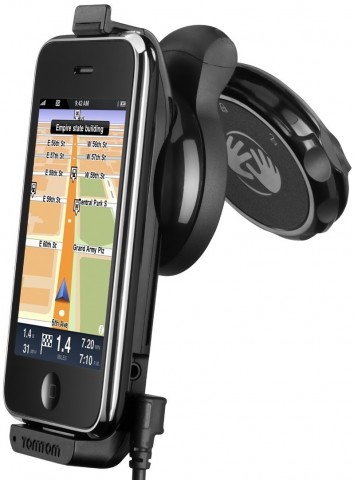
UK retailer Handtec prematurely listed the system on its site a month ago and has yet to remove it – for whatever that’s worth. The system includes a windscreen mount, iPhone charger, amplified speakers, a hands-free kit and a GPS dongle.

The TomTom solution combines two new TomTom products: The TomTom navigation application for iPhone; an Apple version of TomTom’s award-winning turn-by-turn navigation software, including IQ Routes and latest maps from Tele Atlas; The TomTom car kit for iPhone; a specially developed car kit for secure docking, enhanced GPS performance, clear voice instructions, hands-free calling and in-car charging.

Apple, Google seem set for smartphone battle in China

Site default logo image

With Google CEO Eric Schmidt stepping down from the Apple board this week, reports suggest new levels of competition between the two formerly friendly firms.

This may be true, and the battlefield between the two past partners could come down to a smartphone war in the world’s growing superpower, China. There, Apple’s soon-to-ship iPhone is likely to do battle with Android-driven devices from numerous manufacturers.

Don’t just take that from us – the world’s leading business market titles are all looking at the future tousle between the two, seeing this battle as one that one of the firms must win to secure dominance of the high-end smartphone market in China.

China Mobile – the world’s largest mobile carrier – plans to launch a range of Android-powered smartphones, perhaps as early as next week. And these will compete directly with Apple’s iPhone in a market nowhere near as saturated by Apple’s masterly grip on the news agenda.

China Mobile could launch a third-generation (3G) smart-phone called the OPhone, made by Lenovo Mobile, it will also introduce the Magic range of smartphones made by Taiwan’s HTC.

Apple’s response may be delayed – China Unicom, Apple’s purported iPhone China launch partner – isn’t expected to introduce the iPhone until September or October, when it launches its own 3G service in the country.

China Unicom last week denied reports that it had sealed a deal with Apple, but said there had been progress in the talks. A senior team of Apple executives is known to be in China now for talks with the carrier.

There’s a lot to play for in this territory. China is the world’s largest mobile phone market with 700 million subscribers, with smartphones accounting for 10 per cent of all handsets sold.

The Chinese market is extremely diverse, according to Citigroup analyst, Michael Meng, who notes that much of the business currently comes from middle-aged businessmen who don’t use a lot of data but talk incessantly into their mobiles, night and day.

With the Russian experience – where demand for the iPhone has failed to meet supply – smarting in Apple execs minds, Meng also offers a warning, “The average revenue per user [per month] in the Chinese mobile market is Rmb60, and for China Mobile’s customers it’s Rmb85. For the iPhone, the target is Rmb300. That’s a big gap,” he says. “So the potential subscribers we’re looking at need to be young, wealthy, well-educated, probably English-speaking, since the iPhone still has some English-language applications.”

It’s certainly an unusual situation that Google will effectively now be competing with Apple in perhaps one of the world’s key emerging smartphone markets. Particularly in view of comments from Schmidt last week – before his resignation – when he said, "I’ll talk to the Apple people – at the moment, there’s no issue."

While on the board, he once said, “From my perspective, I don’t think Google sees Apple as a primary competitor.” Despite which the Google CEO would recuse himself from discussions related to the iPhone.

“Eric has been an excellent Board member for Apple, investing his valuable time, talent, passion and wisdom to help make Apple successful,” said Steve Jobs, Apple’s CEO, announcing Schmidt’s withdrawal.

“Unfortunately, as Google enters more of Apple’s core businesses, with Android and now Chrome OS, Eric’s effectiveness as an Apple Board member will be significantly diminished, since he will have to recuse himself from even larger portions of our meetings due to potential conflicts of interest. Therefore, we have mutually decided that now is the right time for Eric to resign his position on Apple’s Board.”

The Apple/Google relationship has now become a Chinese puzzle.