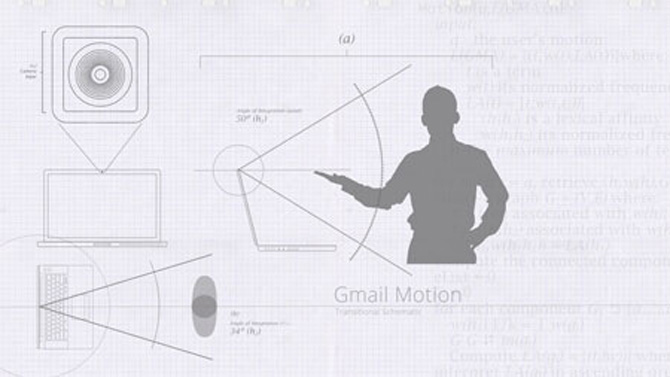
April Fool’s Day is officially in full gear, meaning you need to be on high alert when skimming the news today. Like previous years, big Internet players jumped on the opportunity to play practical jokes on their users. Be it a Kinect-like Gmail interface, Geocities-hosted Hulu, or YouTube’s first blog post from 1911 with President William Howard Taft as a guest blogger, worry not – we have you covered with our selection of the best April 1 jokes. Don’t forget to share your own favorites in the comments.
It should surprise no-one that Apple is poised for a huge growth in China. It’s the 1.3 billion people market, folks. Yes, Apple had been neglecting China for years. That changed when iPhone came along, providing Apple with financially sound incentives to launch retail operations in China, including the latest spectacular glass tower in Shaghai’s Pudong district.
Four Chinese stores are just the beginning as Apple put to work a plan calling for an aggressive retail expansion. Three store openings are scheduled for Shanghai and up to 25 retail outlets for the entire country. That’s just tip of the iceberg. China is a potential gold mine poised to boost Apple’s shares by 60 percent in the next nine months. Read on…
The Promenade at Little Rock’s Chenal mall. Image credit: ArkansasOnline
Apple is allegedly planning to open a new retail store in Little Rock, Arkansas, its first store in the state, reports ifoAppleStore. The company is said to be in the process of hiring retail staff, with grand opening planned this coming October. The retail spot will be located in at the Promenade at Little Rock’s Chenal mall, the publication notes:
After an extended four-year courtship, Apple has finalized plans—for a second time—to open a store at the Promenade at Chenal mall in Little Rock (Ark.). The city of about 190,000 sits in the middle of one of four Apple store black-out zones in the United States that runs from the Gulf to southern Missouri.
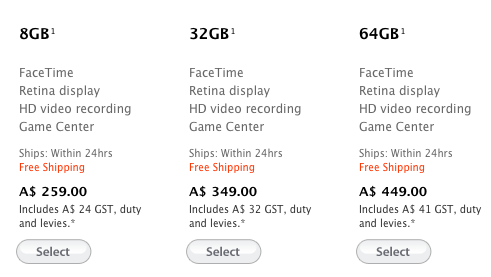
Australian readers are reporting that Apple’s iPods had dropped in price up to AU$50. 3rd party retailers haven’t all reflected the price drops. Full price details below. Anyone else seeing a price drop out there?
Just two weeks after posting its live cable television iPad app, cable operator Time Warner has pulled channels following complaints from Rupert Murdoch’s News Corp., Viacom and Discovery Communications. Big media clearly has issues with the free TWCable TV app, downloaded 300,000 times so far, which lets iPad owners stream 32 selected cable channels to their device in high definition. Even though the software requires a subscription to Time Warner’s pay-TV, content partners argue that the streaming rights are not part of the programming deal.
Bloomberg yesterday reported that Fox Networks Group issued a cease-and-desist letter in an effort to stop unauthorized use of News Corp.’s content, leading to a possible lawsuit. Outdated contracts don’t cover content streaming to tablets like iPad, an entertainment attorney tells the publication. The New York Times chimed in today with information that Viacom and Discover Communications also filed similar complaints. Read on… Expand Expanding Close
One of Lion’s most noticeable features is the reversal of how scrolling works – now it’s meant to be more like iOS. While many Lion reviewers have said that it takes just a few minutes to get used to, now you have the opportunity to get your brain tweaked ahead of Lion’s summer release. Developed by Nick Moore at Pilotmoon Software, the simple application “Scroll Reverser” for Mac OS X Leopard can be downloaded here. Expand Expanding Close
The 47MB update is available now through Software Update or via Apple’s site as a standalone installer.
From release notes:
This update improves overall stability and addresses a number of minor issues, including the following:• Support for opening projects imported from GarageBand for iPad. This update is recommended for all GarageBand ’11 users.
Allison Johnson, Apple’s vice president of worldwide marketing communications, is leaving the company for greener pastures, sources told John Paczkowski who broke the news on The Wall Street Journal’s Digital Daily blog. She played an important role in Apple’s worldwide advertising and reported directly to Steve Jobs, the man known for tight control of Apple’s marketing department.
No bad blood is brewing between Apple and Johnson as a result of her departure, sources said. The marketing whiz worked for the company since 2005, coming from Hewlett-Packard. Sources claim she’s leaving to start a new PR agency with Brandee Barker, a former Facebook PR person:
I can imagine one of their product guys pitching the idea to managers, “Hey, let’s just put some diamonds on a wrist case and sell it for $18,000.” It’s worth your cold hard cash if you’re into luxury items and here’s why. Expand Expanding Close
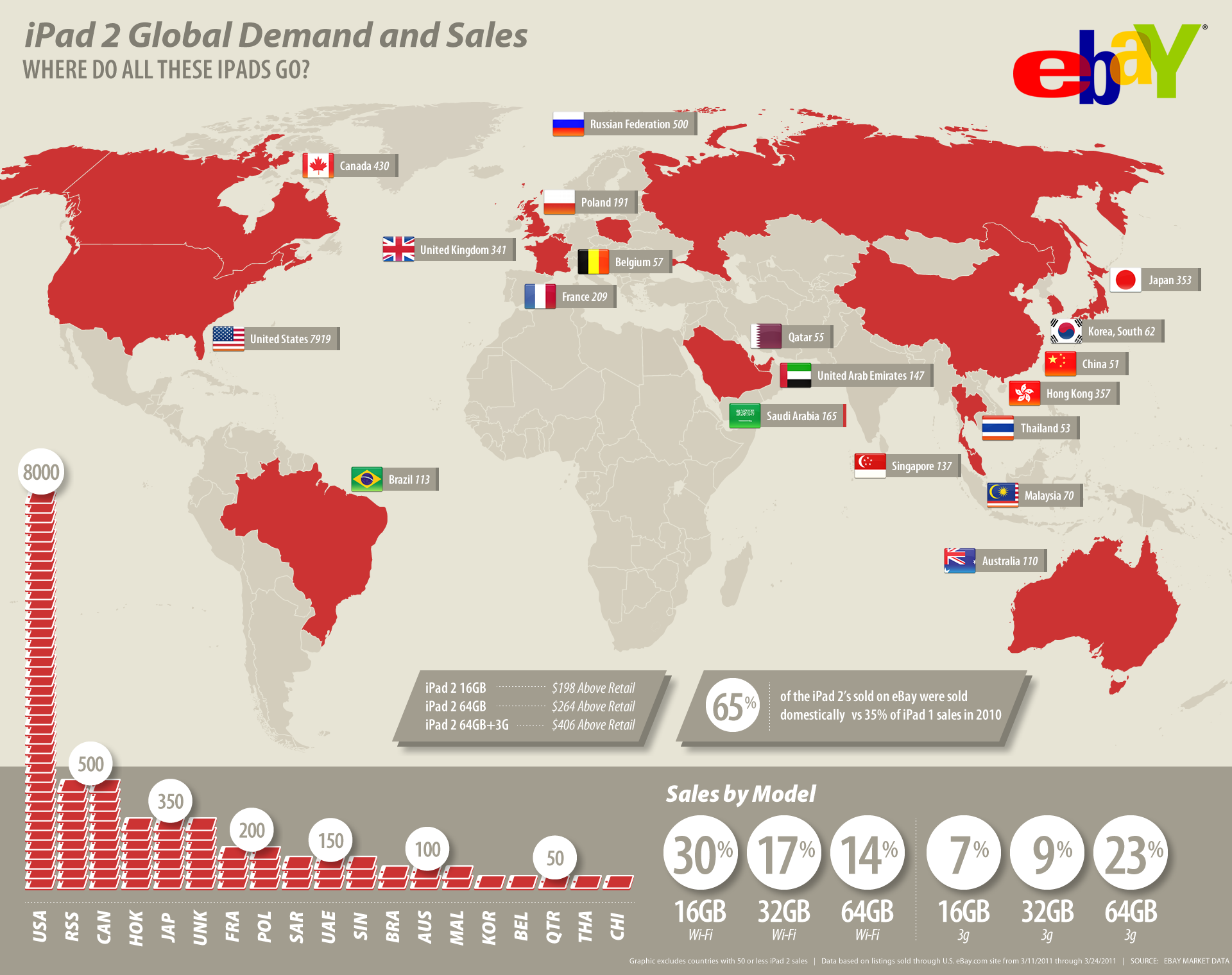
While we’re awaiting Apple’s conference call come April 20 that will shine the light on iPad 2 sales, eBay has just released their official figures relating to a two-week period of iPad 2 activity on their US site, between the launch and international roll out. CNET reports:
Unsurprisingly the hard-to-get tablet has been moving briskly on the service, reaching just less than 12,000 sales in the two-week period between the U.S. launch and the iPad 2’s launch in 25 additional international countries.
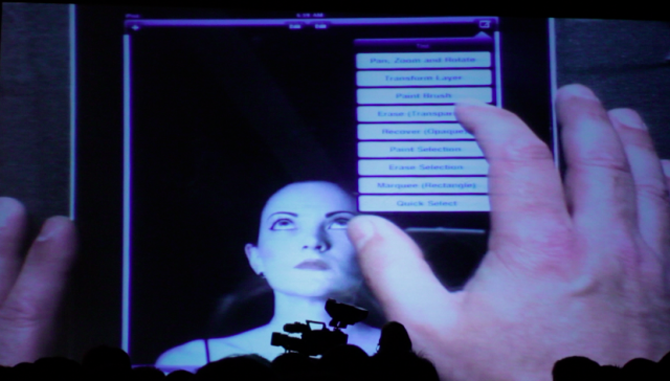
Adobe’s Photoshop Express app for iPhone and iPad gets the job done for quick image edits on the go. It’s free and has a bunch of filters (more available via in-app purchase) and border presets, as well as color correction and image cropping tools. It looks crisp on the Retina Display, supports multitasking and enables seamless sharing and cloud integration via Photoshop.com. Fans of the program will be happy to know that it’s about to get even better. Expand Expanding Close
One of the perks of being the world’s most-valued technology company is the uncanny ability to put your vast cash hoard at work to secure supplies while squeeze out the best prices from component makers, but it also means agreeing to fine print. Like a tax that is additional costs for smooth shipments in unforeseen circumstances, such as the Japan quake.
First samples of Samsung awesome new display panels have begun rolling out from assembly lines. These isn’t your pa’s display – the Korean consumer electronics maker has outdone itself by developing a new technology, pure Star Trek stuff. According to a press release, not only is the display itself transparent, it doesn’t require backlight because they’ve found a way to replace the traditional backlight with ambient light.
Given that traditional backlights consumer the vast majority of power in a traditional LCD, Samsung’s see-thru panels are tremendously power-savvy as well. The first panels coming out are of a 22-inch variety and sport a 1680-by-1050 pixel resolution with a 500:1 contrast ratio. From the press release:
The transparent LCD panel has a high transparency rate, which enables a person to look right through the panel like glass, and it consumes 90% less electricity compared with a conventional LCD panel using back light unit. It’s because a transparent LCD panel utilizes ambient light such as sun light, which consequently reduces the dependency on electricity for generating power.
More awesomeness, including additional images and video, right below the fold.
If you haven’t heard of AU Optronics Corp, it’s the #4 LCD maker in the world. They’ve apparently landed a lucrative contract to produce flat panel screens for iPad 2, the rumor has it. We’re talking 30 million flat panel units in the next twelve months, which is said to take up over half the capacity of their fifth-generation Taichung plant located in central Taiwan.
Reuters reported this morning, quoting a story published by The Economic Daily News, that the company allegedly sold the panels to Apple at three to four times their regular asking price. Read on… Expand Expanding Close
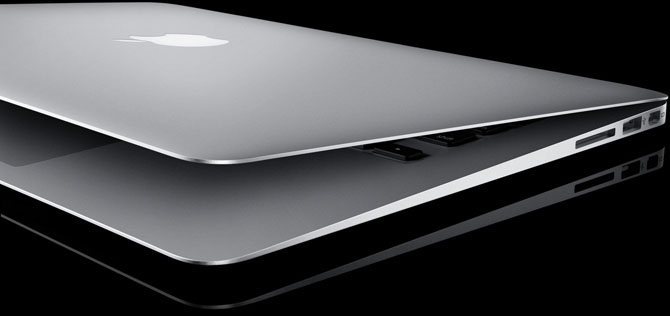
A glitch causing system lockups in iTunes for some MacBook Air owners with Snow Leopard 10.6.7 installed has been fixed with a small update released yesterday. The Supplemental 13″ MacBook Air Update, now available via Software Update or from Apple’s site, “addresses an issue that makes the system unresponsive when using iTunes.” It weighs in at just 461KB and is recommended for all 13-inch MacBook Air (Late 2010) owners running Mac OS X Snow Leopard 10.6.7 (build 10J869). Expand Expanding Close
It’s the tablet craze and everyone’s going bonkers over a post PC era where slates rule casual computing. Everyone except software giant Microsoft who remains suspicious of the trend. Because they lack a horse for this race, it isn’t shocking they’re shooting down tablets. It’s the smartphones that are post PC devices, not the tablets, suggested their chief research and strategy officer Craig Mundie. Microsoft didn’t jump on the distinction between mobile and portable fast enough, he thinks. But isn’t portable and mobile essentially the same thing, you ask.
Mobile is something that you want to use while you’re moving, and portable is something that you move and then use. These are going to bump into one another a little bit and so today you can see tablets and pads and other things that are starting to live in the space in between. I don’t know whether the big screen tablet pad category is going to remain with us or not.
Check out the source link at The Sydney Morning Hearld for a video. Mundie’s also seen a prototype smartphone screen in the labs that beams HDTV to your retina. “Instead of seeing a screen it can beam individual rays of light into your eyes right on your retina,” he said. Wow, what a mind job.
Our friends over at iFixIt have analyzed all iPad models – a whoping eighteen different units – to pinpoint the differences between WiFi-only, 3G GSM and CDMA versions of the tablet. Like a CDMA version of iPhone 4 designed for the Verizon Wireless network, the Verizon iPad also has an additional antenna and an integrated GPS receiver. On the GSM iPad positioning is provided by a Broadcom chip. More interesting than that is Apple’s choice of baseband circuitry for Verizon and AT&T models.
Again, like the Verizon Phone 4 the new CDMA version of iPad 2 runs a Gobi chipset, the Qualcomm MDM6600. It’s compatible with both GSM and CDMA, supporting HSPA+ data rates of up to 14.4 Mbps and CDMA2000 1xEV-DO Rev. A/Rev. B. The similarities between CDMA iPhone 4 and iPad 2 don’t stop there: Both devices pack in Toshiba Y890A111222KA, Qualcomm PM8028 Power Management IC and power amplifier modules the Skyworks 77711 and 77710. Continue reading for key takeaways that caught our attention…
Dying to compete with iPad, rivals are drumming up speeds and feeds in the absence of quality software. Unfortunately for them, the game is software, not hardware. Blogger Justin Williams took time to sort through Android Market and count apps that are featured for Android slates. How many did he count? Just seventeen apps.
My criteria for considering an app for this list is that it either requires Android 3.0 or have its user interface be specifically designed for a tablet experience. I didn’t count games or existing Android apps that are just upconverted to take advantage of the existing screen real estate. Based on my criteria, I found 20 apps in the Android Marketplace for the Motorola Xoom.
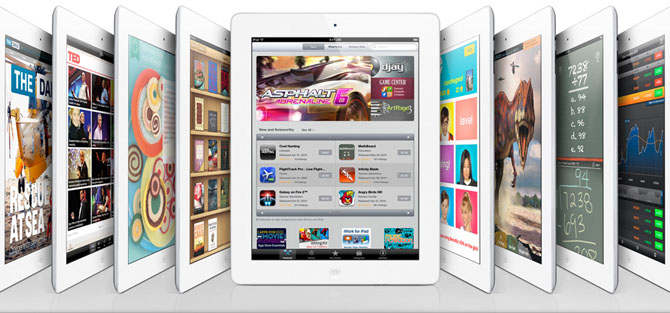
Apple’s first mover advantage with iPad is bearing fruits. A year since its release developers have written more than 65,000 apps that specifically take advantage of the iPad. This excludes iPhone apps that pixel-double to the tablet’s 9.7-inch 1024-by-768 display. Steve Jobs took a crack at Android’s app count at the iPad 2 unveiling: Expand Expanding Close
Avid gamers know about N.O.V.A. – Near Orbit Vanguard Alliance, arguably the best iOS shooter that stuns with console-like visuals, huge environments and epic sci-fi storyline akin to Halo. The third installment of the series is being developed using Epic Games’s Unreal Engine 3, reports Pocket Gamer:
Word has it that shooter sequel N.O.V.A. 3 is among the four titles built around the engine and will be out later this year.
That Apple’s advances in mobile are sending shivers down the spines of the industry’s top brass is old news, but surely high-ranked executives from HP and Dell, the world’s top computer makers, wouldn’t bother lashing out at Apple had iPhone and iPad not instilled fear in their hearts. Stephen DeWitt, senior vice president of HP’s Americas Solution Partners Organization, in an interview with CRN’s Kevin McLaughlin at HP’s Americas Partner Conference in Las Vegas:
Apple’s relationship with partners is transactional, completely. Apple doesn’t have an inclusive philosophy of partner capabilities, and that’s just absurd. Unlike Apple, HP is very channel friendly. And if you have an issue with HP you can pick up the phone and talk to someone. That’s something that’s impossible with Apple. As an Apple partner, I can say that it really feels like they’re holding you hostage sometimes.
Yes, you read that right. The Telegraph yesterday ran an interesting piece that caught my attention. The basis for their story is a breakthrough development calling for a chip that can generate power from microscopic body movement such as the human heartbeat or the pinch of a finger. The new chip is “thousands times more powerful” than a previous prototype and it’s based on nanogenerators.
Scientists say it’s likely this tech will at some point enable gadgets that don’t require batteries because they will generate power from our body movement. It’s not sci-fi, mind you, they already have working prototypes:
The team, presenting their findings at the National Meeting & Exposition of the American Chemical Society, have used it to power LCD displays and diodes, as well as to transmit a radio signal once its generated power has been stored.
Imagine what this could mean for the design of iOS gadgets we have on ourselves. Read on… Expand Expanding Close
Music publishers Universal and EMI are considering packaging more music albums as iPad apps, reports the New York Times. This will allow labels to charge app albums more than their standalone counterparts on iTunes because of the native experience and bonus multimedia content such as photos, video clips and lyrics:
The Universal Music Group has teamed up with a video company, Eagle Rock Entertainment, to create iPad versions of films about classic albums like Nirvana’s “Nevermind,” with social networking features that allow fan commentary. This month, Bjork announced that her next project, “Biophilia,” will encompass “music, apps, Internet, installations and live shows.
EMI already released “Until One”, a ten bucks app album for iPad by Swedish House Mafia, seen below. It weighs in at 659MB and comes with documentaries, image galleries and more. With app albums you get smooth experience and high interactivity without the overhead of iTunes LP (which in itself is a specially packaged web page with Javascript code and hooks for iTunes). Despite these bells and whistles, I see big problems with this new app album trend and here’s why.
AirPlay, a technology from Apple for wireless streaming of media from iOS devices to the Apple TV, would be awesome if it wasn’t for one huge drawback: it’s only 720p. That didn’t stop enthusiasts Eric Govoruhk and Kelly McAteer to develop a full HD 1080p video mirroring for iPad 2 by using a wireless HDMI transmitter and a USB battery pack.
Check out the awesomeness in the above video. First OEM to do this gets a post here. Eric explained how they pulled it off over at the MacRumors forums: Expand Expanding Close
For a company of Apple’s stature that relies on a wide array of Asian suppliers to ship millions of gadgets to the market every month, I’ve always felt even the smallest disruption in supply chain could spell trouble. The March 11 disaster that struck Japan has affected a lot of firms that make electronics components like memory chips and touch panels.
Apple reduces risks by working with multiple suppliers, but it still depends on the weakest supplier. According to the Wall Street Journal, shortages of lithium-ion batteries for iPods are ahead because Kureha, a polymer provider for lithium-ion batteries, had to reduce output of this chemical after shutting its Japan plant, writes author Mariko Sanchanta:
A representative from Apple Inc. recently called Kureha Corp.’s offices in the U.S. The problem: Apple was facing tight supplies of lithium-ion batteries used in its popular iPods, and they traced the supply bottleneck to the relatively obscure Japanese chemicals maker.
It’s entirely possible this hiccup might provoke an alarming scarcity of iPod batteries that could lead to product shortages in stores. It’s affecting other mobile products that use lithium-ion batteries, including iPhones. Supply issues, natural disasters and political unrest are all cited as substantial risk factors in Apple’s filings with the Security and Exchange Commission. Good thing they’ve got operations wizard Timothy Cook on board.