Author

Avatar for 9to5 Staff

9to5 Staff

AT&T Wireless CEO implies iPhone exclusivity in U.S. to end

Site default logo image

Matt Hamblin at Computerworld writes:

AT&T Mobility CEO Ralph de la Vega strongly implied today that the carrier’s exclusive deal to sell the iPhone in the U.S. is ending, although he gave no details in a conference call with analysts…"We have a legacy of having a great portfolio…that will continue after the iPhone is no longer exclusive to us," de la Vega said. "We think we will continue after the iPhone…to drive [results]…."

AT&T announced earlier today that iPhones were 75% of their new Smartphone activations and brought 40% of their customers from other carriers so losing exclusivity might not be in their best interests.  Interestingly,  de la Vega noted the advantages of AT&T’s 3G technology (talking and using data at the same time) vs. Verizon/Sprint’s services which lose data when a voice call is initiated. 

He also talked up Android devices and eBook readers saying:

"Even if we lose exclusivity [of the iPhone], we will be the only carrier with HSPA 7.2 [a network specification being deployed at AT&T] and [new devices] will work on our network faster," de la Vega said. "I feel as strongly as ever [about] the capability of devices in our lineup and [am] super-excited about the deals with e-readers and personal navigation devices. "

De la Vega also said AT&T is now working with device manufacturers to build Android phones that will "work best" on the AT&T network. "They are terrific devices and much better on AT&T than on anybody else’s network."

With Verizon’s latest Droid/iPhone attack ads, and Sprint ahead in 4G coverage, we’re thinking a new CDMA front-runner could be emerging.  Would anybody else out there be interested in a WiMAX iPhone?  Also, Tmobile would be an easy choice as they use the same GSM/EDGE network as AT&T, albeit with differenct 3G frequencies.

Windows 7 "Abso-f#$ing-lutely" launching today, BootCamp support en route

Site default logo image

Windows 7 is now officially shipping and Microsoft’s got some new ads out.  

Separately, Apple has released a Knowledge Base article detailing support for Windows 7 on Bootcamp before the end of the year.  While Apple’s full support makes installation easier, many have had luck installing Windows 7 RTM on BootCamp partitions already (see Giz Post).  Interestingly, Apple lists a slew of Macs which "won’t be supported" on Windows 7, all released in 2006.

A far more popular method of running Windows on Mac hardware is on virtualization either through the free (but limited) VirtualBox software or by $40 Parallels or the new $67 VMWare Fusion.


vids via Crunchgear

Comcast becomes wireless ISP

Site default logo image

This is what we like to see.  Comcast is entering the 3G/4G wireless network market, likely becoming an MVNO on Sprint’s wireless 3G/WiMAX network (anyone else have 4G?). 

They are offering a combination package for $50/month in select metro areas.  What’s REALLY interesting here is that Comcast also has its Digital Voice service which works over VoIP.  It isn’t a stretch to think that they’ll soon be offering their voice services as a wireless product, unless Sprint has something to say about that.


Seeing as the US has got a semi-consumer friendly administration in office, the FCC will likely make sure that Comcast doesn’t throw the kill switch on other VoIP providers like Skype and Vonage.  As this kind of service becomes more popular, Computer companies like Apple will start throwing 4G radios into their iPods and iPhones.

Ballmer takes another stupid swipe at the iPhone

Site default logo image

Look, we know it is his job to downplay the iPhone, but his rationales keeps getting weaker and weaker.  Yesterday in an AP article, Steve Ballmer said:

"Let’s face it, the Internet was designed for the PC. The Internet is not designed for the iPhone. That’s why they’ve got 75,000 applications — they’re all trying to make the Internet look decent on the iPhone."

Now let’s take a look at a Morgan Stanley slide posted by Techcrunch on the relationship of mobile Internet adoption on iPhone+iPod as it relates to desktop Internet adoption.

You don’t just get the name "Monkey Boy".  You have to earn it.


AT&T activates 3.2 Million iPhones in the quarter, a new record

Site default logo image

iPhone growth certainly hasn’t slowed.  AT&T released its quarterly earnings report today and among the announcements was the activation of 3.2 million iPhones in the quarter.  That, not only was a new quarterly record, it was 3/4ths the total of 4.3 million postpaid 3G integrated wireless devices (devices with keyboards – or "smartphones") that AT&T sold.  Incredible. 

4.3 million postpaid 3G integrated wireless devices added to AT&T’s network, the largest quarterly increase in the company’s history; integrated device growth included 3.2 million iPhone activations, also the company’s largest quarterly total to date (integrated devices are handsets with QWERTY or virtual keyboards in addition to voice functionality)

Also, similar to recent quarters, 40 percent of the iPhone activations were for customers who were new to AT&T.

Apple sold 7.4 million devices in the quarter so around 4.2 million were sold internationally.

Free, ad supported version of OSX being investigated

Site default logo image

Apple patented a method for putting ads into the OS X last year which was revealed today by MacRumors and Engadget.  This one has Steve Jobs’ name on it so it might have some significance.  While this initially seems waaaay out of character, there might be some interesting possibilities here.


First, this type of OS could be used in a super low cost Mac.  Just as Microsoft is crippling its Windows 7 to go on Netbooks, Apple may be looking for ways to subsidize the cost of building a machine and selling it for less than $400. 

Also, could this be a hint that Apple is considering releasing OS X, at some time in the future, for Generic PeeCees?  While Apple makes most of its money on hardware -and therefore can afford to sell its OS for cheap and not enforce "Genuine Advantage" type OS security, it could allow an ad-supported "free" version of the OSX to hit the marketplace. This would eliminate the need for people to Hackintosh their computers and also allow apple to compete with the ChromeOS in the Netbook arena.


Can't beat 'em? Sue 'em! Nokia files suit against Apple

Site default logo image

Update: PED Reports: According to Piper Jaffray’s Gene Munster, is 1% to 2% of the cost of an iPhone, or in the worst case, about $12 per unit.

Nokia announced that it has today filed a complaint against Apple with the Federal District Court in Delaware, alleging that Apple’s iPhone infringes Nokia patents for GSM, UMTS and wireless LAN (WLAN) standards. 

We’re sure we’ll hear something from Apple soon. 

From Nokia’s PR:
As a leading innovator in wireless communications, Nokia has created one of the strongest and broadest patent portfolios in the industry, investing more than EUR 40 billion in R&D during the last two decades. Much of this intellectual property, including the patents in suit, has been declared essential to industry standards.  Nokia has already successfully entered into license agreements including these patents with approximately 40 companies, including virtually all the leading mobile device vendors, allowing the industry to benefit from Nokia’s innovation.
 

The ten patents in suit relate to technologies fundamental to making devices which are compatible with one or more of the GSM, UMTS (3G WCDMA) and wireless LAN standards. The patents cover wireless data, speech coding, security and encryption and are infringed by all Apple iPhone models shipped since the iPhone was introduced in 2007.
 
"The basic principle in the mobile industry is that those companies who contribute in technology development to establish standards create intellectual property, which others then need to compensate for," said Ilkka Rahnasto, Vice President, Legal & Intellectual Property at Nokia. "Apple is also expected to follow this principle. By refusing to agree appropriate terms for Nokia’s intellectual property, Apple is attempting to get a free ride on the back of Nokia’s innovation."
 
During the last two decades, Nokia has invested approximately EUR 40 billion in research and development and built one of the wireless industry’s strongest and broadest IPR portfolios, with over 10,000 patent families. Nokia is a world leader in the development of GSM technologies and its evolution to UMTS / 3G WCDMA as well as wireless LAN, which is also demonstrated by Nokia’s strong patent position in these technologies.
 
About Nokia
Nokia is a pioneer in mobile telecommunications and the world’s leading maker of mobile devices. Today, we are connecting people in new and different ways – fusing advanced mobile technology with personalized services to enable people to stay close to what matters to them. We also provide comprehensive digital map information through NAVTEQ; and equipment, solutions and services for communications networks through Nokia Siemens Networks.
 
FORWARD-LOOKING STATEMENTS
It should be noted that certain statements herein which are not historical facts, including, without limitation, those regarding: A) the timing of product, services and solution deliveries; B) our ability to develop, implement and commercialize new products, services, solutions and technologies; C) our ability to develop and grow our consumer Internet services business; D) expectations regarding market developments and structural changes; E) expectations regarding our mobile device volumes, market share, prices and margins; F) expectations and targets for our results of operations; G) the outcome of pending and threatened litigation; H) expectations regarding the successful completion of contemplated acquisitions on a timely basis and our ability to achieve the set targets upon the completion of such acquisitions; and I) statements preceded by "believe," "expect," "anticipate," "foresee," "target," "estimate," "designed," "plans," "will" or similar expressions are forward-looking statements. These statements are based on management’s best assumptions and beliefs in light of the information currently available to it. Because they involve risks and uncertainties, actual results may differ materially from the results that we currently expect. Factors that could cause these differences include, but are not limited to: 1) the deteriorating global economic conditions and related financial crisis and their impact on us, our customers and end-users of our products, services and solutions, our suppliers and collaborative partners; 2) the development of the mobile and fixed communications industry, as well as the growth and profitability of the new market segments that we target and our ability to successfully develop or acquire and market products, services and solutions in those segments; 3) the intensity of competition in the mobile and fixed communications industry and our ability to maintain or improve our market position or respond successfully to changes in the competitive landscape; 4) competitiveness of our product, services and solutions portfolio; 5) our ability to successfully manage costs; 6) exchange rate fluctuations, including, in particular, fluctuations between the euro, which is our reporting currency, and the US dollar, the Japanese yen, the Chinese yuan and the UK pound sterling, as well as certain other
currencies; 7) the success, financial condition and performance of our suppliers, collaboration partners and customers; 8) our ability to source sufficient amounts of fully functional components, sub-assemblies, software and content without interruption and at acceptable prices; 9) the impact of changes in technology and our ability to develop or otherwise acquire and timely and successfully commercialize complex technologies as required by the market; 10) the occurrence of any actual or even alleged defects or other quality, safety or security issues in our products, services and solutions; 11) the impact of changes in government policies, trade policies, laws or regulations or political turmoil in countries where we do business; 12) our success in collaboration arrangements with others relating to development of technologies or new products, services and solutions; 13) our ability to manage efficiently our manufacturing and logistics, as well as to ensure the quality, safety, security and timely delivery of our products, services and solutions; 14) inventory management risks resulting from shifts in market demand; 15) our ability to protect the complex technologies, which we or others develop or that we license, from claims that we have infringed third parties’ intellectual property rights, as well as our unrestricted use on commercially acceptable terms of certain technologies in our products, services and solutions; 16) our ability to protect numerous Nokia, NAVTEQ and Nokia Siemens Networks patented, standardized or proprietary technologies from third-party infringement or actions to invalidate the intellectual property rights of these technologies; 17) any disruption to information technology systems and networks that our operations rely on; 18) developments under large, multi-year contracts or in relation to major customers; 19) the management of our customer financing exposure;  20) our ability to retain, motivate, develop and recruit appropriately skilled employees; 21) whether, as a result of investigations into alleged violations of law by some former employees of Siemens AG ("Siemens"), government authorities or others take further actions against Siemens and/or its employees that may involve and affect the carrier-related assets and employees transferred by Siemens to Nokia Siemens Networks, or there may be undetected additional violations that may have occurred prior to the transfer, or violations that may have occurred after the transfer, of such assets and employees that could result in additional actions by government authorities; 22) any impairment of Nokia Siemens Networks customer relationships resulting from the ongoing government investigations involving the Siemens carrier-related operations transferred to Nokia Siemens Networks; 23) unfavorable outcome of litigations; 24) allegations of possible health risks from electromagnetic fields generated by base stations and mobile devices and lawsuits related to them, regardless of merit; as well as the risk factors specified on pages 11-28 of Nokia’s annual report on Form 20-F for the year ended December 31, 2008 under Item 3D. "Risk Factors." Other unknown or unpredictable factors or underlying assumptions subsequently proving to be incorrect could cause actual results to differ materially from those in the forward-looking statements. Nokia does not undertake any obligation to publicly update or revise forward-looking statements, whether as a result of new information, future events or otherwise, except to the extent legally required.
 
Media Enquiries:
Nokia
Communications, North America
Tel. +1 972 894 4573
Email: communication.corp@nokia.com
 
Nokia
Communications
Tel. +358 7180 34900
Email: press.services@nokia.com
 
Nokia
Mark Durrant
Communications
Tel. +358 71800 8000
 
www.nokia.com

Apple on Win7: Windows users

Site default logo image

Apple’s vice president of OS X worldwide product marketing, Brian Croll, slapped Microsoft’s Windows 7 verbally in an interview published today by the Daily Telegraph, slamming the new OS as ‘complex and expensive’.

"Windows users are really tired of all the headaches that they’ve been getting over the years, starting all the way back from Windows Me to NT to Vista and now Windows 7," he said. "As a result, I think people are looking for something different, and the Mac offers real ease of use, stability and security."

Noting, as Phil Schiller did earlier, that upgrading to Windows is a complex process, he suggested Windows users, particularly those on XP machines, may see this as the right time to switch to Mac.

“Windows 7 is still just Windows. It doesn’t change a lot. It’s still complex, it’s still really expensive when you look at the cost of the upgrade, and there’s still security concerns," he said.

He also observes the operating system’s lack of essential functions you just get with a Mac – no Mail, no chat, no image management solutions are included, he says, meaning Windows users don’t just have to pay one of Microsoft’s many prices to get hold of the software, but have to find a solution for such common tasks all by themselves as well. It’s a lot of “headache”, he notes.

With all this, the Apple VP said, “We believe we can get even more people moving over”.

He makes lots of other points, too, but to see them all you’ll have to pop across to the Telegraph’s website, over here.

(Image used dates from Macworld Tokyo 2002, by the way, hence the old flowerpot iMac).

Stephen Fry calls for mini-projector on future iPhone

Site default logo image


Noted UK personality and inveterate Mac user, Stephen Fry, wants the next-gen iPhone to carry a mini-projector, saying: "Beyond question, in a year’s time, we’ll be used to the sight of someone plugging their iPhone into a dock and broadcasting those beloved powerpoints, keynotes and films,” he told UK gadget mag, T3, during an interview to mark his recognition as ‘Personality of the Year’ in the T3 Awards.

He turned his turn of phrase on Apple, saying of the new iPhone, “it’s damn smart. It’s almost as if they knew that the rivals were bringing out phones that were better than the year before, but on last year’s chipset so wouldn’t have the speed, which explains this weird concentration on ‘S’ for speed.

“The minute you play with it and then try a rival you think ‘come on!’. The iPhone has this marvelous quality where you swear at it less."

T3 is hosting a complete interview with Fry here, including this clip we’ve published for your infotainment. Fry has the distinction of being the man who owned one of the first three Macs to reach the UK, the other being owned by his friend, ‘Hitchiker’s Guide to the Galaxy’ author, Douglas Adams.

Come and see inside the new 27-inch iMac, thanks iFixit

Site default logo image

They’ve torn apart the MacBook, looked inside Apple’s new Mac Mini, now those ever-busy tech elves over at iFixit have ripped apart an iMac so that we, the public, can take a little look inside.

They’ve found a few bits and pieces, such as that the external display won’t be able to be powered without the integral one being on as well, and that the LG-manufactured LCD panel weighs in at nearly 11 lbs. “Then again, it is a massive 27" beauty,” they remark.

Go and take a look at what they found, and the inside of the new sexiest Mac on Terra Firma (some say).
 

CrashPlan – a cross-platform, affordable, powerful backup solution

Site default logo image

Time Machine is good, but sometimes glitchy, with remote disks connected to AirPort Extreme behaving erratically, and other limitations to what you can do – not least that you can’t back your data up online. And that’s where new cross platform backup solution, CrashPlan steps in.

Developers, Code 42 Software offer the solution, making it available free to consumer and small business users, with the more powerful and robust CrashPlan+ service introduced yesterday for enterprise users (which costs $59 US for real-time backup and web restores). In other words, this easy-to-use solution scales for every user, from individual to enterprise users.

The software will automatically back your data up to other computers, external hard drives or even the company’s eminently affordable online back-up service. (And it’s all protected by hardcore security protocols – CrashPlan+ offers 448-bit encryption).

Online service, CrashPlan Central, offers unlimited online backup/storage and costs from as little as $3.50 US per month for individuals and under $5.00 for a family plan (there’s a free 30-day trial, also). You’re not required to sign up to CrashPlan Central though, because CrashPlan can back up to friends’ computers for free.

The software is widely compatible – Windows, OS X, Linux or even Solaris platforms are all covered. Users can backup in multiple ways: locally, remotely and online. CrashPlan also offers automatic backup, which the company claims to be so efficient users won’t even be able to tell it’s going on.

The solution reduces file size by using advanced compression technology. It identifies duplicate files and parts of files and stores them only once. When files change, only the new information is backed up.

Once your files are backed up, CrashPlan continuously checks your files are 100% healthy and ready to restore when you need them. If it finds any problems, it fixes them.

CrahPlan+ offers version retention – the ability to specify rules for removing versions and files from your backup after you no longer care about them. It’s also pretty easy to set the frequency of backups and the number of versions to keep, using slider controls to specify versions to retain over specific periods.

The user can set the frequency of backup, for example: hourly for the first week, while a file is being worked on, then retaining fewer versions as the file gets older.

Code 42’s co-founder Matthew Dornquast said, "Relying on cloud computing as your only backup can be dangerous, as Sidekick users recently found out. CrashPlan can back up to local disk, a friend’s disk, and the cloud in the form of CrashPlan Central. Spreading the risk this way make your data safer."
"Other backup systems use disk space in a comparatively wasteful way. CrashPlan’s frugal approach means less disk space and backups are faster and much more efficient."

CrashPlan works on PCs, Macs, Linux and Solaris. It will also back up from any of the operating systems listed to any other platform it supports.
 

Mac OS X 10.6.2 set to ship as latest dev beta seems bug-free

Site default logo image

Apple developers are currently testing the latest pre-release beta, Mac OS X 10.6.2, and the good news is the software appears relatively bug-free, suggesting it may ship imminently.

There’s two big reasons Mac users are waiting for the new update to ship: Number one, it is required in order to use a Magic Mouse; Number two: it reportedly patches the dreaded Guest account data-munching bug that has caused such distress.

Apple conceded the existence of that bug earlier last week, after multiple reports complained of its existence.

As reported by OS X Brazil, (and reported earlier by MacRumors) developer build, Mac OS X 10.6.2 Build 10C531 fixes the one outstanding issue related to Image Capture mentioned in the previous build (10C527f), as well as half a dozen other problems related to ColorSync, Dock crashes, GraphicsDrivers, and QuartzCore. Build 10C531 lists no known issues, although this may not be a clue that the development is wrapping up.

The site also published the seed notes for the release, elements of which we have republished here:

“Mac OS X 10.6.2 build 10C531 Seed Note

Known Issues

– None

Focus Areas (Changes in 10C531):

ColorSync
– Fix black point compensation images when selecting a printer profile

Dock
– Resolve a crash in Dock

GraphicsDrivers
– Resolve a Sims 3 video corruption
– Resolve a kernel panic in GraphicsDrivers
– Resolve an iTunes hang with video corruption

QuartzCore
– Resolve a Ken Burns effects issues on iMovie
– Resolves an issue with Image Capture scanning.

An extensive list of updated components in the release then follows.


BBC plan makes iPlayer service international

Site default logo image

Looks like the BBC has a plan to go global with its popular iPlayer service, offering viewers worldwide the chance to take a look at its shows, albeit for a fee.

BBC Worldwide plans a paid for international version of iPlayer in a move which would give it more control over the price of its content, and could provide an alternative to iTunes for accessing the same.

The plan still requires approval from the BBC Trust. If approved, international viewers will be able to buy episodes of the BBC’s top-flight shows, such as Doctor Who, Torchwood and Top Gear. The broadcaster would also make available some classic shows from its archives.

Domestic UK iPlayer content won’t be made available because of rights issues, but the service will be able to carry content from other broadcasters, such as Channel 4, to an international audience.

The plan has been in development for the last six months, and is certainly an attempt on the part of the BBC to offer its shows at higher prices than Apple allows with iTunes.

“Millions of people love Torchwood and would probably pay 10 bucks an episode rather than two bucks,” said BBC Worldwide executive vice president, Luke Bradley Jones.

Via: Broadcast Now

Adobe ships Lightroom 3 free public beta

Site default logo image

Adobe has introduced a free public beta of Lightroom 3, it software for digital photographers.

Adobe’s Julieanne Kost has created three videos which detail 25 new minor refinements in Adobe Photoshop Lightroom 3 that could impact your workflow, these clips are available here.

Writing on the Lightroom blog, developer Tom Hogarty said, “We’ve come a long way since our very first public beta on January 9th 2006 at Macworld.(We didn’t even have a crop tool in the first release!) For this latest release we went back to the drawing board and revisited what we believe are the fundamental priorities of our customers: Performance and Image Quality.

“Lightroom has been stripped down to the "engine block" in order to rebuild a performance architecture that meets the needs of photographers with growing image collections and increasing megapixels. The raw processing engine has also received an overhaul right down to the fundamental demosaic algorithms that now allows unprecedented sharpening and noise reduction results.”

Lightroom users can organize, enhance, and showcase their images all from within a fast application that’s available for Mac and Windows.

Some of the new features include:

  • Brand new performance architecture, building for the future of growing image libraries
  • State-of-the-art noise reduction to help you perfect your high ISO shots
  • Watermarking tool that helps you customize and protect your images with ease
  • Portable sharable slideshows with audio—designed to give you more flexibility and impact on how you choose to share your images, you can now save and export your slideshows as videos and include audio
  • Flexible customizable print package creation so your print package layouts are all your own
  • Film grain simulation tool for enhancing your images to look as gritty as you want
  • New import handling designed to make importing streamlined and easy
  • More flexible online publishing options so you can post your images online to certain online photo sharing sites directly from inside Lightroom 3 beta (may require third-party plug-ins)

Full release notes are located here.

Download the software here.
 

New Mac Minis, both traditional and dual hard drive, taken apart

Site default logo image

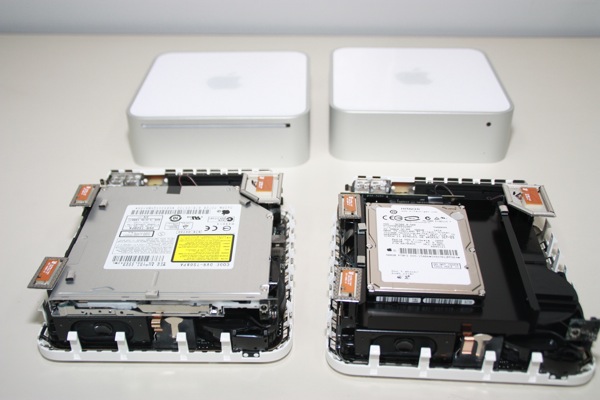
MacMini Colo has a Mini take-apart posted. The "traditional" Mac Mini probably looks familiar and the new server model has another hard drive where the DVD drive used to be, but otherwise these things are pretty much unchanged. 

One interesting tidbit on this: Since Apple’s latest firmware updates, both the new and last generation DisplayPort Mac Minis can use 8GB of RAM (they are advertised as topping out at 4GB).  However, the 4GB memory cards that are required are expensive. 

AAPL crosses all time high today

Site default logo image

Apple is having a pretty solid week, and it is only Wednesday. 

The week began with Apple’s earning call which landed much higher than any analyst had hoped for. Then there was that little product refresh which was met with glowing reviews.  Probably realated to Monday’s and Tuesday’s news is Wednesday’s, which is that Apple’s stock price has reached an all-time high.  It closed today at just under 205 against a lower market and peaked at 208.71 earlier in the day.

The rise puts Apple’s market cap at $183.57 billion and as we know from the earnings call, Apple has $43 billion in cash.  The market cap is now bigger than  Google.  That cash is enough to buy Dell, at a value of $29 billion.

There now is only one bigger tech company in the world, Microsoft (who launch their next OS tomorrow), with a market cap of $236.85 billion. Many think that lead won’t last long, however, $50 billion is a lot of value to gain.

Apple names the latest older Macs to head for the graveyard – official

Site default logo image

Apple has updated its list of Mac and other products it considers vintage and/or obsolete. The company will cease providing any product support or spare parts for these models from next month.

The list pretty much underlines that the PowerPC Mac is extinct, leaving few PowerPC models in the frame. Apple includes products discontinued over five but less than seven years ago as ‘Vintage’. Thanks to Hardmac for the info.

The following Macs and other products, may they rest in peace (or get cannibalised for spare parts via eBay)
 

  •         iBook G4 (early 2004)
  •         iBook G4 (14" early 2004)
  •         eMac (USB 2.0)
  •         Apple Cinema Display ADC
  •         Apple Studio Display 15" ADC
  •         Apple Studio Display 17" LCD
  •         Apple Studio Display 17" ADC
  •         Power Mac G4 (QuickSilver 2002)
  •         Macintosh Server G4 (QuickSilver 2002)
  •         PowerBook G4 (DVI)
  •         iBook (14.1 LCD 16 VRAM
  •         iBook (16 VRAM)
  •         Base Station Airport (Dual Ethernet)
     

UPDATED: Watch out iTunes – Google plans a music service, launch Oct. 28

Site default logo image

Apple’s iTunes empire seems set to meet a bigger than normal threat, on news former ally Google now plans its own online music service.

Details on Google’s music plan are vague right now, we don’t know if it will be offering a la carte downloads, music streaming, subscription services or what – it’s all open to speculation.

TechCrunch is reporting that multiple sources are discussing the Google plan, with the company “spending the last several weeks securing content for the launch of the service from the major music labels.”

The report suggests the name of the service might be ‘Google Audio’. The service will reportedly be available for US users.

UPDATE: "Google will partner with iLike and LaLa for their new music service, we’ve learned. And the announcement date is Wednesday, October 28, 2009." Service to be integrated into Google Search! (For some reason I feel unhappy about that – like – the world’s biggest search engine selling music through the search engine? Doesn’t feel right, somehow). Read it here.

Apple offers tech support notes for all-new consumer Mac range

Site default logo image

Apple has posted a series of support documents for the swathe of products it introduced yesterday, confirming, among other things, some compatibility problems with the new Magic Mouse when used with Windows via Boot Camp.

The company yesterday introduced:

Accompanying those releases, the company has now unleashed a slew of support documents for the new products, including those which follow:

iMac (21.5-inch, Late 2009) or iMac (27-inch, Late 2009): Bluetooth not available with Windows
After installing Boot Camp on an iMac (21.5-inch, Late 2009) or iMac (27-inch, Late 2009), you may notice the Apple Wireless Keyboard (2009) and Apple Magic Mouse will work, but Bluetooth icons do not appear in Control Panel and Bluetooth does not appear in the Device Manager.

Mac mini power LED indicates the computer’s status
The Mac mini has a power light located on the front of the computer in the bottom right corner below the optical drive slot. The LED displays a steady light, no light, or pulses, depending on the computer’s status. Here’s what the Mac mini’s LED is telling you.

Apple Magic Mouse: Up or down scrolling and swiping do not work on Windows with Boot Camp
When you use an Apple Magic Mouse with Windows XP and Vista using Boot Camp 3.0, which ships with Mac OS X v10.6 Snow Leopard, or Boot Camp 2.1, which shipped with Mac OS X v10.5 Leopard, up or down scrolling and two finger swiping does not work.

Apple Wireless Keyboard and Mouse: How to install batteries
“When the batteries in your Apple wireless mouse need to be replaced, replace all of them at the same time with the same kind of batteries,” Apple says. “The Apple wireless mouse uses two AA batteries. Make sure the positive ends of the batteries are pointing the correct direction.”

Wireless input devices: Bluetooth frequently asked questions
“Some Mac computers come with a wireless mouse and keyboard as the default configuration.  Most Mac computers work with wireless input devices that use Bluetooth technology.”

Desktop computers: Troubleshooting wireless mouse and keyboard issues
 If you’re having trouble with your wireless mouse or keyboard, click the mouse to wake it up. If you’re still having issues, choose the link below that most accurately describes the symptom you are experiencing.

ReelDirector: Much better video editing for iPhone 3GS

Site default logo image

The iPhone 3GS may be able to capture, trim and despatch video clips to YouTube, but its editing features are pretty limited. Now there’s a better choice, Nexvio’s ReelDirector.

This nice app lets you do all kinds of things, from adding titles and credits to your clips to editing and arranging clips to a timeline.

Not just that, but you also get to add transitions, arrange positions for text, and offers four different text styles you can apply to your clip.

We think it looks promising and it is available now from the App Store for just $7.99.

Via: OhGizmo
 

Windows 7 breaks Amazon UK (pre-order) sales records

Site default logo image

Hmm – looks like Microsoft’s management may get to breathe easy for a little longer on news from the UK that the company’s Windows 7 OS has just become the biggest grossing pre-order ever on Amazon UK.

The software has grabbed the top spot from the last Harry Potter novel and is already significantly more successful than Windows Vista. The OS launches tomorrow.

Amazon.co.uk says the only item to shift more than Windows 7 in the past three months is Dan Brown’s Da Vinci Code follow-up The Lost Symbol. Indeed, pre-orders for Windows 7 in the first eight hours of going on sale outnumbered those of Windows Vista’s entire pre-order period.

Managing director of Amazon, Brian McBride said, ‘The launch of Windows 7 has superseded everyone’s expectations, storming ahead of ‘Harry Potter and the Deathly Hallows’ as the biggest-grossing pre-order product of all-time at Amazon.co.uk, and demand is still going strong.”

For all its UK success, Microsoft’s not faring quite as well in the more populous US market – sure, it’s currently in the top three slots, but Ballmer’s boys are bound to be aware that Snow Leopard is the fourth biggest selling slice of software in the US.

PS: Knowing the fate of Microsoft’s new OS will offer an interesting insight into Apple’s future success tempting Windows users across to the Mac.