TechCrunch posts Microsoft’s favorite Bing Jingle. What do you think?
Bing goes the Internet


TechCrunch posts Microsoft’s favorite Bing Jingle. What do you think?
Mac OS 10.5.8 was released today….
.jpeg)
With it comes the following fixes and features:
Also, Mac OSX Server was released, bringing with it the following fixes/features:
AFP Server
AFP Client
Managed Client
Server Admin
System Image Utility
Addtional improvements
 Infoworld is reporting that there is a very significant memory leak in Windows 7 involving the chkdsk.exe utility which appears when…
you attempt to run the program against a secondary (that is, not the boot partition) hard disk using the "/r" (read and verify all file data) parameter. The problem affects both 32- and 64-bit versions of Windows 7 and is classified as a "showstopper" in that it can cause the OS to crash (Blue Screen of Death) as it runs out of physical memory.
Randall Kennedy tested the bug against a variety of different builds of the RTM Windows 7. The bug appeared in VMs, 32-bit Netbooks and 64-bit laptops. The bug also appears in Windows Explorer when you run the integrated disk check utility.
In each case, the utility executed the first three stages of the test correctly using modest amounts of memory (several hundred megabytes). Then, when it entered the fourth stage (a read test), the chkdsk.exe utility’s memory consumption started to climb rapidly until several gigabytes had been allocated to its process and the test systems in question began to run out of memory.
Kennedy goes on to say that Microsoft is blaming chip components and recommending that users buy new machines. However, the appearance of the bug in VMWare refutes that hardware is the issue. VMWare virtualizes the chip components.
The bottom line: A file system-level bug, at this late stage in the development cycle, should be considered a showstopper by most IT organizations. Worse still, user comments suggest that Windows Server 2008 R2 suffers from the same flaw. So while the act of running chkdsk.exe under Windows 7 might not be a common occurrence for most users, it is in fact something that server administrators do quite regularly to ensure volume integrity….
What this latest episode has taught me is that no major release of Windows –- not even one that is more or less a supersized patch of the previous version –- deserves a pass, and that the old wisdom of “wait for the first service pack” still applies with Windows 7.
This is, after all, a Microsoft product.
Windows 7 is currently scheduled to be formally released in October, a month after Apple’s latest generation Snow Leopard OS is slated to hit the market.
BGR has the deets on what appears to be an 8GB iPhone3GS entering the Rogers inventory system. If this is real, it will most likely mean the end of the iPhone 3G as we know it as there isn’t much room ($149?) in the middle of the current lineup for the sole non "S" 8GB model. As Tim Cook mentioned at the last earnings conference call, Apple is having trouble keeping up with demand on current iPhone3GS models around the world.


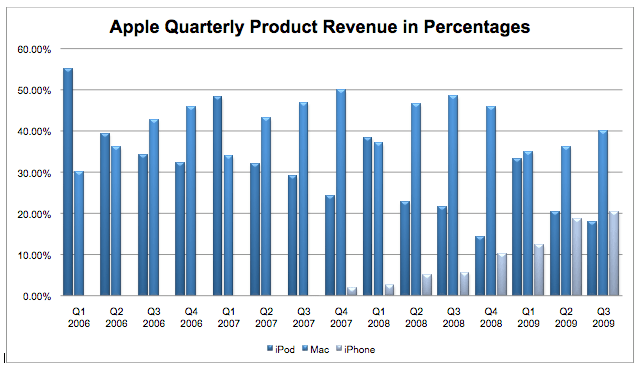
How much is the iPod line faltering – – or how well is the rest of Apple’s line doing in comparison? It turns out that after GAAP accounting is taken out of the equation, the iPod line, which once was Apple’s profit leader is now #3 in profitability, beating only Apple’s AppleTV line.
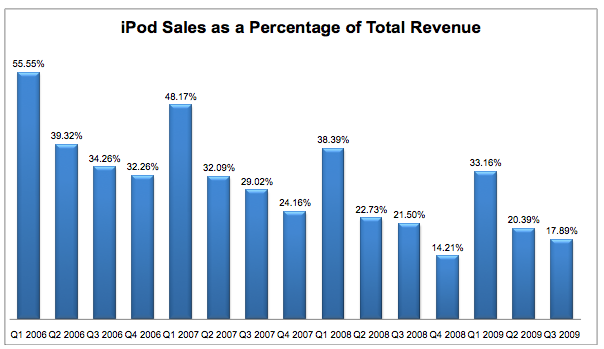
As this graphic shows, iPod sales have been contributing a shrinking amount of revenue to Apple’s general performance, skip past the break to see another graph which shows us in clearer terms the shrinkage of iPod revenues.
These attractive stats come from Philip Elmer-DeWitt over at Fortune. He notes that as recently as 2006, iPod sales accounted for 55.5 per cent of Apple revenue. Now that’s shrunk to under 18 per cent.
He cites day trader, Andy Zaky, who says, “Many Apple critics have argued that Apple would essentially fall off the earth because at some point in time the iPod’s growth would collapse.”
Zaky points out that this is happening as MP3 players head toward becoming commodity items.
(That point at which everyone has one, and brand and features become much of a muchness…incidentally, we think that’s what Microsoft’s betting on with its Zune. We think Microsoft just hopes to sell more Zunes to a market which doesn’t care about features or brand any more. Kind of like a supermarket own brand. We also think Apple has its own low-cost MP3 player plan for that point of market development).
Right now, these shrinking iPod sales don’t matter so much, as Zaky notes, “Apple is still firing on all cylinders thanks to the explosive growth of the iPhone.”
Apple management have been planning to manage the market change, Apple admitted in July. Chief financial officer Peter Oppenheimer said, “We expect our traditional MP3 players to decline over time as we cannibalize ourselves with the iPod touch and the iPhone.”
Notions that Apple’s developing its next brood of iPods are reinforced by the company’s recent half-billion dollar deal with Toshiba for the supply of flash memory chips, as used in iPhones, most iPods and many of its laptops. The deal means Apple’s secured “about one quarter’s worth” of flash memory for use in future products.
Rumours that Apple will add video cameras and other potential new features (WiFi?) to future generations of iPod nano and iPod touch also remain. If true, these moves will be proof positive that Apple is extending the versatility of these devices in order to extend the reach of its market.
Pacific Crest analyst, Andy Hargreaves, recently notes, “iPhone‘s superior mobile internet experience and the ability to create valuable custom applications will continue to drive gains.”
 Big news for iPhone cravers in the UK, as a report this morning claims O2’s exclusive claim to offer the device will time out on October 9, freeing other networks up to offer the must-have device for sale here.
Mobile Entertainment is claiming to have seen documentation, “that states it (exclusivity) will end officially on October 9.” This comes after weeks of chatter claiming other networks are vying to add the iPhone to their roster of available mobiles.
One limitation of the time out may be that O2 will continue to offer the iPhone 3GS exclusively in the UK, leaving the cheaper and less well-featured iPhone 3G for sale by competing operators.
O2 signed its original deal with Apple in late 2007, and is believed to have the rights to sell iPhone to 2012.
As reported last week, The Guardian revealed comments from Vodafone CFO, Andy Halford, who said, “It’s a good product and we would love to have it in the portfolio in more countries.” His comments came after weeks of speculation Orange and T-Mobile are also in the frame to get in on the iPhone deal.
T-Mobile has even begun offering a very limited quantity of iPhones (sourced outside of the UK) to high-spending customers who threaten to quit its network.
Adding further grist to the mill, the Apple/AT&T relationship continues to attract criticism. AT&T CEO Randall Stephenson set tongues wagging recently when he revealed that “there will be a day when you are not exclusive with the iPhone.”
 More news from Namco Bandai’s recently formed Apple Games Division, which is now looking to bring in some legendary classic arcade titles including Soulcalibur and Tekken to the iPhone, iPod touch and other similar devices (iProd, anyone?)
Interviewed by Kotaku, Namco’s newly-hired Apple games chief, Jonathan Kromrey, talks the talk, saying the company is looking into how to make its heavyweight console classics work using Apple’s control UI’s. Might we see voice controlled titles soon?
“My charge is to make games that are the best for the iPod touch and iPhone," explains Kromrey. "There is a gold rush to do Apps for the App store and Namco is at the forefront of that movement."
In future the company plans to introduce a huge range of titles for Apple’s platforms, ranging from casual gaming titles to action and adventure titles.
“In the past Namco’s been known for its depth of arcade experience, games like Pac-Man, Galaga, Soulcalibur and Tekken," he said. “I’m here to champion new things, new IP, to discover what the new Pac-Man is for the iPhone."
He also talked a little about price, and from what he said it suggests Namco titles will be available at prices up to around $5, with some classics offered for slightly more.
‘Course, what we think may happen here at 9to5Mac is that Apple will open up a new Pro games store on the App Store. Here it will offer titles in higher resolution than their iPhone/iPod touch equivalents. These titles will be sufficiently high res to run on your TV using an Apple TV, on your iTablet/iProd/Apple’s biggest secret ever that everyone is talking about/whatever...will they also run on Mac?
We hope so. Apple’s serious about gaming these days…
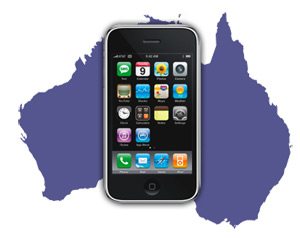 While Russia may have problems shifting its iPhones, it’s no way the same Down Under in Australia, where reports this week state the iPhone 3GS is selling out.
See, seems none of the iPhone-selling carriers in Australia have any iPhones left to sell, and even Apple’s own online shop can only promise to get your iPhone 3GS to you after a week’s wait.
In Australia, Telstra’s online store says: “Please Note: There is currently a global shortage of iPhone models, and we are out of stock of some models. Register here to receive email notification once we have new stock.”
3Mobile, Optus, Vodafone and Virgin Mobile all report the same problems, promising that fresh supplies of Apple’s must-have handheld will reach them in mid-August. This news shows that, at least this soon after launch, demand for the iPhone 3GS in Oz continues to outstrip supply.
No surprise then that a pair of analyst reports released yesterday show Apple’s grabbing an armful of customers with its new device. Bernstein Research has published a report claiming that iPhone now accounts for 8% of all mobile revenue, and 32% of the mobile industry”s handset profits.
And a second report from IDC claims the iPhone 3GS to be the second most popular handset sold in this year’s second quarter, eclipsed only by the BlackBerry Curve.
Here’s America’s top ten iPhones for your visual delectation and delight (according to IDC’s estimates). Note the number four position also belongs to Cupertino.
1. BlackBerry Curve
2. iPhone 3GS
3. BlackBerry Pearl
4. iPhone 3G
5. BlackBerry Bold
6. BlackBerry Storm
7. HTC T-Mobile G1
8. Palm Pre
9. HTC Touch Pro
10. HTC Touch Diamond
(One remark though – with the iPhone 3GS not making its debut until June, we confess to some bafflement as to how it could top the Q2 sales chart, when June is the last month of the second quarter – presumably this means the Curve’s days at the top of the tree could be numbered?)
 Yet more intensity in the spat between Apple and Palm, with the latter company recruiting yet another Apple-experienced staffer, Jeff Zwerner.
Zwerner joins Palm as its Senior Vice President of Brand Design. The new exec has worked with Apple for two short sessions, once between 95-96 as Senior Art Director and again between 2001-2003, when he was Apple’s Creative Director for Packaging.
Additional experience includes stints at numerous big brands, including Coca-Cola, Disney, The Gap, HP and Nike.
He joins a growing coterie of Apple’s exes, not least Palm’s current CEO, Jon Rubinstein as the smaller company attempts to unseat the dominance of the iPhone with its Palm Pre
The man seems to have some strong talents. In 2007, Zwerner was nominated for a National Design Award by the Cooper-Hewitt, National Design Museum, Smithsonian Institution. He’s also received numerous national and international awards from the Type Directors Club, AIGA, American Center for Design, Graphis, Communication Arts, Print, Red Dot, International Forum Design Hanover and How, among others.
He takes his place at the company as battle between Apple and Palm seems firmly joined, with the latter complaining the former company’s move to block iTunes synching on its Palm Pre
Ars points to a USBDeviceConfiguration file which lives in the iPhone SDK 3.1 that has a surprising new addition. Included in all of the recent iPhone SDK updates until now has been the iProd 0,1 device file. 0,1 device files typically stand for prototypes in Apple hardware lingo.
As of iPhone SDK 3.1, there is now a new device profile for an iProd 1,1. Theoretically, this means that production "iProd" devices are already being trialled on iPhone OS 3.1. Ars speculates that this could be the tablet or perhaps even an iPod nano with a camera that would run the iPhoneOS (and would therefore have a lot of other goodies).

Frankly, its hard to decide which of these scenarios is more exciting.
 In one of the more laughable tablet predictions to date, notoriously unreliable Shaw Wu from Kaufman Bros. announces that Apple has been ordering large amounts of 4, 7, 9, 10 and 12-inch screens over the past two years and "based on that information, the analysis [sic] predicts that Apple will launch at least one — but possibly multiple — new devices in the near future".
"We are under the impression that these screens could be used in new form factors including a sub-notebook and/or tablet, and would more likely launch in 2010 as opposed to 2009," the note reads. "As usual, exact timing is always tough to pinpoint as Apple works on its own schedule."
In other news, it is going to rain tomorrow, unless of course, it doesn’t.
Wu goes on to say that China Unicom will be the iPhone carrier in China. A good guess since they’ve been advertising that fact since March.
He also isn’t sure if the device will be a "tablet or netbook".
 Silicon Alley Insider is reporting (Wall Street gossip) that Apple may be building an online payment platform similar to Google Checkout, Paypal and the also-rumored Facebook’s "Pay with Facebook".
It really isn’t that big of a stretch, Apple already plays that role for in-app purchases on the iPhone platform. They also already have millions and millions of global account holders tied to credit cards (Jobs noted 65 million active iTunes accounts just last year).
The infrastructure is already there in iTunes. A first stop? Perhaps you’ll be able to make purchases at the Apple Store with your iTunes account. Maybe they’ll build an app for that to ease the transition. Then, they’ll add a few more retailers and all of a sudden, you have the Bank of Apple.
We took a look at the fast-paced and competitive development of solutions which allow you to use your iPhone to take credit card payments, replacing POS credit card processing machines just yesterday. Today’s claim that Apple plans to introduce its own PayPal-competing payment system simply extends the paradigm.
What it comes down to at its simplest level is: What if 65 million (or more) iTunes users could point their iPhone at a cash terminal in a shop and pay for their goods via their iTunes account? Apple has the micropayments sorted, has your details, you have a password, and with Remote Wipe it’s probably a lot safer than a credit card and a PIN number. Imagine, if you will, a situation in which you pay for your coffees in your local Starbucks with your iTunes account. The advantage being the lack of a minimum charge, as Apple’s used to handling small transactions.
Look – we’re not imagining the situation: Apple has patented the notion of using your iPhone as a device to access and purchase food in restaurants and more…
Consider this: Visa last year confirmed plans to develop a mobile payments-related services for Google’s Android platform. This will let users check their accounts, make payments, and more, using an Android phone. Does Apple want to miss that party? We doubt it.
If there’s one sticking point it’s profit margins. Apple currently takes 30% of in-app purchases. That figure will have to come a lot closer to the 1-2% that Paypal and Google Checkout charge if they want to bring more retaillers on board.
This just in: iTunes heads south of the border. Artists include Paulina Rubio, Vicente Fernandez and Zoe and a wide range of international artists including Shakira, Lady Gaga and Green Day. Songs are priced at 12 pesos and most albums at 120 pesos and will go nicely with Telcel’s iPhone offerings.

Apple(R) today announced the launch of the iTunes(R) Store in Mexico (www.itunes.com/mexico) with an incredible selection of Mexican and international music from all the major labels and hundreds of independent labels. Launching with a catalog of millions of songs, the iTunes Store in Mexico features Mexican artists including Paulina Rubio, Vicente Fernandez and Zoe and a wide range of international artists including Shakira, Lady Gaga, Green Day and thousands more. With most songs priced at 12 pesos and most albums at 120 pesos, the iTunes Store in Mexico is the best way for Mac(R) and PC users to legally discover, purchase and download music online.
"The iTunes Store in Mexico is off to a great start with music from all of the majors and hundreds of indie labels," said Eddy Cue, Apple’s vice president of Internet Services. "And the revolutionary App Store in Mexico gets bigger and better with great new apps using amazing new features, and we can’t wait to see what developers come up with next."
The iTunes Store in Mexico joins the revolutionary App Store, which has more than 65,000 applications available to consumers in 77 countries, reaching tens of millions of iPhone(TM) and iPod touch(R) users around the world. Customers have downloaded more than 1.5 billion apps and the recently released iPhone OS 3.0 software update includes over 100 new features like Cut, Copy and Paste; Spotlight(R) search; landscape keyboard and view; and expanded parental controls. Apps from the App Store work with both iPod touch and iPhone, including the new iPhone 3GS, the fastest, most powerful iPhone yet.
The iTunes Store offers music from all of the major labels and hundreds of independent labels including Warner Music, Sony Music Entertainment, EMI Music and Universal Music Group. All music on iTunes is available in iTunes Plus, Apple’s DRM-free format with high-quality 256 kbps AAC encoding for audio quality virtually indistinguishable from the original recordings. iTunes customers can also choose to download their favorite songs from the world’s largest online music catalog directly onto their iPhone over their 3G network for the same price as downloading to their computer. A great selection of music videos is also available for purchase and download, with most priced at 24 pesos.
Apple has made it easy for music fans in Mexico to purchase and enjoy music with iTunes Gift Cards, which can be purchased at national retailers including Liverpool, Mixup, Office Depot, El Palacio de Hierro, Sanborns and also at iShop, iStore and MacStore locations. iTunes Gift Cards are available in denominations of 200, 300 and 600 pesos.
Apple has made it easy for music fans in Mexico to purchase and enjoy music with iTunes Gift Cards, which can be purchased at national retailers including Liverpool, Mixup, Office Depot, El Palacio de Hierro, Sanborns and also at iShop, iStore and MacStore locations. iTunes Gift Cards are available in denominations of 200, 300 and 600 pesos.
Available starting today, exclusively on iTunes, fans can Countdown to the release of highly-anticipated new albums from Nelly Furtado, Sean Kingston and Jesse & Joy by purchasing and downloading advance songs from the albums as they are released on iTunes. Fans can then buy the albums on their release date at a reduced price based on songs they’ve already purchased with Complete My Album. Also, exclusive iTunes Live Sessions are available from Mexican artists including Plastilina Mosh and Motel, and also from a wide selection of international artists. And the iTunes Podcast Directory features over 150,000 free podcasts, including featured Mexican podcasts from Televisa, MVS Television, El Universal and Grupo Reforma.
With Apple’s legendary ease of use, pioneering features such as the ability to turn previously purchased tracks into complete albums at a reduced price, and seamless integration with iPod(R) and iPhone, the iTunes Store is the best way for Mac and PC users to legally discover, purchase and download music and video online.
 He’s only been in post a month, but new Federal Communications Commission (FCC) chairman, Julius Genachowski, ain’t no slouch – he’s a tech-savvy consumer champion and he wants to foster a culture of competition and innovation – and he’s an iPhone user.
Perhaps that’s why Genachowski’s been so quick to act over Apple’s rejection of the Google Voice app, which most commentators still believe – despite AT&T’s rejection of the argument – was denied a place in the App Store because its users would be able to make calls with Google, circumventing AT&T’s network and impacting the telco’s revenue.
Whatever the reason, and with the FCC determined to press on with its investigation into the rejection of that app, Genachowski’s no enemy of Apple – in fact he’s warming to his iPhone, as revealed in an interview published today by GigaOM.
“I do have an iPhone. I do use it,” he admits, adding, “Now I’ve been a BlackBerry user for a very long time. But now I have a BlackBerry and an iPhone and I’m using both, although I do need a pair of new pants with more pockets.”
Genachowski also admits he’s making increasing use of his iPhone. Perhaps to call some of the engineers, scientists and entrepreuners he wants to see taking some of the top jobs at the regulator, which has drawn heavily on lawyers in the past.
iPhone talk aside, it’s well worth taking a look at the extended interview, which talks a lot about how regulation and the needs for it are changing in the current century. And how he intends transforming the FCC from its previous fairly moribund status into a poster child for how US government agencies could work.
On a normal day, or iPhones hit ht charger at night with a hour or two of usage to spare. However, if we have a heavy gaming day, the iPhone putters out around dinner. That’s when it is good to have an extra iPhone battery. Kensington raps it all up in a pretty
 Apple has kicked its third most active developer from its App Store, citing intellectual property violations as cause.
Developer Khalid Shaikh has had his App Store license withdrawn and his over 900 applications removed from sale. Apple told the developer this was because of multiple complaints his apps infringed other people’s IP.
"The persistent nature of such complaints has led us to conclude that you are entering into the representations and warranties in the iDP Agreement in bad faith by misrepresenting that you have all the necessary rights for your submissions," the company told him, as revealed by TechCrunch.
Most of Shaikh’s apps cost $4.99. They tended to be aggregation applications, which gathered articles and images from websites concerning specific topics, such as stars, Top Sexy Ladies, or Soaper Stars Update (illustrated).
While these apps aren’t exactly the creme-de-la-creme, it’s understood the developer had a 26-person team and was pulling in thousands of dollars each day (TecCrunch). TechCrunch also points out that with the App Store authorising these 900 applications in the past, it wonders what oversight Apple’s approvals team has over instances of copyright abuse?
The whole sage emerges as Apple’s approval processes continue to attract criticism, with the recent denial of Google Voice generating an FCC investigation into the companies. We won’t repeat all the many instances of criticism of Apple’s App Store policies here, except to say that all of this criticism clearly underlines a need for the company to make its approval processes much more transparent.
This lack of transparency may also reflect just how quickly App Store became succesful, with the company’s processes perhaps not yet fully in place to deal with a business of this size.
Here’s an interesting tip from Silicon Valley Insider – a recent Goldman Sachs survey shows that while RIM continues to dominate that sector of the smartphone market, Apple’s iPhone is making strong headway, with approximately half of all iPhone users employing their device for both business and personal use.
 Senior Apple staff will visit China to get into top level negotiations with China Unicom to discuss launch of the product in the country, local Chinese media reports this morning claim.
"Senior officials from Apple Inc are to visit China this week, and they haven’t arrived in Beijing yet," a source told Sina.com. "Apple’s branch company in China are ready for the reception, and informed China Unicom about this earlier.”
Executives from both firms are likely to discuss the launch strategy for the iPhone in China, with Apple officials also likely to meet with the Chinese Ministry of Industry and Information Technology.
An International Business Times report informs a China Unicom team visited Apple HQ in March to negotiate terms for iPhone distribution. Apple’s away to China team is expected to be led by Greg Joswiak, Apple’s vice president of iPod and iPhone Product Marketing.
China is a prize market, with over one billion mobile phone in use. However, at this point – while a Chinese model iPhone has been approved – China Unicom will not offer Apple a share of iPhone-generated revenue. This final point has been a sticking point against inking the deal until now. Negotiations have been proceeding for months.
Having achieved regulatory approval, iPhones for China are thought to be rolling of the production lines even now.
Meanwhile, in the UK, signs continue to emerge suggesting Apple’s exclusive deal with O2 is under threat. T-Mobile has begun flouting this deal by offering limited numbers of iPhone 3G’s to customers threatening to defect to O2 for the device.
T-Mobile has refused comment on this, but recent reports have claimed Apple may be preparing to allow sales of iPhone 3G’s through other networks, while leaving O2 as exclusive provider of the new iPhone 3GS model.
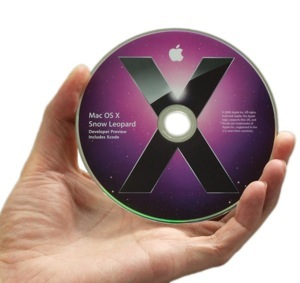 Scant days since the operating system was made available for pre-order on Amazon US, Mac OS X 10.6 Snow Leopard has shot to the top two slots on the online retailer’s Software sales chart.
Amazon UK last night opened an email announcement list for UK Mac users who’d like to be told when Snow Leopard is made available for sale there, though UK pricing hasn’t yet been announced.
The single user version of Snow Leopard, ($29), is top of the charts with the second place taken by the five-user family version ($49)
Apple is also selling a Box Set (Snow Leopard including iWork and iLife):$169
for $169 or $229 for five users. The server edition of Snow Leopard, called Mac OS X Server version 10.6, costs $499.
Some key caveats: the OS will only be available for Intel-based Macs as it requires this hardware because it’s the first Apple OS to be truly 64-bit. Mac users still on a PowerPC Mac may be motivated to purchase an Intel Mac
The OS is expected to ship next month.
Two new Apple ads debuted today: ‘Share’
and ‘Travel’, below:
The latest story making the rounds is that Apple is soon going to approve a native Netflix app for the iPhone and iPod touch. While we’d love to see this, we think there might be some pretty significant hurdles for the Netflix team to overcome. Namely that Apple doesn’t like competition (or duplication) of its apps on the iPhone and has expressly forbidden it in the past. Apple banned Podcaster from the App Store because iTunes plays podcasts for instance.
Apple started allowing iTunes to download movies over the iPhone and iPod touch in the latest update. Netflix also allows you download movies over the network for a price. Additionally, Apple usually parlays a 30% take on apps sold through apps (Amazon Kindle exempted). We aren’t feeling it.

As the article stated, AT&T aren’t going to be huge fans of sending movie files over the wireless networks either.
Would we love to see it? Yes. do we expect to? No.
 Apple’s iTunes Movie downloads on iPhone

This update addresses general compatibility issues, improves overall stability, and fixes a number of other minor issues. The issues addressed include:
This update is recommended for all users of GarageBand ’09.
…in the wake of Eric Schmidt’s "resignation".
http://plus.cnbc.com/rssvideosearch/action/player/id/1203741351/code/cnbcplayershare
 They’re saying games matter more to Apple than ever before, and this new spark’s confirmed today by former senior iPods
"While working at Apple, I was amazed by the renewed passion for gaming that seemed to grow by the day," he said. "The gaming community has never been broader, both in terms of the types of games being played and the audience. This is a great time to be developing games for Apple’s devices."
Until now, Kromrey has been an iPods
He was also involved in identifying and planing strategies to support continued growth and showcase new hardware of these products on their release. Now he’s taken a new job at games developer, Namco, where he holds the new post of general manager of Apple Games.
This key hire clearly underlines the renewed depth of interest games publishers now hold in developing for Apple’s platforms.
He’ll be working at Namco to create new franchise opportunities, oversee research, manage design and production and developing new and original content that make best use of what can be done with Apple devices, including the iPhone and iPod touch. Naturally, this suggests Namco’s ready to invest significantly in seizing a slice of Apple’s growing market.
"It’s an exciting time at Namco. We are preparing to usher in a new generation of games that capitalize on changing consumer preferences, like anywhere’ gaming and social games," said Kromrey.
"With the iPhone and iPod touch, Apple has provided truly innovative platforms and is challenging developers to push these devices to their limits. I’m going to ensure that Namco answers that challenge and exceeds consumers’ expectations."
There’s new breeds of socially-connected, web-savvy, internet-friendly games in preparation, or so it appears. Namco’s going to be exploring ways to implement voice recognition, peer-to-peer game play and accelerometer controls in future games. It’s also looking to upgrade existing titles to exploit new features in iPhone 3.0, such as access to iTunes and Facebook Connect.
Kromrey’s not merely an Apple ex-staffer. He has a serious background in the games industry, before Apple he managed production at iPlay, creating games for sundry mobile platforms. Before this, of course, he held various management and production roles at Eidos Interactive, Namco Bandai Games, Mattel Interactive and Strategic Simulations.
With the mention of the Apple TV


