Author

Avatar for 9to5 Staff

9to5 Staff

Palm fires back legal volley to Apple

Site default logo image

Apple’s de facto leader, Tim Cook, seemed to threaten legal action against Palm (in so many words) during the earnings conference call this week for their use of multi-touch interface in the Palm Pre. 

We like competition, as long as they don’t rip off our IP, and if they do, we’re going to go after anybody that does … We will not stand for having our IP ripped off and we’ll use whatever weapons we have at our disposal [to make sure that doesn’t happen]. I don’t know that I can be more clear than that.

Palms stock dropped 6%.  Those are mighty big words to the bottom line.

What to do?  Palm fired back, in slightly less harsh terms this morning with…

Well, if Palm was shaken by Cook’s remarks, it’s not letting on. Asked if such aggro rhetoric about Apple’s intellectual property and the grim legal fate of those who might pilfer it worried the company, Palm spokesperson Lynn Fox said not in the least. “Palm has a long history of innovation that is reflected in our products and robust patent portfolio (31 pages of patents in Google Patent Search), and we have long been recognized for our fundamental patents in the mobile space,” she told Digital Daily. “If faced with legal action, we are confident that we have the tools necessary to defend ourselves.”

You think Fred Anderson and Jon Rubinstein (ex Applers) are starting to piss off the current crew?

'1984' Commercial is 25 years old

Site default logo image

During the 3rd Quarter of Superbowl XVIII on this date in 1984, Apple released the famous ‘1984’ commercial,  It has pretty much taken the top spot in all of the "Best Ads Ever" contests and people have been talking about it forever.  It also introduced a pretty important product. 

USC Alum Marcus Allen also had a great game that day for the L.A. Raiders.  I don’t remember the Apple commercial (I was 10 and an Atari XE guy at the time), but I remember "that run"..

He heads left and is completely stopped. He spins around and heads back to the right. He swerves through a couple Redskins defenders, then hits a lane and he’s gone. What I remember most was the way he just seemed to glide to the end zone. He wasn’t running. He wasn’t straining. He just glided past the defenders. Effortlessly pulling away from everyone.


Is that a 15 inch MacBook Air?

Site default logo image

Gary Hustwit got to visit Jonny Ive at Apple’s prototyping facility for his upcoming documentary Objectified.  Jonny is holding a regular MacBook Air, but what is that next to him?  It looks a little bigger… but probably isn’t.  Anyway, it is interesting to take a quick peek at where the magic happens.

Doubtful that Apple/Jonny would let Hustwit walk away with a picture of a prototype…But those are some pretty sweet waterjets in the background.  See Jony in the trailer here.

Microsoft Layoffs – 1400 today, 5000 over the next 18 months

Site default logo image

Microsoft missed Q2 revenue and earnings forcasts. Revenue was $16.63 billion versus $17.08 billion expected. EPS was $0.47 a share, below $0.49 expected.  So what to do?

Microsoft today announced they’d be laying off 5,000.  Cuts will come across all divisions, including: "R&D, marketing, sales, finance, legal, HR, and IT" which Microsoft hopes will save it $1.5 Billion/year.

In light of the further deterioration of global economic conditions, Microsoft announced additional steps to manage costs, including the reduction of headcount-related expenses, vendors and contingent staff, facilities, capital expenditures and marketing. As part of this plan, Microsoft will eliminate up to 5,000 jobs in R&D, marketing, sales, finance, legal, HR, and IT over the next 18 months, including 1,400 jobs today. These initiatives will reduce the company’s annual operating expense run rate by approximately $1.5 billion and reduce fiscal year 2009 capital expenditures by $700 million.

For some more interesting stuff check what makes Microsoft tick here:

Statements in this release that are "forward-looking statements" are based on current expectations and assumptions that are subject to risks and uncertainties. Actual results could differ materially because of factors such as:

    — challenges to Microsoft’s business model;
    — intense competition in all of Microsoft’s markets;
    — Microsoft’s continued ability to protect its intellectual property
       rights;
    — claims that Microsoft has infringed the intellectual property rights of
       others;
    — the possibility of unauthorized disclosure of significant portions of
       Microsoft’s source code;
    — actual or perceived security vulnerabilities in Microsoft products that
       could reduce revenue or lead to liability;
    — government litigation and regulation affecting how Microsoft designs
       and markets its products;
    — Microsoft’s ability to attract and retain talented employees;
    — delays in product development and related product release schedules;
    — significant business investments that may not gain customer acceptance
       and produce offsetting increases in revenue;
    — changes in general economic conditions or the availability of credit
       that affect the value of our investment portfolio or demand for
       Microsoft’s products and services;
    — adverse results in legal disputes;
    — unanticipated tax liabilities;
    — quality or supply problems in Microsoft’s consumer hardware or other
       vertically integrated hardware and software products;
    — impairment of goodwill or amortizable intangible assets causing a
       charge to earnings;
    — exposure to increased economic and regulatory uncertainties from
       operating a global business;
    — geopolitical conditions, natural disaster, cyberattack or other
       catastrophic events disrupting Microsoft’s business;
    — acquisitions and joint ventures that adversely affect the business;
    — improper disclosure of personal data could result in liability and harm
       to Microsoft’s reputation;
    — outages and disruptions of online services if Microsoft fails to
       maintain an adequate operations infrastructure;
    — sales channel disruption, such as the bankruptcy of a major
       distributor; and
    — Microsoft’s ability to implement operating cost structures that align
       with revenue growth.
 

Apple's full statement on the Q1 Earnings numbers

Site default logo image

Apple Reports First Quarter Results

Best Quarterly Revenue and Earnings in Apple History
iPod Sales Set New Record

CUPERTINO, California—January 21, 2009—Apple® today announced financial results for its fiscal 2009 first quarter ended December 27, 2008. The Company posted record revenue of $10.17 billion and record net quarterly profit of $1.61 billion, or $1.78 per diluted share. These results compare to revenue of $9.6 billion and net quarterly profit of $1.58 billion, or $1.76 per diluted share, in the year-ago quarter. Gross margin was 34.7 percent, equal to the year-ago quarter. International sales accounted for 46 percent of the quarter’s revenue.

In accordance with the subscription accounting treatment required by GAAP, the Company recognizes revenue and cost of goods sold for iPhone™ and Apple TV® over their economic lives. Adjusting GAAP sales and product costs to eliminate the impact of subscription accounting, the corresponding non-GAAP measures* for the quarter are $11.8 billion of “Adjusted Sales” and $2.3 billion of “Adjusted Net Income.”

Apple sold 2,524,000 Macintosh® computers during the quarter, representing nine percent unit growth over the year-ago quarter. The Company sold a record 22,727,000 iPods during the quarter, representing three percent unit growth over the year-ago quarter. Quarterly iPhone units sold were 4,363,000, representing 88 percent unit growth over the year-ago quarter.

“Even in these economically challenging times, we are incredibly pleased to report our best quarterly revenue and earnings in Apple history—surpassing $10 billion in quarterly revenue for the first time ever,” said Steve Jobs, Apple’s CEO.

“Our outstanding results generated over $3.6 billion in cash during the quarter,” said Peter Oppenheimer, Apple’s CFO. “Looking ahead to the second fiscal quarter of 2009, we expect revenue in the range of about $7.6 billion to $8 billion and we expect diluted earnings per share in the range of about $.90 to $1.00.”

Apple will provide live streaming of its Q1 2009 financial results conference call utilizing QuickTime®, Apple’s standards-based technology for live and on-demand audio and video streaming. The live webcast will begin at 2:00 p.m. PST on January 21, 2009 at www.apple.com/quicktime/qtv/earningsq109/ and will also be available for replay for approximately two weeks thereafter.

*Non-GAAP Financial Measures

During fiscal 2007, the Company began selling the iPhone and Apple TV. Because the Company may provide unspecified features and additional software products to iPhone and Apple TV customers in the future free of charge, in accordance with GAAP the Company recognizes revenue and cost of goods sold for these products on a straight-line basis over their economic lives, with any loss recognized at the time of sale. Currently, the economic lives of these products are estimated to be 24 months. This accounting treatment, referred to as subscription accounting, results in the deferral of almost all of the revenue and cost of goods during the quarter in which the products are sold to the customer. Other costs related to these products, including costs for engineering, sales, marketing and warranty, are expensed as incurred. Further, the costs to develop any future unspecified features and additional software products that may eventually be provided to customers also are expensed as incurred. In contrast, the Company generally recognizes revenue and cost of goods sold for its other products, such as Macs and iPods, at the time of sale, as the Company does not provide future unspecified features or additional software products to those customers free of charge.

In July 2008, the Company began selling iPhone 3G, the second-generation iPhone, and significantly expanded distribution by establishing carrier relationships in over 70 countries. Unit sales of iPhone 3G have been significantly greater than sales of the first-generation iPhone. During the first quarter of iPhone 3G availability ended September 27, 2008, 6.9 million units were sold, exceeding the 6.1 million first-generation iPhone units sold in the prior five quarters combined.

Unit sales of iPhone 3G continued to be significant in the quarter ended December 27, 2008, with 4.4 million iPhones sold. As a result, the amount of revenue and product cost related to those iPhone sales that the Company deferred for recognition in future periods under subscription accounting was substantial. While the GAAP results provide significant insight into the Company’s operations and financial position, management continues to supplement its analysis of the business using financial measures that look at the total sales, related product costs and resulting income for iPhones and Apple TVs sold to customers during the period. The presentation at the end of this press release includes the following non-GAAP measures: “Adjusted Sales,” “Adjusted Cost of Sales,” “Adjusted Gross Margin,” “Adjusted Operating Margin,” “Adjusted Income before Provision for Income Taxes,” “Adjusted Provision for Income Taxes,” “Adjusted Net Income” and “Adjusted Diluted Earnings per Share.” These financial measures are not consistent with GAAP because they do not reflect the deferral of revenue and product costs for recognition in later periods. The Company uses these financial measures, along with other measures discussed below, to provide additional insight into current operating and business trends not readily apparent from the GAAP results.

Management uses Adjusted Sales to evaluate the Company’s growth rate, revenue mix and performance relative to competitors. Given the impact of iPhone unit sales during the quarter ended December 27, 2008, Adjusted Sales provides a meaningful measurement of the Company’s growth by reflecting amounts generally due to Apple at the time of sale related to products sold within the period. Further, eliminating the effects of deferred revenue (current sales deferred to future periods and prior sales being recognized currently) provides more transparency into the Company’s underlying sales trends. Management uses the non-GAAP measures of “Adjusted Cost of Sales,” “Adjusted Gross Margin” and “Adjusted Operating Margin” to measure the Company’s operating performance based on current period iPhone and Apple TV sales and to facilitate ongoing operating decisions. Additionally, because the Company recognizes engineering, sales, and marketing expenses as incurred, including expenses related to iPhone and Apple TV, management uses Adjusted Sales to evaluate returns on those costs, to manage year-over-year operating expense growth, and to budget future expenses. Furthermore, because they are considered meaningful indicators of current business performance, the non-GAAP measures “Adjusted Sales” and “Adjusted Operating Margin” are metrics that will factor into the determination of management compensation beginning in fiscal year 2009. Finally, management uses the non-GAAP measures of “Adjusted Income before Provision for Income Taxes,” “Adjusted Provision for Income Taxes,” “Adjusted Net Income” and “Adjusted Diluted Earnings per Share” to measure the Company’s operating performance based on current period iPhone and Apple TV sales, to facilitate ongoing operating decisions, and compare performance relative to competitors.

Management believes that these non-GAAP financial measures, when taken together with the corresponding consolidated GAAP measures and related segment information, provide incremental insight into the underlying factors and trends affecting both the Company’s performance and its cash generating potential. Management believes these non-GAAP measures increase the transparency of the Company’s current results and enable investors to more fully understand trends in its current and future performance.

Cautions on Use of Non-GAAP Measures

As noted previously, these non-GAAP financial measures are not consistent with GAAP because they do not reflect the deferral of revenue and product costs for recognition in later periods. These non-GAAP financial measures do not adjust for the costs associated with the Company’s intention to provide unspecified new features and software to purchasers of iPhone and Apple TV products. These costs are expensed as incurred under GAAP’s subscription accounting model, and are not adjusted in these non-GAAP financial measures. As such, these non-GAAP financial measures are not intended to reflect in a given period all of the costs of sales made in that period. Rather, the non-GAAP financial measures presented below are intended for the limited purpose of presenting performance measures that include the total sales, related product costs, and resulting income for iPhones and Apple TVs in the period those products are sold to customers.

Management believes investors will benefit from greater transparency in referring to these non-GAAP financial measures when assessing the Company’s operating results, as well as when forecasting and analyzing future periods. However, management recognizes that:

these non-GAAP financial measures are limited in their usefulness and should be considered only as a supplement to the Company’s GAAP financial measures;

these non-GAAP financial measures should not be considered in isolation from, or as a substitute for, the Company’s GAAP financial measures;

these non-GAAP financial measures should not be considered to be superior to the Company’s GAAP financial measures;

these non-GAAP financial measures were not prepared in accordance with GAAP and investors should not assume that the non-GAAP financial measures presented in this earnings release were prepared under a comprehensive set of rules or principles;

these non-GAAP financial measures are not presented with comparable non-GAAP financial measures for prior periods, although management intends to continue to track and present these non-GAAP financial measures for future periods; and

until management presents comparable non-GAAP financial measures for additional periods, these non-GAAP financial measures do not provide any information regarding trends in the Company’s performance and, as such, investors should not assume that the presentation of these non-GAAP financial measures reflects any positive or negative trends in the Company’s performance.

Further, these non-GAAP financial measures may be unique to the Company, as they may be different from non-GAAP financial measures used by other companies. As such, this presentation of non-GAAP financial measures may not enhance the comparability of the Company’s results to the results of other companies.

A reconciliation of each non-GAAP financial measure to the most directly comparable GAAP financial measure or measures appears at the end of this press release.

This press release contains forward-looking statements including without limitation those about the Company’s estimated revenue and earnings per share. These statements involve risks and uncertainties, and actual results may differ. Risks and uncertainties include without limitation the effect of competitive and economic factors, and the Company’s reaction to those factors, on consumer and business buying decisions with respect to the Company’s products; potential litigation from the matters investigated by the special committee of the board of directors and the restatement of the Company’s consolidated financial statements; continued competitive pressures in the marketplace; the ability of the Company to deliver to the marketplace and stimulate customer demand for new programs, products, and technological innovations on a timely basis; the effect that product transitions, changes in product pricing or mix, and/or increases in component costs could have on the Company’s gross margin; the inventory risk associated with the Company’s need to order or commit to order product components in advance of customer orders; the continued availability on acceptable terms, or at all, of certain components and services essential to the Company’s business currently obtained by the Company from sole or limited sources; the effect that the Company’s dependency on manufacturing and logistics services provided by third parties may have on the quality, quantity or cost of products manufactured or services rendered; the Company’s reliance on the availability of third-party digital content; the potential impact of a finding that the Company has infringed on the intellectual property rights of others; the effect that product and service quality problems could have on the Company’s sales and operating profits; the Company’s reliance on sole service providers for iPhone in certain countries; war, terrorism, public health issues, and other circumstances that could disrupt supply, delivery, or demand of products;  the continued service and availability of key executives and employees; unfavorable results of other legal proceedings; and the Company’s dependency on the performance of distributors and other resellers of the Company’s products. More information on potential factors that could affect the Company’s financial results is included from time to time in the Company’s public reports filed with the SEC, including the Company’s Form 10-K for the fiscal year ended September 27, 2008 and its Form 10-Q for the quarter ended December 27, 2008, to be filed with the SEC. The Company assumes no obligation to update any forward-looking statements or information, which speak as of their respective dates.

iPod Touch / MacBooks lead Apple to record earnings…

Site default logo image

Liveblogging the earnings call here:

AAPL is up nearly 11% in after hours trading….word on the Street:

  • Revenue: $10.167 billion, up from $9.608 billion in Q1 2008
  • Profit: $1.605 billion, up from $1.581
  • EPS: $1.78 per diluted share vs. $1.76
  • iPods: 22.7 million
  • iPhones: 4.4 million
  • Macs: 2.524 million

Macs (Laptops) and iPods (Touch) were way higher than anticipated (except by some ;).  And somehow they managed to increase margins!?


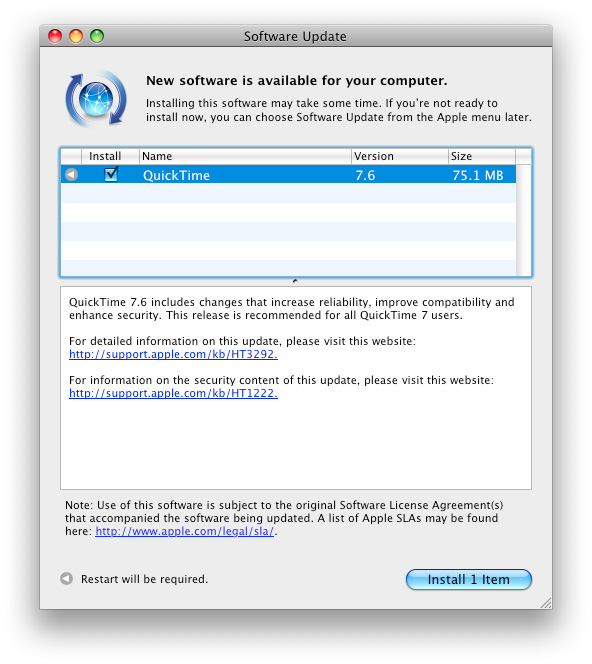
Quicktime 7.6 Update increases reliability, improves compatibility and enhances security

Site default logo image

…and a bunch of secret stuff too.  Hit software update (and get ready to restart?!) for the goods, Apple’s description below.

Summary

QuickTime 7.6 includes changes that increase reliability, improve compatibility and enhance security. This release is recommended for all QuickTime 7 users.

Products Affected

QuickTime

What’s in this update?

Video:

Improves single-pass H.264 encoding quality

Increases the playback reliability of Motion JPEG media

Audio:

Improves AAC encoding fidelity

Audio tracks from MPEG video files now export consistently

Application Support:

Improves compatibility with iChat and Photo Booth

Security:

For information on the security content of this update, please visit this website:
http://support.apple.com/kb/HT1222

White MacBook's specs are now closer to Unibody MacBook's

Site default logo image

Maybe Apple ran out of the old motherboards? 

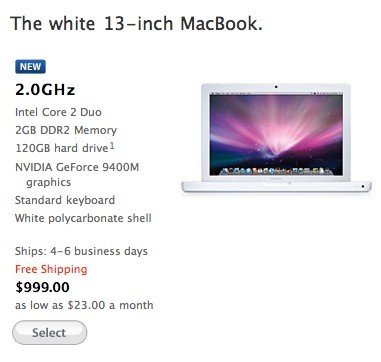
Apple, a few days ago (sneaky little bastards), updated the polycarbonate white MacBook’s specs pretty significantly. 

No one noticed. 

Strangely, even with the NVIDIA 9400M chipset, the White MacBook still uses the Mini DVI Port from the look of the side.  Also, while the RAM has been upgraded to 2GB (joy!) it is DDR2 and not DDR3 like the Unibody MacBook.  Bluetooth moves from 2.0 to 2.1.

These won’t be able to power a 30 inch screen like the Unibodies as well because Mini DVI only supports resolutions of 1920×1200.

Oh, and don’t worry, Firewire is still there.


Read — Old white MacBook
Read — New white MacBook

via Engadget

Apple Q1 2009 Earnings Call today

Site default logo image

Apple’s shares are at a two year low, trading at just over 78 at Tuesday’s close.  Pulled under by the general economic gloom, lowered consumer spending and concerns about Steve Jobs’ health, Apple hopes to assure investors today that the company will weather the storms.  Wall Street analysts have different outlooks.  According to two of the bigger analysts, Piper Jaffay’s Gene Munster and Bernstein Research’s Toni Sacconaghi, the numbers should look something like this:

  • Mac sales. Munster: 2.5 million to 2.6 million. Sacconaghi: 2.57 million
  • iPod sales. Munster: 18.6 million. Sacconaghi: 18.1 million
  • iPhone sales: Munster: 6.4 million. Sacconaghi: 3.5 million to 4 million

Interestingly, Munster keeps his $235 price target on Apple even though it has lost over half of its value since he set that price target.   While a year ago, when Apple was trading at 200, this seemed attainable, now it just seems silly.  Unless Apple has some sort of device waiting in the wings that no person can be without, 235 isn’t going to happen in 2009.  Most Apple investors would probably be happy with 135.  Munster needs to admit he was wrong and lower his expectations.

I also think Apple might have some surprises in its earnings call.  Particularly in the apps department.

Tron for iPhone is four hands on one iPhone good

Site default logo image

Props go to Japanese developers Pankaku, for developing not only a cool single player mode game but also one that allows simultaneous two player light cycle action on one iPhone.


Or four players can play over Wifi.  While we can’t find it at the iTunes store quite yet, we did find (iTunes link to Neu-Tron) another slightly less exciting but more 3D Tron game.  You know, to hold you over until Pankaku makes it through the obstacle course that is the App store selection process or Tron 2 comes out in theaters, whichever comes first.

via Giz

Garage Band 'Learn to play' for Intel Mac owners only

Site default logo image

Lost in all of the confusion of the iLife introduction (at least to us) is the little tidbit that Garage Band’s most exciting new feature "Learn to Play" will only work on Intel based Macs.  That isn’t all.  It must be a dual core or better (sorry older Minis).   Wow, those must be some serious lessons.  According to Apple:

GarageBand Learn to Play requires an Intel-based Mac with a dual-core processor or better.

Also, for good measure, if you want to take advantage of the AVCHD video in iMovie you must also be with-dual core Intel.

The baseline requirements for iLife in general are PowerPC G4 867MHz or faster with 512MB of RAM and 4GB of available Disk space.

Snow Leopard, the next major version of OSX, is widely believed to be an Intel only (ARM?) distribution as well.

You can buy iLife from Amazon, a 9to5mac affiliate, below.

iLife ’09 – $79
Family Pack – $99

Palm Pre Elevation Partners interview

Site default logo image
Roger McNamee of Elevation Partners is a well-known investor in both Wall Street and Silicon Valley. But two years ago, when he invested 20 percent of his private equity fund in smart phone has-been Palm, even his biggest fans were doubters. 
He takes a few passive agressive stabs at Apple’s iPhone which should be of interest to readers here.  Also, remember that not only is Palm’s Jon Rubinstein Apple alumni, but Elevation Partner’s co-founder is ousted Apple CFO (and interim CEO between Amelio and Jobs), Fred Anderson, who left under not-so-nice circumstances.
 

http://cosmos.bcst.yahoo.com/up/fop/embedflv/swf/fop_wrapper.swf?id=11572406&autoStart=0&prepanelEnable=1&infopanelEnable=1&carouselEnable=0

How rich is he?  He’s "I don’t give a FSCK about what my hair looks like" rich.

More.

(Try to keep your eyes on the right left..)

More Sling teasing..

Site default logo image

So apparently all of the Sling employees are playing with the new iPhone app but as of every 8 seconds we check, it isn’t in the iTunes store. More teasing below.

[blip.tv http://blip.tv/play/AeTnHIX+KQ]

Thanks Lil Joe

Steve Jobs Top 10 Quotes

Site default logo image

Steve Jobs Top 10 Quotes

Steve Jobs’ Top 10 Quotes

5 Management Mantras

#10. On Management

My job is to not be easy on people. My job is to make them better. My job is to pull things together from different parts of the company and clear the ways and get the resources for the key projects.

And to take these great people we have and to push them and make them even better, coming up with more aggressive visions of how it could be.

#9. On Hiring

Recruiting is hard. It’s just finding the needles in the haystack. You can’t know enough in a one-hour interview.

So, in the end, it’s ultimately based on your gut. How do I feel about this person? What are they like when they’re challenged? I ask everybody that: ‘Why are you here?’ The answers themselves are not what you’re looking for. It’s the meta-data.

#8. On Firing

We’ve had one of these before, when the dot-com bubble burst. What I told our company was that we were just going to invest our way through the downturn, that we weren’t going to lay off people, that we’d taken a tremendous amount of effort to get them into Apple in the first place — the last thing we were going to do is lay them off.

#7. On a CEO succession Plan

I mean, some people say, ‘Oh, God, if [Jobs] got run over by a bus, Apple would be in trouble.’ And, you know, I think it wouldn’t be a party, but there are really capable people at Apple.

My job is to make the whole executive team good enough to be successors, so that’s what I try to do.

#6. On Product Strategy

It’s not about pop culture, and it’s not about fooling people, and it’s not about convincing people that they want something they don’t. We figure out what we want. And I think we’re pretty good at having the right discipline to think through whether a lot of other people are going to want it, too. That’s what we get paid to do.

We just want to make great products. (I think he means “insanely great products!“)

5 Leadership Mantras

#5. On Leadership

So when a good idea comes, you know, part of my job is to move it around, just see what different people think, get people talking about it, argue with people about it, get ideas moving among that group of 100 people, get different people together to explore different aspects of it quietly, and, you know – just explore things.

#4. On Evangelism

When I hire somebody really senior, competence is the ante. They have to be really smart. But the real issue for me is, Are they going to fall in love with Apple? Because if they fall in love with Apple, everything else will take care of itself.

They’ll want to do what’s best for Apple, not what’s best for them, what’s best for Steve, or anybody else. (this actually reiterates my oft-repeated mantra of “ubiquitous evangelism” in companies)

#3. On Focus

People think focus means saying yes to the thing you’ve got to focus on. But that’s not what it means at all. It means saying no to the hundred other good ideas that there are. You have to pick carefully.

#2. On the User Experience

Our DNA is as a consumer company — for that individual customer who’s voting thumbs up or thumbs down. That’s who we think about. And we think that our job is to take responsibility for the complete user experience. And if it’s not up to par, it’s our fault, plain and simply.

#1. On Creativity

That happens more than you think, because this is not just engineering and science. There is art, too. Sometimes when you’re in the middle of one of these crises, you’re not sure you’re going to make it to the other end. But we’ve always made it, and so we have a certain degree of confidence, although sometimes you wonder.

I think the key thing is that we’re not all terrified at the same time. I mean, we do put our heart and soul into these things.

And, my favorite, which nails the ethos of living the dream at your job (that I’ve written about here)

We don’t get a chance to do that many things, and every one should be really excellent. Because this is our life.

Life is brief, and then you die, you know?

And we’ve all chosen to do this with our lives. So it better be damn good. It better be worth it.

Jobs seeking re-election to Disney board

Site default logo image

Steve Jobs has been a board member of Disney since 2006 when they bought Pixar, the digital animation studio he had run after originally leaving Apple.  According the the FT, his re-election bid may be fraught with people like Charles Elson, professor of corporate governance at the University of Delaware who state:

“A directorship is not an honorary position, If he’s said he can’t run Apple, how on earth can he [stand for the Disney board again]?  Non-executive directors of large public companies need to be able to devote at least 250 hours a year to the position.”

Bob Iger, CEO of Disney, has cited Mr Jobs knowledge and experience as he positions Disney to capitalize on new media platforms.


Shortly before it bought Pixar, Disney signed a landmark deal with Apple to make its ABC TV programming, such as Lost and Desperate Housewives, available on Apple’s iTunes store.

Disney has been at the forefront of Hollywood’s embrace of new technology ever since, launching the first video player for a US TV network and making its library content available on iTunes.

Casting Jobs aside might not be the best move for the entertainment conglomerate.

Fake Steve has a pretty scathing view of the Apple PR machine

Site default logo image

Dan "Fake Steve" Lyons has penned a pretty nasty (but in many ways true) piece about the Apple PR Machine:

That’s what happened to the poor guy at CNBC.   Sure, he got his share of "exclusive" 10-minute spots with Steve Jobs. You can find them on YouTube. They look like training videos for a correspondence course on bootlicking. Now, of course, the CNBC guy says he’s outraged. He sputters about how Apple has been irresponsible and "deplorable." His pals at Apple won’t care. They’re already moving on to the next useful idiot. Among the Silicon Valley press corps there is no shortage of them.

We wonder if Newsweek will get any more advanced copies of Apple hardware to review.  All signs point to no.

Atom/Ion Mini discussion thread…

Site default logo image

The Mini has always been a compromised machine. With very limited expansion capabilities, it was designed to allow addition of memory and external storage, but little else. The lack of upgrade path made it a limited machine by design. It was designed to be hedged in at the bottom end to be attractive as a switcher’s machine and low cost mac desktop. Speed wasn’t a prime design consideration.

At first glance, the Atom/Ion Mini rumor doesn’t make much sense. Why would Apple put a hole in their line-up by making such a large gap between a Mini and a Mac Pro?

The landscape now is very different to six months ago. There’s a recession in full swing. Desktop and laptop sales are sliding across the board, and we can anticipate some sour notes when Apple’s Q4 results come out on January 21st. Combine this with the market trend toward laptops, and you can predict some big changes as Apple reacts to the marketplace and the recession.

PCs reached commodity status many years ago, and Macs are there now – anyone who would buy a Mac as a first computer probably already has. The main reason to buy a new Mac is designed obsolescence – a style change to make us want to trade up. It works – I recently bought a 2.33 C2D MacBook Pro for $1,015 because someone wanted a unibody version. They paid $2,000 for a 2.4GHz C2D with better graphics. With the loss they took on their MBP, they paid about $3,000 for appearance. Designed obsolescence works.

Many Mac Mini switchers buy laptops, but few go on to buy the iMac or the Mac Pro. Some people like the traditional display, keyboard and CPU 3-box set-up. Apple is looking to do well in a bad economy by gaining more switchers, but they also need these switchers to trade up to a more expensive machine. I believe Apple is going to target these switchers now.

In light of this, what does this rumor mean if it’s true?

If the Mini is getting an Atom 330, it is going down market. It could not sell for $599 and up. Even allowing the Apple premium we’re looking at a $399 device with 2GB and a DVD burner, miniDVI and DisplayPort out, ethernet and WiFi. This would make a good switcher, kid’s room or office machine, but it does leave Apple with a very large hole in their product lineup. Apple could make the Mac Pro more affordable, but it does not make sense to compromise their flagship product. This isn’t a Mac Mini, it’s a Mac Nano.

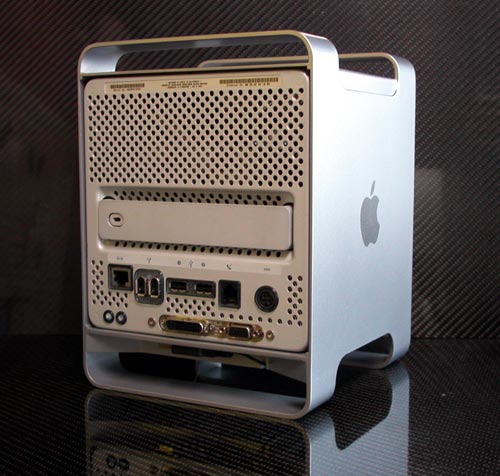
What makes sense to me is a new Mac Mini – not too big, not too small, but just right. This would be a Core 2 Duo or i7-powered machine with integrated graphics and a single 16x PCIe slot for upgraded graphics, or other PCIe card. It might have a couple of 3.5" drive bays. Suddenly, it’s an expandable machine that’s worth $999, and doesn’t really compete in the Mac Pro space.

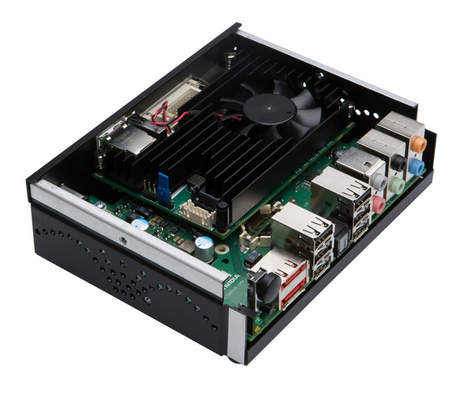
Some have speculated this Atom/Ion combo might be used in a netbook, but if you look at the size of the heatsink on that thing – I don’t think so. Some have also speculated that this may be for AppleTV, but why would Apple use such a short-life design in one of their embedded products when they have a fantastic new embedded device coming?

Maybe it’s just wishful thinking on my part, but I hope it happens this way, and we get a cheaper low end Mac Nano and a more capable Mac Mini.