Author

Avatar for 9to5 Staff

9to5 Staff

Pigeon learns to play Tap Tap Revenge. Alfred Hitchcock's 'Birds' senario nears

Site default logo image

You know that pigeon you have on your desk at work?  That’s right, the one you rescued off the street and nurtured back to health…well it turns out that domesticated office fowl <3 Tap Tap revenge.  Don’t believe us?? Cue up the video….


It does take awhile for this bird to get going and it doesn’t really seem like the pigeon get’s the gist of the game. I am glad I am not the only one.

Via Engadget

UK report claims iPhone nano for Christmas

Site default logo image

Remember our report when we explained Apple’s preparing to diversify its iPhone range in order to bring its products within the reach of a wider customer base?

And recall Peter Oppenheimer’s intimations that the company plans to introduce a range of products other competitors can’t match, and that Apple is willing to sacrifice a little margin to make its offering a success?

And, of course, you can’t ignore that AT&T has persuaded Apple to allow it to remain the exclusive iPhone carrier until 2010…(there had to be something more in it for the carrier than just one model, after all…)

This morning in the UK reports claim Apple plans to introduce an smaller, cheaper ‘iPhone nano’ in time for Christmas 2008. This will be made available to pay-as-you-go customers and will cost £150, the Daily Mail explains.

"A cut down version, with the candy bar shape of iPod nano music players, would be a huge hit as a Christmas gift," an industry insider said.

(Image used here is not 4 real, people, no need to mention that, it came from here).

Microsoft Launches Vista Ad Campaign

Site default logo image

 See Here. Microsoft has finally launched their response to Apple’s “Get a Mac” ads. They call it the “Mojave Experiment” and basically called Vista by a different name (Mojave) to try to get rid of the bad association the name Vista has with the general public. It took me about 25 minutes to actually start watching the ads: dragging my mouse over those tiles was so addicting!


Unfortunately for Microsoft, I highly doubt that they will work. Even John Dvorak agrees with me! The ads just seemed so staged to me… the chance that a bunch of random people, who come in saying they hate Vista, would all of a sudden change their minds, and say they will immediately buy it, seems way to slim for the ads to have any effect over me. 


What I think Microsoft should have done with the ads is shown the same group of people Windows 7: the actual next version of Vista. If they had simply shown people’s reactions to the next version, not shown any features, and ended it with the name of the OS, I believe they could have built up some serious hype for the new OS. Instead, they are still trying to push a failed version of Windows, that no one will accept no matter how much advertising they do. Why doesn’t Microsoft do this? They can’t admit when they make a mistake.  If Microsoft could confess their failures, they would gain the respect and trust of the people, instead of having them believe that they are stupid because they think Vista is "a huge success" (Steve Ballmer). It appears though, that Microsoft is simply continuing their old ways… despite what they say.

For more extensive coverage about Apple, have a can of Mac Soda.


Microsoft 10k hints a fear of Apple

Site default logo image

 Microsoft is running scared at Apple’s resurgence, and now warns shareholders that the Steve Jobs-led company could be a threat to Redmond’s business.

Proof positive of the new fear in at Microsoft CEO Steve Ballmer’s HQ is contained within the company’s recently-filed Form 10-K. This time around, Microsoft has introduced a new risk factor that has never been there before – and while the company fails to name the company that threatens it, you can draw your own conclusions.

“A competing vertically-integrated model, in which a single firm controls both the software and hardware elements of a product, has been successful with certain consumer products such as personal computers, mobile phones and digital music players," Microsoft’s threat assessment states, adding, "We also offer vertically-integrated hardware and software products; however, efforts to compete with the vertically integrated model may increase our cost of sales and reduce operating margins.”

We’re pretty sure we know who that company is. Ballmer said last month, "In the competition between PCs and Macs, we outsell Apple 30-to-1. But there is no doubt that Apple is thriving. Why? Because they are good at providing an experience that is narrow but complete, while our commitment to choice often comes with some compromises to the end-to-end experience."

He has a plan, saying, "Today, we’re changing the way we work with hardware vendors to ensure that we can provide complete experiences with absolutely no compromises."

This means we can see the near future become pretty personal, as the world’s largest software company tries to ignore the damp interest in Vista and Apple’s ever-growing market share.

iPhone tethering app, comes and goes

Site default logo image

Update:  It is back on – full review here..

Mac and PC users are incensed at news that a third-party software solution that enable them to use the iPhone’s 3G connection to get their computers online appears to have been withdrawn from sale.

Nullriver (the cool people who developed Installer.app, to all you jailbreakers out there), had its NetShare application available for sale through the App Store yesterday, according to a forum post on MacRumors. The $9.99 software allowed users to share the iPhone’s EDGE or 3G internet connection with a PC, offering a SOCKS5 proxy for the PC to connect to.

This is one of the most-requested features of the iPhone. Most mobile phones with advanced data connections can be tethered to a computer for use as a data modem to get online. It’s a feature commonly used by major media outlets in order to file words, images or, in recent years, video reports from remote locations. Absence of such support remains a puzzle, even for iPhone lovers.


Why Apple and AT&T are denying this to customers defies most observers. Of course, it is equally possible the application turned out to be faulty and has been withdrawn from sale pending an update.

Neither Apple or Nullriver have explained the situation.

Apple's enemies slowly surround iTunes

Site default logo image

 Apple continues to feel the pinch in digital music, with competitors closing in on all sides – and this week has seen multiple examples of the heat slowly turning up on the iPod manufacturer.

The stakes are high: Apple holds 70 per cent of the US MP3 player market with its iPod range. We believe Cupertino plans to upgrade its digital music players within weeks.

One band that may not appear at the new iPod launch this time around may be U2. The only band to have had an official iPod model made in its honour has now dropped the DRM from its music catalogue – but only through Real’s Rhapsody service – a snub to iTunes.

One high-profile competitor already appears in two minds at taking on Apple in this market, Dell, which this week moved to diminish reports claiming it plans the release of its own MP3 player to compete with the iPod.

A Dell spokesmen would only admit that while an MP3 player was under consideration, no decision has been made: "We have not announced that we are going to be selling an MP3 player," the spokesman said

Universal’s announcement of its LostTunes service this week is also clearly a move into Apple. The website itself declares the songs it sells to be "double the quality of iTunes". In case you missed it, LostTunes is a Universal Music-owned service offering rare music in MP3 format, free of DRM at 320kbps (better quality than iTunes).

Universal is looking to offer its catalogue DRM-free to services such as Amazon MP3 in the US, and is likely to extend this to other services in Europe. Universal now clearly accepts that provision of DRM-free, high-quality music downloads is a winning proposition for online sales.

But for all the DRM-free deals emerging from Universal, the company remains cool on Apple.

This has prompted Jupiter Research analyst, Mark Mulligan, to say: "“The major record labels cannot continue to treat DRM-free as a tactical experiment and must recognize it as the strategic necessity it really is.”

Later revelation that NBC Universal has reached a deal with Microsoft to stream coverage from the Beijing Olympics adds further fuel to the corporation’s anti-Apple zeal.

Also this last few days it emerged that T-Mobile will challenge iTunes with its own video-on-demand service for full length video, including film, available in the UK.

Finally, Apple, Real Networks and Amazon are all competing to provide the infrastructure for the soon to launch and presumably set to be lucrative MySpace Music store, a report claims.


Keep it in the iFamily

Site default logo image

 Synium Software has introduced MobileFamilyTree, its all-new iPhone/iPod touch application for genealogy application, MacFamilyTree 5.

The full-fledged genealogy software syncs your genealogy onto any iPhone or iPod touch, meaning your family tree is easily accessible and editable, and kept in sync with your Mac too.

The software requires a fully licensed installation of MacFamilyTree 5.2.3 or any newer version of our popular Mac genealogy application. Features include the ability to sync, view and edit multiple family trees on the iPhone or iPod touch, interactive lists for ‘Persons’ and ‘Families’, detailed information views with direct edit access and the ability to add and edit multiple ‘Partners’, ‘Children’, ‘Events’ and ‘Notes’. The software costs $4.99 from the App Store.

iFund invests in iPhone gaming

Site default logo image

 The iPhone developer iFund has taken out another investment, this time in start-up game publisher, ngmoco.

The fund is run by venture capital firm Kleiner Perkins Caufield & Byers and has taken an undisclosed investment in the games company. Ngmoco will use the cash to develop new titles for the iPhone, and is already advertising for developers, producers and other games development staff.

CEO Neil Young is a former Electronic Arts executive. While at that company, he oversaw development of several titles, including  Lord of the Rings, The Sims 2, and the about-to-be-released Spore. He left EA in June, and wants to both develop its own games and finance and produce games from other developers. 

Kleiner Perkins partner Bing Gordon, a former chief creative officer for game publisher Electronic Arts will join the ngmoco board.

As we also reported here, iPhone application development is proving surprisingly lucrative for some developers, with one developer informing 9 to 5 Mac that their application has been generating near $2,000 per day in sales.

In related news, iPhone music game Tap Tap Revenge is on course to pass the million download mark this weekend, the second iPhone application to reach that benchmark, the first one was Facebook.

What this means is that approximately one-in-five iPhone owners have now downloaded the application, which has also seen 2.5 million songs downloaded to play in the game, mostly from independent and unsigned artists. Publisher Tapulous is in talks with labels about releasing a premium edition of the currently free game, featuring songs from established artists.


Part-time apps developers getting rich

Site default logo image

Now that Apple is letting Apps developers know how many downloads their Apps are receiving, some successful coders are getting quite the positive "shell shock".  Part-time developers who didn’t know if they were making the monthly minimum($250) or not are finding out they have huge paychecks coming their way.

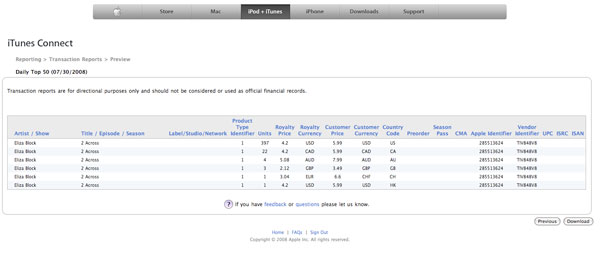
Eliza Block, our favorite crossword puzzle developer, found out she’s almost hitting $2000/day lately – which, according to her, was totally unexpected. 

Hey Seth,

So yes: they’ve provided us with download #s by region for the past 3 days (28th-30th). I did *way* better than I had expected, and am a little shell-shocked.

Here’s a screenshot from the report for yesterday:

But, she deserves it…her app is the best of the breed, filling a need that many people want.  The amazing thing is that Apple has taken care of everything from the development environment to the transaction services to the distribution to the marketing.   You can be a great software developer on your own without having a huge company to back you up.  This is truly a game changing play for Apple and the development community.

If you ever needed a motivation to get into the iPhone development world, *ahem take a look at the golden goose below….(full size)


Time to crack open those Objective C books…Maybe you’ll come up with something as good as 2Across

Buy 2Across (iTunes App Store Link)

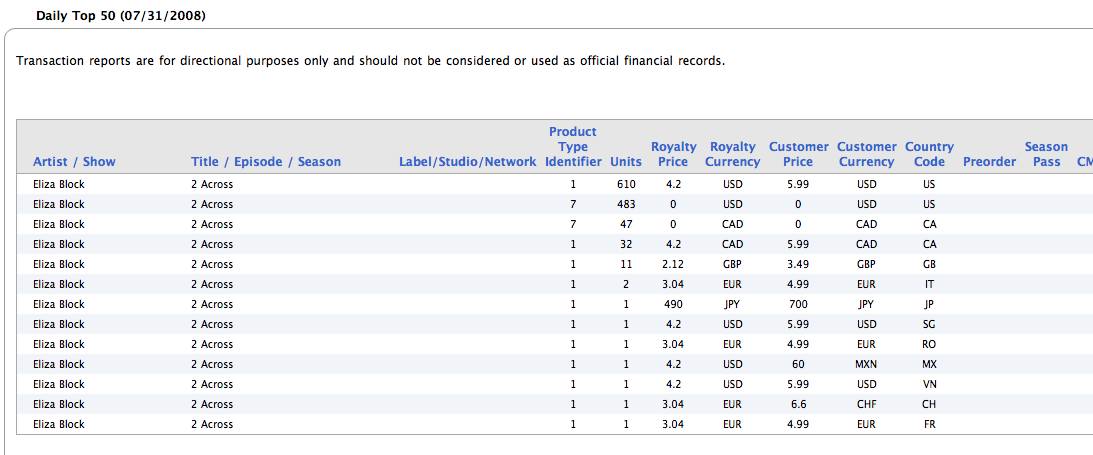
Update: Here’s July 31st’s report.  It isn’t a fluke…it continues to grow…

digg_url = ‘http://9to5mac.com/iphone-apps-developers-rich’;

Apple number one in Europe's education market

Site default logo image

 Apple continues to broaden its grip on European education computer sales, Gartner confirmed today.

According to the statistics for the second calendar quarter of 2008, Apple remains the number one PC manufacturer in the education segment across Europe, a position its held for eight successive quarters. In fact, Apple sold 19.2 per cent of all CPU’s sold in the sector – including servers.

The company also remains the leading manufacturer in the UK – eclipsing Dell – for notebooks and now also desktops, holding 17.3 per cent of UK education marketshare, the analysts said.

These figures are simply a continuation of good news for Apple. In May, NPD revealed that two-thirds of laptops costing $1,000 or more and sold across US retail shops are Macs – 66 per cent.

The situation is very similar in the US, where Apple surpassed Dell as the number one supplier of portables to US higher education for 2007.

Beyond notebooks. Apple’s retail desktop sales have climbed 45 per cent, against industry patterns for desktop sales. 

Firewire speed set to increase four-fold

Site default logo image

 The group behind development of FireWire, the IEEE, has approved the new IEEE 1394-2008 specification that gives support for better bandwidth of up to 3.2Gbps.

In an attempt to maintain compatibility between different evolutions of FireWire, the revised specification combines and incorporates all previous IEEE 1394 standards developed since 1994.

The standard provides specifications for a high-speed serial bus which supports both asynchronous and isochronous communication and integrates well with most IEEE standard 32-bit and 64-bit parallel buses. More than 500 million IEEE 1394 ports have been produced since the standard was first published in 1995.

"The new standard includes all of the amendments, enhancements and more than 100 errata which have been added to the base standard over the last 12 years," said Les Baxter, chair of the working group which developed the standard. "This update provides developers with a single document they can rely upon for all of their application needs."

The 1394-2008 standard updates and revises all prior 1394 standards, including 1394a, 1394b, 1394c, enhanced UTP, and the 1394 beta plus PHY-Link interface. 

For future use in video and other high bandwidth applications, the new FireWire standard offers plenty of speed improvement – it incorporates the complete specifications for S1600 (1.6 Gigabit/second bandwidth) and for S3200, which provides 3.2 Gigabit/second speeds. 

The standard is expected to be available this October. 


Upgrade season: Apple products enter upgrade cycle

Site default logo image

 If you plan shopping for a MacBook, MacBook Pro or any iPod, then you need to move fast – Apple is running down available stocks.

The company is warning its products will be in short supply, telling resellers it has begun reducing production of its laptops and iPods.

Apple is even advising resellers to get a few weeks worth of stock in to deal with the supply problem.

We’ve been anticipating new iPods and MacBooks for some time now, and believe plans to introduced the all-new laptops were delayed when Intel was unable to manufacture  its new 45-nanometre Centrino 2 chips (expected to power the new range) to schedule.

Processors have always been a major concern to Apple, which is probably why it’s looking to license ARM technology for its mobile devices.

We’ve also been predicting some interesting movement in the MacBook/Pro range: the new models will be thinner, will host a multi-touch glass trackpad and will be manufactured in one piece of aluminum.

Apple’s iPod range should also see improvement. MacRumors claims the iPod touch will see 64GB max capacity and also receive a GPS implant, which in conjunction with the App Store transforms the device into a second wireless mobile platform.

The new iPod nano is anticipated to be less wide, but longer, than the current edition, but with a larger screen that’s situated along the length of the device.

Apple CFO Peter Oppenheimer’s warned of product transitions ahead last week, saying: "We have some investments in front of us that I can’t discuss with you today where we’re going to be delivering state of the art new products that our competitors just aren’t going to be able to match, and as a result, I would see gross margins being about 30 per cent and that’s – that’s all I can tell you at this point."

While we await the new models, here’s a few concepts we came across earlier this week…

Microsoft bungles UK imaging competition

Site default logo image

 Nikon has withdrawn its sponsorship of a Microsoft online photo competition in which photographers end up with no attribution for the images entered into the race.

The competition – ‘Iconic Britain’ – requires competitors to find images they think are iconic online using Windows Live Image Search.

These image searches must be submitted to the competition, where they will  judged by a panel that was originally to include Simon Coleman, General Manager, Imaging Division of Nikon UK, Brian Blessed, and Joanna Lumley.

However, Microsoft gives no attribution to the images that appear in the competition, driving some photographey groups to recommend suing Microsoft, and, as mentioned, Nikon has withdrawn its support.

Website, Pro Imaging, got a response from Microsoft on the matter, in which the company said: “All images that feature on Iconic Britain are images from the Internet that are already in the public domain.” However, this doesn’t mean they’re copyright-free.

"If copyright was truly respected by Microsoft they would have made sure that no images subject to third party copyright would be selected by Live Search," Pro Imaging said.

A Microsoft statement counters: "When an individual wishes to submit an image into Iconic Britain, it is the subject matter (for example, red telephone box or cup of tea) that they are searching for, not a specific image. The site then repeats the individual’s search and displays a dynamic, visual set of search results from images that are already available on the internet and not one specific image. At no point, does www.iconicbritain.co.uk copy, host, or download any image."


VMWare Fusion 2.0 beta 2 ships

Site default logo image

 VMWare has released its second beta version of VMWare Fusion 2.0, its virtualization software for the Mac.

There’s lots of new features, including Unity 2.0 which lets users launch Windows apps from the dock or access Mac apps from within your virtual machine. 

Additional features include: Multiple Snapshots; Better Video and Graphics. The software also offers support for more client OSs, including Leopard Server.

Get the beta.


Apple with PA licenses ARM technology for mobile devices?

Site default logo image

Rumours claiming Apple has reached a licensing deal with ARM continue to intensify following the latter firm’s financial results announcement today, when management revealed an extensive multi-year architectural licensee has reached a deal with ARM.

Naturally, ARM management refused to disclose just who the new licensee actually is, beyond describing it as a "leading handset OEM", adding "which is developing its roadmap for mobile computing devices."

As EETimes observes, there’s no complete evidence of the licensee being Apple, but that company is now a leading handset OEM and is widely known to be developing mobile computing devices. An ARM processor is in the iPhone (to the detriment of Intel) and Apple recently invested in PA Semi, which works on PowerPC chips and has extensive ARM experience.

"Don’t get excited about any revenue on this deal as it’s all tied up with future technology and the revenue will be recognized over several years. But it is very important as far as we’re concerned in terms of securing design wins with that particular OEM and also in the mobile space altogether," said Warren East, CEO of ARM, at an analysts conference.

He also said, "Some handset manufacturers want to have more control over the design of their handset, including the components within it, than others. And it’s as simple as that. And the ARM business model offers one that level of control, if that’s what one wants to do and one has the technical resources available to do it," East added, as reported by EE Times. (You can watch a video webcast of this mornings Q2 financial call from ARM here).

Apple purchased P.A. Semi for $278 million in April. P.A. had one major product and about 150 really smart engineers.  They had lots of venture capital including money from Texas Instruments.  They also had a genius CEO  – Dan Dobberpuhl, with a long history in designing revolutionary chips – including DEC Alpha and the ARM architecture itself….and the one product, the PWRficient chip, was built on StrongARM’s legacy of power efficiency but with a PowerPC core.

Apple boss Steve Jobs has previously said, "PA Semi is going to do system-on-chips for iPhones and iPods."

We think this looks like Apple’s plan for its mobile devices…..who else would be so secretive?

Universal Music launches LostTunes music store

Site default logo image

 Universal Music has launched a service to compete with iTunes, called Lost Tunes, which is available now in the UK.

Naturally, Universal isn’t presenting the service as an iTunes threat, and, to be fair, its focus isn’t on selling music to everybody. Instead, the new Universal service offers extremely rare single and album tracks from the labels extensive music back catalogue – better still, songs are being sold in MP3 format at a (relatively) impressive 320kbps – so high quality, near lossless audio downloads of tracks you just can’t find elsewhere. And all tracks work on any platform, and nearly all devices.

Azi Eftekhari, Head of Digital and Media for Universal Music Catalogue told <a href="http://distorted-loop.com/2008/07/30/universal-stabs-itunes-launches-lost-tunes/" target="_blank">Distorted Loop</a>: “We wanted Lost Tunes to replicate the experience of going to a favourite local record shop where browsing and discovering music is a real pleasure and an adventure.  We only include music that we love.”

The service launches with such rarities as the Walker Brothers’ ‘Live In Japan’, three albums by the hugely acclaimed Comsat Angels, Bill Fay’s eponymous album, UK blues Nine Below Zero, Mellow Candle and Oriental Sunshine. A further 500 exclusive download albums are scheduled for addition to the store in the coming six months, including never-before-released material from the Trojan, Fiction and Decca archives. Lost Tunes is powered by UK operator and Apple competitor, 7 Digital. International versions of the site will launch in the coming months.

iPhone as remote control for Mac

Site default logo image

 This looks incredibly promising….

Your iPhone/iPod touch as a remote control Mac…..

[youtube http://www.youtube.com/watch?v=skZCBvWVu8A&hl=en&fs=1]

"One of the great advantages of this toolkit is that you can develop and test your multi-touch application on your standard desktop Mac, using your iPhone as multi-touch input device."

Thanks to Mac Daily News and the Media Computing Group for this one.


De Vere's shows us diamond-studded iPhone luxury

Site default logo image

 Diamond jewellers, De Vere’s of London, have introduced a range of diamond-studded iPhone 3Gs.

The range includes an iPhone studded with 88 diamonds commemorating Beijing’s summer Olympics. 88 signifies double wealth in Chinese superstition, the jewellers explained. That’s why the opening ceremony of the Beijing Olympics is 8/8/08 at 8pm. The 88 diamonds are set into the steel bezel surrounding the iPhone’s screen. The price is £4148 ($8219).

De Vere’s is aiming its exclusively blinged-iPhones at the booming £700 million ($1.4 billion) luxury cellphone market that is driven by the new rich of China, Russia and the Middle East.

Another De Vere iPhone design contains 28 diamonds (£1,700, £3,376). 28 translates into easy to get wealth or easy to get rich. A design containing 168 diamonds translates into want smooth wealth. This version is £7,800 ($15,493).

"At De Vere’s of London we’ve looked at designing and creating diamond phones for some time". Said Philip De Vere. "We wanted to have the most elegant, glamorous and desired phones without being excessive.

"The black backed 3G iPhone came along at the right time. Its smooth, symmetrical and uncluttered shape was perfect. Inset this with diamonds and it’s reminiscent of a Cartier Art Deco vanity case of the 1920s. Very chic and glamorous," he added. 

De Vere’s then offered the luxury goods makers greatest compliment: "The Apple iPhone is already the most desirable phone on the market. We wanted to create the most desirable luxury phone on the market". 


Asus on Apple Mac mini attack

Site default logo image

Asus has taken another attempt at Apple, introducing the Windows XP-powered Mac mini alternative, the ASUS Eee Box.

Small, quiet and equipped with an Intel processor, the Eee Box costs just £199 (UK), around $300 (US), and ships later this year (in the UK, at least).

The Eee Box comes with the option to VESA mount on the back of LCD displays, for "the ultimate minimalist space-saving solution".

There’s touch sensor buttons and the company has clearly paid a little thought to design, smooth curves and its paperback-thin construction could make this interesting to floating Mac switchers, scared to leave Windows. 

Though the choice of XP says a great deal about the current situation for that OS. And there’s a Linux version to follow…


Additional detail: Boot time, 8-seconds; "The Eee Box also supports a range of connectivity options including  the latest WiFi 802.11n wireless standard "; operating noise, 26db; apparently green-friendly (company says, "made completely from earth-friendly materials for reduced CO2 emissions; conforming to stringent RoHS and WEEE standards".)

Separate reports claim: 1GB RAM, 80GB storage (other options available, 802.11n as standard, Intel Atom 1.6GHz processor, graphics, Intel GMA 950. 

Ports USB, memory card reader, headphone out, mic in, Gigabit ethernet, DVI out, Line out. 

Looking back Apple looking forward

Site default logo image

 Just another re-run…blurb says, "Time Capsule recorded in 1987, looking into the future of 1997. Woz, Yocam, Sculley, Spindler. (funny, interesting!)"… Bit choppy at times, but interesting in a way, I thought.

[youtube http://www.youtube.com/watch?v=MV5lzMclx7Y&hl=en&fs=1]

iPhone gains MMS, sorta

Site default logo image

 iPhone owners have gained MMS, well, kinda.

New application Palringo is available now from the App Store. A free app, the software lets users send picture messages, text messages and (in future) vocal messages using an iPhone’s data connection. Better still, the app integrates with most instant-messaging (services: AIM, Google Talk, Yahoo! Messenger, Gadu, ICQ, Jabber and Windows Live Messenger. And iChat. 

As Palringo is also available for many models of mobile phone, this means an iPhone user can engage in messaging with most everyone they need to make contact with. Sending voice, picture or text-based messages to an individual or a group are single screen-tap operations.

The service is available worldwide, which means conversations can include people from across the globe, on any mobile network or connected PC or Mac. 

Orange, O2 deny UK iPhone claim

Site default logo image

Orange and O2 are have moved into damage control, denying claims that both will offer the iPhone in the UK from the end of the year, a report claims.
These denials follow reports which emerged last week, reports which suggested Orange would join O2 in selling the device in the UK market by the end of the year.

It was then claimed that the exclusive deal between Apple and O2 was due to expire this year, leaving Apple open to working with other carriers in the region. These reports were unfounded, it seems, with O2 once again stressing it holds a multi-year agreement with Apple for iPhone distribution in the UK. The iPhone has been available in the UK for under a year.

Public reaction to the reports suggested that should Apple want to tweak iPhone sales higher at any point, there is a demand for an Apple mobile to be sold free of any network restriction, a preference many in the value-conscious consumer market for mobile phones in Europe prefer.