Woz is back with more good ol’ days musings..
| http://cosmos.bcst.yahoo.com/up/fop/embedflv/swf/fop_wrapper.swf?id=7350376&autoStart=0&prepanelEnable=1&infopanelEnable=1&carouselEnable=0 |


Woz is back with more good ol’ days musings..
| http://cosmos.bcst.yahoo.com/up/fop/embedflv/swf/fop_wrapper.swf?id=7350376&autoStart=0&prepanelEnable=1&infopanelEnable=1&carouselEnable=0 |
IBM is working on a new form of memory that promises future iPods could hold half a million songs the company has confirmed.
In two papers published in the April 11 issue of Science, IBM Fellow Stuart Parkin and colleagues at the IBM Almaden Research Center in San Jose describe the fundamentals of a technology dubbed "racetrack" memory
[youtube http://www.youtube.com/watch?v=dJf3z9AfiVM&rel=0&hl=en]
The memory is being described as faster and more reliable than a hard drive or flash memory. It combines elements of both memory types in its conception, but is capable of storing far larger quantities of data and reading that information an astonishing 100,000 times faster than flash memory is able to achieve. The solution uses spintronics, a technology that exploits the spin and charge properties of electrons to deliver large capacity memory on very small devices.
There’s other advantages: like flash, there’s no moving parts, but unlike flash it never wears out (flash drives can handle 10,000 read/write cycles before failing). Even better, the new storage technology is cheap to manufacture.
"It has been an exciting adventure to have been involved with research into metal spintronics since its inception almost 20 years ago with our work on spin-valve structures," said Dr. Parkin. "The combination of extraordinarily interesting physics and spintronic materials engineering, one atomic layer at a time, continues to be highly challenging and very rewarding. The promise of racetrack memory – for example, the ability to carry massive amounts of information in your pocket – could unleash creativity leading to devices and applications that nobody has imagined yet."
There’s no chance of the new technology seeing immediate deployment, though the company hopes to provide storage solutions based on it in six to eight years. And the company hasn’t yet built a functioning racetrack memory unit – but it’s boffins are confident they have the theory pretty much nailed.
So in 2014, will Apple introduce the world to the iPod nano nano? Can we look forward to an even smaller, lighter MacBook Air?
 Like thousands of developers worldwide, Nike is retooling its Nike + software for use with the iPhone and the iPod touch, embracing the wireless connectivity of both devices.
While Nike has recently extended its system with the introduction of the Nike + Sportsband, which doesn’t require an iPod, this doesn’t mean its relationship with Apple has changed.
The new iPhone/iPod touch solution will embrace these devices WiFi and (eventual) 3G support to allow users to update training logs "on the fly", meaning training data can be uploaded wirelessly.
The company is also developing a new version of its Nike + Coach software to support Apple’s devices. This software offers new running distances, which users can select in order to be given a training routine designed to help them achieve these distances.
Apple and Nike last month announced they are working with major gym equipment manufacturers including Life Fitness, Precor, Star Trac and Technogym to make their equipment Nike + iPod compatible. Participating gyms will include 24 Hour Fitness and Virgin Active Health Clubs.
In July 2007 Nike revealed that 22 million running miles had been logged on its Nike+ website at that point. Trevor Edwards, Nike’s vice president of global brand and category management, said: "Nike+ started as a simple idea and has quickly become the world’s largest networking place for runners."
 The latest series of digital music reports are in, and they suggest Apple could account for 28 per cent or more of global music sales by 2012; that’s fairly impressive for the iTunes Store service which only launched on April 28, 2003.
The understanding that Tunes may one day account for a quarter of global music sales comes through the extrapolation of data from a series of recent reports. These reports suggest digital sales will soon stem the continued meltdown in music retail.
In-Stat research claims digital music sales will account for 40 per cent of music sales by 2012. With iTunes accounting for in the region of 70 per cent of digital music sales in most of the 22 markets Apple offers the service in, it’s clear that (should iTunes retain such marketshare) it will account for around a quarter of the world’s music retail market by 2012. (70 per cent of 40 per cent is 28 per cent).
The iTunes Store became the largest music retailer in the US based on the amount of music sold during January and February 2008.
Apple faces ever increasing competition in the sector, not least the desire of major labels to encourage more persity in distribution.
JupiterResearch believes labels need to encourage ad-supported downloads, subscription services and DRM-free downloads in order to drive digital music revenues.
The iPhone and iPod touch are regarded as the vanguard of an Apple attempt to transform the iPod into a more sophisticated wireless device. Apple already offers the iTunes WiFi Store for these devices, but with a 3G iPhone waiting in the wings, might Apple plan a mobile iTunes service?
To retain iTunes marketshare, Apple continues in its effort to encourage DRM-free music sales through iTunes Plus, while recent market chatter has speculated the company is in discussion to launch a music subscription service.
In the absence of compelling competition, the music retail market is Apple’s to lose. Services such as those from Amazon and eMusic threaten to break the iTunes hegemony, but whatever the outcome of the battle between incumbents in the space, Apple seems set to maintain a commanding presence in music retail for some time to come.
 Needham & Co. this morning initiated coverage on Palm and BlackBerry manufacturer, Research In Motion, noting both companies seem likely to take a bounce on strength of the iPhone effect.
Palm seems most exposed to risk, the analysts said, saying the company had "lost its way". Pointing out that Palm hasn’t introduced a major upgrade of its smartphones and the Palm operating system for almost five years, the analysts observe the company to be, "counting on a new operating system and a totally redesigned smartphone to restore its leadership role.
"Neither is likely to be introduced until late in the year. Even then, it’s an open question whether they’ll be successful. We’re initiating coverage with an under perform rating," Needham & Co. said. And the market for personal organisers is shrinking in favour of the smartphone.
The analysts also note the enterprise market could become more competitive with the entry of Apple, while in the consumer market, Palm will have to compete with the likes of Research in
Motion and Apple, which have the vision and resources to make continued headway in this market.
"It’s unlikely that Palm can match RIM or Apple on either dimension. In its favor, Palm’s other competitors are currently much weaker, in our opinion, because many, such as Motorola, Samsung and HTC, are saddled with the Windows Mobile operating system, a non-starter in the consumer world," the analysts explain.
Research In Motion (RIM) appears slightly less exposed to Apple’s entry to the smartphone market, the analysts explain.
"Research in Motion, the leader in wireless email services in the business market, has actually experienced far faster growth in the consumer market in recent quarters. However, we believe BlackBerry’s supercharged growth in this market could slow materially when far more versatile applications developed for the iPhone begin to appear in the second half of the year. We’re initiating co
verage with a hold rating," Needham & Co. said, while predicting the company will see healthy growth.
But the risk to all incumbents in the smartphone sector remains iPhone, with Google’s Android platform promising a new level of complexity and challenge.
"The competitive landscape in the consumer smartphone market was totally disrupted with Apple’s introduction of the iPhone in the summer of 2007. The iPhone is a game changer, weaving together a wide array of computer-like functions. It runs on the industrial strength and user friendly Mac OS X. It totally changes the concept and versatility of a smartphone."
"Given the choice between a BlackBerry and iPhone, we believe a material percentage of consumers will opt for the iPhone once exciting applications for the phone begin to proliferate in the second half of the year. BlackBerry sales should continue to grow but at a materially slower rate than they would have in the absence of the iPhone."
 Germany, home of the (2nd -ed) best beers, Jagermeister and fine sausages – and now also home to the world’s first iPod-integrating Lederhosen.
That’s right. The iPod ecosystem just grew that little bit larger with Lodenfrey’s introduction of leather Lederhosen integrating a secret iPod pocket and built-in controls for the music player, situated down the wearer’s left leg.
The new garment was introduced at IFA 2007, alongside a Bavarian hunting jacket that’s also equipped with iPod controls.
Mactalk.com.au is reporting some startling information on the iPhone in Australia. Their Source? Apple resellers who were apparantly told this ahead of schedule (perhaps slightly unlikely). But anyway here’s their take:
 Last week of June release
The June release isn’t a shocker. However, they are saying that it will be sold like iPods – from resellers and at the new Apple Stores – with out carrier lock-in. Since Telstra is the only carrier with EDGE, this either means that they don’t need to lock the iPhone in – because it will only run on Telstra – or that it will be of the 3G variety so it works on all of the networks.
Was this what Tim Cook meant by saying "Apple isn’t married to the current carrier lock in model"?
MacTalk also expects the release to coincide with the opening of the Sydney and Melbourne Apple Stores.
This adds to the information about a iPhone programmer job description from Telsta.
 Another piece of the 3G iPhone puzzle most likely got revealed today as Zibri of ZiPhone fame found a little bit of code in the newest iPhone SDK. The code in question references a "SGOLD3" Chipset. The "old" iPhone uses "SGOLD2". Other fun stuff in the SGOLD3 chip include SDCard access and support for 5 megapixel cameras. The processor speed remains the same as its predecessor.
German Infineon would likely work with King of Prussia’s InterDigital corporation (which has already stated that it licensed 3G software to Apple) on the baseband implementation.
Is the evidence conclusive? Hardly. However it could represent yet another piece of evidence that the 3G iPhone is, of course on its way…any…minute…now…
 Intel CEO Paul Otellini is a Mac user by night, but sticks with his Windows laptop for business applications, he revealed today.Otellini was speaking in a wide-ranging interview with the BBC. He admits: "I’ve got a Centrino Pro machine that I carry around with me for business and I’ve got a Mac I use for my photos at home."
He also adds: "I’ve enjoyed learning how to use a Mac, it’s something I never did in the first part of my career and it’s nice seeing what both sides can do because I do different things with different machines."
The Intel CEO also talks a little on the future of the mobile phone, "to become nothing more than a very portable computer".
He touches on Intel’s new Atom processor, which he describes as "about as fast as the fastest laptop in the world was a couple of years ago but very low power." Atom will appear in low-cost devices and handhelds when it reaches market.
Otellini also speaks up for Wimax, promising support for the wide area wireless network standard will appear this year, and "starts going into handheld devices, starting next year."
"I think you’ll sit here a year from now and you’ll have tens of millions of subscribers and you’ll move to hundreds of millions of subscribers say two years later than that."
FireWire data transfer speeds seem set to double, thanks to a new chipset that has been announced this week by developing company, Symwave.

While there’s no immediate plans to implement it in the Mac the company behind the invention is now actively seeking device and computer manufacturers prepared to employ it.
Devices implementing support for the new technology will see speeds of 1.6 gigabits per second. Even better, it will power external hard drives without demanding they be plugged in.
This high performance FireWire chipset – FirePHY-1600 – is already compatible with all existing FireWire drivers for Mac OS X 10.4 and 10.5, Windows XP and Vista and Unibrain.
The new solution is backwards-compatible with previous FireWire versions and is already being designed into a number of consumer devices for FireWire 800 (1394b) such as external storage devices/enclosures, hubs, repeaters and flash readers.
Jim Kappes, Director of Marketing at Symwave explained: “The significant advantages of Symwave’s PHY technology will enable manufacturers to develop innovative, new products with higher functionality and lower cost than what exists in the market today.”
Compared to USB 2.0 High Speed, the FirePHY-800 interface is typically 2-3 times faster, doesn’t require CPU overhead, and supports peer-to-peer networking (also called daisy-chaining) of devices.
FirePHY-1600 enables up to 45 Watts of power to be carried over the 1394 cable so external hard drives can be powered without an extra power supply.
Symwave is providing chipset samples to interested manufacturers and will also sponsor the 1394 Trade Association’s Q2 quarterly meeting in China this month.
Apple invented FireWire in the mid-90s and guided it to become a cross-platform industry standard, which is now cared for by the 1394 Trade Association. FireWire won an Academy Award for its material impact on the television industry in August 2001.
 A few weeks back, news of a study that compared people’s reactions when they saw different brands was released. According to the study, people who saw the Apple brand – even for a subliminal amount of time – scored 20-30% better on creative tests – well outside of a possible placebo effect. NPR interviews Duke University professor, Gavin Fitzsimmons – who ran the study- on why this might be the case. Very interesting!
BTW, We think the NPR Logo also might have a similar effect…Meanwhile 9to5Mac makes us drool…
We don’t usually catch Fox News*…but they got a few extra "innings" with the US leader…and what do we learn?
Prez Bush knowz iPods. He says he has the Beatles on that iPod. BTW, the Beatles aren’t available on iTunes or any other download service.
We forget. Is it legal to rip CDs and put them on your iPod?
[youtube http://www.youtube.com/watch?v=Gb7iOvS7Akc&hl=en]
According to the RIAA, Bush is breaking the law:
The industry’s lawyer in the case, Ira Schwartz, argues in a brief filed earlier this month that the MP3 files Howell made on his computer from legally bought CDs are "unauthorized copies" of copyrighted recordings.
"I couldn’t believe it when I read that," says Ray Beckerman, a New York lawyer who represents six clients who have been sued by the RIAA. "The basic principle in the law is that you have to distribute actual physical copies to be guilty of violating copyright. But recently, the industry has been going around saying that even a personal copy on your computer is a violation."
RIAA’s hard-line position seems clear. Its Web site says: "If you make unauthorized copies of copyrighted music recordings, you’re stealing. You’re breaking the law and you could be held legally liable for thousands of dollars in damages."
They’re not kidding. In October, after a trial in Minnesota — the first time the industry has made its case before a federal jury — Jammie Thomas was ordered to pay $220,000 to the big record companies. That’s $9,250 for each of 24 songs she was accused of sharing online.
Whether customers may copy their CDs onto their computers — an act at the very heart of the digital revolution — has a murky legal foundation, the RIAA argues. The industry’s own Web site says that making a personal copy of a CD that you bought legitimately may not be a legal right, but it "won’t usually raise concerns," as long as you don’t give away the music or lend it to anyone.
Of course, that’s exactly what millions of people do every day. In a Los Angeles Times poll, 69 percent of teenagers surveyed said they thought it was legal to copy a CD they own and give it to a friend. The RIAA cites a study that found that more than half of current college students download music and movies illegally.
The Howell case was not the first time the industry has argued that making a personal copy from a legally purchased CD is illegal. At the Thomas trial in Minnesota, Sony BMG’s chief of litigation, Jennifer Pariser, testified that "when an individual makes a copy of a song for himself, I suppose we can say he stole a song." Copying a song you bought is "a nice way of saying ‘steals just one copy,’ " she said.
But lawyers for consumers point to a series of court rulings over the last few decades that found no violation of copyright law in the use of VCRs and other devices to time-shift TV programs; that is, to make personal copies for the purpose of making portable a legally obtained recording.
Walt Mossberg talks about how the US cable companies and DSL providers are screwing the US over with tricks and slow speeds…. (Yah, you know you can get 100Mb Fiber in France for €50/month?)
…AppleTV is nice but currently has limited appeal because of bandwidth…..
Oh and a little bombshell….Says iPhone will be 3G in 60 days (at about 6:53 in)! As someone who regularly gets to test Apple products way ahead of the public, he would know! Update: He now says that is just n ducated guess. Uh huh.
Go Walt!
[youtube http://www.youtube.com/watch?v=kvci1vTXyUo&hl=en]
The time has finally come. Games like Quake 3 are hitting the iPhone platform. It is particularly cool to see the accelerometers being used to control the action.
Bonus points for controlling 2 players at once.
Apple’s new gaming platform looks to be shaping up quite nicely.
Via Hermitworks
or..
How I learned love the enterprise beta-bug.
One problem with Beta-Testing is that you never know how deep you’re in, until its too late. You’ve invested countless man-hours setting up, what should be a simple server, only to find out that the bugs and glitches make it wholey un-TEST-able.
Yes, this is beta-testing which, by all accounts, should be called "Alpha-Testing" and whatever primordial ooze that companies like Apple and Microsoft conjure up in the privacy of their respective skunk-works should be called "procreative speculation".
-316 smIntStatVErr The InitStatusV field was negative after primary or secondary init.
The point of diminishing returns comes all too late in the game as you strugggle to find purpose in what has turned out to be a frustratig excersize in futility.
You reflect, somewhat somberly, how that at 9:00am, you were bright-eyed and bushy-tailed, almost giddy with anticipation about getting your hands dirty in the new pre-release server update. You cancelled your lunch plans, dentist appointment and forwarded your phone straight to voicemail.
Error from server (debug enabled)
Perhaps you re-install, re-configure re-deploy, smiling all the while at the Execs to whom your career owes its precarious existance to. They don’t care about error strings, debugging or anything having to do with technology for that matter. Remember, these colloge educated Ivy-leagers can’t, won’t and don’t know how to set the time and date in system preferences.
In all fairness, they don’t get paid to give a damn about HOW technology gets implimented. They just want the s*** to work.
Send bug report
So there you sit, all alone in some cold server room. Probably on your third re-install of the latest pre-release seed, murmering to yourself about how "At least its better than the last seed."
Sort of…
Its now the golden hour, rounding past tea time and you have yet to connect from a client. Your limbs are stiff, your brow is furrowed and you begin to understand just how Charlie Brown felt everytime Lucy took the ball away. If you were a cartoon character, you’d have one of those black, scratched out thought bubbbles over your head.
You reflect once more about how, until recently, Apple has been so conspicuously absent from the world of Enterprise computing. They jumped in to a crowded ring as a rookie and an underdog, with some pretty amazing offerings, some of which have replaced many of the more-expensive tried-and-true server solutions in your own company!
Check console CrashReporter
So then you wonder, "How could Apple get it so right with Laptops, desktops, a kick-ass OS and a world-dominating MP3 player and a friggin’ phone, but miss the mark completely with its enterprise solutions?". Obviously the right hand is not on spekaing terms with the left.
A jack of all trades and master of a few? The execs who takes pleasure in holding your head under the corporate heat lamp only cares about the technology initiatives mandated by the holding company. They read their trade publications and pick up on stuff like "Web 2.0" and "Service-oriented architecture" to use during meetings and coctail parties without really knowing what they mean.
Reinstall
We already know that they’re not paid to know this stuff. You are. And in the end (all together now): "They just want the s*** to work!"
Right now that’s exactly what you want. Nothing more, nothing less. You would trade all the fancy smoke and mirrors of "Web Collaboration", "Podcasting" and "Social Networking" for some good ol’ solid filesharing…
Yes, I hear you screaming "ITS PRE-RELEASE BETA SOFTWARE!!!" and I agree, we signed on for this. Not for girls, money, fame, power or drugs – and not even industry respect… We signed on because we get the Apple gestalt – lucid, elegant and yet powerful. A dichotomy of IKEA-like simplicity with the power of a stage-one booster rocket.
Connection failure
Just like any successful NASA Space Shuttle launch, there are a myriad of aborted launches, red-light warnings and close-calls that preceded it, right? Your organic vegan rice-pasta, soy-cheese lasagna didn’t come out right the first time, did it?
This seems somewhere in the middle betweeen rocket science and kitchen alchemy – and what we want now, more than anything in the world, including world peace, the end of global warming and eternal life is for the s*** to just f****** work.
 Here’s the story: four Italian students this weekend will take the iPhone SDK and begin a 36-hour marathon to develop an iPhone application. The four intrepid developers begin their experiment on Saturday, April 5 at 9am CET. The plan for this iTalian Job is that after 36 hours they will stop working and the software should be finished.
Want more?
These iPhone-crazy developers want to give it up: the 36hoursdeveloping.com website will let you watch them working their socks off across the 36-hours, with a blog to let you know how it’s going. The story’s not quite finished yet. As far as we can tell from one of those comedic Google translations, the developers don’t even know what the application is they’ll be working on. But that’s not the whole point, really, is it? The point has to be – iPhone has become a meme.
We know the folks in Cupertino are enjoying a Karaoke session today. Why not? We hope they enjoy it. But when they wake up tomorrow, we’d like to think some of the Apple-staffers will take a moment to point their copy of Safari at what we, at 9 to 5 Mac are christining, the iTalian Job.
 Apple’s in development firmware iPhone Software 2.0 potentially supports a range of features that have been hoped for by users, including the capacity to stream music to Bluetooth speaker systems, printing and more.
Meanwhile, third-party developer Jajah has confirmed it intends producing a solution that will legitimately enable voice over IP calling using the Apple device, though only when using a WiFi connection.
Apple confirmed it would allow the development of VoIP applications in early March, when it announced the new software and the iPhone SDK. Jajah will ship its VoIP solution shortly after the iPhone Software 2.0 ships in June.
Developers have been exploring the new version of the iPhone Firmware since it debuted, and interesting nuggets suggesting the addition of a new set of features for the device continue to emerge.
Such new features include more general support for YouTube in Safari – where users navigating to a YouTube video using the browser have so far been transported to the built-in YouTube application, it appears users can now expect to enjoy their video within a browser session.
Bluetooth support has also reportedly been improved in the new software. Apple has clearly understood that the limited form of Bluetooth currently supported by the device is inadequate for many users, who want to, for example, stream music from their iTunes collection held on their device to external speaker systems. Now it appears Apple will deploy Bluetooth GPS and A2DP (required for media streaming) on the phone.
It also appears possible users will be able to print directly from their device – a useful feature for backing up important email correspondence. The evidence for this is a new Printers folder which has appeared in the Library of the OS, though this doesn’t mean such support is a definite for the release.
Apple has confirmed the latest batch of reports claiming it to be the number one music retailer in the US.
Many news sources had questioned the NPD MusicWatch figures, pointing out that Apple had claimed to be the number two US retailer after the period covered by the latest research, which was January.
 Apple is taking on New York City in the courts on grounds of copyright infringement.
Filed in September 2007, the case Apple Inc.s bought against the Big Apple stems from the logo used for the city’s environmental awareness campaign, reports Crain’s. That logo uses the outline of an apple with a leaf on top – and Apple reckons it’s too similar to the logo it now uses with complete impunity, following the settlement of a long-standing dispute on the matter of the logo with The Beatles’ Apple Corps.
Apple Inc now claims the Big Apple’s apple is too similar to its own logo.
New Yorkers are a tough breed, and their chief lawyer Counsel Michael Cardozo has fired back a counterclaim demanding the case be thrown out. Noting the differences between the logos and that Apple doesn’t sell mugs or caps (the kind of merchandise Apple-emblazoned during the green campaign), arguing that any confusion between the two logos is unlikely.
Apple Inc.’s legal team are pursuing the case, the report indicates. The below image represnts the "A Greener Apple" logo – which bares a stronger resemblance to the NY one…sort of….if you squint a bit…and have a few drinks…and turn the lights down low….

 An iPhone was an essential witness in the apprehension of the man responsible for a grisly murder, with location information tracked using cellphone towers leading police to the killer.
Attorney Melissa Lewis was strangled inside her garage. At first, police in South Florida thought it was a random attack, but later determined that the victim’s iPhone was missing. Working with AT&T, they tracked data relayed from the missing phone to cellphone towers in the area – and that data led them to the killer, Tony Villegas.
Villegas was the estranged husband of the victim’s best friend, Debra Villegas. The couple separated because the husband was jealous of the success of his wife and had threatened her with violence, leading to the split. The victim had been helping Debra draft a will designed to protect her children in the event her estranged husband committed an act of violence against her.
The murderer has been indicted for first-degree murder, and faces the death penalty.
iMac stocks across Apple’s reseller chains are running down, suggesting the company is closing in on a refresh for its range of all-in-one desktops.

If whispers emerging from Apple partners are to be believed, the product upgrade may not be immediate – stocks of the product still exist, but supplies of the product are wearing thin. This suggests the product may see an update as soon as this month.
Apple has been expected to improve its iMac offering since the beginning of March, when the first claims emerged to say it intend popping Intel’s new 45-nanometer Penryn processor inside the machines. The Mac mini is expected to receive a similar treatment, with the addition of an improved graphics chip and Penryn processor.
As 9to5Mac has previously reported, the new iMacs may make use of Intel’s Eaglelake motherboard, which carries built-in support for Blu-ray. However, the cost of Blu-ray players may preclude the introduction of built-in support for the standard for a while yet, despite that Sony’s US president recently confirmed his company to be in talks with Apple to deliver the hardware required for Blu-ray playback. He predicts Blu-ray drive prices to fall to $299 or less by the end of the year.
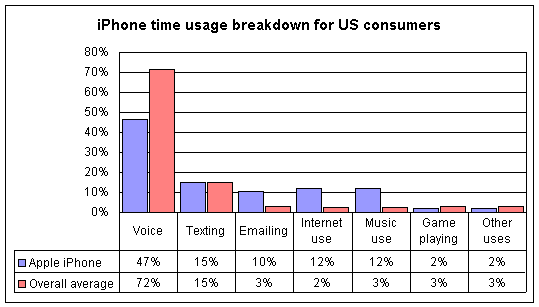
People use their iPhone much more for non-voice activities than the industry average. *GASP!*
Seriously though, it is interesting to see exactly how much more of each category..sort of.