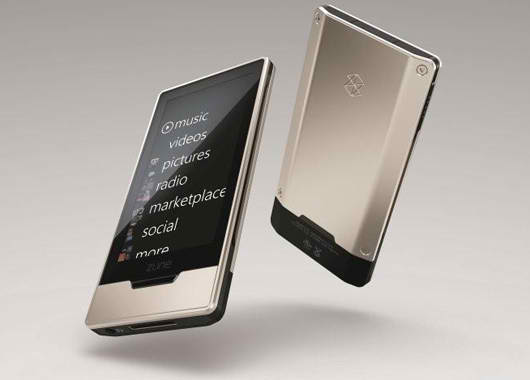
As noted by tech journalist Ed Bott on Twitter, Microsoft has removed all references to Zune hardware on the official website dedicated to the personal media player. The other sections of the site have remained intact, including parts related to the Zune Music Pass subscription service, the Zune app on various platforms and support sections.
However, the reports of Zune’s death may have been exaggerated because the Zune HD direct link was still live at post time, as noted by other readers in the comments. Perhaps they’re keeping it up until supplies last? Also, it should be noted that Apple’s iPod classic is kinda whistling past the graveyard, too.
It’s just that Zune, the digital media player Microsoft unveiled November 14, 2006, is no more. The writing’s been on the wall for quite some time. Steve Ballmer said numerous times that the Zune will eventually evolve into the media service, hinting in no ambiguous terms that Microsoft will exit the hardware game. Pretty sad, if you ask us…
We knew Zune’s days were numbered when Bill Gates posed in public holding one of them brown beauties in his hand.
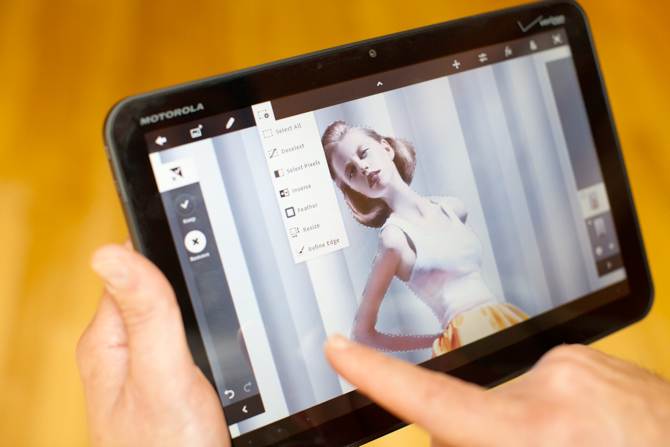
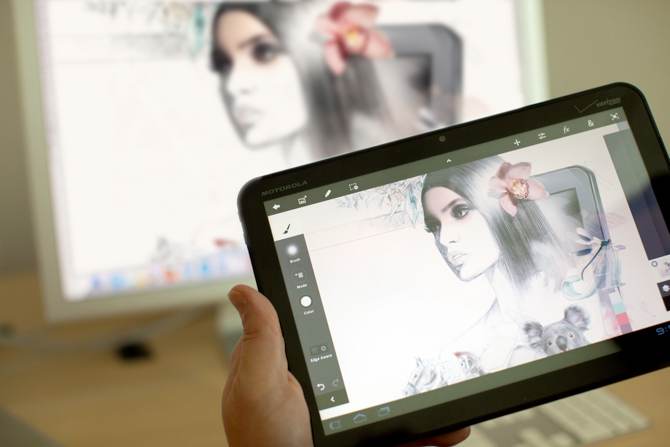
Adobe Photoshop Touch and five other new iPad apps from Adobe will land on the App Store soon, coming to Android devices in November.
Adobe today made a series of announcements at their MAX conference which runs October 1-5. The company doubled down on its tablet and cloud initiatives with the announcements of six new tablets apps for iPad and Android tablets – Adobe Collage, Adobe Debut, Adobe Ideas, Adobe Kuler and Adobe Proto – in addition to the Adobe Creative Cloud online service. Eagle-eyed readers will remember Adobe’s Eazel, Nav and Color Lava apps that hit the App Store in May, optimized for the updated version of Photoshop.
The official release bills Adobe Creative Cloud as “a major new initiative from the company that radically redefines the content creation process”. Adobe’s cloud is conceived as a backbone of their desktop and tablet software, allowing users to store, share and view their creative work across devices, using 20GB of online storage, as well as transfer the files into Adobe Creative Suite for further refinement.
As for the new tablet apps, Adobe says they enable “professional-level creativity”, spawning image editing, ideation, sketching, mood boards, website and mobile app prototyping, as well as presenting finished work. They also build upon Adobe Carousel, the recently released software which keeps your photos in sync across desktop and mobile worlds, via the cloud (we described it as “the Lightroom for iPad” with element of the Photo Streaming feature of iOS 5)
The most important of the bunch, of course, is Adobe Photoshop Touch, described as “a groundbreaking app that brings the legendary creative and image-editing power of Photoshop to tablet devices for the first time”. Think core Photoshop features on your iPad, including layers and pro effects – all optimized for finger-friendly interaction. So far so good. Go past the fold for the full scoop.
Adobe Creative Cloud, a new wordlwide hub providing a central cloud-based storage and sharing features for Adobe’s software.
Because everything else surrounding tomorrow’s iPhone 5 launch has already become monumental. If you ask analysts, the launch will be a smooth sail. As you know, Apple CEO Timothy Cook is widely expected to address media at the Cupertino headquarters tomorrow at 10am PT, taking the wraps off Apple’s next-generation handset: The iPhone 4S, iPhone 5 or whatever you want to call it.
It’s gonna be a career-defining presentation for Apple’s new boss, his first following the August 24 resignation of Steve Jobs. No doubt investors will be searching for signs of the reality-distortion field in Cook’s keynote address while pundits weigh in on his on-stage persona and charisma. But what about the general public and consumers outside the core base?
These folks couldn’t care less about all the brouhaha – they just wanna a brand spanking new iPhone. “Consumers view Apple products as a must-have”,says Channing Smith, co-manager of the Capital Advisors Growth Fund, which owns Apple shares. “Apple phones and products have become almost a necessity. We don’t expect them to falter.”
ChangeWave says demand for the next iPhone is off the charts. Granted, Cook might face a difficult task convincing buyers to take the plunge in the economy like this. Let’s not forget the onslaught of powerful Android smartphones offered at various price points, form factors and networks.
Despite those obstacles, analysts are upbeat about the perfect storm of factors working towards Apple’s biggest product launch yet. The iPhone brand is mature, established and still iconic. Ticonderoga Securities analyst Brian White is calling for long lines stemming from the pent-up demand and unprecedented media blitz. At a time of broad market decline, he writes in a Monday note to clients:
We would rather own Apple than any other tech company in the current environment.
And Janney Capital Markets analyst Bill Choi predicts 84 million iPhones in 2011 and about 107 million iPhone shipments in 2012:
Apple is well positioned to capture an enormous profit pool as mobility and content worlds converge.
Choi also expects a new iPhone with the aluminum back resembling the MacBook Air, even though our manufacturing sources saw no signs of a major redesign. A general consensus among analysts is that the launch will shatter the 1.7 million iPhone 4s sold during the launch weekend.
Macgasm.netreports that Verizon Wireless is demanding its Salt Lake City employees work “unlimited overtime” Tuesday as “it’s clear that Verizon is expecting something big to drop THAT DAY”, implying the next iPhone will be available beginning tomorrow – a stretch, to say the least.
Meanwhile, Ticonderoga Securities’ Brian White singles out five reasons why it will knock everyone off their seat, as reported by Fortune’sPhilip Elmer-DeWitt:
Tomorrow is the new iPhone day and while the spotlight (and pressure) will be on Apple’s new CEO Timothy Cook, the world will be definitely watching for any clue about Apple co-founder and chairman Steve Jobs. The world may as well be disappointed, if blogger Robert Scoble’s sources are to be trusted (and often they are credible). According to his Google+ post, Steve won’t be at tomorrow’s event as he continues to attend to his fragile health:
I’m hearing that Steve Jobs won’t be at tomorrow’s press event. He’s just not feeling well enough to come out in public, I hear.
Of course, we should be really careful about armchair analysts assessing anyone’s health. In addition, usually all sorts of crazy rumors crop up ahead of Apple’s major product launches. If it weren’t for Robert Scoble, we’d dismiss this tidbit entirely. However, in our minds, this makes perfect sense…
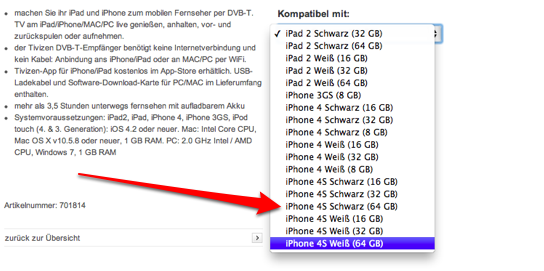
Following a questionable list of iPhone 5 specs seen on the website of carrier Cincinnati Bell and iPhone 5 references that surfaced in Radio Shack’s inventory system, the German branch of British multinational carrier Vodafone – which in the United States has a 45% ownership stake in Verizon Wireless – references the yet unreleased 8GB iPhone 4 model in addition to the rumored iPhone 4S.
Specifically, as first reported byiPhone-Ticker.de, the 8GB iPhone 4 model is being referenced on the carrier’s online store, available in black and white. Last month, Reuters reported that suppliers are building the 8GB iPhone 4 model which the news gathering organization claimed was the inexpensive iPhone the rumor-mill’s been hyping about.
In addition, the site makes mention of the black and white iPhone 4S, each in 16/32/64GB flavors, confirming the findings of 9to5Mac’s Mark Gurman. As for the Vodafone Germany, remember they are Apple’s high-profile partner that carries the iPhone 4 in Germany alongside Deutsche Telekom-owned T-Mobile. To get a clearer picture of the next iPhone, check out our exhaustive overview of late rumors and what we’re expecting from tomorrow’s presser.
You can rent movies and television shows on iTunes, but not apps for your iPhone, iPod touch and iPad. That could change as compelling evidence surfaces just a day before Apple’s “Let’s talk iPhone” event that app rentals might be in the works.
The Tech Errapoints to some code strings, uncovered by Sonny Dickson from iTunes 10.5 Beta 9, that strongly suggest such a feature could be unveiled at tomorrow’s press conference. The contents of the strings (seen below) clearly points to the app rental ability. Any rented app will be automatically removed from your devices, including your computer, after the rental period expires, one of the string reads:
Apps are automatically removed from your iTunes library at the end of the rental period.
This could be an interesting twist to today’s App Store rules that make a clear distinction between paid and free apps, here’s why.
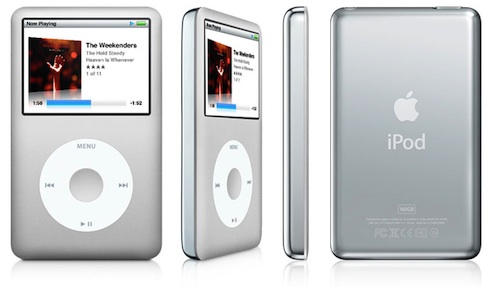
Today brought us the news of the removal of the iPod click wheel games from the iTunes Store. Even casual observers ask themselves whether that’s another clue of the beleaguered music player heading to the technology graveyard. Last week, reports indicated that both the iPod classic and the nano are heading out to pasture. The current sixth-generation iPod classic has certainly seen better days. It was last refreshed two years ago and Apple had totally ignored it with last Fall’s redesign of the iPod family. They didn’t even bother upgrading the classic to Toshiba’s latest 1.8-inch 220GB hard drive so it could carry 55,000 songs in your pocket.
Worse, iPod sales as a whole have been declining due to some cannibalization from the iPhone and because everyone has an iPod now (see chart below). More than anything, the click wheel-based iPod is a dinosaur, a relic from the past. Apple launched its first iPod on October 23, 2001. It featured a 5GB hard-drive that held “a thousand songs in your pocket” (surely you remember that tagline?) and came enclosed in the signature snow-white casing.
Everyone from Bono Vox to teenagers drooled over its sexy metal back which caught grease and scratches all too easily, literally as soon as you picked it up or laid it on a table. Ten years later, the iPod’s once revolutionary click wheel is so last century and we aren’t lusting after the design neither. It’s OK to be sad. You probably have fond memories of the iPod classic – we do. And you likely don’t want to see it discontinued.
Be that as it may, the fact is the iPod classic doesn’t fit in anymore. It can’t live in an iCloud world. Heck, it’s not even an iOS device. We’re living in a post-PC world where all-flash storage takes center stage in ultra-portable gadgets. Would Apple really do away with its most spacious music player? Read on…
[vodpod id=Video.15505945&w=425&h=350&fv=]
Here, a clip from last night’s episode of The Office. Meet the Pyramid, a new breed tablet which takes the opposite approach to today’s tablet marketing focused on superlatives. The Pyramid is heavy, it has poor battery life and, of course, prominently features the pyramid form factor. Without the optional “memory booster”, the device is “barely three pounds”.
And how much memory does that booster have? 50L. L? You really gotta watch the clip to understand the joke. It’s an amusing (depending on your taste) take on today’s mobile landscape and another wake-up call for Apple’s rivals who so far have managed to produce an admirable range of iPad alternatives which however failed to catch on with consumers – with the notable exception (to some extent) of Samsung tablets.
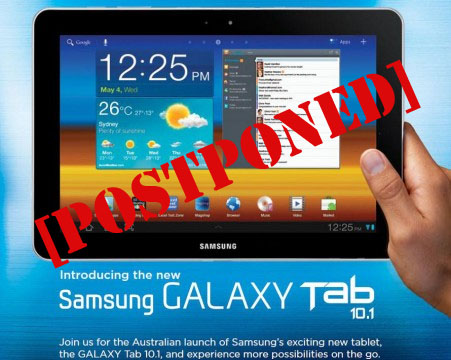
According to the Wall Street Journal, Samsung has offered Apple a secret deal to sort out the mess surrounding the Galaxy Tab 10.1 tablet launch in Australia. The report has it that Samsung proposed a cunning solution that would allow them to release the device in the country next week. Apple’s legal counsel Stephen Burley allegedly told Justice Annabelle Bennett that Samsung’s “inconvenience would be diminished and we would be comforted” if the deal was accepted.
What incentive Samsung might have in store for Apple in exchange for releasing its tablet in Australia as early as next week is anyone’s guess. I asked patent expert Florian Mueller, who runs the FOSSPatents blog, about this. He responded on Twitter that Samsung “might promise not to infringe certain patents, make a payment, and perhaps also procedural concessions”.
Apple has made its concerns official. The iPhone maker fears Samsung tablet will lure consumers away from the powerful iTunes ecosystem. Apple’s been successfully leveraging iTunes to tie people to the platform through app and entertainment content sales.
The heated Apple vs. Samsung legal battle over who’s copying who is really about the ecosystem rather than the hardware or the patents. That’s the gist of today’s hearing before the Federal Court in Sydney related to an Apple-requested ban on sales of Samsung’s Galaxy Tab 10.1 tablet in Australia. According toSmh.com.au, lawyers for Apple argued that the launch of the Galaxy Tab 10.1 could take away iPad 2 sales so quickly that buyers may be “seduced” from the iOS platform.
It’s all about the apps and the broader ecosystem, Apple’s legal team told Justice Annabelle Bennett, arguing the Galaxy Tab 10.1 “is vastly the one that is going to be targeting the iPad 2”. IDC numbers released today suggest that that tablet shipments to Australia and New Zealand doubled sequentially in the June quarter, which the research firm attributed to an influx of Android tablets recently released into those markets.
Apple’s lawyers then resorted to the “fire hose” metaphor to make their case:
This is going to be launched on the market with the velocity of a fire hose and it is going to just come in and take away iPad 2 sales so quickly that by the time we get to final hearing the full impact of the patent infringement will be to the detriment of Apple and to the benefit of Samsung.
And this bit about the battle of ecosystems:
They’ll then be Android people and the investment in the apps that they make to purchase on their Galaxy Tab will be something they can’t use on an Apple product.
2K Sports chose the iPhone 5 day to launch its multi-platform basketball series on iOS devices. NBA2K12 will be hitting Apple’s iPhone and iPad for the first time next Tuesday, October 4. CNETplayed the game and walked away pretty impressed. Animations are great and console-like, down to the Signature Style shooting moves. NBA2K12 supports Apple’s Game Center and sports Michael Jordan classic battles. In fact, it’s the first time the famous basketball player has adorned any mobile gaming platform. As for playing modes:
You have the standard Quick Game; there’s a full 82-game Season Mode with player transactions; Playoff Mode, where you’ll skip the regular season and jump right into the games that count; and Situation Mode, which allows you to create custom scenarios where you can try to comeback from 5 points down with a minute left.
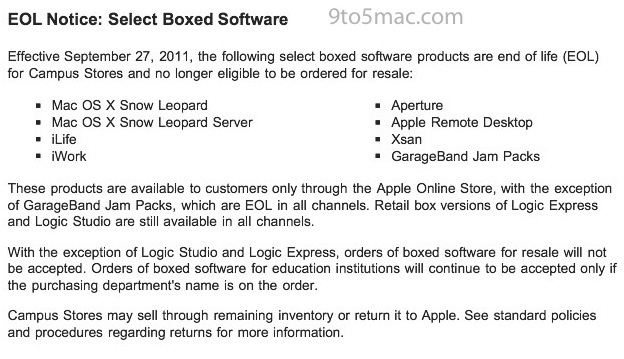
Update: We’ve gotten ahold of the EOL notice, above.
Apple is telling its educational resellers not to expect any more packaged software in the future, ZDNetreports. This includes boxed copies of Mac OS X, iLife, iWork, Apple Remote Desktop and Aperture. Each of these programs has been available on the Mac App Store for months. The news came in an email Apple sent to educational resellers and included just one exception:
Samsung, the second largest supplier for Apple, was contacted by Steve Jobs in July of 2010 over a patent dispute that had already threatened to degrade the two company’s lucrative supplier-buyer relationship, Bloombergreports:
Jobs wasn’t involved once the ultimately unsuccessful talks over the Galaxy smartphone began, Richard Lutton, a senior director at Apple and the company’s patent attorney, told Federal Court in Sydney today.
Responding to Samsung lawyer David Catterns, Apple’s patent attorney and senior director Richard Lutton said:
Samsung is an important supplier with whom we have a deep relationship. We wanted to give them a chance to do the right thing.
But even the famed Steve Jobs reality-distortion field would fail to persuade Samsung to “do the right thing”. In fact, the Korean conglomerate did what was right for them: They doubled down on Android with Galaxy-branded smartphones and tablets, sending Apple through the roof and prompting them to take Samsung to court.
The two former industry partners are now embroiled in twenty legal proceedings in nine countries around the world (the latest on the Apple vs. Samsung saga: here, here and here). Apple even went as far to refer to Samsung in court documents as “the copyist”. A cool infographic we included below the fold offers a side-by-side overview of Apple and Samsung product aspects that have a ‘familiar’ feel to it, found on Reddit.
Following-up on a Mashablestory that Facebook will launch its long-awaited iPad app at Apple’s ‘Let’s talk iPhone’ media event next Tuesday, TechCrunch has just reported that Facebook’s iPad app is “about to launch”. It’s been ready to go for a while, writes author MG Siegler, and that goes for Project Spartan, too, an HTML5 web app store for Facebook apps. The Facebook for iPad app and Project Spartan are now “joined at the hip”, Siegler writes, noting “one will not launch without the other” (and Apple is cool with that).
Facebook’s iPad app is about to launch. That too has been ready to go for a while now, but it has been held up by some internal back-and-forth between Apple and Facebook. And Project Spartan has been waiting on that iPad app. […] Earlier this week, Mashable reported that Facebook’s iPad app would launch at Apple’s iPhone event this coming Tuesday. For what it’s worth, we’ve heard Facebook is actually planning to launch the iPad app at their own iPad/Spartan event on Monday. But they’re still discussing all of this with Apple. And Apple has been well known to change things at the last second. It is possible that they want Facebook to launch this on stage at their event to showcase some of the new HTML5 capabilities of iOS 5 (which will also be formally unveiled at the event).
Apple is understood to have partnered with Facebook on Project Spartan and the social networking giant is said to tap tens of millions of iPhone users to get the word out.
Nuance released Dragon Go! for the iPhone back in July and we praised the program’s combination of intelligent search capabilities coupled with Nuance’s phenomenal voice recognition technology. Today, Dragon Go! (free download) has been updated with a number of new services that the app taps to deliver accurate results based on your natural-language voice input. Specifically, they added support for Google+ public posts, media content on Netflix and Spotify and search engines Ask.com and Wolfram|Alpha.
Additionally, improved Yelp support now means you can access a map view right within Yelp. You will recall that Nuance powers speech-to-text integration in iOS 5 where a user just taps the microphone icon on the virtual keyboard, speaks aloud and the speech becomes text. The feature ties nicely to the Assistant, a surprise feature allegedly exclusive to iPhone 5 that lets you ask the handset to perform complex operations simply by speaking natural-language commands. Release notes after the break.
MacRumorspoints to a thread on the Apple Discussion Forums where Apple posted a firmware fix for the flickering issue on the Apple 24-inch LED Cinema Display stemming from Thunderbolt. The problem is specifically related to the 24-inch LED Cinema Displays connected to your Thunderbolt-enabled Mac rather than the glitches on the 2011 MacBook Pro causing flickering and lock ups under heavy load. It should be applied only when the display is connected to a Thunderbolt-enabled Mac. It is interesting that Apple decided to release the fix on the forum rather than its Support Downloads page. From the release notes accompanying the 926KB download:
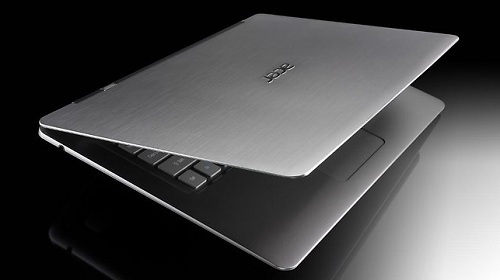
Acer’s brand spanking new MacBook Air challenger: The Ultrabook Aspire S3.
Acer vice president Scott Lin is drumming up Ultrabooks, low-powered, ultra-thin and ultra-portable Windows PCs akin to the MacBook Air based on Intel’s latest chips and reference designs. Lin estimated that Ultrabooks will account for nearly one-third (30 percent) of the worldwide consumer notebook shipments by the end of next year. Moreover, tablet PCs, of which iPad accounts for approximately two-thirds of shipments, will be the first products to be impacted, he claims. DIGITIMEShas the story:
Lin pointed out that tablet PCs are mainly emphasizing light and thin features as well as entertainment capabilities, and once notebooks are capable of achieving the same features, while still maintaining battery longevity, consumer’s purchasing behavior will reverse as consumers would rather choose a machine that can satisfy their demand for both entertainment and work, instead of carrying a tablet PC and a notebook around.
He concludes by saying we’ll turn our attention back to notebooks at the expense of tablets in 2012. We’re not so sure about this. First Utrabooks are either pricier than the Air (due to Intel’s stubbornness and expensive chips) or they offer fewer features than Apple’s ultra-portable.
The story also references a J.P. Morgan Asia study asserting a 25 percent drop in iPad manufacturing output for the fourth quarter which has been however quickly debunked by J.P. Morgan themselves. Most importantly, notebooks – even the ultra-thin ones – and tablets cater to totally different needs and usage scenarios: The former are for serious work, the latter are for entertainment, web activities and media consumption. Also…
This probably isn’t real, but we’re posting it for discussion. Found on a Chinese forum, source is unknown but we gave it to someone who is running it by some higher ups for clarification. Video of iPhone 5 prototype with double GPU rainbows below:
[youtube=http://www.youtube.com/watch?v=jUtmOApIslE]
Kinda neat. The voiceover quotes French writer François-Marie Arouet Voltaire.
The instruction we find in books is like fire. We fetch it from our neighbors, kindle it at home, communicate it to others, and it becomes property of all.
And then, Amazon adds its own cheesy part: From Kindle, the Fire is born. Talk about pun intended.
[youtube=http://www.youtube.com/watch?v=_u7F_56WhHk]
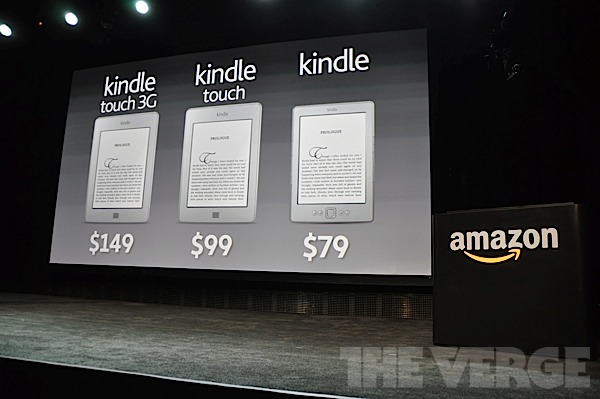
Amazon has just unveiled at a press conference in New York its inaugural seven-inch tablet and a new family of Kindle e-readers that now include the $99 Kindle Touch and the low-priced regular Kindle which retails for just $99. Seth Weintraub is on the scene and the latest information includes the news that Amazon will be rolling out its own brand new browser for the Fire tablet, named Silk.
The company set up a new blog for the Silk team and their first blog post explains that Silk is “an all-new web browser powered by Amazon Web Services (AWS) and available exclusively on the just announced Kindle Fire”. It appears Silk is using WebKit rendering engine and leveraging Google’s SPDY on the network protocol layer. According to a promo clip included above, a “split browser” architecture (kinda similar to Opera’s Turbo mode) taps the Amazon cloud which caches files (limitless caching) and does the heavy-lifting, depending on workload. It’s a smart approach which offload page rendering to Amazon Web Services, resulting in faster page load times. And here’s what’s so smart about it, according to the Silk team:
While the new Kindle Fire tablet failed to impress folks who were hoping for an iPad killer, the $79 regular Kindle has gotten us excited because this thing is now within grasp of an average consumer and if history is an indication, sales should grow at an exponential rate. Conveniently, Amazon has a new television commercial to push the $79 Kindle into mainstream. Clearly they want you to view the device as the perfect holiday gift. The new inexpensive Kindle is available today. Its touch-based counterpart named the Kindle Touch is arriving in time for Thanksgiving, priced at $99/$149 for Wi-Fi/3G variant.
In addition to the new Kindle Fire tablet, Amazon has also re-shuffled their Kindle offering at a New York event this morning. Our Seth Wientraub is on the scene and has the latest info. Amazon CEO Jeff Bezos has just unveiled a brand new e-reader with a touchscreen. The device is aptly named the Kindle Touch and costs just $99 for the Wi-Fi-only version or $149 if you want to use it over 3G cellular networks. There is no physical keyboard on the Kindle Touch as it uses the all-touch approach and relies on typing on the virtual keyboard instead which pops up when needed.
They are shipping it November 21, right before Thanksgiving, and taking pre-orders today. Perhaps more important than that is the news that the regular Kindle now costs just eighty bucks. Yeah, you read that right. Plus, they are shipping the $79 Kindle today.
Just as Amazon’s media event begins in New York, serving as a launchpad for their inaugural tablet, Bloomberg spoils the announcement by publishing key pieces of information about the device. It will be called the Kindle Fire, as rumored, and will cost just $199, which is a pretty big deal.
The tablet is powered by a dual-core processor, has a seven-inch color display which responds to touch (just two fingers at once, though) and a “fresh and easy user interface” running on a forked Android version. You can read e-books on it, listen to music, watch movies and play games available for download through the Amazon Appstore for Android. Meanwhile, our own Seth Weintraub is on the scene in New York at Amazon’s press conference and here’s what he was able to glean from Amazon’s announcement…
A biggie: The device will come with a 60-day free trial of Amazon Prime (a $79 a year value) membership and pre-registered with your Amazon account, so you can literally use it right out of the box. Bad news: It has no cameras – not even a microphone. Heck, it even lacks 3G access so looks like the Fire will be a Wi-Fi affair only. The Kindle Fire is available at Amazon’s newly published Fire page and over at amazon.com/kindlefire. November 15 can’t come soon enough.
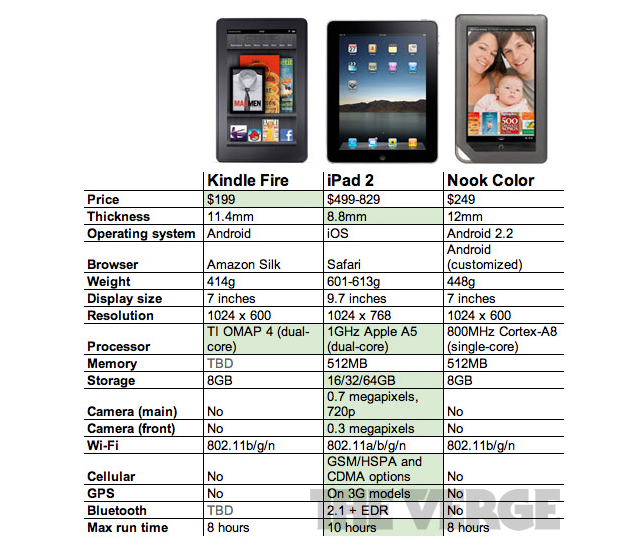
As for competition, check out this side-by-side specs comparison of Amazon’s Fire, Apple’s iPad 2 and Barnes & Noble’s Nook Color, courtesy ofThe Verge.
That, plus this bit from the Bloomberg article:
Chief Executive Officer Jeff Bezos is betting he can leverage Amazon’s dominance in e-commerce to pose a real challenge to Apple’s iPad, after tablets from rivals such as Hewlett-Packard Co. and Research In Motion Ltd. have fallen short. Sales of Amazon’s electronic books, movies and music on the device may help make up for the narrower profit margins that are likely to result from the low price, said Brian Blair, an analyst at Wedge Partners Corp. in New York.
The analyst observes what all of us have known for a long time, that the Seattle-based online retailer has the most compelling ecosystem to take on Apple’s iTunes juggernaut. His quote plus three more Fire shots after the break.
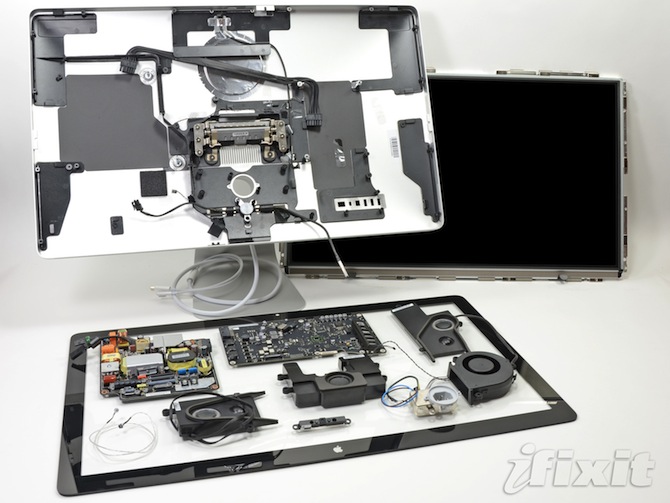
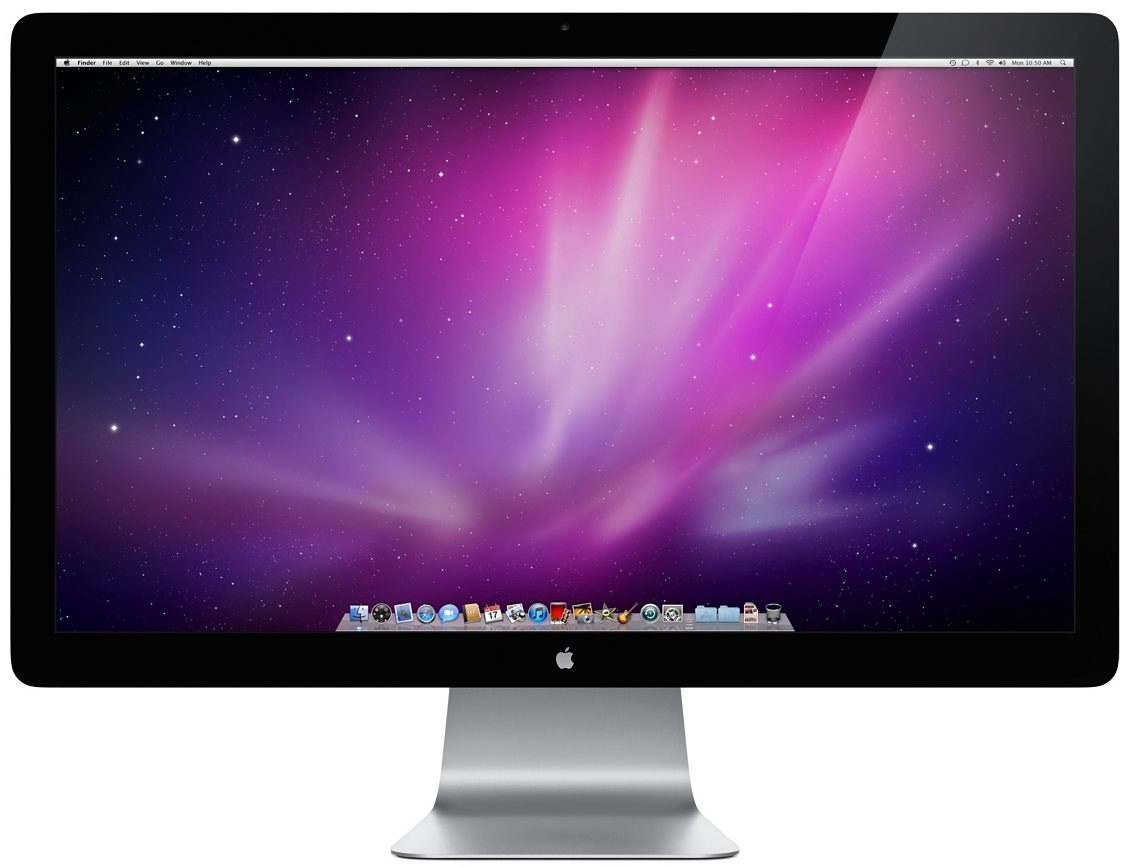
The wizards over at iFixit tore down the new 27-inch Apple Thunderbolt Display which has two Thunderbolt ports that let you hook up the display to a Thunderbolt-equipped Mac and have the display’s USB, FireWire and Gigabit Ethernet ports at disposal, all via a single $49 Thunderbolt cable. iFixit “were struck” by the Thunderbolt Display’s ease of disassembly. Inside, they found a lot of chips that support a plethora of ports on the back.
The display is the same model number LM270WQ1 by LG Display as found in the iMac Intel 27″ from October of 2009. A thing of note: The display rocks a 49 Watt 2-speaker sound system, including a miniature subwoofer, while a Flextronics power supply provides 250 watts of maximum continuous power. As for the panel, it’s basically the same as in Dell’s competing 27-incher (UltraSharp U2711), sans LED backlights and matte coating.
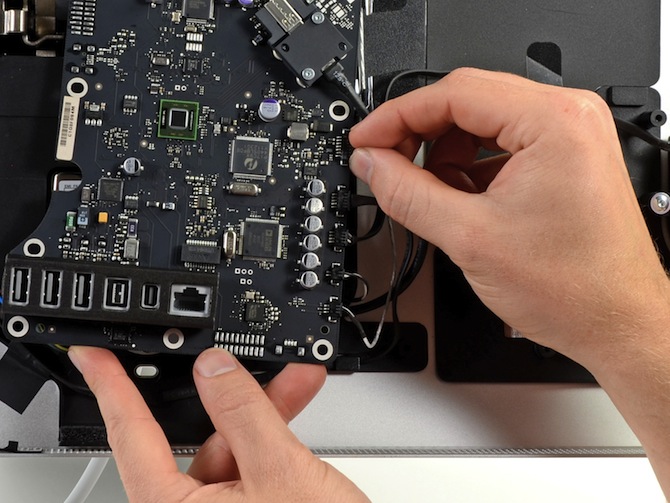
Unlike the Dell display’s 6 ms response time, Apple’s display has twice as much. There is also “a large, brushless fan to keep the colossal Thunderbolt Display cool and quiet”. Apple also engineered a solution that prevents the Thunderbolt cable from being detached from the logic board’s Thunderbolt socket, as seen in the below image. “Interestingly enough, the Thunderbolt cable that routes into the display also plugs into a standard Thunderbolt socket on the logic board”, iFixit explains. The most impressive aspect of the display has got to be the logic board full of chips. More information after the break.




 Adobe Creative Cloud, a new wordlwide hub providing a central cloud-based storage and sharing features for Adobe’s software.








 Just as Amazon’s media event begins in New York, serving as a launchpad for their inaugural tablet, Bloomberg spoils the announcement by