iOS devices refer to any of Apple’s hardware that runs the iOS mobile operating system which include iPhones, iPads, and iPods. Historically, Apple releases a new iOS version once a year, the current version is iOS 10. Here is the complete list of iOS 10 compatible devices.
A pattern is emerging in smartphones. Think about it, the same scenario has been playing out over and over in every territory where Google and Apple battle for supremacy. Apple first wows the market with its iPhone. Then, Google brute forces its way into the game and eventually takes the lead thanks to countless Android handsets in all shapes, sizes and price points, carried by virtually all wireless operators. Japan, however, is an indication of a new pattern that has iOS and Android forming a duopoly that squeezes out entrenched players, upping the barrier to entry.
In the latest survey of the Japanese market by MMI Research Institute reported by Bloomberg Businessweek, Android posted an incredible 2,000 percent year-over-year growth, capturing 57 percent of the country’s 2010 smartphone market versus 38 percent for Apple’s handset (as big as anywhere) – a notable decline for the iPhone’s 72 percent share from a year earlier and also a catastrophic loss for other platforms.
Shipments of Android phones rose to 4.91 million units in the year ended March 31, Tokyo-based MM Research said in a statement today. That compares with sales of 250,000 units, or 11 percent of the market, a year earlier when devices running Google’s software started to be widely available in Japan.
Apple shipped 3.23 million iPhones in the country in the last fiscal year, all sold excursively via Softbank. The combined 57 percent share for Android plus 38 percent for iPhone leaves little room for Nokia and BlackBerry maker Research In Motion. Both brands have been reduced to the Others category with a minuscule five percent market share. Is this a sign of things to come? Read on…
A new survey by IHS iSuppli has confirmed that Apple was the best-performing smartphone vendor in the first quarter of this year, while Nokia and BlackBerry maker Research In Motion posted double-digit decline each. The entire smartphone market contracted 1.5 percent in terms of units shipped, the first sequential decrease since the beginning of 2009. It wasn’t unexpected due to the supply woes and the preceding holiday quarter being traditionally the most lucrative period for consumer tech.
Apple shipped 18.6 million iPhones, a 14.9 percent increase over the 16.2 million units from the holiday quarter. None of the remaining top five handset vendors matched Apple’s growth. Second-ranked HTC, for example, grew shipments by a modest 6.2 percent. Canada-based RIM rose 4.2 percent and is now trailing Apple by four percentage points. The iPhone hurt Motorola and Nokia the most in the first quarter of 2011.
The research firm contributed Apple’s growth to the Verizon iPhone that expanded Apple’s addressable market in the US. At the same time, the move “placed additional pressure” on Motorola, Samsung, LG and HTC – all major Verizon Wireless customer – iSuppli’s senior analyst Tina Teng pointed out.
It’s been four years since the original iPhone came out, but the rumored Facebook integration with iOS remains non-existent. iPhone users, however, needn’t eye their webOS- or BlackBerry-toting friends with envy – there’s an app for jailbroken devices that addresses this issue.
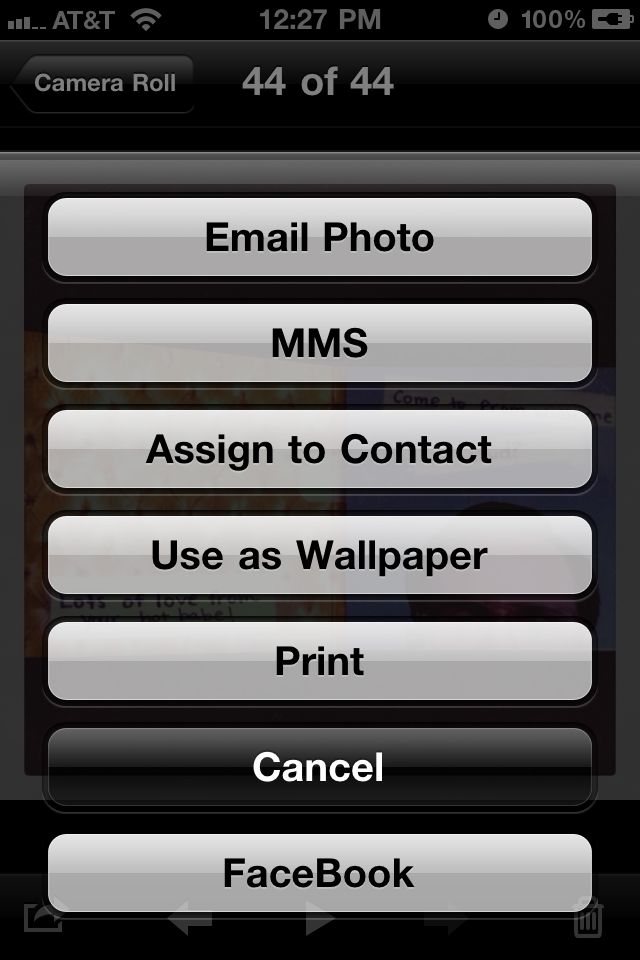
Native FB Upload, a two-buck download from the Cydia Store, enables you to share images by choosing a photo in the Photos app and tapping the new Facebook option in Export menu. Once you authorize via Facebook Connect, you can compose an optional message or share the image as is. Multiple photo uploads and other tweaks are being planned for future versions, Modmyi noted (via Cult of Mac).
As Apple is about to finally flip the switch on a massive 500,000 square feet datacenter in North Carolina, said to be one of the biggest in the world, TechCrunch heard the company’s rumored iOS 5 voice recognition technology is driven by Nuance Communications’ technology that runs in the Apple cloud. A formal announcement is expected next month at WWDC, the publication claims.
More specifically, we’re hearing that Apple is running Nuance software — and possibly some of their hardware — in this new data center. Why? A few reasons. First, Apple will be able to process this voice information for iOS users faster. Second, it will prevent this data from going through third-party servers. And third, by running it on their own stack, Apple can build on top of the technology, and improve upon it as they see fit.
Nuance is behind Dragon Dictation, a free iOS app enabling advanced voice recognition on iOS devices. The app is powered by the company’s NaturallySpeaking technology which turns spoken word into text via the cloud. It supports numerous global languages and is advertised as being five times faster than typing on a virtual keyboard.
Apple’s 500,000 square feet datacenter in North Carolina
Mobile devices, especially iOS gadgets, command the largest share of digital game downloads so it doesn’t really come as a surprise that big games publishers are scrambling to port famous franchises over to the iPhone. According toTouchArcade, Duke Nukem Forever is almost certainly in the works for iOS devices. The publication spotted a mention of the App Store in the game’s manual on Steam, leading them to speculate that Gearbox is planning an iOS release of Duke Nukem Forever as well.
What reason could there possibly be to include App Store licensing terms in a document for a PC game?
Adobe, which last week updated Photoshop to work with its freshly announced iPad apps, has finally released said programs for iOS devices. Adobe Eazel, Adobe Nav and Adobe Color Lava, iPad companion apps for Photoshop, are now available for download on the App Store. Adobe Eazel is a finger-paint program that sells for five bucks. The app lets you send your artwork directly to Photoshop CS5 from any location, provided you have a network connection between your iPad and a computer. The remaining two apps sport even tighter integration with the popular image editing software. More information and videos after the break…
Now that one analyst thinks that Apple is going to ARM for its laptops (notice we didn’t say “Mac”), another one says that Apple could be moving its MacBook lineup to ARM as early as next year. Barclays Capital hardware analyst Ben Reitzes says through Barron’s:
And, drum roll please …. “We believe that Apple will be the first in our sector to embrace ARM for some Macs, as early as C2H12,” writes Reitzes, with a nod to speculation last weekApple may ditch Intel chips for ARM chips.
We believe that Apple is already working hard on the software to accomplish this feat within the MacBook Air line-up. Through its own development of ARM-based processors and ARM-based iOS software, this migration would be rather natural for Apple. Apple is already moving toward enhanced battery life and ultra portability with its current MacBook Air line, which uses NAND instead of HDDs.
If photography on the go is your thing, you can be picky with a myriad of photography-focused software vying for your attention on the App Store. FX Photo Studio from MacPhun, the creators of Silent Movie Director, a video editing app I recently reviewed, has caught my attention recently. Now, I mostly use awesome Camera+, Photo fx and Instagram to capture and edit images so I approached FX Photo Studio with a skeptical eye. I mean, who needs yet another photography app, right? Expand Expanding Close
The ‘not really endorsed by the labels but its ok because the Cloud is really just a hard drive partition that you own’ Cloud Drive service by Amazon is now working on iOS devices according to a report by TechCrunch/iFans today.
If you visit Amazon’s Cloud Player through the Safari web browser on an iOS device, you’ll see that it does in fact now work. You’ll first hit a warning page telling you that your browser is not supported, but just ignore that. Click into the music in your drive and it will begin playing. It works flawlessly — even to the point where if you get a Push Notification or incoming call, the music will be paused.
Amazon will probably announce the new compatibility at some point soon.
That’s all well and good but you know Apple is going to have a similar service, perhaps even endorsed by the record labels, ready by September at the very latest. Still, if you are already an Amazon music purchaser, this puts your Cloud collection on your iOS device.
Two interesting iOS tidbits this morning related to iOS. A rumor has it that Apple is in talks with YouKu, Chinese version of YouTube, over replacing the native YouTube app on iPhones in China because YouTube is still blocked in the country, writesTechNode. A trusted source told the publication that YouKu founder Victor Koo discussed the possibility with Apple’s chief Steve Jobs. The report is questionable knowing Apple has never replaced a standard iOS app with a third-party alternative. The other tidbit is official: Microsoft has released the Bing Maps SDK that allows programmers to embed Bing Maps inside their apps…
If you recently upgraded to iOS 4.3.3 that fixed Locationgate woes, you’ll be delighted to know that untethered jailbreak and unlock for iOS 4.3.3 is now available. The iPhone Dev-team have updated their PwnageTool and redsn0w programs so it’s now possible to jailbreak iOS 4.3.3 using Mac and Windows in a way that doesn’t require connecting the device to a computer each time it’s rebooted.
The iOS 4.3.3 untethered jailbreak is based on the exploit created by @i0nic for iOS 4.3.1. The updated redsn0w tool also allows you to turn on multitasking gestures, the team noted in a blog post. If you wish to unlock your device for use with any carrier, there’s an app for that.
Oh, another pretty news reader, that’s what you must be thinking, right? Pay attention for Hitpad is your personalized window to relevant content that helps put those trending topics on Twitter and Google Trends into perspective by combining tweets, videos, images, news articles and web links into a uniquely designed news flow.
“Five minutes with Hitpad is like spending an hour browsing around”, developers Jay Meydad and Nir Holtzman Ninio wrote in the app’s iTunes description. So how does Hitpad differ compared to dozens of regular feeds readers or visual news readers such as Flipboard?
Apple’s been on a roll lately. They sold a record 18.65 million iPhones in the first quarter and for the first time zoomed past Microsoft in terms of profitability. The 49,400 Apple employees helped the company earn $14 billion annually and pull 30 percent growth in earnings per share. Recognizing those strides and Apple’s rising fortunes, the company is now ranked 35th on the Fortune 500 list of America’s largest corporations. Just a year ago, Apple was 56th on the list. Fortuneexplains:
The company not only continues to expand its reach in existing markets, it also keeps creating new ones. Take the iPad, which showed the world the power of tablet computing when it was introduced last year. iPad 2 followed, and was one of the most highly anticipated electronic products this year.
And according to the latest smartphone survey by IDC, Apple has beaten Research In Motion and became the world’s second-best smartphone maker, right behind Nokia…
…in fact, if Apple turned on the HSPA part of the Gobi 14.4 chips in its Verizon iPad and iPhone, they’d already be 4G, at least according to AT&T.
Chris Ziegler noticed today that AT&T has started calling regular old 14.4Mbps HSPA devices 4G in its latest marketing materials. Until recently, the pseudo ‘4G’ was reserved for HSPA+ on T-Mobile which tops out at 21Mbps. However, with the release of the HPalm Veer 4G, HTC Inspire 4G and Motorola Atrix 4G, AT&T has extended the ‘4G’ down to speeds of 14.4 Mbps, the same speed as those Qualcomm chips that Apple loves.
Most industry watchers expect the next iPhone to run on some version of the Qualcomm chip that the Verizon has which would let it do double radio duty and be operable on all US networks.
As Ziegler notes, AT&T is paving the way to charge extra for the benefit of using the newly branded ‘4G’ which doesn’t sound good to us. Expand Expanding Close
As of today, MobileMe stopped using Sync Services, Apple’s own platform for data synchronization between your programs and supported devices. As we pointed out, this has affected recently released Office for Mac 2011 Service Pack 1 which relied on the platform to sync Outlook calendar with your iPhone. As a result, Mac people must physically connect their device and sync via iTunes, which kills the purpose of push calendar in the first place.
Alternatively, you can change your email client and go through the email server supported by the Mail app. Sounds like too much hassle just to keep your Outlook calendar and iOS gadget in perfect sync.There’s a workaround that lets you wirelessly sync Outlook calendar with your iOS device via Windows – on your Mac.
Everybody knows that the iOS notification system is way overdue for a much-needed refresh. It needs to be rethought from the ground up, if fan-made concepts are an indication. In the meantime, you can customize the look and feel of of the boring blue iOS notification alert using AlertArtist, a tweak for jailbroken devices available on the Cydia store.
The program lets you customize a number of elements, such as typeface and the color of border, font and shadow. Or, you can quickly switch between one of the pre-installed templates. If you’ve been on the lookout for the ultimate multitasking tweak for your jailbroken device, look no further than Physwitch (video below)…
Publisher Hearst has agreed to selling subscriptions to their iPad magazines through iTunes, after months of negotiations with Apple, reportsThe Wall Street Journal.
Starting with their July issues, iPad apps for Esquire, Popular Mechanics and O, The Oprah Magazine, will be available through a service from Apple that allows customers to sign up for subscriptions inside the apps and get billed automatically. Subscriptions to all three publications will be sold for $1.99 a month or $19.99 a year.
Hearst has also confirmed plans to eventually begin selling newspaper apps (perhaps The San Francisco Chronicle and Houston Chronicle?) and other content through in-app subscriptions. The news leaves Condé Nast as the only major magazine publisher out there not participating in Apple’s new iOS subscription service. However, it’s only a matter of time before Condé Nast joins other big publishers. Last week, Time Inc. reached a deal with Apple enabling them to offer print subscribers digital magazine subscriptions at no additional cost.
The Daily, an iPad-exclusive digital magazine that launched February 2, has been a money-losing business for Rupert Murdoch-owned media empire so far. According to Peter Kafka of The Wall Street Journal’s MediaMemo blog who chatted with op-chief Chase Carey during an earnings call, the magazine lost ten million dollars last quarter. What’s surprising is the mention of just 800,000 downloads. Even though those downloads don’t equal paid subscriptions, it’s still a disappointing figure for such a high-profile digital publishing operation.
Apple has long used the proxy of iTunes to push updates to its iOS devices: when a new software update is available, users need to plug their device in via USB, click update, and the new software version is downloaded and installed.
Smartphone competitors have long offered a different, more direct method for software updates that happens over-the-air. Specifically, when an update to Google’s Android operating system or HP/Palm’s webOS is released, users are provided an update notification and can update the software right on their phone. No computer required.
Now, Apple wants to provide the same convenience to their iPhone users and is preparing to provide over-the-air iOS updates, starting this fall.
Multiple sources (one as far back as March) say the new feature will debut in iOS 5, meaning iOS 5 will not come over-the-air but following point updates to it will. Just like tethering in iOS 3, Apple has the technology but cannot just unleash it everywhere. Apple and Verizon Wireless are said to have been in talks over these wireless software updates since early this year. Sources could not comment on whether or not Apple is negotiating similar deals with AT&T or international iPhone carriers.
The iOS-based AppleTV has been able to update itself without iTunes intervention so the hooks are obviously in iOS. Two things to note:
Updates are now over 600MB. Apple would have to make these smaller to get the carriers to agree to push these things as they are. We believe that Apple will make the updates much smaller by using incremental patches rather than full OS downloads
iTunes provides the backup to the iOS device so a failed update would need some sort of backup. We think there will be a Cloud-based backup system.
Obviously, if this is a feature in iOS 5, it should conceivably make its way to iPad and iPod touches as well. That means iTunes may no longer be a needed conduit for updating iOS devices in the future. It would also mean that the iPad could finally be a stand alone device.
Streaming music service Spotify has made an interesting move with a new version of their desktop application that can sync your playlists with iPods without having to go through iTunes. Just connect your iPod shuffle, iPod nano or iPod classic to a computer and watch it automagically appear in the Devices section in the Spotify sidebar to easily sync your iTunes music and playlists.
The Swedish startup wrote in a blog post that an updated version of their free app for iOS and Android devices provides the same functionality over your local WiFi network so you can wirelessly sync your MP3 playlists in Spotify from your computer to your phone. Plus, it’s now possible to wirelessly sync these playlists to an iPod touch.
Spotify also took the battle to Apple’s home turf with a new music download service that undercuts iTunes’ three-tier pricing model with 50p per track pricing in MP3 bundles. All the aforementioned goodies will be rolled out to all users, including those using an ad-supported free music streaming, as part of an automatic update. Check out iPod syncing in a video after the break. Expand Expanding Close
According to a yesterday survey of the app store economics by IHS iSuppli, Apple will grab more than two thirds of the overall market for mobile application stores this year. People will spend an astounding $3.9 billion this year alone on apps for their homescreens, a 78 percent year-on-year revenue increase. For comparison, when the App Store launched back in the summer of 2008, the market for mobile applications was worth just $206.1 million that year ($830.6 million in 2009). The App Store is projected to hit $2.91 billion in revenues this year, equaling to a 76 percent revenue share and a healthy 63.4 percent year-over-year growth. Total market for mobile apps will be worth an estimated $8.3 billion by 2014, iSuppli predicts.
In 2011 Android users are projected to spend a cool $425 million buying apps (why note more?) versus about $200-$300 million for the users of BlackBerry App World and Ovi Store. The App Store’s market share will shrink due to the growth of other mobile platforms, but Apple is still expected to command a 60 percent revenue share for mobile apps by 2014, running at an annual rate of five billion dollars.
SK Telecom and KT Corp, top South Korea telcos, halted online iPad 2 sales Tuesday due to tight supplies, reportsReuters. The unusual move comes merely a week following the iPad 2 arrival to South Korea. A notice on SK Telecom’s site reads:
Our iPad 2 inventory has been depleted and we apologize for failing to provide enough supplies due to the product’s global supply shortages.
Heck, we’ve just learned that the online Apple Store in Singapore has also stopped shipping all WiFi and cellular iPad 2 models, as seen in the below screenshot. Is this a sign of tough supply-related problems for Apple’s iconic tablet?
Apple’s iOS devices, which collectively sold about 200 million units to date, are affecting consumer electronics at large and not just smartphones and tablets. Add digital still cameras to the list of losers as plugged-in sources warn that camera vendors may ship lower than expected units in the second quarter. The reason? Apple’s iPhone and iPad:
Taiwan-based digital still camera (DSC) makers including Ability Enterprise, Altek, Foxconn Electronics (Hon Hai Precision Industry) and Asia Optical may see their DSC shipments in the second quarter lower than fore casted due to a shortage of small-size panel because of demand from Apple’s iPhone and iPad, according to sources from upstream players.
Virtually not a day goes by that we don’t learn about high demand for iOS gadgets affecting shipments of a particular rival product. Here, just a few examples…