What are we going to see at the next Apple Event besides the SDK?


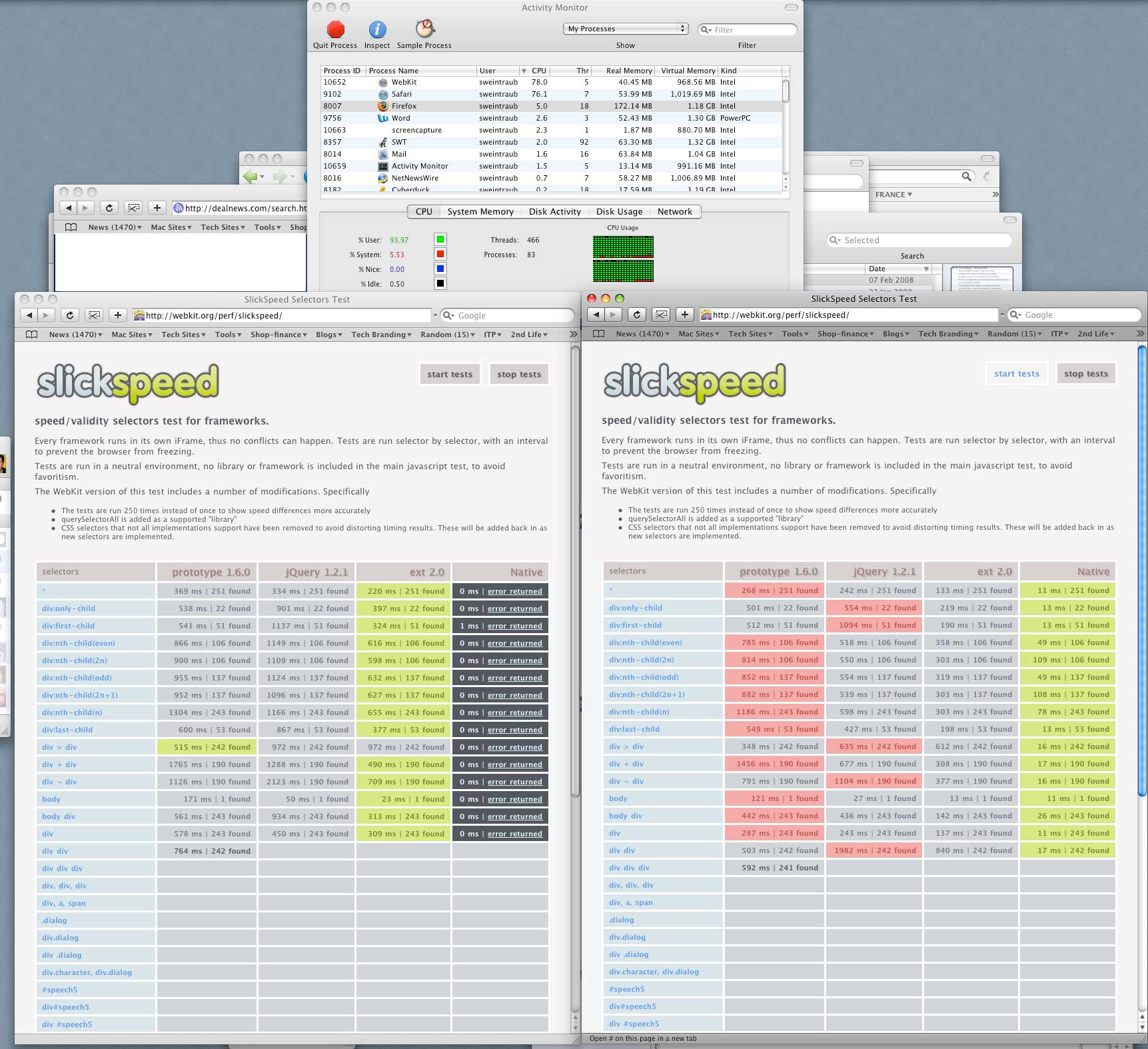
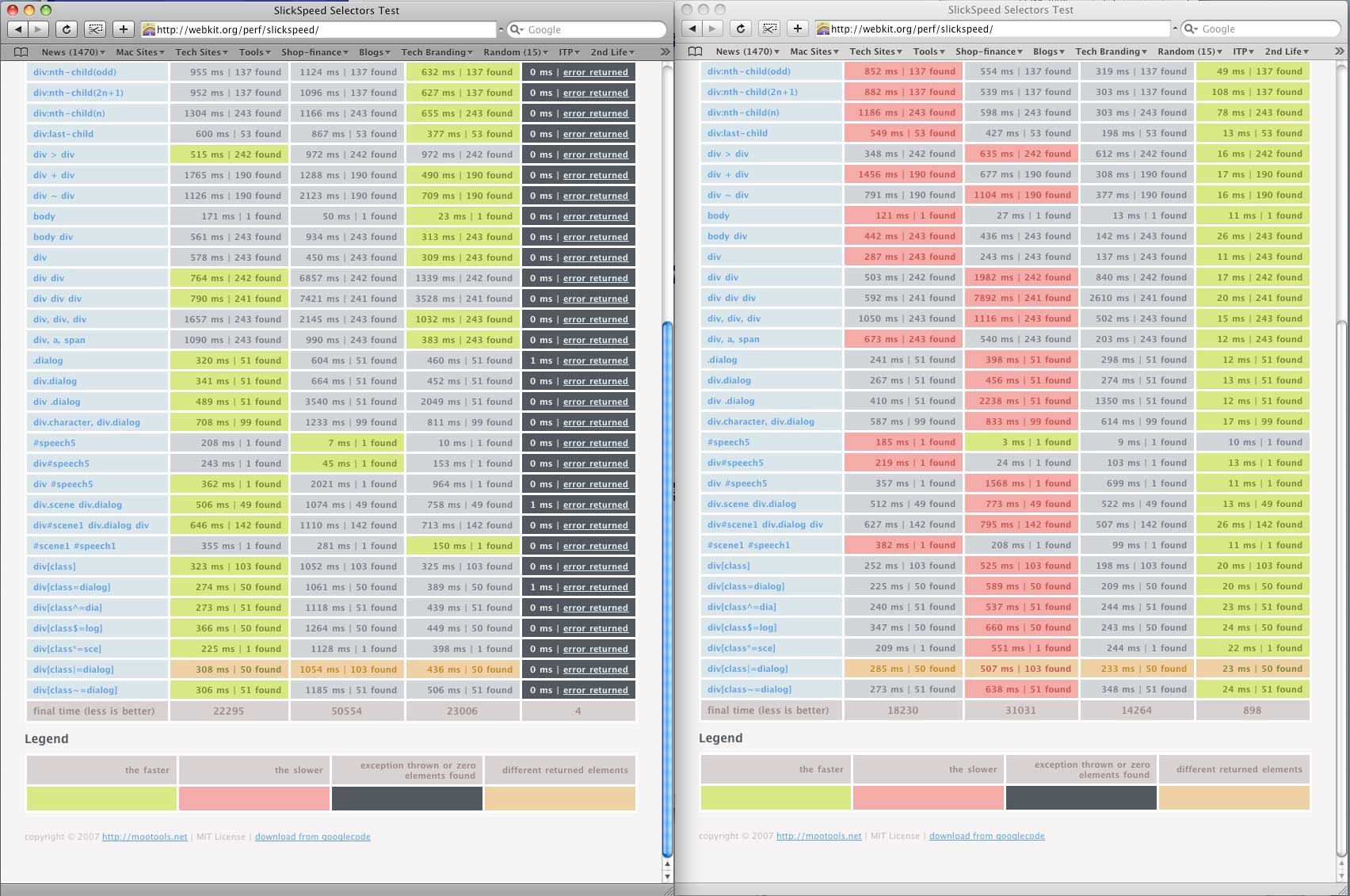
 I just spent a few hours running tests on the latest version of WebKit for Computerworld.
Conclusion?
The upcoming builds of WebKit/Safari are really realy fast. The unoptimized WebKit is often twice as fast as the current standard Safari in page load times. And Safari is supposed to be the fastest desktop browser out there!?
According to the WebKit surfin’ Safari blog, the speed increases are largely due to Javascript handling improvements.
Whenever the new WebKit code gets pushed into Safari (soon?), you’ll notice these significant speed increases and possibly even more after the code is optimized. Download the latest WebKit here, compiled for both Mac and even PC to get a preview or check the article for more results.
Oh and Firefox users (like myself) should also see similar speed improvements in coming versions.
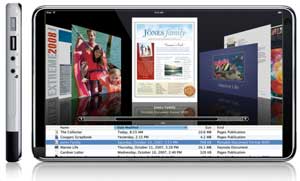
Erica Sadun has been doing some digging around and found an extra platform in the iPod/iPhone lineup. Along with the current iPod Touch (N45), iPhone (M68) and a "simulator"- which means the SDK will likely contain a simulator), she found reference a currently unknown "N82". Could this be the new 3G iPhone set to be released later this year? Or perhaps this could be a reference to a new Apple Tablet or Mac Touch? Or maybe Apple putting out a Touch OS release (no) for Nokia’s N82 Hardware?
Perhaps we’ll know on the 26th?
(Thank you Jesus for the image)

What exactly does soon mean? Apple usually uses the sticky when it means a few hours…
http://developer.apple.com/iphone/maintenance.html
EDIT: Nope, the page is back up:
http://developer.apple.com/iphone/devcenter/
Update – delayed until March 6th
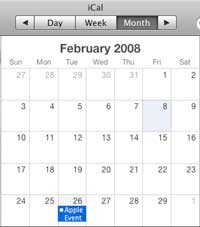
We’ve gotten reports as well as TUAW that there will be an Apple event tentatively scheduled for February 26th. The event will likely be the launch pad for the iPhone/iPod touch SDK and applications including Exchange support and Lotus Notes support.
The date was likely finalized recently as Apple, who usually announces some new products at NAB, pulled out of the early April event for the first time in recent memory. Perhaps Apple is saving its Final Cut Pro Server announcment for the February event – or more likely, as we’ve heard, pushed it back to mid-year.
It could also be the launch pad for the new MacBook Pros which have been waiting for the late-to-the-party Penryn chips. Since 10.5.2 builds have been lingering around for awhile now, it might also might also hit around then.
Did we forget anything?
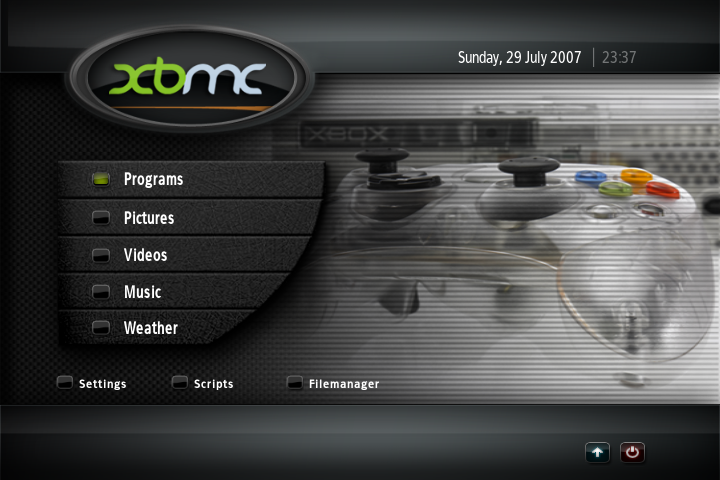
 The XBox Media Center (XBMC) project was started as an alternative OS for the original modded XBoxes in 2002. It has since grown into one of the most functional media center applications out there.
Last year it was ported to Linux and it was reborn as one of the best media centers for the platform, doing many things that Front Row/AppleTV and Windows Media center can’t do.
Recently a team of programmers led by Elan Feingold decided that maybe an OSX version might have a market..as he puts it, "it seems like it’s a
9to5Mac: That sounds like a lot of amazing stuff. What functionality are you working on now?
Elan: We don’t support DLL loading on OS X yet (or linux, that i know of), but we CAN. Note that the Xbox version of XBMC supported Windows codecs through DLL loading for "closed" formats like RealAudio, WMV etc. We can use and enhance the existing DLL loading code which comes from MPlayer. We are also working on full support for the Apple Remote and other popular remotes out there like the wireless XBox 360 controller, etc. We also want to get Python working as soon as possible. As more people join the project, more interesting things get picked up.
9to5Mac: Speaking of other devices, do you have any plans to port XBMC to the AppleTV?
Elan: Unless Apple opens up a SDK for the AppleTV, it is very unlikely that our core group will do so. We are all huge fans of Apple and are trying to stay on their good side. We’ve talked to a lot of people lately who say they went and picked up a Mac Mini for the sole purpose of running the XBMC. Hopefully we are putting some money into Apple’s coffers for developing such a great operating system and hardware combination.
9to5Mac: (plays devil’s advocate) Why not just put XBMC on a cheap ShuttlePC with Linux and let it be the sole application? XBMC would appear to be almost everything you need in a mediacenter PC.
Elan: I happen to think OS X is a much better platform for XBMC than Linux. It’s got great OpenGL support and in the long term, desktop Linux (in my opinion) just hasn’t stuck. People who love Unix are moving to OS X. My grandmother is moving to OS X…and what better looking HTPC is there than the Mac Mini?
Oh, and Linux probably has more OpenGL driver issues. Ultimately, though, as compared to the original Xbox version, I think there is use for an OS. For example, you can install some headless bittorrent client, ssh into it, or put whatever you want there to work along side XBMC. Those little boxes that just turn on and run a media center as firmware are ultimately limiting.
9to5Mac: You mentioned BitTorrent. Are there plans to include other media-centric applications like a Vuze, Sling Client, Joost, or EyeTV support?
Elan: I think there are some interesting things going on with Bittorrent in the field right now. I am focussed on Mac support so I can’t say specifically what is coming up. Those other applications are great reasons why you want a full OS underneath the media center. Again, it is an open platform, if you want to build it in, you are welcomed to – a bit of Python code later and you’ve got it.
9to5Mac: That brings us to the XBMC team itself, how have you found the team, the code, and the atmosphere?
Elan: It was highly intriguing to be brought into their inner circle. The XBMC code is top-notch, compared to lots of other open source products i’ve worked with. It’s well written by smart people who know what they’re doing…and "pike", the project manager boss-man does a really nice job of managing the project – something that’s lacking with lots of other open source projects.
9to5Mac: Cool, that really comes through in the buzz around the project and the quality of the product. One last thing. The name. It seems like it would be a big turnoff for Mac-heads and even Linux people. You’ve moved pretty far away from the XBox, any chance we’ll see a catchier name in the future?
Elan: There has been talk around the water cooler. Nothing yet to report on that.
9to5Mac: Thanks for your time Elan! We’ll let you get back to work. Or you can eat breakfast while we go to sleep…
If you wish your Mac could do a lot more and/or want an alternative to Apple’s iTunes/AppleTV/Front Row, check it out: Download
Although, it is only version 0.1, you can already see the awesome potential that this system has.
From the site:
XBMC Project Background
OS X Port Background
Community Interest
Current Status (Working features)
Next Milestones
Contact Info
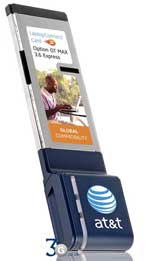 Yeah the rest of the world is rolling their collective eyes because they’ve had 3G for like 35 years or something… but AT&T has just announced a major expansion of their 3G network in the US. Their announcement means AT&T will roll out an additional 1,500 cell sites in the U.S. this year adding 80 more cities – which will bring the total to 350 markets in the US – and all of the top 100 cities. Just about ubiquitous enough for Apple to do some kind of 3G deal with AT&T, not just in iPhone, but also in iPod, and Mac laptops as well.
We are still sticking to our Mayish prediction of iPhone3G rollout – about a year after the the original announcement. Also, this is about the timewhen Japan, who’s networks aren’t compatible with EDGE, and the rest of Asia should start seeing the iPhone. Also expect the EDGE iPhones to take two price cuts of $100 each before then. One to eliminate the 8Gb iPhone in 1-2 months. Another for when the 3G model comes out to clear the EDGE iPhone inventory. Apple isn’t doing $200 price drops anymore.
As far as we know Apple is also sticking with their exclusivity agreement with AT&T and not going anywhere else.
The talking heads at AT&T have this to say about catching the US up to Europe and Asia’s networks (take it for what it is worth):
"Fast wireless broadband is the foundation for a whole range of new and emerging applications that our customers are adopting, including everything from social networking to sending live video and large business files," said Ralph de la Vega, president and CEO for AT&T’s wireless unit. "With these aggressive initiatives, we’re expanding the scope and the speed of our 3G capabilities, connecting people with their world and enabling more customers to do more with their wireless devices, wherever they may be.
"We’re also planning for the future by establishing a clear path to a 4G network that will meet the needs of our customers for years to come," said de la Vega.
The deployment of HSUPA this year is the next step in the evolution of AT&T’s 3G network, with further enhancements and speed boosts expected in the near future. This year’s HSUPA deployment will complete the transition of the AT&T 3G network to High Speed Packet Access (HSPA) standards, marking the only full transition by any wireless provider in the United States to this latest generation of wireless broadband capabilities.
As customer needs continue to evolve and grow in the future, AT&T’s global leadership in deployment of GSM technologies positions the company to continuously evolve its network to meet those needs. The evolution towards HSPA+ and LTE technologies will enable the company to continue to deliver higher speeds and capacity in the years to come.
"From the beginning, our wireless network has been designed with the future in mind," said de la Vega. "The capabilities of 3G standards will continue to expand over the next several years, enabling us to stay well ahead of our customers’ broadband needs. And looking even further into the future, our existing technologies provide the ideal platform for a smooth transition to next-generation platforms."
AT&T’s GSM technology also offers customers the largest international roaming footprint. AT&T devices work in 196 countries and regions — accounting for more than 90 percent of the planet. All GSM customers in those countries can roam on the AT&T network in the United States as well.
 Apparantly, while we were all clamouring over the MacBook Air and iTunes Movie Rentals, AT&T was pushing through the FCC a proposed buyout of Aloha Communications. Aloha had earlier bid and won the chunk of spectrum in the 700Mhz band that covers almost 2/3rd of US housholds.
The proposition won by a 4-1 vote. One of the two democrats, Jonathan Adelstein, said he voted in favor of the Aloha sale because there was no public opposition to it but remained "troubled" that AT&T could hold a "disproportionate share of the spectrum" when the auction is finished. The other Democratic commissioner, Michael Copps, voted against the ruling. He said the deal could have a large impact on a mobile voice and data market "that has seen round after round of consolidation in recent years."
Copps also raised concerns about the FCC’s review of the deal. The review "contains only an extremely abbreviated analysis of the competitive effects of this change in ownership," he said.
So we say to Mr. Adelstein: If you are really wondering about public opposition to telecommunications monopolies, maybe do a little more research. For future reference, everyone in your district is against them.
Edit: This is the third in a series of four articles on Battling iPhone’s GSM Buzz. A solution to this issue is described in the fourth installment.
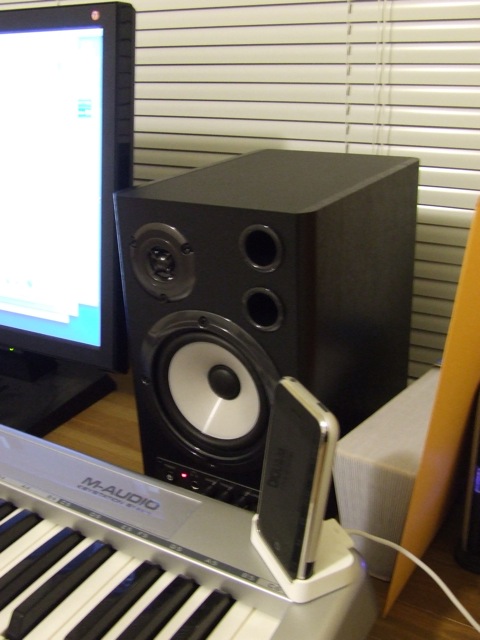
Here is what I hope will be the final installment of my Battling iPhone’s GSM Buzz series. It has become somewhat of an abiding obsession to outfit my G5 workstation with speakers that don’t go rat-a-tat-tat every time my iPhone wants to talk to a cell tower. You readers have been very helpful with your suggestions, and I hope you’ve gotten some use out of my commentary (even if it’s only Schadenfreude or commiseration).
Martin started me off on a new angle, and I commenced a search for a pair of computer speakers that could make use of my G5’s optical audio out. I found them for a slight premium over my original budget of $100 in the Behringer MS40 Digital Monitor Speakers. American Musical Supply have them for $129 through Amazon. I also picked up an inexpensive digital optical cable from them, since they had free shipping on orders of $50 or more.
I have to say I was impressed with the service of AMS. I contacted Behringer directly about GSM buzz, and received no response. I repurposed my email to AMS and heard a reply within a day. They even responded to a follow-up. Here’s how it went:
Me:
I was wondering if the digital coaxial and/or digital optical
interface of the Behringer MS20 and MS40 multimedia speakers does anything to alleviate interference from GSM mobile phones (GSM Buzz). I currently have a Mac tower and a docked iPhone in my studio, and the phone has caused significant interference with all analog speakers I’ve tried. See discussions here and here.I did see the below instructions from the manufacturer, and wondered if a GSM mobile phone counted as a high-frequency source. I also have 802.11 wifi at home, and wonder if that would interfere.
IMPORTANT NOTES CONCERNING INSTALLATION: The sound quality may diminish within the range of powerful broadcasting stations and high-frequency sources…
AMS:
Optical connections use light channeled through a fiberoptic cable and radio/cell phone transmissions should not affect it. If you are experiencing gsm buzz you may want to check your cables and make sure they have sufficient shielding/insulation. You may want to make sure the electrical outlets have proper grounding as well.
Well, this was the first I’d heard of checking the electrical outlets for proper grounding. As for the shielded cables, I could see this was leading to a recommendation that I drop another C-note on Monster-branded cables, and all I see on audiophile sites is hate for their price/quality quotient.
As for the Behringer MS40 digital monitors, I was willing to give optical a try. Especially if the risk was only $29.99 over my initial $100 budget (list, for what it’s worth, is $196.49). Sure, the MS20s (20 watt vs. 40 watt) were also on sale for $87.95, but I’m a sucker for the extra power. So I punched the purchase button on a Friday, and got the box the next Monday.
Speaking of which, I’ve been very impressed by how quickly Amazon (and now AMS) has delivered my packages to NYC (every time for free), and also how quickly my returns and refunds have been completed. Both the Klipsch and the M-Audio have been returned and refunded as I write this. Shipping and returning have all beat their time estimates by several days. It might be because I’m in a huge city, or it might be a case of underpromising and overdelivering. Either way, the lesson is that Super Saver shipping is quite sufficient, and all those inducements to pay extra for expedited shipping is usually a waste.
Okay, so this time the box was huge. My mailroom at work wrapped it with string so I could carry it to the train. I’m a big guy, and this tested my upper body strength. I switched carrying arms about a dozen times in the four blocks I had to walk. When I got home, I unpacked two substantial wooden cabinets, 11 inches tall, 9.625 inches deep, and almost 7 inches wide. That’s some serious desk real estate—I won’t deny it.
One thing I want to immediately point out about connecting optical cables to your mac is that the volume controls on the keyboard do not work unless you mute the sound entirely. The volume has to either be controlled through your apps or through the knob on the right speaker. Maybe there’s some plugin I’m missing and one of you can set me straight.
I tested the speakers on a variety of music, and they’re awesome. All the detail I discovered in the M-Audio Studio Pro 3s was there and more. The high- and mid-frequency sounds are very much in the foreground, and while the bass is strong, it appears to reside more in the background. This is not to say there is a lack of bass here for a 2.0 system—quite to the contrary, it has the most of any I’ve tested—but I don’t want to get the inevitable hate mail about how subwoofers are the only way to get proper bass.
There is so much detail in the sound that I actually found myself nitpicking flaws in the music. On live classical tracks, you can hear the odd cough in the hall. On hip-hop tracks, you can hear where some samples don’t quite connect. I suppose that is because these are proper studio monitors, not consumer-grade "speakers" which may smooth-over some detail in service of a more balanced "mix."
You have to be careful with the volume on the MS40s. I never got any distortion, but they definitely "go to 11." The sound is so enveloping that you could actually endanger your hearing. I had some mild ringing in my ears after testing through my library for an hour or so. I don’t want chronic tinnitus, so I’ll be keeping the volume at a reasonable level from now on.
I heard no GSM buzz at all from the right speaker, which is the one that has the optical input. The left, however, didn’t take long. Here’s my next note to AMS:
Me:
I’ve installed the MS 40 speakers, and the right speaker has no buzz. The RCA cable connecting the speaker appears to be cheaply made, and I am getting a little buzz on the left side. Can you recomme
nd a good shielded RCA cable in the 3′ range? What should I look for in a shielded RCA cable?
AMS:
I would suggest the following…
http://www.americanmusical.com/item–i-MON-I1001M.html
Argh. The dreaded Monster cable recco. I went over to Radioshack, because I didn’t want to pay shipping, and I picked up a shielded RCA cable. I demurred on the Monster for $30, and got a house brand "Gold Series" stereo audio cable for about $17. And it was a waste of time and money. No change in the buzz on the left. I may try the Monster, but I really don’t hold out any hope. If it really could make a difference, I’m sure one of you will weigh in.
Maybe there’s something to AMS’s "Properly-Grounded Outlet" hypothesis. I’ve got a couple of upcoming projects around the house for the local electrician, and I’ll make sure he takes a look. In the meantime, that first attribute of the MS40s that I told you about—the weight—is what will keep them on my desk. They’re too heavy to return. The buzz is certainly a lot less than the Klipsch or Logitech speakers, and maybe a new wall outlet will make everything all right in the end. Plus, my arms are tired.
OK – this has nothing to do with Apple – but it may be of some use to people outside the US. We found over at Valleywag – they embedded MSNBC’s election coverage into the website. Hey – MSNBC isn’t our favorite but embedding and allowing people all over the world to watch on the internet is OK by us. It even works on Macs.
http://www.msnbc.msn.com/id/22425001/vp/22887506#22887506
..or you could get a Slingbox…
 8Gb iPod Touch $300 8Gb iPhone – $400
16Gb iPod Touch $400 16Gb iPhone – $500
32Gb iPod Touch $500
It should be $100 for 8GB right? Memory controllers and packaging design cost money – but for the most part on Apple iPhones and iPod Touches, the only difference is the RAM size. To go from a 8Gb iPhone to a 16Gb iPhone – $100. From a 8Gb iPod to a 16Gb iPod. $100.
But to go from a 16Gb iPod to a 32GB iPod, 16GB of RAM, it is also only $100. How can they afford that? It seems like quite a deal – even at $500.
Just an observation…
 Apple today released the 32Gb iPod touch and the iPhone at 16Gb. The sizes of the devices and the feature sets appear to be the same. The prices for the higher capacities raise the bar to $499 for the top of the line for each model.
Apple Press release:
Apple Adds New iPhone & iPod touch Models
CUPERTINO, California—February 5, 2008—Apple® today added new models of the iPhone™ and iPod® touch which have double the memory, doubling the amount of music, photos and videos that customers can carry with them wherever they go. The revolutionary iPhone now comes in a new 16GB model for $499, joining the 8GB model for $399. iPod touch now comes in a 32GB model for $499, joining the 16GB model for $399 and the 8GB model for $299.
“For some users, there’s never enough memory,” said Greg Joswiak, Apple’s vice president of Worldwide iPod and iPhone Product Marketing. “Now people can enjoy even more of their music, photos and videos on the most revolutionary mobile phone and best Wi-Fi mobile device in the world.”
Both iPhone and iPod touch feature Apple’s revolutionary Multi-Touch™ user interface and pioneering software that allows users to find and enjoy all their music, videos, photos and more with just a touch of their finger. All iPhone and iPod touch models include the latest software enhancements announced last month including the ability to automatically find your location using the new Maps application*; create Web Clips for your favorite websites; customize your home screen and watch movies from the new iTunes® Movie Rentals. Both iPhone and iPod touch feature the world’s most advanced mobile web browser in the world with Safari™ and great mobile applications including Mail, Maps, Stocks, Weather and Notes.
Pricing & Availability The new 16GB iPhone is available immediately for a suggested retail price of $499 (US) through the Apple Store® (www.apple.com), Apple’s retail stores and AT&T retail and online stores. The 32GB iPod touch is available worldwide immediately for a suggested retail price of $499 (US) through the Apple Store (www.apple.com), Apple’s retail stores and Apple Authorized Resellers. iTunes Movie Rentals are available in the US only. iPhone and iPod touch require a Mac® with a USB 2.0 port, Mac OS® X 10.4.10 or later and iTunes 7.6; or a Windows PC with a USB 2.0 port and Windows Vista or Windows XP Home or Professional (Service Pack 2) or later and iTunes 7.6.
*Availability and precision of Maps positioning features will vary depending on actual location.
Apple ignited the personal computer revolution in the 1970s with the Apple II and reinvented the personal computer in the 1980s with the Macintosh. Today, Apple continues to lead the industry in innovation with its award-winning computers, OS X operating system and iLife and professional applications. Apple is also spearheading the digital media revolution with its iPod portable music and video players and iTunes online store, and has entered the mobile phone market with its revolutionary iPhone.
 The Scotsman throws it out there:
GLOBAL giants including Apple and Rupert Murdoch’s News Corp are believed to be considering rival bids for the internet company Yahoo, which has received a $44.6bn (£22.6bn) offer from Microsoft.The conglomerate InterActiveCorp was another company named as a potential bidder for Yahoo, which is said to be unwilling to give in to Microsoft without a fight.
After Microsoft’s chief executive Steve Ballmer made the offer in a letter on Thursday, it emerged that Yahoo had rejected a similar takeover attempt by Ballmer’s organization a year before.
Yahoo chief executive and co-founder Jerry Yang is understood not to be Microsoft’s greatest fan, and would be prepared to line up another ‘white knight’ rather than concede to Ballmer.
It is believed he would be particularly open to a rescue bid from Steve Jobs’ Apple Corp, having openly expressed his admiration for the firm in the past.
Apple does have a bit of cash laying around ($16 Billion) and Steve Jobs did pay the Yahoo! VPs a visit last year. According to Kara Swisher, it was quite the motivational speech. Steve Jobs also knows how to bring a company back from the brink of collapse (see Apple 1997).
Stranger things have happened – and the drive from Cupertino to Sunnyvale is a bit shorter than from Redmond – not to mention that the Valley culture is much stronger at Apple and Yahoo than at Microsoft.
Also, Apple has much less overlap in products and services than Microsoft does with Yahoo.
The unlikely move however, would put Apple in direct competition with (Apple Board member) Eric Schmidt’s Google, a partner and ally in its battle vs. a Microsoft dominated marketplace.
Other white Knights include InterActiveCorp, Rupert Murdoch’s NewsCorp (yikes!) and some foreign suitors.
Dinosaur Securities analyst David Garrity even thinks it’s possible that China’s search leader, Baidu.com Inc., or Chinese e-commerce conglomerate Alibaba.com Inc. might bid for Yahoo. Alibaba.com is 40 percent owned by Yahoo. He also considers Apple a potential suitor.
Still though. Super-unlikely.
 Italy, Spain and Switzerland are next up in getting the iPhone officially from Apple according to a post by Macworld UK.
Spain Telefonica (parent company of O2, the UK iPhone provider) and Telecom Italia Mobile for Italy are both said to be in the latter stages of a planned release.. Macity has reported that iPhone’s software already includes a piece of code (the TIM_Italy.bundle) that strongly suggests support for that network is already being built-in.
The announcements are going down next week in Barcelona at the World Mobile Congress (Feb 11-14) according to their sources.
A third publication, Le Temps, claims that Switzerland will also carry the iPhone on Swisscom by late February. That is for the few people left in Europe who don’t already have a hacked iPhone.
 The stars have been further aligning up lately on the new MacBook Pros. If you are thinking about making an Apple laptop purchase hold out for a week or so. MacRumors thinks it will be within two weeks and some new battery specs have hit the interwebs. Also we’ve been hearing stories from retailers that new SKU’s for MacBook Pros are hitting the streets (anyone care to elaborate?)…So our predictions are as follows:
Thanks to Macsimum for the video
[youtube http://www.youtube.com/watch?v=GKqQtkLQlmA&rel=1&border=1]
Was that two SIM cards in there? Or just two SD cards? It’s no replacement for the original but sometimes these things spark the "what if?" ideas in our heads…
 All of you holier-than-thou iPhone users that would never, ever, hack your sacred virgin iPhone, call out your high horse (whew), because a one click install has been developed for the 1.1.3 iPhone Jailbreak.
OK. It’s not as easy as last time, when you could just happen over to http://jailbreakme.com and restart. It is only a one click install if you are on hacked version 1.1.1 or 1.1.2. And it involves downloading a 200mb file over wifi. That’s at least 20 minutes of time.
If you are already on 1.1.3, it’s fairly straight forward to get down to 1.1.1. Just follow a simple downgrade procedure. Once you are downgraded – hit the lifehacker link.
Also, for you who’ve already been jailbroke, some of the apps need a rework to work with 1.1.3 because of the new "mobile" user that applications are running as and the new preferences location.
As always, use at your own risk. Apple warranty will void (just like upgrading a hard drive on a laptop), kittens will die and Steve Jobs will cry.
So the news around the watercooler at Apple and probably also at Fidelity (PDF) Investments (disclosure: my retirement pennies are in Fidelity – son.of.a..!) this week was Steve Jobs emailed Apple employees and investors about the recent drop in share price.
As Apple CEO and Board member, it is Steve’s job to tell everyone what they should already know – that the US market is in a downward spiral and the whole tech sector (US Market?) is in a freefall right now. It isn’t Apple, it is the economy. If you want someone to blame, hit up the US voters who elected this current administration. Yes, Democrats and Republicans both, we aren’t taking sides of course.

From the graphic above (provided from Appleinsider) you can see that overall, Apple is outperforming the tech sector – even with its massive 35% losses.
Of course, nothing is really going to help those who bought near 200 and lost 35% of their investment over the past week. Feel free to scream at us in the comments about revealing MacBook Air early details…or saying that Macworld was lackluster or f’ing up the 5 million iPhones call…Or saying that there will be new Macbook Pros within a month or so ;)
The truth is Apple is a solid stock and the numbers from iTunes Movie Rentals will again shoot Apple’s stock up where it belongs. Also, when people finally put MacBook Airs in their hands (this week they’ll be in stores), they’ll realize how amazing this device really is – and buy from their hearts – no matter what their heads say.
iPhone numbers also hurt Apple’s stock. We had heard 5 million. Apple said 4 million, The telecoms said 3 million. Trust the web metrics. iPhones are selling like crazy and more importantly, being used like crazy. Web sites are being developed just for iPhones. Seriously, what iPhone competitor can say that? Oh and the SDK is out soon. And so are all kinds of business applications including Exchange and Lotus support. Think that will help sales?
In short, buck up little camper. You are going to get your money back…eventually…and btw, if Apple’s stock gets anywhere near 100, we’re selling the 9to5HQ and putting it into Apple Stock!
 They were hacked. There are a lot of people who use phones outside of AT&T, and the European carriers. But, are 1/3 of Apple’s iPhones hacked? Probably.
For the people who say that they are in the "channel", we have to wonder what they are referring to. RoughlyDrafted points this out as well. iPhones are only sold by Apple’s online store and retail and its telecom partners. Not by Best Buy or Target or Circuit City. Apple knows exactly what’s in its inventory. It also knows what AT&T and the EU’s got on their shelves.
Frankly, we think Apple wants us to say it. Yes, "one-third of iPhones are now hacked to work on non-sanctioned providers". Apple had to make this deal with the mobile carriers to let them use their networks for a reasonable fee. Apple agreed to lock the iPhone down enough so that people would be coerced into using the providers. But Apple wants this phone in as many hands as possible. The ten million mark is something they’d like to make come hell or high water. They probably weren’t anticipating a recession to be thrown into the mix either.
So there are over 2 billion people in China and India. Is it impossible to believe that 200,000 of them (1/10,000th) snapped up iPhones? Now add in a bunch of Canadians, Mexicans, Indonesians Australians and Europeans. It isn’t hard to find hacked iPhones. Just look at our Google ads! It also isn’t illegal.
Is it really so hard to believe?
 I was complimented by the salesperson at the 5th Avenue Apple Store for my preparation. I had brought the manuals of my Scientific Atlanta Cable box, my Sony 5.1 system, my Samsung HDTV, and a drawing of how I thought I would rout the cables. I wanted to buy an Apple TV, but I wanted to make sure I could integrate it with my system so I could have HD from the cable box and the ATV (My 5.1 system has a standard DVD player built in—for an essay on why BluRay and HDDVD are irrelevant, see, The Chums of Chance Embrace Digital Downloading at 720p, and Rejoice at the Advent of 1080i Two Years Later) and 5.1 sound from ATV, Cable, and the Sony box.
We figured out a way that I could use the optical output on the ATV to give me surround in my Video 2 port and how the cable box had a spare coaxial audio port that could do the same on Video 1. I’d need an HDMI cable (do not buy these at retail, if you don’t already know—you can save around 80% online) and that RCA coax, and I’d be ready. I was reaching for my Amex. Then I happened to mention that once I owned an ATV, I could move my Airport Express (which sits next to my cable box and cable modem) down to the basement so I can finally move my ugly and not-often-used brother laser printer out of my office.
That’s when the salesperson gave me a funny look and asked if I also wanted to get an Airport Extreme base station. I was confused. Why would I need an airport extreme base station if I already have an Apple TV? And then he dropped the bomb: The Apple TV, despite having an Ethernet input and a 802.11n card, is not a router.
What?? Why not? Doesn’t ATV already have all the appropriate hardware to be a router? I’m not an engineer, but how much money are we talking to make this box a router? Is it above a dollar?
So now, instead of expanding my wireless network by putting my Airport Express in the basement with my printer, I would need to keep the airport express and the ATV together in my TV hutch so the ATV can receive a signal from the AX, six inches away. My two computers (one is a MacBook) receive their internet connections from the AX now, which has allowed me to place the G5 tower where I won’t have to drill holes to rout cat5 cables. I know these last few sentences have been inelegant, but that’s my beef—Apple is the king of elegance. Wouldn’t adding routing capabilities to ATV make the box more, well, Apple-y?
In my situation, the answer is absolutely. I would gladly be an early adopter of ATV, even with it’s 720p petitHD spec, if it meant I could also use it as a router. I would do it just for the elegance alone. But without a router, my TV hutch starts to look like an IT office, with a million blinking lights and a Medusa’s coif of cables everywhere. Screw that. I’ll wait until ATV gets a router and 1080i.
Unless, dear Steve, there is a firmware update in the near future that will give me my wish? Let me know…
My personal fave:
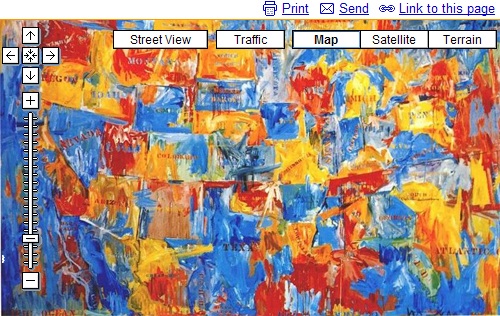
Probably more because I am a Jasper Johns fan 1st and Google Maps fan 2nd. Yes I tried to zoom in and "link to this page". Creature of habit.
or the slideshow.
 One thing that stood out from all of the reviews was Ed Baig’s comment that Steve Jobs wanted to put 3G access into the Air but ran out of room.
Air does not come with the built-in ability to connect to a speedy wireless data network run by various cellular carriers. Jobs told me last week that Apple considered it but that adding the capability would take up room and restrict consumers to a particular carrier. Through a USB modem, he says, you can still subscribe to wireless broadband with your favorite carrier.
I hate to badmouth Mr. Baig and Mr. Jobs but there is no other way to put it. BS!…
Taking up room? Currently, the latest 3G chips are the size of a fingernail and reside in the smallest of cell phones – let alone computers. If Apple needed to add some space, the added millimeters wouldn’t make any discernible difference to the size of the Air. While the argument could be made for the iPhone that the 3G card drains the battery, it is damn near impossible to argue this with a laptop. Also the power and the antenna can be shared with the Wifi – just like in the motherboard design of Sony’s latest TZ WITH 3G.
Restricting carriers? Putting a HSDPA chipset in the Air would allow the consumers to choose between Tmobile or AT&T in the US and tons of carrier choices abroad. Just like Dell, HP, Sony, and others have been doing for years. Even an EVDO chip would allow carrier choice between Sprint and Verizon. Besides, SINCE WHEN IS APPLE ABOUT GIVING ITS CUSTOMERS OPERATOR CHOICE?!
Oh, and in case you are thinking cost… The bulk price on 3G chips is $23. Not much when you consider that the starting price on the Air is almost $1800.
So why did Apple leave out the 3G on the MacBook Air? We are looking into it – we have our theories. As for now, I stick with my initial reaction – wait for Rev 2. IF you think you know – vote!