We noted before the release of the new Apple products that it often pays to wait a week before buying Apple’s new products. Not only don’t you get “the first ones off the line”, but prices drop significantly over the first week.
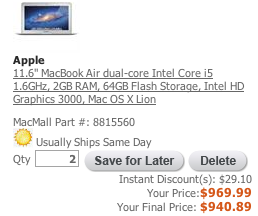
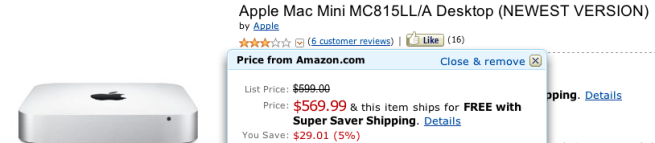
A number of Apple Authorized Retailers/affiliates are new selling Apple’s new MacBook Airs and Minis at prices up to $100 lower than Apple. MacMall and Amazon appear to be the lowest.
MacMall has the MacBook Air for the following prices (note: $30 more is taken off at checkout):
1.60GHz 11″ MacBook Air 2GB/64GB $940.89 1.60GHz 11″ MacBook Air 4GB/128GB $1,129.07 1.70GHz 13″ MacBook Air 4GB/128GB $1,216.37 1.70GHz 13″ MacBook Air 4GB/256GB $1,502.52
iPhone Italialearns“from a very reliable source” that Switzerland’s carrier Swisscom will offer a next-generation iPhone beginning October 5, following a September 5 launch in the United States. The handset, we learn via a not-so-accurate Google translation, will arrive to international markets in October. This information apparently comes from a senior Swisscom executive who is apparently in the know because Apple has already contacted carriers around the world to make necessary arrangements.
Swisscom, Apple’s partner, currently offers iPhone 4 and iPhone 3GS. Apple also has distribution agreements in Switzerland with carriers Sunrise and Orange. Unlike the other two carriers, Swisscom does not offer authorized carrier unlock even though Apple itself sells unlocked iPhones in the country via its online Apple Store. Lowell McAdam, a new CEO for Verizon Wireless, suggested in a conference call with analysts today that the next iPhone should come out this Fall:
We are probably what I would view as maybe a quarter behind what we had talked about in January, primarily because we expected an iPhone 5 refresh sometime this summer. We don’t know when the next one is going to come out. You will have to ask Apple that, but we expect that probably sometime in the fall, and I think you will see a significant jump there when we get to that point.
[vodpod id=Video.13631351&w=425&h=425&fv=]
We’re applying proper skepticism to iPhone Italia’s report. First, September 5 is a Monday and Apple would never release a major new iPhone on Monday. Second…
As first reported by App Advice, in what could be a sign that T-Mobile USA will soon get the sought-after iPhone – and that’s pretty much a given if their merger with AT&T goes through, the company began selling Micro SIM cards specifically to GSM iPhone customers. Per their website .
Already have a GSM phone or iPhone that you need to activate—or have an unlocked GSM phone you want to use on the T-Mobile network? Just get a Micro SIM card and choose a plan. Slip the ready-to-use Micro SIM Card into your phone and you’re ready to go.
In a rare official confirmation, T-Mobile USA confirmed to 9to5Mac they host over a million unlocked iPhones on their network as of June. As you know, AT&T in March announced intentions to acquire Deutsche Telekom-owned T-Mobile USA in a cash-and-stock transaction valued at approximately $39 billion. The merger would give birth to the nation’s largest wireless company and also formalize a duopoly in the country. This had Sprint officially oppose the merger, ask the government to intervene and threaten “nuke tactics.” Tensions rose last week when Sen. Herb Kohl, D-Wis., who chairs the Senate’s Antitrust Subcommittee, called for regulators to block the proposed merger.
“Computers are like a bicycle for our minds”, Steve Jobs said in the early days (see the below clip). Believe it or not, the Cupertino company has literally come full circle since this famous quote. Apple took a page from Google’s environment-friendly book by offering its employees bicycles to commute across their vast Cupertino campus. MacMagazine.brwrites:
There is no iBike (although this is horrible), but the bikes that Apple is now offering its employees are all aluminum, very good taste, have only three gears (heavy, light and normal) and still have a bag for MacBook, Cases, and the like.
It’s a clever – and green – move on Apple’s part. Bicycles promote healthy living. Using them for commute is both a useful cardio exercise and mind training as one gets to observe the outdoor environment while having to constantly pay attention to other commuters and traffic regulations. Plus, iBikes should prove indispensable as Apple increasingly spreads its employees between the 1 Infinite Loop campus, nine new buildings they recently leased and that breathtaking space ship-like building scheduled for 2015.
The case has been building for a third-generation iPad with Retina Display in recent weeks. The latest clue arrives in a Korean Times report about LG Display CEO’s meeting with reporters late yesterday. Asked whether his company would enter the OLED market for smaller portable devices, CEO Kwon Young-soo responded by accusing Samsung of misleading the market because OLED displays “are not suitable in terms of picture quality, response time, energy consumption and contrast ratios for smartphones and tablets”. He said LG Display would make OLED displays for big screen TVs and then dropped this bombshell:
He said more smartphone manufacturers will release new models employing LG’s “Retina Display’’ that has been used in iPhones and iPads.
This is the most solid piece of semi-official evidence so far asserting that Apple might incorporate a high-resolution display on iPad 3 which may or may not be marketed as being Retina-capable. A number of media outlets and people in the know, from Daring Fireball’sJohn Gruber to DigiTimes have been whispering about iPad 3 having a much crisper display with as much as four times the iPad 2’s pixel count. The Korean Times also reported last week that Apple was quality-testing 2048-by-1536 displays from Samsung and LG.
Verizon Wireless just announced their second-quarter earnings, reporting a 2.8 percent revenue growth on revenues of $27.5 billion and consolidated earnings of 57 cents in diluted earnings per share. They activated 2.3 million iPhone 4 units in the June quarter, which is their first full quarter of iPhone sales. This is 1.3 million units less than the 3.6 million iPhone activations AT&T reported yesterday, which in itself was a flat growth in iPhone activations for AT&T compared to their previous quarter. The key thing to bear in mind here is that Verizon only sells iPhone 4 while AT&T also carries iPhone 3GS which costs just $49 after a two-year service contract. In the seven weeks they had been selling iPhone 4 in the previous quarter Verizon Wireless activated 2.2 million units.
We now have enough data to draw some solid conclusions. Apple sold 20.34 million iPhones in the June quarter, representing 142 percent unit growth over the year-ago quarter. Adding Verizon’s and AT&T’s activation figures leaves Apple with 14.44 million iPhones sold overseas, or 71 percent of the 20.34 million iPhone units sold in the quarter. This is a higher ratio than Apple’s overall international sales that accounted for 62 percent of the quarter’s revenue. True, AT&T’s, Verizon’s and Apple’s June quarter is not exactly the same day, but the comparison is pretty close nevertheless.
Another thing to factor in: Apple may have sold a lot of iPhones to people who take them overseas. That Verizon activated only additional 100,000 iPhone 4 units in the full quarter tells us sales are decelerating as their customers probably put off iPhone 4 purchases in anticipation of a new model this Fall. Verizon also reported sales of 1.2 million 4G LTE devices, a 3.2 percent year-over-year increase of ARPU and 2.2 million new connections totaling 89.7 million subscribers at the quarter’s end versus 98.7 million for AT&T.
Over the past few months, basically since early last year, we’ve seen resurgence of high-profile litigation among tech giants as the stakes grow higher in the battle for supremacy in mobile. Even though Apple is not suing Acer, their chairman JT Wang saw fit to draw attention to a possible patent infringement claim from Apple, adding the California company “started the patent war“, reportsDigiTimes:
As Apple’s patent lawsuits against HTC have created concerns among market watchers, and have even strongly impacted HTC’s stock price, Wang pointed out that the player, which started the patent war, wants either money or market influence and should consider any related losses as costs of doing business.
His comment is in line with Eric Schmidt’s outrageous claim that Apple is suing Android vendors out of jealousy and lack of innovation. Earlier this year, Acer’s CEO and president Gianfranco Lanci stepped down due to his inability to tackle Apple’s iPad while his company pledged to “overhaul operations” in the wake of the iPad challenge. A Strategy Analytics market research claims Android tablets took 30 percent of the market in June based on total shipments into the channel rather than actual sales to consumers.
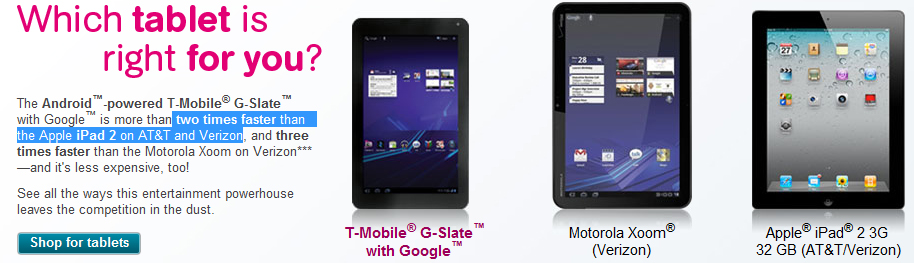
Boy Genius Reportnoticed the newly created tablet comparison page over at T-Mobile USA’s web site that compares Apple’s iPad 2 against Motorola’s Xoom and LG’s G-Slate. The carrier blatantly slams both Motorola’s device and especially Apple’s gizmo while praising G-Slate:
The Android-powered T-Mobile G-Slate with Google is more than two times faster than the Apple iPad 2 on AT&T and Verizon, and three times faster than the Motorola Xoom on Verizon – and it’s less expensive, too! See all the ways this entertainment powerhouse leaves the competition in the dust.
True, they were comparing iPad 2’s network speed rather than CPU performance. Still, here’s a wireless company which gets away marketing their third-generation 3G HSPA+ network as being 4G-capable, telling its customers the most popular tablet in the world is no good. Could it be the carrier is simply jealous for it doesn’t carry iPad 2? The only two tablets they currently have on offer? Dell’s seven-inch Streak and the aforementioned G-Slate.
Way to go, T-Mobile, you’ve just diminished your chances of landing that iPhone distribution deal. If AT&T’s 3.6 million and Verizon’s 2.3 million iPhone activations in the June quarter are anything to go by, T-Mobile USA is clearly missing out on the opportunity to cash in on the popularity of Apple’s mobile gadgets. On the other hand, T-Mobile does host (unofficially, of course) a million iPhone users on their network and they now offer Micro SIM cards to GSM iPhone 4 users.
British monthly Tomorrow’s Technology Today, better known as T3, which specializes in gadgets, gizmos and other technology, is out today with its shortlist of technology products, brands and personalities for 2011. T3 Gadget Awards, one of the biggest tech awards in the UK informally recognized as the “technology Oscars”, already has over 350,000 user votes.
A strong Apple showing is evident, with some interesting Apple vs. Google battles shaping up. The Cupertino, California-based consumer electronics powerhouse has fifteen nominations, only trumped by eighteen nods for Google and its Android operating system. Samsung comes in third with eight spots on the shortlist, while Sony picks up six.
Kieran Alger, editor of T3.com, comments for 9to5Mac:
Despite a harder year than they’re used to Apple’s success continues with a strong showing across a number of categories. For one brand to secure 15 nominations out of 126 in the finals of the T3 Gadget Awards 2011 is no mean feat and testament to the continuing competitiveness of Apple’s latest products.
Apple’s iPad 2 and iPhone 4 face off Amazon’s Kindle and Samsung’s seven-inch Galaxy Tab for the Commuter Gadget of the Year award. With its commanding market share lead, iPad 2 is also battling Motorola’s Xoom, Samsung’s Galaxy Tab, Asus’s Eee Pad Transformer and LG’s Optimus Pad in the Tablet of the Year category. The gizmo is also challenging the dominance of Sony’s PlayStation 3 and Nintendo’s 3DS consoles, as well as Microsoft’s Kinect Sony’s PlayStation Move motion controllers in the Gaming Gadget of the Year category.
In all, iPad 2 is up for six gongs total, including overall Gadget of the Year. There is plenty of time to vote up your favorites at the official website – the winners will be announced at the star-studded awards ceremony at Old Billingsgate, London on Monday, October 10. The full list of entrants and award categories is right past the break.
9to5Mac yesterday briefly touched on the subject of installing Lion by noting that you’ll need at least 17 gigabytes of free space: Four gigabyte for the Lion installer itself and at least 13GB available on your hard drive after formatting for the Lion operating system. This is the minimum, per Apple’s knowledge base article, for Lion and an Internet Restore partition. But some users are reporting being unable to install the operating disk even though their hard drive has plenty of free space available. For them, the Lion installer grays out the disk and labels it with the “This disk cannot be used to start up your computer” message.
The extreme solution entails backing up and reformatting the target disk before installing Lion. Luckily, Apple explains in a support document, you can try resizing the partition which you wish to install OS X Lion on. This is done by selecting a desired disk partition in Disk Utility and dragging the resize corner to make the partition slightly smaller, Apple explains:
The partition only needs to be approximately 128MB smaller than it was before resizing.
When the partition resizing is complete, simply proceed with Lion installation. You can resize the partition back to its original size when you install Lion, Apple explains. The company does not provide an explanation for the issue…
You’d first fill up your iPhone with credits using the device information pane in iTunes…
When buying an iPhone app from App Store or a song via iTunes Music Store, a network connection is required – not only to deliver purchases, but also to process payments using your credit card on file or iTunes Store credits. That could change in the not-so-distant future as Apple lays out in excruciating detail a system allowing for on-device offline purchases of digital warez. Ruling out real-time credit card transactions for obvious reasons, Apple proposes storing iTunes credits (currently obtainable as iTunes Gift Cards) on the device itself. This, in turn, will be your primary mean of payment while offline. Your device would sync settled offline purchases made offline with a remote payment processing entity (iTunes Store) when you are back online to ensure your account balance is up-to-date:
This is directed to providing offline purchasing of media items using an electronic device. One or more media items that are not part of a user’s media library can be stored on an electronic device. When a user later wishes to play back one of the media items, but the device cannot connect to a communications network to provide payment information for purchasing the media items, the electronic device can use pre-paid credits that were purchased and stored by the device when a communications network was available to complete the purchase. By using pre-paid credits, the media store can be assured that the user has sufficient funds for the media item purchase.
There’s only one problem with this invention, credited to engineer Taido Nakajima – you’d still need a network connection in order to download stuff bought offline. Don’t worry, Apple thought of that, too… Expand Expanding Close
A pair of patent applications from Apple that surfaced this morning in the United States Patent & Trademark Office’s (USPTO) database prove Apple’s been researching 3D displays for mobile devices and personal computers. As always, Apple’s solution is one with a twist. The company is calling for a device with two displays, one on the front and the other on the back, which can be interacted with in order to enhance the e-reading experience on mobile devices, automatically turning on and off as you flip the device around. The twist?
Apple’s been thinking of using a transparent OLED display. The pixels of the OLED panels “may remain transparent”, Apple writes, when an OLED panel is in use. What’s more, the two panels “may be separated by one or more distances or may have varying thicknesses” in order to create the believable perception of depth, without requiring the use of stereoscopic 3D glasses. This could be used in desktop computers as well and separate graphics processors could also adjust the brightness of the front panel and reduce the brightness of the other panels in order to emphasize the foremost user interface elements. Apple writes:
Generally, one embodiment may take the form of a multilayer display device, where each layer is made of a separate element. Each display element may be referred to herein as a “layer” or a “panel,” although any given display element may take any form and may be constructed from any of a variety of materials. For example, a panel may be a relatively thin sheet of organic light-emitting diode (OLED) material, in some embodiments transparent, or a more conventional liquid crystal display with or without backlighting (such as CCFL or light-emitting diode (LED) backlighting), a LED display, e-ink, and so forth.
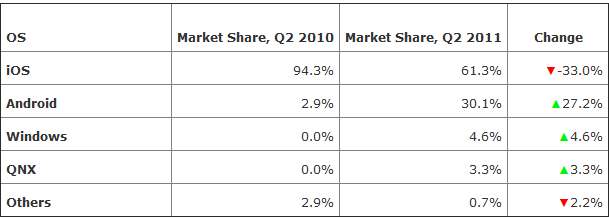
Research firm Strategy Analytics discovers that shipments of Android-driven tablets are finally beginning to make a meaningful impact on the overall tablet market. Yes, Android slates are making their presence known, even though iPad is still king of the hill. According to the research firm’s survey, June quarter tablet shipments topped 15.1 million units, a material increase over the 3.5 million units from the year-ago period. Apple seized the #1 slot with 9.25 million iPads the company reported for the June quarter, representing a 61.3 percent share of the tablet market overall.
At the same time, Android tablets have gone from 2.9 percent market share in June 2010 to 30.1 percent in June 2011, a surprising 27.2 percentage points increase based on sales of 4.55 million units. In the year-ago quarter Apple enjoyed a 94 percent share, so iPad’s 33 percentage points drop is substantial no matter how you look at it. GSM Arenaobserves that “in terms of market share, the iOS lead in the past quarter is nearly three times smaller than it was in the same period of last year”. Granted, the change in market dynamics isn’t surprising at all…
MacRumorspoints at a Financial Times report (subscription required) asserting that Apple has now officially surpassed Nokia to become the #1 smartphone maker globally. IDC Worldwide Mobile Phone Tracker had Nokia ship 24.2 million smartphones versus 18.7 million iPhones. A quarter later, however, iPhone sales have gone through the roof while sales of Nokia smartphones fell down the cliff as the world’s once leading mobile phone maker fights to regain influence. The financial paper explains:
Shipments of Nokia smartphones declined by 34 per cent to 16.7m units, compared with the 20.3m iPhones shipped by Apple in its second quarter. Apple was already the biggest smartphone maker by revenue and profits, but the April-June period marked the first time it had surpassed Nokia in volume.
Apple,which just four years ago wasn’t even on the radar, managed to become the world’s #1 smartphone maker with a year old handset, a limited footprint and with just one high-end handset model refreshed once a year. The news must be tremendously humiliating for the people at Nokia who are holding on to their burning platform. Remember how cocky Nokia executives used to laugh off the iPhone and boast in public how Nokia sells a quarter’s worth of iPhones in a week? Apple’s feat isn’t entirely surprising given a Nomura analysis from earlier this month that predicted Apple topping Nokia’s volume by the end of June.
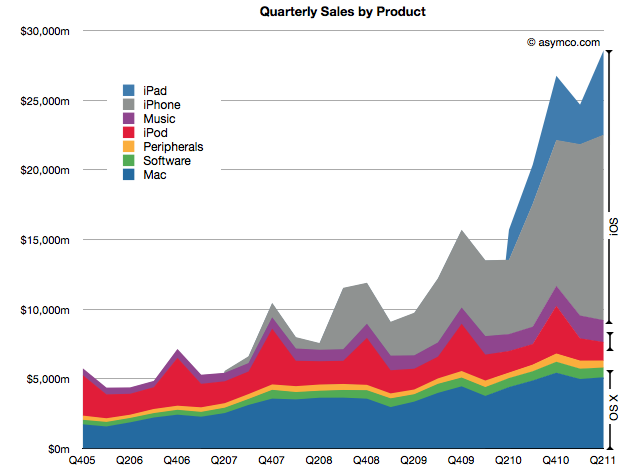
Also of note is how Nokia’s market share in Australia fell spectacularly, from almost 50 percent in the first quarter to less than 25 percent as iPhone became the king of the hill in the country, per IDC. Android devices collectively outsell iPhones due to broader distribution and a wider range of sizes, models and price points, but no single Android vendor has been able to touch Apple in terms of volume. Apple is already the world’s biggest phone vendor by revenues and profit, controlling as much as half the total mobile phone industry’s income. Today, the iPhone is the main driving force behind Apple’s seemingly unstoppable growth, as seen in the below chart, courtesy ofAsymco.
AT&T this morning posted their fiscal 2011 second quarter results (calendar 2011 June quarter). Consolidated revenues were up 2.2 percent to $31.5 billion. The carrier activated 3.6 million iPhones during the June quarter, representing more than half of the smartphones sold. More than one quarter of iPhone activations came from new users, the carrier said. The figure matches the 3.6 million iPhone activations from the March quarter, with 23 percent of them from new users. AT&T’s flat growth in iPhone activations suggests that most of the growth in Apple’s June quarter iPhone sales came from China and new carriers deals.
Quite possibly, the biggest driver was Verizon Wireless, which is set to report its quarterly earnings before the stock market opens Friday. The earnings will be watched closely for performance metrics because it will be the first full quarter of iPhone sales for the big red carrier. Apple on Tuesday reported selling a record 20.3 million iPhones worldwide in the June quarter. The California-based gadget maker ended the quarter with about 5.9 million iPhones in channel inventory. International sales from the more than 40 million gadgets and computers Apple shipped accounted for 62 percent of the quarter’s revenue. Go past the fold for more highlights and the full AT&T earnings release.
Update: Adobe has retracted their claim (via MacRumors) that OS X Lion disables Flash Player hardware acceleration. Great news:
The final release of Mac OS X Lion (10.7) provides the same support for Flash hardware video acceleration as Mac OS X Snow Leopard (10.6). The previous “Known Issue” described in a tech note suggesting that video hardware acceleration was disabled in Lion was incorrect and based on tests with a pre-release version of Mac OS X Lion that related to only one particular Mac GPU configuration.
In addition to the goodies Lion brings to your everyday computing, some unwanted side-effects surface with Adobe writing in a knowledge base article yesterday (viaTUAW) that the operating system disables hardware acceleration while exhibiting other issues with their Mac apps:
Flash Player may cause higher CPU activity when playing a YouTube video possibly related to disabled hardware acceleration. Custom native mouse cursors are not animating properly on Mac 10.7. The Flash Player settings dialog does not respond to mouse clicks. If you find yourself in this state, you can use the “tab” key to change the focus to the “Close” button and use the spacebar to close the dialog. While not all settings are available, you can also use the Flash Player native control panel located in System Preferences.
Other affected Adobe products include Fireworks, Illustrator, Acrobat, Lightroom, Photoshop and Premiere Pro. On a brighter note, Adobe promised to “investigate” which of the Lion-specific features will see support in their Mac programs, such as Restore, Autosave, Versioning, Full Screen Mode and new multitouch gestures. Adobe on Tuesday released Photoshop Elements on Mac App Store for $80, a modest saving over the $99 for boxed version. The release marked Adobe’s first offering on Apple’s online-only store for Mac apps.
Making good on Steve Jobs’ promise to get rid of legacy technologies in Apple’s products, Lion installation does not include Java runtime nor Flash Player, both of which users are required to install manually. Earlier this month Adobe released beta versions of Flash Player 11 and its run-time environment, AIR 3. In what could only be described as a step towards a file system-agnostic environment akin to iOS, Lion also hides the Library folder from view to reduce the chances of tech illiterate users accidentally deleting application support files.
It seems the refreshed MacBook Air that came to light yesterday is bound to become another smash hit for Apple. According to trade publication DigiTimes, shipments of the latest MacBook Air from the supply chain already topped half a million units in June, the volume expected “to remain strong throughout July and August”. If shipments remain at this level, Apple could ship at least a million and half units of the third-generation MacBook Air during the September quarter:
The sources estimated that Apple’s MacBook series sales will reach 13-14 million units in 2011 and may even reach 15 million units, while adding that Apple is the only vendor that has provided a full shipments forecast to the first quarter of 2012 as the IT industry is being rather conservative about the overall demand in the second half of 2011.
In its latest quarterly filing Apple reported shipments of 3.95 million Macs, a fourteen percent annual increase, which is slightly below Wall Street estimates of four million units as consumers put off their planned purchases anxiously awaiting the new models. Even though Apple didn’t make it the world’s top 5 list of PC vendors, in the US the company climbed from the fifth spot overtaking Toshiba and Acer to become the nation’s #3 computer vendor. Apple also outpaced the average industry growth by a factor of four, according to preliminary figures from both IDC and Gartner.
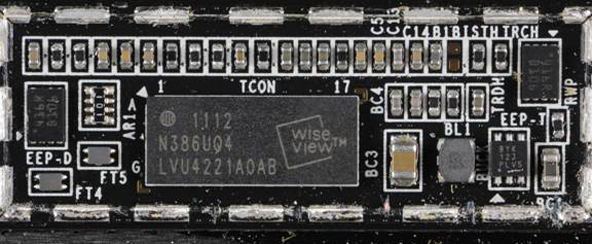
Recently manufactured iPad 2 units have this Wise-View controller, a Samsung technology. Previous iPad 2s had an LG chip. Photo: Chipworks
For all the talk about Apple reducing its reliance on frenemy Samsung and getting its chips and gadget parts elsewhere, iFixIt reports that silicon experts Chipworks have found out that newer versions of iPad 2 incorporate a new display driver from Samsung whereas iPad 2 units manufactured up to March 2011 used display driver labeled as SW0627B, “an LG display driver that dates back to the original iPad”. As for the new chip labeled as SW0627B, used in the original iPad and newer iPad 2s:
Chipworks’ latest batch of iPad 2s, however, seem to be using a new Wise-View chip. Little to no information can be found about the chip at this time, except that it appears to be a technology developed by Samsung. Sadly there’s no information on Samsung Semiconductor’s site regarding this display driver product line.
Despite lack of information, the Wise-View chip can be yours on Taobao for 24 Yaun a piece, or some $3.7. iFixIt speculates that Apple changing display driver suppliers may be “foreshadowing the release of an updated iPad with a higher-res screen”, providing no substantiation to support the theory, though. If you ask us, it’s just Apple at its best, covering all bases and making sure it doesn’t rely too heavily on a sole supplier.
Remember yesterday we told you about a new Lion ability to re-install itself over the Internet? Why would it come in handy? Well, as you know Apple distributes Lion exclusively as a Mac App Store download and the new MacBook Airs and Mac minis no longer ship with the USB stick pre-loaded with the OS installer. Apple is now offering the Lion installer on a 8GB USB key for $70, but most folks likely won’t bother with it. If you need to install Lion on another Mac, you can always re-download your purchased copy off Mac App Store free, but what if your hard drive has some issues?
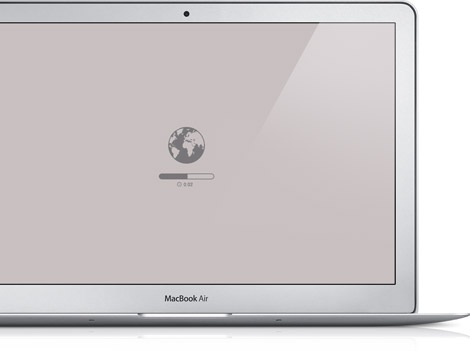
Enter Lion Recovery, a new mode invoked upon holding down Command-R during startup. After a few moments, you will see a desktop with a Mac OS X menu bar and a “Mac OS X Utilities” application window. From there, Apple explains on the Lion Recovery page, you can restore your Mac from a Time Machine backup, run Disk Utility to check, repair or erase your hard drive and run Safari to get help from Apple Support online. All those capabilities are provided regardless of the state of your OS X Lion installation because Lion Recovery resides on a hidden partition as a separate software entity. But what happens when your hard drive completely fails, forcing you to replace it with a blank volume that has no recovery partition? Apple has thought about that, per this knowledge base document:
If your Mac problem is a little less common — your hard drive has failed or you’ve installed a hard drive without OS X, for example — Internet Recovery takes over automatically. It downloads and starts Lion Recovery directly from Apple servers over a broadband Internet connection. And your Mac has access to the same Lion Recovery features online. Internet Recovery is built into every newly-released Mac starting with the Mac mini and MacBook Air.
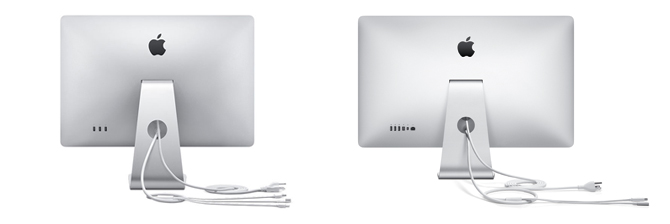
The old Cinema Display (left) had three USB ports on the back and required a cable with separate power, USB and Mini DisplayPort connections. The new Thunderbolt display (right) adds Gigabit Ethernet, FireWire 800 and Thunderbolt, all fed to a computer via a single Thunderbolt cable (in addition to three USB ports, built-in microphone and FaceTime HD camera).
We take it you’re still digesting the new hardware Apple has released this morning. Before you grab that credit card, here are some observations you may wanna take into consideration.
MacBook Airs
• Built-in FaceTime camera has not been upgraded to high-definition. As a result, you are not able to FaceTime in HD with people who use the latest iMacs or MacBook Pros, which sport a FaceTime HD camera
•Based on the description from Apple “And because we place the flash chips directly on the logic board, they take up much less space — about 90 percent less, in fact.” , it sounds like the SSD is probably no longer upgradable via OWC and others (thanks commenter)
• Just as previous, RAM is soldered directly on the motherboard so configure your machine carefully because you won’t be able to upgrade RAM yourself later
• Just like with the previous generation, the 11.6-incher lacks an SD card slot found on the 13-inch model
• Last year’s models got a significant discount today
• New Airs sport Bluetooth 4.0 compatibility versus Bluetooth 3.0 in the previous generation, which gives you low-energy wireless Bluetooth transfer within a short range of up to 50 meters, per this Wikipedia article
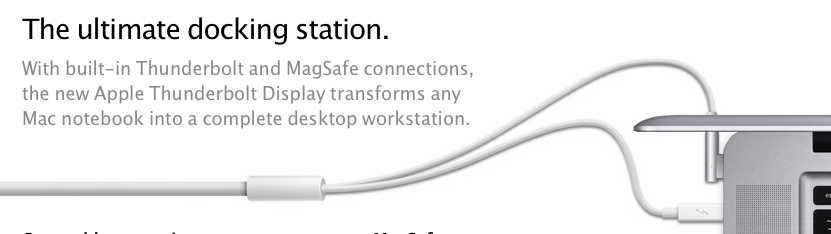
• New MacBook Airs can use Firewire and Gig Ethernet! If you hook up your new MacBook Air to that latest Apple Thunderbolt Display, you will enjoy the ultimate simplicity because a single Thunderbolt cable is all you need to charge your notebook and transfer data from your monitor’s Gigabit Ethernet, FireWire 800, an additional Thunderbolt port, three USB ports, a FaceTime HD camera, 2.1 stereo sound and a built-in microphone. Perhaps Apple will release a Thunderbolt to GigE, Firewire, etc. standalone adapter.
• On the Thunderbolt Displays, the old MagSafe would have been a better match, because the new one has to be bent around (see the image below) for MacBook Pros
• Additionally, On MacBook Airs, the Thunderbolt port and MagSafe are on opposite sides of the keyboard meaning that cable is going to Y-Out behind the computer.
The new Thunderbolt Display comes with a new MagSafe adapter, which has to be bent around the computer rather than going straight on, like the old MafSafe adapter could have
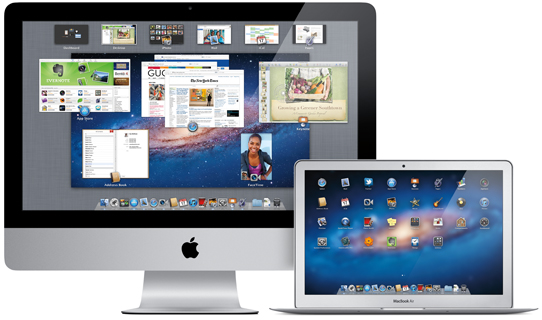
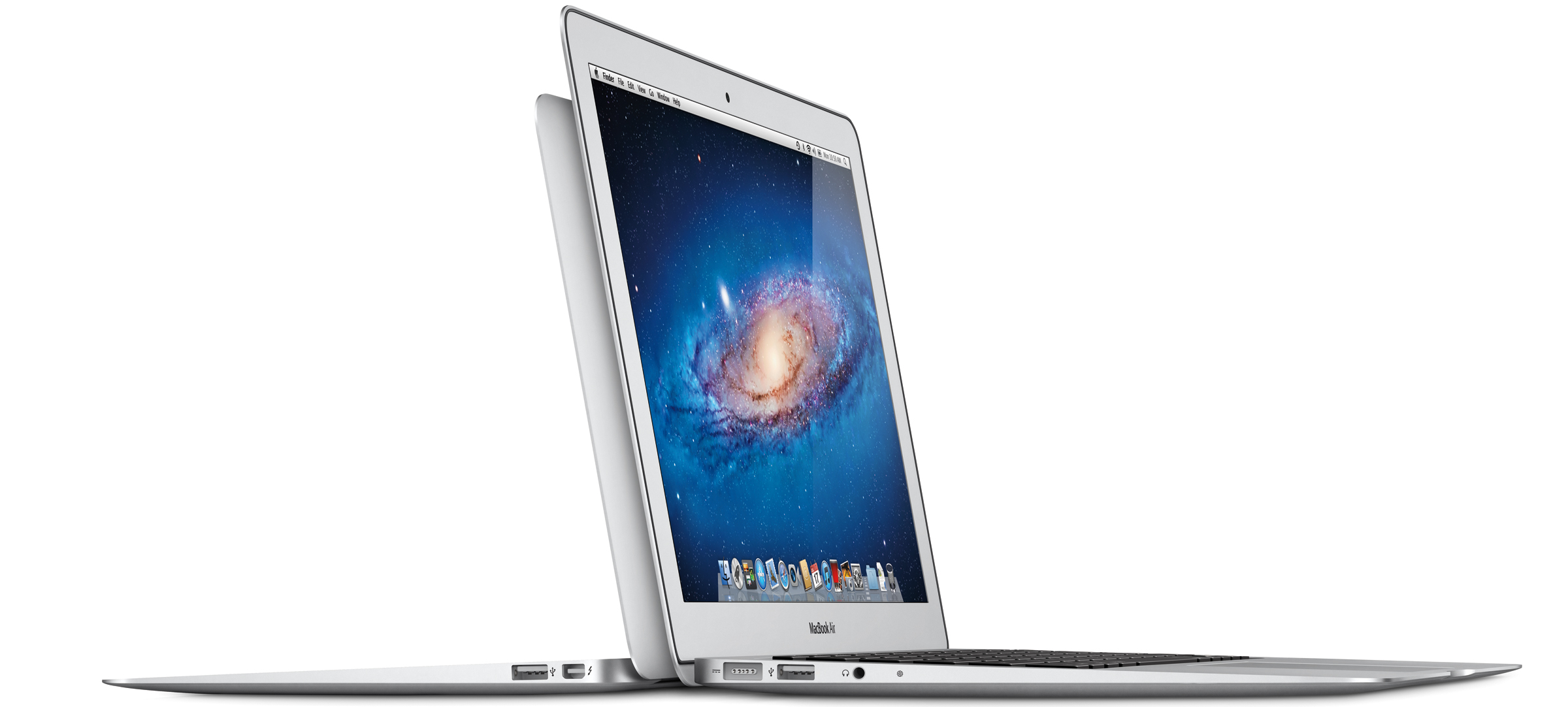
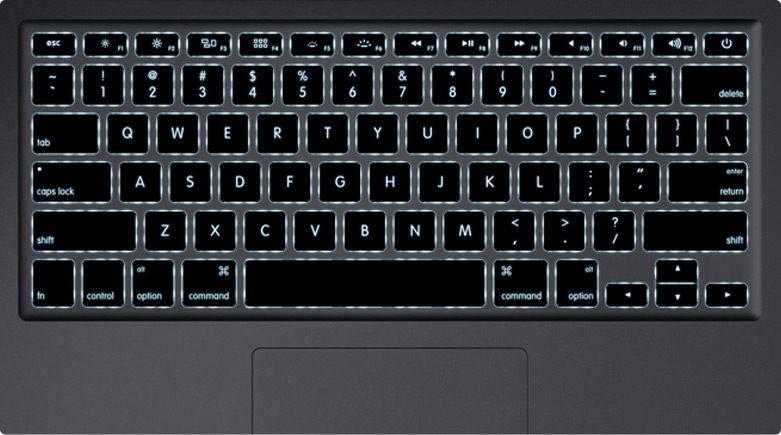
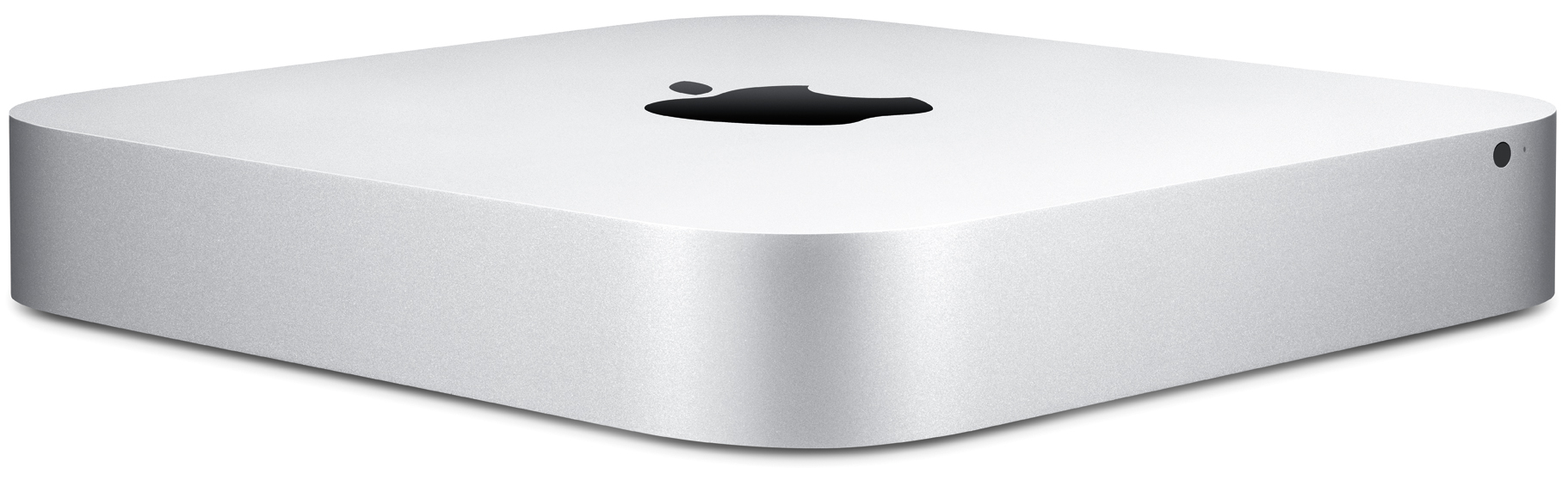
Apple Store has been down since late yesterday and a lot of folks have been keeping their credit cards ready for new products. Well, Apple has just upgraded Mac minis and MacBook Airs featuring the latest Sandy Bridge processors and Intel’s speedy Thunderbolt I/O technology. As a bonus, Cinema Displays have been refreshed with Thunderbolt technology as well. In line with 9to5Mac’sreport, the new MacBook Air family finally features backlit keyboard. Just like before, the new MacBook Airs come in 11.6-inch and 13-inch flavors, each is available in baseline, more powerful and build-to-order flavors.
The base line 11.6-incher includes a 1.6 GHz processor, 2GB RAM and 64GB of flash storage and the pricier model doubles RAM and storage. Note: Because the memory is soldered onto the motherboard, you must decide on RAM at purchase time. The same goes for storage, configurable only at the online Apple Store. The entry-level 13-incher sports a 1.7 GHz processor, 4GB RAM and 128GB of flash storage while the more expensive 13-inch MacBook Air doubles the storage to 256GB. Build-to-order options for both 11.6-inch and 13-inch models include a 1.8 GHz chip, 4GB RAM and 256 GB of flash storage for 13-inchers. Note that a 1.8 GHz processor and 256GB flash storage upgrades are the firsts for the 11.6-incher. All models run on Intel’s HD Graphics 3000 processor with either 256MB (11.6-inch machines) or 384MB (13-inchers) of DDR3 SDRAM shared with main memory. Another thing worth mention: The built-in FaceTime camera has not been upgraded to high-definition. Go past the break for information about the new Mac minis and nice press shots.
We’re getting word from numerous Apple Stores that the Lion transition has begun. In this photo taken at the 14th St. Apple Store in NYC by a passerby, you can see Apple employees updating Macs as well as some heavy hardware in the foreground. Those are reportedly the new signage packages.
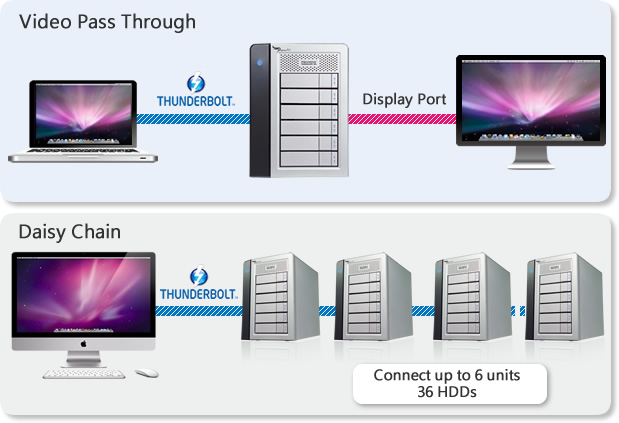
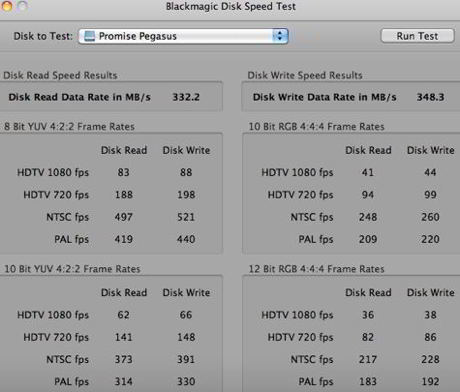
ZDNet has benchmarked the latest Thunderbolt-equipped iMac with a Promise Pegasus RAID with Thunderbolt and came away pretty impressed. Because out-of-the-box Thunderbolt RAID experience on new iMacs leaves a lot to be desired due to constrained RAM, author Robin Harris set himself up with a 16GB iMac. This isn’t a common scenario for average consumers, of course, but heavy-duty apps like Final Cut Pro benefit from as much memory as possible.
Harris used Blackmagic’s Disk Speed Test to pit a quad-core 2.66 GHz Mac Pro equipped with a 300GB 10k Velociraptor drive, 1GB ATI Radeon 5770 graphics card and 12GB RAM against a built-to-order 3.4 GHz Core i7 iMac with a 1TB hard drive, the standard 1 GB AMD Radeon HD 6970M video card and 16GB RAM. Both computers were benchmarked against a 4-drive Promise Pegasus Thunderbolt RAID that had both an empty array and more than a third full. The RAID performed pretty nice in both configurations…
Italian site Macitynet.it (viaMacRumors) snapped nice shots depicting in-store Lion materials and signage in third-party retail stores, indicating the official launch could be due in hours, not days. Both small table-top signage and tall free-standing banners captured on these shots showcase Lion’s focus on multitouch gestures. MacRumors discovered standard App Store gift cards redeemable against OS X Lion purchases in at least one store of Dutch retail chain Dixons, depicted in a promo material above:
Gift cards not only allow customers to effectively purchase OS X Lion for others, but also provide those without a credit card with a means to purchase content from the Mac App Store and Apple’s other digital stores.