iOS devices refer to any of Apple’s hardware that runs the iOS mobile operating system which include iPhones, iPads, and iPods. Historically, Apple releases a new iOS version once a year, the current version is iOS 10. Here is the complete list of iOS 10 compatible devices.
App Store developer FutureTap just revealed that they have received their first crash report from an iOS 5 device. This means that Apple is currently field-testing their next-generation mobile operating system that runs on the iPhone, iPad, and iPod touch with applications from the iOS App Store. The application apparently crashed in iOS 5 due to the MKUserLocationBreadCrumb. Developer Will Strafach (Chronic) let us know that this API relates to the iOS maps and location functionality.
Just received the first iOS 5.0 crash report. MKUserLocationBreadCrumb sounds interesting.
This could possibly mean that Apple changed up some map and location APIs in iOS 5, causing issues with map-based applications built for current versions of iOS 4. iOS 5 is expected to take on some new cloud-based features and will be officially unveiled at Apple’s World Wide Developers Conference in early June. Apple is expected to release iOS 5 in September alongside the fifth-generation iPhone. Thanks, Peter Silie!
Update: FutureTap sent us the below screenshot of their iOS 5 hits. Their WhereTo application has seen five iOS 5.0 and four of the hits come from AT&T HQ. This means that both Apple and their largest carrier are actively testing the new operating system before its early June preview. The AT&T-based device(s) is the iPhone 4 (iPhone 3,1) and the hit from Apple HQ comes from a first-generation iPad. We don’t learn much, but at least we now know that iOS 5 will seemingly not require the dual-core A5 processor in the next iPhone and iPad 2.
The headline won’t shock anyone following the mobile space, although there’s more to it than meets the eye. A Distimo survey, relayed by TechCrunch, shows the Android application store rocks more free programs than Apple’s App Store. Utrecht, Netherlands-based Distimo counted 134,342 free items on Android Market versus 121,845 freebies on the App Store.
Even though Apple’s store was the slowest growing mobile bazaar in March 2011, it still leads in terms of quantity and remains the most vibrant app community on the planet. The number of App Store items is approaching the 400,000 milestone (Distimo counted 367,334 apps). At current 16 percent growth rate, however, Android Market will overtake Apple’s store in app volume five months from now.
Also interesting: iPad submissions grew 12 percent in March to 75,755 apps, with an average daily revenue nearing a cool $400,000. As any iPad owner knows, a larger canvas commands premium prices ($5.36 on average for an iPad app). Another tidbit: Distimo expects BlackBerry App World to overtake Nokia’s Ovi Store by the end of next month. Some insight and more pretty charts after the break.
Did you ever wonder why it took Apple ten months to produce the white iPhone 4, which finally goes on sale tomorrow? According to The Wall Street Journal’sMobilized blog, white iPhones need UV protection. Author Ina Fried interviewed both Apple’s boss Steve Jobs and marketing honcho Phil Schiller. The latter said:
It was challenging. It’s not as simple as making something white. There’s a lot more that goes into both the material science of it–how it holds up over time…but also in how it all works with the sensors.
And here’s from Jobs:
We obviously think about this in a generic way because you have a white iPad.
Jobs also confirmed that an upcoming iOS update will address that location tracking issue that Apple earlier today characterized as a “bug” and confirmed Apple will next week testify in a Congress hearing about location-gathering practices.
The $39B dollar deal isn’t over yet and T-Mobile isn’t ready to drop its guns and surrender. Today they issued a challenge to iPhone owners (Read: Verizon and AT&T) in the Seattle area to prove that their network was faster than T-Mobile’s. They’ll give any iPhone owner $1000 if their download speed is faster.
Now obviously this has little to nothing to do with the iPhone vs. Galaxy and more to do with T-Mobile’s “4G” vs. AT&T and Verizon’s 3G which it appears is marginally better as John Patchakosfihskgweo points out in data from Rootspeed Metrics, below:
Apple engineers went to great lengths to conceal the innards of the iPhone 4 with an elegant glass case that looks like a cool black monolith, but now teardown wizards over at iFixit have tweaked that design in order to expose the guts of the handset to the world. Think circuit boards, the large battery and everything else one normally doesn’t see. iFixIt’s solution rocks camera lens, the flash diffuser and bezel to ensure proper operation of the back camera and pristine appearance of your phone. Read on… Expand Expanding Close
The blogosphere is abuzz this morning with Apple’s official response to the Locationgate scandal. While the company’s powerful PR machinery is in full swing trying to dodge the bullet, we have pinpointed a rather interesting line in Apple’s document entitled “Q&A on Location Data”. Before we dive into that – and for those who didn’t get the memo – Apple has confirmed a database residing on the device that contains anonymized data generated by tens of millions of iPhones sending the geo-tagged locations of nearby WiFi hotspots and cell towers.
They use it to “help your iPhone rapidly and accurately calculate its location when requested”. Storing a year’s worth of data was a “bug” that will be fixed with a forthcoming iOS update. “We don’t think the iPhone needs to store more than seven days of this data,” the company wrote. But Apple may be planning to use this crowd-sourced information to release a new traffic service in the future, quite possibly a turn-by-turn traffic service. Apple itself alluded to this in the document:
Apple is now collecting anonymous traffic data to build a crowd-sourced traffic database with the goal of providing iPhone users an improved traffic service in the next couple of years.
Apple has finally gone on the record regarding the ongoing story about iOS location tracking by putting out a press release this morning. The document entitled “Q&A on Location Data” begins by saying that “Apple would like to respond to the questions we have recently received about the gathering and use of location information by our devices.” It immediately flatly denies allegations of deliberate location tracking for unknown purposes. “Apple is not tracking the location of your iPhone. Apple has never done so and has no plans to ever do so”, it reads:
The iPhone is not logging your location. Rather, it’s maintaining a database of Wi-Fi hotspots and cell towers around your current location, some of which may be located more than one hundred miles away from your iPhone, to help your iPhone rapidly and accurately calculate its location when requested. These calculations are performed live on the iPhone using a crowd-sourced database of Wi-Fi hotspot and cell tower data that is generated by tens of millions of iPhones sending the geo-tagged locations of nearby Wi-Fi hotspots and cell towers in an anonymous and encrypted form to Apple.
This line especially caught my attention as it indicates a new geolocation-based service from Apple:
Apple is now collecting anonymous traffic data to build a crowd-sourced traffic database with the goal of providing iPhone users an improved traffic service in the next couple of years.
Gawker on Monday discovered an Apple patent that hints at plans to collect location history from users, although it doesn’t seem to be related to this issue. A bunch of independent experts were able to prove that the location data file is simply left sitting in an iPhone backup file on your computer and your device without ever being beamed up to the Apple cloud. The statement goes on to detail why Apple has been tracking your geographical location, what they’ve been doing with this data and how they plan on tackling the PR scandal dubbed Locationgate which ensued following the discovery of this issue.
They conclude by promising an iOS firmware update, due “sometime in the next few weeks”, that will encrypt the location data file on your device. Apple confirmed that said iOS update will “reduce the size of the crowd-sourced Wi-Fi hotspot and cell tower database cached on the iPhone, ceases backing up this cache, and deletes this cache entirely when Location Services is turned off”.
By the way, Microsoft has also come out with its own Q&A on location tracking in Windows Phone 7. The Windows maker confirmed it stores location data in a database, but only when users approve app requests for location retrieval.
Read Apple’s statement in its entirety right below the fold…
Apple today confirmed that iPad 2 will launch in thirteen more countries in the coming days and weeks. China will get WiFi iPad 2 beginning Friday, May 6. The device will go on sale in Japan on Thursday, April 28, 2011 and in eleven additional countries on Friday, April 29, 2011: Hong Kong, India, Israel, Korea, Macau, Malaysia, Philippines, Singapore, South Africa, Turkey and UAE.
iPad 2 will be available at Apple retail stores at 9am local time, Apple said, in addition to select Apple Authorized Resellers. Online sales via the online Apple Store will begin at 1am. Further international availability will be announced at a later date, Apple said. Suggested retail prices in the additional thirteen countries are the same as US price points for WiFi and 3G iPad 2 variants.
Reports are coming in that both iPad 2 and white iPhone 4 will launch in Japan tomorrow, April 27. Even though Apple has yet to make an official announcement regarding the arrival of iPad 2 in Japan, the device will be available for sale beginning Thursday, according to an exclusive report by Nikkei (subscription required) and relayed by CNNGo:
That veritable font of all knowledge, the “Nikkei Shimbun” newspaper, says the shiny lust-bauble will hit Japanese stores in stealth mode, more than a month after the scheduled March 25 launch-date.
And according to a MacRumors report, white iPhone 4 will also launch the same day in Japan, based on the below image listing the April 28 date provided by their reader.
A reader sent this in. He was apparently able to make iPad-only GarageBand run on an iPhone 4 using a hack that requires a jailbroken device. It involves transferring the GarageBand application with changed metadata to an iPhone 4 via OpenSSH. “Surprisingly, it didn’t crash as much as I expected it to do”, he writes.
It obviously isn’t the perfect solution because as GarageBand for iPad isn’t formatted for a slightly lower iPhone 4 resolution but it works well enough. Check out a couple of screenies after the break.
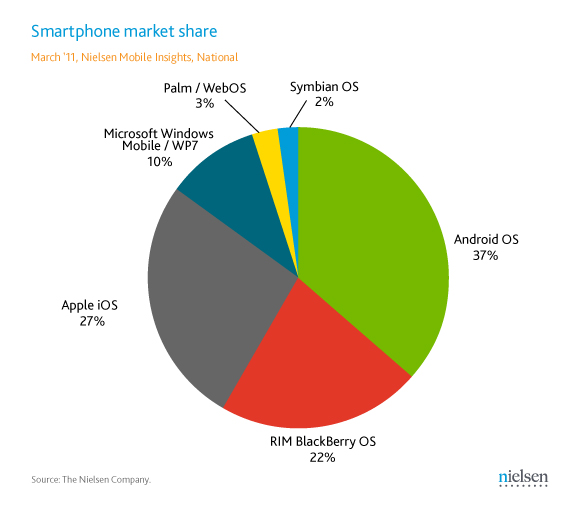
The latest survey from a respected research firm has Android as the #1 smartphone platform in the US for the month of March. Nielsen reported this morning that Android tops the charts as the country’s leading smartphone platform with a 27.9 percent market share measured by units, followed by the iOS platform which grabbed 27 percent market share. Research In Motion’s BlackBerry came in third with 22 percent of the market.
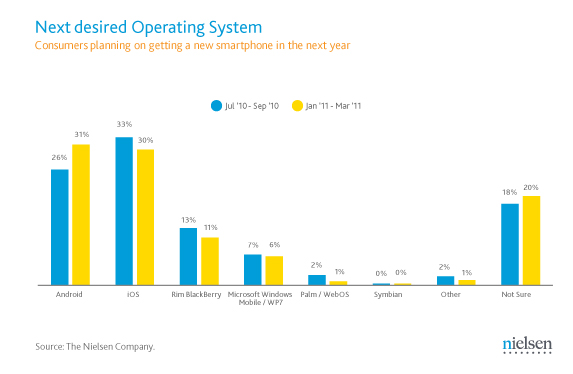
Just six months ago iOS led the pack with 27.9 percent of the smartphone market, followed by RIM (27.4 percent) and Android (22.7 percent). Some 31.1 percent respondents planned on buying an Android phone in March versus a 30 percent inclination towards iPhones. That’s also an increase for Android from a 25.5 percent preference and a drop for the iPhone from 32.7 percent, both six months ago. And now, the good news…
TweetDeck, a popular cross-platform Twitter client based on Adobe AIR technology, has received a complete overhaul to address a number of user complaints. The app’s rebuilt from the ground up and packs in a number of new features, including all major Twitter capabilities such as old and new style retweets, favorites, sending updates, direct messages and searching.
TweetDeck’s column-based dashboard is now more flexible as you can create columns consisting of multiple sources like Facebook feeds, Twitter timelines, direct messages and more. Go past the break to learn more about new features. Expand Expanding Close
The real white iPhone 4 won’t even hit the hands of consumers until Wednesday, but prototypes are still popping up all over the place. Last week, a white 64 GB prototype iPhone 4 made its way into the hands of a Vietnamese site, and now a 16 GB white prototype iPhone 4 has shown up for sale on eBay. The back features the markings of “XX” like all the other prototype iPhone 4s we’ve seen in the wild. We are really not sure how Apple could lose so many prototypes of one product. Thanks, Sonny D.
That didn’t take long… Bloomberg reports that two Tampa, Florida-based iPhone customers have sued Apple over the controversial iPhone location tracking issue. The customers claim that Apple is secretly recording the whereabouts of iPhone and iPad users. Steve Jobs is going to love this one…
The complaint cited a report last week by two computer programmers claiming that Apple’s iOS4 operating system is logging latitude-longitude coordinates along with the time a spot is visited. The programmers said Apple devices are collecting about a year’s worth of location data. Apple hasn’t commented on the matter since the April 20 report was released.
“We take issue specifically with the notion that Apple is now basically tracking people everywhere they go,” Aaron Mayer, an attorney for the plaintiffs, said today in a telephone interview. “If you are a federal marshal, you have to have a warrant to do this kind of thing, and Apple is doing it without one.”
M.I.C. Gadget posts two images of what they are calling the “iPhone 4S.” Of course this name comes from our report about game developers preparing their next-generation iPhone applications on iPhone 4s with A5 processors. We didn’t hear anything about a larger display on the “iPhone 4S” so if the above image has any legitimacy, we’re going to call it the iPhone 5.
iPhone 5’s with larger displays have long been rumored with Digitimes saying 4 inches, the WSJ says edge-to-edge, and Joshua Topolsky saying 3.7 inches. A quick glance at the photo shows the new screen to be slightly taller and slightly wider. If the image is legitimate, it appears to be closer to 3.7 inches than 4 inches. Of note, the image features a white iPhone bezel with Apple’s new proximity sensor. We think it perhaps adds legitimacy to the photo if anything. However, it is a long way from an official announcement.
Since BGR broke the news that Apple is testing, or has tested, a version of the iPhone that works on T-Mobile USA’s network, we started thinking about the future of the iPhone. Specifically, the fifth-generation product that is not too far off from public consumption. Right now, the iPhone 5 – or whatever Apple ends up calling it – does not seem to be such a big hardware upgrade. Sure there are reports that peg a gesture-based home button and 3.7 inch display (which we would love), but more reports are talking an iPhone 4 design, an A5 chip, and possibly a better camera.
What could Apple throw into the purported iPhone 5 package to make it a better device and a device that more people would buy? Right now, the general consensus is that Apple is going to use a Qualcomm chip within the iPhone 5 that can connect to both Verizon (CDMA) and AT&T (GSM) networks around the world. What about T-Mobile? Apple is obviously testing the T-Mobile iPhone (4S?) and with the technology available for Apple to create an antenna system that supports both types of GSM networks, what stops Apple from making an AT&T+T-Mobile iPhone 5? We received an unconfirmed report, from a connected individual, that Apple is actually testing a device that runs on both networks…
If jailbreaking is your thing, you’ll be delighted to learn about a simple hack that lets you run purchased iPad apps on your iPhone 4. Plus, folks waiting to free their iPhone 4 from the clutches of their carrier can sigh a collective breathe of relief as Dev-team goes live with an updated Ultrasn0w tool that supports iOS 4.3.2 carrier unlock.
Ultrasn0w 1.2.2, which does not include any new baseband support, will unlock your iPhone 4 or 3GS running the latest iOS 4.3.2 firmware, allowing you to take your device to any 3G GSM carrier. It requires a jailbroken device with 06.15.00 baseband so you’ll probably want to use a tethered jailbreak for iOS 4.3.2. Upon downloading and installing the Ultrasn0w 1.2.2 tool from Cydia, you need to reboot your device using the normal “slide to power off” prior to running the unlock (detailed guide).
But how about running iPad apps on your iPhone 4? Read on…
MacRumorsposts a purported Steve Jobs email from a reader who questions Apple’s location data stance.
Q: Steve, Could you please explain the necessity of the passive location-tracking tool embedded in my iPhone? It’s kind of unnerving knowing that my exact location is being recorded at all times. Maybe you could shed some light on this for me before I switch to a Droid. They don’t track me.
A: Oh yes they do. We don’t track anyone. The info circulating around is false. Sent from my iPhone
If this is a Jobs email, the details are vague (per usual). He seems to imply that the data that is stored in the phone isn’t used to “Track” iOS users. Apple’s public stance on the data is that it is used to build its IP location DB.
Android, it has been discovered, doesn’t keep as long of a record of users’ locations but perhaps, as Jobs implies, Google does more tracking with that data. Data mining for Advertising purposes comes to mind.
G-Form, a protective-wear company that is transitioning to iPad enclosures loves doing these stunts. In the video below, someone drops an iPad in their extreme sleeve out of an ultralight at 500 feet. The camera falls off but it looks like the iPad survives.
BGR’s T-Mobile iPhone prototype leak from earlier today is not simply an iPhone 4 packed with guts that support the T-Mobile 3G network radios, but it also carries the A5 processor from the next-generation iPhone.
The ‘N94’ prototype build (above) is the exact iPhone build that we found carries an A5 or ‘S5L8940’ processor a few months ago.
…and the iPhone 5 (N94AP), has the same S5L8940 processor as the iPad.
That makes last week’s story pretty convenient…
Remember that ‘iPhone 4S’ we told you about? That’s the prototype iPhone with an A5 processor that game developers are using to prepare their iPhone 5 apps. That sounds a lot like this phone.
The only question now is if that is a prototype ‘4S’ or ‘5’.
BGR has nabbed a bunch of photos of a purported white T-Mobile USA iPhone 4 test unit. The phone looks virtually identical to the current iPhone 4 and runs a version of iOS 4. You can tell that it’s a test unit by the several field-testing settings and applications on the device. The device is obviously a prototype unit, not a production model, and that is evidenced by the prototype markings on the back of the device. There is no information on a release time frame or if Apple is going to release this thing to customers at all, but be sure to check out all 26 photos in the gallery.
Our sources in Europe have already told us that the white iPhone 4 is launching on Wednesday, April 27, in the Netherlands at least, and now other sources are pointing to a launch on that same day in the United States. A source at Best Buy sent us the above inventory screenshot and this screenshot details the April 27th launch date for the product. That particular screenshot is for the AT&T, GSM model of the white iPhone 4, but our connects at Verizon told us there is a CDMA version coming, too. We suppose that the Verizon version is launching that same day in the United States.
Additionally, we have been told that both 16 GB and 32 GB white units have already been shipped to Best Buy locations across the United States, so those models should arrive by Monday or Tuesday ahead of the Wednesday launch. White iPhone 4s have already arrived at phone retailers in the Netherlands and at Vodafone in the UK. Most stores have about ten 16 GB units on order for launch day (screenshot after the break), but there could be more coming, and inventory numbers for the 32 GB units are unconfirmed. If the white iPhone 4 launch in Europe is any indication, there might be a shortage of 32 GB units in the U.S. That is unconfirmed, though. As soon we hear more, you’ll be first to know.
Update: MacRumors and people in the know who we have spoken to are having their doubts about this one.
This is my next drops a bombshell, claiming that the next-generation iPhone will not be a minimal departure from the iPhone 4, like others are saying, but will be a completely re-designed phone, as Engadget reported earlier this year. The iPhone 5 that the report describes is said to be a prototype in testing – we know that Apple tests many products before going to market – that features a body akin to that of the one found on the fourth-generation iPod touch. This design is said to also be “teardrop” like the late 2010 MacBook Air’s design – thicker to thinner from top to bottom.
Even more interesting is that the next-generation iPhone is said to gain a larger home button on the bottom portion of the device and… it’s gesture sensitive. This is my next points out that this could easily work hand-in-hand with some of those funky new gestures Apple is testing in iOS 4.3 with iOS App Store developers. The report also backs up a report from the Wall Street Journal, and says the screen will cover most of the device’s front and the new phone will likely lack a true bezel. Even cooler is that This is my next says Apple is exploring ways to hide the earpiece and the iPhone 4’s famous sensors behind the screen.
Speaking of screens… the report says that it’s not your everyday iPhone 3.5 inch display, but it’s 3.7 inches and the pixels are staying the same. This will cause a drop in pixel density of 13 pixels-per-inch – but this will still be above the magic Retina mark of 300 pixels per inch. The screen will likely look the same to the human eye, and developers will not need to adjust their graphics. Perhaps they will have the option in the iPhone SDK to to take full advantage of the extra screen real estate. This is my next is also saying that this all-new-phone could possibly sport some sort of wireless/inductive charging and/or NFC, but that is less confirmed – on their part – compared to the rest of the story.
Finally, This is my next closes by making it clear that the described iPhone 5 may never hit the streets, but it’s certainly being toyed with at Apple HQ: