Author

Avatar for 9to5 Staff

9to5 Staff

Survey: 89 percent iPhone users loyal, one in three Android users likely to switch to Apple

Site default logo image

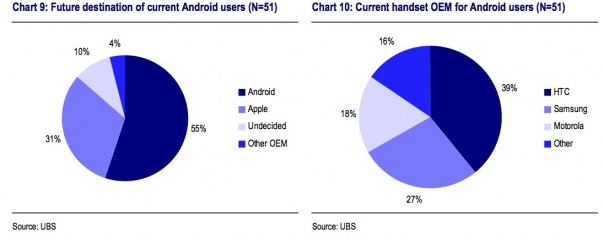
As iPad is killing it, Apple’s embattled iPhone is competing against the legions of Android handsets that have flooded the market. That shouldn’t come as a surprise: Carriers are promoting inexpensive Android devices left and right and they are literally everywhere. But how satisfied are Android and iPhone users with their handsets? According to a study of 515 smartphone owners conducted by UBS Research (via GigaOM), iPhone is “sticky” like no other phone, with an average retention rate of 89 percent.

It is falling rapidly for other vendors, though, and the next nearest hardware is HTC with a retention rate of 39 percent and 28 percent for Samsung. Android phones in general are at 55 percent. Nokia and Research in Motion are sinking really fast. The former saw its retention rate drop from 42 percent in March 2010 to just 24 percent and the latter dropped from 62 percent to 33 percent.

The survey may not be terribly accurate due to a small sample size, but it helps understand market trends. People are obviously happy with their iPhones and a large portion of users will happily stay within the Apple ecosystem. UBS concludes:

Demand for iPhone, iPad and MacBook Pro remains robust, with a leading ecosystem that creates sticky demand.

Truth be told…

Expand
Expanding
Close

Why Android isn’t catching up to iPad yet? Gartner says it’s the software, stupid

Site default logo image

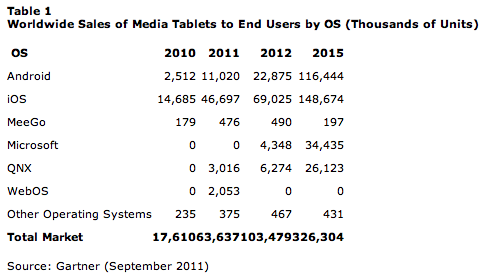
Gartner today revised their tablet numbers in the face of iPad’s dominance and weakening competition. Of the 63.6 million media tablets projected to ship this year, Gartner expects Apple’s iPad to account for nearly three-quarters of the global market, of 73.4 percent. The figure is based on an estimated 47 million iPads this year, a 9.6 percentage points drop from the 83 percent market share in 2010.

Apple is totally killing it and the company is seen retaining its 50+ percent market share lead until 2014. Why? Apple’s legendary ease of use, Gartner explains:

Apple delivers a superior and unified user experience across its hardware, software and services. Unless competitors can respond with a similar approach, challenges to Apple’s position will be minimal. Apple had the foresight to create this market and in doing that planned for it as far as component supplies such as memory and screen. This allowed Apple to bring the iPad out at a very competitive price and no compromise in experience among the different models that offer storage and connectivity options.

Wow, some nice words there – and from a research firm, too! As for Android, about eleven million Android tablets should ship in the calendar year 2011 for a 17.3 percent market share. And check out this quote on Google’s software:

Gartner has pared back its estimates for Android tablet sales in 2011 by 28% over last quarter’s projections, identifying extremely weak adoption due to high prices, user interface issues, and limited app offerings. Only some success in low-cost Asian markets and strong expectations for Amazon’s forthcoming tablet kept Gartner from slashing projected Android device sales even further.

At the same time, notebook players tell DIGITIMES, an Asian trade publication, they aren’t being so sure that Google’s upcoming Ice Cream Sandwich software will move the needle for Android tablets. Of course, as with any research – take this one with a grain of salt.

You may recall that Strategy Analytics measured Android’s share of the tablet market at nearly one-third back in July. A lot has happened since, including the downfall of HP’s TouchPad and lackluster sales of Research In Motion’s PlayBook tablet which shipped only 200,000 units in the last quarter. We’re also hearing that the seven-inch Android tablet from Amazon will have a hard time selling in the millions, per latest checks from Asia. One note about the MeeGo numbers…


Besides iOS and Android, no other platform in Gartner’s table has more than five percent share of the tablet market in 2011.


Expand
Expanding
Close

In France, publishers seek to break Apple’s rigid terms and 30 percent cut

Site default logo image

As apps become more lucrative than music, no wonder iTunes is projected to rake in a cool $6 billion in the combined 2011 music and app revenues. Be that as it may, Apple’s content store has seen little success in digital publishing due to a conflict of interests which is causing significant friction between Apple and publishers. In fact, Apple is under heightened pressure to loosen up its tight control over digital newspapers and magazines on iPad. Reuters reports:

Apple’s tight control over media content on its iPad is about to fall foul of some of France’s most powerful newspapers and magazines, which hope that by teaming up they can stop the technology giant from dictating the terms of their distribution. The bid by eight publications, including newspaper Le Figaro and sports daily L’Equipe, is the latest sign of growing disillusionment among some global publishers over what they consider Apple’s rigid terms and high commission of 30 percent.

Without “key concessions”, these publishers will not sell their digital magazines and newspapers on the Newsstand, Apple’s upcoming digital kiosk launching soon with iOS 5. Moreover, the French publications have a digital newsstand of their own which they will use to push digital editions, subscriptions and bundled offers to iPad owners. This comment from Le Figaro executive Pascale Pouquet caught our attention:

We’ll have to be ready to accept to lose some sales if we cannot come to terms with Apple,” he said. “But sometimes it’s better to cut off a finger than to sever the whole arm.

So publishers would rather “lose some sales” than make some money on iTunes? That’s a weird strategy. Print people should know better and remember that Apple generally does not budge to pressure. Pouquet’s school of thought brings to mind the following Steve Jobs comment on monetizing news made at last year’s D8 conference at Rancho Palos Verdes, California:

I can tell you as one of the largest sellers of content on the internet to date – price it aggressively and go for volume.

Granter, the uniform, low price approach did work in music, but it’s not striking chord with print die-hards, most of whom are stuck in the old ways. In any case, a growing disconnect between the print folks and Apple will test the company’s practice to impose its thirty percent cut on all items its content partners sell in iTunes. Now, some people warn Apple is at a disadvantage because media mogul Jobs personally cut crucial media deals with content owners. While that may have been the case, there’s now a new guy at Apple to talk to content industries…


Expand
Expanding
Close

AllThingsD: Apple CEO Tim Cook to unveil iPhone 5 at October 4 media event

Site default logo image


Apple CEO Tim Cook at the January 11 Verizon iPhone presser

We received an interesting tip in July that AT&T would be changing its iPhone tiers on October 4th. At the time, we said,

AT&T raises iPhone device tier on October 4th, perhaps signaling launch date?

Fast forward to today. AllThingsD reports that Apple CEO Tim Cook will unveil a fifth-generation iPhone at a media event scheduled for Tuesday, October 4:

Tuesday, October 4. That’s the day Apple is currently expected to hold its next big media event, according to sources close to the situation, where the tech giant will unveil the next iteration of its popular iPhone.

Author John Paczkowski mentions Apple could change plans at any time. The time frame jibes with the publication’s previous report calling for a mid-October launch of the next iPhone. Kara Swisher, another author with AllThingsD, wrote on Twitter last month that there will be no iPhone event “until Oc … to … ber”.

This will obviously be a huge event for Tim Cook, his first in the CEO role. AllThingsD notes that pressure is on Tim Cook to perform well.

Cook is certain to preside over the iPhone 5 rollout. He has to, of course. To pass the presentation on to anyone else — even one of Apple’s key executives such as Phil Schiller, who has handled the Macworld and Worldwide Developers Conference keynotes in 2009 — would undercut Cook’s new role and reinforce public perception that its legendary outgoing CEO and co-founder Steve Jobs is Apple and that it will be a different company without him.

Flash Player 11, AIR 3 due next month: Full frame rate HD video in AIR apps on iOS, console-quality 3D graphics, more

Site default logo image

Adobe today announced in a blog post that it updated its Flash Player and AIR platform with new capabilities allowing for rich 3D-accelerated graphics across desktop and mobile devices. Also, from the press release:

Full frame rate HD video can now be displayed within AIR applications on Apple iOS devices using H.264 hardware decoding. Rich applications on televisions are also able to deliver HD video with 7.1 channel surround sound.

The company boasted top to bottom 3D acceleration on supported hardware and said developers will be able to take advantage of native code libraries and tap specific hardware and software features of a target device, such as NFC, accelerometers, light sensors, magnetomeres, device vibration and what not.

2D graphics will also see significant performance enhancements with overall rendering faster up to a thousand times. AIR 3 apps can be packaged with the embedded AIR run-time and can be updated separately of the AIR runtime updates. They believe that under-the-hood tweaks will enable Flash Player 11 and AIR 3 to power console-quality games on any mobile or desktop platform and there’s a demonstration video to prove the bold claim, embedded below.

Flash Player 11 and AIR 3 will be available across Windows, Mac OS X, Linux, BlackBerry Tablet OS, Android and other platforms. The release candidate versions are available for download here. The company also noted it partnered with Microsoft to bring Flash Player 11 and AIR 3 to Windows Phone software. Needles to say, support for iOS is planned only for AIR 3. Go past the fold for more impressive tech demos and features.

[youtube=http://www.youtube.com/watch?v=c0IwvN4IdH4]


Expand
Expanding
Close

Apple is too powerful for the Dow Jones Industrial Average

Site default logo image

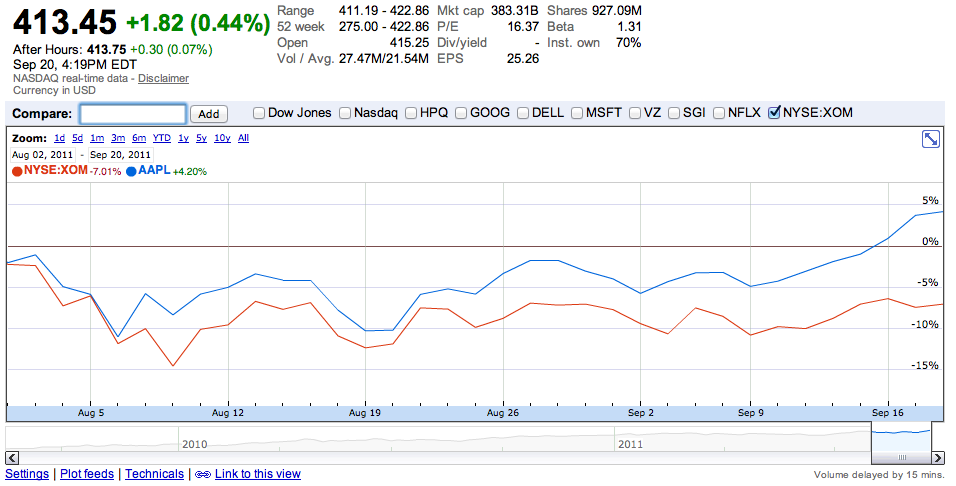
In the face of the shrinking economy and broad market decline, AAPL yesterday surged 2.8 percent at $411.65 a share for a market valuation of $381.62 billion. The Cupertino, California gadget king has been worth more than Exxon Mobil since August 2011. The latter used to be the world’s most-valued company bar none for a long time. Apple’s market cap is also approaching the combined value of Microsoft and Google.

Today, we’ve been served another eyebrow-raising factoid which helps paint Apple’s ever-growing influence in the world, via Bloomberg:

Putting Apple Inc. (AAPL) in the Dow Jones Industrial Average would mean the benchmark gauge would get 22 percent of its value from the iPhone maker, too much influence even for the world’s largest company, according to Bespoke Investment Group LLC. Apple, trading at about $420, would have the largest weighting in the 30-company measure because Dow companies are ranked by stock price, not market value.

Apple shares would have to be split if the stock were included in the Dow, the investment group wrote in a note to clients: “If the stock were added to the index without a split in the shares, it would have a disproportionate weight in the index, making it more like the Dow Jones Industrial Apple.”

Dow Jones Industrial Apple, we love the sound of that. Another quick nugget: Shares of Apple are now worth 91 times their 1997 value when Steve Jobs had been appointed interim CEO…


AAPL vs. XOM: Apple has previously passed Exxon and is now the world’s most-valued company.


Expand
Expanding
Close

Autodesk’s SketchBook for iPhone becomes a $14 million app

Site default logo image

You’d be forgiven for thinking that Autodesk’s SketchBook Mobile is just a fad which ranks down below on the App Store earnings chart. I mean, how popular a pro-grade paint and drawing software costing two bucks a pop can become in this freemium economy? You will probably be surprised to learn it amassed a cool seven million paid downloads on the App Store thus far. This would mean revenues in the range of fourteen million dollars for the company, or about $9.8 million after Apple’s customary thirty percent cut. Bloomberg has the story:

Autodesk Inc. spent almost 30 years selling engineering and design software to accumulate 12 million customers. It took a single iPhone app – and less than two years – to attract 7 million more. Autodesk’s SketchBook application, which also works with the iPad and Android devices, has boosted the company’s user base and drawn new kinds of customers, Chief Executive Officer Carl Bass said today.

The San Rafael, California company benefited in ways more than just direct revenue from paid downloads…


Expand
Expanding
Close

Samsung to go after iPhone 5 in Europe too?

Site default logo image


iPhone Air concept render by Ciccarese Design

On Monday, The Korea Times wrote Samsung would seek “a complete ban” on iPhone 5 sales right after the handset goes on sale in Korea. Today, Reuters chimed in with new pieces of information asserting Samsung’s retaliatory moves could include an injunction against iPhone 5 in Europe. The story, based on “a source familiar with the matter”, goes like this:

Samsung Electronics Co is considering legal action to ban sales of Apple’s new iPhone, a source familiar with the matter said on Tuesday, in what could be its strongest step to defend against claims by the U.S. firm that the South Korean firm had copied its product designs. The source declined to elaborate further on where Samsung planned to take legal actions and the Maeil Business Newspaper reported that the South Korean firm may seek injunction request on Apple’s new iPhone in Europe.

Recent developments have brought new twists, marking a change in Samsung’s otherwise defensive handling of its ongoing legal spat with Apple, its biggest buyer of electronic components. The case now involves 23 lawsuits in multiple countries such as France, Japan, Germany, Korea and the United States. In fact…


Expand
Expanding
Close

Apple wraps up September quarter retail push with five grand openings this weekend

Site default logo image


Apple’s expertise in creating curved glass buildings will culminate with the iSpaceship campus but it actually stems from retail stores. From the Pudong store to the upcoming Nanjing East store in Shanghai, Apple’s profound love for the curved glass and huge open spaces has become iconic. The Shanghai store is opening Friday, September 23, at 9am local time. Image courtesy of our reader Ethan.

As the end of September draws closer with each passing day, Apple is on the roll opening new retail stores around the world at a rapid pace (1, 2, 34 and 5). With the final week of Apple’s fiscal 2011 year upon us, no wonder five new stores are opening this weekend as the company works towards meeting its self-proclaimed goal of having up to thirty new retail stores in their fourth fiscal quarter.

As noted by ifoAppleStore, “with this week’s grand openings, the number of new stores will total 27”. The site which specializes in Apple’s retail efforts says up to five additional stores could open before the U.S. Thanksgiving holiday, including retail spots in Canada, France, Spain and the Netherlands.

There’s a very prudent reason for such an aggressive retail expansion: iPhone 5 should launch next month to what’s been described as ‘unprecedented’ demand and these new stores should support the massive launch.

Go past the fold for a quick run down through store openings this weekend, in addition to Canada’s Metrotown store we covered the last week. All grand openings are scheduled for Saturday, September 24, at 10am local time, with the exception of the Shaghai store which opens doors for business Friday.

Expand
Expanding
Close

Apple releases major Final Cut Pro X update with XML support (BONUS: 30-day trial now available)

Site default logo image

Apple today released a long-awaited update to Final Cut Pro X, its video editing software which fell on def ears with pro video editors. CNET reports that the new version takes into account a number of issues professional users took with the application:

Among the biggest new feature to be added as part of a software update that will go out to users this morning is support for XML. This adds the option to both import and export projects in the XML format, meaning users can take XML formatted projects from Final Cut Pro 7 and other non linear editing software and work on them in Final Cut Pro X.

XML support gives users who previously couldn’t import old projects a workaround solution, requiring them to first export Final Cut Pro 7 projects in XML and then import them into the new Final Cut Pro X. Another big news: Apple says that multicam editing and broadcast-quality video monitoring – the two features absolutely indispensable in professional work – are coming “in early 2012”.

Another glaring omission has been fixed because Final Cut Pro X 10.0.1 now takes advantage of your graphics card to speed up export. Apple also released a new software development kit to camera manufacturers. Using the SDK, vendors can write Final Cut Pro X plug-ins so latest cameras can work with the software provided there’s a FCPX plug-in from its vendor. Previously, users would have to wait until a new Final Cut Pro version is released with support for the latest hardware.

Last, but not the least, there is now a new free version to try before you buy the $300 application. The trial version works for 30-days from the time it’s first launched. Interestingly, Final Cut Pro X version 10.0.1 was not yet available on the Mac App Store at press time. The updater is available from the Final Cut Pro X Software Update page. Compresson 4 and Motion 5 have also been updated to support new features in Final Cut Pro X 10.0.1. In addition, Apple released the ProApps QuickTime Codecs update which adds eight new codecs to apps that use the QuickTime platform. Release notes: Final Cut Pro X 10.0.1, Motion 5.0.1 and Compressor 4.0.1. More on other enhancements and tidbits after the break.

Expand
Expanding
Close

After iOS gadgets, Unreal Engine 3 comes to the Mac

Site default logo image

After bringing its Unreal Engine 3 to the iPhone, iPad and iPod touch, Epic Games yesterday announced (via MacStories) the free Unreal Development Kit beta for OS X which finally lets developers write games for the Mac based on the latest and greatest version of the Unreal Engine. Epic Games explained in a blog post:

Unreal Engine 3 supports developing for Apple’s Macintosh platform for easy cross-platform distribution. The development process is virtually identical for games to be run on the Mac platform, but the packaging and deployment process does require some additional steps.

Hopefully, this development will pave the way to Gears of War and Unreal Tournament for the Mac, which we were promised four years ago.


Expand
Expanding
Close

Three iMessage trademarks surface, point to Apple messaging consolidation

Site default logo image

Last week, code strings were found in iChat’s framework in Lion indicating Apple could be at work developing a cross-platform support for the iMessage protocol in iChat. Today, Fusible points to a set of three trademarks (1, 2 and 3) which surfaced in the United States Trademark & Patent Office’s database. All three are related to iMessage. As you know, iMessage is Apple’s new messaging protocol allowing iOS 5 devices to exchange instant messages and rich media between themselves (think BlackBerry Messenger for the iPhone). It doesn’t take a rocket scientist to figure out it makes a lot of sense to eventually integrate FaceTime, iMessage and iChat into a unified messaging solution on both the Mac and iOS 5 devices. Switching between iChat and FaceTime for Mac is unwieldy and there is no reason we shouldn’t be able to send iMessages from iOS devices to our Mac peers and vice versa.


Expand
Expanding
Close

Intel’s Ivy Bridge chips could enable 2012 Macs to support 4K resolution

Site default logo image


Presentation slide via VR-Zone

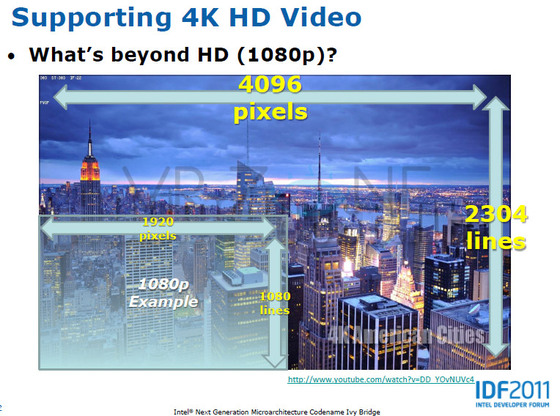
The Verge’s Vlad Slavov notes that Intel’s upcoming Ivy Bridge chips will be 60 percent faster than the Sandy Bridge platform, but the biggest news is support for display resolutions up to 4096-by-4096 pixels and OpenCL. The silicon also features a Multi Format Codec engine which supports 4K QuadHD video on YouTube and is speedy enough to decode multiple 4K video streams at once.

Knowing that the Ivy Bridge platform is a successor to the Sandy Bridge chips which Apple extensively uses in portable and all-in-one Macs, this could mean that 2012 Mac models may enable so-called the 4K resolution:

The graphics processor integrated inside the Ivy Bridge chip will be able to decode video at a resolution of up to 4,096 x 4,096. That’s north of 16 megapixels at a time.

Current-generation Sandy Bridge chips found in Macs support up to 2560-by-1600 pixel resolution. For reference, the 27-inch Apple Thunderbolt display maxes out at 2560-by-1440 pixels. The Verge points to an AnandTech report which details that such a high display resolution would require new cables because the latest DisplayPort 1.2 implementation lacks the bandwidth to feed the monitor with such a huge amount of image data:

4096×4096 at 60Hz with 24-bit color would require a bandwidth of roughly 36Gb/s, more than any of the current display interfaces supports (DisplayPort 1.2 is the king at 21.6Gb/s). 4096×2304 requires only ~20.2Gb/s, and that DP 1.2 can easily provide. 4096×4096 should, however, work with DP 1.2 by lowering the refresh rate to e.g. 30Hz, which would reduce the required bandwidth to be within DisplayPort’s range.

What about Thunderbolt? Per the official Thunderbolt web site, as 9to5Mac explained, optical Thunderbolt cables coming in 2012 will still sport the same 10 Gbps bidirectional data transfer speeds per channel, much as today’s electrical cables that have circuitry in cable ends. Of course, nobody wants to squint their eyes at a 4K display with a refresh rate of only 30Hz so we’re expecting the Video Electronics Standards Association to update the DisplayPort specification with support for new resolutions. How might Apple fit in all this talk?


Expand
Expanding
Close

Lion permissions oversight lets non-admin user to change other account passwords

Site default logo image

Apple usually does a commendable job patching the Mac’s security flaws in a rapid order as they arise. Numerous holes have been plugged, bugs squashed and exploits fixed as they are discovered over the years. And just when you thought Lion couldn’t be drastically compromised, arrives a new exploit based on Apple’s old Achille’s heel: The permissions system in OS X.

CNET warns that any local user on a Lion machine can quite easily change passwords of any other local account, without admin privileges – how spooky is that?  Not very good for shared machines certainly. Kudos for discovering this nasty design omission go to the security blog Defence in Depth, which explains that Lion’s Directory Services no longer requires authentication when requesting a password change for the current user:


Expand
Expanding
Close

J.P. Morgan calls for two iPhones: Entry-level ‘iPhone 4-plus’ and iPhone 5 with CDMA and GSM, but not LTE

Site default logo image


Analysts expect the current iPhone 4 to subsume 3GS as the entry-level offering.

Piggy-backing on a 9to5Mac story from July about two different iPhones in September, FinancialPost reports on a research note from J.P. Morgan which – surprise, surprise – suggests Apple releasing two iPhone models in the coming weeks. One is a major redesign of the current iPhone 4 – the anticipated iPhone 5 – and the other is an inexpensive handset for the masses tentatively named “iPhone 4-plus” (or iPhone 4S, depending on whom you ask).

The latter will re-use most of the components found in today’s iPhone 4, replacing the $99 iPhone 3GS as the entry-level iPhone. Sporting “minor improvements”, iPhone4-plus is said to cater to low-income markets, specifically China whose 1.33 billion population represents an untapped potential for the Cupertino, California firm. J.P. Morgan analyst Mark Moskowitz:

A device targeting China could add to Apple’s super growth rates recently exhibited in the region.

Of iPhone 5, Moskowitz wrote:

The new iPhone 5 stands to be based on the iPad 2’s A5 processor or a newer A6 version. We also expect 1GB of RAM to increase memory access times. Other improvements are increased battery life due to advancement in battery technologies, the printed circuit board (PCB), the touch screen, and LCD power consumption metrics.

The device should basically be a thinner, lighter worldphone (GSM+CDMA) sans the fourth-generation LTE radio technology (which, it increasingly appears, will debut with iPhone 6). The note also backs up reports of an eight-megapixel camera with LED flash on iPhone 5 and a larger screen compared to the iPhone 4’s 3.5-inch Retina Display.


An iPhone 5 case from a Chinese maker that got it right on the iPhone 4 launch. Thanks, SulfoDK!


Expand
Expanding
Close

Ahead of the launch, Samsung wants iPhone 5 banished from Korea

Site default logo image


An artist’s rendition of iPhone 5.

The Korea Times reports that Samsung “is seeking a complete ban” on the iPhone 5 sales in Korea – even before the handset is even released, let alone officially announced. Local carriers KT and SK Telecom have so far sold about 3.1 million iPhones in the country. The paper quotes an unnamed Samsung senior executive:

Just after the arrival of the iPhone 5 here, Samsung plans to take Apple to court here for its violation of Samsung’s wireless technology related patents. For as long as Apple does not drop mobile telecommunications functions, it would be impossible for it to sell its i-branded products without using our patents. We will stick to a strong stance against Apple during the lingering legal fights.

Another Samsung executive is “quite confident” about “a big breakthrough” provided Samsung wins in Germany, adding that “so will other envisioned efforts against such products as the iPhone 5”. The report goes on to mention that iPhone sports an LG Display-made screen, LG Innotek’s eight-megapixel camera, Samsung-made NAND flash and A5 chip and an NFC chip for wireless payment.

The twist in this case, of course, is the fact that Apple is Samsung’s biggest customer, buying displays, NAND flash memory and custom-built A4 and A5 chips for its products. It has been reported that Samsung may soon lose its iOS device processor contract as Apple turns to rival TSMC.

The manufacturing relationship means Samsung gets information about the innards of Apple’s non-released devices months before the actual manufacturing ramp up. This early access to Apple’s designs could have led Samsung to move with the iPhone 5 ban in Korea ahead of Apple’s official launch. On the other hand, Apple did not accuse Samsung yet of abusing its manufacturing contract to rip off Apple’s upcoming devices with its own products.


Expand
Expanding
Close

The United Arab Emirates, Hungary, Poland and the Czech Republic get online Apple store

Site default logo image


Each new country’s online store is prominently advertised with a cutesy banner.

Apple sure is not standing still concerning their worldwide retail presence. The company’s been adding new brick-and-mortar retail spots around the clock (1, 2 and 3) and now the company’s online store arrives to four new countries: The United Arab Emirates, Hungary, Poland and the Czech Republic. Together, these countries have a combined population of more than 65 million people. That Apple expanded its online retail operations to these territories is a signal of their products being sticky enough in these far-flung places to justify an Apple-run online store.


Expand
Expanding
Close

Massive Apple stores due this week in Hong Kong, Shanghai, new store in Vancouver (UPDATED 2x)

Site default logo image


A new Apple store about to open in Vancouver’s Metrotown mall. Image: Reader Prem Sharma.

UPDATE 1 [Monday, September 19, 2011 at 11:55am ET]: This article has been updated with additional store photos included below the fold, at the bottom of the article…

UPDATE 2 [MONDAY, September 19, 2011 at 3:40Pm ET]: The Metrotown Apple Store in Canada has been confirmed on the official Metrotown account on Twitter.

Following grand openings last week, Apple remains adamant to open additional stores worldwide in order to meet its self-proclaimed goal of having thirty new brick-and-mortar spots ready by the end of September, coinciding with the expected launch of the next-generation iPhone.

B. C. Metrotown, Vancouver, Canada – Apple is opening a new retail space shortly in the Metrotown mall, the biggest flagship mall of British Columbia in Canada. The store was not listed on Apple’s retail site at press time so grand opening may not be imminent yet. Apple also operates three other stores in British Columbia, the Oakridge Centre store, the Pacific Centre store and the Richmond Centre location.

UPDATE: iPhoneinCanada.ca notes that Metrotown on Twitter confirmed the September 24 grand opening. Apple’s store is located “on the top floor of the mall nearby Guess, Lululemon and Mexx”, the site adds. Mark your calendars: The new Apple Store at @MetropolisatMet will open on September 24th, reads the tweet.

Nanjing East, Shanghai, China – A listing for this massive store on Apple’s Chinese retail site mentions grand opening this coming Friday, September 23. Recent photos reveal a wide building adorned with the red curtain promotional signage matching that on Apple’s retail site. Shanghai’s third store sporting five levels is located at the corner of Nanjing Road East and Henan Zhong Lu, within walking distance of the city’s famous skyscraper panorama and right within The Bund, a major tourist attraction consisting of the wide avenue of historic buildings.


Image credit: M.I.C. Gadget

The Nanjing East place will be Apple’s biggest store in China yet and their sixth store in the country (including the upcoming Hong Kong store). It is said to sport four floors of retail space. Shanghai is also the home to the spectacular cylindrically shaped Pudong store and the Hong Kong Plaza store.

Both these stores pale in comparison with a massive new store opening in the heart of Hong Kong’s financial centre. More details and a juicy shot after the break…


Expand
Expanding
Close

Reality check: Apple’s iPad has no competition

Site default logo image

“Is 2011 going to be the year of copycats?”, Apple’s then chief executive rhetorically asked at the March iPad 2 introduction in San Francisco. Really, the title of this article couldn’t be more true. iPad is now stealing market share from Android, climbing from 65.7 percent share to 68.3 percent globally as Android slipped from 34.0 percent to 26.8 percent. HP exited the game, having retired its TouchPad and today lackluster sales of RIM’s PlayBook tablet made the news.

Apple decimated competition so thoroughly that analysts are saying the company can take its time releasing a third-generation iPad. According to J.P. Morgan analyst Mark Moskowitz, Apple should be in “no rush” with iPad 3:

Our latest research continues to indicate that there is no such device slated for production this year. In our view, Apple should be in no rush. The other tablet entrants have stumbled so far, and that trend-line could persist deep into 2012.

He also wasn’t impressed by Sony’s tablet which “lacks the refined, sleek feel of the iPad and its bezel-like back is not user-friendly”. And Research In Motion’s BlackBerry PlayBook tablet? On a downward spiral and probably due for life support. Per RIM’s quarterly filing, they shipped only 200,000 PlayBooks in the quarter, a paltry number compared to Wall Street expectations of 700,000 units. RIM refused to reveal actual sell-through as it is no doubt significantly lower than the sell-in. Ticonderoga analyst Brian White weighs in:

We believe the PlayBook is poised to follow HP’s TouchPad as the next casualty of iPad’s tablet dominance

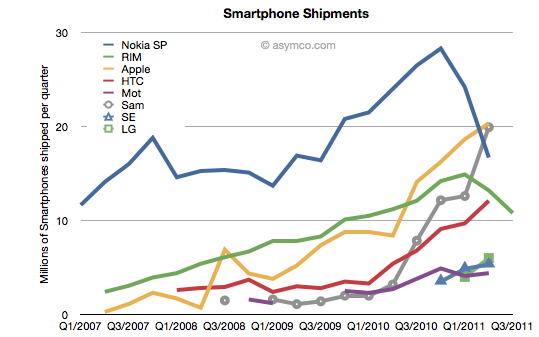
To put PlayBook sales into perspective, RIM shipped one PlayBook to every 46 iPads. With just 200,000 units, PlayBook may very well be heading to the technology graveyard. BlackBerry phones are also shrinking due to “lower than expected sales for older models”. One fifth of RIM’s stock valuation was wiped out today as a result of poor tablet and smartphone performance. By the way, RIM’s global market share is now dropping to single digits. Did the Waterloo, Ontario company learn a valuable lesson?


Many watchers have written off the PlayBook, but RIM has bigger worries on its mind: Its smartphone business is declining and global market share dropping to single digits. Chart courtesy of Asymco.


Expand
Expanding
Close

Intel: Optical Thunderbolt cables due next year, still at “only” 10 Gbps per channel

Site default logo image

Intel today released a couple tidbits to cast more light on Thunderbolt I/O and give folks some perspective concerning its road map. This is my next details some of the features which are outlined in greater detail over at the brand new Thunderbolt web site, which mostly covers branding and various technicalities. For example, we now have it in writing that all Thunderbolt-branded products are to interoperate across all vendors. Per official information, the maximum allowed length of electrical Thunderbolt cables is three meters. Plugs are compatible with Mini-DisplayPort, but DisplayPort cables won’t work as a Thunderbolt cable replacement.

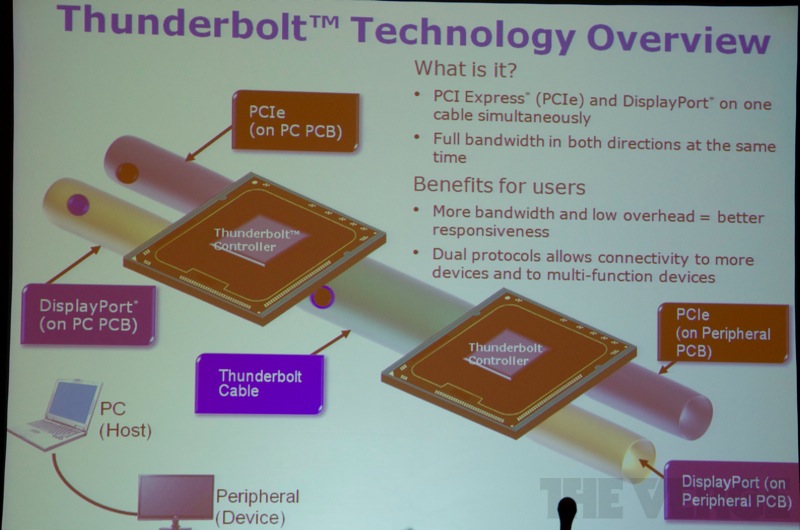
The biggest takeaway is that active optical cables are coming “sometime next year.” Optics will extend Thunderbolt cables to “tens of meters”, but they’ll still provide the same 10 Gbps bidirectional data transfer speeds per channel (there are two channels per cable), much as today’s electrical cables that have circuitry in cable ends. In all, about twenty third-parties are backing Intel’s technology, which isn’t that much considering that Thunderbolt, after all, is a future-proof I/O technology from the world’s largest chip maker.


Expand
Expanding
Close

Apple appears to affirm TD-LTE iPhone for world’s biggest carrier

Site default logo image


iPhone 5 mockup, first published by TechVulture

China Mobile’s chairman Wang Jianzhou went on the record (again) to sort of confirm that an iPhone version for their fourth-generation TD-LTE network is coming. Bloomberg has the quote:

China Mobile and Apple hope to find a solution for close collaboration. We discussed this issue with Apple. We hope Apple will produce a new iPhone with TD-LTE. We have already got a positive answer from Apple.

You may recall China Mobile recently all but confirmed TD-LTE dealings with Apple. Back in January, their boss said in no vague terms that Apple will support TD-LTE. 4G TD-LTE is not to be confused with 4G LTE. The two radio technologies are incompatible and TD-LTE is mostly used in Asia. China Mobile’s third-generation TD-SCDMA network also doesn’t support current iPhones as this radio technology is incompatible with CDMA used by Verizon Wireless in the United States.

Regardless, China Mobile counts a cool 8.5 million iPhone users who surf the web on its second-generation data network or wireless hotspots, Wang confirmed. That’s an impressive number, especially in the light of one million iPhone users on T-Mobile’s USA network as of June. The issue of iPhone in China is dominating the headlines lately. For example…


Expand
Expanding
Close

Apple behind big last-minute chip order with TSMC?

Site default logo image


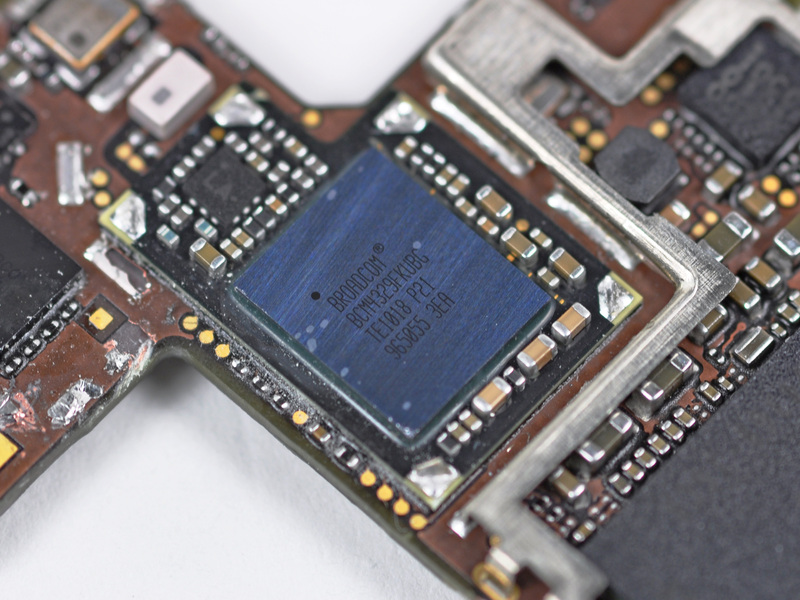
Broadcom is a major Apple supplier, providing both WiFi+Bluetooth and GPS chips for iPhone 4, pictured above. Image courtesy of iFixit

DigiTimes reported yesterday that TSMC’s expected third-quarter revenues will exceed July guidance, thanks to some “rush” orders from their customers which count such fabless chip makers as Qualcomm, Broadcom, MediaTek and MStar Semiconductor. Bloomberg’s supply chain analyst Richard Davenport is convinced TSMC’s revenue boost is linked to Broadcom:

Broadcom is the largest link between Apple and Taiwan Semiconductor. Broadcom appears to be a likely candidate for Taiwan Semiconductor’s rush orders.

How can he tell Apple is behind this supposed Broadcom order? First of all, all the other semiconductor makers – with the exception of Broadcom – have reduced their estimates amid weakening economy. Add on top of that TSMC’s larger-than-expected revenue estimate and you get a positive anomaly amid the current semiconductor slump. At this moment, Apple may be the sole company that could have placed such a materially impacting order, most likely for iPhone/iPad parts.

The notion is shared by William Blair & Co. chip analyst Anil Doradla. He said the last-minute order could be the result of a new Apple deal for iPhone chips with Broadcom. After all, Apple is Qualcom’s largest customer, accounting for an estimated eleven percent of sales. Broadcom supplies Apple with the WiFi+Bluetooth silicon and the GPS chip  for iPad and iPhone and has been a supplier since the original iPhone. However, this “rushed” order may not be related to iPhone 5, Davenport warns:


Expand
Expanding
Close

Ex-Samsung manager spills the beans on leaking iPad trade secrets

Site default logo image

A manager for Samsung has admitted in court to passing Apple’s trade secrets to Mountain View-based Primary Global Research’s executive James Fleishman and an unnamed fund manager, after being granted immunity from prosecution by U.S. District Judge Jed Rakoff. Bloomberg describes how Suk-Joo Hwang, a long-time Samsung veteran, had passed information involving shipments of Samsung’s LCD displays to Apple before the original iPad debuted. He recalled one case of sharing trade secrets with Fleischman over lunch at a California restaurant:

One particular thing I remember vividly was that I talked about the shipment numbers of Apple, it was about iPad. This is in December 2009, before it came out with the tablet PC, they didn’t know the name then, so I talked to them about the tablet shipment estimates in that meeting.

Hwang told Judge that a visitor was intensely staring at their table, which led him to suspect that the person might have been an Apple employee. Shortly thereafter, Hwang learned that Samsung had lost a supply contract with Apple. “I thought, ‘Oh that guy was an Apple guy and they found out,’” Hwang said, adding he was “scared”.

And what did Fleishman do with this information?


Expand
Expanding
Close