AT&T announced it would introduce new data plans for phones and tablets on Sunday, Jan. 22. There will be three phone plans: $20 for 300MB, $30 for 3GB, and $50 for 5GB with tethering. While the two tablet plans will be: $30 for 3GB and $50 for 5GB.
In the past, AT&T made available $15 for 200MB, $25 for 2GB, or $45 for 4GB with tethering. Each plan earned more data and a $5 price hike. AT&T will charge $10 for each 1GB roll over. AT&T explained the sudden change:
“Customers are using more data than ever before,” said David Christopher, chief marketing officer, AT&T Mobility and Consumer Markets. “Our new plans are driven by this increasing demand in a highly competitive environment, and continue to deliver a great value to customers, especially as we continue our 4G LTE deployment.”
UPDATE [Tuesday, January 17. 2012 at 2:29pm ET]: An AT&T spokesperson chimed in with a comment noting that “throttling only applies to top users with grandfathered unlimited plans”. The full quote is included at the article bottom.
AT&T and other major carriers in the United States recently instituted data throttling and began limiting network speeds for the top 5 percent of data-hungry users. Carriers around the world tend to hide data throttling in fine print, so users are in for a surprise when they find out that their unlimited plan entails data throttling once a carrier-imposed ceiling is reached (usually 1GB per month). Throttling is not something worth losing sleep over until it hits you. For starters, throttling reduces your downlink speed by a factor of 10 or more. Depending on your carrier’s network, this means your throttled downlink will drop all the way down to a paltry 0.1MBps. What you might not have known is how badly throttling affects the user experience on your device… Expand Expanding Close
Update: Reports that T-Mobile knows Apple’s chipset roadmap are false I’ve confirmed with T-Mobile’s PR department. Ray only said that Apple could choose to use Chips that are AWS compatible, which is obvious.
I had a few minutes this evening between Colbie Cailat songs at T-Mobile’s CES 2012 party to talk to CTO Neville Ray on what the future holds for T-Mobile since the AT&T merger is off. T-Mobile walked away with not only $3 billion but also some AWS spectrum from AT&T.
First, Ray is excited. He talked like someone who has been imprisoned by the merger over the past year, unable to make any long term moves. T-Mobile is still evaluating its long-term options (like LTE) but there is a buzz in the air now. While the parent company Deutsch Telekom gets the $3 billion payoff from AT&T, it seems that there will be big investment over the next few years in the T-Mobile USA subsidy.
On Dec. 19, T-Mobile’s official AT&T breakup release stated what —besides the $3 billion— T-Mobile would get:
As part of the break-up fee, T-Mobile USA will receive a large package of AWS mobile spectrum in 128 Cellular Market Areas (CMAs), including 12 of the top 20 markets (Los Angeles, Dallas, Houston, Atlanta, Washington, Boston, San Francisco, Phoenix, San Diego, Denver, Baltimore and Seattle).
The UMTS roaming agreement for the U.S. in T-Mobile USA’s favor has a term of over seven years and will allow the company to improve its footprint significantly among the U.S. population and offer its customers better broadband coverage for mobile communications services in the future. Population coverage will increase from 230 million potential customers at present to 280 million. As a result of the agreement with AT&T, coverage will be extended to many regions of the U.S. in which T-Mobile USA previously had neither its own high-speed mobile communications network nor the associated roaming agreements.
That spectrum will allow T-Mobile to light up HSPA+ radio frequency used by the iPhone’s 3G.
Nevada, parts of Northern California and the Pacific Northwest are also seeing some pockets of 1900MHz spectrum refarming for HSPA+. There are other parts of the country T-Mobile can refarm the 1900MHz spectrum but, the focus is on the Pacific Northwest, Nevada, Utah and California for right now from what we’re told. We should emphasize and emphasize greatly that this post does not mean that all of the aforementioned areas are seeing this refarmed spectrum, just pockets inside those areas.
Ray said those networks were not officially lit up (perhaps some tower testing or AT&T roaming confusion happened).
Nevertheless, there is good news for those who want to use an iPhone on T-Mobile’s 3G network…
Carrier AT&T is holding its sixth annual Developer Summit at the 2012 Consumer Electronics Show in Las Vegas today, and President and CEO Ralph De La Vega addressed some 2,500 attendees from 33 different countries. “What’s good for developers is good for customers,” said La Vega while explaining why AT&T runs this developer summit.
Shortly, Chief Marketing Officer David Christopher took the stage to announce AT&T’s new API platform for HTML5 web applications meant to run across multiple devices and mobile operating systems, reminding that the web really is the ultimate app store. Interesting enough, Visual Voicemail for the iPhone (which turned 5-years-old today) was AT&T’s very first network API, so you could say Apple also helped revolutionize how carriers interoperate.
An impressive 85 percent of all smartphones will have HTML5 browsers by 2016, Christopher explained. The new API Catalog sports 130 individual APIs divided into 14 different categories — it is essentially a revamped U-Verse API catalog. The APIs enable a range of features, such as completely automated sign ups to use APIs in minutes, wrappers for Ruby, PHP and Java and tons of sample code in Github.
A storefront for web apps called the “App Center” will be available later this year (developers can sign up for a beta here). In short, this new platform is conceived from the ground up with HTML5 developers in mind and targets most cellular networks, not just AT&T’s…
Verizon Wireless’ Chief Financial Officer Fran Shammo told attendees at a conference today that Verizon sold a total 4.2 million iPhones during the holiday quarter, according to Bloomberg. Interestingly, the numbers reported by Shammo show that Verizon more than doubled iPhone sales from the previous quarter, where they sold 2 million. This sales hike was likely helped by pent up demand for the iPhone 4S, a cheaper iPhone 4, and the influx of shoppers during the holidays. Verizon’s previous iPhone sales were said by some to be a disappointment.
Apple’s fiscal Q1 earnings call is coming up on Jan. 24, where we will hear the total number of iPhones sold during the holiday quarter. We will also hear specific numbers from Sprint and AT&T in the coming weeks. Last quarter’s total amount of iPhones sold should blow out any previous quarters with some experts putting estimates as high as 35 million.
RadioShack is offering a $30 discount on all of their AT&T high end smartphones which obviously includes the iPhone 4S and iPhone 4, starting Sunday and running until December 17th. The sale will bring the iPhone 4S 16GB down to $170 0n contract and the iPhone 4 16GB to $70 on contract. Also, if you use Radioshack’s trade-in program you can get the phones for free and even have some extra credit left over. Head over to your local store to take advantage of this sale.
Digitimes’latest report puts some numbers on the low end iPhones coming out of China. The 2.5 year old iPhone 3GS has continued to sell briskly with the volume likely to reach two million units in the fourth quarter of 2011 and 1.4-1.6 million units in the first quarter of 2012, according to “industry sources”.
Think about that for a second. In a world where a new, free Android flagship phone comes out every week or so and dying out a few months later, Apple is selling 2 million/quarter of a device that was introduced two and a half years ago. This is the phone the original Droid went up against — in fact.
Verizon and conceivably other CDMA carriers in the world have also continued to sell the iPhone 4 CDMA version at an impressive clip.
Meanwhile, the production of the CDMA version of iPhone 4 is expected to top 800,000 to one million units in the fourth quarter of 2011 and 500,000-600,000 units in the following quarter, estimated the sources.
Big news today (surprisingly on a 4 day US weekend). The AT&T and T-Mobile merger was withdrawn from the FCC today.
On November 23, 2011, AT&T Inc. and Deutsche Telekom AG electronically withdrew without prejudice, as of that date, the pending applications listed in the Public Notice released by the Federal Communications Commission on April 28, 2011 in that proceeding. Associated manual notification of withdrawal filings also are being made.
The two companies look to be pursuing an alternative plan… Expand Expanding Close
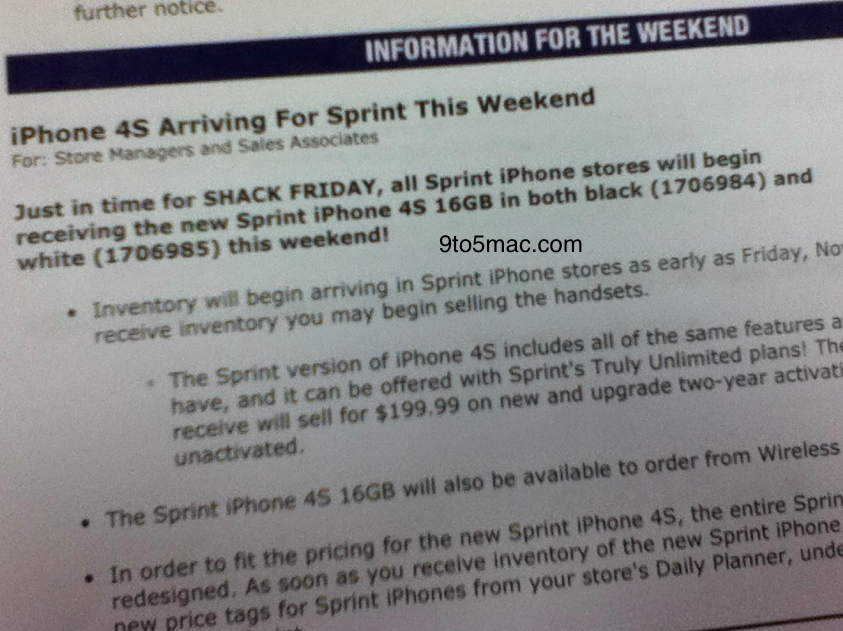
If you’re still trying to get your hands on the Sprint iPhone 4S, you’ve now got another outlet. According to internal documents we’ve obtained, RadioShack will be adding Apple’s latest handset to their Sprint lineup this weekend. Some stores should have stock now and many more will be getting it over the coming days. Unfortunately, if you want the 32 or 64 GB models, you may be out of luck, at least for now. According the documents we’ve seen, there is no indication that those models will be available at this time at Radio Shack.
The 16 GB model will be available in both black and white, and will be available at all stores that currently carry the iPhone, and stores that don’t typically carry the iPhone should be able to order it in. RadioShack has carried the iPhone 4 on Sprint since they started selling the 4S on Verizon and AT&T last month with a note that the Sprint 4S would be available at a later date, due to inventory issues.
Verizon isn’t just selling Droids these days, they are still making an effort to sell some iPhones on their talk network reputation. AT&T has seen much less churn than was expected when it lost its exclusivity. We hope to see more entertaining back and forth as we ease into the holidays. Expand Expanding Close
In addition to the big three (AT&T, Verizon Wireless and Sprint) as well as regional carrier C Spire which has begun selling iPhone 4S today, Apple’s new handset is now available from Claro Puerto Rico, the largest Puerto Rican telecommunications services company. The Guaynabo, Puerto Rico-headquartered wireless operator hosts a million US customers in Puerto Rico (yes, it is a U.S. territory, U.S. dollars, U.S. citizenry) which makes it slightly bigger than C-Spire by subscribers.
Claro is the largest mobile phone network in the Americas. It is part of the Mexican telecom group América Móvil which is one of the four largest mobile phone network operators in the world, with more than 200 million customers.
What’s interesting about their offering is that Claro will be offering the 16GB iPhone 4S for just $99.99 with a standard two-year contact, quite possibly the lowest subsidized price in the United States. The 16GB/32GB version is a $199/$299 value with a two-year contract. Customers can choose between four plans costing $64.98, $74.98, $79.98 and $84.98 a month. All plans include unlimited minutes and text messages and 250MB/2GB/5GB/unlimited data.
They are also offering no-contract iPhone 4S for $669.99/$769.99/$869.99 for the 16/32/64GB version, which is a $20 premium from Apple’s online store, which began accepting orders for the unlocked iPhone 4S this morning. Claro is offering both the 16GB iPhone 4S subsidized and non-subsidized beginning today, with 32GB and 64GB capacities “coming soon”.
Claro is also offering the 8GB iPhone 4 for $49.99 ($569.99 contract-free).
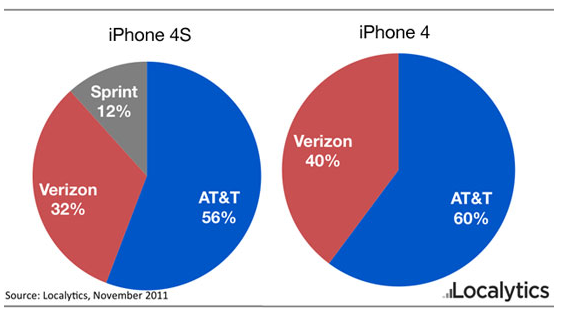
According to Localytics, AT&T continues to be the dominant iPhone carrier in the US, even with the Verizon entering the market strongly last year, grabbing 40% of the users in half the time.
As the 4S was launched on Sprint as well with truly unlimited data plans, one would have thought more of AT&T’s marketshare would have been diminished. However, it appears that sprint is taking more away from Verizon.
Sprint’s share of the 4S market now stands at 12% according to the figures. AT&T, though coverage is spotty in urban areas like New York and San Francisco, does have a significant speed advantage over Sprint and Verizon’s 3G as well as the ability to talk and use data at the same time.
Looking at iPhone 4 distribution as a comparison, Sprint seems to have eroded more of Verizon’s market share than AT&T’s – of the previous-generation handset, 60% are on AT&T versus 40% on Verizon.
A likely driver for these differences is the fact that AT&T can mine its existing base of iPhone users. Because all Verizon iPhone users are in the first year of their wireless contract, the cost of upgrading will be high. However, many longer-term AT&T users, especially those holding iPhone 3GS and earlier devices, are off-contract or nearing the end of their contract. AT&T has been aggressively leveraging the iPhone 4S to sign these customers to new two-year contracts, and the data in this study suggests that tactic may be working.
That data strongly lines up with our poll which we’ve been tracking since before the iPhone 4S launch…
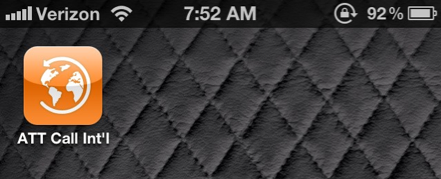
Out of the AT&T idea factory comes a new app that allows users to make calls via Voice over IP. While it doesn’t say so explicitly, Verizon and Sprint users can use this VoIP app to make cheaper(?) calls on their iPhones even though they don’t use AT&T’s wireless service. Theoretically, International iPhone users could as well. The app is also available for Android.
The costs are billed directly to a credit card and not necessarily to an AT&T card holder’s account.
Just think of it as a more expensive Skype or (insert your favorite VoIP service here) with more limitations.
Also, while traveling in some countries, AT&T will allow you to use Wifi to make international calls over VoIP.
Here’s a few situations where this makes sense:
1. If you don’t have an AT&T signal but have Wifi – like Midtown Manhatten or the greater San Francisco area for instance. T-Mobile already does this and it is a great service. However, T-Mobile lets you recieve calls over Wifi too – which is awesome anywhere (including overseas) where a T-Mobile signal isn’t available. T-Mobile’s is also integrated into the phone and is free — see where I am going here? AT&T has a ways to go.
2. If you are travelling internationally and don’t want to get hit with International roaming fees. Using Wifi saves some money here.
3. If for whatever reason, your Verizon or Sprint long distance calling service is too expensive.
4. International users may be able to get better rates f they can provide AT&T with an acceptable credit card.
Just think, a few years ago VoIP apps were being blocked and now the Telcos are doing it themselves. Full App info below:
China Mobile doesn’t officially offer the iPhone yet. But it is carrying 10 Million iPhones on its network according to Reuters.
“We have not yet got agreement with Apple,” Wang said on the fringes of the ITU World telecoms fair in Geneva. “Apple promised to provide, when they develop the iPhone for LTE, that it will include TD-LTE. We are discussing the details.”
There had been rumors that Apple would offer a TL-LTE version of the iPhone 4S earlier this year with China Mobile going as far as saying:
China Mobile and Apple hope to find a solution for close collaboration. We discussed this issue with Apple. We hope Apple will produce a new iPhone with TD-LTE. We have already got a positive answer from Apple.
It appears that positive answer wasn’t for this round of devices, though the CDMA Verizon iPhone arrived off schedule in January. TD-LTE will require some separate chips which could be hard to fit inside the iPhone 4S’s enclosure. Apple however has to look longingly at that 600 million+ subscriber base, however.
While T-Mobile USA is on the opposite end of the subscriber spectrum (China Mobile has around the same amount of subscribers as the populations of Europe and the US combined), T-Mobile is the #4 carrier in the US in the midst of AT&T attempting to swallow it.
But they both don’t officially offer the iPhone, yet have a significant number of iPhones floating around on their network. Both offer a different type of high speed 4G network that stock iPhone 4Ses can’t take advantage of. Both networks do offer EDGE/GSM speeds however which some may find valuable tied with reduced fees or better coverage. T-Mobile told us earlier this year that they had over a million iPhones on their network, a figure that is likely to go up with Apple sneakily offering iPhones 4S unlocked at launch.
Carrier Verizon Wireless, a joint venture of U.S. telecommunications firm Verizon Communications and UK multinational mobile network operator Vodafone, today announced financial results for the September quarter. Big Red sold two million iPhone units which represents a 300,000 units decline compared to the June quarter. Verizon was also behind rival AT&T which yesterday reported activating 2.7 million iPhones in the quarter out of a total of 4.8 million total devices.
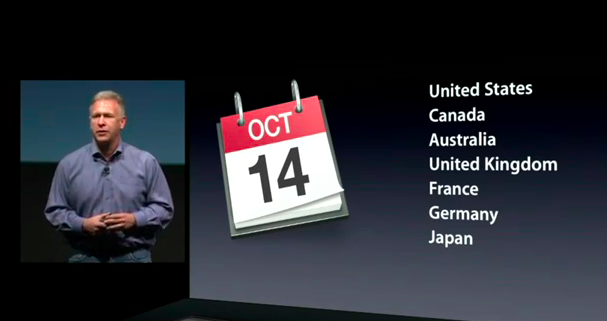
In a separate statement, rival AT&T said it activated a million units of the new iPhone 4S on its network as of Tuesday, while Verizon made no mention of iPhone 4S in its quarterly filing. iPhone 4S went on sale in the United States, UK, Australia, France, Germany, Canada and Japan on Friday, October 14. The phone will roll out to 22 new countries later this month, with regional online Apple Stores in those countries accepting reservations beginning today.
Verizon’s full press release is right after the break.
[youtube=http://www.youtube.com/watch?v=wPuYWwBDHHQ]
AT&T just issued a press release saying they activated one million iPhone 4S units, or one-quarter of the four million devices Apple sold during the launch weekend. It’s the most successful launch in AT&T’s history, the company wrote in the release:
AT&T today announced it activated more than 1 million iPhone 4S’ as of Tuesday, making it the most successful iPhone launch in the company’s history. AT&T was the first carrier in the world to launch iPhone in 2007 and is the only U.S. carrier to support iPhone 4S with 4G speeds. “It’s no surprise that customers are clamoring for iPhone 4S and they want it to run on a network that lets them download twice as fast as competitors’,” said Ralph de la Vega, President and CEO, AT&T Mobility & Consumer Markets. AT&T’s speed advantage, and the unique ability to talk and surf at the same time, has been roundly praised by industry pundits.
About those “4G speeds”…
AT&T is reportedly pushing Apple to put a “4G” cellular icon on iPhone 4S to represent its faster Internet connection, which theoretically hits 3G HSPA 14.4 Mbps speeds (lawmakers wouldn’t approve of that). The carrier also released a customer testimonial video, included above, with people explaining why they opted for an iPhone 4S on the AT&T network (hint: because it’s “super-fast”).
Taking into account September quarter earnings, iPhone 4S sales in just a few days since last Friday’s launch hit nearly one-third of the 2.7 million iPhones activated in the last quarter which was down from the 3.2 million iPhones from the year ago September 2010 quarter (which included the iPhone 4 launch).
Note that this is one million iPhone 4Ss only, excluding the newly price-reduced iPhone 4 and iPhone 3GS units.
AT&T just released its earnings and showed strong iPhone sales despite having a 16-month old device on hand with updates looming. The carrier reported activating 2.7 million iPhones in the quarter out of a total of 4.8 million total devices. Android device sales doubled year over year.
Non-iPhone Smartphone Sales Increase.AT&T continues to deliver robust smartphone sales. (Smartphones are voice and data devices with an advanced operating system to better manage data and Internet access.) In the third quarter, the company sold 4.8 million smartphones, representing nearly two-thirds of postpaid device sales. Sales of Android devices more than doubled year over year, and almost half of all smartphone sales were non-iPhone devices. During the quarter, 2.7 million iPhones were activated.
Our polls show that significantly more than half of all US iPhone users go with AT&T, due mostly to the higher data rates and ability to talk and use data at the same time.
Shawn Blanc (viaThe Next Web) calculated this morning that Apple is selling 16 iPhone 4Ss a second, or roughly 1,000 a minute. Blanc’s figuring comes after Apple announced this morning that there were 4 million iPhone 4Ss sold its opening three-day weekend. Figures are also expected to expand as the iPhone 4S is introduced in 22 more countries on the 24th.
Reaching this milestone, Apple is on tract to pass Microsoft’s Kinect as the fastest selling consumer device of all time. Microsoft sold 8 million Kinects in the first 60 days, a number Apple could theoretically pass in the first two weeks.
The success of the iPhone 4S is most likely helped by a few factors:
The availability on three U.S. carriers: AT&T, Verizon, and Sprint. AT&T and Sprint both announced opening day sales records on Friday. The iPhone 4 was only on AT&T in the US its opening day.
iPhone 4 was released in 5 countries. iPhone 4S was also available in Canada and Australia in addition.
iPhone 4 saw serious product shortages while it appears that Apple made plenty of iPhone 4Ss (OK, maybe not)
There was a longer than normal wait time between the iPhone 4 and 4S (15 months)
iPhone 4S is amazing.
We’re sure to hear more in Apple’s FYQ4 earnings call tomorrow afternoon.
Apple announced sales of four million iPhone 4S units in the three days after its launch on October 14. In addition, the company said, more than 25 million customers have already upgraded to the new iOS 5 software in the first five days of its release and more than 20 million customers have signed up for iCloud: Apple’s marketing honcho Phil Schiller was quoted in a statement:
iPhone 4S is off to a great start with more than four million sold in its first weekend—the most ever for a phone and more than double the iPhone 4 launch during its first three days. iPhone 4S is a hit with customers around the world, and together with iOS 5 and iCloud, is the best iPhone ever.
In 2010, Apple announced 1.7 million sales of iPhone 4 during the launch weekend. The company reported 600,000 pre-orders for iPhone 4 in the first 24 hours, which included orders placed with overseas carriers.
It should be noted that the iPhone 4S is the first iPhone to launch simultaneously on three carriers in the United States, available for the first time on the Sprint network – which together with Verizon, certainly helped sales numbers. Apple also added Australia and Canada to the five launch countries it had for the iPhone 4: US, Japan, UK, Germany and France.
If you’re trying to make your iPhone 4S buying decision based on network speeds, here’s a helpful comparison video (above). The test shows the loading of websites and also runs the speed test application on all three networks.
Remember, this was done at one fixed location so you’re mileage most certainly will vary.
Sprint took a big risk on the iPhone, paying a rumored $20B up front to get the iPhone over the next four years (that is some pipeline!).
Mr. Hesse told the board the carrier would have to agree to purchase at least 30.5 million iPhones over the next four years—a commitment of $20 billion at current rates—whether or not it could find people to buy them, according to people familiar with the matter. In order to keep the price people pay for the phone low and competitive with rivals, Sprint would be subsidizing the cost of each phone to the tune of about $500, which would take a long time to recoup even at the high monthly fees iPhone users pay.
Directors debated what they had just heard. Some worried the payoff would be too long in coming. One member questioned whether the multiyear deal might outlast the iPhone’s popularity. To sell that many iPhones, Sprint would have to double its rolls of contract customers, convert all of them to the Apple device or a combination of the two.
It appears that the risk is already starting to pay off.
Today, spokeswoman Michelle Mermelstein told us:
Fared Adib, Sprint Product Chief, issued the following statement: “Sprint today reported its best ever day of sales in retail, web and telesales for a device family in Sprint history with the launch of iPhone 4S and iPhone 4. We reached this milestone at approximately noon CT/1pm ET. The response to this device by current and new customers has surpassed our expectations and validates our customers’ desire for a truly unlimited data pricing plan.”
Readers are writing in to tell us that AT&T is backlogged on their iPhone activations while Verizon and Sprint appear to be handling the load a little better.
One reason is likely sheer numbers. Our survey (below) shows that US users are picking AT&T over Verizon and Sprint by a significant margin (mostly for the Data speed). We’ve also heard that Apple was expecting this and stocking up to five times as many AT&T iPhone 4Ss as Sprint or Verizon iPhones.
The iPhone 4S has sold out completely across AT&T, Verizon, and Sprint reportsBusinessweek. While you can still get your order in, delivery in AT&T’s case has been pushed back 3 -4 weeks. Shipping should be similar for Verizon and Sprint too, but they aren’t providing a time frame on their website.
Apple announced it had sold 1 million iPhone 4Ss across 100 world carriers in 24 hours in contrast with 600,000 across the five launch countries in 2010 with the iPhone 4.
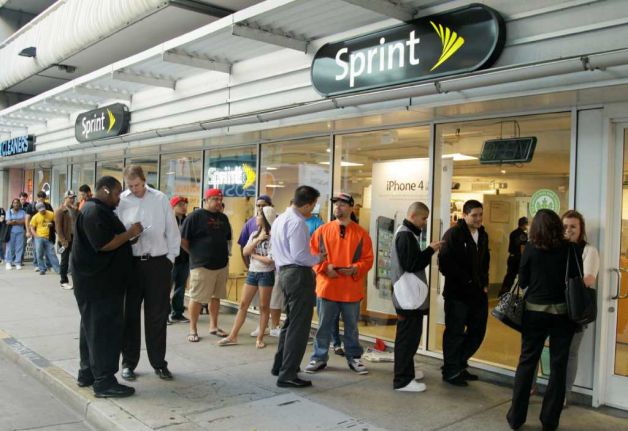
Tomorrow the iPhone 4S goes on sale, and stores should have an extra stock of the iPhone 4S for those who haven’t pre-ordered yet. To get your hands on those, you’ll probably have to hop in line pretty early. Expand Expanding Close
Owning up to its ‘Worldphone’ capabilities, Macworldgot the SIM unlock policies from Verizon and Sprint which may make the CDMA phone more attractive than one from AT&T that is SIM-locked.
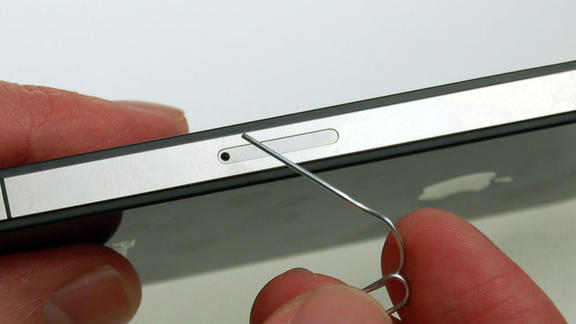
But there’s a new wrinkle that potentially makes the international-roaming experience better on Sprint and Verizon iPhones than it is on AT&T. Sprint plans to sell the iPhone 4S with its micro-SIM slot unlocked; Verizon’s will be initially locked, but if you’ve been a customer in good standing for 60 days, you can call Verizon and ask for an “international unlock.” (A Verizon spokesperson told me that this is Verizon’s standard policy for all world phones—it’s just the first time it’s manifested itself on an iPhone.)
That’s interesting because for instance the Verizon Droid II Worldphone comes with a locked Vodafone (Verizon’s half parent company) SIM card. If you travel overseas you cannot exchange a local carrier’s SIM, you have to use Vodafone. Verizon may unlock these but it was my understanding that it was up to their discretion. Their policy might be two months old now but that could change on a whim (plus, what is “good standing” – seems shady).
AT&T of course won’t let you put in a local carrier’s SIM card and will charge you their high rates for roaming (though they’ve come down a bit over the past year).
When added to Sprint’s unlimited data plans, ol’ Yellow is looking pretty good, especially for those who travel internationally.
Update: Sprint refuted this claim to Ars Technica and says you will get a Sprint SIM and be charged Sprint Roaming charges, like AT&T.