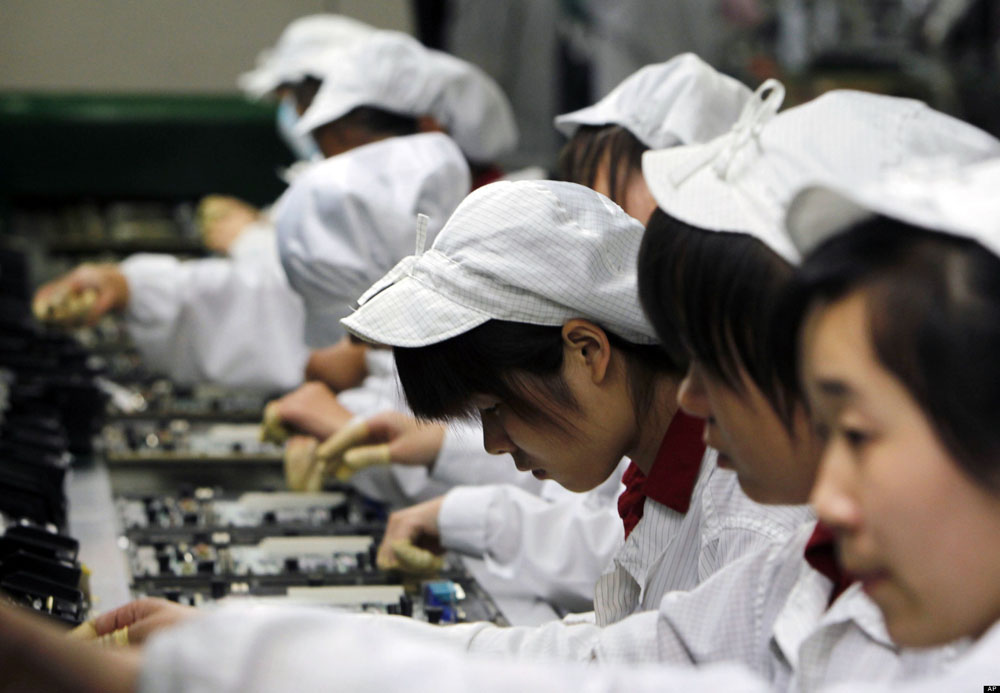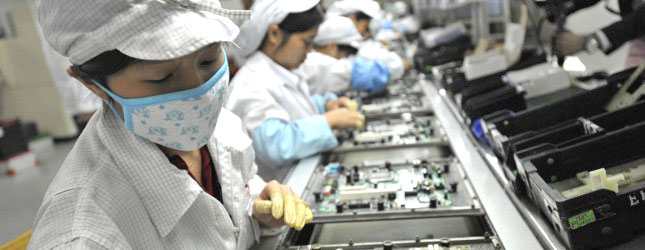
China Labor Watch says that an undercover investigation at a Pegatron factory manufacturing iPhones and iPads found that 58% of workers there were working in excess of 60 hours a week – the limit laid down by Apple for its suppliers. It also said that overtime, which is supposed to be voluntary, is effectively mandatory, reports CNET.
The report claimed that the standard shift was nine hours, but that – between September and December last year – staff worked an additional minimum of 20 hours of overtime each week, usually split up between an extra two hours each week day and one 10-hour shift on Saturdays. […] This overtime was essentially a requirement, according to the investigator, who claimed to be told by a trainer that working eight-hour shifts five days a week “does not conform to our hiring requirements.”
The report says that many workers in any case said that significant overtime was necessary to meet their living expenses, with wages at the local minimum wage of around $1.85 per hour.
The report also alleges that Pegatron falsifies documents shown to Apple to give the appearance of complying with supplier audit requirements while failing to do so in reality.
Despite providing only about eight hours of pre-job safety training—where Chinese law requires 24 hours—Pegatron forces each new worker to sign a form that “certifies” that she has undergone 20 hours of safety training. A worker also must sign a trainer’s name on the form. The factory has workers quickly copy answers to the safety information quiz. These falsified forms are the types of documentation that are provided to Apple in their audits.
The report notes some improvements since 2013, with partial improvements in sick leave and the ending of claimed discriminatory hiring practices. CNET says that neither Apple nor Pegatron responded to requests for comments on the report.
It’s not the first time that China Labor Watch has criticized working conditions in factories run by Apple’s suppliers. A report last year on another Apple supplier detailed claims of 22 violations ranging from hiring practices to safety concerns.
A BBC documentary based on an undercover investigation at another Pegatron factory prompted Tim Cook to say he was “deeply offended” by the claims and the show’s failure to include facts and perspectives provided by Apple.
Apple publishes an annual Supplier Responsibility Progress Report in which it details the issues it faces in its supply chain and the steps taken to address these.
Photo: AP Photo/Kin Cheung