Author

Avatar for 9to5 Staff

9to5 Staff

Apple launches gestures-heavy iPhoto for iPad, can tell you weather in images. Available today for $4.99

Site default logo image

In what many might call a long overdue move, Apple finally ported the photo management application iPhoto to iPad. The release of the software completes a trio of the most important iLife apps that are now available on the iPad: iMovie, GarageBand, and now iPhoto. The app supports images up to 19-megapixels. It also sports many familiar and popular features, including the auto-enhance tool, social sharing through Facebook, Twitter, Flickr, email, and more.

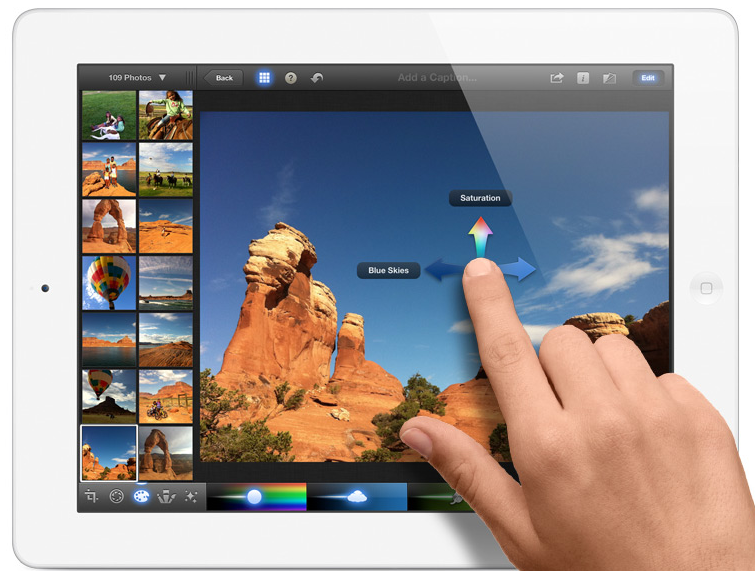
The iPhoto app is aimed at people who “want to do more with your photos.” One aspect immediately becomes clear: iPhoto for iPad is gestures-heavy (per an extensive live demo Apple’s Chief Architect for Photo and Video Randy Ubillos gave on stage).

You can use the new bezel gesture —a first for an Apple-made iPad app— to swipe from the left side of the screen to look at other images in the album. From there, just tap on an image to bring the editing interface up. When you want to bring in the thumbnail view, just swipe from the side again.

Another cool feature: Double-tapping a single image tells iPhoto to scan your entire library and compare all the images to find the ones that look similar. You can also beam photos between devices over-the-air, tap a specific area to adjust it, touch, and drag to brighten or tweak saturation, and more.

However, when it comes down to heavy image editing, the iPhoto app does not disappoint. For example, brush palettes include tools such as red-eye, saturation, and lighten. Other notables include sharpen, soften, darken, and a general repair tool. Meanwhile, the effects gallery includes black and white, vignette, tilt-shift, watercolor, and more.

More information is available below.

Expand
Expanding
Close

The new iPad has 10-hour battery life, is 0.6mm thicker and 0.07lbs heavier

Site default logo image

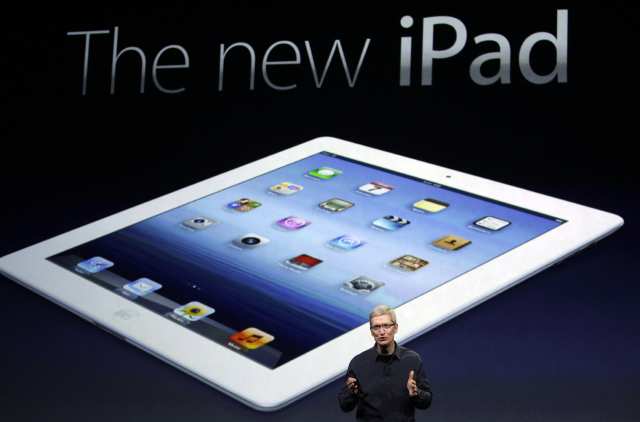
Apple just finished the new iPad presentation at San Francisco’s Yerba Buena Center for the Arts. Now we have full tech specs, and the new Retina Display is its defining feature, but what about the little things? Per pre-event rumors and whispers, the new iPad is a tad heavier and thicker than its predecessor is.

The new iPad is 9.4mm thin and weighs 1.4lbs. As for the iPad 2, it is 8.8mm deep and weighs 1.33lbs (Wi-Fi model). This makes the new iPad 0.6mm thicker and 0.07lbs heavier. However, we somehow doubt anyone other than the most eagle-eyed fans will notice the difference.

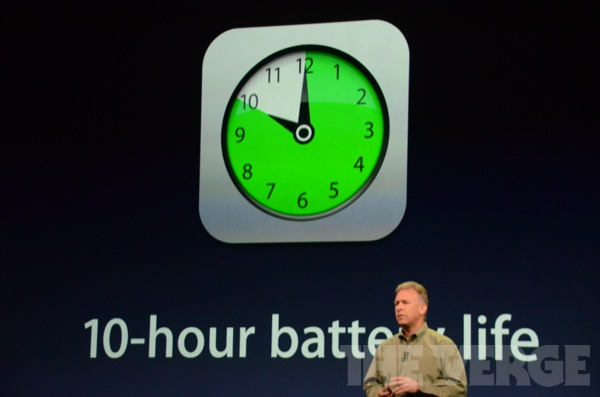
As for its battery, the new iPad maintains the same 10-hour battery life as both the original iPad and iPad 2. Steve Jobs highlighted battery performance at the iPad 2 unveiling by underscoring how iPad 2 features the same “legendary” battery as the original model. “We don’t want to give that up,” he said, “This has been tried and tested by many reviewers.”


Expand
Expanding
Close

iPad gets iSight camera with fifth lens: 5MP stills, 1080p video recording

Site default logo image

Another feature of the new iPad is a redesigned camera system that seems to borrow heavily from both the iPhone 4 and iPhone 4S. Gone are the poor man’s backside camera on iPad 2. The new iPad boasts Apple’s proven camera system design featured on iPhone 4S.

On the back is the new iSight camera with a 5-megapixel CMOS sensor. It’s got a number of iPhone 4S features, including backside illumination, auto-exposure, auto-focus, face detection in still images, video stabilization, a fifth lens and hybrid IR filter. This crazy camera hardware is driven by an Apple-designed image processor built into the A5X chip. Oh, in case you were wondering – yes, it records video in full HD 1080p resolution at up to 30 seconds with stereo audio.

As for the front-facing videoconferencing camera, it is the same “FaceTime camera with VGA-quality photos and video at up to 30 frames per second”.


Expand
Expanding
Close

And the new iPad is officially called…

Site default logo image


Image courtesy of the Los Angeles Times

From the beginning of today’s iPad launch event at San Francisco’s Yerba Buena Center for the Arts, Apple executives referred to the new iPad simply as “the new iPad” slide after slide. No “iPad 3” moniker or “iPad HD,” as the bloggers called it. So, what fancy new name did Apple come up with this time?

[youtube=http://www.youtube.com/watch?v=g88ufDHEYpY]

The truth is but a click away.


Expand
Expanding
Close

The new iPad is here and it has a Retina Display packing a million more pixels than your HD TV

Site default logo image

In case you had any doubts, Apple just unveiled at a media event in San Francisco the new iPad and boy does it have that ultra-high resolution display you have clamored for. Apple’s marketing honcho said, “Until you see it, you can’t understand how amazing it is.” The screen itself packs in a 2048-by-1536-pixel resolution, or 3.1 million pixels, for “the most ever in a mobile device.”

This screen resolution on a 9.7-inch display translates to a pixel density of 264 pixels per inch, which is less than the 326 pixels per inch on the iPhone 4/4S. However, when holding the device at 15 inches away (the iPhone is typically held at 10 inches away), your eye is unable to distinguish the individual pixels—hence the Retina moniker.

We’re allowed to call 264 pixels per inch Retina because you hold it further from your face.

Another interesting aspect: With a 2048-by-1536-pixel resolution, the new iPad has a million more pixels than your HDTV. It also has 44 percent greater saturation. Moreover, Apple upgraded the processor with quad-core graphics, naming the enhanced chip the “A5X.” to drive all those pixels. Executives bragged on stage that the device has more memory and a higher screen resolution than an Xbox 360 or PlayStation 3 console.


Expand
Expanding
Close

Apple unveils new Apple TV: Streamlined UI, 1080p video output, full HD iCloud movies, same $99 price

Site default logo image

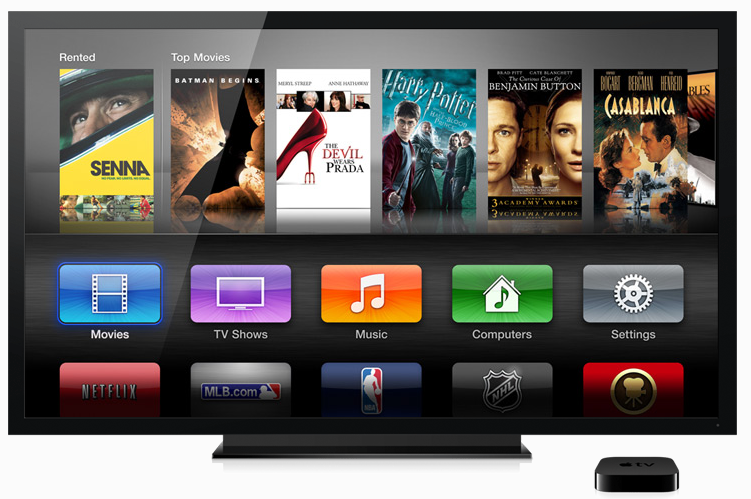
Apple just announced at a media event occurring in San Francisco’s Yerba Buena Center for the Arts that an updated Apple TV set-top box is capable of 1080p video output. Of course, 9to5Mac was the first to call that one. What is better: iCloud now streams movies in 1080p—an upgrade from the previous and often criticized 720p video resolution. Even more importantly, you can now access purchased movies in iCloud any time you want, just like with music and television shows.

Also updated is the Apple TV’s user interface. It is now more streamlined and taking advantage of the full 1080p video resolution. The new interface takes clues from iOS with its shiny new icons and the beautiful Cover Flow view. The new Apple TV has the same low price of just $99 and is available for pre-order today with shipments beginning March 16. In addition to the new Apple TV, Apple has tweaked its pricing matrix for movies and television shows on iTunes to reflect 1080p content. More on that below.


Expand
Expanding
Close

Tim Cook: Post-PC devices made up 76 percent of revenues

Site default logo image

Apple is having a media event underway at the Yerba Buena Center in San Francisco to unveil its third-generation iPad tablet. The company’s CEO Tim Cook just took the stage to share news about the new iPad. The executive noted that Apple has three post-PC products: The iPod, the iPhone, and the iPad.

“Now any company would be thrilled to have just one of these devices,” he said. “At Apple we’re fortunate to have all three.”

In total, 172 million post-PC devices were sold last year, accounting for 76 percent of Apple’s revenue. He remarked:

We have our feet firmly planted in the post PC future.

Apple now has 362 retail stores that greeted 110 million visitors just during the holiday quarter of last year alone. The company sold a whopping 62 million iOS devices last quarter and 315 million in total—the same numbers Apple shared while announcing the winner of the 25 billionth App Store download.


Expand
Expanding
Close

Liquid Metal announces shipment of amorphous alloy parts on iPad 3 launch

Site default logo image

Liquidmetal Technologies just announced it has begun shipment of commercial parts to unnamed customers around the world. The announcement of the Delaware-headquartered company is conveniently timed just two hours before Apple unveils its third-generation iPad at a media even in San Francisco’s Yerba Buena Center for the Arts.

The press release reads:

Liquidmetal Technologies today announced that its manufacturing operations are currently in the midst of shipping commercial parts to several of its customers world-wide. Parts delivery began this past December with continuing shipments scheduled for the months ahead.

CEO Tom Steipp noted that customers could use his company’s amorphous alloy technology to deliver “stronger, lighter, and more corrosion resistant parts.” Although no customer has been named, Apple is known to have obtained exclusive worldwide rights to use Liquidmetal’s patented metallic glass substance in consumer electronic products.

Specifically, Liquidmetal Technologies granted all of its intellectual property to Apple in 2010. There has been some speculation that the iPhone maker is already using the alloy in batteries and the SIM removal tool, but no compelling evidence has been produced to support those claims. With that in mind, the Cupertino, Calif.-headquartered consumer electronics giant has yet to make a jump from aluminum to metallic glass in its gadgets.


Expand
Expanding
Close

Last-minute rumor: Apple snuck Senseg’s groundbreaking haptic display technology into iPad 3?

Site default logo image

We are extremely skeptical about this one, but we are reposting it for the sake of discussion. According to Pocket-lint sources, Apple’s iPad 3 will include a new advanced tactile feedback technology that could add a completely new sensory input to the tablet. Unlike traditional haptic feedback that creates the sensation of physical touch with a small electrical stimulus (creating pulses that push against the finger), Apple’s solution allegedly puts an electrical pulse behind every pixel.

In theory, this would effectively create a 2048-by-1536 Retina display with so-called “textured feedback.” That is, it would add “texture” to objects on the screen when touched. Possible applications of this technology could be numerous and especially handy for both seeing and hearing issues. In addition, games would gain a whole new dimension if programmers could control screen pulses with a pixel-level accuracy and provide sensory perception of textures by varying friction between the screen and the user’s finger.

According to the article, Apple has been in talks with a Finnish startup called Senseg, the creators of advanced haptic display technology called E-Sense, depicted in the below clip. Now, when asked whether Apple licensed its technology, a company spokesperson told the publication “We won’t be making any statements until after Apple’s announcement.”
Similarly, Senseg’s technical marketing manager Petri Jekonen provided a similar answer to The Guardian newspaper yesterday:

That would be for Apple to say. My comment is no comment.

Furthermore, Senseg Senior Vice President Ville Mäkinen told Trusted Reviews that his company is “currently working with a certain tablet maker based in Cupertino.” The publication explains that the aim of Senseg’s technology is to “make a corrugated surface feel corrugated, a rough surface rough, a soft surface soft.”

On the other hand, Senseg CEO said less than four months ago that his company’s technology won’t be available for prime time for 1 to 2 years. “We’re certainly optimistic that we’ll have something in the next year. That might extend to 24 months,” he said in the below clip. The new iPad’s hardware design was likely finalized four months ago when Senseg’s CEO made those comments.

What is so special about Senseg’s technology, you ask? Read on…

[youtube=http://www.youtube.com/watch?v=5X-9-57qG9Y]


Expand
Expanding
Close

Apple granted major patent for iWallet, drawings depict iPhone with NFC, transactions via iTunes billing backend

Site default logo image

Ever since we first sampled the Starbucks app in September 2009, we could not help but wax eloquently how your iPhone will become your wallet. A deluge of ideas Apple has patented with NFC over time, and some interesting hirings, hint that the company is heavy into NFC. Then, in January, 9to5Mac heard from a developer at Macworld that iPhone 5 would have NFC and that MasterCard/Paypass would launch partners for an Apple-branded payment service that would span both iOS devices and Macs.

Fast forward to today, as the United States Trademark & Patent Office awards the company a major patent grant that covers the intricacies of the iWallet. According to PatentlyApple, this invention is supported by as much as 23 patent claims and dates back to the first quarter of 2009—indicating just how important it must have been to Apple.

The document outlines “techniques for implementing and defining financial transaction rules for controlling a subsidiary financial account,” allowing parents to control spending of their children, for example. Financial transaction rules are also detailed that would allow for spending limits based upon different criteria, such as a particular time period or geographic region.

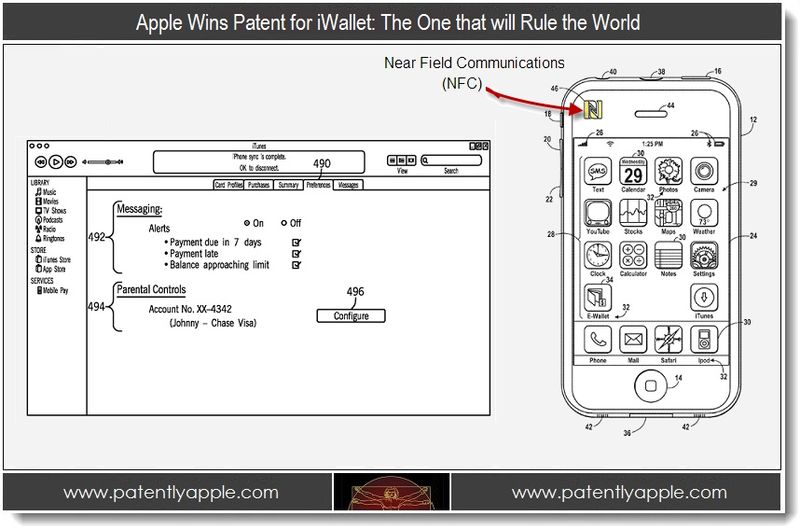
The really interesting part about this are the drawings included with the patent application depicting a future iPhone with Near Field Communications (see the above illustration). The drawings indicate the use of iTunes billing system for credit card statements and records. The iWallet app could also tie nicely with a number of other utilities Apple’s been researching, such as this iPhone app for buying movie tickets.

But what’s in all this for you and me?


Expand
Expanding
Close

Apple goes directly after Google, secures full disclosure of Motorola purchase and Android roadmap

Site default logo image

Apple’s latest cunning move in its Holy Crusade against Android involves getting a court order to force Google, the maker of Android software, to produce documents detailing the Android roadmap and its proposed $12.5 billion acquisition of handset maker Motorola Mobility. It was not immediately clear what data Apple was exactly seeking to uncover. This is notable, because Apple is actually going after Google with this request. It is the first direct in the ongoing legal war considering Apple fought Google by proxy in the past.

According to Bloomberg, U.S. Circuit Judge Richard A. Posner ruled yesterday based on a patent lawsuit Apple filed in 2010 against Motorola that both Motorola and Google must spill relevant information to Apple, as “the Android/Motorola acquisition discovery is highly relevant to Apple’s claims and defenses.” Motorola, of course, opposed the request, offering the following argument.


Expand
Expanding
Close

Adobe announces Photoshop Lightroom 4 availability, upgrades from $79

Site default logo image

[youtube=http://www.youtube.com/watch?v=q0ZHtNGrhIA]

Photoshop maker Adobe, Inc. today announced in a blog post general availability of its Aperture competitor Lightroom. A free beta of Photoshop Lightroom 4 was posted two months ago and today the software is available for education customers on both Mac OS X and Windows platforms. The company’s Vice President of Products and Creative Media Solutions Winston Hendrickson billed Lightroom 4 “a stunning new release that will enhance photography workflows and help photographs stand out from the crowd.”

Amongst the new features, Adobe touts the new shadow and highlight recovery capabilities, the ability to soft-proof images, improved auto adjustments to dynamically set values for exposure and contrast, and added local adjustment controls, such as noise reduction, moire, and white balance. The new Books and Map modules let you order photo books and display geotagged images on a world map with reverse geo-tagging controls, respectively. You also get new video controls to play, trim, and extract frames from video clips and export in H.264 to Facebook and Flickr.

More information about Lightroom 4 is available at the Adobe website. You can order the application for $149.99 as a standalone download or pay $79 for an upgrade. Alternatively, customers who purchased Photoshop CS5, Photoshop CS5 Extended, or any Creative Suite 5.5 edition can get Lightroom 4 for $99.

The full press release is below.


Expand
Expanding
Close

Apple squashes Time Machine bugs with Mac OS X 10.7.3 Supplemental Update 1.0

Site default logo image

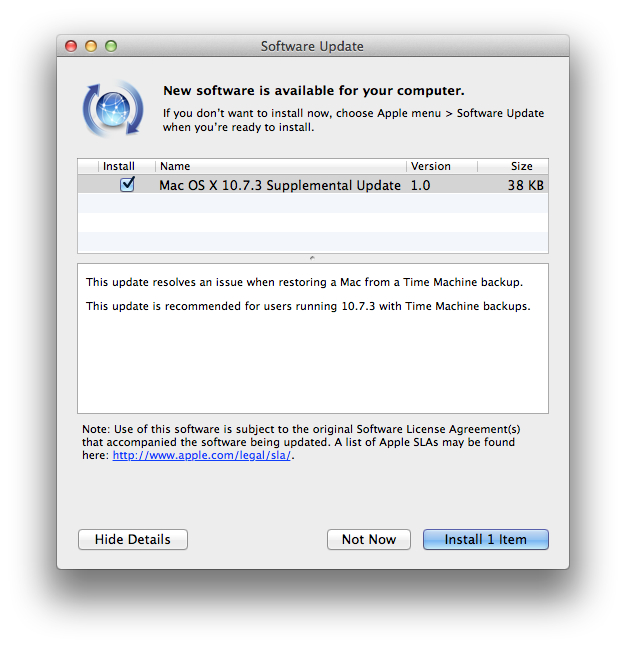
Apple just issued a maintenance update to the Mac OS X Lion 10.7.3 system update that was released into the wild a little over a month ago. The Mac OS X Lion 10.7.3 Supplemental Update, which is available through Software Update under the Apple menu or as a standalone download here [24.55MB], fixes an issue when restoring a Mac from a Time Machine backup. Apple said the update is recommended for users running 10.7.3 with Time Machine backups.


Expand
Expanding
Close

Facebook Messenger coming to Mac, hits Windows boxes

Site default logo image

In another display of how native apps are beating the web, the social networking behemoth Facebook revealed intentions to launch its first native chat client for the Mac. Put simply, it brings Facebook to your desktop and lets you chat with people without logging into Facebook.com in a browser. The company posted Messenger app for iPhone in August 2011 and today released the Facebook Messenger for Windows client, bringing the Facebook Chat functionality to beige boxes.

A Mac version will follow shortly. The Windows client requires Windows 7. Support for Vista is on its way and there are no plans for an XP version, the company said. If you are a daily Facebook user, you will want to integrate this handy program into your daily workflow. True, you can already set up a Facebook Chat account in iChat, as well as Pidgin, Adium, or other IM apps using the industry-standard Jabber protocol. If I were theatrical about this one, I would claim that the arrival of the native Mac client marked an important milestone in our daily productivity.

Bear with me for one more second…


Expand
Expanding
Close

Apple appeases 15 million unofficial iPhone users on incompatible China Mobile network with software fix, due shortly after iPad 3 unveiling

Site default logo image

China Mobile, the world’s largest wireless company with 665 million subscribers, confirmed Monday that it now hosts 15 million iPhones on its network with an average of 35,000 new iPhone activations each day. Back in October, its network hosted 10 million iPhones. People get excited about T-Mobile USA’s 1 million iPhones, so it is worth pointing out that China Mobile’s number is more than seven times larger than what Sprint has—and it is not even Apple’s official carrier yet.

The real kicker: Those people do not get 3G service as China Mobile’s 3G TD-SCDMA network is incompatible with iPhone 4S. Similar to T-Mobile USA, China Mobile employs a different type of high-speed 4G-radio technology that the iPhone 4S cannot use. As a result, both networks’ customers are relegated to using EDGE/GSM data speeds.

iPhones are sold in China through carrier China Unicom, but that is bound to change soon. China Telecom, the country’s second-largest carrier with 130 million subscribers, will start selling the sought-after smartphone this Friday.

It would seem the China Mobile iPhone is a no brainer as 15 million people already unofficially use the device on China Mobile’s network with many more millions in the 1.33 billion-people market deemed potential subscribers. Another piece of information also indicates that Apple and China Mobile could be in the final stages of negotiations to bring the iPhone to China Mobile’s network. Read on…


Expand
Expanding
Close

iPad 3 round-up: Retina Simulator out, Retina iPads running iOS 6.0 in server logs, 20MB download limit concerns

Site default logo image


An example iPad 3 app screenshot simulated using the Retina Simulator tool. Click for larger.

The forthcoming March 7 announcement of a third-generation iPad will (again) force third-party developers to update user interfaces with high-resolution graphic assets that will take advantage of the tablet’s substantial pixel density increase. Some developers took to Twitter to complain that Apple currently does not provide tools for them to test how apps will look on the iPad 3. Enter Ryan Petrich, who is an iOS developer and mobile engineer at Medialets.

With a bit of good ole’ under-the-hood pluming, Petrich put together a nifty hack that lets developers test existing iPad apps on iPad 3’s Retina Display. It reportedly maxes out at a whopping 2048-by-1536 pixel resolution. The tool is called “Retina Simulator,” and it is available free of charge here.

Developer Steve Troughton-Smith tapped Petrich’s tool to create gorgeous high-resolution screenies depicting how incredibly crisp and detailed Retina-optimized apps will look on the upcoming iPad 3. Just click on any image in this article for full-resolution awesomeness. Marvel. Repeat.

Meanwhile, a credible publication analyzed server logs and found traces of iOS 6.0 and iPads rocking Retina Display originating from Apple’s Cupertino campus.

Continue reading for more information on this and concerns related to over-the-air distribution of Retina-optimized iPad 3 apps.


Expand
Expanding
Close

Report: Bloom Energy to power Apple’s iCloud cell farm, the nation’s biggest non-utility fuel cell installation

Site default logo image


Apple’s $1 billion data center in North Carolina powers iTunes and iCloud.

We told you in October about a 174-acre solar farm Apple reportedly started building to power the new Maiden, N.C., data center facility. Surrounding the facility will be the largest end user–owned onsite solar array in the United States. It will consist of a 100-acres and a 20-megawatt facility to provide approximately 42 million kWh of clean, renewable energy each year. The company’s 2012 Environmental Update from two weeks ago revealed plans for another five-megawatt non-utility fuel cell installation—the nation’s biggest—right next to the data center.

Supposedly running on biogas made from landfill waste and carbon-neutral, it will offer 40 million kWh of 24×7 baseload renewable energy every year. Now, GigaOM has it “from a couple sources” that Apple commissioned fuel cell maker Bloom Energy to supply the firm with fuel cells for the facility. Apparently, Apple already has “a few Bloom fuel cells running on its campus.”

Bloom’s fuel cells are large boxes that suck up oxygen on one side and fuel (natural gas or biogas) on the other to produce power. That means that with the fuel cells (and a solar array that will be built) Apple’s data center will have a source of cleaner distributed power that isn’t coming from the local utility via the grid. Bloom offers boxes capable of supplying 100 kW, which could translate into 50 Bloom Boxes being installed at Apple’s data center.

Each Bloom Box costs $700,000 to $800,000 and takes about as much room as a parking space. The Bloom Boxes are approximately 67 percent cleaner than a typical coal-fired power plant or the grid, and 12 were installed at Adobe’s San Jose campus. Bloom Energy also has deals with Bank of America (500 kW), Coca-Cola (500 kW), FedEx (500 kW), Staples (300 kW), Cox Enterprises, and Walmart (800 kW), in addition to various telcos and Silicon Valley giants, such as eBay (500 kW) and Google (400 kW). The firm is also in talks to build a 30 MW fuel cell farm consisting of 300 Bloom Boxes in Delaware.

CEO K.R. Sridhar founded the Sunnyvale, Calif.-headquartered fuel cell maker in 2002. Originally called “Ion America,” it was renamed to Bloom Energy in 2006. Now, what is interesting about Bloom Energy is that the company was funded by Apple’s old pal, venture capital firm Kleiner Perkins...


Expand
Expanding
Close

New Apple Stores coming to London’s Harrod’s, Italy’s Turin, Sweden’s Stockholm, US’s Portland and Houston

Site default logo image

Having successfully reset the center of Amsterdam with the beautiful Hirsch store—the company’s first in the Netherlands, while gearing to launch a landmark outlet in London’s world-famous Harrods department store by mid-March (quite possibly coinciding with iPad 3 availability), Apple is ready to open new retail outlets in the United States and overseas. Per the latest retail chatter, Apple now plans to build four new stores, including an outlet in Houston’s Highland Village Shopping center at Westheimer and Drexel, and a spectacular store at the old Saks space in downtown Portland, Ore.

A retail application from an unnamed company that Portland is reviewing describes a block-long glass storefront with a 10-foot deep plaza in front in Saks Fifth Avenue at the Pioneer Place shopping mall.

Likely replacing the existing Apple store building’s basement, OregonLive.com reports the development plan calls for a “single story building and outdoor plaza area… fully glazed with clear glass.” The report also mentioned “bead blasted, matte finish stainless steel panels,” another tell-tale sign of an Apple store.

A Google Maps view on the right, courtesy of ifoAppleStore, outlines the proposed area for the store in yellow. Plaza steps are planned and the entire store is slated at 165 feet wide with 22 glass panels. Downloadable PDFs offer a glimpse into the project description and drawings and the ground-floor plan. The design review of the proposed store is due March 15 at 1:30 p.m.

More information on other upcoming outlets, including Italy’s “most important store,” are after the break.


Black curtains hiding the glass front of Apple’s upcoming store in Houston’s Highland Village Shopping center at Westheimer and Drexel. Image credit: Chron.com


Expand
Expanding
Close

Munster on Apple’s mythical HDTV set: ‘It will be the biggest thing in consumer electronics since the smartphone’

Site default logo image


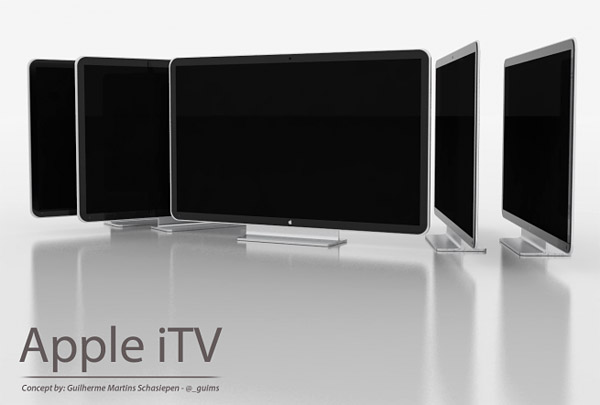
Pictured above: An Apple television concept render by Guilherme Schasiepen.

Piper Jaffray’s resident Apple analyst Gene Munster stands out as arguably the most outspoken proponent of an Apple-branded HDTV television set otherwise known as the mythical iTV. With all eyes now on Apple’s iPad 3 unveiling next Wednesday, the pundits are also keeping their fingers crossed for a much-needed Apple TV refresh with 1080p video output and a faster processor, especially now that Apple TVs are increasingly disappearing from shelves.

Piggy-backing on the forthcoming product unveiling hype, Munster shed more light on what he believes a full-blown television set adorned by the shiny Apple logo should be like during yesterday’s interview with Bloomberg Radio’s Tom Keene and Ken Pruitt. Munster is betting Apple will introduce the rumored product some time this year and is expecting fall availability. You will want to buy it, because:

It’s going to live up to some of the building hype. It will be the biggest thing in consumer electronics since the smartphone.

From a design standpoint, the iTV “will look different” than your regular television: “Imagine just a sheet of glass – no edges or bevels.” The analyst re-iterated his previous observations, including strong focus on content consumption (presumably delivered through iTunes/iCloud) and Siri voice control


Expand
Expanding
Close

Apple tops Fortune’s World’s Most Admired Companies five years in a row

Site default logo image

The 12 months of 2011 were an exhilarating ride for Apple of Cupertino, Calif. It went through a major leadership transition after the company lost its cofounder Steve Jobs and op-chief Tim Cook took the reigns and appointed several new executives. The iPhone 4S became a huge success and pushed Apple’s market capitalization above the half a trillion-dollar valuation.

Editors at Fortune magazine did not have second thoughts when ranking Apple first on its annual list of World’s Most Admired Companies due to the company’s impending iPad 3 unveiling, off-the-chart sales, and beautiful new retail stores like the upcoming Amsterdam outlet. Seasonal product refreshes and new rumored gizmos (of which an Apple-branded HD TV television set is conceivably everyone’s favorite) helped Apple garner the spot, as well. Mind you, Apple earned this coveted title for five years in a row.

Here’s from the publication’s editors:

Expand
Expanding
Close

Readability lands on iOS devices

Site default logo image

After a long wait and several setbacks, the free Readability app finally landed on iOS devices. Readability is a universal binary that supports both iPhone/iPod touch and has a native iPad interface. According to a blog post announcing the software, the app was born from a collaboration between the Readability team and the talented designers and builders at Teehan+Lax.

It features clean typography from Hoefler & Frere-Jones to turn any web page into a clean view for reading now or later on an iOS devices or desktop with the free Readability browser add-on. Articles seamlessly sync between platforms through an unlimited, searchable archive on the Web.

A paid subscription is still available to those wishing to reach beyond the most recent articles in their Reading List, including the ability to use daily digest of the Reading List on the Amazon Kindle. Early reviews by The Verge and MacStories are positive and it looks like Instapaper maker Marco Arment should worry, indeed (he just updated the Instapaper browser bookmarklet).

Readability for iOS is a free download from the App Store.

The image gallery and release notes are below.


Expand
Expanding
Close

Digitimes: 14 inch Asian MacBook Air, in April, no more 64GB iPads, iPad Mini in Q3, Retina display shortages

Site default logo image

Over the past 24 hours, Digitimes has posted a series of reports each a bit more outlandish than the ones previous to it.  They’ve been right on some stuff in the past but lately it doesn’t seem like they are even paying attention anymore.  Our colleagues at other Apple blogs have been posting every one of these so let’s run them down.

Last night/this morning: Apple ‘considering’ a 14-inch MacBook for Asian Market.

Currently, 14-inch panels are the mainstream specification of the Asia notebook market, while consumers in Western countries prefer 15-inch models. In the global market, 14-inch models have an about 20-25% market share, but in Asia, the market share is about 35-40%, an indication of Asia consumers’ fondness for 14-inch models, the sources noted.

So Apple is going to make a .7-inch bigger MacBook (vs. 13.3 is current) specifically for the Asian Market?  Makes no sense.  Apple won’t even make an iPhone for China Mobile’s 600 million subscribers.  We’re not doubting that Apple could change its size matrix, we just don’t think they will do a special size just for Asia.

Within hours, Digitimes said:

Apple is expected to launch new MacBook Pro notebooks with an even thinner and lighter design than existing models in April, at the soonest. When paired with the company’s upcoming Mountain Lion operating system as well as Apple’s MacBook Air models, the product lines are expected to create a significant threat against notebook players’ ultrabooks, according to sources from the upstream supply chain.

Apple is expected to launch upgraded 13- and 15-inch MacBook Pros in April with initial shipments estimated to reach 900,000 units.

Mountain Lion is currently scheduled for “late summer” as when it will be cut loose.  Also, Digitimes among others, said that Intel’s next processors weren’t coming out until June.  So Apple is going to release a new MBP a few months before new processors?

Tonight it got even more abstract:
Expand
Expanding
Close