American carrier AT&T is planning on eliminating its $10 a month messaging (a thousand text messages) come this Sunday. Instead, they’re forcing pricier plans upon new iPhone customers. In their vocabulary, it’s only a “streamlining”, a spokesperson for AT&T toldEngadget:
Starting August 21, we’re streamlining our text messaging plans for new customers and will offer an unlimited plan for individuals for $20 per month and an unlimited plan for families of up to five lines for $30 per month. The vast majority of our messaging customers prefer unlimited plans and with text messaging growth stronger than ever, that number continues to climb among new customers. Existing customers don’t have to change any messaging plan they have today, even when changing handsets.
It is obvious the new plans work towards milking iPhone customers for extra profits. Let’s not forget they in January AT&T had also killed $5 and $15 messaging plans. Additionally, their pay-per-message options are clearly overpriced at twenty cents for a text message and thirty cents for a media-rich MMS. Fortunately, carrier-controlled messaging is a dying dinosaur as come this Fall…
Reutersreported this morning that top brass from China Mobile, the world’s largest carrier by both subscribers and market valuation, and Apple’s head honcho Steve Jobs met “several times on introducing an iPhone based on its network standard”. Did Jobs travel incognito or was he accompanying Apple’s operations wizard Tim Cook during his China tour (snapped paparazzi-style in the shot below)?
More likely, Jobs probably hosted China Mobile reps in Cupertino.
Interestingly, China Mobile counts a cool 7.44 million iPhone users on its network, although it doesn’t carry the handset yet and iPhone users cannot tap 3G speeds on their TD-SCDMA 3G network.
Apple’s been alleged previously as wanting to release an iPhone optimized for China Mobile’s fourth-generation TD-LTE network. The Wall Street Journalchimed in with sources saying the gadget maker and China Mobile are close to cutting a deal set to open up the carrier’s 600+ million subscribers to Apple’s phone. The highest-level meeting isn’t surprising considering that Apple is only “scratching surface” in China, having reported in the June quarter a sixfold growth in the country for a total of $3.8B in revenues from operations in the country.
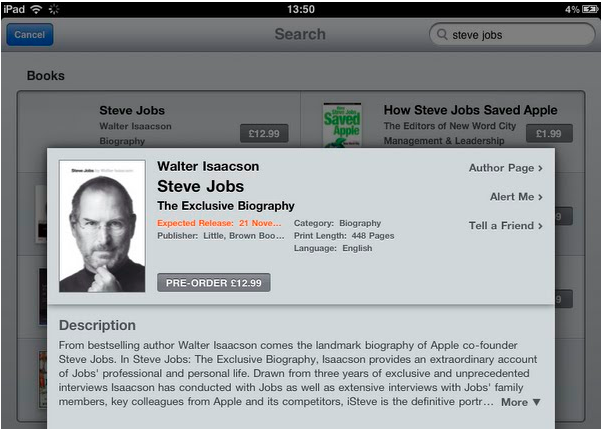
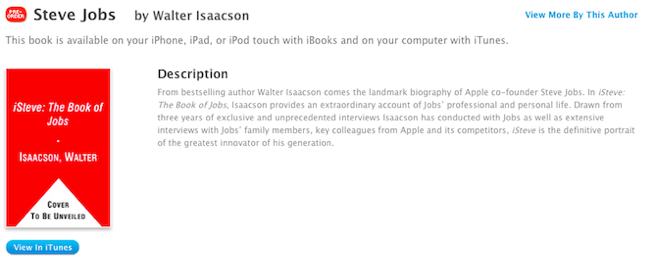
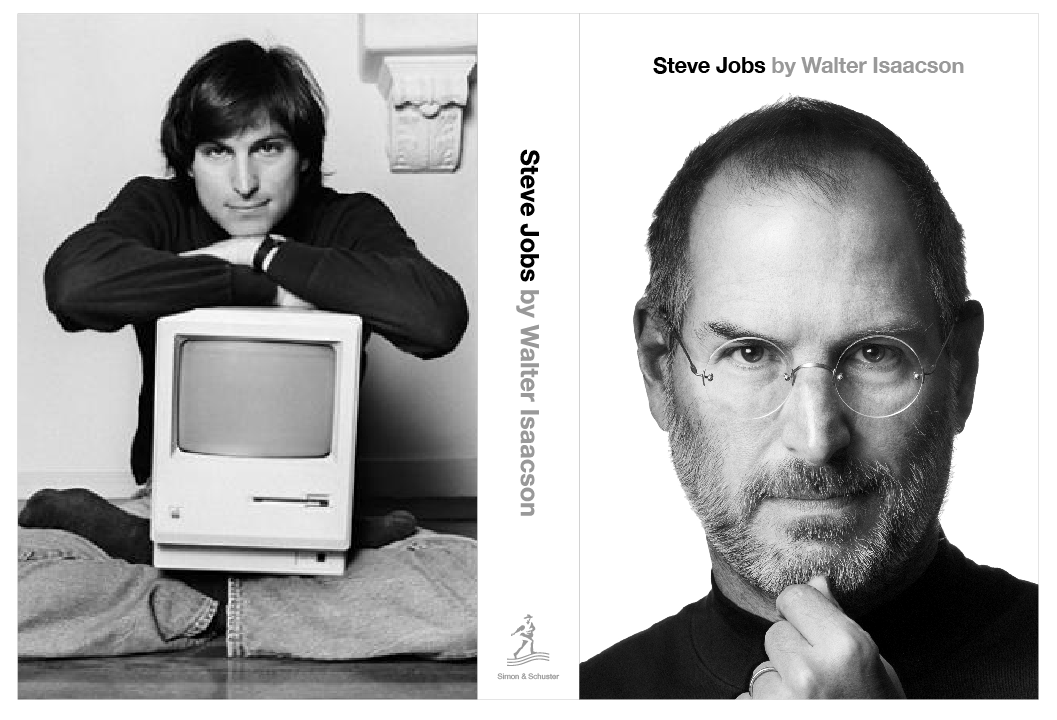
The official Steve Jobs biography by Walter Isaacson, which is now set for the November 21 release, has been available for pre-order on Amazon for a while and Apple’s iBooks store also had an entry and meta data in place, but without a price and sporting the old cover, depicted below. A tipster told us (thanks, Roshan Z.) that iTunes now lists the book for pre-order for $17 (or 13 quid, above), also featuring the new cover by Albert Watson and the official description from publisher Simon & Schuster, as evident in the updated iTunes listing on the web.
Interesting that Amazon has also updated the blurb, but they still show wrong publication date (the original release date of March 6, 2012) and incorrect tittle, “Steve Jobs: A Biography” as opposed to just “Steve Jobs” (the original, rather painful title, was “iSteve: The Book of Jobs”). The online retailer has a $19.50 price tag for the hardcover, which makes it a much better deal for those preferring a dead tree version – $2.50 more compared to the digital download over at the iBooks store. iTunes already has nine “reviews” from fans eagerly awaiting this high-profile release. Also find two screenshot for the iPhone below the fold.
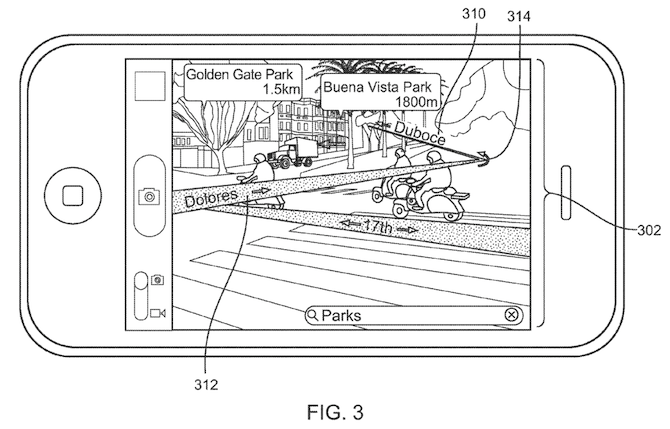
While there are plenty of augmented reality apps that highlight nearby points of interest overlaid over live video feed, this feature is still non-existent in iOS Maps app. But a number of mapping-related patents and quiet acquisitions of startups focused on mapping tech indicate that Apple has been quietly working on taking the mapping experience on iOS devices to the next level.
The latest patent application Apple filed with the United States Trademark and Patent Office is the best example of that. Simply titled “Augmented Reality Maps”, it describes a next-generation mapping app for iOS devices that augments live video feed of your surroundings with various points of interest overlays based on your geographic position, camera direction, tilt of the device and even based on a landmark:
The handheld communication device visually augments the captured video stream with data related to each point of interest. The user then selects a point of interest to visit. The handheld communication device visually augments the captured video stream with a directional map to a selected point of interest in response to the user input.
The twist? Apple’s solution would provide really interesting data, including street names, and would be clever enough to issue warnings when a user is heading in the wrong direction when navigating. “In some instances, street signs may be missing or indecipherable, making it difficult for the user to find the directed route”, the company argues, adding:
In one form of interaction, a device can receive input from the user requesting directions from a present location to a selected search result. Directions can be overlaid onto the presently displayed video feed, thus showing a course and upcoming turns
Patently Apple has more information on the filing. Apple credits engineer Jaron Waldman with coming up with this invention, available in full detail by typing in a document ID of 20110199479 into the USPTO search engine. The same person was also credited in the recent “Schematic Maps” patent application describing how a mobile device could dynamically detail important points of interest. Why is Waldman important?
Although Apple’s name still is not mentioned in paperwork accompanying a 8,084-square-foot project at the Third Street Promenade (where Apple already operates a smaller store), said to feature the spectacular glass ceiling and the front façade, media outlets don’t have the slightest doubt that this in fact is an upcoming flagship Apple store. Just 24 hours after it came to light, city staff apparently greenlighted the project, reportsSanta Monica Dispatch.
As it does with all commercial projects, City staff prepared a detailed staff report on the Apple project (though it did not mention Apple and purported not to know who the actual builder was), complete with renderings, and, as it virtually always does, it concluded that the commission should approve the project and it should go forward.
What’s interesting about this, according to author Peggy Clifford who attended the meeting, is that Santa Monica Planning Commission approved the project without even discussion:
The surprise was that the staff put the project on the Consent Calendar. I cannot remember any large, complex commercial project ever going on the Consent Calendar. Apple was the only item on last night’s Calendar. And, under the rules, the Consent Calendar is approved as a whole – unless someone wishes to pull at item for discussion. And in that crucial blink, the commissioners approved the Consent Calendar (aka Apple Glass House), and that was that – except for a staff report on the redesign of the Project Case List, after which they adjourned.
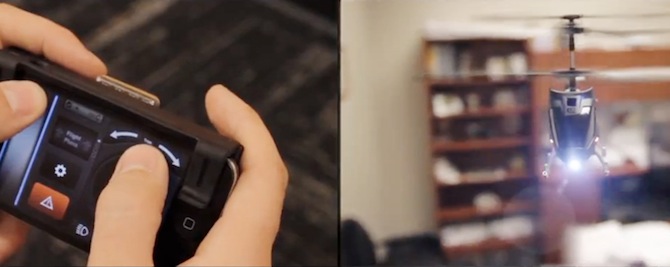
Add Griffin Technology on your wish list of iPhone-controlled helicopter makers (and Parrot’s AR.Drone and Keyword Shopping’s iHelicopter, if you haven’t yet). The Helo TC, announced today, works with a free iOS app that lets you control a twin-rotor helicopter by the means of touching virtual buttons or tilting your device. Interestingly, the app talks to the helicopter using an infrared battery-powered module attachable to your iOS device’s headphone jack rather than communicate via a wireless base station in your home or office.
You can even store your best maneuvers as presets and invoke them later to amaze your boss. We can tell why these things are popular in offices, if the below over the top commercial is an indication. Three people can play at once, each on a different channel. The Helo TC costs fifty bucks and is available now from the company’s online store and the iOS app is a free download from the App Store.
Louie Mantia is leaving Apple, where he served as a visual interface designer for the company’s iTunes Design team, an announcement was made yesterday on Twitter. He is leaving for Square, a San Francisco mobile payment startup founded by Twitter co-founder Jack Dorsey. Square, as you recall, is behind an iPhone app and the accompanying dongle which turns the handset into a cool mobile payment terminal.
Apple loves it and we’re sure Mantia will appreciate it, too, when getting paid for freelance work. The iTunes Design team is “specifically looking for visual designers”, Mantia wrote on Twitter, advising candidates interested in filling his shoes to link him to their portfolio:
My position at Apple in iTunes Design will be available soon, so if you are interested, send me a link to your portfolio!
If you’re not familiar with the name, here’s a little backgrounder to get you up to speed…
All Things Dreports that Apple’s vice president of mobile advertising Andy Miller is leaving the company, citing “sources close to the situation”. The departure is interesting because Apple in early 2010 snatched mobile advertising firm Quattro Wireless for $275 million, the company Miller co-founded back in 2006.
Miller will go on to become a general partner at venture firm Highland Capital and staffers at Apple were reportedly told today of his “impending departure”. It is also an undesired setback for Apple’s iAd mobile advertising platform, which had gotten off to a good start only to fade to irrelevance due to high prices and Apple’s seeming inability to exercise flexibility with major marketing agencies who are not used to dealing with such a controlling middle-man.
UPDATE [August 18, 2011 10:58am Eastern]: The online Apple store is back up after it mysteriously went offline this morning. No new products were added, it appears but some new social buttons are popping up. Ping us if you spot anything unusual.
File this under the “wow, just wow” category. According toCurbed (viaMacRumors), Apple could be interested in building a new store at the Third Street Promenade in Santa Monica, California, right in the neighborhood of another store the company already runs in the area. What’s interesting about this particular brick-and-mortar shop is concept. Breaking away from its usual flagship stores design, this could be Apple’s first-ever flagship store with an all-glass transparent ceiling (sans the Upper West Side store), accentuated by an “expansive floor-to-ceiling height”, per this proposal (PDF document) from applicant Howard Robinson.
The document describes a 8,084-square-foot building with a 5,210-square-foot basement. The front façade is said to consist “entirely of transparent glass panels that will project five feet from stone paneled side walls”. Even though the proposal never names the iPhone maker directly, no other company in the world save Apple is famous for its love for glass store design on such a large scale. It could be, however, anything so take this report with a healthy dose of skepticism as we are running it for the sake of discussion. Another interesting tidbit regarding a transportation program for store workers:
The applicant will offer all full-time retail employees a $100 monthly transit subsidy towards the purchase of transit fare and a $20 per month bicycle reimbursement subsidy for improvements, maintenance, and service. In addition, secure bicycle parking for employees of the building will be located in the basement level.
As Apple gears up to launch iPhone 5 (possibly on October 7), the company has been aggressively building new stores to meet high demand for its many products. Three new grand openings are due this coming Saturday in America, England and Spain. In China alone Apple promised up to 25 new stores by the year’s end, including another flagship brick-and-mortar building in Hong Kong…
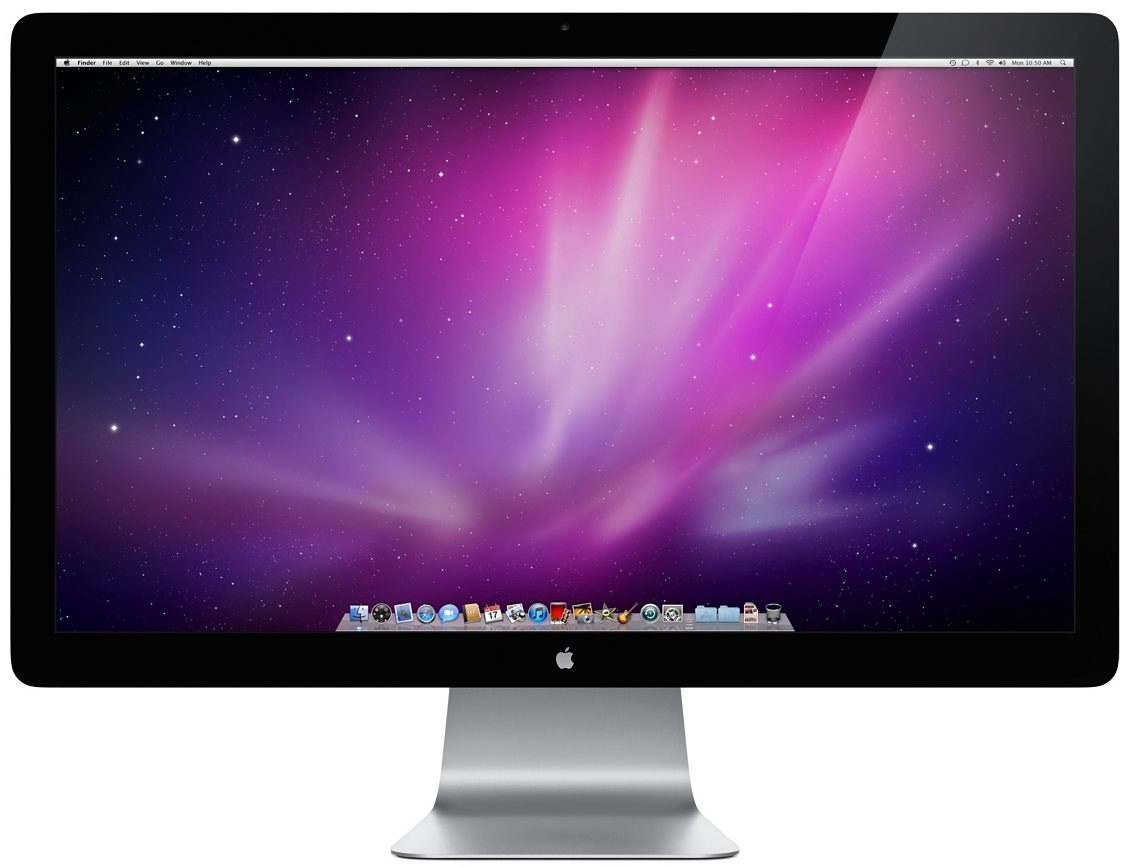
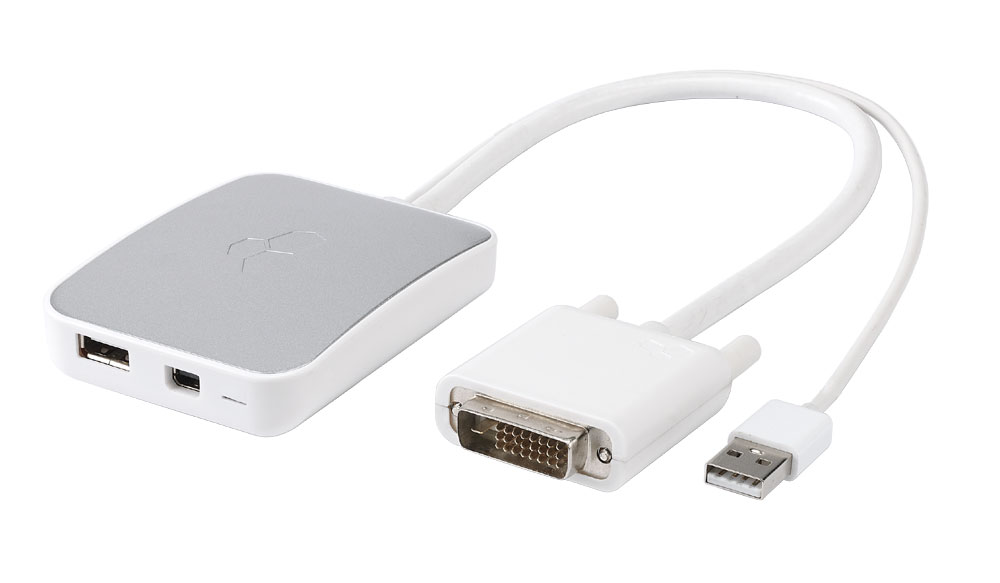
If you have a DVI-equipped Mac or PC that you want to hook up with the gorgeous 24-inch or 27-inch LED Cinema Display (available refurbished for just $599 and $849, respectively), you will need one of them adapter boxes because Apple’s display only understands DisplayPort interface. Kanex’s cryptically named C247DL cable lets you feed the display from a full resolution dual-link DVI source – that’s right, the whole 2560-by-1440 pixel resolution. Additionally, it sports a USB-to-Mini-DisplayPort converter so you won’t lose the added functionality of the display’s iSight camera and USB ports found on its back.
The included USB cable also powers the adapter and allows for audio transfer to the display’s speakers. The box is especially handy for users with legacy Macs, including early-2006 and early-2008 MacBook Pros, as well as mid-2005 and 2007 Mac minis. And what’s in it for the PC types? Well, if your PC packs in a high-end graphics from AMD or Nvidia, you can now play the latest games living room style, on Apple’s monstrous 27-inch display. Price? Just $149 a pop, available at the Kanex online store.
A pair of teaser images posted on Madrid’s Parquesur mall’s Facebook page.
That Apple’s retail chief Ron Johnson is on its way out, taking over CEO post at JC Penney early 2012, hasn’t affected the slightest bit the company’s aggressive retail expansion. Last week, the gadget maker opened five new stores: Two in the U.S. (one in Anchorage, Alaska and the other in Murray, Utah), a store in Research In Motion’s Waterloo, Ontario homeland, as well as shops in Australia’s Cheltenham and Italy’s Florence. But Apple ain’t resting on their laurels: They’ve scheduled three international grand openings for this weekend.
ifoAppleStoreexplains this entails a Bay Area shop, the first Apple Store opening in the area in nearly three years. The new 4th Street store at Berkeley, North California will be open for business beginning 10am this Saturday. At the same time, another store will greet visitors in the United Kingdom, at the Festival Place shopping mall in Basingstoke southwest of London.
That’s just tip of the iceberg, though. Apple last month confirmed in an earnings call twenty new stores before the end of September, including a new flagship store in Hong Kong meant to at least partially satisfy the insatiable appetite of the Chinese. In all, Apple plans on opening up to 25 new stores in China by the year’s end. These new stores will serve to meet Apple’s growth while supporting their other grandiose undertakings.
Take, for example, the monumental shopping experience Apple has in store for New York’s Grand Central Terminal, depicted below. The company is also replacing the iconic glass cube at New York’s Fifth Avenue – which is also one of the city’s top photo attractions – with a simpler version sporting just fifteen glass panes, three per side, down from ninety. The new, seamless glass cube will cost six million dollars. Go past the break for more information and images about Apple’s third store opening in Spain.
CLICK FOR LARGER The Metropolitan Transportation Authority this morning released high-quality renderings depicting Apple’s monumental 23,000-suqare-foot retail space integrated right inside New York’s landmarked Grand Central Terminal. It will sport a long balcony and elevator lobby, among other treats. Apple will be paying for the elevator and a cool $1.1 million to rent space from Charlie Palmer’s Metrazur restaurant.
Image courtesy of Simon & Schuster. Click for larger.
The official Steve Jobs biography, which is based on forty interviews and set for publication by Simon & Schuster November 21, sports the memorable front cover shot depicting Apple’s leader touching his guru-like beard, his eyes piercing intensely at the camera and eyebrows slightly lifted as if he is imagining Apple’s next big thing. That image, also found on Apple’s recently revamped PR website under the Apple Leadership section, is the Albert Watson portrait taken in 2009, author Walter Isaacson revealed in a private email exchange with Fortune’s Philip Elmer-DeWitt. The back cover?
The back is a Norman Seeff portrait of him in the lotus position holding the original Macintosh, which ran in Rolling Stone in January 1984. The title font is Helvetica. It will look as you see it, with no words on the back cover.
More important to Apple fans, the earlier than expected book launch – which had been originally pinpointed for March 6, 2012 – has nothing to do with the state of Steve Jobs’s health, Isaacson told Fortune’s Elmer-DeWitt. Apple’s boss has gone on an indefinite sick leave in January 2011, his third health-related leave of absence from the company he co-founded. Here’s from Isaacson:
It’s actually not related to any decline. I turned most of the book in this past June. It’s now all done and edited. The March 2012 date (or whatever date it was) was never a deeply-considered pubdate. Like the original cover design, it came about because the publisher wanted to put something in the database last spring.
This is obviously an important tidbit for Apple fans concerned about Steve’s well-being. Go past the fold for the publisher’s long description of the book. The book is available for Pre-Order at Amazon for $20.
As we inch closer to the late 2011 iPhone 5 introduction, more parts purported to belong to a fifth-generation iPhone find their way onto the web at large. MacPosthas discovered (viaMacRumors) several components claimed to represent iPhone 5 parts, including the headphone jacks (above), camera lens and proximity sensor flex cable which is pictured in the above below. Note that these are actually iPhone 5 replacements, not the actual parts used in manufacturing of the handset.
They were floated by Chinese resellers and as such may or may note indicate the internal design and features of the handset. It could be also Asian resellers looking for some free press. “They’re superficially similar but are subtly different to the iPhone 4”, notes the publication. The most interesting takeaway is that the headphone jack replacements come in both black and white, suggesting Apple will offer iPhone 5 in two colors, just like its predecessor.
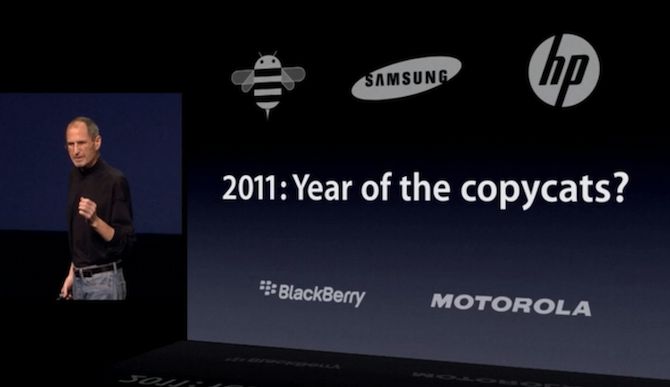
Steve Jobs at iPad 2 introduction in March 2011 rhetorically asked if 2011 “will be year of the copycats”, highlighting several times the iPad’s attractive selling price as a big advantages.
The billions in profits from iOS gadgets that Apple strategically invests to pre-pay long-term component deals is a crucial enabling factor that has been allowing the company to over time bring down the prices and make its gear more and more affordable to the growing number of consumers. Nowhere is this more evident than with iPad, which debuted with a “breakthrough” price of five hundred bucks, originally pricing the vast majority of competing tablets out of the market.
Despite a recent Strategy Analytics survey asserting Android’s share of the tablet market in June 2011 at 30 percent, in reality those numbers are inflated as all competing devices (which, by the way, include borderline devices such as e-readers and de-featured tablets) struggle to make it past store shelves. It’s the difference between shipping and actually selling something: iPad gets picked by millions of consumers each quarter whereas Apple’s rivals settle with channel shipments. Realizing their products are collecting dust on store shelves, tablet makers are scrambling to slash prices once again in a last-minute effort to “digest inventory overstock”, reportsDigiTimes, an Asian trade publication:
Non-Apple tablet PC players, facing the fact their devices are having weaker sales than their order volumes, while demand from the retail channel has been quickly shrinking, are expected to start cutting their tablet prices by the end of September to digest inventory and minimize losses, and the decisions are expected to trigger a new price war within the tablet industry, according to sources from notebook players.
The latest price cuts will arrive on top of the already slashed prices forcing Motorola, Hewlett-Packard, Asustek and Acer to offer their products from as low as $370. The sources talk about “at least two waves of price cuts from the end of September to the year-end holiday”, possibly reducing the average price of non-Apple tablets further to $300. It should come as a surprise that underpricing iPad is no guarantee of success because technology alone (and price) “is not enough”, as Apple boasts in its cool iPad commercials (you need apps, too!). Apple could also pull the iPhone 4-3GS trick with the iPad, selling iPad 2 at a reduced price of, say, $350, as the $499 iPad 3 debuts. One thing’s for sure: 2011 won’t be the year of copycats. So, who’s not selling their warez?
Starbucks has been an Apple partner ever since Steve Jobs placed a prank call to a Seattle, Washington-based international coffee and coffeehouse chain using the Google Maps app during the original iPhone introduction back in January 2007. “I’d like to order four thousand lattes to go, please”, he joked with an operator before quipping, “Sorry, wrong number”, earning him enthusiastic applaud from the MacWorld Expo audience (see video after the break). Since then, Starbucks and Apple have been involved in a promotion offering free iTunes downloads to iPhone customers visiting their coffee shops.
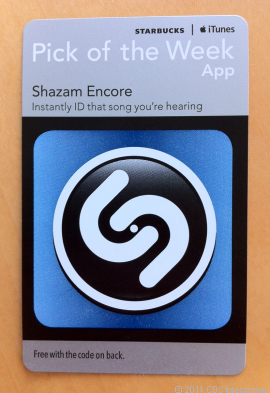
Also, Starbucks released the official app, in addition to Starbucks Card Mobile, another iPhone program which lets you pay for drinks and snacks using a Starbucks Card associated with the handset. Yesterday, the two partners started a new promotion (viaCNET) that allows customers to download a free iPhone app using the “Pick of the Week” cards waiting at the cash register. Just type in a code on the back of the card into the App Store app to redeem your free download of the day. Looks like they’re serious about providing real value here because the first app they’re giving away is Shazam Encore, a popular music fingerprinting app normally costing six bucks. Go past the break for a video snippet of that Steve Jobs prank call.
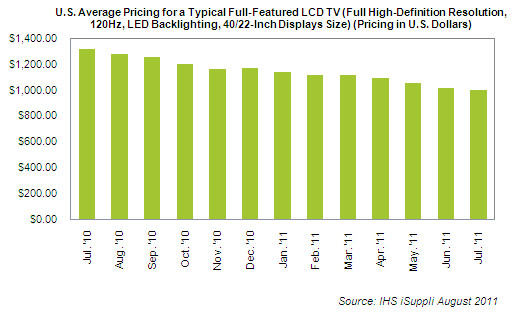
The above chart from research firm IHS iSuppli tells us that premium TV brands have been consistently lowering prices of high-end LCD TV units because white label makers have been on a roll, putting out inexpensive products with features previously offered by branded vendors only. According to IHS iSuppli, the average price of a typical high-end LCD TV in the United States dropped from $1,317.89 in July 2010 to $1,002.58 in July of this year. That’s a healthy 23.9 percent drop in just a year. IHS displays researcher Lisa Hatamiya:
Long the chief attraction for high-end brands like Sony and Samsung, features such as 1080p high-definition resolution, 120Hz refresh rates and LED backlighting technology now are cropping up in value brands entering the market, especially in the 40- to 42-inch space. But unlike their pricey counterparts, the new upstarts boast dramatically lower pricing. For example, value brands like Apex and Element offer 40-inch 1080p/120Hz LED sets for $550 at Target and Wal-Mart stores across the United States. In comparison, premium brands with the same features are priced at about $1,100—double the price offered by the discount brands.
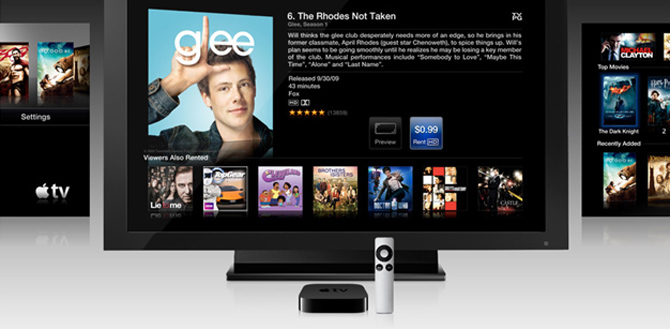
It has been speculated that a possible networked television set from Apple won’t gain traction due to vendors going after each other’s throat with low-priced commodity products that yield very slim margins. This would force Apple out of the entry- to mid-level range and the company would price itself even out of the premium segment, conventional wisdom has it. Then again, wasn’t the mobile landscape riddled with same barriers to entry prior to the iPhone? With the average selling price of a premium LCD TV falling below the magic $1,000 barrier, however, the timing for an Apple television couldn’t be better. A stylish 50-inch television set priced at $999 with the shiny Apple logo could easily hit the ground running and here’s why.
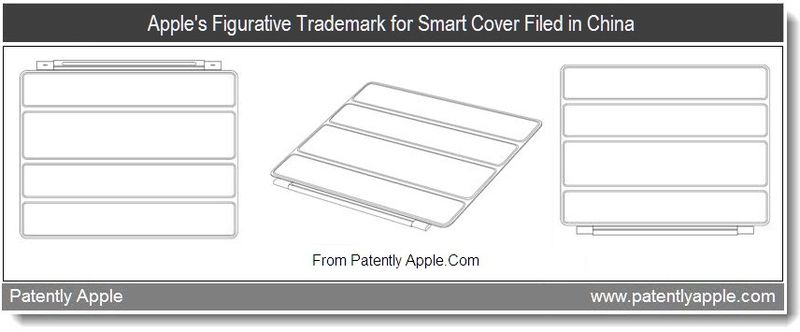
Remember Smart Case, that blatant rip-off of Apple’s Smart Cover that was traced back to Samsung and subsequently pulled following a 9to5Macstory? It will be much harder for Chinese knock-off vendors to put knock-off cases like that one on sale in the country because Apple, as Patently Applediscovered today, has filed for a figurative Smart Cover trademark in China. The company previously filed for the actual trademark Smart Cover name in Canada, the US, Europe and China.
However, a figurative trademark is much stronger as it “confers the exclusive right to the trademark in its concrete figurative version, whereas a word trademark confers the exclusive right to the word(s) in any font with or without figurative elements”, the publication explains. The patent application was filed today with the Patent & Trademark Office in China and covers covering cases, sleeves, sheaths and pouches for computers as well as business cases, claiming the above three-dimensional shape as an element of the trademark. Makes you wonder what took so long…
Google today announced in a blog post an agreement to acquire Motorola Mobility for $12.5 billion, a 63 percent premium to the closing price of Motorola Mobility shares on Friday, August 12, 2011. Is this an example of “moon shots” we’d been promised? Hard to tell as this is a developing story, but Google recently accused Apple and others of attempting to “strangle Android” through litigation.
Motorola Stock was suspiciously up last Friday on rumors of an Icahn takeover. Perhaps Icahn was gathering enough strength to make the decision.
A statement on Google’s Investor Relations site and Motorola Mobility’s press section quotes Motorola CEO Sanjay Jha, Google CEO Larry Page and the search firm’s senior vice president of mobile Andy Rubin as saying that this strategic acquisition will “enable Google to supercharge the Android ecosystem and will enhance competition in mobile computing.” It will be interesting to see how other Android backers react to the news that their operating system provider is in bed with one of their rivals. Google on its part says Motorola Mobility will “remain a licensee of Android and Android will remain open”, adding they will run Motorola Mobility as a separate business.
If the deal doesn’t go through, Google owes Motorola $2.5B.
Motorola Mobility, of course, has helped put Android on the map with their aggressive anti-Apple promotion of the original Droid. Still, Apple is reaping the vast chunk of profits in the handset business. Motorola Mobility in the June quarter reported a GAAP net loss of $56 million, 19 cents a share, on revenues of $3.3 billion and non-GAAP earnings at nine cents a share. They shipped 400,000 Xoom tablets, amounting to an estimated 2.65 percent tablet market share in June, and 4.4 million Android smartphones, enough to earn an eight percent market share and rank Motorola Mobility as the #8 smartphone vendor and #5 Android backer. Contrast this to Apple…
As you know, OS X Lion ships without Flash Player to the delight of fans in support of Apple’s ongoing argument against Adobe’s resource-hungry technology. This leaves us with three choices: Avoid Flash content altogether (possible, but hardly an option for mainstream folks), switch to Google’s Chrome browser that comes with the latest version of Flash Player built-in (a forced option for Safari fans) or just install the darn thing and deal with consequences later.
I’ve vowed never to install anything from Adobe again on my brand spanking new MacBook Air as I only allow Adobe software on my Mac mini, which I relegated to my testing machine and media center. That said, the FlashtoHTML5 extension from Joris Vervuurt was Godsent. The extensions has a sole purpose: It replaces the CPU-hogging YouTube Flash Player with an HTML5 video player. More info and screenies after the break
Adobe today released public beta of a new graphics design software, code-named Muse, aimed at web site designers. The release arrived on the heels of Edge, another Adobe tool that takes the pain out of creating motion and interaction on the web. Muse lets you create pretty HTML web sites with no prior knowledge of HTML5 and CSS3 standards, or so Adobe claims:
Create websites as easily as you create layouts for print. You can design and publish original HTML pages to the latest web standards without writing code. Now in beta, Muse makes it a snap to produce unique, professional websites.
The official 1.0 release is planned for early 2012, when Muse will cost $15 a month ($180 a year). A gallery showcases examples of Muse-built web sites incorporating HTML code snippets from sources including Google Maps, YouTube and Facebook. Muse also features other standard design elements, ranging from widgets and slideshow galleries to navigation menus.
You can even host your creation on Adobe’s servers for a fee, in addition to your other hosting providers. Muse is a free download available from Adobe’s site. Note that you will need Adobe’s AIR run-time installed in order to run Muse. Full release below the fold.
Amazon today released a new iPhone app for college students called Amazon Student. This one’s not about renting Kindle textbooks, there’s already an app for that. What Amazon Student does is it lets you trade used textbooks from the palm of your hand. Just scan barcodes of as many books as you like and the Amazon cloud will calculate trade-in offers for you. This also works for games, movies and electronics (including iOS gadgets). You can also put scanned items into your trade-in list to buy later.
Payments go to your Gift Card and Amazon will even mail a pre-paid shipping label to your address on file. Sweetening the deal, the online retail giant is offering free two-day shipping for six months to those who join the Amazon Student program (Amazon Prime shipping benefits included). Beats the craze of having to put your unwanted textbooks on offer at the end of each semester and deal with all sorts of weirdos and trade-in combinations. Amazon Student is a free download from the App Store. More screenies after the break.
If you’ve ever been *ahem* channel surfing late at night and stumbled upon HBO subsidiary Cinemax programming you know that there isn’t much differentiation between what you see there and all out pornography.
The news this weekend is that Apple just gave the go-ahead to Cinemax’s MaxGo App(free) for both iPhone and iPad. Yes, it includes “Late Night” content.
Far be it from us to judge what should and shouldn’t be on the App Store, but it seems that Apple is continuing to create controversy with its “no porn” stance.
In an email exchange with Gawker’s Ryan Tate last year, Jobs said that the iPad would offer users “freedom from porn.” And in a Q&A session after the launch of iOS 4, Jobs told reporters that porn was one reason Apple wouldn’t allow unsigned or unapproved apps onto iOS devices like the iPhone and iPad.
“You know, there’s a porn store for Android. You can download nothing but porn. You can download porn, your kids can download porn. That’s a place we don’t want to go – so we’re not going to go there.”
Playboy,which is at least as “soft-core” as SCinemax, was denied access to the App Store for its nude pictorials. For what it is worth, access to the Max Go app is parental controlled to users 17 or older.
If this story picks up, Apple will probably force HBO to curtail its mature content retroactively, not that there aren’t plenty of other outlets via Safari for such material. Expand Expanding Close
What we thought was a static file in iOS that correctly predicted the previous Saturday iOS 5 Beta 5 update turns out to be one that Apple can change remotely. Yesterday, it changed from Wednesday August 17th to Thursday, August 18th. We can only assume that Apple can change this on a whim so the date appears to be a target date, which we know can change. As of this writing, the target is in a week. We’ll keep you updated. (Thanks to iCloudil.com for notifying us of the change) Expand Expanding Close