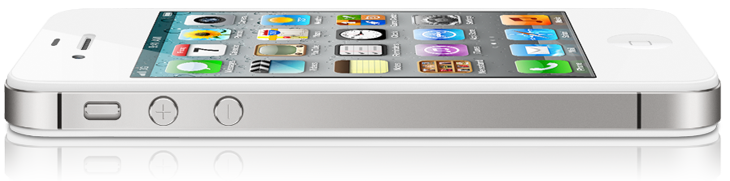
So about two weeks ago we got a tip from a reliable source that Apple was going to call the iPhone 5 (or whatever)- the new “iPhone”.
That seemed a little nuts at the time but what a difference a Keynote makes. As Christian explained, Apple chopped the suffix off if the iPad as part of a branding makeover that will likely expand. Just like iMac is not called iMac 1,2,3 it looks like Apple won’t be doing the numbering on iOS devices (though it never did with the iPod touch).
So that tip –That the next iPhone is simply the new “iPhone” – seems a lot more plausible now.
Following a report from Bloomberg in December featuring advice from analysts, we asked you if Apple should settle for up to a $10 royalty per Android device and not keep paying its lawyers to fight patent disputes. Today, Dow Jones Newswiresreports that Apple is interested in seeking settlements. According to the report, Apple “indicated a willingness to cut deals with competitors,” including Motorola and Samsung: Expand Expanding Close
Apple’s latest cunning move in its Holy Crusade against Android involves getting a court order to force Google, the maker of Android software, to produce documents detailing the Android roadmap and its proposed $12.5 billion acquisition of handset maker Motorola Mobility. It was not immediately clear what data Apple was exactly seeking to uncover. This is notable, because Apple is actually going after Google with this request. It is the first direct in the ongoing legal war considering Apple fought Google by proxy in the past.
According toBloomberg, U.S. Circuit Judge Richard A. Posner ruled yesterday based on a patent lawsuit Apple filed in 2010 against Motorola that both Motorola and Google must spill relevant information to Apple, as “the Android/Motorola acquisition discovery is highly relevant to Apple’s claims and defenses.” Motorola, of course, opposed the request, offering the following argument.
Handset maker Motorola Mobility may have found itself in an uneasy place as both Microsoft and Apple are attempting to block its $12.billion sale to Google, but the company’s marketing department is as vigorous as ever. With this week’s spotlight on the latest mobile developments showcased at Mobile World Congress 2012 in Barcelona, Spain, the Razr-maker published three provocative clips on its YouTube channel.
The videos pit the iPhone 4S-exclusive Siri feature against Android Voice Actions running on three different handsets: The Atrix 2, Photon 4G and Electrify. In each instance, Siri runs notably slower (and therefore less useful) than Android Voice Actions on Motorola’s devices.
Both Android Voice Actions and Siri need a network connection to upload audio samples of spoken queries. The cloud does the rest–speech recognition, parsing your query and beaming down the results.
Last year, the iPhone was the best-selling smartphone in the world, and Apple re-captured the crown for top smartphone maker in the United States last quarter with an estimated one-fifth of the market. While the original arrived at $499 (remember Ballmer’s reaction?), Apple would not hit the ground running until switching to the subsidized model with the second-generation iPhone 3G. Nowadays, U.S. carriers subsidize the full price of the device with an estimated $400, so those willing to commit to a two-year contract end up paying just $199 upfront for the hardware… Expand Expanding Close
The United States’ National Oceanic and Atmospheric Administration (via The Loop) is turning the tide in its IT department. Doing what many companies are doing these days, NOAA plans to ditch RIM’s BlackBerry in favor of Apple’s iPhone and iPad. NOAA’s support for the BlackBerry will end May 12, 2012, according to a memo sent to CIO Joseph F. Klimavicz. NOAA did not give a time frame for the roll out.
This is a broader move in the “consumerization” of IT. Apple makes very little effort to woo IT departments, instead making products that consumers want to bring to work (Read: the CxOs want iPhones). Coupled with the crashing market share and outlook for RIM, smart IT departments are getting ahead of the curve by moving to iOS.
Oil company Halliburton is also making similar moves over the next two years by dumping the BlackBerry platform and moving to the iPhone. In an internal memo, Halliburton said after “significant research,” the iPhone is more favorable than Android.
We saw the Android-iOS duopoly coming last summer. Now, the effects of this incredibly tight chokehold are becoming painfully evident to virtually every handset maker sans Apple and Samsung. According to a fresh NPD survey from this morning, during the fourth quarter of 2011 Android and Apple together accounted for over 90 percent of smartphone sales in the United States. No wonder RIM is sliding fast. The remaining 10 percent is up for grabs.
Apple, which seized the No. 1 crown from Samsung last quarter, and leapt past Samsung and LG to become the best-selling U.S. handset brand, according to NPD. The iPhone maker grabbed 43 percent of all U.S. smartphone sales, while Android devices accounted for 48 percent of devices. First-time buyers prefer Android (57 percent) to iPhone (34 percent). Smartphones in Q4 represented 68 percent of all cell phones in the U.S., up from 50 percent in the year-ago quarter.
Some perspective: HTC today reported fourth-quarter results and blamed Samsung and Apple for a 26 percent income drop. What’s more, HTC devices are nowhere to be seen on NPD’s list of the top five best-selling devices in the U.S.
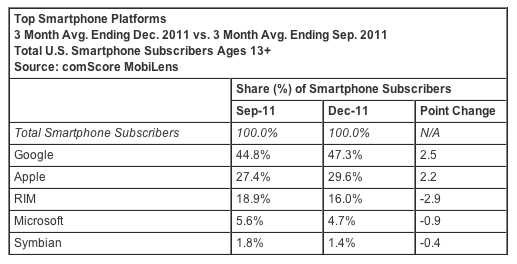
Research firm comScore is out with its latest numbers for the month of December, giving us a glimpse at the current United States mobile market. The report indicates that mobile sales are up-and-rising for the holiday month. comScore found that Google’s Android is leading with a 47.3-percent OS market share (rising 2.5 points) and Apple’s iOS is in second with a 29.6-percent market share (rising 2.2 points).
When it comes to device market share for both smartphones and non-smartphones on the OEM side, Samsung tops the charts with a 25.3-percent market share, which did not change from the previous month. LG and Motorola place second and third, both losing a small amount of market share during December. Apple comes in fourth in market share, and now boasts 12.4-percent of total mobile subscribers (rising 2.2 points).
The U.S. still ranks in as one of the world’s most important places for smartphones, with 97.9 million people owning smartphones during Q4 2011. When it comes to worldwide sales, Research Firm IDC yesterdayreleased its estimates for December. They found that Apple passed LG to become the third-largest smartphone manufacturer worldwide, with an 8.7-percent market share in Q4 2011, and a 6 percent market share in 2011 as a whole. Nokia remains in the top spot with 26.6-percent, followed by Samsung who has 22.8-percent. You can check out the graphs after the break for the full run-down:
[youtube=http://www.youtube.com/watch?v=pS9sUm5Y0sg] last year’s
The iPhone maker is many things to many people and it is easy to overlook Apple’s powerful marketing amidst the popularity of its gadgets. Yet, the two are inseparably intertwined. No wonder well-known names in business are (again) taking cues from Apple’s marketing cookbook, including United States specialty retailer of consumer electronics Best Buy that uncharacteristically decided to break away from the usual Super Bowl advertising featuring celebrities, which seems to be norm these days.
Instead, its new approach calls for celebrating technology innovators, a concept Apple popularized back in 1997 with the “Think Different” campaign. According toBloomberg, the retailer opted to feature Silicon Valley inventors, such as Instagram cofounder Kevin Systrom and camera phone pioneer Philippe Kahn who will help bring home the message at Sunday’s big game. From the mouth of Best Buy’s Marketing Chief Drew Panayiotou:
Big brands like to hire celebrities. We looked at everyone from George Clooney to Stephen Colbert. We believe the inventors are more than enough. I give those 125 million viewers a lot of credit. I think they’ll appreciate the story. […] They may not be at the same level as Steve Jobs, but they created some amazing stuff.
Eagle-eyed readers could point out that the retailer last holiday season aired Apple-focused adverts promoting its store-within-a-store displays, seen below. However, Best Buy’s latest creative concept marks a departure from its past Super Bowl campaigns that tapped celebrities, such as heavy metal rocker Ozzy Osbourne and teen heartthrob Justin Bieber. Meanwhile, a Taiwanese vendor is treading the fine line between originality and a display of disrespectfulness by featuring a Steve Jobs imitator to drum up excitement for its upcoming Android slab. Check it out that commercial in a clip included right after the break.
Apple’s iPad maintained its market lead throughout fourth quarter of last year even though it lost some ground compared to the previous quarter due to an influx of Android-based tablets. In fact, Amazon’s dirt-cheap Kindle Fire device that costs just $199 saved the day for Android slates, really. This is the gist of the latest survey by research firm Strategy Analytics that was released this morning.
Global tablet shipments reached 26.8 million units in the fourth quarter of 2011— up 150 percent from 10.7 million from the year-ago quarter. Global tablet shipments hit 66.9 million units throughout 2011— a 260 percent increase from just 18.6 million units in 2010. Looking at how tablet vendors performed throughout Q4 2011, the survey recorded a 39.1 percent share for tablets powered by Android. Even though it is a record for tablets driven by Google’s software, Apple sold 15.43 million iPads during the holiday quarter for a healthy 57.6 percent share. This left the remaining 3 percent for tablets outside the Android/iOS tablet duopoly, with Microsoft-driven devices holding onto 1 percent share of the market.
This compares to a Strategy Analytics’ survey for the September 2011 quarter that depicted a 27 percent share for Android tablets in Q3 2011 (up from 2.3 percent in Q3 2010) and 67 percent for iPad (down from 96 percent in Q3 2010). Android tablets are clearly picking up steam, largely based on the success of Amazon’s device that launched Oct. 15, 2011. Still, the iPad is expected to remain king of the hill as analysts expect its lead to maintain throughout 2012.
Strategy Analytics Research Director Peter King opined:
Apple announced monster sales of 37 million iPhones yesterday for the holiday quarter that spanned 14 weeks and ended Dec. 31, 2011. It’s a 128 percent unit increase and 133 percent revenue increase, annually, and enough to knock Samsung off the No. 1 spot it briefly held in the previous quarter. However, it appears that the popularity of the iPhone 4S also helped Apple thrive over Google’s platform, especially with Android backers such as Motorola Mobility, HTC and Sony Ericsson reporting disappointing results.
According to research firm Kantar Worldpanel ComTech (viaReuters), iPhone sales gave iPhone a lead over Android in smartphone sales in the United States. Specifically, Apple’s share of the U.S. market during October to November of last year doubled from 22.45 percent a year ago to 44.9 percent. Meanwhile Google’s Android smartphones dropped from 50 percent to 44.8 percent in the same period. Kantar’s global consumer insight director Dominic Sunnebo:
Apple has continued its strong sales run in the U.S., UK and Australia over the Christmas period. Overall, Apple sales are now growing at a faster rate than Android across the nine countries we cover.
Another way to look at iPhone numbers: The iPhone business generated $24.42 billion revenue. During the same quarter, all of Microsoft raked in $20.89 billion revenue. In fact, all of Apple’s holiday-quarter revenues and profits were two times higher than Microsoft’s.
Yet another look at iPhone numbers: Apple sells more iPhones in a day than babies born.
Apple just announced its Q1 2012 earnings in a press release a few minutes ago, which revealed very impressive numbers from the company. Apple revealed it sold a whopping 37 million iPhones during the holiday quarter, which now gives the company the No. 1 smartphone manufacturer spot —back from Samsung, who previously held the title. Earlier this month, Samsung gave estimates of 35 million phones sold during the holiday quarter. This means Apple beat the company by 2 million.
Newsweek‘s Dan Lyons reported today that Apple’s “thermonuclear war” on Android smartphone manufacturers is fading fast, while a new rumor surfaced among the suits’ lawyers claiming the company spent $100 million on its initial set of claims against HTC.
“Who knows if it’s true, but if so, Apple didn’t get a lot for its money,” wrote Lyons on his RealDanLyons’ blog Jan. 23.
Apple’s legal claims are abruptly junked left and right, and its only minor victories to date are so inconsequential that Android device makers can dance around the momentary obstacles with just a few minor tweaks to products, explained the Newsweek reporter.
The technology giant’s case against HTC with the International Trade Commission began in February 2010, when the Cupertino, Calif.-based company wanted the ITC to block HTC from importing products into the United States. The case originally had 84 claims based on 10 patents, but it was dwindled down to only four claims by the time a judge became involved, according to Lyons.
The rulings —for the most part— were a wash for Apple. One patent was invalid as Apple did not have a rightful claim to it, and HTC did not infringe upon two of the other patents due to Apple apparently not implementing them into its products. In other words, Apple did not have a right to seek an injunction, because ITC injunctions can only occur if it is provable that both parties are “practicing” the patent in question, which Apple could not demonstrate against HTC…
We have seen Siri clones in the Android Market trying to pass themselves off as the real thing, and some Siri alternatives making their way to the Windows Phone Marketplace. Evi, on the other hand, might actually be the first true Siri competitor/alternative for Android and non-iPhone 4S iOS users.
Available on the App Store for 99 cents and free to Android users on the Android Market, Evi is the work of True Knowledge and its “core semantic search technology” better known as The True Knowledge Answer Engine. The 99-cent price tag on iOS is apparently to cover the cost of using Nuance voice recognition (the same voice recognition tech as Siri), which is not used in the Android version.
The app’s iTunes page explained Evi is capable of returning local data for the United Kingdom (along with the United States), which has been a complaint from U.K. Siri users since the iPhone 4S launch. According to TechCrunch, the app uses “an ontology of tens of thousands of classes into which” every possible user command can be recognized. True Knowledge said the app contains “almost a billion ‘facts’ (machine understandable bits of knowledge)” with the ability to infer trillions if necessary. It also reportedly uses all the expected sources, such as local results from Yelp, third-party websites, traditional web searches, and APIs.
While as of yet Evi is incapable of integrating with Calendar and Reminders like Siri, TechCrunch pointed out it sometimes provides more accurate and useful results for certain types of questions. Siri requests to search the web for an answer when users ask certain questions, such as “How do I make apple pie?” Evi, however, would provide a list of recipes with relevant links to that specific question. TechCrunch highlighted another example where Evi excels:
Samsung is continuing its anti-Apple rant with a new television commercial titled “Samsunged.” Once more, the South Korean conglomerate laughs off those who would wait in line for a new iPhone. The commercial opens with the familiar scene as line waiters get a visit from their Galaxy SII-toting friend, and they promptly feel envious over his phone’s turn-by-turn navigation capabilities.
When asked by a girl waiting in the line how much he had paid for the navigation app, the Android person responded: “I didn’t, Galaxy S II just has it – it just comes with it.” To that, one of the Apple fans remarked angrily: “Ooooh, we just got Samsunged!”
It is also worth noting that the advertisement subtly pokes fun at the iPhone 4S’s same design as the iPhone 4, as well as its widely reported battery issues. The commercial starts out with the line’s awaiting customers eagerly watching a streaming video of the device they are hoping to buy being unveiled online, and upon seeing the device, one customer sighed: “Awe, that looks like last year’s phone.” The scene immediately transitions into the Galaxy S II user bringing his friends a white smartphone charger, presumably because their device’s battery is almost dead.
Apple fans are obviously going to be seeing more of these advertisements as the Super Bowl approaches. It is certainly interesting, though, that these commercials paint Samsung customers as hipsters.
AT&T announced it would introduce new data plans for phones and tablets on Sunday, Jan. 22. There will be three phone plans: $20 for 300MB, $30 for 3GB, and $50 for 5GB with tethering. While the two tablet plans will be: $30 for 3GB and $50 for 5GB.
In the past, AT&T made available $15 for 200MB, $25 for 2GB, or $45 for 4GB with tethering. Each plan earned more data and a $5 price hike. AT&T will charge $10 for each 1GB roll over. AT&T explained the sudden change:
“Customers are using more data than ever before,” said David Christopher, chief marketing officer, AT&T Mobility and Consumer Markets. “Our new plans are driven by this increasing demand in a highly competitive environment, and continue to deliver a great value to customers, especially as we continue our 4G LTE deployment.”
There is no shortage of surveys proving that Apple’s smartphone market share has benefited from strong iPhone 4S reception thus far. A new report published this morning by reputable research firm Nielsen is another indication of Apple halting Android’s seemingly unstoppable rise as a growing number of United States consumers pick iPhones over other smartphones. Based on a poll of recent acquirers —among those who said they got a new device within the past three months— Nielsen found out that 44.5-percent chose an iPhone while 46.9-percent picked an Android phone. Contrast these figures to just 25.1-percent for Apple in October and 61.1-percent for Android.
Furthermore, 57 percent of new iPhone owners surveyed in December said they got an iPhone 4S. […] The high-profile launch of Apple’s iPhone 4S in the Fall had an enormous impact on the proportion of smartphone owners who chose an Apple iPhone.
Therefore, while fewer people bought an Android device in December compared to a month earlier, Apple substantially increased its share among recent smartphone acquirers. These findings are understandable given that iPhone 4S was announced on Oct. 4, 2011 and it became available 10 days later, selling 4 million units during the launch weekend. Pent-up demand and wider price gamut certainly did help boost domestic iPhone sales as did the fact that Sprint and local carriers Claro Puerto Rico and C Spire Wireless finally landed the device.
UPDATE [Wednesday, January 18, 2012 at 7:35am ET]: Steve Wozniak commented on the original article on Facebook, saying he’s been misinterpreted (again). His full comment can be found at the bottom of this article.
Journalist Dan Lyons (aka Fake Steve Jobs) filed a report with The Daily Beast on Saturday that highlights Steve Wozniak’s thoughts on the iPhone 4S’s widely reported battery woes (that did not go away with iOS 5.1 Beta 3):
With the iPhone, something happened with the new OS or the new phone, and it just started running through the battery so fast. I’ve had a lot of issues with things I have to turn off just to save the battery life.
Wozniak, 61, who cofounded Apple with Jobs in 1976, also has gripes with Siri. The engineer thinks Siri is cool, but at times impractical compared to Android’s voice action. This is mostly due to Siri’s architectural reliance on network connectivity that is required to complete functions.
I have a lower success rate with Siri than I do with the voice built into the Android, and that bothers me. I’ll be saying, over and over again in my car, ‘Call the Lark Creek Steak House,’ and I can’t get it done. Then I pick up my Android, say the same thing, and it’s done. […] On the 4S I can only do that when Siri can connect over the Internet. But many times it can’t connect. I’ve never had Android come back and say, ‘I can’t connect over the Internet. […] Plus I get navigation. Android is way ahead on that.
Apple is thought to be creating its own navigation and mapping solution stemming from the company’s three mapping-related acquisitions: C3 Technologies, Poly9 in 2010, and Placebase. Wozniak is also good friends with Andy Rubin who heads the Android project and one said, “There’s more available [on Android] in some ways.”
Although Apple did not detail Siri, its voice recognition and artificial intelligence systems run on Apple’s servers rather than the phone itself. Siri may also infringe old Excite patents, said to be changing hands soon as a valuable asset in order to compete with Siri. In case you are wondering, the iPhone remains Wozniak’s primary phone. He loves “the beauty of it,” and he is first to recommend it to friends. However, Wozniak sometimes wants the iPhone to do “all the things my Android does.”
Intel is looking to use its recently unveiled Medfield chips in the iPhone, according toThe Telegraph. In the report, Dave Whalen, vice president of Intel’s architecture group, told The Telegraph that Intel has talked to Apple and other manufacturers about using the new Medfield chips in iOS devices. Specifically, Whalen said as iOS continues to grow, “We talk to everybody.” Intel is also looking to Android and Windows Phone to use the new chips.
It is worth noting that it is highly unlikely Apple would move to Intel chips in iOS devices, even though the company uses Intel in Macs. Since the iPhone 4, Apple has continued to use its own line of processors—with the help of Samsung. The iPhone 4 was graced with the A4, the iPad 2 had the A5, and most recently— the iPhone 4S got the A5. The iPad 3 is rumored to get the quad-core A6 (mock up on the right), and going off Apple’s recent timeline, the iPhone 5 will most likely have the A6.
The most unique aspect about the Medfield chip is that it is a single core, unlike Intel’s previous chips. The Medfield uses the ARM chips’ strategy, in pulling all processes onto a single chip, which helps to save battery life and other things. For now, it looks Apple will most likely stick with its own proprietary chips. Samsung recently opened a factory in Texas for developing the A5 chip, showing Apple is committed to producing its own goods. Therefore, it is interesting that Intel is trying to make a move.
In what is perhaps surprising to some, Apple’s iPhone 4S is turning the tables in the heated smartphone competition between Apple and Google, latest data from NPD reveals. Focusing on U.S. smartphone data for October and November, the research firm found out that iOS increased its operating system share of U.S. smartphone sales substantially while the Android platform lost significant ground to Apple (viaFortune). Yes, data only includes sales of smartphones, not tablets.
The Cupertino, California-headquartered iPhone maker is now within spitting distance of Google with only four percentage points of difference. iOS was close to doubling its share of the U.S. smartphone market, climbing from 26 percent in the third quarter of 2011 all the way up to 43 percent in October and November. During the same timeframe, Android fell from 60 percent to 47 percent.
Collectively, the two rival platforms grabbed an astounding 90 percent of U.S. smartphone sales. Moreover, the top three best-selling smartphones on NPD’s holiday list belonged to Apple, the iPhone 4S, iPhone 4 and iPhone 3GS. What a difference a few weeks of sales make. Another interesting chart and more findings can be found right after the break. Expand Expanding Close
Carrier AT&T is holding its sixth annual Developer Summit at the 2012 Consumer Electronics Show in Las Vegas today, and President and CEO Ralph De La Vega addressed some 2,500 attendees from 33 different countries. “What’s good for developers is good for customers,” said La Vega while explaining why AT&T runs this developer summit.
Shortly, Chief Marketing Officer David Christopher took the stage to announce AT&T’s new API platform for HTML5 web applications meant to run across multiple devices and mobile operating systems, reminding that the web really is the ultimate app store. Interesting enough, Visual Voicemail for the iPhone (which turned 5-years-old today) was AT&T’s very first network API, so you could say Apple also helped revolutionize how carriers interoperate.
An impressive 85 percent of all smartphones will have HTML5 browsers by 2016, Christopher explained. The new API Catalog sports 130 individual APIs divided into 14 different categories — it is essentially a revamped U-Verse API catalog. The APIs enable a range of features, such as completely automated sign ups to use APIs in minutes, wrappers for Ruby, PHP and Java and tons of sample code in Github.
A storefront for web apps called the “App Center” will be available later this year (developers can sign up for a beta here). In short, this new platform is conceived from the ground up with HTML5 developers in mind and targets most cellular networks, not just AT&T’s…
According to the latest ChangeWave Research survey posted Monday, both Apple and Samsung are enjoying “explosive momentum” as 2012 begins while other handset makers are struggling to win the hearts of minds of consumers, such as Canada-based Research In Motion, which today updated its struggling BlackBerry platform with new software features, and Taiwan-based HTC, which posted a 26 percent income drop today —its first quarterly profit decline in two years.
Based on data obtained from 4,000 North American consumers, 54 percent of respondents planning to buy a smartphone in the next 90 days will opt for an iPhone. This is a drop from 65 percent last quarter, but more than enough to keep the coveted title of the most sought-after device. The iPhone’s “industry leading” customer satisfaction remains off the chart at 75 percent by vendor and mobile OS each (3 in 4 iPhone owners said they are ‘Very Satisfied’ with their device). Google’s Android is second with 47 percent mobile OS satisfaction rating and Samsung and HTC are at 47 percent each…
Google’s Android Market is now home to a couple not-so convincing Siri clones, both of which use Apple’s official Siri icon and one that attempts to mimic the UI. Developer Viewide is even marketing one of the applications called “Speerit” as “REAL Siri for Android”.
Speerit (pictured above), is for now only available in Korean, but the developers plan to support English in a future update. As Electronista pointed out: “Differing results on the weather widget suggest it’s not actually asking Apple’s servers.” The app is available on the Android Market for free.
Another app, called Siri for Android, as picked up by The Next Web, made a point of clarifying it is simply a Siri icon that acts as a shortcut to Google’s Voice Actions. Although, like Speerit, it too boldly uses what appears to be Apple’s official Siri icon.
Also, the app’s name, “Siri for Android,” beside the developer’s name, “Official App,” could give users who don’t know any better the impression it is some type of official Siri port. The app is also available for free in the Android Market.
No word on whether Google or Apple plans to take action. Controversial or knockoff apps being removed from the Android Market and the App Store is not uncommon, but it is clearly a bigger concern for the Android Market’s easygoing review policies.