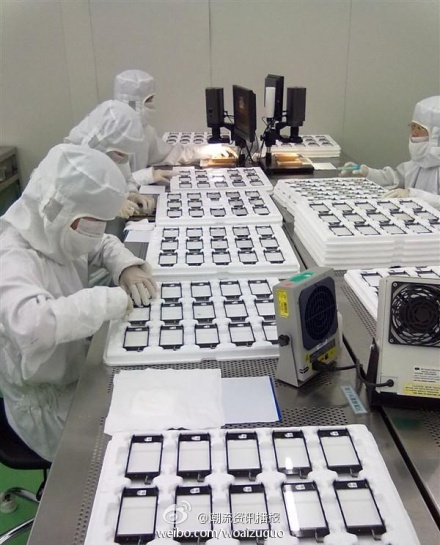
A report from Digitimes claims that, although touch panel orders from the iPhone and iPad 2 have increased significantly for the third quarter, Apple is allegedly placing orders at nearly half the cost of previous shipments. This leads us to believe they are either trying to reduce BOM (and increase margins) at the expense of suppliers, or they’re prepping for the usual price cuts in the wake of new product releases (iPhone 5, we’re looking at you).
The report notes:
Wintek has received touch sensor orders from Apple at prices nearly 50% lower than the ones previously offered by the client. The impact of Wintek’s low-margins is expected to ripple out to other downstream players
The move is expected to result in lower than usual profit-margins for the supplier and also affect other suppliers down the chain. The report is also quick to point out that “Wintek has previously rejected low-margin orders from Apple”. We’ll keep you posted as more becomes available.
We’ve independently heard that Apple has plans to begin selling the next-generation iPhone on Friday, October 7th; the date first reported by TiPB. According to our sources, Apple has been weighing between launching the new iPhone on October 7th or October 14th, but with the product’s latest stages of pre-mass-production currently moving along nicely, Apple is presently shooting towards a launch on the 7th. On top of this, unlike with the iPad 2, Apple plans to offer pre-orders for the new iPhone.
Apple currently plans to begin pre-orders for their next-generation smartphone in the final days of September. The company has still not finalized the pre-order start date, but is debating between Thursday, September 29th and Friday, September 30th. The 30th seems more likely at this point according to one of our sources.
Pre-orders for the new iPhone starting in late September will also mean that Apple’s fall event will take place in September; which would seem to counter NewsCorp’s Kara Swisher’s combative insistence of an October iPhone 5 event. Additionally, the first week of October date for the new iPhone’s availability, fits nicely with our report about AT&T’s major early October changes: data throttling and a new insurance plan for $199 devices. This release date would also jive with John Paczkowski’s report about the iPhone 5 becoming available in October.
There has been mixed chatter about the device’s exterior design, with cases, which we first revealed, pointing to a thinner form factor. Others, though, have said the design will be largely similar to the current iPhone 4. As with any launch date report, we have to note that Apple is constantly shifting their launch plans. As we noted earlier, the launch date was already moved up a week in the company’s recent launch planning. We are reasonably confident, though, that as of today, Apple is planning to unleash their next iPhone on October 7th and offer pre-orders starting on September 29th or 30th. The date could and likely will change again, but we feel it is necessary to report the company’s current plan.
It appears that Apple is now putting an LTE 4G-capable iPhone or iPad through the usual carrier testing. The proof comes from a .plist hinting at “LTE” (discovered by BGR) in an internal iOS test build that is allegedly from “one of Apple’s major carrier partners”. Of course at this point we don’t know whether this is the iPhone 5 (iPhone 4S variant?) or even a new iPad, but its a good sign that the company has plans to take advantage of 4G LTE networks in the future… even if it isn’t the iPhone 5 “worldphone” you might be hoping for.
This wouldn’t be the first time Apple prototyped a device to take advantage of the latest carrier networks.
It’s a glaring hole in Apple’s MacBook line: The ability to access 3G (4G?) networks without tethering or using a 3G hotspot. Apple CEO Steve Jobs told the USAToday in 2008 that the reason that he didn’t want to build that functionality into MacBooks was that it invited complexity and locked users into a carrier.
Air does not come with the built-in ability to connect to a speedy wireless data network run by various cellular carriers. Jobs told me last week that Apple considered it but that adding the capability would take up room and restrict consumers to a particular carrier. Through a USB modem, he says, you can still subscribe to wireless broadband with your favorite carrier.
When Jobs says “considered it”, this is what he means:
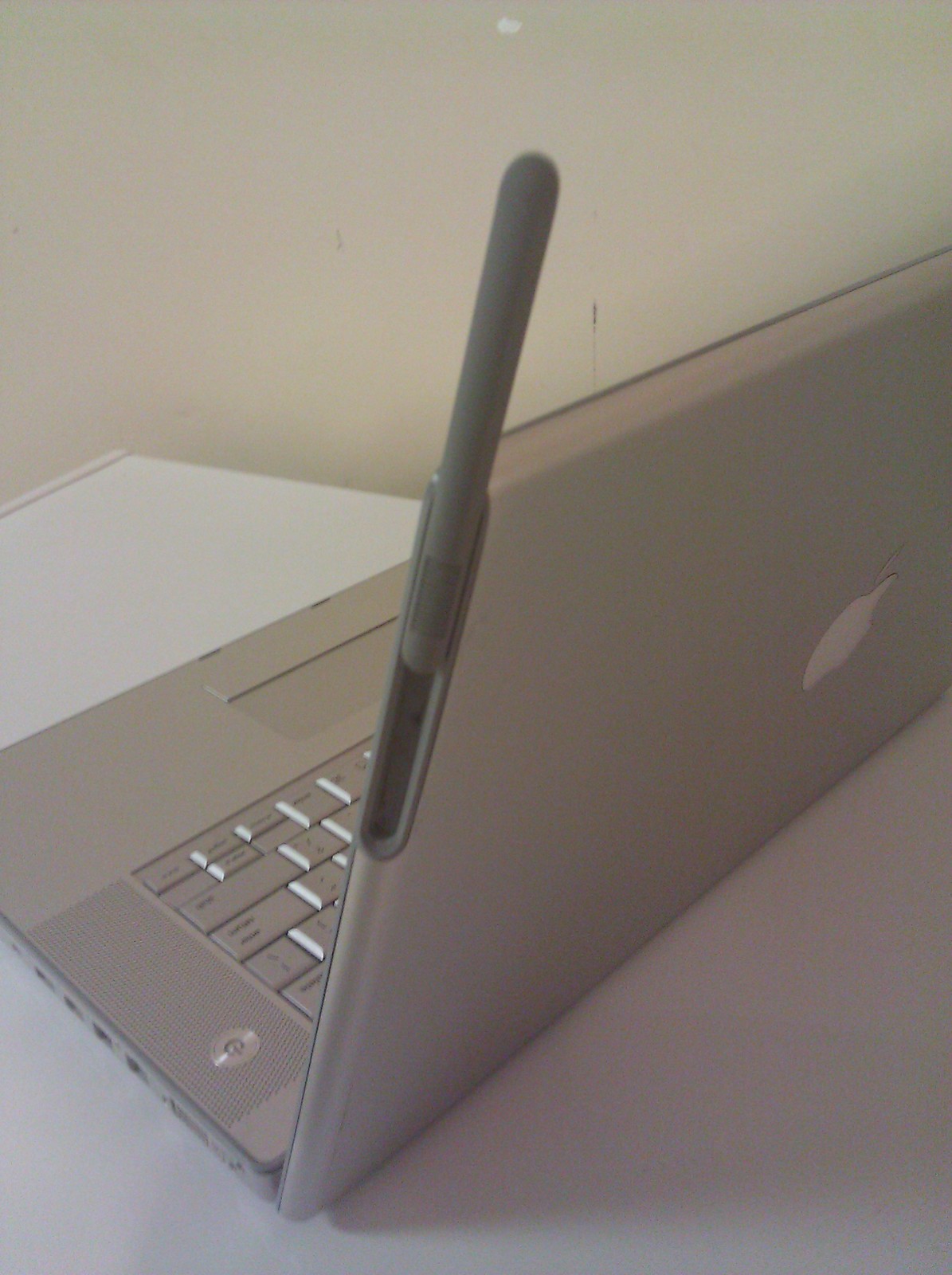
An Ebay auction today (via MacRumors) shows that Apple was getting ready to release such a MacBook Pro – all the way back in 2007.
.
The prototype Santa Rosa MacBook Pro has a SIM card slot which is identified as a Dynastream ANT2USB card. In the US, that would have worked on T-Mobile or AT&T as well as many international GSM carriers. The seller originally bought it from a Craigslist ad as a non working machine for parts. Upon opening it, he realized that this was no ordinary MacBook Pro (if the huge antenna didn’t give it away!). He got the machine into working order (thought 3G is not tested) and is selling it as-is, “no guarantees”.
It isn’t certain why Apple never opted to go with a 3G option in any of its Macbooks. Perhaps the complexity and the numbers never made sense. Now that almost everyone carries a Personal Hotspot capable phone in their Pocket, it may not ever make sense.
Digitimes previously reported that manufacturers have already begun preparing for production of the iPhone 5 and iPad 3, which would be unveiled in September and reach customers as early as October. Now, adding more weight to these claims, Macotakara is reporting that an iPhone 4S variant along with a new iPad will arrive in the same timeframe.
According to the rough translation, it appears sources have provided information on a possible iPhone 4S based on the current CDMA iPhone 4. The report doesn’t rule out an iPhone 5 saying it “can not be confirmed”. It also briefly suggests a new iPad will be released in October as well. Could it be possible Apple is planning on releasing an iPhone 4S as the rumored entry-level model in addition to an iPhone 5?
Of course the mention of a new iPad is less than likely. Apple appears to be quite a long way from releasing a refreshed model, especially if you are counting on them including those new 28-nanometer, TSMC-built A6 chips that just started trials. Expand Expanding Close
A few more interesting Apple Inc-filed patents have surfaced today (viaPatently Apple) as part of the many applications published by the US Patent & Trademark Office recently. Perhaps the most notable include a design for an iPhone antenna clip, new finger reducing oil resistant coating, and a patent describing using solar energy as an alternate power source in portable devices (something we know Apple has been researching from patents and other sources in the past).
One of the more interesting patents with technology that could (and probably should) make its way to iOS devices in the near future is a the method of reducing “finger oils on touch surfaces”. The patent describes Apple’s method of “Direct Liquid Vaporization for Oleophobic Coatings”. Fingerprints have seem to become less of an issue to iPhone users over the years, but are definitely still a major annoyance to users in less than desirable lighting conditions.
From the report:
Apple states that to prevent the deposition of oils on an electronic device surface, an oleophobic ingredient could be bonded to the electronic device surface. The oleophobic ingredient could be provided as part of a raw liquid material in one or more concentrations. To avoid adverse reactions due to exposure to air, heat, or humidity, the raw liquid material can be placed in a bottle purged with an inert gas during the manufacturing process.
The image below shows what appears to be an antenna attached to a small device’s housing via an “attachment member”. Patently Apple reports Apple states the antenna invention could be used in “their iPod family (MP3 players), a radio, an audio/video recorder, a mobile telephone, personal digital assistant, tablet computing device, or other similar device”. They also speculate from the “exploded view above that it might even be an “iPhone-nano-like device”. Expand Expanding Close
Taiwan Economic News is reporting that local Taiwan Semiconductor Manufacturing Co., Ltd (TSMC), the company slated to supply Apple with the A6 processor after a shift from Samsung, has begun trials of the new chip made with the company’s “newest 28-nanometer process and 3D stacking technologies”. However, dont expect to see the A6 in a new iteration of the iPad anytime soon, as the report suggests the processor wont be officially unveiled until Q2 of next year, at the earliest.
Included in the report:
TSMC has applied its newest 28-nanometer process and 3D stacking technologies to produce the next-generation processor A6, which is based on the ARM architecture and will undergo TSMC’s cutting-edge silicon interposer and bump on trace (BOT) methodologies. Industry insiders said that the manufacturing will help to pump considerable momentum into TSMC’s business growth starting next year, though the company has yet to comment on the deal for the moment.
This contradicts an earlier report thru Reuters which stated that test production had already begun in July. Both reports agreed that the final A6 processors would be complete and ready for iPad 3 in early 2012. EETimeshad reported the move back in March which was said to involve Apple’s current A5 chip but that never materialized.
An Apple switch to TSMC would obviously be a huge blow to ‘frenemy’ Samsung who currently makes the iPad CPU, DRAM and supplies Flash storage as well.
Pinch? Swipe? How about “dig a hole” or “open the window”? Another round of Apple Inc filed patents have been published today by the US Patent & Trademark Office. The most interesting of the latest patents (via Patently Apple) is one focused on “advancing iOS metaphors to a higher level”. What does this mean exactly?
Essentially it would see iOS including a number of new interactive UI elements, many of which will replicate the experience of being able to “manipulate and organize various graphical objects”, similar to the desktop-like environment of “conventional personal computers” (OS X). In other words, Apple wants you to have more control over what you can do with elements within iOS, presumably to close the gap between what’s possible on OS X compared to current iOS builds… which also highly supports theories of iOS and OS X becoming one in the future.
Perhaps the most clear example of how these new UI elements might appear to the end user comes from the “Example Interactions Digging a Hole in a Device User Interface” section of the patent…
From Patently Apple:
Apple is always looking for new ways to distinguish iOS from the pack and today Apple introduces us to a number of new GUI gestures and metaphors that are fun and Kooky – if not creatively insane. The first one describes the notion of “digging a hole” in your interface that will allow you to drop a file into it quickly or act as a garbage bin or other uses.
Apple also described a number of other interactions similar to “digging a hole” including opening a trap door or window via gestures. Expand Expanding Close
There are a lot of people who think Apple is going to eventually move its “Mac” line to iOS. In fact we found it curious when Apple turned ‘MacOSX’ to ‘OSX’ as of Lion earlier this year.
Steve Jobs and Apple in general are very sensitive to CPU power issues with their push to make high end devices thinner.
As part of the WSJ article on Intel spending $300 million on developing MacBook Air alternatives (a hint in itself – why does Intel need to create competition for its own Air), it was revealed that Apple was threatening to leave Intel’s ‘low power’ processors if they didn’t drastically cut power.
Welch said Apple informed Intel that it better drastically slash its power consumption or would likely lose Apple’s business. “It was a real wake-up call to us,” he said.
What are the alternative processors for the MacBook Air? AMD? Not likely (though not impossible).
The big alternative is a platform switch to ARM which certainly schools the Atom Chip in terms of power consumption. It would also mess with a lot of non-App Store Apps built on legacy code.
But, you know Apple would love to create a cheaper, thinner, more power efficient iAir type of hybrid device that still operated like a laptop. In fact, Lion seems to already be heading in that direction.
There certainly isn’t a shortage of Apple patents being published today (probably more fuel for a legal battle a year from now). We just told you about a new Map related (Placebase acquisition) patent, and now Patently Apple reports Apple has been granted a patent that will allow them to integrate tiny projectors into future mobile devices.
This latest patent describes, in rather clear detail, exactly how Apple could integrate projectors into iPhones, iPads, and MacBooks. It even suggests Apple cameras will be able to detect gestures and “shadows and/or silhouettes” (Kinect-style iOS games anyone?).
The patent also describes what Apple calls a “shared projected workspace”. This appears to essentially be the ability for users to share content with one another over two projected displays. For example, if I were to project an image from one iOS device, and you from another, we could then share content (via gestures?) between both displays. The patent explains: Expand Expanding Close
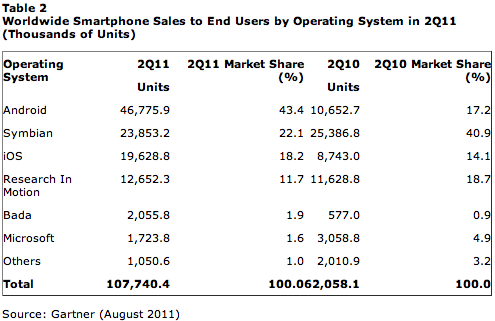
Gartner’s latest global smartphone numbers are out and if your name isn’t iOS or Android, the future looks pretty bleak. While iOS continues to gain share at pace even without a new model release (up one point for the quarter and over 4 points year over year), the bigger story continues to be Android’s outright theft of marketshare from Symbian. Just in the last quarter, 10 percent of the market shifted from Symbian to Android and for the year, the number is close to 20%
Meanwhile Blackberry continued its paced slide down another 2 points quarter over quarter while Samsung’s Bada made modest gains. In the “Other” category, Windows Phone 7 somehow lost market share falling from 2% to 1% and Windows Mobile is now off the charts. HP’s webOS is somewhere in the “other” as well with Meego and the ghosts of smartphone past.
In a report from Computerworld way back in 2009, we learned that Apple had quietly acquired Maps API company Placebase. Then, founder of Placebase and CEO, Jaron Waldman, started working at Apple on a new “Geo Team”, presumably helping to integrate Placebase mapping technologies into future Apple products.
Fast forward two years to a new patent application titled “Schematic Maps”, filed by Apple Inc. and published today with Waldman, along with Placebase co-founder Moran Ben-David, listed as inventors.
Essentially the patent describes new methods of modifying a map in order to highlight certain objects by distorting others. For example, Apple could provide more data to the user (especially those on smaller screens) by blurring useless data and highlighting what it predicts is most useful to the user at any given time. You can imagine this being particularly useful for navigation. If a user were to request directions to a specific location, the maps could dynamically blur data that isn’t helpful and modify objects or landmarks that would otherwise be difficult to locate.
A snippet from the patent summary explains:
The following relates to preparing and presenting schematic maps, which are maps that present information in a format that presents only information that is most relevant to a given situation in order to provide a simple and clear representation sufficient to aid a user in guidance or orientation. The schematic maps as described herein can be formatted based on the attributes of a display on which they are presented so that the map layout and presentation can be optimized for the particular display. The schematic maps can be “distorted” to better illustrate important maps areas in greater detail and using a relatively larger display area while deemphasizing less important map areas by illustrating them in less detail and using a relatively smaller display area, and thus the schematic maps can be devoid of adherence to a particular scale.
There was originally speculation that Apple might be acquiring Placebase in order to build their own native Maps application, rather than having to rely on Google Maps. With the patent wars heating up and relationships between smartphone makers weakening, the likelihood of Apple not wanting to rely on their rivals for key technologies is increasing. Expand Expanding Close
Variant of SSD that could go in future MacBooks Pros and Airs
We told you back in April that Apple was upgrading from Toshiba SSDs to Samsung-built drives in the latest MacBook Air lineup. Today a report from Anandtech notes the Samsung PM810 (a customized variant of the same drive currently ships in the 2011 Air) has received some substantial upgrades in its latest refresh.
Samsung has announced the PM830, the latest generation of the PM810, which is slated to pack a 6Gbps SATA 3 that provides up to 500MB/s reads and 350MB/s writes, according to Samsung. That 150% to double the real world speed of the current Samsung Air SSDs and easily beats Apple’s Pro line options.
The new drive will also be shipping with up to 512GB capacity, a nice bump up from the current 256GB offered in the MacBook Air.
Normally it wouldn’t be much of a stretch to think that Apple might naturally include this upgraded SSD in the next MacBook Air refresh. However, with tension growing between Apple and Samsung due to patent related lawsuits (if you haven’t heard by now), more and more questions are being raised about the sustainability of Samsung being one of their main competitor’s part suppliers.
According to a story from The Economist, Samsung might turn out to be a much more important supplier than you may have thought. While companies like Taiwanese-based Foxconn are known to provide many of the cheaper components that make up Apple devices, the report notes Samsung “provides some of the phone’s (iPhone) most important components” including flash memory, DRAM, and processor components. However, they are also quick to point out Apple is one of “Samsung’s largest customers”. Expand Expanding Close
According to Reuters, this is a high risk strategy for Apple maintaining its market share lead. The cases could take months, if not years to come to court and Apple will have to provide more substantial evidence in subsequent court cases that the design of the Galaxy infringed its patents or copied their designs in order to make any bans permanent. So, they aren’t done deals. And if Apple Loses, it will owe Samsung a lot of money.
If Apple loses it will be liable for the business lost by Samsung in the meantime.
“Apple has a strategy of filing patents, getting some protection and trying to prevent other people from entering the market in the short-term,” said Nathan Mattock, an intellectual property lawyer at Marque Lawyers in Sydney. “If Apple’s wrong it will have to pay Samsung a considerable amount of damages, so it’s potentially quite risky.”
Frankly, it feels like lawsuits are taking too much of our time and mind space lately – and they aren’t fun to think about. So here’s a roundup of the more exciting lawsuits news of the last hour:
A class-action lawsuit has been filed against Apple and 5 of the 6 major book publishers, alleging they “colluded to increase prices for popular e-book titles to boost profits and force e-book rival Amazon to abandon its pro-consumer discount pricing.”
On Lodsys (important if you are a App developer with an auto-updating app):
Apple insists to intervene in Lodsys lawsuit against app developers. Apple still requests a court hearing on its motion. Things may still take some more time, but there will be no more written pleadings unless the court asks the parties to address particular questions in more detail. At this stage it’s possible that the court decides very quickly, and I continue to be reasonably optimistic that Apple’s motion will be granted.
At some point, we should start referring to Lodsys by the name of its parent company, Intelectual Ventures.
Saturday, Apple will open its first Apple Store in the great state of Alaska which will be by far the most northernApple Store on the planet. It will be located on 320 West 5th Avenue (in the 5th Avenue Mall) in Anchorage, and doors open at 10 A.M.
You’d think this would make for an Apple Store in every state, but there are still seven (Arkansas, Montana, North Dakota, South Dakota, Vermont, West Virginia, and Wyoming) without according to this map (thanks commenters).
Along with a store in Alaska, Apple will unveil four other stores worldwide Saturday:
From the “I would be shocked if it was successful” department (literally – a quote from one of the execs near the situation), comes news from CNN that Tribune Company is exploring the idea of building a tablet that would compete against Apple’s iPad and tablets from other manufacturers.
Tribune owns a handful of major US daily newspapers, including the Chicago Tribune, Los Angeles Times and The Baltimore Sun, along with 23 television stations.
Tribune aims to offer the tablet for free, or at a highly subsidized price, to people who agree to sign up for extended subscriptions to one of its papers and possibly a wireless-data plan with a partner cellular carrier, said five people briefed on the project.
The report states that this is the pet project of Eddy Hartenstein, Tribune’s chief executive, and they are working with manufacturing partners which may include Samsung.
The Tribune has faced threat of bankruptcy woes in recent years but it is noteworthy that only 8% of the US currently has a tablet, perhaps leaving the door open for other players.
Another suggestion: Subsidized iPad with subscription?
BGR posts a quick report on the launch of the next “Google Phone” which is said to carry Android 4.0 dubbed “Ice Cream Sandwich”. According to their sources, Google is planning to launch the new device in the same window as the iPhone 5, which we’re hearing is slated to start pre-orders in early October.
We have been told that Google is looking to push up the release of Ice Cream Sandwich devices as Apple’s iPhone 5 is expected in September or October, and the Mountain View-based company doesn’t want potential customers coming out of contracts (especially original DROID owners) and “drooling over the iPhone 5.
While ‘Droid’ owners are on Verizon, which hasn’t traditionally carried the Nexus devices, Google will likely want to keep people from leaving its platform. Also with the iPhone 5 in its crosshairs is the Galaxy S2 from Samsung which is said to be coming to all four big US carriers in the coming months. Cross posted from 9to5Google.com Expand Expanding Close
At the end of the day, the new Airport Extreme dramatically improves throughput in the best case and in a few regions where signal was previously unusable. In the worst case (location 4), performance improves from being essentially unusable to totally fine, and in the case of the 2010MBP goes from not being able to connect at all to pushing 23 Mbps.
The new Broadcom BCM4331 based WiFi stack replaces the Marvell 88W8366 WLAN solution of the generation 4. The results are more power usage on the downside but much better range on the upside as you can see in the figures, above and below. Specifically, the 2.4GHz network performed almost at almost full strength in some places where the previous model had barely a signal.
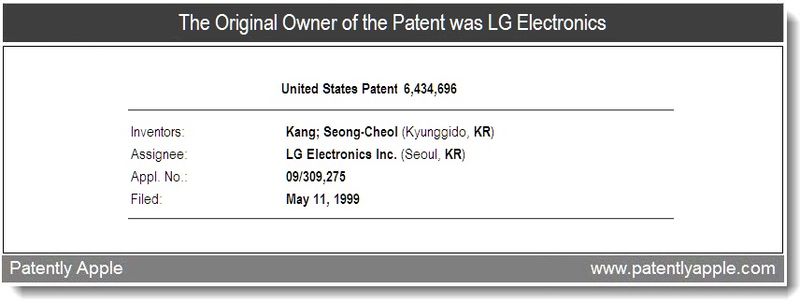
More patent fun today as a small Florida company that may or may not be an LG spinoff called OSS systems sues Apple according to Patently Apple. The Patent was originally filed by LG in 1999 and describes…
“A method for fast booting a computer system, comprising the steps of: A. performing a power on self test (POST) of basic input output system (BIOS) when the system is powered on or reset is requested; B. checking whether a boot configuration information including a system booting state which was created while executing a previous normal booting process exists or not; C. storing the boot configuration information from execution of the POST operation before loading a graphic interface (GUI) program, based on the checking result; and D. loading the graphic user interface (GUI) program.”
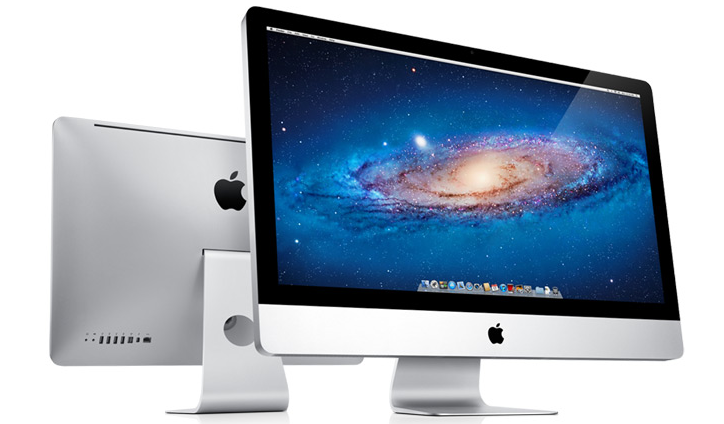
As far as Android competitors go, LG and Apple have a pretty cordial relationship having signed a $500 million display deal a few years ago. Displays in Apple’s popular devices, from 27-inch iMacs to retina iPhones are made by LG. LG could have spun the patent off as its own company, in an attempt to avoid locking horns with Apple in the courts. Apple has been suing what seems like every other Android manufacturer over patent disputes. Expand Expanding Close
Update (Aug. 8th): Following our report, Apple has gone ahead and released it!. Interestingly, no Thunderbolt and RAM not upgradable?!
Apple is gearing up to launch a new addition to the iMac lineup later this month that appears to be geared towards education/volume customers. The new iMac has less power than the current line of all-in-one Apple desktop computers and also has less storage space. The computer packs a last generation 3.1 GHz dual-core processor (3.06 GHz rounded up), 2 GB of DDR3 RAM, 250 GB of hard drive storage space, and the AMD Radeon HD 6750M graphics processor with 256 MB of dedicated memory.
This lower-end iMac obviously has much less horsepower than the current iMac line and should be priced as such. For comparison, the entry level 21.5-inch iMac features a 2.5 GHz quad-core processor, 4 GB of RAM, a 500 GB hard drive, and the same AMD Radeon HD 6750M graphics processor but with double the dedicated memory at 512 MB. This entry level 21.5-inch iMac is priced at $1,199, so don’t be surprised to see this less-powerful machine with a sub-$1000 price tag. For reference, Apple’s last education-geared iMac was priced at $899. A similar (more RAM, worse graphics) refurbished model is currently priced at $929 (pictured below).
Apple is expected to silently release this new machine later this month. As always, thanks Mr. X.
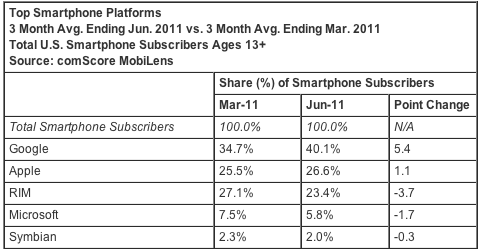
While Google passed the 40% smartphone share (Microsoft must be happy!) in the US threshold, Apple continues to outpace the industry as a whole posting modest 1 point gains in the US smartphone category according to comScore. Apple moved up from 25.5% in March to 26.6% in June on the year old iPhone 4 model which also saw its US debut on Verizon.
Apple also moved up in the hardware category, below:
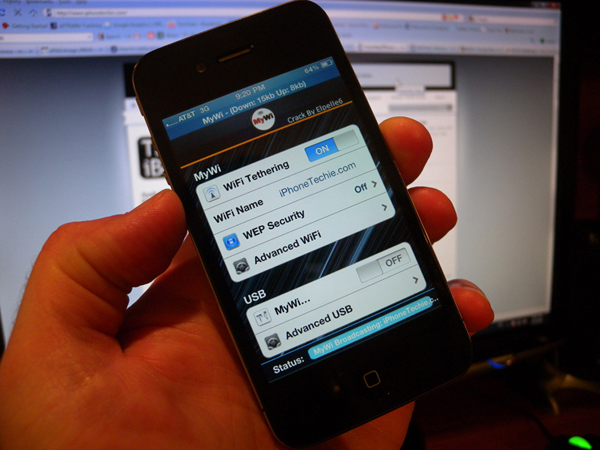
We’ve gotten word from some readers that AT&T is moving forward and removing unlimited plans for users who jailbreak iPhones to tether or hotspot off of AT&T’s unlimited data plans (for those grandfathered):
I was just informed that as of Thursday August 11th 2011, if you use MyWi or any tethering on the phone or using the phone as a modem, AT&T will automatically change ur unlimited plan to a 2Gb tethering plan for 45 dollars without the customers consent. This is for those who received emails or texts about the use of tethering without an AT&T tethering plan.
An AT&T spokesperson has confirmed this, but not August 11th as a hard cutoff date, saying:
Earlier this year, we began sending letters, emails, and text messages to a small number of smartphone customers who use their devices for tethering but aren’t on our required tethering plan. Our goal here is fairness for all of our customers. (This impacts a only small percentage of our smartphone customer base.)
The letters outline three choices:
1) Stop tethering and keep their current plan (including grandfathered unlimited plan)
2) Proactively call AT&T or visit our stores and move to the required tethering plan
3) Do nothing and we’ll go ahead and add the tethering plan on their behalf — after the dated noted in their customer notification
Is this fair of AT&T? Well, it is certainly fair that people pay for the data that they are using and unlimited tethering turns your iPhone into a data sucking monster. AT&T’s service to others is obviously affected, so they have to do something about it and this seems like a reasonable solution. The obvious retort is that some may have purchased their unlimited plans back when unlimited really meant unlimited, jailbroken or not.
The matter doesn’t appear up for debate however. MiWi users: get your free data this week and hope AT&T doesn’t decide to move you over early. Expand Expanding Close