Reliable sources recently provided 9to5Mac with official blueprints of Apple Campus 2 that detail and illustrate the mammoth project currently in development. (These are just a few of the confidential images.)
Solar panels cover the main building’s entire roof, and the images above depict additional outdoor and indoor aspects of the new structure. The exclusive slides named Foster + Partners as one of the architecture firms working on the project, and they cited Arup for consulting engineering, OLIN for landscape architecture, and Davis Langdon for construction. Previous reports indicated that construction is supposed to start later this year.
In related news: Apple CFO Peter Oppenheimer sent neighbors brochures recently to solicit feedback on the project.
DisplaySearch analyst David Hsieh noted today that Apple’s upcoming product launches and refreshes will keep the LCD supply chain in Asia very occupied during the remainder of 2012.
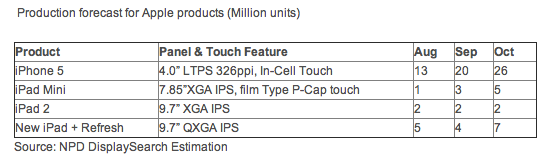
The LCD supply chain (including panel makers, component suppliers, subcontract manufacturing companies) has started to gear up for Apple: in the second half of 2012, Apple will launch three new products (a first): iPhone 5, iPad Mini and New iPad refresh model. These mobile devices will require displays with high resolution, slim form factor, light weight and low power consumption. And certainly, these features are keeping the LCD supply chain very busy.
DisplaySearch’s estimates of near-term production for these Apple products are shown in the table (above). The LCD supply chain companies involved in the Apple new products include Corning, Japan Display, LG Display, Sharp, AUO, Chimei Innolux, Samsung, Radiant, Coretronic, TPK, Wintek as well as Foxconn.
Apple’s business appeals to the LCD supply chain for various reasons related to production stability, but the displays are very technologically specific and present many challenges. As Hsieh further noted, Apple requires light and slim displays with high resolution, minimal power consumption, maximum color saturation, etc.:
…the iPhone 5: while not disclosed publicly yet, many believe the panel size will be increased to 4.0” from 3.5” in the iPhone 4S, while the resolution remains at 326 ppi. The technology breakthrough will be the in-cell touch sensor integration, which presents a big challenge for LCD suppliers to maintain good yield rates.
The iPad mini is expected to launch in Q4’12 as well. Compared to the iPad, the smaller 7.85” screen is targeting the segment of the market currently addressed by Amazon, Samsung, and Google. The ultra slim form factor and low power consumption LCD is the key, as well as the film type projective capacitance touch panel.
Due to these requirements, Apple has been investing in Asia’s LCD supply chain, according to Hsieh, specifically giving down payments to LCD panel makers for “strategic supply agreements.” Apple’s business is a “dual-edged blade,” but suppliers cannot ignore a company with such engaging product launches.
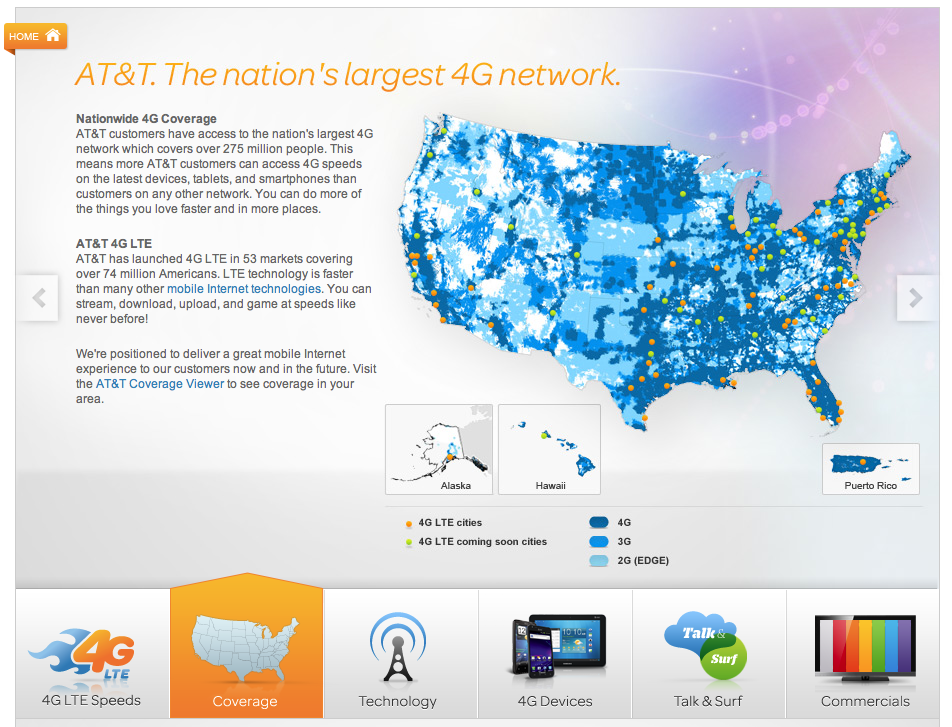
AT&T just announced in a flurry of press releases that it expanded 4G data network coverage to customers in nine new cities. It further revealed over 40 more LTE markets will light up by the end of 2012. Today’s news comes just a week before the launch of an LTE iPhone, which will surely spotlight the coverage differences between the leading U.S. carriers. AT&T only has 53 LTE markets, while Verizon, for instance, boasts 337 LTE markets.
The nine cities:
Anchorage, Alaska
Bakersfield, Calif.
Bridgeport, Conn.
Jacksonville, Fla.
Modesto, Calif.
North Montgomery County, Md.
Syracuse, N.Y.
Omaha, Neb.
Northern N.J.
The additional markets:
Albany, N.Y.
Albuquerque, N.M.
Allentown, Pa.
Birmingham, Ala.
Boise, Idaho
Charleston, S.C.
Cincinnati, Ohio
Columbia, S.C.
Columbus, Ohio
Denver-Boulder, Colo.
Detroit, Mich.
El Paso, Texas
Fayetteville, N.C.
Ft. Myers, Fla.
Gary, Ind.
Grand Rapids, Mich.
Green Bay, Wis.
Harrisburg, Pa.
Hartford, Conn.
Hawaii
Knoxville, Tenn.
Lancaster, Pa.
Little Rock, Ark.
Louisville, Ky.
Memphis, Tenn.
Milwaukee, Wis.
Nashua, N.H.
New Haven, Conn.
Philadelphia, Pa.
Pittsburgh, Pa.
Portland, Ore.
Providence, R.I.
Reading, Pa.
Rochester, N.Y.
Sacramento, Calif.
Salinas-Seaside-Monterey, Calif.
Seattle, Wash.
Springfield, Mass.
Toledo, Ohio
Tucson, Ariz.
Tulsa, Okla.
Wilkes-Barre, Pa.
Wilmington, Del.
“Over the past five years, AT&T invested more than $115 billion into operations and into acquiring spectrum and other assets that have enhanced our wireless and wired networks,” said AT&T in a press release.
The company also claimed its 4G network now covers 275 million folks in the United States, and it is the only stateside carrier to provide 4G using both HSPA+ and LTE technologies. Check out more facts in the carrier’s infographic below, and get all the pressers at AT&T’s website.
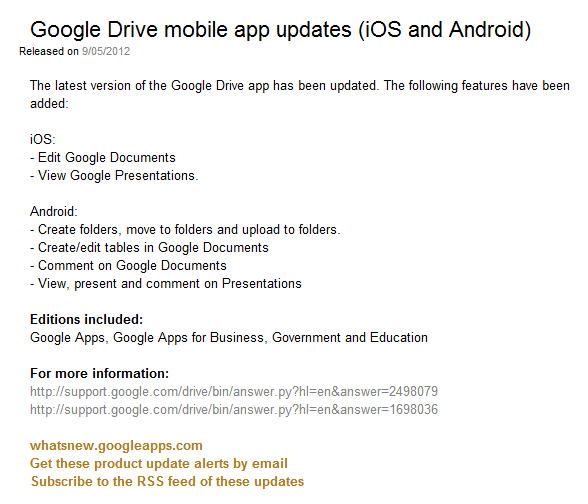
Google just accidentally revealed unreleased updates to its Google Drive for iOS and Android apps.
As TechCrunch first noted, Google prematurely published this post on its blog to announce the upcoming versions, but it deleted the announcement shortly after. The new tweaks for the iPhone counterpart include in-app editing for documents, so users no longer have to access a web browser to edit a Docs file, and the ability to view Google presentations.
The Google Drive for Android app will also get a new interface for editing while mobile, with more options for creating and editing tables in documents. Moreover, the Android app will soon boast comments in documents, as well as the means to create folders, move documents and upload files. Additional Drive features to Google Presentations include viewing, presenting and commenting capabilities.
Both updates are still in process, as indicated by the post’s removal, but they should come down the pipeline soon.
A screenshot of the deleted Google Apps post is above, courtesy of TechCrunch.
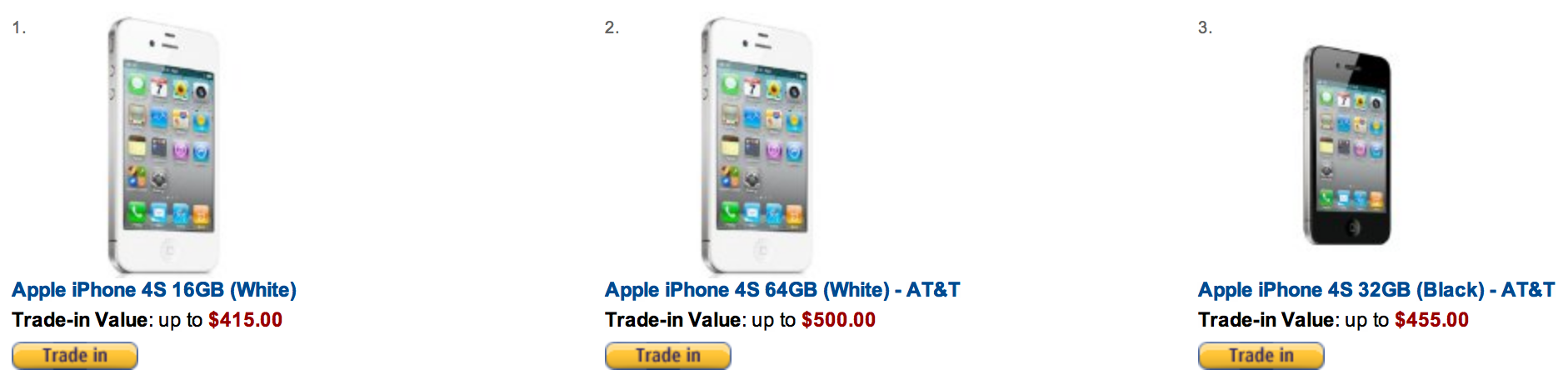
The next-generation iPhone is set to launch in next week and trade-ins are peaking, so now is the perfect time to start exchanging those soon-to-be old models to earn some cash for Apple’s upcoming smartphone. 9to5Mac compiled a list of reliable places to help you trade in that ole’ dusty iPhone for cash or credit—up to $500s worth in some cases! That is enough to buy a new iPhone and cover the AT&T early termination fee for moving to a carrier that fully supports FaceTime.
Before browsing the options, take a moment to identify the condition, features, and model of the swappable iPhone. This will help determine its potential value, because most online programs use a survey to calculate the iPhone’s estimate. Moreover, it is prudent to act now, as retailers will likely drop their prices as the launch date draws nearer.
In just one U.S. Presidential term, Google has made the Internet experience more consistent across Windows, Mac, Linux, Chromebooks, and even Android and iOS devices, by simply signing into Chrome.
So, the folks at Google are celebrating the 4-year-old web browser’s birthday today by going back in time.
Both applications were configured to virtualize Windows on a 2011 27-inch iMac running on OS X 10.8.1 at 3.4 GHz with 16 GB of RAM for this showdown. The comparison specifically measured their ability to handle the 64-bit versions of Windows 7 Professional and Windows 8 Pro.
From a purely performance-based perspective, Parallels has won this year’s competition of virtualization software on OS X. The good news for consumers, however, is that Fusion is not far behind in most categories and, while Parallels is indeed faster, Fusion is often fast enough for common tasks.
A slew of apps updated, launched or made announcements recently, and 9to5Mac gathered the most noteworthy ones in our regular round up below. Today’s crop includes a new game from the makers of Angry Birds, a fresh app for finding and outsourcing well-paid jobs, a few app sales, and more. Per usual, we will continue to update this list throughout the day.
For the first time since it launched in October 2011, according to BusinessInsider, Apple’s Siri-equipped smartphone did not outsell its competition in the United States for August.
Amazon has consistently bulked its Prime Instant Video service with many Hollywood studio and cable network agreements since the Kindle Fire launched last year, and now it is announcing a new multi-year licensing deal with EPIX studio in the United States.
The agreement adds thousands of fresh and old titles, as well as original programming, from Paramount Pictures, Metro-Goldwyn Mayer Pictures, Liongates, and other EPIX partners. The beefed catalog more than doubles Prime Instant Video’s previous content offering, which provides instant, unlimited streaming to paid Prime members on the Android-powered Kindle Fire or other supported devices like the iPad.
A few of today’s content additions include “The Avengers”, “Iron Man 2”, “The Hunger Games”, “Transformers Dark of the Moon”, “True Grit”, and more. It is worth noting Amazon plans to hold a product launch event on Sept. 5 in Los Angeles; the glitzy location could suggest more content deals are coming down the pipeline.
HackerNews linked last night to a Pastbin file, which is a long-rambling diatribe by hacker group AntiSec, that eventually said the group infiltrated an FBI laptop in March and was able to download files off the machine. One of those files, NCFTA_iOS_devices_intel.csv, contained more than 1 million Apple UDIDs, but the group claimed to have over 12 million UDIDs and other personal information, which it apparently gathered after breaching the Dell Vostro of an FBI operative.
During the second week of March 2012, a Dell Vostro notebook, used by Supervisor Special Agent Christopher K. Stangl from FBI Regional Cyber Action Team and New York FBI Office Evidence Response Team was breached using the AtomicReferenceArray vulnerability on Java, during the shell session some files were downloaded from his Desktop folder one of them with the name of “NCFTA_iOS_devices_intel.csv” turned to be a list of 12,367,232 Apple iOS devices including Unique Device Identifiers (UDID), user names, name of device, type of device, Apple Push Notification Service tokens, zipcodes, cellphone numbers, addresses, etc.
“NCFTA_iOS_devices_intel.csv” looks like it stands for the National Cyber-Forensics and Training Alliance, which “functions as a conduit between private industry and law enforcement.” (http://www.ncfta.net/)
Apple previously said it would limit developer access to UDIDs, but the Pastebin post asserted AntiSec published the identifiers, after first leaving out full names, cell numbers and addresses, to warn folks about the FBI tracking U.S. citizens with the mobile data.
Fun Fact: 166 devices in the data set are named “Titanic” or “The Titanic” because of the “Titanic is syncing” joke.
Cydia creater Saurik took to Hacker News to note that it is unlikely that the source was from jailbreaking:
I run Cydia, and have determined only 16.7% of the UDIDs in that file are from jailbroken devices: I thereby do not believe that whatever managed to get this data is anywhere in our ecosystem.
Apple and four major publishers are reportedly trying to end the EU antitrust investigation against them and avoid subsequent fines by letting retailers, such as Amazon, sell eBooks at a markdown for two years.
According to Reuters, the investigation launched in December due to concerns that Apple’s pricing agreements with publishers restricted competition in Europe. Simon & Schuster, HarperCollins, Hachette Livre, and Verlagsgruppe Georg von Holtzbrinck allegedly agreed to set prices on the online versions of their books for sale through Apple.
The deal’s conditions specifically stipulated that Apple takes 30 percent of the proceeds, while other retailers, like Amazon, were not allowed to sell eBooks at a lower price.
The Commission said in April that the five companies had offered concessions in a bid to end the investigation and avert penalties which could reach 10 percent of their global turnover, but it did not give details.
Pearson Plc’s Penguin group, which is also being investigated, was not mentioned among those submitting proposals.
The Commission was now sounding out opinions from the industry as to whether the concessions are sufficient, the person familiar with the matter said, before a formal market test which could lead to the investigation being dropped.
The proposed concessions, as Reuters further reported, apparently resemble the settlements from April regarding a price-fixing lawsuit brought by the U.S. Department of Justice against HarperCollins, Simon & Schuster, and Hachette.
Japan-based Sharp Corp is failing to keep pace when it comes to manufacturing screens for Apple’s latest iPhone just weeks prior to the much-reported Sept. 12 launch event.
Reuters, which cited an unidentified source, reported today that Sharp is floundering due to high costs eating into its iPhone screen margins. The struggle is apparently raising questions about whether Apple will need to offer “financial incentives” to encourage speedier production:
The source, who is familiar with Sharp’s production operations, did not give an indication of how far behind the output had fallen. The source spoke on condition that he not be identified because of the sensitive nature of the disclosure.
Sharp President Takashi Okuda said on August 2 that his company would begin mass production and shipments from its Kameyama LCD plant in central Japan this month. The facility is widely known to make screens for Apple, but Sharp has declined to acknowledge that Apple is a customer.
Sharp’s rumored delay comes as it also deals “with a cash crunch amid approaching debt repayment deadlines,” The Wall Street Journal reported earlier this morning. The company holds “$15 billion in interest-bearing debt…Sharp has forecast a net loss of 250 billion yen ($3.18 billion) for this fiscal year through March, as its core businesses remain unprofitable.” Expand Expanding Close
Apple CEO Tim Cook and Google CEO Larry Page are reportedly in talks regarding mobile patent disputes between the companies.
According to Reuters, which cited “people familiar with the matter,” both chiefs spoke on the phone last week while more discussions between “lower-level officials” are also underway:
Page and Cook are expected to talk again in the coming weeks, though no firm date has been set, the sources said. One source told Reuters that a meeting was scheduled for this Friday, but had been delayed for reasons that were unclear.
The two companies are keeping the lines of communication open at a high level against the backdrop of Apple’s decisive legal victory in a patent infringement case against Samsung, which uses Google’s Android software.
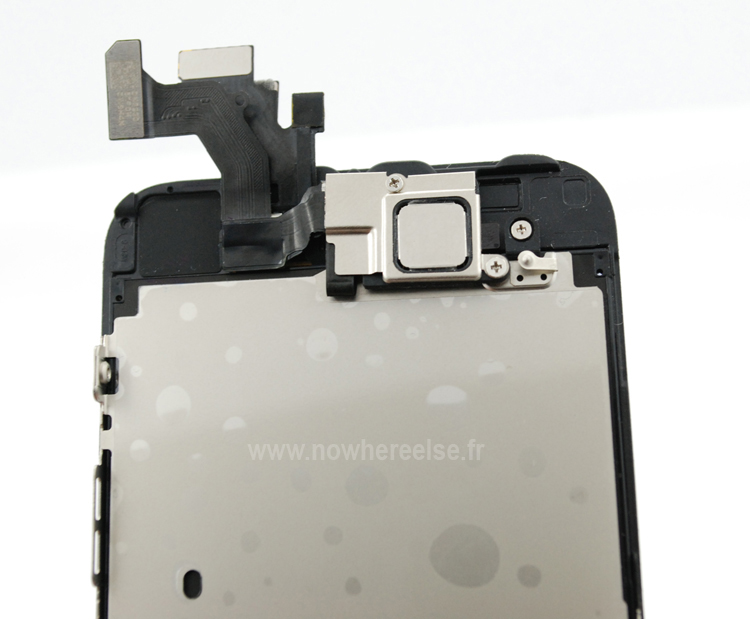
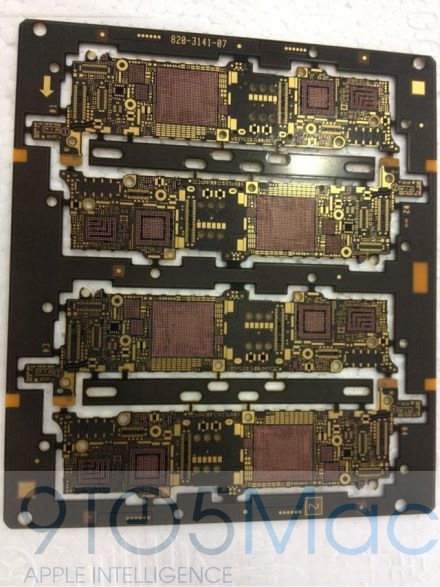
French website Nowhereelse [translated] posted more part leaks for the next-generation iPhone this morning, and while we get a new glimpse at the front screen, neither of the pictures show anything terribly new. The bronze piece pictured was originally thought to be an NFC chip, but more conventional wisdom suggests it is a speaker for the headset.
We also received an image of 4 iPhone motherboards before being chip loaded:
.
…And, perhaps our most sketchy image:
Thanks, Sonny!
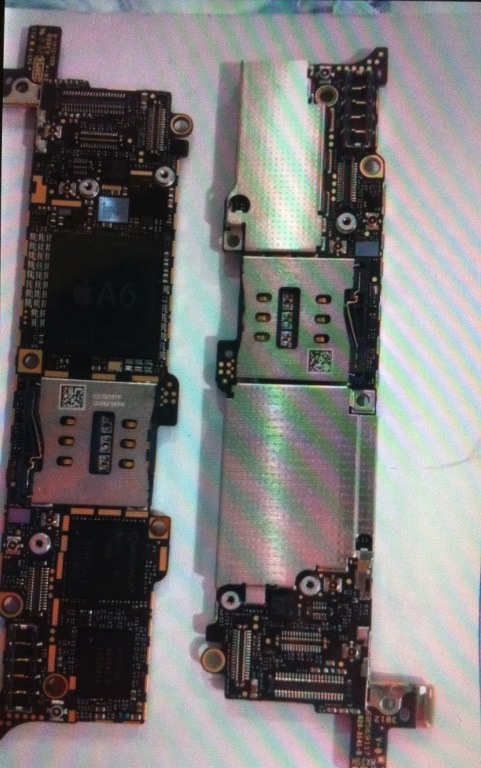
Adding to the slew of alleged leaks, a new image of a purported logic board for the next-generation iPhone has surfaced. The crisp picture shows the logical board without any protective EMI shielding for an internal look at the A6 chip that supposedly sits inside. We are a bit wary about the authenticity of this picture, as its originator, Sonny Dickson, said it needed to be “enhanced with Photoshop.”
It is speculated the A6, or a variant of the A5X chip, would appear in the next iPhone, and many thought Taiwanese Semiconductor Manufacturing Company’s 28nm process would manufacturer the quad-core chip, but the latest reports claimed Apple is stuck with Samsung for at least CPU and/or baseband chip building after TSMC rebuffed an exclusive bid.
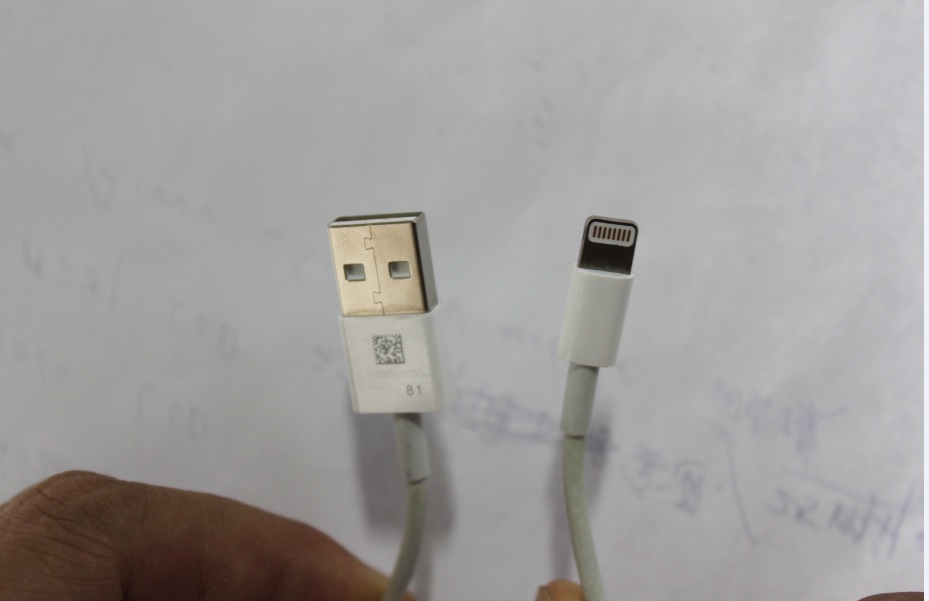
We also see another 9-pin dock cable from Sonny below:
.
A gallery of new parts is below—including a video from Sinocent. Expand Expanding Close
JumpFromPaper (perfect name, eh?) offers a line of handbags, profile bags, carrying pouches, etc., which look colorful and two-dimensional, and will hold an iPad, MacBook or just about anything else.
So, where did the idea come from?:
JumpFromPaper™ is a playful and innovative line of bags created by Taipei-based design duo, Chay Su and Rika Lin.
One cozy afternoon, the two girls were chatting, when they got to sketching their dream designer bag. A surprising idea popped up – “How amazing it would be if a two-dimensional hand-drawn illustration could come to life as a real bag!” They explored every possibility, rendering fantasy handbags in perspective, and giving birth to JumpFromPaper™.
Each bag boasts a cartoon-like outline and vivid colors that are sure to mess with folks’ eyes. Prices range from $79 to $129, and the Tropical Fish bag (top), in particular, is a gadget-targeted carrier sporting a slim, striped design with polyester fabric for just $79:
Topical Fish is your new protector for your gadgets. This carry pouch perfectly holds your netbook, iPad/tablet, or whatever other accessories you need for a day in the office or fun in the sun. Are they real? Yes they’re real. Although slim in appearance, each JumpFromPaper™ bag has a roomy interior to accommodate an iPad/tablet, book, magazines, and your everyday accessories. A zipper bottom expands the bag for extra room.
Pre-ordered Tropical Fish bags began shipping Aug. 27, and we hope to get our hands on a review unit soon. Check out JumpFromPaper to see what else the brand offers.
A few apps either updated or made announcements recently, and 9to5Mac gathered the most noteworthy ones in our regular round up below. Today’s crop includes a new goal-setting app backed by Twitter cofounders, a new screenwriting app with a huge launch discount, UI refreshes for a popular eReader app and stargazing app, and more. Per usual, we will continue to update this list throughout the day.
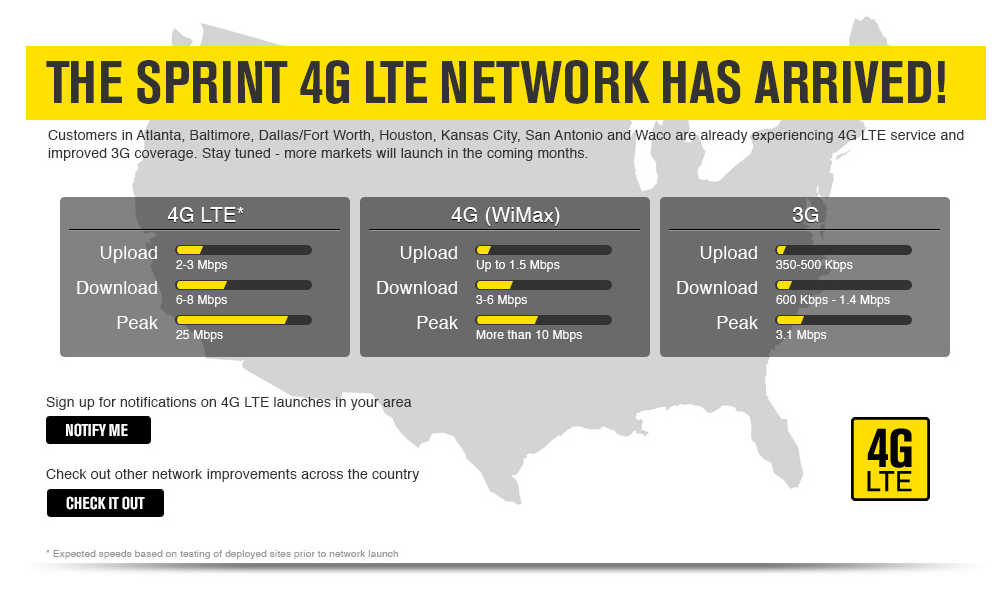
Sprint just announced it expanded 4G LTE data network coverage to customers in four more cities. Why do you care? Sprint carries the iPhone, but it does not carry the 4G LTE iPad partly due to its thin LTE spread. Sprint is thickening a bit now, however, so perhaps it will be on the same LTE footing when the LTE iPhone comes out in, oh, say a month.
Sprint today introduced its 4G LTE high-speed data network to customers in Baltimore, Md., Gainesville, Ga., Manhattan/Junction City, Kan., and Sedalia, Mo. Additionally, Sprint customers in Baltimore, Boston and Washington, D.C., are beginning to enjoy the benefits of Sprint’s all-new 3G service – which is expected to deliver an exceptionally clear signal, better in-building coverage and fewer dropped/blocked calls.
Sprint was the first national wireless carrier to introduce 4G (WiMAX) service in 2008, and the next-generation iPhone, which Sprint now carries, is largely expected to boast LTE capabilities. The carrier further told customers on its website to “stay tuned,” as more markets will launch “in the coming months.”
Apple and Qualcomm were denied, according to Bloomberg, when they tried to obtain exclusive chip production rights from Taiwanese Semiconductor Manufacturing Company.
Both put forward more than $1 billion in investments so TSMC would pledge production capacity to them, but the manufacturer rebuffed the bid to keep versatile in chip yielding.
The two companies are trying to satisfy booming demand for smartphones, a market estimated by to be worth $219.1 billion, according to data compiled by Bloomberg Industries. Any deal would give Apple an alternate supplier to Samsung Electronics Co. (005930), which builds the main chip used in the iPhone and iPad and is also its biggest rival in smartphones. Qualcomm needs to boost supply, since shortages are starting to limit earnings.
As a supplier to Qualcomm, Broadcom Corp. (BRCM), Nvidia Corp. (NVDA) and other companies that no longer operate their own factories, TSMC wants to keep the flexibility to switch its production between customers and products. TSMC ChairmanMorris Chang told investors last month that he was willing to devote one or even two factories to a single customer.
One read of the story is that Apple wants to bail on Samsung and its new Texas foundry for CPU production. Qualcomm, on the other hand, is experiencing an insufficient ability to produce chips, which is starting to affect its earnings. TSMC forewarned that its 28nm mill for Qualcomm’s Snapdragon S4 would not meet demand until 2013, and NVidia’s 23nm Keplar graphic chip, also manufactured by TSMC, has suffered much the same as Qualcomm.
There have been false CPU rumors regarding Apple and TSMC in the past. The Qualcomm and Apple rumor here might actually be for baseband chips, which Qualcomm makes for Apple. With the new iPhone, Apple is probably trying to ramp up those Qualcomm baseband chips in epic numbers (not the A5 processor, as implied by the story). Expand Expanding Close
A slew of apps either updated or made announcements recently, and 9to5Mac gathered the most noteworthy ones in our regular round up below. Today’s crop includes a new project on Indiegogo, UI tweaks to popular iOS apps, a Mac app adding more features, interface refreshes for a Web browser and an instant-messaging client, and even some new Flipboard stats in celebration of its second birthday. Per usual, we will continue to update this list throughout the day.
It’s a penetrating look inside Apple: psychological mastery, banned words, roleplaying—you’ve never seen anything like it.
The Genius Training Student Workbook we received is the company’s most up to date, we’re told, and runs a bizarre gamut of Apple Dos and Don’ts, down to specific words you’re not allowed to use, and lessons on how to identify and capitalize on human emotions. The manual could easily serve as the Humanity 101 textbook for a robot university, but at Apple, it’s an exhaustive manual to understanding customers and making them happy. Sales, it turns out, take a backseat to good vibes—almost the entire volume is dedicated to empathizing, consoling, cheering up, and correcting various Genius Bar confrontations. The assumption, it’d seem, is that a happy customer is a customer who will buy things. And no matter how much the Apple Store comes off as some kind of smiling likeminded computer commune, it’s still a store above all—just one that puts an enormous amount of effort behind getting inside your head.
In related news, Apple started giving Apple employees a free 50GB storage boost to their iCloud accounts. The $100 a year value also includes the 5GB of complimentary storage that comes standard upon signup. A screenshot of the perk is in the workbook gallery above. [via MacRumors]
Ah, the Genius Bar: It’s (mostly) free, it’s accessible, and nine out of 10 Apple product owners love it.
The latest research from NPD Group indicates folks are willing to buy multiple Apple devices primarily due to their pleasant experience at the Genius Bar. A whopping 90 percent, in fact, said they were “extremely or very satisfied” following their experience. The approval rate is primarily attributed to 88 percent of those Genius Bar consumers receiving complimentary service.
That service left almost all of the 40 percent of Apple owners who took their Apple devices to the Genius Bar very happy. Nearly 90 percent of consumers who used Apple’s tech service said they were extremely or very satisfied. In contrast, top 2 box satisfaction among all consumer service interactions was 78 percent. A major part of their satisfaction came from the fact that only a small percentage actually paid for their service. According to the report, 88 percent of Genius Bar consumers said their service was free compared to 78 percent of all consumers.
The majority of the support was for troubleshooting (37 percent), followed by product repair (28 percent), how-to support (18 percent), software installation/upgrade (11 percent), and product installation/set-up (7 percent).
Apple product consumers also approve the retail giant’s tech support offerings. Sixty percent of consumers claimed they were “somewhat or much more likely” to make another purchase following their experience, while another 31 percent admitted they had a “much more positive view” of the Cupertino, Calif.-based company after their service. However, as the study noted, “physical presence is key.” Fifty-three percent of consumers were extremely satisfied with in-store encounters versus other types of interactions, but 45 percent of younger consumers still preferred virtual communications.
These statistics are interesting, especially considering yesterday’s report from IFOAppleStore. It claimed then-COO Tim Cook and current CFO Peter Oppenheimer pushed former Apple Senior Vice President of Retail Ron Johnson toward revenues over customer satisfaction when then-CEO Steve Jobs was on medical leave in 2009. Moreover, Apple has maintained new policies —despite wide-spread criticism over recent retail layoffs— that reflect budget cuts with an emphasis on revenue. With this outlook, it surely won’t be long until tech support experiences start falling by the wayside.
NPD gathered responses from over 2,000 adults via an online survey in May 2012.
More stats are available in the press release below.
Apple recently unveiled Germany’s ninth Apple Store on its website (translated). The latest shop will open Sept. 1 at 10 a.m. in Cologne’s Rhein-Center shopping mall. It is located on the top floor next to Zara and across from Lush. According to German news blog iFun (translated), those who wait in line to gain entrance will receive a limited number of T-shirts.
In related news, Apple’s signage now covers a second spot in Hong Kong. The gray, simple look indicates a new retail store is coming to the Festival Walk mall in the Kowloon Tong area, according to Engadget China (translated), which also posted a few pictures, as seen below. The report said the store could open in September, but the date is not confirmed.













 .
.