A federal appeals court today has upheld the 2013 ruling in Apple’s long-winded and high-profile ebooks case. The case, which centered around Apple price fixing content in the iBooks store, went through three years of litigation thanks mostly to Apple. Today’s ruling by a federal appeals court will see Apple pay $450 million in damages at long last.
Just as we thought Apple’s long-running ebooks suit might finally be settled, the out-of-court agreement has been thrown into doubt. The judge required to approve the settlement terms has expressed concern that they may be unfair to consumers, reports Business Insider.
U.S. District Judge Denise Cote in Manhattan said she found “most troubling” a clause requiring Apple to pay only $70 million if an appeals court reversed her finding that the company is liable for antitrust violations and sent it back to her for further proceedings.
Apple was found guilty of price-fixing, an allegation it always denied and is currently appealing. To speed things up, lawyers on both sides agreed what would happen for each of the three possible outcomes of the appeal.
If Apple wins the appeal, it will pay nothing. If it loses the appeal, it will pay $50M in legal costs and $400M to a compensation fund for consumers. The contentious part is what happens if the appeals court overturns the original verdict but sends the case back for new proceedings. In this event, the proposal is that Apple would pay just $70M, of which the compensation fund would receive $50M.
Cote questioned if that would be fair and what might happen if the appeals court reversed her ruling on a minor issue.
This is not the first example of post-trial arguments, Apple having earlier called for the removal of the court-appointed antitrust monitor, a request rejected by the court.
Apple settled out of court in the latest e-books price-fixing suit brought against the company, allowing the company to dodge an $840 million bullet, as reported by Bloomberg. The case, brought against the Cupertino company by multiple states and consumers, was set to go before a jury next month, but that will no longer be necessary.
The terms of the settlement have not yet been revealed, and the opposing sides of the case have one month to request formal acceptable of their agreement by the court.
Apple is facing a new class-action lawsuit from iBooks customers over price-fixing practices according to Reuters. As has been previously argued, Apple conspired with book publishers to hike the prices of ebooks, a violation of U.S. anti-trust law. The Department of Justice won its case against Apple for the same reason last year, and Apple is currently in the middle of appealing that case.
This new lawsuit is a civil case being brought by customers affected by the price-fixing scheme. Today U.S. District Judge Denise Cote ruled that the customers suing could do so as a group despite Apple’s objections. The actual trial will be scheduled for later this year. Expand Expanding Close
Plaintiffs’ proposed injunction is a draconian and punitive intrusion into Apple’s business, wildly out of proportion to any adjudicated wrongdoing or potential harm. Plaintiffs propose a sweeping and unprecedented injunction as a tool to empower the Government to regulate Apple’s businesses and potentially affect Apple’s business relationships with thousands of partners across several markets. Plaintiffs’ overreaching proposal would establish a vague new compliance regime—applicable only to Apple—with intrusive oversight lasting for ten years, going far beyond the legal issues in this case, injuring competition and consumers, and violating basic principles of fairness and due process. The resulting cost of this relief—not only in dollars but also lost opportunities for American businesses and consumers—would be vast.
After reaching settlements with just about every publisher involved in the long-running Apple/Amazon e-book price fixing case, The United States Department of Justice today published its proposal to end the case with Apple after finding the company guilty of conspiring to fix ebook prices during trial earlier this month:
“The court found that Apple’s illegal conduct deprived consumers of the benefits of e-book price competition and forced them to pay substantially higher prices,” said Bill Baer, Assistant Attorney General in charge of the Department of Justice’s Antitrust Division. “Under the department’s proposed order, Apple’s illegal conduct will cease and Apple and its senior executives will be prevented from conspiring to thwart competition in the future.”
Update: Apple provided a comment to AllThingsD and confirmed it will appeal the decision:
“Apple did not conspire to fix ebook pricing and we will continue to fight against these false accusations. When we introduced the iBookstore in 2010, we gave customers more choice, injecting much needed innovation and competition into the market, breaking Amazon’s monopolistic grip on the publishing industry. We’ve done nothing wrong and we will appeal the judge’s decision.”
Reuters reports that a judge just ruled that Apple conspired to raise the retail prices of e-books and said a trial for damages will soon follow:
The decision by U.S. District Judge Denise Cote[pictured, right] in Manhattan is a victory for the U.S. government and various states, which the judge said are entitled to injunctive relief. The publishers have already settled with the federal government on e-book pricing. Cote ruled after a non-jury trial that ended on June 20.
Apple warned that a guilty verdict in its e-book price-fixing case could have a negative impact on how digital media deals are negotiated in the US and Apple CEO Tim Cook even called the suit ‘bizarre’:
The e-book case to me is bizarre. We’ve done nothing wrong there, and so we’re taking a very principled position. … We’re not going to sign something that says we did something we didn’t do. … So we’re going to fight.
The DOJ had argued that Apple had conspired to raise prices with all of the publishers and hurt rival Amazon.
Interestingly, according to the NYTimes, one of the most damning pieces of evidence in the government’s case is the video below of Steve Jobs talking with Walt Mossberg. Per Daring Fireball: Mossberg asks Jobs why someone would buy a book for $14.99 from the iBookstore when they could buy the same book from Amazon for $9.99.
Jobs: Well, that won’t be the case.
Mossberg: Meaning you won’t be $14.99, or they won’t be $9.99?
After a three week debate between Apple and the U.S. Department of Justice, the controversial e-book price-fixing case concluded today with final summations at the U.S. District Court in Manhattan. As part of its last remarks, Apple presented a 136-slide deck describing its case against the DOJ in full detail underscoring its argument that they did not conspire with publishers to illegally fix e-book prices.
On the other side of the argument, the DOJ argues that Apple was the “ringmaster” of a plot to raise mainstream e-book pricing above Amazon’s pre-established $9.99 price point by moving the industry from a wholesale model to an agency model. In the proposed model, Apple granted retailers the ability to set prices much like Apple’s App Store. Like Apple, the DOJ provided a deck explaining their point of view. Both decks can be viewed below.
U.S. District Judge Denise Cote is expected to rule on the case in the coming weeks.
Earlier this month we heard that Apple submitted to the courts that it engaged in “contentious negotiations”– and not a pricing conspiracy– at a time when publishers were already considering methods of getting Amazon to increase pricing. According to the latest comments from a judge in the high-profile eBook pricing case, Apple might not be able to prove its case when it goes to trial early next month.
U.S. District Judge Denise Cote believes that the U.S Justice Department will indeed be able to prove a pricing conspiracy took place (via Bloomberg):
“I believe that the government will be able to show at trial direct evidence that Apple knowingly participated in and facilitated a conspiracy to raise prices of e-books, and that the circumstantial evidence in this case, including the terms of the agreements, will confirm that,” U.S. District Judge Denise Cote in Manhattan said yesterday.
“We strongly disagree with the court’s preliminary statements about the case,” Orin Snyder, Apple’s lead lawyer in the case, said yesterday in an e-mailed statement. “The court made clear that this was not a final ruling and that the evidence at trial will determine the verdict. This is what a trial is for.”
We already knew back in December that Pearson, along with a handful of other publishers had decided to settle with the U.S. Department of Justice in the high-profile Apple ebook price-fixing case. Today a statement from Peason’s Penguin unit confirms that it has now also reached an agreement that will see the publisher pay $75 million in consumer damages to the US State Attorneys General on behalf of people that were overcharged due to the alleged price fixing:
Penguin has reached a comprehensive agreement with the US State Attorneys General and private class plaintiffs to pay $75 million in consumer damages plus costs and fees to resolve all antitrust claims relating to eBook pricing. Penguin has also committed to the State Attorneys General to abide by the same injunctive relief as previously agreed in a separate settlement with the Department of Justice.
In anticipation of reaching this agreement, Pearson had made a $40m provision for settlement in its 2012 accounts. An incremental charge will be expensed in Pearson’s 2013 statutory accounts as part of the accounting for the Penguin Random House joint-venture.
In the ongoing e-book price fixing case with the Department of Justice, in which Apple is accused of conspiring with publishers to fix eBook pricing and cut out Amazon, Apple has again responded to the DOJ’s claims detailing the “tough negotiations” it went through with publishers. To further prove its point that it was not colluding with publishers to fix e-book pricing, Apple said it “one-on-one” and “contentious negotiations” at a time when publishers were already considering methods of getting Amazon to increase pricing: Expand Expanding Close
Apple may face an anti-trust investigation in Europe over its iPhone contracts with carriers as it defends itself against separate investigations for alleged price gouging in Australia.
Apple was informed last year that it would be required to attend a hearing by Australia’s Standing Committee on Infrastructure and Communications to explain why its pricing of digital content was higher in Australia than in the United States. The hearing is now underway, as reported by the Sydney Morning Herald, with Apple asked to explain why content sold through iTunes is marked up between 30 and 70 percent higher than in the U.S. Apple is blaming wholesale pricing agreements in the country.
“The pricing of this digital content is based on the wholesale prices which are set through negotiated contracts with the record labels, movie studios and TV networks,” said Mr King, who is Apple’s vice president for Australia, New Zealand and South Asia.
We noted last month that Apple filed a document with the Southern District of New York attempting to have settlements with the U.S. Department of Justice and three publishers delayed until after the high profile eBook price-fixing case goes to trial in June 2013. The Wall Street Journal reported today that a federal judge approved the settlements, which would allow Amazon and other retailers to return to its previous model and freely set eBook prices. Not surprisingly, Apple is expected to appeal the decision:
In a move that could reshape the publishing industry, a federal judge has approved a settlement with three of the nation’s largest book publishers over alleged collusion in the pricing of e-books… Apple has previously indicated in court papers that it would seek to appeal any decision approving the settlement. As a result, it could take some time before consumers see lower prices on e-books… “It’s devastating to bookstores,” said Paul Aiken, executive director of the Authors Guild. “For two years the settling publishers must allow vendors to discount e-books at any price they want. The court acknowledges that this restores the status quo conditions before 2010, when Amazon was able capture 90% of the e-book market. The Justice Department is reshaping the literary marketplace without submitting a single economic study to the court to justify its actions.”
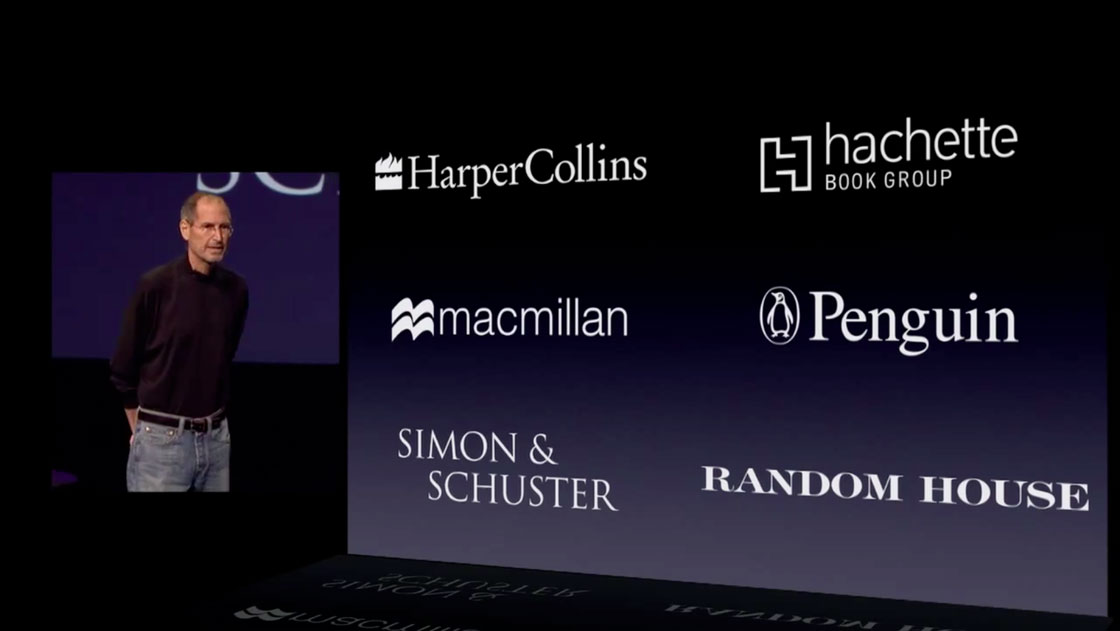
Following an investigation into alleged eBook price-fixing, the U.S. Department of Justice filed an antitrust lawsuit against Apple and publishers Macmillan and Penguin earlier this month, who refused to settle. Other publishers, including Hachette, HarperCollins, and Simon & Schuster, settled and reached an agreement to return Amazon to its previous wholesale model and dismantle Apple’s agency model. The settlement also included agreements with select states that would see $51 million in restitution paid to those who purchased eBooks through Apple’s platform. Now, several Canadian publications are reporting class-action lawsuits were filed against Apple and the five publishers throughout Canada.
Lawyer Normand Painchaud spoke withThe Montreal Gazetteabout his class-action suit filed in Quebec Superior Court and talked about two others filed in Ontario and British Columbia:
Bloomberg is reporting that the United States has filed an antitrust lawsuit in a New York district court against Apple and publishers Hachette SA, HarperCollins, Macmillan, Penguin, and Simon & Schuster over alleged eBook price-fixing. The news follows reports from Reutersyesterday that the U.S. Department of Justice was preparing to launch a lawsuit against Apple and five major publishers accused of colluding to fix and increase the price of eBooks.
According to the report, all the parties named in the suit—except Macmillan, Penguin, and Apple— are willing to settle to avoid legal costs. The Department of Justice could announce “unspecified” settlements as early as today.
At the core of the settlement discussions is the agency model introduced with the iPad in 2010. The deal with publishers was described by Steve Jobs to biographer Walter Isaacson:
“We told the publishers, ‘We’ll go to the agency model, where you set the price, and we get our 30%, and yes, the customer pays a little more, but that’s what you want anyway…. They went to Amazon and said, ‘You’re going to sign an agency contract or we’re not going to give you the books.’ “
The model allows publishers to set their own prices as long as Apple gets a 30 percent cut and a guarantee that the same content is not offered lower elsewhere, but the Department of Justice is trying to return to Amazon’s wholesale model by giving retailers like Amazon control over pricing. Bloomberg explained: Expand Expanding Close