Author

Avatar for 9to5 Staff

9to5 Staff

Google "phone" is on. High Noon EST

Site default logo image

Google will announce their "phone" today.  At noon.   We use quotes because people aren’t going to be buying – or leasing it as the case may be – it for its phone features – nor will it be available until the second 1/2 of 2008.  It will be a mobile browser platform and more.  Think Nokia Tablet type devices but smaller.  As for carriers, T-Mobile will certainly be one of the carriers taking it on but many othes will be jumping on.  Also think WiMAX.

This year and next will be known as the time that the desktop (or laptop as it were) moved to the palmtop.  Every major advancement is occurring in this space.  Vista and Leopard are evolutions, not revolutions…

Google’s phone will most likely be light on phone features but heavy on Linux OS and Firefox browsing capabilities.  This is a very exciting time indeed!

Google Announcement Page

Fun Details below (you think many people will join the conference call?)

Google, T-Mobile, HTC, Qualcomm and Motorola to Discuss New Open Platform for Mobile Devices

–(BUSINESS WIRE)–Google Inc. (NASDAQ:GOOG):

WHAT:

Industry leaders hold conference call to discuss the development of Android, the first truly open and comprehensive platform for mobile devices, and the announcement of the Open Handset Alliance, a multinational alliance of more than 30 technology and mobile industry leaders.

WHEN:

Monday, November 5, 2007, 9:00am pacific / 12:00 pm eastern

WHO:

The following executives will participate in the call:

Eric Schmidt, Chairman and CEO of Google Inc.

Andy Rubin, Director of Mobile Platforms, Google Inc.

René Obermann, CEO of Deutsche Telekom, parent company of T-Mobile

Peter Chou, CEO of HTC Corp.

Paul Jacobs, CEO of Qualcomm

Ed Zander, Chairman and CEO of Motorola, Inc.

WHY:

With nearly 3 billion users worldwide, the mobile phone has become the most personal and ubiquitous communications device. However, the lack of a collaborative effort has made it a challenge for developers, wireless operators and handset manufacturers to respond as quickly as possible to the ever-changing needs of savvy mobile consumers. Through Android, developers, wireless operators and handset manufacturers will be better positioned to bring to market innovative new products faster and at a much lower cost. The end result will be an unprecedented mobile platform that will enable wireless operators and manufacturers to give their customers better, more personal and more flexible mobile experiences.

CONFERENCE CALL DETAILS:

Toll-free: 800-817-2743

Toll: 913-312-1295

Confirmation Code: Google 8747527

The names of companies and products mentioned herein may be the trademarks of their respective owners.

Contacts
Google Inc.
Erin Fors, 1-650-930-3555
press@google.com


Thoughts on Wireless Access – part 2

Site default logo image

Apple Statement – Steve Jobs -February 6, 2007 9to5Mac Revised Apple Statment for use with iPhones
With the stunning global success of Apple’s iPod music player and iTunes online music store, some have called for Apple to “open” the digital rights management (DRM) system that Apple uses to protect its music against theft, so that music purchased from iTunes can be played on digital devices purchased from other companies, and protected music purchased from other online music stores can play on iPods. Let’s examine the current situation and how we got here, then look at three possible alternatives for the future. With the stunning success of Apple’s iPhone and AT&T wireless data service, some have called for Apple to “open” the SIM Lock system that Apple uses to protect its iPhone from obtaining data purchased from other online wireless data providors so that it can be used on iPhones. Let’s examine the current situation and how we got here, then look at three possible alternatives for the future.
To begin, it is useful to remember that all iPods play music that is free of any DRM and encoded in “open” licensable formats such as MP3 and AAC. iPod users can and do acquire their music from many sources, including CDs they own. Music on CDs can be easily imported into the freely-downloadable iTunes jukebox software which runs on both Macs and Windows PCs, and is automatically encoded into the open AAC or MP3 formats without any DRM. This music can be played on iPods or any other music players that play these open formats. To begin, it is useful to remember that all iPhones can use wireless data that is free of any SIM Lock and encoded in “open” data formats such as GSM and EDGE. iPhone users can and do acquire their wireless data from many sources, including home Wifis they own. Wired data on home Wifis can be easily used to provide downloadable data which runs on both Macs and Windows PCs, and is automatically encoded to support TCP/IP formats without any SIM Lock. This Wifi data can be used on iPhones or any other wireless data devices that use these open formats.
The rub comes from the music Apple sells on its online iTunes Store. Since Apple does not own or control any music itself, it must license the rights to distribute music from others, primarily the “big four” music companies: Universal, Sony BMG, Warner and EMI. These four companies control the distribution of over 70% of the world’s music. When Apple approached these companies to license their music to distribute legally over the Internet, they were extremely cautious and required Apple to protect their music from being illegally copied. The solution was to create a DRM system, which envelopes each song purchased from the iTunes store in special and secret software so that it cannot be played on unauthorized devices. The rub comes from the wireless data Apple sells from AT&T. Since Apple does not own or control any wireless data itself, it must license the rights to distribute wireless data from others, primarily the “big four” wireless data companies. These four companies control the distribution of over 90% of America’s wireless data. When Apple approached these companies to license their wireless data to distribute legally over the Airwaves, they were extremely cautious and required Apple to protect their wireless data from being overly used. The solution was to create a SIM Lock system, which envelopes each phone purchased from the AT&T store in special and secret software so that it cannot be used on other services.
Apple was able to negotiate landmark usage rights at the time, which include allowing users to play their DRM protected music on up to 5 computers and on an unlimited number of iPods. Obtaining such rights from the music companies was unprecedented at the time, and even today is unmatched by most other digital music services. However, a key provision of our agreements with the music companies is that if our DRM system is compromised and their music becomes playable on unauthorized devices, we have only a small number of weeks to fix the problem or they can withdraw their entire music catalog from our iTunes store. Apple was able to negotiate landmark usage rights at the time, which include allowing users to use their SIM Lock protected iPhones to get unlimited wireless data. Obtaining such rights from the wireless data companies was unprecedented at the time, and even today is unmatched by most other digital wireless data services. However, a key provision of our agreements with the wireless data companies is that if our SIM Lock system is compromised and iPhones can use data on unauthorized wireless providors, we have only a small number of weeks to fix the problem or they can withdraw their entire wireless data agreement from our AT&T deal.
To prevent illegal copies, DRM systems must allow only authorized devices to play the protected music. If a copy of a DRM protected song is posted on the Internet, it should not be able to play on a downloader’s computer or portable music device. To achieve this, a DRM system employs secrets. There is no theory of protecting content other than keeping secrets. In other words, even if one uses the most sophisticated cryptographic locks to protect the actual music, one must still “hide” the keys which unlock the music on the user’s computer or portable music player. No one has ever implemented a DRM system that does not depend on such secrets for its operation. To prevent illegal access, SIM Lock systems must allow only authorized devices to use the protected wireless data. If a copy of SIM Lock breaking software is posted on the Internet, it should not be able to used on a downloader’s computer or portable wireless data device. To achieve this, a SIM Lock system employs secrets. There is no theory of protecting content other than keeping secrets. In other words, even if one uses the most sophisticated cryptographic locks to protect the actual wireless data, one must still “hide” the keys which unlock the wireless data on the user’s computer or portable wireless data device. No one has ever implemented a SIM Lock system that does not depend on such secrets for its operation.
The problem, of course, is that there are many smart people in the world, some with a lot of time on their hands, who love to discover such secrets and publish a way for everyone to get free (and stolen) music. They are often successful in doing just that, so any company trying to protect content using a DRM must frequently update it with new and harder to discover secrets. It is a cat-and-mouse game. Apple’s DRM system is called FairPlay. While we have had a few breaches in FairPlay, we have been able to successfully repair them through updating the iTunes store software, the iTunes jukebox software and software in the iPods themselves. So far we have met our commitments to the music companies to protect their music, and we have given users the most liberal usage rights available in the industry for legally downloaded music. The problem, of course, is that there are many smart people in the world, some with a lot of time on their hands, who love to discover such secrets and publish a way for everyone to get unlock the wireless data source access. They are often successful in doing just that, so any company trying to protect content using a SIM Lock must frequently update it with new and harder to discover secrets. It is a cat-and-mouse game. Apple’s SIM Lock system is called iPhone Updates. While we have had a few breaches in iPhone Updates, we have been able to successfully repair them through updating the AT&T SIM lock, the iTunes software and software in the iPhones themselves. So far we have met our commitments to the wireless data companies to protect their wireless data, and we have given users the most liberal usage rights available in the industry.
With this background, let’s now explore three different alternatives for the future. With this background, let’s now explore three different alternatives for the future.
The first alternative is to continue on the current course, with each manufacturer competing freely with their own “top to bottom” proprietary systems for selling, playing and protecting music. It is a very competitive market, with major global companies making large investments to develop new music players and online music stores. Apple, Microsoft and Sony all compete with proprietary systems. Music purchased from Microsoft’s Zune store will only play on Zune players; music purchased from Sony’s Connect store will only play on Sony’s players; and music purchased from Apple’s iTunes store will only play on iPods. This is the current state of affairs in the industry, and customers are being well served with a continuing stream of innovative products and a wide variety of choices. The first alternative is to continue on the current course, with each manufacturer competing freely with their own “top to bottom” proprietary systems for selling, playing and protecting wireless data. It is a very competitive market, with major global companies making large investments to develop new wireless data devices and online wireless data stores. Apple, Microsoft and Sony all compete with proprietary phone OS’s. Wireless data purchased for Microsoft’s WM6 devices will only used on WM6 devices; wireless data purchased from Sony’s Symbian devices will only be used on Sony’s devices; and wireless data purchased from Apple’s AT&T store will only useon iPhones. This is the current state of affairs in the industry, and customers are being well served with a continuing stream of innovative products and a wide variety of choices.
Some have argued that once a consumer purchases a body of music from one of the proprietary music stores, they are forever locked into only using music players from that one company. Or, if they buy a specific player, they are locked into buying music only from that company’s music store. Is this true? Let’s look at the data for iPods and the iTunes store – they are the industry’s most popular products and we have accurate data for them. Through the end of 2006, customers purchased a total of 90 million iPods and 2 billion songs from the iTunes store. On average, that’s 22 songs purchased from the iTunes store for each iPod ever sold. Some have argued that once a consumer purchases a wireless data contract from one of the proprietary wireless data stores, they are forever locked into only using wireless data devices from that one company. Or, if they buy a specific device, they are locked into buying wireless data only from that company’s wireless data store. Is this true? Let’s look at the data for iPhones and the AT&T store – they are the industry’s most popular products and we have accurate data for them. Through the end of 2007, customers purchased a total of 1.5 million iPhones.
Today’s most popular iPod holds 1000 songs, and research tells us that the average iPod is nearly full. This means that only 22 out of 1000 songs, or under 3% of the music on the average iPod, is purchased from the iTunes store and protected with a DRM. The remaining 97% of the music is unprotected and playable on any player that can play the open formats. It’s hard to believe that just 3% of the music on the average iPod is enough to lock users into buying only iPods in the future. And since 97% of the music on the average iPod was not purchased from the iTunes store, iPod users are clearly not locked into the iTunes store to acquire their music. And since 97% of the wireless data on the average iPhone was not purchased from the AT&T wireless, iPhone users are clearly not locked into the AT&T wireless to acquire their wireless data.
The second alternative is for Apple to license its FairPlay DRM technology to current and future competitors with the goal of achieving interoperability between different company’s players and music stores. On the surface, this seems like a good idea since it might offer customers increased choice now and in the future. And Apple might benefit by charging a small licensing fee for its FairPlay DRM. However, when we look a bit deeper, problems begin to emerge. The most serious problem is that licensing a DRM involves disclosing some of its secrets to many people in many companies, and history tells us that inevitably these secrets will leak. The Internet has made such leaks far more damaging, since a single leak can be spread worldwide in less than a minute. Such leaks can rapidly result in software programs available as free downloads on the Internet which will disable the DRM protection so that formerly protected songs can be played on unauthorized players. The second alternative is for Apple to license its SIM Lock technology to current and future competitors with the goal of achieving interoperability between different company’s devices and wireless data stores. On the surface, this seems like a good idea since it might offer customers increased choice now and in the future. And Apple might benefit by charging a small licensing fee for its SIM Lock. However, when we look a bit deeper, problems begin to emerge. The most serious problem is that licensing a SIM Lock involves disclosing some of its secrets to many people in many companies, and history tells us that inevitably these secrets will get hacked. The Internet has made such hacks far more damaging, since a single hack can be spread worldwide in less than a minute. Such hacks can rapidly result in software programs available as free downloads on the Internet which will disable the SIM Lock protection so that formerly protected phones can get unauthorized data.
An equally serious problem is how to quickly repair the damage caused by such a leak. A successful repair will likely involve enhancing the music store software, the music jukebox software, and the software in the players with new secrets, then transferring this updated software into the tens (or hundreds) of millions of Macs, Windows PCs and players already in use. This must all be done quickly and in a very coordinated way. Such an undertaking is very difficult when just one company controls all of the pieces. It is near impossible if multiple companies control separate pieces of the puzzle, and all of them must quickly act in concert to repair the damage from a leak. An equally serious problem is how to quickly repair the damage caused by such a hack. A successful repair will likely involve enhancing the wireless data software, the itunes software, and the software in the devices with new secrets, then transferring this updated software into the tens (or hundreds) of millions of Macs, Windows PCs and devices already in use. This must all be done quickly and in a very coordinated way. Such an undertaking is very difficult when just one company controls all of the pieces. It is near impossible if multiple companies control separate pieces of the puzzle, and all of them must quickly act in concert to repair the damage from a hack.
Apple has concluded that if it licenses FairPlay to others, it can no longer guarantee to protect the music it licenses from the big four music companies. Perhaps this same conclusion contributed to Microsoft’s recent decision to switch their emphasis from an “open” model of licensing their DRM to others to a “closed” model of offering a proprietary music store, proprietary jukebox software and proprietary players. Apple has concluded that if it licenses Sim lock others, it can no longer guarantee to protect the wireless data it licenses from the big four wireless data companies. Perhaps this same conclusion contributed to Microsoft’s recent decision to switch their emphasis from an “open” model of licensing their SIM Lock to others to a “closed” model of offering a proprietary wireless data store, proprietary jukebox software and proprietary devices.
The third alternative is to abolish DRMs entirely. Imagine a world where every online store sells DRM-free music encoded in open licensable formats. In such a world, any player can play music purchased from any store, and any store can sell music which is playable on all players. This is clearly the best alternative for consumers, and Apple would embrace it in a heartbeat. If the big four music companies would license Apple their music without the requirement that it be protected with a DRM, we would switch to selling only DRM-free music on our iTunes store. Every iPod ever made will play this DRM-free music. The third alternative is to abolish SIM Locks entirely. Imagine a world where every online store sells SIM Lock-free wireless data encoded in open licensable formats. In such a world, any device can use wireless data purchased from any carrier, and any carrier can sell wireless data which is usable on all devices. This is clearly the best alternative for consumers, and Apple would embrace it in a heartbeat. If the big four wireless data companies would license Apple their wireless data without the requirement that it be protected with a SIM Lock, we would switch to selling only SIM Lock-free wireless data on our iPhones. Every iPhone ever made will use this SIM Lock-free wireless data.
Why would the big four music companies agree to let Apple and others distribute their music without using DRM systems to protect it? The simplest answer is because DRMs haven’t worked, and may never work, to halt music piracy. Though the big four music companies require that all their music sold online be protected with DRMs, these same music companies continue to sell billions of CDs a year which contain completely unprotected music. That’s right! No DRM system was ever developed for the CD, so all the music distributed on CDs can be easily uploaded to the Internet, then (illegally) downloaded and played on any computer or player. Why would the big four wireless data companies agree to let Apple and others distribute their wireless data without using SIM Lock systems to protect it? The simplest answer is because SIM Locks haven’t worked, and may never work, to halt wireless data piracy. Though the big four wireless data companies require that all their wireless data sold online be protected with SIM Locks, ISPs continue to sell billions of home Wifis a year which contain completely unprotected wireless data. That’s right! No SIM Lock system was ever developed for the home Wifi, so all the wireless data distributed on home Wifis can be easily be used on any computer or device.
In 2006, under 2 billion DRM-protected songs were sold worldwide by online stores, while over 20 billion songs were sold completely DRM-free and unprotected on CDs by the music companies themselves. The music companies sell the vast majority of their music DRM-free, and show no signs of changing this behavior, since the overwhelming majority of their revenues depend on selling CDs which must play in CD players that support no DRM system. The ISPs sell the vast majority of their wireless data SIM Lock-free, and show no signs of changing this behavior, since the overwhelming majority of their revenues depend on selling home Wifis which must usein home Wifi devices that support no SIM Lock system.
So if the music companies are selling over 90 percent of their music DRM-free, what benefits do they get from selling the remaining small percentage of their music encumbered with a DRM system? There appear to be none. If anything, the technical expertise and overhead required to create, operate and update a DRM system has limited the number of participants selling DRM protected music. If such requirements were removed, the music industry might experience an influx of new companies willing to invest in innovative new stores and players. This can only be seen as a positive by the music companies. So if the wireless data companies are selling over 90 percent of their wireless data SIM Lock-free, what benefits do they get from selling the remaining small percentage of their wireless data encumbered with a SIM Lock system? There appear to be none. If anything, the technical expertise and overhead required to create, operate and update a SIM Lock system has limited the number of participants selling SIM Lock protected wireless data. If such requirements were removed, the wireless data industry might experience an influx of new companies willing to invest in innovative new stores and devices. This can only be seen as a positive by the wireless data companies.
Much of the concern over DRM systems has arisen in European countries. Perhaps those unhappy with the current situation should redirect their energies towards persuading the music companies to sell their music DRM-free. For Europeans, two and a half of the big four music companies are located right in their backyard. The largest, Universal, is 100% owned by Vivendi, a French company. EMI is a British company, and Sony BMG is 50% owned by Bertelsmann, a German company. Convincing them to license their music to Apple and others DRM-free will create a truly interoperable music marketplace. Apple will embrace this wholeheartedly. Much of the concern over SIM Lock systems has arisen in European countries. Perhaps those unhappy with the current situation should redirect their energies towards persuading the wireless data companies to sell their wireless data SIM Lock-free. Convincing companies to license their wireless data to Apple and others SIM Lock-free will create a truly interoperable wireless data marketplace. Apple will embrace this wholeheartedly.
   

Thoughts on Wireless Access

Site default logo image

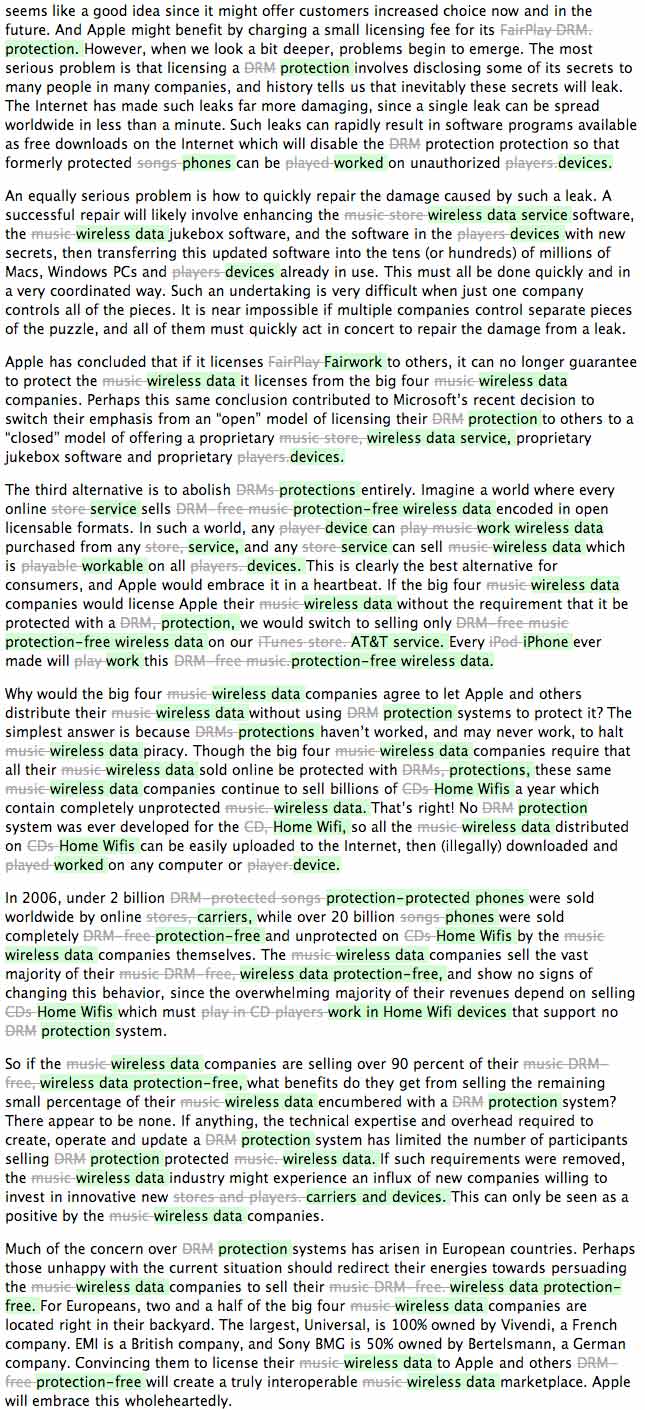
We were Inspired by Steve Wozniak’s comment the other day on Apple’s stance on SIM Locking vs. DRM locking.  We decided to do something about it.  What if we took Apple’s position on DRM for music and applied it to the SIM locking of the iPhone?  Does Apple stand up to its own scrutiny on the locking in of content and services?  For this experiment we did the following: 

  1. We took Steve Jobs Open Letter to the Music industry
  2. Copied it verbatim
  3. Did a Text Edit – Find/Replace on it using the following:
    cd -> Home Wifi
    iPod -> iPhone
    music -> wireless data
    iTunes -> AT&T
    MP3 -> GSM
    AAC -> EDGE
    leak -> hack
    DRM -> SIM lock
    copied -> used
    song -> phone
    Screen
    Capture
  4. Then we cleaned it up and removed iTunes specific data.

Below you will find the results of this experiment.  Notice how just exchanging a few words turns everything around on Apple.

Apple Statement – Steve Jobs -February 6, 2007 9to5Mac Revised Apple Statment for use with iPhones
With the stunning global success of Apple’s iPod music player and iTunes online music store, some have called for Apple to “open” the digital rights management (DRM) system that Apple uses to protect its music against theft, so that music purchased from iTunes can be played on digital devices purchased from other companies, and protected music purchased from other online music stores can play on iPods. Let’s examine the current situation and how we got here, then look at three possible alternatives for the future. With the stunning success of Apple’s iPhone and AT&T wireless data service, some have called for Apple to “open” the SIM Lock system that Apple uses to protect its iPhone from obtaining data purchased from other online wireless data providors so that it can be used on iPhones. Let’s examine the current situation and how we got here, then look at three possible alternatives for the future.
To begin, it is useful to remember that all iPods play music that is free of any DRM and encoded in “open” licensable formats such as MP3 and AAC. iPod users can and do acquire their music from many sources, including CDs they own. Music on CDs can be easily imported into the freely-downloadable iTunes jukebox software which runs on both Macs and Windows PCs, and is automatically encoded into the open AAC or MP3 formats without any DRM. This music can be played on iPods or any other music players that play these open formats. To begin, it is useful to remember that all iPhones can use wireless data that is free of any SIM Lock and encoded in “open” data formats such as GSM and EDGE. iPhone users can and do acquire their wireless data from many sources, including home Wifis they own. Wired data on home Wifis can be easily used to provide downloadable data which runs on both Macs and Windows PCs, and is automatically encoded to support TCP/IP formats without any SIM Lock. This Wifi data can be used on iPhones or any other wireless data devices that use these open formats.
The rub comes from the music Apple sells on its online iTunes Store. Since Apple does not own or control any music itself, it must license the rights to distribute music from others, primarily the “big four” music companies: Universal, Sony BMG, Warner and EMI. These four companies control the distribution of over 70% of the world’s music. When Apple approached these companies to license their music to distribute legally over the Internet, they were extremely cautious and required Apple to protect their music from being illegally copied. The solution was to create a DRM system, which envelopes each song purchased from the iTunes store in special and secret software so that it cannot be played on unauthorized devices. The rub comes from the wireless data Apple sells from AT&T. Since Apple does not own or control any wireless data itself, it must license the rights to distribute wireless data from others, primarily the “big four” wireless data companies. These four companies control the distribution of over 90% of America’s wireless data. When Apple approached these companies to license their wireless data to distribute legally over the Airwaves, they were extremely cautious and required Apple to protect their wireless data from being overly used. The solution was to create a SIM Lock system, which envelopes each phone purchased from the AT&T store in special and secret software so that it cannot be used on other services.
Apple was able to negotiate landmark usage rights at the time, which include allowing users to play their DRM protected music on up to 5 computers and on an unlimited number of iPods. Obtaining such rights from the music companies was unprecedented at the time, and even today is unmatched by most other digital music services. However, a key provision of our agreements with the music companies is that if our DRM system is compromised and their music becomes playable on unauthorized devices, we have only a small number of weeks to fix the problem or they can withdraw their entire music catalog from our iTunes store. Apple was able to negotiate landmark usage rights at the time, which include allowing users to use their SIM Lock protected iPhones to get unlimited wireless data. Obtaining such rights from the wireless data companies was unprecedented at the time, and even today is unmatched by most other digital wireless data services. However, a key provision of our agreements with the wireless data companies is that if our SIM Lock system is compromised and iPhones can use data on unauthorized wireless providors, we have only a small number of weeks to fix the problem or they can withdraw their entire wireless data agreement from our AT&T deal.
To prevent illegal copies, DRM systems must allow only authorized devices to play the protected music. If a copy of a DRM protected song is posted on the Internet, it should not be able to play on a downloader’s computer or portable music device. To achieve this, a DRM system employs secrets. There is no theory of protecting content other than keeping secrets. In other words, even if one uses the most sophisticated cryptographic locks to protect the actual music, one must still “hide” the keys which unlock the music on the user’s computer or portable music player. No one has ever implemented a DRM system that does not depend on such secrets for its operation. To prevent illegal access, SIM Lock systems must allow only authorized devices to use the protected wireless data. If a copy of SIM Lock breaking software is posted on the Internet, it should not be able to used on a downloader’s computer or portable wireless data device. To achieve this, a SIM Lock system employs secrets. There is no theory of protecting content other than keeping secrets. In other words, even if one uses the most sophisticated cryptographic locks to protect the actual wireless data, one must still “hide” the keys which unlock the wireless data on the user’s computer or portable wireless data device. No one has ever implemented a SIM Lock system that does not depend on such secrets for its operation.
The problem, of course, is that there are many smart people in the world, some with a lot of time on their hands, who love to discover such secrets and publish a way for everyone to get free (and stolen) music. They are often successful in doing just that, so any company trying to protect content using a DRM must frequently update it with new and harder to discover secrets. It is a cat-and-mouse game. Apple’s DRM system is called FairPlay. While we have had a few breaches in FairPlay, we have been able to successfully repair them through updating the iTunes store software, the iTunes jukebox software and software in the iPods themselves. So far we have met our commitments to the music companies to protect their music, and we have given users the most liberal usage rights available in the industry for legally downloaded music. The problem, of course, is that there are many smart people in the world, some with a lot of time on their hands, who love to discover such secrets and publish a way for everyone to get unlock the wireless data source access. They are often successful in doing just that, so any company trying to protect content using a SIM Lock must frequently update it with new and harder to discover secrets. It is a cat-and-mouse game. Apple’s SIM Lock system is called iPhone Updates. While we have had a few breaches in iPhone Updates, we have been able to successfully repair them through updating the AT&T SIM lock, the iTunes software and software in the iPhones themselves. So far we have met our commitments to the wireless data companies to protect their wireless data, and we have given users the most liberal usage rights available in the industry.
With this background, let’s now explore three different alternatives for the future. With this background, let’s now explore three different alternatives for the future.
The first alternative is to continue on the current course, with each manufacturer competing freely with their own “top to bottom” proprietary systems for selling, playing and protecting music. It is a very competitive market, with major global companies making large investments to develop new music players and online music stores. Apple, Microsoft and Sony all compete with proprietary systems. Music purchased from Microsoft’s Zune store will only play on Zune players; music purchased from Sony’s Connect store will only play on Sony’s players; and music purchased from Apple’s iTunes store will only play on iPods. This is the current state of affairs in the industry, and customers are being well served with a continuing stream of innovative products and a wide variety of choices. The first alternative is to continue on the current course, with each manufacturer competing freely with their own “top to bottom” proprietary systems for selling, playing and protecting wireless data. It is a very competitive market, with major global companies making large investments to develop new wireless data devices and online wireless data stores. Apple, Microsoft and Sony all compete with proprietary phone OS’s. Wireless data purchased for Microsoft’s WM6 devices will only used on WM6 devices; wireless data purchased from Sony’s Symbian devices will only be used on Sony’s devices; and wireless data purchased from Apple’s AT&T store will only useon iPhones. This is the current state of affairs in the industry, and customers are being well served with a continuing stream of innovative products and a wide variety of choices.
Some have argued that once a consumer purchases a body of music from one of the proprietary music stores, they are forever locked into only using music players from that one company. Or, if they buy a specific player, they are locked into buying music only from that company’s music store. Is this true? Let’s look at the data for iPods and the iTunes store – they are the industry’s most popular products and we have accurate data for them. Through the end of 2006, customers purchased a total of 90 million iPods and 2 billion songs from the iTunes store. On average, that’s 22 songs purchased from the iTunes store for each iPod ever sold. Some have argued that once a consumer purchases a wireless data contract from one of the proprietary wireless data stores, they are forever locked into only using wireless data devices from that one company. Or, if they buy a specific device, they are locked into buying wireless data only from that company’s wireless data store. Is this true? Let’s look at the data for iPhones and the AT&T store – they are the industry’s most popular products and we have accurate data for them. Through the end of 2007, customers purchased a total of 1.5 million iPhones.
Today’s most popular iPod holds 1000 songs, and research tells us that the average iPod is nearly full. This means that only 22 out of 1000 songs, or under 3% of the music on the average iPod, is purchased from the iTunes store and protected with a DRM. The remaining 97% of the music is unprotected and playable on any player that can play the open formats. It’s hard to believe that just 3% of the music on the average iPod is enough to lock users into buying only iPods in the future. And since 97% of the music on the average iPod was not purchased from the iTunes store, iPod users are clearly not locked into the iTunes store to acquire their music. And since 97% of the wireless data on the average iPhone was not purchased from the AT&T wireless, iPhone users are clearly not locked into the AT&T wireless to acquire their wireless data.
The second alternative is for Apple to license its FairPlay DRM technology to current and future competitors with the goal of achieving interoperability between different company’s players and music stores. On the surface, this seems like a good idea since it might offer customers increased choice now and in the future. And Apple might benefit by charging a small licensing fee for its FairPlay DRM. However, when we look a bit deeper, problems begin to emerge. The most serious problem is that licensing a DRM involves disclosing some of its secrets to many people in many companies, and history tells us that inevitably these secrets will leak. The Internet has made such leaks far more damaging, since a single leak can be spread worldwide in less than a minute. Such leaks can rapidly result in software programs available as free downloads on the Internet which will disable the DRM protection so that formerly protected songs can be played on unauthorized players. The second alternative is for Apple to license its SIM Lock technology to current and future competitors with the goal of achieving interoperability between different company’s devices and wireless data stores. On the surface, this seems like a good idea since it might offer customers increased choice now and in the future. And Apple might benefit by charging a small licensing fee for its SIM Lock. However, when we look a bit deeper, problems begin to emerge. The most serious problem is that licensing a SIM Lock involves disclosing some of its secrets to many people in many companies, and history tells us that inevitably these secrets will get hacked. The Internet has made such hacks far more damaging, since a single hack can be spread worldwide in less than a minute. Such hacks can rapidly result in software programs available as free downloads on the Internet which will disable the SIM Lock protection so that formerly protected phones can get unauthorized data.
An equally serious problem is how to quickly repair the damage caused by such a leak. A successful repair will likely involve enhancing the music store software, the music jukebox software, and the software in the players with new secrets, then transferring this updated software into the tens (or hundreds) of millions of Macs, Windows PCs and players already in use. This must all be done quickly and in a very coordinated way. Such an undertaking is very difficult when just one company controls all of the pieces. It is near impossible if multiple companies control separate pieces of the puzzle, and all of them must quickly act in concert to repair the damage from a leak. An equally serious problem is how to quickly repair the damage caused by such a hack. A successful repair will likely involve enhancing the wireless data software, the itunes software, and the software in the devices with new secrets, then transferring this updated software into the tens (or hundreds) of millions of Macs, Windows PCs and devices already in use. This must all be done quickly and in a very coordinated way. Such an undertaking is very difficult when just one company controls all of the pieces. It is near impossible if multiple companies control separate pieces of the puzzle, and all of them must quickly act in concert to repair the damage from a hack.
Apple has concluded that if it licenses FairPlay to others, it can no longer guarantee to protect the music it licenses from the big four music companies. Perhaps this same conclusion contributed to Microsoft’s recent decision to switch their emphasis from an “open” model of licensing their DRM to others to a “closed” model of offering a proprietary music store, proprietary jukebox software and proprietary players. Apple has concluded that if it licenses Sim lock others, it can no longer guarantee to protect the wireless data it licenses from the big four wireless data companies. Perhaps this same conclusion contributed to Microsoft’s recent decision to switch their emphasis from an “open” model of licensing their SIM Lock to others to a “closed” model of offering a proprietary wireless data store, proprietary jukebox software and proprietary devices.
The third alternative is to abolish DRMs entirely. Imagine a world where every online store sells DRM-free music encoded in open licensable formats. In such a world, any player can play music purchased from any store, and any store can sell music which is playable on all players. This is clearly the best alternative for consumers, and Apple would embrace it in a heartbeat. If the big four music companies would license Apple their music without the requirement that it be protected with a DRM, we would switch to selling only DRM-free music on our iTunes store. Every iPod ever made will play this DRM-free music. The third alternative is to abolish SIM Locks entirely. Imagine a world where every online store sells SIM Lock-free wireless data encoded in open licensable formats. In such a world, any device can use wireless data purchased from any carrier, and any carrier can sell wireless data which is usable on all devices. This is clearly the best alternative for consumers, and Apple would embrace it in a heartbeat. If the big four wireless data companies would license Apple their wireless data without the requirement that it be protected with a SIM Lock, we would switch to selling only SIM Lock-free wireless data on our iPhones. Every iPhone ever made will use this SIM Lock-free wireless data.
Why would the big four music companies agree to let Apple and others distribute their music without using DRM systems to protect it? The simplest answer is because DRMs haven’t worked, and may never work, to halt music piracy. Though the big four music companies require that all their music sold online be protected with DRMs, these same music companies continue to sell billions of CDs a year which contain completely unprotected music. That’s right! No DRM system was ever developed for the CD, so all the music distributed on CDs can be easily uploaded to the Internet, then (illegally) downloaded and played on any computer or player. Why would the big four wireless data companies agree to let Apple and others distribute their wireless data without using SIM Lock systems to protect it? The simplest answer is because SIM Locks haven’t worked, and may never work, to halt wireless data piracy. Though the big four wireless data companies require that all their wireless data sold online be protected with SIM Locks, ISPs continue to sell billions of home Wifis a year which contain completely unprotected wireless data. That’s right! No SIM Lock system was ever developed for the home Wifi, so all the wireless data distributed on home Wifis can be easily be used on any computer or device.
In 2006, under 2 billion DRM-protected songs were sold worldwide by online stores, while over 20 billion songs were sold completely DRM-free and unprotected on CDs by the music companies themselves. The music companies sell the vast majority of their music DRM-free, and show no signs of changing this behavior, since the overwhelming majority of their revenues depend on selling CDs which must play in CD players that support no DRM system. The ISPs sell the vast majority of their wireless data SIM Lock-free, and show no signs of changing this behavior, since the overwhelming majority of their revenues depend on selling home Wifis which must usein home Wifi devices that support no SIM Lock system.
So if the music companies are selling over 90 percent of their music DRM-free, what benefits do they get from selling the remaining small percentage of their music encumbered with a DRM system? There appear to be none. If anything, the technical expertise and overhead required to create, operate and update a DRM system has limited the number of participants selling DRM protected music. If such requirements were removed, the music industry might experience an influx of new companies willing to invest in innovative new stores and players. This can only be seen as a positive by the music companies. So if the wireless data companies are selling over 90 percent of their wireless data SIM Lock-free, what benefits do they get from selling the remaining small percentage of their wireless data encumbered with a SIM Lock system? There appear to be none. If anything, the technical expertise and overhead required to create, operate and update a SIM Lock system has limited the number of participants selling SIM Lock protected wireless data. If such requirements were removed, the wireless data industry might experience an influx of new companies willing to invest in innovative new stores and devices. This can only be seen as a positive by the wireless data companies.
Much of the concern over DRM systems has arisen in European countries. Perhaps those unhappy with the current situation should redirect their energies towards persuading the music companies to sell their music DRM-free. For Europeans, two and a half of the big four music companies are located right in their backyard. The largest, Universal, is 100% owned by Vivendi, a French company. EMI is a British company, and Sony BMG is 50% owned by Bertelsmann, a German company. Convincing them to license their music to Apple and others DRM-free will create a truly interoperable music marketplace. Apple will embrace this wholeheartedly. Much of the concern over SIM Lock systems has arisen in European countries. Perhaps those unhappy with the current situation should redirect their energies towards persuading the wireless data companies to sell their wireless data SIM Lock-free. Convincing companies to license their wireless data to Apple and others SIM Lock-free will create a truly interoperable wireless data marketplace. Apple will embrace this wholeheartedly.
   

2 and 1/3 years old Mac Mini. No Leopard for you!

Site default logo image

If you bought a new G4 Mac Mini before July 26, 2005 with the base configuration and you are looking to upgrade to Leopard, we have some bad news for you.  You can’t.  You see these machines only came with 256MB of warranty-voiding non upgradable RAM. 

That is unfortunate.

Your Options:

  1. Be content with Tiger
  2. Get a putty knife and 3rd part memory upgrade (1Gb whynot?)  then upgrade.
  3. Start the mini it in Firewire Target disk mode and upgrade it from a newer Mac. It runs slow but ok.

Do we sound a little bitter?  OK.  You caught us – we are the proud owners of a two year old, co-located/non upgradeable Mini.  Putty knife/memory kit en route…

Macintosh OS Virtualization right around the corner?

Site default logo image

Tidbits is reporting that the new license agreement with MacOSX Leopard SERVER allows for Virtualization of the MacOS

From the Leopard Server License:

This License allows you to install and use one copy of the Mac OS X Server software (the "Mac OS X Server Software") on a single Apple-labeled computer. You may also install and use other copies of Mac OS X Server Software on the same Apple-labeled computer, provided that you acquire an individual and valid license from Apple for each of these other copies of Mac OS X Server Software.

While this change only applies to Leopard Server, the implications are that it will be easily possible for the 10.5 client OSX to run as well.  Paralles and VMware are the two main vendors of virtualization solutions on the Mac platform and are both involved in this new development.  While Parallels market is mostly Macintosh machines, VMWare also runs on Windows or Linux. 

More from Tidbits who got a chance to talk to people at Parallels and VMWare:

Ben Rudolph, Director of Corporate Communications for Parallels, told me, "Enabling Leopard Server to run in a virtual machine may take some time, but we’re working closely with Apple on it and will make it public as quickly as possible."

Pat Lee, Senior Product Manager at VMware, concurred, saying "We applaud Apple for the exciting licensing changes implemented in Leopard Server. Apple customers can now run Mac OS X Server, Windows, Linux and other x86 operating systems simultaneously on Apple hardware so we are excited about the possibilities this change presents."

Virtualization is not only hot on the Mac platform for running Windows and Linux, it is also blowing up in the Enterprise.  In fact, many enterprise software vendors are turning out their products as virtual machine images instead of software that runs on an operating system.  This way the vendor has more control of the operating environment and has less to worry about in terms of incompatibility with hardware or other installed applications on the machine.

Rogue copies of OSX tiger have been running on VMWare for awhile but because most of the drivers are unsupported and not optimized, it is a dog on performance.  An Apple blessed and supported version of this would allow a huge leap forward in speed ad performance.  It would also mark a big change of direction for the company who has always had a zero tollerance policy for Virtualizing OSX.

And of course, the next logical step – Apple sanctioned Leopard Virtual Machines able to run on any Intel hardware.  Will we see Leopard Client running on PCs anytime soon?  The next step in that evolution has just been taken.

MacBook Updates. Yawn.

Site default logo image

Apple is doing a silent (and slight) refresh of it’s MacBook and MacBook Pro line as supplies of the new machines hit retailers.  While processor speeds, HDs and RAM specs remain mostly unchanged on the MacBooks, the motherboard chipset is being updated to include a 800Mhz bus and the GMA X3100 video card whose drivers had previously been spotted in Leopard (har).   The updated motherboard also includes better power management and Pre-N wireless.  

Unfortunately, it still comes with a combo (no super-) drive standard.  :(

The MacBook Pros now offer the option of a 2.6Ghz chip at a $250 premium and still top out with 4Gb of RAM and 250Gb hard drive options.

This refresh is similar to the silent Mac Mini refresh earlier this year which was made with little fanfare.

Obviously, much bigger announcements are on the horizon in the portable space from Apple.  If we had to guess… we’d say Macworld is looking like a pretty likely time frame…but our timing sucks.

Apple has bender weekend, slangs 2 Million copies of Leopard

Site default logo image

Apple has a bender of a weekend selling two million copies of Leopard.  We can’t tell if this is a monstrous amount or just a lot but if you consider $100x2million = $200 million bucks, that’s a pretty good weekend.

Also – since Apple just had its first 2 million Mac sales quarter, this is a pretty impressive display of trust from its customers.  Both from a “users not pirating something that they can get for free” standpoint and from an EARLY adopter “trust that Leopard is a good piece of software at a great price” standpoint.  They didn’t even wait for the reviews!

Finally, note that every single copy sold was of the “Ultimate Edition” variety.

There is no word yet on breakdown but no doubt a lot of these licenses came with new machines.  Hardware demand has been pent up for quite awhile waiting for the new OS so we’ll be better able to see how this unfolds in the coming weeks.

Apple.  Nice job.

Woz, Keeping it Real

Site default logo image

Laptop Mag got a pretty solid interview out of Apple Co-founder Steve Wozniak.  It is pretty entertaining overall but pay particular attention to the money quote:

L: Is there anything you would change about the iPhone?
SW: I think it could be more like a computer. It should be open like a computer. Anyone should be able to develop their own games and programs on it. And keep the phone and the phone services off guard so it’s protected.
 
L: So you’re in favor of the unlocking and jailbreaking for third-party applications?
SW: From a business point of view, Apple owns what they have done. They have a right to lock it. But I am really for the unlockers, the rebels trying to make it free. I’d really like it to be open to new applications. I’d like to install some nice games. Why in the world can I not install a ringtone that I’ve made? How would that hurt AT&T’s network? Here is Steve Jobs sending letters to the record companies saying [they] should provide music that’s unprotected, but here he is taking the opposite approach with the iPhone. I don’t know to what extent AT&T is involved in the thinking and direction.

In case it isn’t painfully obvious, he’s with the hackers.  He also takes a minor swipe at his fellow Steve Apple co-founder and asks "why the double standard?"  Obviously AT&T is the easy scapegoat if you want one.  But really, is it that hard to release an unlocked phone?  It definitely is easy in Europe and Apple is still locking it here.  Can’t blame big bad AT&T for that one. 

I guess you can speak freely when you don’t have thousands of shareholders and communications monopolies to please.  BTW, now that all it takes to open the iPhone to applications is browsing to a website, is there anyone left who hasn’t unlocked their iPhone?  If so, what are you waiting for?

VIA DIGG

Apple "Analysts" don't seem to be very good

Site default logo image

So doing the last post, we had to do some research on Shaw Wu an Analyst for American Technology Research who had made a bad call on the numbers of iPhone unlocking. Thankfully, MacRumors has put together a list of Shaw’s predictions and their subsequent  "truthieness".  He’s riding about 15% correct…which is like picking horses at the track based on their names.   Given all of this, he has a 4/5 star rating from Yahoo and many people make investment decisions based on his guidance.   Some of the better ones (from Macrumors):

  • Bigger monitors or TV sets are pending: "We are not certain on timing but our analysis indicates that AAPL is beyond prototype on large-screen technologies". [1] Status: unknown. 
  • A second Apple phone with "iChat mobile" instant messaging is in the works, timetable unknown. [2] [3] Status: unknown. 
  • Apple seriously considering $50-$150 rebate on iPhone. [4] Status: False – no rebates came with the iPhone introduction.
  • "Our sources indicate that Apple’s latest [Leopard] beta build has made noticeable improvements in stability and functionality from previous builds and that Apple is likely one or two upcoming builds away from reaching ‘final candidate’ stage to be released for manufacturing." [5] Status: False – Apple delayed Leopard until October.
  • An Apple cell phone is coming, as all the pieces are in place for it. Quoted as saying "The design will be an iPod nano-like candy bar form factor and come in three colors ." to AppleInsider [6] [7] Status: False – while it is a candy bar, the product does not resemble the nano and no case options are offered.
  • Claims more Motorola iTunes phones will come. Status: False – With the introduction of the [iPhone], additional Motorola-based iTunes phones are highly doubtful. June 2006
  • iPod nanos will be given a magnesium enclosure, and are expected by October 2006.
  • …and of course iphone hacking…"immaterial," representing "only a small group of users, namely hackers."

Its unfair to call out just Shaw.  Looking at the list of Analysts for someone who might have a clue yields very little.  Even Gene Munster (Piper Jaffray) whose full time job (and huge budget and crew of at least 4) it is to gather information on what Apple is up to, is not even 33% right.  Even worse, most of his "correct" "information" is weeks behind some of the better Apple blogs – like Appleinsider, Ars Technica, and MacRumors.   Heck, we even call a thing or two right once in awhile.  His numbers for the iPhone sales were way too optimistic – all of the smarter blogs knew that (Gizmodo, Engadget, etc.).

These are the same guys at the Apple sales calls that ask the same stupid, meaningless questions when given the chance to get information out of Apple.  For instance, Apple almost showed it’s hand in regards to the AT&T kickback pricing.  They stated that:

Total revenue recognized during the quarter from sales of iPhones, iPhone accessories, and payments from AT&T was $118 million.

Damn!  You know the price of the iPhone (generally).  You know the amount they sold.  They are giving you two more variables and a sum.  ASK HOW MUCH REVENUE FROM IPHONE ACCESSORIES!  It is on a piece of paper right in front of them.  If they give that you you, you know the AT&T kickback amount.

Nope.  Nothing.  Wasn’t someone taking notes?  So we are still guessing.

These "analysts" who work for huge Wall St. firms have huge budgets to do large amounts of research, take polls, time/ travel money to network with Apple employees, suppiers and contacts, yet can’t come up with one bit of credible information.  Nearly all of them strike out all of the time.  It is uncanny.

Of course these guys have been at B-Schools and investment banks behind IBM Thinkpads their whole life, listen to music on the Hifi, not over wifi and have absolutely no idea about anything related to the Mac culture. 

They also tend to give broad generalizations like one of Gene Munster’s latest:

Billing the subject its "Hot Topic of the Month," investment bank Piper Jaffray said Monday it believes there’s a "high" likelihood Apple will announce an ultra-portable Mac sometime in the next 4 to 6 months.

"The move could take place in the form of an smaller laptop and/or a tablet device using the iPhone’s multi-touch technology," Sr. Analyst Gene Munster explained in a report issued to client investors. "Although we do not have firm evidence, either product would be a strategic extension of Apple’s current technology base."

So basically Apple MIGHT release a device between a macbook and iPhone in size within a half year.  That’s pretty bold.  How could they not?

Also, there is the case of Scott Moritz from TheStreet who basically read recent blog intel verbatim and blindly guessed that new Macbooks would be released next week (don’t worry they are still coming).  Many people think that Scott and others at TheStreet are shorting Apple stock and making quick cash on their public rumor-mongering.  So much for TheStreet cred.

So the point we are trying to make here is this:  Hire us!  We’ll give you much better info than your current analysts.  If not that’s cool, keep visiting our website.  We might throw a few Google ads your way but at least you know we aren’t shorting Apple and trying to make a quick buck off of investor ignorance.


Apple only accepting credit cards for iPhones?

Site default logo image

Engadget this morning pointed us to the news that Apple was now only selling iPhones to people with credit cards – no Cash/Check money order.  In addition, the limit on phones is now down from 5 to 2 per purchase.

Why? 

According to Apple spokeswoman Natalie Kerris, the official Apple Line is, um:

"Customer response to the iPhone has been off the charts, and limiting iPhone sales to two per customer helps us ensure that there are enough iPhones for people who are shopping for themselves or buying a gift," Kerris said. "We’re requiring a credit or debit card for payment to discourage unauthorized resellers."

YEOUCH!  The 1st 1/2 of that statement would seem to be untrue – there are plenty of iPhones out there no one is complaining of store shelves being bare – in fact, Apple will have to ramp up sales (Europe/Asia help) to meet its 10 million by the end of 2008 forecast.  

The second half is a bit more genuine.  Apple has a very real problem with unauthorized resellers.

We’ve been saying all along that iPhone hacking isn’t just a niche market devoted to crazy hackers.  Here in Paris, SIM unlocked iPhones are all over the placeLondon too.  The plummeting Dollar has made an Apple Store visit a requirement for every iPod loving European over the past few years.  Now, iPhones are on the shopping list.  My wife has been hit up numerous times for iPhones on her current trip to New York (hehe).

So what about the MBA’s at Apple who came up with the revenue sharing plan?  They are obviously falling all over themselves trying to correct course with things like the 1.1.1 (codename: bricksville) update and this current plan – which will surely stop the problem…  Seriously though (see picture – this isn’t going to slow), it is kinda getting scary – the lengths to which Apple is willing to go to to keep people from changing carriers – one shutters to think of what happens next.

What about the analyst’s predictions?  Hacking was not a concern for Apple?

Shaw Wu of American Technology Research described the number as "immaterial," representing "only a small group of users, namely hackers."  He is 100% wrong – yet again (who hires/listens to these guys?).  The phone hacking IS a problem for Apple.  The recently announced quarter of a million SIM unlocked iPhones was probably a low "guess".  We use quotes because Apple knows the exact number.  How?  Take Apple’s iPhone total sales, call AT&T ask their total iPhones activated, then ask someone in finance to subtract one from the other.  That’s how you come up with your "guess".

Apple is probably dealing with about one in five of iPhones getting hacked (geeze – look at our Google ads if you don’t believe us!). That is pretty significant – especially if it continues to grow.  As the practice becomes more "accepted" and mainstream, more and more people will jump on board.

Obviously, not only is Apple losing their cut (10-20% of iPhone owner’s wireless revenue over 2 years), but AT&T is not pleased.  While most of these phones are heading to Canada/overseas, many more are being used in the States on Tmobile or on AT&T without the 2 year plan.  As we’ve said before, hacked iPhones are blanketing Europe ahead of their official (more costly) release next month.  The O2s, Oranges and T-mobiles have got to be getting pretty pissed off and want to see some action…schnell!

Hence, today’s action.  Apple, you know you could just call the whole thing off right?


Getting Time Machine to work as advertised

Site default logo image

Obviously,  Time Machine is a very complex and ground-breaking application.  Unfortunately, it looks like Apple wasn’t able to get it completely running the way it would like in time to get out the door in time for Leopard GM.  It does really great work to a local USB or Firwire disk drive.  However, you won’t be able to back up to network drives at all whereas you (in the Leopard Betas) were able to back up to Airport Extreme USB disks as well as other SMB and AFP shares.  A@ron at Macrumors forums was able to revitalize this functionality by doing the following:

1) disconnect airport disk and plug into computer as a USB drive directly.
2) Set up time machine to use this volume.
3) In terminal cd to volume "cd /Volume/HDD"
4) In terminal "touch .com.apple.timemachine.supported" this will create an invisible file.
5) In terminal "sudo chown root:admin .com.apple.timemachine.supported"
6) In terminal "sudo chmod 1775 .com.apple.timemachine.supported"
7) In terminal "ls -l -a" the .com.apple.timemachine.supported file should be -rwxrwxr-t
8) eject disk, unplug from mac, plug into Airport.
9) mount at mac using connect to server in finder (command k) and afp://airportname.local./HDname
10) see if time machine now sees the drive and tries to use it.

We were able to do this as well.  In fact, we were able to do this and got our NAS SMB share working again as our backup space for Time Machine.

Obviously this is a hack and not something you want to be relying on for real backups.  Most likely Apple will continue to work on reliability issues and re-enable the functionality that the Beta included in a 10.5.x release.  This was one of the coolest features advertised about Time Machine, however, and Apple simply trying to brush the loss of the functionality under the rug is a bit of a letdown.  We’ll be waiting somewhat patiently for updates.

EDIT: While it thinks it works, the time machine backups to the SMB share are not actually moving any data.  More. Work. Needed.

Front Row on Leopard – Like getting an AppleTV for Free

Site default logo image

Like the rest of the people who will burn in hell we are tooling around with our new Leopard upgrades (don’t worry we’ve got an order in for a family pack – already paid for) finding some little interesting things here and there. One majorly cool thing we found is Front Row….in its new home in the /Applications folder like a real grown up app. It used to be hidden in the Library folder.

The best part of the new Front row is that you can browse your local network for media to play. That isn’t just your MP3 SMB fileserver, that is also your buddies computer that came over to hang out on your wireless. That also includes your pesky neighbor who is stealing your bandwidth to download torrents. Any shares on the network – are browsable.

Unfortunately, Front Row still doesn’t play .avi files (or at least our tricked out super compressed movies). I am sure there are some hacks on the way – or maybe we need to update our codecs? We’ll find out soon.

Also the new Front Row has a separate menu for podcasts, movies, tv and music. the settings page is very similar to AppleTV. Actually. This is AppleTV – in Leopard!


Apple estimates 250,000 unlocked iPhones

Site default logo image

"Apple estimates that 250,000 iPhones were sold with the intention of unlocking"

During their sales call, Apple stated that they estimate (and they have sales numbers minus AT&T numbers so they know that they are talking about) that 250,000 of the 1.4 million iPhone sold were unlocked.

That is over 17%!!!

Way more than almost anyone has anticipated. 

Also,  Apple is "estimating" when they have sales numbers and AT&T figures at their disposal.  It is in Apple’s financial interest to artificially deflate this number so they probably rounded down.

Just to clarify: this is sim unlocks which is much less than the number of people on AT&T who unlock their phone for just the applications.  That is probably closer to 50%.

To Quote Timothy D. Cook:

Toni, we were very happy with the elasticity that we saw. It enabled us to far surpass our expectation of hitting around a million units cumulatively by the end of the quarter. Some number of these were sold to people that have an intention to unlock and where we don’t know precisely how many people are doing that, our current guess is there is probably 250,000 of the 1.4 million that we sold where people had bought them with the intention of doing that. Many of those happened after the price cut. (full transcript here)


Apple Earnings Data. Wow.

Site default logo image

To summarize.  Apple is rich. 

Stats stats stats

Stores:

$6.6 Million per store x 190 average…$5.6 million last year.

Announcing Store in China – Bejing next summer just in time for Olympics

Units for the quarter:

2,164,000 Macs (34%growth)

10,200,000 iPods ( 17%growth)

iPhones: 1,119,000 …1.4 Million overall.

Yowee.   


ONE MORE THING: Apple is helping put Salesforce.com on the iPhone. 


Jobs drops hints on NYTimes

Site default logo image

The NY Times has a great piece on all things Apple and got a gold nugget of information from Mr. Jobs about upcoming devices:

Indeed, many of the new features in the Leopard operating system version are incremental improvements. But Mr. Jobs said he was struck by the success of the multitouch interface that is at the heart of the iPhone version of the OS X. This allows a user to touch the screen at more than one point to zoom in on a portion of a photo, for example.

“People don’t understand that we’ve invented a new class of interface,” he said.

He contrasted it with stylus interfaces, like the approach Microsoft took with its tablet computer. That interface is not so different from what most computers have been using since the mid-1980s.

In contrast, Mr. Jobs said that multitouch drastically simplified the process of controlling a computer.

There are no “verbs” in the iPhone interface, he said, alluding to the way a standard mouse or stylus system works. In those systems, users select an object, like a photo, and then separately select an action, or “verb,” to do something to it.

This actually jibes with what we’ve been hearing about upcoming devices.  Multitouch. Multitouch. Multitouch.

Hundreds of hacked iPhones!

Site default logo image

Check out this amazing gallery of thousands of hacked iPhones from all over the world.  People are doing so many amazing things with this device.  I have to admit one of the most exciting parts of the day is when I check the installer.app to see that kind of exciting applications and updates are awaitng me.

Some of these skins are amazing as well.  I really wish Apple would jump on board with these talented hackers instead of trying to fight them…

What’s on your iPod/iPhone?

 via digg

TUAW Calls Apple Out. Snowball Fight Started in Hell.

Site default logo image

Mike Schramm over at TUAW (who we usually love to tease about being unapologetic Apple fanbois) posted a great article pointing out how Apple has enraged a large part of its once loyal fanbase with its recent actions.  Originally inspired by another (usually pro-Apple Macworld) article, TUAW calls for Apple to stop its current path.  Although it has made attempts to heal the wounds, Apple’s offerings have been measly:

  1. Apple lowers the price of DRM free music.  TUAW points out that this has probably more to do with competeing with up-and-comer Amazon in the online music sales biz.
  2. Apple has unlocked the iPhone.  Albeit in France (woohoo!).  Albeit because they have to because of France’s consumer protection laws.  Albeit they will charge an absurd amount for it negating the benefit of taking it to a more convenient carrier…and helping the black market importers (terrorists?!  ha) from the US.  Oh BTW, bring more iPhones over to Europe.  Don’t worry about unlocking – we got it covered.
  3. SDK for the iPhone.  In February of next year.  Apple will be the distributer and decider of what goes out and what doesn’t.  So basically they get help from 3rd parties pushing iPhone apps.  Otherwise hit the Web 2.0 "SDK".
  4. Charging for ringtones (itoner is working again woot!) Which is a blatent FU to Apple’s customers over its Music Biz partners who are reselling the same song to the consumer twice.  Of course this was not Apple’s choice so it isn’t entirely fair to blame them.
  5. Bricking unlocked iPhones – can now be unbricked thanks to some 3rd party work.  Again – not entirely Apple – probably some AT&T thrown in there.

Hard to argue Apple’s side on this – which Schramm rightfully points out.   He then points an appeal to Apple to wise up but doesn’t say how…don’t worry TUAW and Macworld, 9to5Mac is not about problems, it is about solutions….

Think about this scenario:  Apple buys itself out of its carrier agreements (because is Apple adding value to the voice or data connection?- why should they get a piece?).  Much the same as when it bought itself out of the clone biz oh about 10 years ago. 

Apple then sells the iPhone unlocked in every GSM market for a price which it decides is fair.  They would then sell their ten million iPhones by Christmas.  It is a revolutionary device – just about everybody wants one.    Sell it just like the iPod.  Sell it with VOIP.  Sell a Skype client for $50.  Vonage, SIP – Sure.

Apple would now also  have a bigger market to sell music and video content all over the world.  Heck, people can even buy ringtones if THEY CHOOSE to.  MO MoneyEveryone would be happy…Huge market share, Mind Share. Everything.  Everyone wins including those who are looking after the currently plummeting Apple brand.

The reason why Apple fans like us are upset is because we buy Apple products for what they bring to us on a holistic level.  We happily pay $129 for an operating sytem upgrade because it has better features.  It is a fair give and take.  There is no lock in..we are free to do what we decide.    We don’t have to deal with CALs.  We don’t want DRM.  We don’t have viruses, spyware or malware.  We don’t like Genuine Advantage checking up on us every 10 minutes to see if we’re behaving.  We have a trusting relationship with our devices and the vendor (Apple).

The iPod was the same.  We can put our MP3s and old CDs on there.  We can put iTunes stuff on there.  Even Windows users are invited to the party – and Linux – sort of.  It is the customer’s decision.   We could even throw Linux on the iPod if we pleased.  No bricky bricky from Apple.

Along comes the iPhone/Touch and the game totally changes.  We can use only one ISP (carrier).  The iPod touch doesn’t have 1/2 of the Apps that it should (Offline email, notes, editable calendar maps etc.).  When people figured out how to put the iPhone on their carrier, Apple bricked their devices.  

We realize that most iPhone users won’t ever want to put games, their own ringtones or 3rd party apps on their devices.  They are happy with the awesome music and web browsing experience alone.  We also realize it is human nature to argue an issue to your point of view – therefore a lot of people within AT&T’s coverage range are content with Apple’s  software offering and are naturally taking up Apple’s side on 1 ISP and closed development choices. 

If they could see out of their fishbowl, they’d realize that it is a bigger issue.  If Apple only offered their devices to Europeans on a single network, these same people would be the ones most enraged.  We all know this by now.  The term Stockholm Syndrome is thrown about to describe their defending the lock-in….but we need to get back to the point here…

Computing devices are very important.  We technologists deserve the best.  It’s like the mattress salesmen says:  You can justify spending a lot more for a bed because you spend 1/3 of your life using it.  Computing devices are the same.  We fortunately or unfortunately spend a lot of time on our Apple devices and have a strong relationship with them.  Apple knows this.  That is why most of their consumer products are "i"This and "i"That.  It is about identifying the relationship.

Apple has started to taint the personal relationship in a  big way.  We (9to5mac, TUAW-Schramm, MacWorld/Dan Moren, Brian Lam/Gizmodo, the rest of the Technology Media) are asking Apple to please reverse your course.  It isn’t too late and can be much more lucrative in the long run.  We know you’ve been working with communications and recording industry monopolists for a few years now and their business models are tempting.  But..

It just isn’t who you are, Apple.  Not to us anyway.

Whatever short-term financial gains can be made by partnering with/becoming monopolists at the expense of disenfranchising a big chunk of your customers, in the long term will do far more to tarnish Apple’s most important asset, the Apple brand.


Oh BTW, because some of the more absurd comment fights that have been happening recently on 9to5mac, we’ve had to start administering comments.  If you don’t have anything to bring to the conversation and just want to diss us or another commenter – or use derogatory terms – don’t bother it won’t make it to the page.  We can handle criticism but you better bring some sort of evidence/relevant data to the table.  Otherwise, you are just wasting everyone’s time.  At some point we’ll have an automated comments rating system like Digg….

Don’t like that?  Welcome to OUR closed Ecosystem – we’ve modeled it on the iPhone :D

Installer.app Updated to 3.03B

Site default logo image

Wow big surprise for those of us using hacked iPods/iPhones this morning. Installer.app was in its own updates notifications list. Interestingly, they reccomend running installer.app version 3 on 1.1.1 software. I guess its time to upgrade the iPhone to iPod level.

The interface is totally redesigned with a much better menu system. There are so many installable apps that the old menu system was being buried under the weight. This new one is a few levels deep so that it is much easier to browse the applications by category.

The bottom also has an iPod-like main menu and the application itself has a shiny new icon (that kinda looks like .Mac(!!).

There are a few bugs still left in the system as described in the About page on the app but none of them appear to be too significant. Expect a final version 3 shortly.

To download simply go to Installer.app and click on the updates tab. You’ll see Installer.app asking to be updated. After updating you’ll need to restart your iPod/iPhone.

Now how about Fring finish that Skype client so we can call it a day?

Mobile Micro Wifi Router

Site default logo image

Just a random observation here but I can’t help myself. Why in the world doesn’t some company come out with a PAN (Personal Area Network) device that turns 3G wireless to Wifi? Something that would take a mobile signal and turn it into a very low powered (enough for maybe 6 foot radius) Wifi zone for all of my devices.  
It doesn’t have to be 802.11G or N – it could be the incredibly low powered 802.11b electronics that are pervasive in super-small mobile phones like the iPhone.  The bottleneck in speed isn’t going to be the Wifi.  At least not this year.  Cost-wise, an unlimited data plan is about $80/month these days.  I can handle that.

Think of it.  You get to use all of your wifi devices, computer, cell phone, tablet etc anywhere you go.  It is always on and is very small.   It would only sign on when you tried to access the net and could have different levels of security to protect you from getting hacked.

Who could make such a device?  Novatel would be a good candidate as the make a great deal of SIM Card wireless devices.  So could Nokia or any of the other handset providers.  In fact, they could make one out of the N95 and throw in GPS to boot.  The hardware is there.  Just write the software.

Larger variants like Junxion boxes already exist and the even less expensive DLink variant can be had for under $200.  You can technically make one out of a Sony UX series or OQO device but thats overkill and still too big and too little battery.

But there is no reason why these things can’t be made way way smaller.  Perhaps the size of a deck of cards.  About 1/2 of that deck of cards is battery which should last 24 hours.  If you need more, you get an extended battery that is another deck of cards in size.  Now you have a whole 3 day weekend worth of broadband network in your pocket.  Or your briefcase or car or whatever.

Then you can start adding things like (SAN) memory, GPS receiver and bluetooth.  All things you don’t need in your hand – things you can leave in your briefcase.  The new hand gadgets (like iPhone) would pick up on this  device and use it for all kinds of fun stuff.  You could even share it with your friends and colleagues.

With VOIP, the traditional telecoms are all but dead in terms of phone service.  Skype, SIP variants and Vonage could all use this device to have an always on mobile phone.  The telecoms could focus on their strong points – delivering packets quickly, efficiently and everywhere.

This device that doesn’t exist?  It will.  The future will be begging for them.

btw – I hope I am wrong and something like this already exists.  If so, please point me to it so I can join the future.

Update: Cradle has answered our prayers