Last month, we broke the news that there were clear signs AT&T was at least laying the groundwork for charging an additional fee for FaceTime over its network. You really do not need any more evidence than the screenshot above, but AT&T’s CEO went on record refusing to deny the plans.
That might not be such a smart move, however. Already, U.S. Senators, like Al Franken, do not seem to cool with the idea, with the former comedian from Minnesota saying in an interview with Nilay Patel of The Verge:
“That’s wrong,” he quickly replied when told of rumors that claim Ma Bell may place a premium on Apple’s video chat technology when iOS 6 launches this fall. “Because that’s not the architecture we’ve had.”
Video with wider network neutrality context follows:
The New York Times reported in December that a small group of people at Apple were “conceptualizing and even prototyping some wearable devices,” so we posted Federico Ciccarese’s creepy take on a wearable, curved-glass iOS device last week. Now, Swedish designer Anders Kjellberg introduces his iteration of the tech with an “iWatch” concept featuring FaceTime.
The mockup touts a Retina display, an 8-megapixel camera with HD and FaceTime capabilities, Wi-Fi, Bluetooth and Airplay support, a built-in, rechargeable Lithium-ion battery, 16 GB of storage, accelerometer, proximity and ambient light sensors, and eight customizable wristbands. Oh, and iTunes and apps—of course.
Almost three years before Apple launched the original iPad in 2010, a company by the name of Axiotron unveiled the first “Mac tablet” with the launch of the Modbook—a stylus-based tablet running OS X that is made from a converted MacBook Pro. Today, the Modbook is officially returning thanks to one of its original developers and designers. Former co-founder of the now-defunct Axiotron, Andreas Haas, and his new company LA-based Modbook Inc., today announced the new Modbook Pro- “the world’s most powerful and largest-screen tablet computer.”
Like past generations of the Modbook, the Modbook Pro uses the guts of one of Apple’s new MacBook Pros. The company will offer two configurations, both with a 13.3-inch, 1,280-by-800 flush-mounted display, based off the specs for the recently refreshed non-Retina MBPs running Mountain Lion:
The Modbook Pro’s configurable base system includes a 2.5GHz dual core Intel® Core™ i5 processor or 2.9GHz dual core Intel Core i7 processor, up to 16GB of RAM, a 2.5–inch SATA drive (up to 1TB HDD or up to 960GB SSD), an 8X SuperDrive® DVD burner, an Intel HD Graphics 4000 chipset, 802.11n Wi-Fi and Bluetooth 4.0 wireless connectivity capability
The company is promising seven hours on a full charge from a built-in 63.5-watt-hour lithium-polymer battery (Modbook will also utilize a 60W MagSafe adapter). As for the digitizer and included stylus, Modbook will once again use Wacom tech:
As iOS 6 officially unveiled yesterday, we noted a few of the features—such as Siri and FaceTime—would only be available on certain iOS devices. Ars Technica noticed the 3D flyover feature of Apple’s new Maps app would only be available to A5-powered iOS devices. In case you were wondering exactly which iOS 6 features will be compatible with your iOS device, Apple published a list (below) on its iOS 6 preview page that details all of the limitations for specific features:
-Flyover and turn-by-turn navigation will be available only on iPhone 4S and iPad 2 or later. Cellular data charges may apply.
-Siri will be available only on iPhone 4S and iPad (3rd generation) and requires Internet access. Siri may not be available in all languages or all areas, and features may vary by area. Cellular data charges may apply.
-Shared Photo Streams requires iOS 6 on iPhone 4 or later or iPad 2 or later, or a Mac computer with OS X Mountain Lion. An up-to-date browser is required for accessing shared photo streams on the web.
-FaceTime over a cellular network requires iPhone 4S or iPad (3rd generation) with cellular data capability. Carrier data charges may apply. FaceTime is not available in all countries.
-VIP list and VIP and Flagged smart mailboxes will be available on iPhone 4 or later and iPad 2 or later.
-Offline Reading List will be available on iPhone 4 or later and iPad 2 or later.
-Made for iPhone hearing aids require iPhone 4S.
-Find My Friends and Find My iPhone enable you to locate iOS devices only when they are on and connected to a registered Wi-Fi network or have an active data plan. Not available in all areas.
We posted high-resolution images of both the black and white versions of the next-generation iPhone back plate yesterday. Although we could determine many new features of the device, such as the redesigned speaker grills, repositioned earphone jack, and FaceTime camera, the exact display dimensions are still unknown. We noted one of our images depicted what appears to be the next-generation iPhone front glass with enough room for the much-rumored, roughly 4-inch display, but new schematics surfaced today (via Cydia Blog) that show a diagonal opening of just slightly over 4-inches. The designs also shows the repositioned FaceTime camera above the earpiece.
Although calculations of the display show an opening less than 0.1-inch over 4-inches, the display could likely measure a flat 4-inches diagonally as the front panel is typically slightly larger than the display. We noted yesterday that our sources informed us that the next-generation iPhone front glass images we posted feature the same width of the current iPhones, which would comfortably allow for an approximate 16:9 aspect ratio. We cannot confirm the schematic is 100 percent legit, or not just a past prototype, but also all the recent evidence points to a 4-inch next-generation iPhone that we expect to see this October.
Rumors of Apple’s “iTV” set have spiraled ever since former CEO Steve Jobs told biographer Walter Isaacson that he finally “cracked the television.” Since then, many analysts and publications reported on the iTV—sometimes very inaccurately—claiming it will feature Siri and a Facetime camera for video calls built-in to a larger panel that looks like Apple’s current Thunderbolt displays (at least that’s the consensus). Analysts said Apple will announce the TV set later this year, but one analyst points out why this is not likely.
Pacific Crest analyst Andy Hargreaves released (viaFortune) a note to clients on Monday making some very good points. First off, he said the iTV does not make much sense if Apple cannot get content providers in line to stream content to the TV. This type of situation is one of the reasons that the Google TV out of Mountain View has not been off to a great start, because content providers are not in line to stream content for those who want to ditch cable. Moreover, those who tried to get access to online streaming of content from websites like NBC and ABC were quickly blocked. So, then comes the realization: why would Apple release a TV set if they do not have the right content providers? If it is going to use Internet streaming services like Netflix or Hulu, why not just stick with the current Apple TV solution?
Then comes the second point regarding Apple’s famous retail stores, which rank among the top retail spaces in the world. As Hargreaves pointed out, a TV would be a terrible use of space, compared to Apple’s smaller offerings like the iPhone, iPad, and Mac. If Apple’s TV were in fact to be the rumored 46-inches, it would likely generate less than a mere 1/200th of the gross profit per cubic that the iPhone drives in retail. If money could generate from content, or from in-store sales, what would be the point?
Of course, Apple could have something very different up its sleeve, but the totally revamped Apple TV just does not seem likely this year. What seems more in-line is the rumored 7.85-inch “iPad Mini” that Apple is said to release later this year, and even then, I am skeptical.
A Foxconn executive allegedly claimed that his company is “making preparations” for an Apple television, but development and manufacturing has not begun. English-language daily newspaper China Daily(via How To Arena) quoted, well, summarized Foxconn Chairman Terry Gou on Friday:
Gou said Foxconn is making preparations for iTV, Apple Inc’s rumored upcoming high-definition television, although development or manufacturing has yet to begin.
iTV reportedly features an aluminum construction, Siri, and FaceTime video calling […]
Foxconn’s recent 50-50 joint venture factory with Sharp in Japan is one of the preparations made for the new device, Gou added.
The report refers to the device as “iTV,” which is a common name circulating for the Apple television set. Despite no official confirmation from Apple, rumors persist that the product is edging closer and could feature a host of appealing characteristics, such as the ones mentioned in the excerpt above.
With the introduction of a new LTE iPad, there is no shortage of rumors about a 4G iPhone not being far behind. We saw LTE in iOS code strings before the new Pad was introduced, but it was only speculation whether those were for iPhone, the new 4G iPad, or both.
Today, code strings in iOS 5.1 discovered by Cydia developer Krishna Sagarcontain the text: “Enabling 4G will end your phone call. Are you sure you want to enable 4G?” It also has various other mentions of enabling and disabling 4G when on phone calls and FaceTime. While most of the references to 4G in the strings could be for the iPad, references to calling features is pretty solid evidence that Apple is at the very least testing a LTE iPhone.
AT&T recently began calling its HSPA+ service 4G on iPhone 4S, but switching that on and off would not disable a phone call or a FaceTime chat.
There is also a full reference to FaceTime over 4G in the code strings (below):
Had Apple’s “next-generation of notebooks” announcement in October 2010 played out as planned, the MacBook family of today would look very different. In October 2010, Apple co-founder Steve Jobs took the stage at the Apple Cupertino campus to unveil a preview of OS X Lion, FaceTime for Mac, iLife ’11 and the latest MacBook Air design as the closing “one more thing” announcement. That MacBook Air brought with it an all-new and thinner form-factor, a higher-resolution display, an incredibly light body, a large Multi-Touch single-button trackpad, flash SSD storage, and battery life improvements.
Those aforementioned features, according to Apple, are what constitute the future of notebooks. This notebook announcement not only brought the successor to the previously available 13-inch MacBook Air, but brought along with it an 11-inch MacBook Air for the first time.
But these new notebooks weren’t the only planned pieces of the late 2010 MacBook Air story, though. Reliable sources have told us that not only were 13 and 11-inch models planned, but a groudbreaking new 15 inch MacBook Air was scheduled for a late 2010 release. Read on to learn about what could have been:
I don’t know about you, but this is one freakily awesome Halloween costume. If you have a pair of iPad 2s lying around, you could put them to work and create an illusion of a huge hole in your torso. How? Dead simple, says one Mark Rober, a NASA employee. Just strap one iPad to your front and the other to your back and start a FaceTime chat between them.
The front iPad will display live video feed recorded by the back camera of the device strapped to your back and vice versa. The effect is totally believable, as if someone shot a hole through your body. Spray a little red paint around cutouts in your T-shirt and paint some gruesome flesh parts and you could easily become the star of this year’s Halloween amongst your geek friends.
AllThingsD, which seems to have a bead on Apple’s Fall Event, says the event will be held on Apple’s campus.
Sources close to the company say the demonstration — currently scheduled for Tuesday October 4 — will be held at Apple’s campus in Cupertino, California. Why? That’s not entirely clear. Perhaps the release date was too much of a moving target to risk booking a large space like Yerba Buena Center for the Arts (YBCA), which has hosted a number of big product unveils in the past.
OracleWorld is happening in the Moscone/Yerba Buena area during the October 4th announcement so that could be a reason for the move. Though Yerba Buena, the usual venue for such announcements, isn’t marked as booked.
Also, Apple has much more control over the wireless access at its campus auditorium, something that had caused some issues during the iPhone 4 announcement. With all of the wireless devices in the audience, Steve Jobs had trouble demonstrating things like FaceTime and the improved speed of the iPhone 4.
Could Apple have plans to integrate iMessage, the new all-in-one messaging app in iOS 5, into OS Lion’s iChat, an app that is indeed in need of desperate attention? Perhaps.
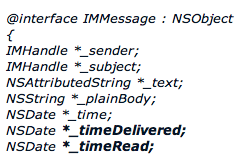
The evidence comes from a developer who provided the following hints found in iChat’s framework in Lion. Of course it is only speculation at this point, but MacRumors guesses these elements have been added to provide cross-platform support for the iMessage protocol in iChat.
Buried in the framework of OS X Lion’s iChat, are two new properties – The “timeDelivered” and “timeRead’ fields that indicate the tracking of delivery and read receipts for instant messages. These features, however, are not supported in any of iChat’s native messaging protocols, while the same features are offered in Apple’s iMessage protocol. These properties were also not present in previous versions of iChat prior to OS X Lion.
Want that face on your big screen? No problem! Just Facetime with Rene Ritchie over at TiPb. You see, the latest build of iOS 5 Beta 3 has support for Airplay.
With all of the new trickery in the AppleTV 5.0 software, it wouldn’t surprise us to see a family-like FacetimeHD option for the current AppleTV or even a new 1080P version.
will fix the issues we’ve been hearing about with some Verizon iPad 2 models. Additionally, the new update is said to contain a fix for FaceTime in addition to security fixes for things like WebKit vulnerabilities and other minor changes.
It isn’t certain yet if this update is for Verizon iPhone 4s but that’s a bit …due as well. Expand Expanding Close
3G and GPS are supposedly the only notable differences between WiFi and 3G models of iPad 2. Alas, the WiFi model records higher-quality audio than its 3G counterpart. Mind you, it’s a design deficiency rather than a feature. iLounge did some testing and discovered that WiFi units evidently record better-sounding audio.
With iPad 2 now in the picture (no pun intended), exhaustive camera benchmarks from numerous publications paint a pretty bleak picture for Apple’s magical device. Like it or not, iPad 2 cameras mostly earn lower scores when pitted against Motorola’s Xoom, Samsung’s Galaxy Tab and even Apple’s own iPod touch. The empirical testing backed by real-life footage proves what we’ve been suspecting all along, that iPad 2 takes substandard stills and grainier video than most tablets.
That’s the conclusion from Forrester Research in their latest research which predicts US tablet sales will double this year.
They now anticipate tablet sales last year of (a deeply conservative) 10.3 million units, thanks to stronger than expected iPad sales. And they think iPad will take the ‘lion’s share’ of a market they expect will double in size (to 24.1 million units) this year, despite all those newCES-introduced ‘competitors’. Expand Expanding Close
Skype just updated their Skype application for iOS to include video chat functionality. It works both over WiFi and 3G networks and two-way video calling is supported by the iPhone 4, iPod touch 4, and iPhone 3GS. The iPad and third generation iPod touch support one-way video calling. Just like on Apple’s FaceTime application Skype for iPhone will video conference in both portrait and landscape orientations.
Seth and I just tested out the application and it looks very smooth on both ends. It even works in the background but your face gets frozen for the person on the other end (audio still works). Just like with FaceTime there is an option for the iPhone user to display either the front camera’s view, back camera’s or no camera. We have more screenshots of Skype video chat after the break.
We also ran some tests over 3G and it looked very smooth. I was on 3G and Seth was on WiFi and he saw me as crisp as I looked over my WiFi network. My view of him was also smooth and when he pointing his camera at a moving fan that looked smooth as well. Also, we tested it on an iPad (which still is blown up, not a universal binary) and it looked as expected without the camera. When used with an iPhone 3GS you should get the option to see the user’s back camera. Release notes, official promo video, and more screenshots are after the break.
Update: Skype video calls over 3G will use around 3.4 MB of data per minute. We calculated this by looking at our usage info on our iPhone 4 before and after a one minute (timed of course) call. Below are our screenshots:


 .
.