iOS devices refer to any of Apple’s hardware that runs the iOS mobile operating system which include iPhones, iPads, and iPods. Historically, Apple releases a new iOS version once a year, the current version is iOS 10. Here is the complete list of iOS 10 compatible devices.
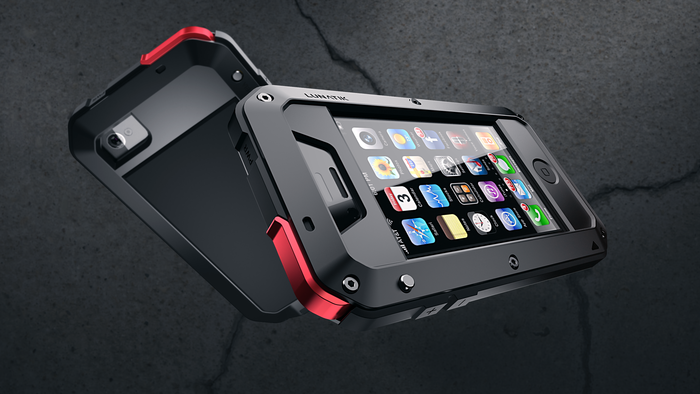
We previously profiled and reviewed the LunaTik iPod nano watch strap, a nano accessory crafted with incredible detail, precision, and high-grade materials. The LunaTik iPod nano accessory became a smash hit last year, raising millions of dollars on the Kickstarter funding service. The company came back with a second product earlier this year – a stylus called the TouchPen – and now the firm is back with another Apple device accessory. This time, an iPhone case named TAKTIK. Read on for all of the details:
After yesterday’s release of jailbreak iOS 6 developer, well known to all users iGuides Anton Titkov (iTony) decided to dig a little bit in the new firmware, and became the first man in the world, who managed to get working 3D card on the iPhone 4. New tweak from Anton Titkova called 3DEnabler , and at the moment we can confidently say that it adds support for 3D cards on the “old” devices, but it is possible that the “unavailable” Turn-by-turn navigation will be defeated by our talented developer.
iGuides offers instructions for the hack on its website, while another video of 3DEnabler running on iPhone 4 is below: Expand Expanding Close
Following a keynote from T-Mobile’s Chief Technology Officer Neville Ray at the NGMN conference this morning, Senior Vice President of Technology Dave Mayo provided an update today regarding the company’s $4 billion 4G-network plan.
We already knew T-Mobile would be make its 4G HSPA+ in the 1900 MHz band available to iPhone users later this year as its new network equipment gets installed. It recently confirmed that it began testing the network on a small scale. Today, we get an update on the progress of the carrier’s 4G rollout with Mayo confirming installations of new equipment at the first 400 modernized GSM / HSPA+ sites, which will be complete by the end of June, with the number growing to 2,500 sites a month after. He also noted the carrier was approved for 19,500 additional sites. This indicates the LTE network is on track for its 2013 rollout. Expand Expanding Close
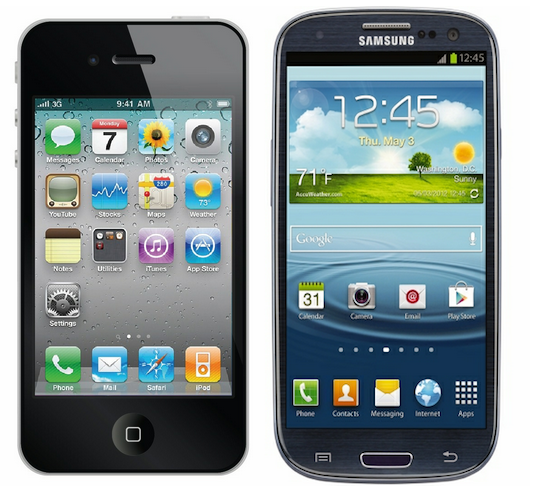
When we checked in last Friday on the ongoing Apple vs. Samsung cases in the United States, Apple’s lawyers were threatening Samsung with a temporary restraining order on the Galaxy S III to stop sales of the device before its June 21 release date. Apple was hoping Judge Lucy Koh would add the Galaxy S III to existing preliminary injunction requests that Apple previously made on other Galaxy products. However, according to a report from Reuters, Judge Koh ruled this week that Apple’s requests would “overload her calendar” given a July 30 trial date in the previous Galaxy cases is already set.
Apple can still request a ban on the Galaxy S III with a separate hearing date, but it likely will not be able to do so in enough time to block the device from launching later this month:
U.S. District Judge Lucy Koh in San Jose, California, effectively dashed Apple’s hopes of stopping the launch of Samsung Electronics Co Ltd’s new Galaxy S III smartphone, which also runs on Android. Koh had said Apple’s push to get a court order blocking the June 21 launch would overload her calendar… Koh last week said Apple could ask for a temporary restraining order against the Galaxy S III phone, but that would likely delay the trial over a Galaxy tablet and other smartphones. In her order on Monday, the judge said Apple would have to request a new hearing date if it wanted to stop sales of the Galaxy S III phone. That likely would not take place before the phone’s scheduled launch. Apple has not said what its next move will be.
The 3D renders above, which were posted by Flickr user Martin uit Utrecht, are modeled in Rhinoceros 3D. They were deemed good enough that numerous websites published them, assuming they were real shots of the next-generation iPhone. As noted by the poster, the renderings are based on leaked photos and video of what most believe to be the next-generation iPhone’s metal back. The models also have other elements present in the leaked casings, including: a smaller dock connector, redesigned speaker grills, and a repositioned headphone jack.
As iOS 6 officially unveiled yesterday, we noted a few of the features—such as Siri and FaceTime—would only be available on certain iOS devices. Ars Technica noticed the 3D flyover feature of Apple’s new Maps app would only be available to A5-powered iOS devices. In case you were wondering exactly which iOS 6 features will be compatible with your iOS device, Apple published a list (below) on its iOS 6 preview page that details all of the limitations for specific features:
-Flyover and turn-by-turn navigation will be available only on iPhone 4S and iPad 2 or later. Cellular data charges may apply.
-Siri will be available only on iPhone 4S and iPad (3rd generation) and requires Internet access. Siri may not be available in all languages or all areas, and features may vary by area. Cellular data charges may apply.
-Shared Photo Streams requires iOS 6 on iPhone 4 or later or iPad 2 or later, or a Mac computer with OS X Mountain Lion. An up-to-date browser is required for accessing shared photo streams on the web.
-FaceTime over a cellular network requires iPhone 4S or iPad (3rd generation) with cellular data capability. Carrier data charges may apply. FaceTime is not available in all countries.
-VIP list and VIP and Flagged smart mailboxes will be available on iPhone 4 or later and iPad 2 or later.
-Offline Reading List will be available on iPhone 4 or later and iPad 2 or later.
-Made for iPhone hearing aids require iPhone 4S.
-Find My Friends and Find My iPhone enable you to locate iOS devices only when they are on and connected to a registered Wi-Fi network or have an active data plan. Not available in all areas.
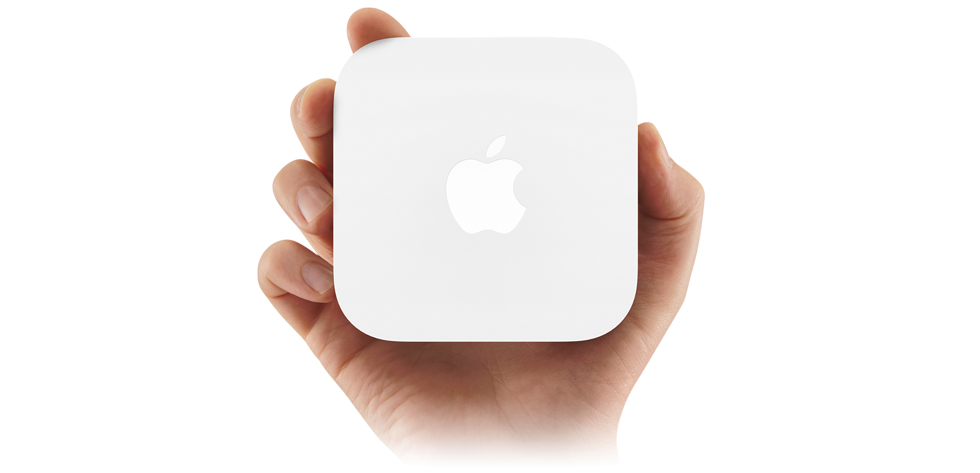
Apple just unveiled its new AirPort Express on its online store at the conclusion of its WWDC keynote. The new router features dual-band 2.4GHz and 5GHz 802.11n Wi-Fi for $99. Besides the new bands, the new Express does not seem to feature any new updates, except that it does seem to look closer to an Apple TV — in white. The update Express keeps the same USB 2.0 and 3.5mm headphone jack that it has always carried. You can check it out on the Apple Online Store now. Expand Expanding Close
Magenta is an implementation of Darwin/BSD on top of the Linux kernel. It is made up of a number of kernel and userland components that work together. It is fully binary compatible with iPhone OS 5.0 (as in, it uses the same binary format).
It runs on ARM 7 Hardware currently, but what is the goal?
The final goal is probably recreating the iPhone OS 1.0 stack. I think this is a pretty feasible goal, considering the fact that there are so many open source libs that can be used to replace the proprietary libs used by Apple. Just as an example:
* CoreGraphics -> Cairo
-> FreeType
-> libpng/jpg
* Celestial -> Various open source media decoding libs.
* UIKit -> Chamelleon
The project does not wish to build a platform that can run Apple’s App Store apps; it appears to just aim at running iOS.
It will be interesting to see where this goes.
[tweet https://twitter.com/chronic/status/211315542026493953] Expand Expanding Close
WWDC 2011 was the last Apple event Steve Jobs would be a part of and one of the last public appearances he made. Since then, Apple has continued to soldier on, adding value to its market cap and releasing new smash hit products like the iPhone 4S last fall and the new Retina iPad and 1080P Apple TV this spring.
This year’s Worldwide Developers Conference, WWDC 2012, will pick up where last year’s event left off. It will introduce major updates to Apple’s mobile and desktop operating system, the cloud-based syncing strategy, and it will bring Mac hardware back to a Mecca of Apple’s top software developers for the first time in three years.
There have been a lot of WWDC predictions, many made on information we made available. Over the past month and change, we’ve revealed the lion’s share of what’s now known about WWDC 2012, and we have some more to share in our highly anticipated WWDC 2012 round-up.
We break down everything you should expect into categories of iOS 6, iCloud updates, OS X Mountain Lion, and the exciting updates to multiple Mac hardware lines. Our complete round-up is available after the break:
The Australian reports that Apple has agreed to a $2.25 million settlement in Australian courts over the advertising of the third-generation iPad as “4G” in Australia.
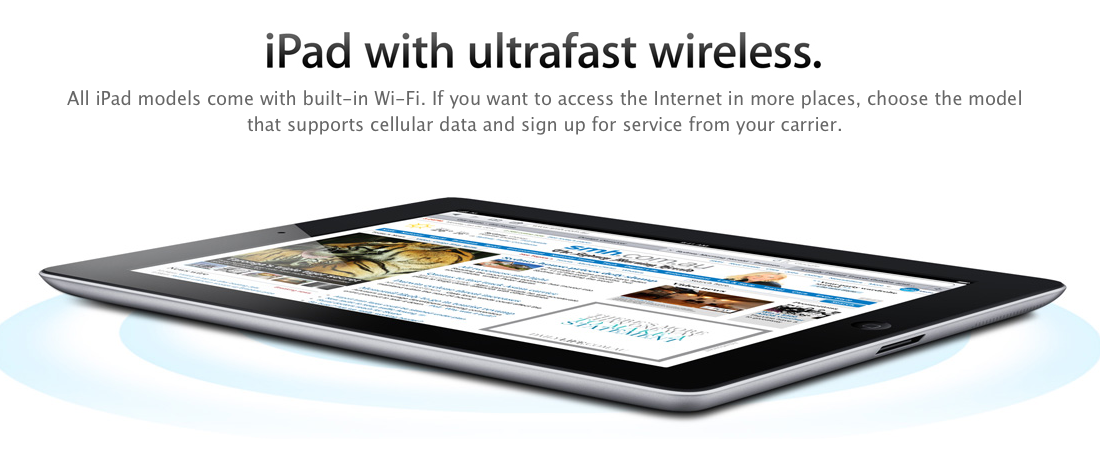
The source of the issue is that a true 4G LTE network is not supported by the third-generation iPad in Australia. Apple has already taken a big step to settle the 4G iPad confusion: the company has renamed the “iPad WiFi + 4G” to “iPad WiFi + Cellular.”
The lawsuit is to be settled with the Australian Competition and Consumer Commission, the group that accused Apple of the false advertising. However, the judge presiding over the case is yet to provide the final approval for the settlement.
[youtube http://www.youtube.com/watch?v=8XY841RAY4Y]
In late May, we had exclusive high-resolution photos of both black and white next-generation iPhone backs. These backs showed a brand-new, thinner design with a smaller dock connector, new speaker grills, and a new metal back plate. Now, ETradeSupply – a parts reseller – has gotten their hands on these already leaked parts (via CydiaBlog). They have posted a video to YouTube (shown above), and the video does not show anything different than the photos, but it is nice to see more of a hands-on demonstration of the unreleased iPhone parts.
Other findings from our photos that are affirmed by this video include the unibody/integrated approach for the antenna band and back portions of the device, a relocated headphone jack (now on the bottom), and an overall taller design.
The videographer of the parts believes that the SIM card used in the next-generation iPhone will be smaller than the MicroSIM card used in the iPhone 4S and iPhone 4. However, this is based on the SIM card holder piece itself being smaller in the new iPhone back piece, rather than a measurement of the actual SIM cutout in the part itself. While a smaller SIM card standard is being developed, it is hard to tell whether or not these smaller cards will make their way into the new iPhone.
Some nice big stills (click to enlarge):
We are expecting to see this new iPhone launch sometime in the late summer/fall. Thanks Norin!
In what now seems like a rite of passage, iPhone hacker Chpwn (Grant Paul) has taken a job at Facebook following Geohot’s brief tenure at the Social Network.
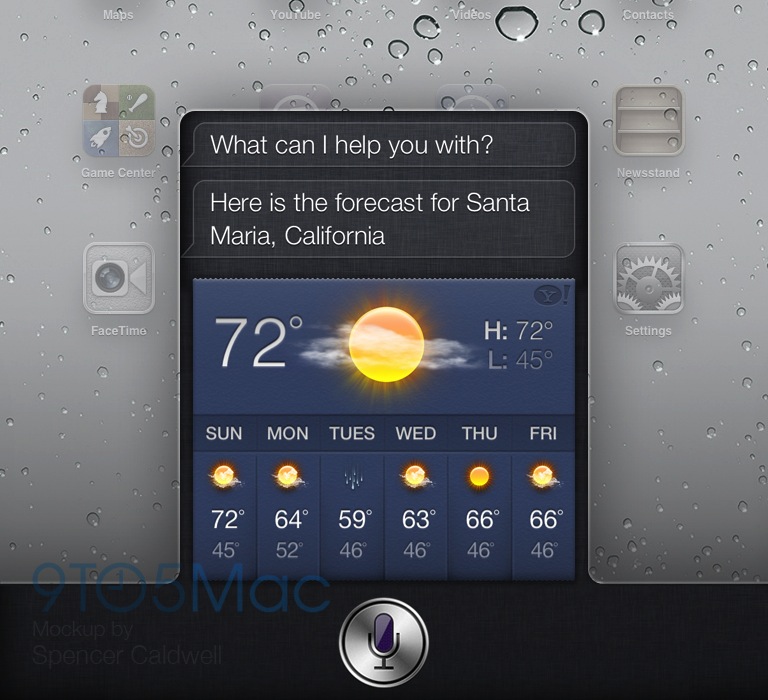
Siri on iPad mockup based on descriptions from sources
Come this fall, people will start talking to their iPads. Apple’s breakthrough Siri Assistant, based on an incredible artificial-intelligence system, will no longer be exclusive to users of the popular iPhone 4S. According to trusted sources, one of the tentpole iOS 6 features is Siri support on the iPad. Not just the Voice Dictation brought to the iPad with the third-generation models and iOS 5.1, but the complete Siri voice assistant.
Siri, the software we first detailed for the iPhone in September of last year, brings all of its iPhone 4S features to the iPad, except for the phone-related commands. Music playback, iMessaging, Calendar managing, Reminders, Weather, Maps integration, E-mailing, Notes, Contacts searching, Safari integration, Wolfram-Alpha searching, and more are all present.
With the iPad being a device that is larger than the iPhone, the product typically sits farther away from the user’s mouth. Because of this, some speculators of Siri for iPad have believed that the device’s microphone would be unable to properly hear, and therefore incorrectly interpret, command inputs. Sources, however, dismissed this as nonsense, and these sources say that commands input with same or similar accuracy to the iPhone 4S. iPad voice dictation appears to work well for third-generation iPad users.
Unlike on the iPhone 4S, Siri for iPad is not a full screen experience. This makes sense given the device’s larger, 9.7-inch display. Siri on the iPad is activated by a quick hold of the home button, just like on the iPhone 4S. The interface slides up from below the display with a clever animation. Siri is built into the iPad as a small window on top of whatever interface the user is currently interacting with. This Siri window with rounded corners sits at the bottom center of the display, as you can see in our mockup above. The Siri iPad interface takes very little space over the iPad interface currently in use, and is designed with the same linen texture as on the iPhone 4S. Siri for iPad also works from the lock screen.
Apple’s upcoming release of OS X Mountain Lion takes several features from iOS 5, but also introduces the world to some new features that are also coming to iOS 6. According to trusted sources, iOS 6 will include iCloud Tabs support, Mail VIPs, and a simple, yet handy and so-far praised Notification Center enhancement.
iCloud Tabs is a feature that allows iCloud users to view a list of tabs opened in the Safari web browser across multiple iOS devices and Macs. Although previously rumored, iCloud Tabs is not a feature – in its initial implementation in iOS 6 and Mountain Lion – that syncs your entire current web browser work across devices. When the iCloud Tabs button is clicked on an iOS 6 device (or Mac), all the tabs opened on each device are simply shown in a synchronized list. From here, users can quickly pickup individual tabs that they were working on across their Apple devices. The iCloud Tabs button on the iPhone and iPod touch is hidden behind the Bookmarks toolbar.
Another subtle, yet much requested, feature from Mountain Lion is Mail VIPs. Like in Mountain Lion, Mail VIPs in iOS 6 puts a star next to emails received from a specified group of people. VIPs assigned to iCloud accounts will sync with iCloud across iOS 6 iPads, iPhones, iPod touches, and OS X Mountain Lion Macs. OS X Mountain Lion users have so-far praised the feature, as many users find themselves constantly looking for email from a select group of contacts.
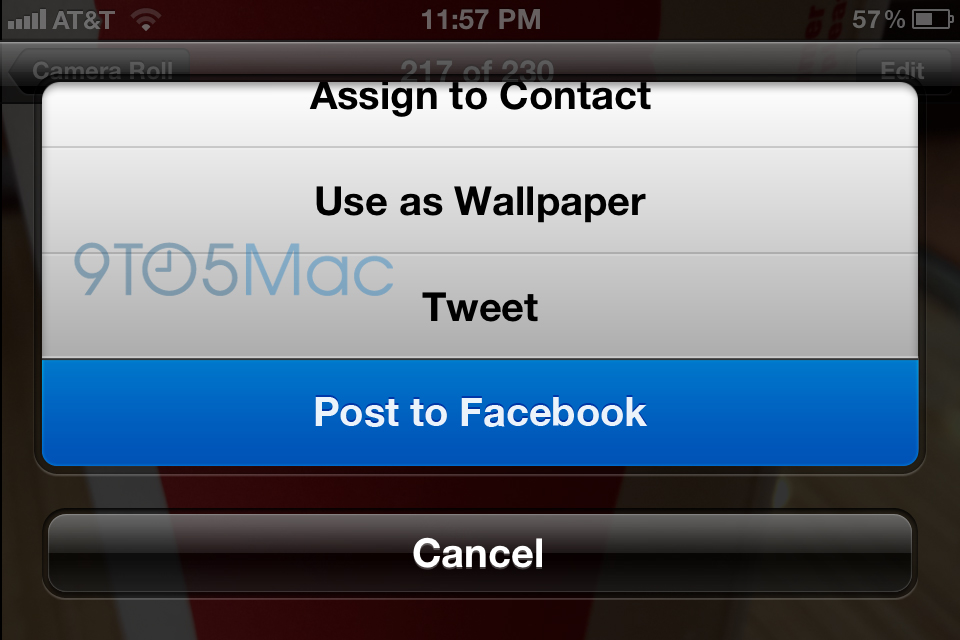
Mockup of Facebook sharing in iPhone Photos app (thanks, Spencer Caldwell)
A few days ago, TechCrunch reported that Facebook will be integrated into iOS 6 in some fashion. This is not a major surprise given Apple CEO Tim Cook’s hint at the AllThingsD D10 Conference of iOS Facebook integration. We heard many weeks ago that Apple and Facebook engineers were working in collaboration on implementing some sort of integration of Facebook into iOS 6. Simultaneously, Apple and Facebook executives were discussing the terms of the deal and exactly how Facebook would be integrated into iOS 6. While we knew that some sort of integration was incoming, we have been waiting to learn the exact spots in which integration is present, something that has up in the air due to the agreement talks just recently coming to a close. The thought of Facebook integration into iOS is a dubious one itself, given that the two tech leaders talks of integration into iOS 4 and Ping both abruptly fell apart.
According to sources familiar with the Facebook integration into iOS 6, the integration will be very similar to Twitter’s integration that launched with iOS 5. The integration’s biggest presence will be in the iOS Photos application. Like you are able to send photos to Twitter from the Photos application, you will be able to post photos to Facebook. A single sign-on section for all Facebook connected applications is present in the iOS 6 system settings application. Like with Twitter, a new “social sheet,” as some people familiar with the matter call it, will appear for an accompanying status message.
The argument over which carrier has the fastest network speed in any given location in the United States is still up for debate. Putting network speed comparisons aside, which are often not an accurate representation of speeds, you will receive in your specific area, a new app from startup SwayMarkets aims to provide a more realistic comparison.
The app, CarrierCompare, allows users to test the network speed of their current carrier against the two other major iPhone providers. CNNMoney went hands-on when the app released last month and just posted the user data it obtained that compares major iPhone carriers in multiple locations.
Analyzing user-generated data from Boston, New York, Washington, Chicago, San Francisco, and Los Angeles, these were the results:
During the AllThingsD D10 conference tonight, Apple CEO Tim Cook was asked about Apple and Facebook’s relationship. The question came in the context of iOS 5 users having the ability to easily share through Twitter on their iPads, iPhones, and iPod touches. To this, Cook said “stay tuned.”
With WWDC less than two weeks away, we can’t help but to speculate that Facebook will get the iOS 5-Twitter treatment in iOS 6. iOS 4 betas contained such Facebook integration, but the feature was scrapped at the last minute. Perhaps this had something to do with an Apple/Facebook falling out, something demonstrated by Facebook’s removal from Apple’s music social network, Ping.
In other social network news, Cook said that Apple was not interested in acquiring Instagram, the iPhone and Android based photosharing app that was acquired by Facebook for $1 billion. Apple Senior Vice President of Marketing Phil Schiller previously said that Instagram “jumped the shark” when it launched on Android.
As noted byMacRumors, an eBay listing popped up today showing what appears to be a prototype 16GB iPad with two dock connectors. The iPad has always included the same, single dock connector that allows docking in portrait orientation, but the prototype in the listing shows a second dock connector that would allow for docking in landscape view.
We heard rumorsseveral times as far back as the original iPad launch that Apple was working to add a second dock connector. The rumors were supported by several patents that surfaced. They detailed possible advancements Apple could make to its dock connectors on iOS devices. As pointed out by the report, the prototype in the eBay listing does not actually have any iPad trademarks, but just a prototype ID number instead. Otherwise, it appears to be genuine with components carrying “part numbers and copyright dates from prior to original iPad’s components.”
From 9to5toys: Many iOS game and app developers are slashing prices of their most popular titles to celebrate Memorial Day this weekend. We will continue to update this post as we find more great deals for you.
There’s no denying iOS devices and cheaper Android solutions are taking the place of Cius. Recent studies show Apple with 97 percent of tablets in the enterprise, while 94 percent of the Fortune 500 arecurrently testing or deploying iPad. The result is no further investment in the Cius tablet line and only limited support for what is currently available. The company will instead “double down” on Jabber and WebEx
Ever since the release of iOS 5.1.1, many in the jailbreak community have anxiously waited for the destined release of an untethered jailbreak for the new software. For those who have been waiting, the day has finally come. The Chronic Dev Team just released Absinthe 2.0, which is the tool to jailbreak iOS 5.1.1—untethered style. It was announced on-stage at Hack in the Box 2012 in Amsterdam today as a “one more thing.”
Tim Cook likes to refer to the iPad as “the poster child of the post PC world” and often brags about how it is leading the pack. According to new numbers out today from research firm NDP, if you account for the iPad (13.6 million units during the quarter), Cupertino, Calif.-based Apple has maintained its position as the leader in mobile PC sales with 17.2 million units shipped during Q1. Apple beat out its nearest competitor HP by a solid 8.3 million units, which makes it the leader by far.
As for the area of key growth, NDP backs up Cook’s recent claims that China is a key emerging market. According to the study, China accounted overall for 13 percent of mobile PCs shipped during the quarter. In related China news, a new study reported Apple doubled its device market share in China during Q1. Of course, this is due in part to the launch of the iPhone 4S with the fighting bustling crowds. However, Samsung still leads in the country by roughly 2.8 million devices shipped.
Apple already announced its Q2 earnings, where the company revealed it shipped 11.8 million iPads. It will be interesting to see how Apple fairs against the competition during Q2. But, right now, it looks like the others do not have a shot. Apple also led in tablets shipped, with a 62 percent marketshare during Q1: