When it comes to the state of Apple Computer, everyone has an opinion.
And at the Gartner Symposium and ITxpo97 here today, the CEO of competitor Dell Computer added his voice to the chorus when asked what could be done to fix the Mac maker. His solution was a drastic one.
“What would I do? I’d shut it down and give the money back to the shareholders,” Michael Dell said before a crowd of several thousand IT executives.
We have heard a lot about HTC’s upcoming M7 smartphone expected to replace the company’s One X line in recent weeks. The rumored 4.7-inch device has some pretty impressive specs, including “several industry firsts,” according to recent reports. However, it certainly doesn’t have an industry-first design, if this new leaked image from UnwiredView is legit, and I think Apple might agree.
The report quoted a “trusted source” and claimed the image above is clipped from “a short animation clip instructing new owners on first-time SIM card installation” for the M7. It’s likely we’ll get our first real look at M7 next month during Mobile World Congress in Barcelona.
“As word of the earlier production schedule starts to spread, we believe we could see a slight slowing of demand CQ1 in anticipation of the new product launch and Apple will likely start curtailing channel inventory. Therefore we tweak down our CQ1 iPhone shipment estimate from 48M to 44M, which is still well above widespread fears of shipments in the mid-30Ms.”
Back in December Misek also claimed the 5S is coming in June and at the time said he expects Apple to ship the device with multiple colors, improved battery life, and possibly a 4.8″ Retina/IGZO display. However, in today’s note Misek said there has been no additional evidence for the 4.8″ prototype signaling the design could be for the iPhone 6. Today he also added his thoughts on rumors of a low-cost iPhone, claiming Apple could release a low-cost device made of polycarbonate with no LTE and a 4″ non-retina display.
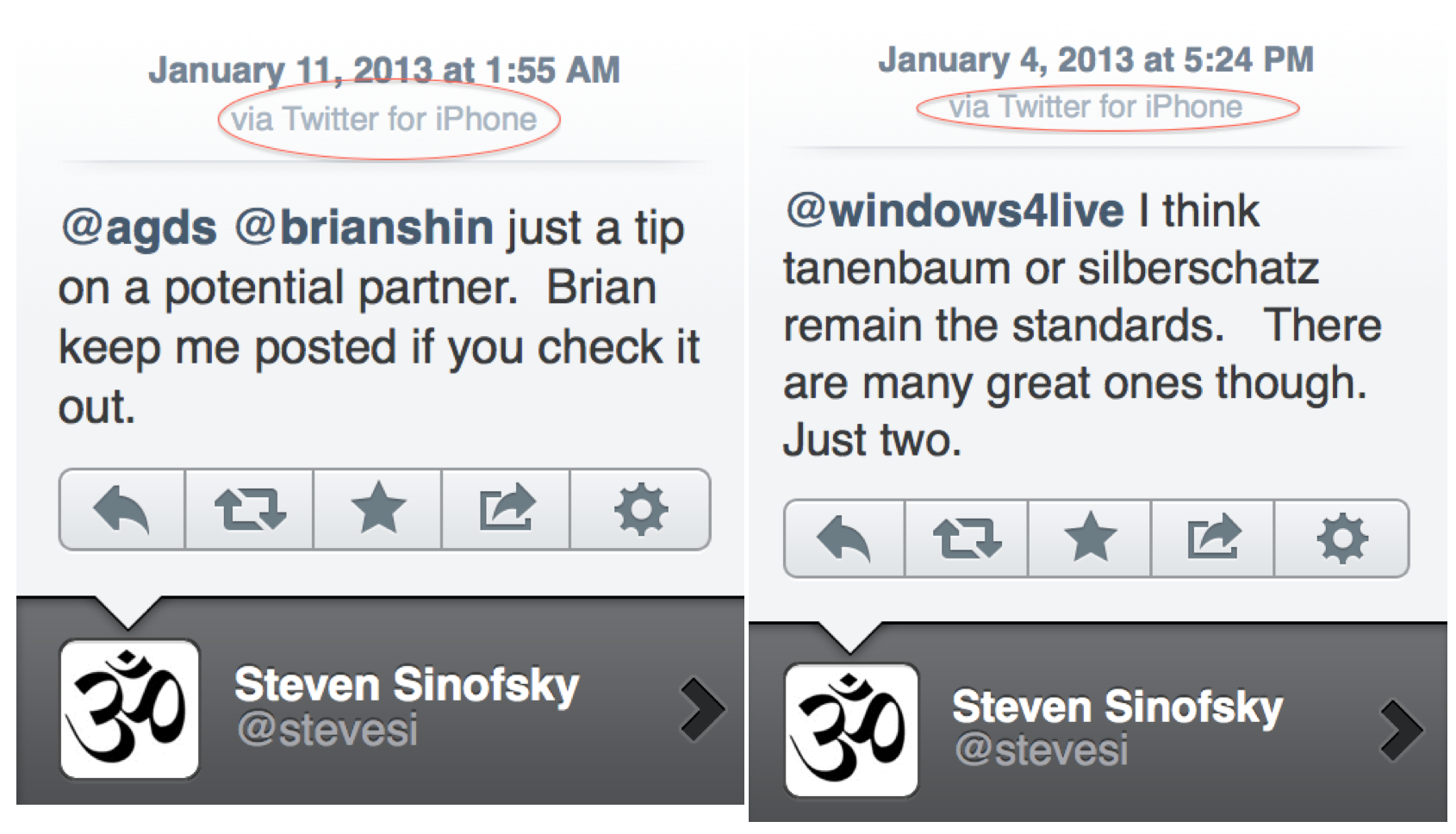
Immediately following the release of the Microsoft Surface in November, Microsoft sent its Windows head Steven Sinofsky packing. Just a couple of months later, he is already trying out a new platform: iOS.
We were tipped to a tweet from Sinofsky (@stevesi) from January 11th that was sent from Twitter for iPhone. We soon discovered a second tweet from the same platform on January 4th. Sinofsky is still tweeting from his Microsoft Surface and the Web, but we don’t see as many Windows Phone-based tweets as we do earlier in his Twitter timeline.
International CES 2013 is officially ending, so we decided to share some of what we saw from the show floor and surrounding events. 9to5Mac has tons of CES coverage for some of the most interesting new iOS accessories, advancements in display technology, and new Apple-related products we saw at the show right here, but below we have put together a collection of photos and video we shot while walking the many acres of CES exhibits at the Las Vegas Convention Center. Enjoy.
From a bygone era, Amazon today announced AutoRip. It is a service that will let customers that purchase AutoRip enabled CDs from Amazon access MP3 versions from Cloud Player. The service isn’t just for newly purchased CDs, it includes over 50,000 albums for CDs since the launch of Amazon’s music store in 1998, but we’re not sure how many people have stacks of CDs lying around since ’98 that they’ve yet to rip. If for some reason you’ll still purchasing physical CDs from Amazon’s music store, and you’re located in the U.S., you can start taking advantage of the AutoRip service today.
@9to5mac More useful if they would offer Kindle versions of the books you buy.
Bloomberg Businessweek shared a story today about Steve Jobs having contacted Mark Hurd, the displaced CEO of HP, in 2010 to offer support and help the executive mend relationships with HP.
Hurd’s expulsion, although allegedly for different reasons, is often likened to Jobs’ departure from Apple in 1985. As MacRumors noted, Jobs gave advice to many people in Silicon Valley. He apparently felt Hurd’s presence strengthened HP and supposedly did not want the company to flounder after ousting him:
“Hurd met Jobs at his home in Palo Alto, according to people who know both men but did not wish to be identified, compromising a personal confidence. The pair spent more than two hours together, Jobs taking Hurd on his customary walk around the tree-lined neighborhood. At numerous points during their conversation, Jobs pleaded with Hurd to do whatever it took to set things right with the board so that Hurd could return. Jobs even offered to write a letter to HP’s directors and to call them up one by one.
“Over the previous five years, Hurd had built HP into the largest technology company in the world; sales in 2010 were $126 billion. Shares were on a tear, and profits kept rising. Yet Jobs told Hurd and other friends that he thought the board would unwind HP’s progress and send the company spiraling into chaos.
“By offering Hurd counsel, Jobs wasn’t merely lending a friend psychological support. Rather, he was going to bat for the legacy of Bill Hewlett and Dave Packard. A healthy HP, Jobs urged, was essential to a healthy Silicon Valley. “It’s the founding company of the Valley,” says Bill Campbell, the chairman of Intuit (INTU) and an Apple board member. “You don’t want to see it go away.”
“Jobs ultimately could not pull off a reconciliation between Hurd and HP.
Jobs and Hurd seemed close, and they were both tight friends of Oracle’s Larry Ellison as well, but history shows Jobs’ attempts at helping the fallen executive eventually failed and he would pass away just a year later.
In July 2011, a federal jury in Texas awarded “patent licensing company” Personal Audio LLC $8 million in its patent infringement lawsuit against Apple. The jury found Apple infringed two valid patents related to downloadable playlists with its iOS devices as far back as the original iPod. One covered an “audio program player including a dynamic program selection controller,” while the other covered an “audio program distribution and playback system.” 9to5Mac has now learned Personal Audio LLC is attempting to target content creators directly, starting with a new patent infringement case in Texas against one of iTunes biggest podcasters, Adam Carolla’s Ace Broadcasting.
If the outcome of the case is anything like Personal Audio’s previous cases, it could have a major impact on podcasters and other content creators on iTunes and elsewhere. Personal Audio also sued and entered licensing agreements with Sirius XM Radio, Archos, Coby, RIM, Samsung, Amazon, and Motorola related to its downloadable playlist patents and others.
The new patent, issued just last year on Feb. 7, 2012, is quite broad and describes a “System for Disseminating Media Content Representing Episodes in a Serialized Sequence.” Personal Audio is also suing the popular Howstuffworks.com series, which like Ace Broadcasting, is a large podcasting presence on iTunes and across the web…
FreedomPop, the company that makes 4G-capable cases for the iPod touch, announced today that a version of its case compatible with the iPhone 4 and iPhone 4S has been delayed by the U.S. Federal Communication Commission’s certification process. FreedomPop reportedly has 5,000 of the cases in the United States, but it cannot ship them to customers until the FCC certifies them.
The devices are stuck in the certification process due to their design that puts the case’s cellular radio directly next to the cellular radio inside of the iPhone. The FCC has never tested a device with this configuration before, and it has had to conduct extensive (and expensive) tests before giving FreedomPop the green-light to sell them inside the U.S.
Neither the FCC nor FreedomPop have given an estimate as to when the cases will finally be available.
We’ve already seen 100-foot (30 Meter) Thunderbolt Optical cables from Corning and others, but we had a chance to drop into Intel’s CES booth this morning to discuss their Thunderbolt products. While there wasn’t much new to us, we did note the new “thin” one-meter cable. It is as thin and flexible as any USB cable we’ve seen and still carries a bus-powered charge for devices. We’re told they will begin to drop in price significantly as volume production picks up.
We went hands-on with a 30-meter optical cable (below). It is thick but lighter than you’d expect from a cable that size. Also, I’m guessing it doesn’t carry a charge—contrary to the information provided by the spokesperson. Expand Expanding Close
CBS posted an excellent interview of David Kelley this evening. Kelley discusses Steve Jobs at 3:00 and then again at 7:40, but the whole video is definitely worth a watch. A longer Jobs clip and the transcript is below:
Straight from the CES Unveiled event in Las Vegas, audio accessory maker Ion just introduced us to one if its latest creations— a hardware DJ controller kit called “Scratch 2 Go” that puts a physical crossfader, two sets of three control knobs for pitch, EQ, etc., and a two small platters right on the display of your iPad. The company also announced updated versions of its other DJ and Guitar controllers for iPad and iPhone…
The hardware controls attach to your iPad’s display via suction cups and essentially work like a stylus, allowing you to control elements of several DJ apps on the App Store. The hardware controls are designed specifically for the iDJ 2GO app that will also work with Ion’s just announced updated Lightning version of its iDJ 2 Go hardware DJ controls. However, Ion confirmed to us that it would also work with the popular djay app for iPad.
It could also work with other iOS DJ apps provided the stylus-like tip of any particular element of the 5-piece kit lines up with the controls inside the app you’re using. Ion is making the new Scratch 2 Go kit available in April for $30 through select retailers.
A video of the kit in action from the CES show floor below:
This is what CES looked like the last time Apple attended. J/K. Via the Verge
The 2013 International Consumer Electronics Show is almost here, with official CES show floor at the Las Vegas Convention Center opening up next week on Jan. 8. To kick things off, hundreds of companies and the press will invade Las Vegas this weekend for three days of pre-show product demos, press conferences, and more from the majority of the tech industry’s biggest names. Samsung, Sony, NVIDIA, Intel, Toshiba, and LG are just a few of the companies with scheduled announcements, but there will surely be more than a few surprises with over 3,000 exhibitors setting up shop. Apple’s last official appearance at CES was in 1992 with John Sculley’s keynote introduction of the Newton, but its presence at the show remains with hundreds of new Apple-related products unveiled every year.
9to5Mac is on its way to Vegas to bring you full coverage of the best products from the show. But, until then, here’s a wrap-up of what we already know will be there and what else you can expect to see at CES 2013:
Ahead of CES 2013 taking place in Las Vegas next week, Corning has unveiled a new optical Thunderbolt cable for folks who need extra long-reaching Thunderbolt access (perhaps to storage closets or for dummy terminals). Corning’s new cable, perfect for plugging peripherals into supported Macs and moving away from copper core cables, will ship in lengths of 10, 20, and 30 meters and boast the same data transfer speeds of up to 10GBbps. Corning plans to unveil a USB 3 cable as well. No launch date or pricing has been provided for the cables—only that they will be available sometime during the first quarter of this year. At any rate, you bet we’ll stop by Corning’s booth for a closer look next week’s CES.
Just last week, Sumitomo Electric got the “world’s first” Thunderbolt optical cable certification and announced it would mass-produce the cables immediately. The cables are as thick as current copper cables (4.2 mm), can be bent 180 degrees or tangled in knots, and they still perform just like shorter copper cables.
A 100-foot Thunderbolt cable could let Mac users put their whole rig in a closet, run just a Thunderbolt cable to the desktop, and connect to peripherals via the Thunderbolt display. If only there were a Thunderbolt-enabled Mac Pro…
According to the latest numbers from comScore MobiLens for the United States mobile phone market, Apple and Samsung both continue to gain marketshare as the leading OEMs as Android and iOS move closer toward a duopoly with a combined almost 90 percent of the market. ComScore’s latest numbers track the three-month period ending in November, which saw Apple jump from 17.1-percent in August to 18.5-percent of the U.S. mobile phone market. Samsung continued its lead jumping up 1.2-percent to 26.9-percent, while gains for both companies come at the expense of decreases in market share for LG, Motorola, and HTC.
As for the U.S. market by platform, iOS and Android both experience slight gains over August numbers. With a joint 88.7-percent of the market for Apple and Google, RIM is the closest competitor dropping from 8.3-percent of the market in August to just 7.3-percent in November. Microsoft dropped from 3.6-percent to 3 percent:
In November, 75.9 percent of U.S. mobile subscribers used text messaging on their mobile device (up 0.3 percentage points). Downloaded applications were used by 54.2 percent of subscribers (up 0.8 percentage points), while browsers were used by 52.1 percent (up 0.1 percentage points). Accessing of social networking sites or blogs increased 0.9 percentage points to 39.2 percent of mobile subscribers. Game-playing was done by 33.7 percent of the mobile audience, while 28.7 percent listened to music on their phones (up 0.4 percentage points).
Steve Jobs needed some advice. It was 2006, and Apple was working on the design for its first smartphone. Jobs had questions about its radio. So he called up Ralph de la Vega, Cingular Wireless’ chief operating officer, who had helped broker the exclusive deal between Jobs and the telco, soon to be part of AT&T Inc., to carry the phone. ” ‘How do you make this device be a really good phone?’ ” de la Vega recalls Jobs asking. ‘ “ I’m not talking about how to build a keyboard and things like that. But I’m saying the innards of a radio that worked well.’ ”
AT&T had a 1,000-page manual that detailed how suppliers should build a mobile radio optimized for its network. “
He said, ‘Well, send it to me.’ So I sent him an e-mail. Thirty seconds, he calls me back. ‘Hey, what the … ? What’s going on? You’re sending me this big document, and the first 100 pages have to do with the standard keyboard,’ ” de la Vega says, laughing. ‘ “ Sorry we didn’t take those first 100 pages out, Steve. Forget those 100 pages. Those don’t apply to you.’ He says, ‘Okay,’ and he hangs up the phone.”
Honestly, this sounds exactly like something AT&T would do.
News quickly spread inside Cingular that Apple didn’t have to adhere to the specs, an act deemed blasphemous by the carrier’s CTO, who rang up de la Vega and called him “crazy” for “giving in to Apple.” De la Vega had signed a nondisclosure agreement in Jobs’ office that was so secretive it prevented him from describing the device to his bosses except in the most general terms. Board members didn’t even get to see one until after the deal was signed. “I said, ‘Trust me, this phone doesn’t need the first hundred pages.’ ”
And then the quick switch around:
During the first year of the deal AT&T sold the iPhone starting at $499 and agreed to give Apple an unheard-of cut of its customers’ monthly bills, estimated to be a $720 million slice of revenue. Some wags inside AT&T predicted the iPhone would be mostly a Wi-Fi device with little cellular data use. Once early reports on surging traffic came in, Stephenson knew he had an expensive hit on his hands. “It went beyond any rational expectation we could have ever put together,” he says. He renegotiated with Jobs to end the revenue share and buy the phones up-front for a reported $400 apiece and subsidize the new $199 cost with a two-year contract.
Since the removal of YouTube, and Maps as preloaded Google apps within iOS, Google has been especially adept at developing its own set of iOS apps. We previously detailed how Google wants to own the iOS ecosystem on the apps level, providing users with an alternative universe to most of the core features of Apple’s mobile operating system. It appears Google now has a dedicated iOS app team which builds cohesive apps rather than having each business unit build its own apps. Expand Expanding Close
T-Mobile’s Chief Technology Officer Neville Ray announced on the company’s blog today that 14 new metro areas are getting access to its iPhone-compatible HSPA+ 4G network. The updates are hitting areas such as New York, Boston, Philadelphia, Detroit, Dallas, Texas, Florida, and San Antonio, following rollouts to Chicago, California, and elsewhere earlier this month.
The carrier also said enhancements to its network in additional areas like Los Angeles and San Diego have already started. This means that customers on Solavei, the new, no-contract T-Mobile MVNO offering of $49 per month unlimited, will also get coverage for unlocked iPhones in the new areas. A full list is below:
Rumors have been in the air for several months that claim Amazon will compete in the handset space with its own offering, much like it did with its Kindle Fire line of tablets. According to a new report from the Taiwan Economic News, the Internet retail giant has selected the infamous Foxconn to manufacture the handset. Additionally, Amazon is said to have ordered 5 million units and will launch the device at $100 to $200 sometime in the second quarter or third quarter of 2013.
The Kindle Fire line of tablets, which has software based off Android with many custom additions (and even more subtractions), has done wonders for Android’s tablet marketshare, helping the platform close the seemingly insurmountable gap with the iPad. Amazon was the first to offer a tablet at such a low cost, selling in seemingly big numbers. However, no specific figures have ever been given. Many saw the $199 Kindle Fire as a cheaper alternative to the $499 iPad, but things may change this holiday season with the iPad mini now available at $329.
With its large online marketplace and bevy of apps on its Amazon Appstore, we wouldn’t put it past the company to be a serious competitor in the handset game—at least for the Android devotees and the relatively small footprint of countries where Amazon operates/offers content. (via Engadget)
Hulu shared some new stats today for 2012 on its blog. It announced revenue of roughly $695 million—accounting for a 65 percent growth in revenue for the year. Perhaps even bigger news is the announcement that the service now boasts over 3 million paying subscribers, doubling the number of paid subs in the last year, thanks to the launch of the service on Apple TV and elsewhere during 2012.
Google announced on its official blog today that it would do some “winter cleaning” by discontinuing a number of services in the near future. Among the services shutting down as of Jan. 30 is Google Sync, which allowed users to get access to Gmail, Calendar, and Contacts using the Microsoft Exchange ActiveSync protocol. As an alternative, Google recommended IMAP for mail and the recently launched CardDAV and CalDAV protocols. Google also confirmed it would continue offering the service to existing consumers and Google Apps for Business, Government, and Education customers.