Samsung

See All Stories

Samsung requests Apple reveal terms of Qualcomm partnership, might reveal next LTE chips

Site default logo image

Samsung made a formal request with the U.S. District Court in California for Apple to reveal the intricacies of its contract with wireless chipmaker Qualcomm, who currently supplies chips for the iPhone 4S, CDMA iPhone 4, and iPad 2. Qualcomm is currently in a cross licensing agreement with Samsung, bringing up the question of whether “Apple’s buying Qualcomm chips is as good as paying for the patents.” The documents could potentially reveal Apple’s plans to move to Qualcomm LTE chips in future iOS devices.

Specifically, Samsung defense lawyer Dylan Ruga wants to know if Apple is considered a “Qualcomm Customer,” a term that is “defined in certain licensing agreements between Samsung and Qualcomm.” The request was discovered in court documents by Korea Times and later confirmed by Samsung Electronics spokesperson Lim Yoon-jeong. Korea Times reported:

Samsung Electronics is alleging that Apple has infringed on Samsung-owned patents that relate to technology embodied in chipsets used in Apple’s iPhones and iPads. The documents are expected to determine whether Apple is in fact a direct customer of Qualcomm — and potentially immune from Samsung’s suits — or whether it purchased its chips through an intermediary.

Here is an excerpt from the document that has not been released by the courts:
Expand
Expanding
Close


Verizon finally launching live TV streaming app to iPad in 2012

Site default logo image

Verizon Wireless made 26 of its live FiOS TV channels available for online streaming on the Xbox 360. In a new report, GigaOM had the chance to sit down and talk to a Verizon representative at CES 2012, who said a similar app would be available for the iPad sometime this year. Verizon originally announced the streaming app about a year ago and a half ago, but the company held back from releasing it. Verizon accredits the hesistance to making sure networks have the same reliability as IPTV services so streams do not crash.

Verizon also rolled out a similar app to Samsung’s connected Blu-Ray players and televisions today. The iPad app will presumably be available free to those who subscribe to Verizon’s FiOS TV service. We look forward to seeing the app land sometime later this year. Obviously, this will only be available for paying FiOS customers.


Expand
Expanding
Close

The MacBook Air Samsung SSD is about to get twice as fast

Site default logo image

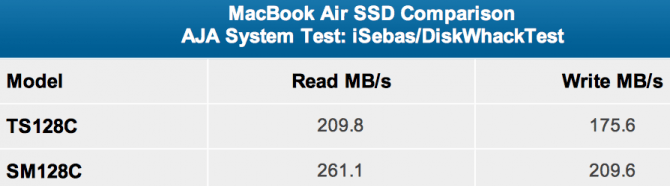
I had a chance to meet with Samsung Storage solutions at CES 2012 this week and got the low down on its new OEM SSDs that Apple tends to buy in large numbers.  Samsung and Toshiba are the OEMs that provide the SSDs in MacBook Airs.  Samsung’s 470 OEM SSD product is noticeably faster than the Toshiba model that Apple also puts in otherwise identical MacBook Airs.  We have talked about the speed difference before and how Air-buyers often will pay a premium for the faster Samsung drives.

Well, the speed difference is about to get even more noticeable. Samsung told me that it sold out of the 470 series OEM SSDs late last year and the company only makes a much faster variety: the 830 series.

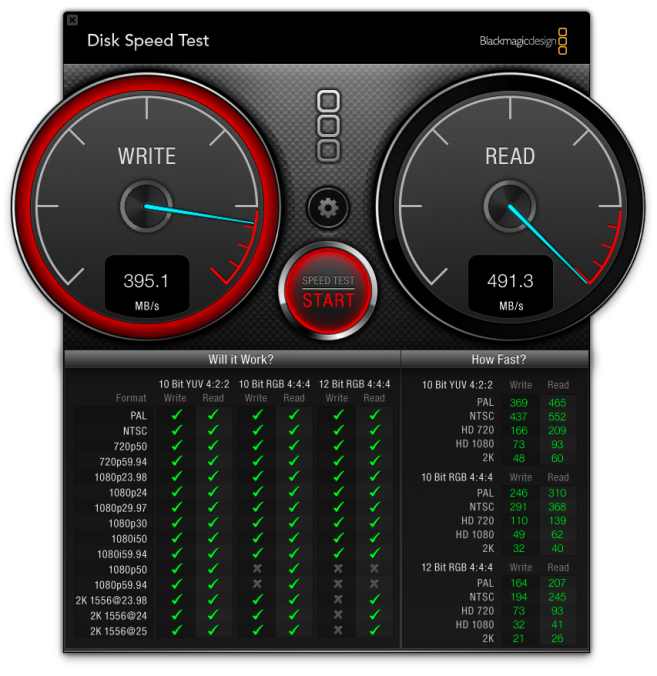
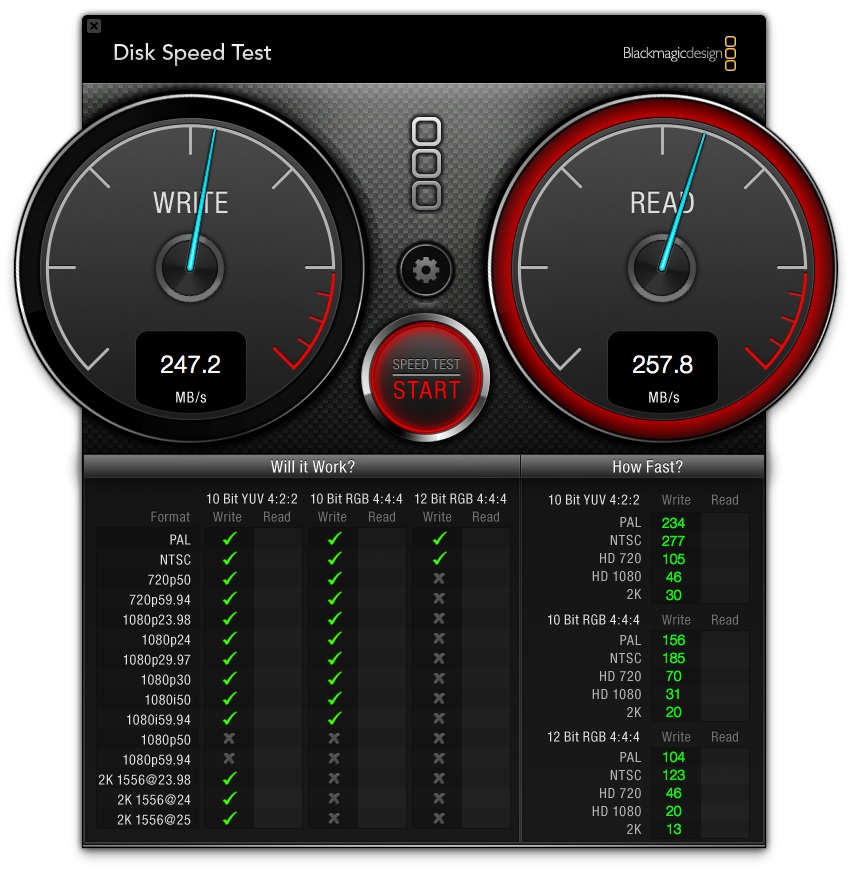
How fast is the 830 Series controller/chips?  I had a chance to speed test the popular 2.5-inch 830 model late last year when it debuted.  Typical speeds were over 400MB/s write and 500MB/s reads (below, left).  That is almost twice as fast as the current MacBook Air SSD from Samsung (below, right), which itself is significantly faster than Toshiba’s SSD.

Samsung stopped short of announcing it is shipping the 830s to Apple, but the company confirmed it ran out of 470s a while ago and all of its SSD customers were receiving the updated 830 series. Samsung also confirmed that Apple is still a customer.

Today I ventured to the Las Vegas Apple Store to check the speeds of the MacBook Airs.  I checked a new 128GB MacBook Air right out of the box which had the same “APPLE SSD SM128C” listed in System Profiler as my year-old Air.  I checked the speed and it is indeed the old disk (same as above, right), which means the new Samsung SSDs haven not hit stores —at least here anyway.

Theoretically, a few things could happen at this point…


Expand
Expanding
Close

Rumor: LG and Samsung to supply iPad 3 displays as Sharp fails to meet Apple’s approval process

Site default logo image

Following reports this morning from Macotakara that claimed Sharp would be supplying display panels for a next-generation iPad, a conflicting report from Korean publication Electronic Times Internet News (via PatentlyApple) claimed Sharp “failed to pass Apple’s approval process for mass production.” The report also claimed Samsung and LG already kicked production for iPad 3 panels into full capacity as of the beginning of this year:

It has been confirmed that Samsung Electronics and LG Display will supply LCD panels for Apple’s iPad 3, which is scheduled to be unveiled as early as in Q1 this year. Sharp was originally known to be developing display panels, but reportedly failed in initial supply.

According to the report, Apple is planning on placing orders for 65 million LCD panels for iPad 3 during 2012. It also claimed Samsung and LG would be supplying 5 million displays in the first quarter to meet demand for the device’s launch. Although there is obviously no way to verify this, and the publication does not exactly have a track record for breaking Apple news, the report does mention the same XQGA (2048×1536) display as Macotakara’s. The report cited only an “industry source.”

Expand
Expanding
Close

ChangeWave: iPhone steals more than half planned smartphone purchases

Site default logo image

According to the latest ChangeWave Research survey posted Monday, both Apple and Samsung are enjoying “explosive momentum” as 2012 begins while other handset makers are struggling to win the hearts of minds of consumers, such as Canada-based Research In Motion, which today updated its struggling BlackBerry platform with new software features, and Taiwan-based HTC, which posted a 26 percent income drop today —its first quarterly profit decline in two years.

Based on data obtained from 4,000 North American consumers, 54 percent of respondents planning to buy a smartphone in the next 90 days will opt for an iPhone. This is a drop from 65 percent last quarter, but more than enough to keep the coveted title of the most sought-after device. The iPhone’s “industry leading” customer satisfaction remains off the chart at 75 percent by vendor and mobile OS each (3 in 4 iPhone owners said they are ‘Very Satisfied’ with their device). Google’s Android is second with 47 percent mobile OS satisfaction rating and Samsung and HTC are at 47 percent each…


Expand
Expanding
Close

Report: Apple to double the capacity of next iPad battery, release two different models with high megapixel cameras

Site default logo image

A report this evening from DigiTimes said the next iPad will have a monster battery that will more than double the current  6579 mAH to a whopping 14,000mAH.  Apple currently uses battery suppliers Simplo Technology and Dynapack who both denied to comment on the report.

Furthermore, Apple is set to unveil two versions of its next-iPad, “One for the high-end segment and one for the mid-range segment” according to another DigiTimes report.  Strangely, the report said the new iPads will be released at Macworld/iWorld in late January, a show that Apple has no plans to attend right now and bowed out of completely two years ago.

Apple is set to unveil its next-generation iPad – which will come in two versions – at the iWorld scheduled for January 26, 2012, according to sources at its supply chain partners

This is extremely unlikely; however, perhaps, a same-time but separate release could happen.  More details that are interesting were reported, as well….


Expand
Expanding
Close

Judge: “We don’t think someone buys a Samsung to make his table neighbor at the coffee house believe he owns an iPad”

Site default logo image

Perhaps in what might be read as a wake-up call for Apple, the Cupertino, Calif., gadget powerhouse was just served a dose of reality before a Dusseldorf court in Germany. A quick recap: Apple secured a sales ban on Samsung’s Galaxy Tab 10.1 in September on the grounds of too many similarities and patent infringement.

Samsung then re-engineered its device and re-introduced it under the Galaxy Tab 10.1N moniker, but Apple pushed for an injunction of that model, too. Today at the Dusseldorf court, presiding judge Johanna Brueckner-Hofmann made it known that Apple was pushing its luck with a request for an injunction.

According to Bloomberg, she said:


Expand
Expanding
Close

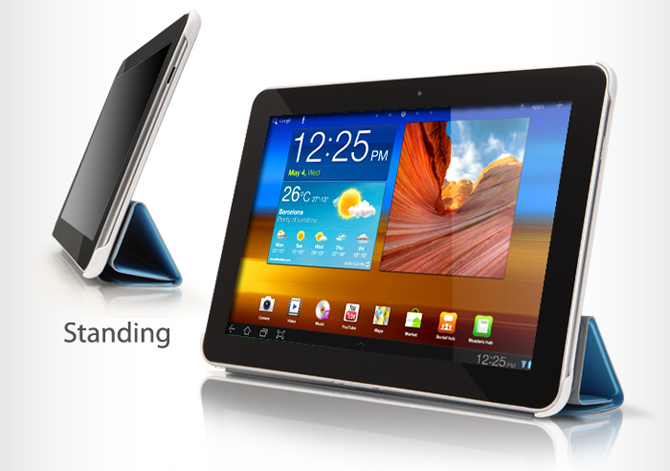
Apple takes Samsung to court over patented smart cover for smartphones and tablets

Site default logo image

UPDATE [Wednesday, December 21, 2011 at 7:25am ET]: A Samsung spokesperson chimed in, providing us with the official statement, included at the end of this article.

After Samsung confirmed the addition of four more complaints to its German patent offensive (two are standard-related patents, the other two being utility patents) on Monday, Apple this morning fired back by extending its Australian patent complaint to include Samsung-made cases for Galaxy tablets and smartphones, according to Bloomberg.

Apple issued the notice of infringement to Samsung in Australia over the cases, and will file a statement of claim, Apple’s lawyer Stephen Burley said at a hearing in Sydney today. Samsung’s lawyer Katrina Howard said at the same hearing the company was served with the notice that the cases infringe at least 10 patents.

The two companies are embroiled in a complicated legal fight that already includes more than 30 lawsuits filed against each other across the globe. The exact nature of Apple’s patent infringement claim concerning smartphone and tablet cases is not known, but 9to5Mac can’t help but wonder whether it has something to do with this.


Expand
Expanding
Close

Apple grabs 61.5-percent of global tablet market in Q3, 10 times over closest competitor (Samsung)

Site default logo image

Last time we checked with research firm IDC, they listed Apple at 68.3-percent of the worldwide tablet market with approximately 9.3 million units of the iPad 2 shipped in quarter two of 2011. While the firm’s estimates for Q3 saw a drop to 61.5-percent of the market, Apple still leads the market and increased shipments from the 9.3 million in Q2 to approximately 11.1 million units in Q3.

To put that in perspective, Apple’s closest competitor, Samsung, is over 10 times behind with just 5.6-percent of the market. The overall tablet market increased 23.9-percent to approximately 18.1 million units, representing a 264.5-percent increase from the year-ago quarter.

As for where Apple stands in comparison to the overall Android tablet market, IDC expects Android tablet market share to increase rapidly in Q4 from just 33.2-percent in Q3 to 40.3-percent. It’s important to note that IDC recently included “media tablets,” such as Amazon’s Kindle Fire and Barnes & Noble’s Nook Tablet, in their worldwide tablet market estimates. These additions will more than likely account for much of the increase.

This morning, Morgan Stanley significantly raised its forecasts for 2012, predicting Apple could possibly sell 90 million iPads during the year (in addition to 190 million iPhones). The analysts apparently have high hopes for Android 4.0’s ability to offer a competitive alternative to iPad going forward:


Expand
Expanding
Close

Samsung markets Galaxy Tab as “the tablet Apple tried to stop”

Site default logo image

Last week Samsung got to breathe a sigh of relief as an Australian court ruled they didn’t “slavishly copy” the iPad with the Galaxy Tab 10.1, as Apple has been insisted from the onset in court documents. Yesterday, the South Korean company told the Sydney Morning Herald that the court cases have helped make their device a “household name” and today we are seeing the Galaxy Tab maker taking advantage of the media spotlight and the fact that it’s been in the headlines thanks to lawsuits and those cheesy commercials.

As tweeted by Martin Aungle, an Australian corporate and marketing communications professional, Samsung is now pitching its device as “the tablet Apple tried to stop”. The above advert ran in the Sun-Herald newspaper this week. Samsung has obviously decided to up the stakes in this game considering they resisted up until now mentioning Apple by name in their marketing communication. We’ll see, of course, whether publicly celebrating its courtroom victory at Apple’s expense will have any effect on sales.


Expand
Expanding
Close

Samsung didn’t “slavishly copy” iPad, High Court rules and gives Galaxy Tab 10.1 a go-ahead in Australia

Site default logo image

Today is a bad day for Apple’s legal sharks. First Motorola Mobility scores a ruling in Germany which has paved the way for a Europe-wide injunction on sales of Apple’s iOS devices and now High Court in Australia denies Apple’s request to appeal against an earlier decision which overturned the ban on Galaxy Tab 10.1 sales in Australia.

Put simply, the country’s highest-level legal instance has ruled that no, Samsung’s tablet does not “slavishly copy” Apple’s iPad, as the Mac maker argues in court documents. The Federal Court honored Apple’s recent request that its injunction against the Samsung tablet remain in effect until today at 4pm in order to allow Apple time to prepare an appeal.

According to the Sydney Morning Herald, Tyler McGee, vice-president of telecommunications for Samsung Australia, said customers in Australia will be able to pick up the Galaxy Tab 10.1 tablet “towards the latter part of next week”. Also…


Expand
Expanding
Close

Federal Judge lifts Samsung Galaxy Tab ban in Australia, Apple appeals

Site default logo image

A new twist in the Apple vs. Samsung legal proceedings spanning more than two dozen lawsuits across continents as the Federal Court in Australia lifted sales ban on Samsung’s Galaxy Tab tablet today. The court unanimously overturned a ruling last month from Justice Annabelle Bennett which required that Samsung’s Galaxy Tab 10.1 be banned from sale in Australia.

Sydney Morning Hearld quoted the ruling:

Samsung will be permitted to launch the Galaxy Tab 10.1 in Australia provided it keeps accounts of all transactions involving that device in Australia.

Samsung’s Australian subsidiary says it is “pleased with today’s unanimous decision”. Reacting to the decision, Apple plans on appealing to the High Court. The Federal Court also honored Apple’s request that its injunction remain in effect until Friday at 4pm, to allow the company time to prepare an appeal. A full hearing on copycat accusations is set for March 2012, which could still result in a permanent injunction.

Expand
Expanding
Close

Apple could lose German patent case vs. Samsung in January, gives up iPhone 4S firmware in Australia

Site default logo image

In Australia, as part of discovery, Samsung got access to Apple’s Qualcomm baseband source code for the iPhone 4S (lookout for battery issues while you are in there Sammy!).

Other matters appeared to be resolved, including Samsung’s access to the firmware used in the iPhone 4S’ baseband chip, supplied by Qualcomm.

A software expert had approximately two hours’ access to the firmware and would submit his findings by Sunday.

According to FOSSPatents, Samsung’s lawsuits against Apple in Germany are really heating up after a Mannheim hearing set a schedule for January 20 and 27 of 2012. It looks like Apple has a tough case, as the hearing leaned towards Samsung’s claims.

The two patents asserted in today’s litigations are

  • EP1005726 on a “turbo encoding/decoding device and method for processing frame data according to QoS”, and
  • EP1114528 on an “apparatus and method for controlling a demultiplexer and a multiplexer used for rate matching in a mobile communication system”.

Samsung’s third German complaint against Apple, which wasn’t at issue today, relates to EP1188269 on an “apparatus for encoding a transformat format combination indicator for a communication system”.

Below is a full rundown of the issues discussed at today’s hearing..


Expand
Expanding
Close

Did Motorola just win an injunction barring Apple from selling mobile products in Germany?

Site default logo image

Florian Mueller isn’t a patent attorney but he plays one on his blog FOSSPatents.  For better or worse, he’s often quoted in the ongoing mobile technology patent battles where the winner is often Apple.  He’s also German so he probably understands this new, disturbing ruling a lot better than us (Our German is “rostig”)

Apple knows what it’s like to win injunctions against rivals. It won four of them against Samsung (two in Germany, one in the Netherlands and most recently one in Australia; all of them preliminary). Now it seems that Apple has just come out on the losing end of a patent infringement lawsuit. I have received a copy of what purports to be a default judgment by the Mannheim Regional Court barring Apple from selling in Germany — the single largest market in Europe — any mobile devices infringing on two Motorola Mobility patents and determining that Apple owes Motorola Mobility damages for past infringement since April 19, 2003.

If true, this would be a Hindenburg-sized backfire for Apple’s legal efforts in Europe.

The two patents and their US equivalents, Statements from Apple and Motorola and an update from Mueller below:
Expand
Expanding
Close

Samsung requests depositions from Jony Ive and other key Apple inventors

Site default logo image

Raising the stakes in the ongoing legal battle between Apple and Samsung over copycat accusations involving mobile devices, Samsung is upping the ante by asking to depose Apple’s iPhone designers, including Apple’s leading industrial design guru Jonathan Ive.

According to Josh Rosenthall of Edible Apple, depositions of Apple’s iPhone inventors Jonathan Ive, Douglas Satzger, Shin Nishibori and Christopher Stringer “will be taking place relatively soon” and ahead of the expedited trial between Apple and Samsung in the United States, scheduled for July 30, 2012.

According to Samsung’s motion, none of the aforementioned designers will be able to sit for deposition for various reasons. In the case of Jony Ive, the motion mentions “personal reasons”. Ive is especially important in this case. Jobs’s spiritual partner, it is said that no one could tell Ive what to do, at least until Jobs resigned. According to Jobs’s authorized biographer Walter Isaacson:

He called Jonathan Ive, Apple’s design chief, his “spiritual partner” at Apple. He told Isaacson that Ive had “more operation power” at Apple than anyone besides Jobs himself — that there’s no one at the company who can tell Ive what to do. That, says Jobs, is “the way I set it up.”

As such, Ive is the holder of Apple’s many secrets and inner workings, something Samsung is legitimately hoping to exploit ahead of the trial. And while Apple’s design guru really needs no introduction, here’s a brief overview of the others.


Expand
Expanding
Close

Market shifts: Samsung beats iPhone in sales, ZTE passes Apple in global cell phone volume

Site default logo image

The third quarter of 2011 marks a shift in the cell phone biz as Samsung takes the smartphone crown from Apple and China’s ZTE rises to become the world’s fourth-largest cell phone vendor by volume and Apple slides to fifth place. The bad news for Cupertino arrives just as the company for the first time in years missed Street expectations after shipping 17.07 million iPhones in the September quarter, a modest 21 percent annual growth and a notable 16 percent quarterly decline in units. As you recall, Apple in the June quarter sold 20.34 million iPhones, allowing them to beat Nokia and Samsung and become the world’s leading smartphone vendor, prompting Samsung to stop divulging smartphone and tablet shipments for competitive reasons.

Everyone was waiting for the new iPhone 4S.

Samsung today posted their quarterly earnings and they passed iPhone by an estimated ten million units. According to Reuters which cited a Strategy Analytics survey, Samsung shipped about 27.8 million smartphones, up nearly four times annually and 44 percent sequentially. This gave Samsung a 23.8 percent global market share in smartphones vs. 14.8 percent for Apple. Such a strong growth is attributed to their Galaxy smartphones, particularly the Galaxy S II model which sold ten million units in the five months since its introduction. Strategy Analytics attributed Samsung’s success to “a blend of elegant hardware designs, popular Android services, memorable sub-brands and extensive global distribution”, adding:

After just one quarter in the top spot, Apple slipped behind Samsung to second position and captured 15 percent share. Apple’s global smartphone growth rate slowed to just 21 percent annually in Q3 2011, its lowest level for two years. We believe Apple’s growth during the third quarter was affected by consumers and operators awaiting the launch of the new iPhone 4S in the fourth quarter, volatile economic conditions in several key countries, and tougher competition from Samsung’s popular Galaxy S II model.

Apple also slid to fifth place in Strategy Analytics’s worldwide cell phone rankings as ZTE shipped 18.5 million handsets for a five percent global market share. Apple CEO Tim Cook said at the October 4 iPhone 4S introduction that iPhone had five percent share of the global cell phone market, hinting at Apple’s phone strategy:


via Fortune


Expand
Expanding
Close

More details on the iPad 3’s 2048×1536 resolution display

Site default logo image

CNET’s Brooke Crothers has heard some information about the iPad 3’s upcoming 264PPI display. As we’ve heard a lot in the past, it will be a 2048×1536 resolution display as long as the Korean display manufacturers, Samsung and LG, can produce them in large numbers. According to his source, there could be some problems building it in the monstrous quantities that Apple demands.

The closest that iPad display manufacturers like LG Display and Samsung can get is 2048×1536 resolution display, according to the source. That’s a PPI of 264, twice the 132 PPI on the iPad 2.

But whether manufacturers can make them in volumes that Apple demands is the question. “They have production plans for 2,048×1,536 displays. Starting in November. But those are only plans at this point,” said the source, referring to LG and Samsung.

“It’s not a question of making just one. That, of course, can be done. The challenge is making lots of them,” the source said. “This is a quantum leap in pixel density. This hasn’t been done before.”

If manufacturers are not able to hit the volumes necessary for the higher resolution, there is an interim option of 1,600×1,200, according to the source.

The display is also expected to have a brightness of 550 nits. That’s pretty bright, as the typical laptop display panel tops out at about 350 nits.

I don’t think it is as easy as dropping the resolution down to 1600×1200. Apps don’t scale that easily even if the aspect ratio is the same. If for some reason, they can’t pump out the 2048×1536 in sufficient numbers (and Samsung is already testing better ones), Apple will continue with the same resolution….or wait until they can produce enough high resolution displays.


Expand
Expanding
Close

Samsung looks to make Apple parts beyond 2012 and into 2013-2014

Site default logo image


Samsung manufactures the Apple-designed A5 chip found inside iPhone 4S and provides 512MB DDR2 RAM for the processor.

Samsung and Apple are working towards a resolution to the differences that have been plaguing their long-standing relationship, which culminated with some twenty patent infringement claims filed before courts in a dozen countries around the world. Quoting industry sources, Korea Times, asserted Monday that Samsung might provide Apple with custom-built A6 chips for upcoming new iPhone and iPad models.

Today, Yonhap News reports that Samsung COO Lee Jae-yong said his company would continue to supply the Cupertino, California client with crucial components, including Apple’s in-house designed A-family of chips powering their iOS devices. The supply chain ties with Apple, he told reporters upon arriving at a Seoul airport, continue to be long-term. The executive sat down the previous day with Apple CEO Tim Cook following a private memorial service for Steve Jobs, to which he had been invited. His two-hour meeting with Apple’s boss touched on parts for the 2013-2014 period, he told journalists:

For the 2013-2014 period, we discussed how best to supply even better parts.

The executive, pictured below the fold, also spoke of “a need to compete in a fair manner for the benefit of the consumer”, adding “this stance existed in the past, is taking place now and will occur in the future”. Another indication of attempts to diffuse the ugly legal brawl comes in another report quoting Samsung’s mobile chief Shin Jong-kyun as saying that the Galaxy Nexus smartphone, which was unveiled yesterday with great fanfare, is designed to bypass potential legal attacks from Apple:

Now we will avoid everything we can and take patents very seriously. We will see if it will be 100 percent free [from Apple lawsuits]. I think it is just a start and [the lawsuits] will last for a considerable time. I don’t think there is much gain [from lawsuits against Apple]. What we are losing is the pride in our brand.

Now, despite Apple’s rumored chips deal with Taiwan Semiconductor Manufacturing Company (TSMC), Apple reportedly isn’t taking risks. The company sold a quarter billion iOS devices to date and hopes to grow sales even faster in the years ahead.

Apart from Samsung’s semiconductor fab in Austin, Texas, other chip vendors may not be capable of producing mobile processors for Apple in volume, without affecting quality and all the while meeting Apple’s high standards. Remember, we’re talking up to 200 million chips for iPhones, iPads and iPods in 2012. As for Apple cozying up to TSMC…

Expand
Expanding
Close

US Judge says Samsung tablets do infringe Apple patents but doesn’t issue an injunction

Site default logo image

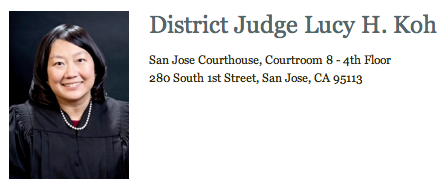
US District Judge Lucy Koh came down on Samsung today for infringing on Apple’s patents in a preliminary hearing on Apple’s request to bar some Galaxy products from being sold in the United States. She stopped short of issuing an injunction however, like her Australian counterpart yesterday, saying that Apple may have some issues establishing the validity of its patents.

Apple and Samsung have been at each others’ throats in more than 20 districts around the world. The fight has ensnarled some of the two companies’ partners and vendors.

Mobile providers Verizon Wireless and T-Mobile USA have opposed Apple’s request, arguing that a ban on Galaxy products would cut into holiday sales.

Apple must show that Samsung infringed its patents and that its patents are valid under the law.

At the hearing on Thursday in a San Jose, California federal court, Koh also said she would deny Apple’s request for an injunction based on one of Apple’s so-called “utility” patents.

She did not say whether she would grant the injunction based on three other Apple “design” patents.

Koh characterized her thoughts on the utility patent as “tentative” but said she would issue a formal order “fairly promptly.

The case in U.S. District Court, Northern District of California is Apple Inc v. Samsung Electronics Co Ltd et al, 11-1846.


Expand
Expanding
Close

Judge blocks Samsung Galaxy Tab 10.1 sales in Australia at Apple’s request

Site default logo image

Claiming Samsung copied the iPad’s design, Apple has successfully achieved their mission in getting an Australian judge to block Samsung’s Galaxy Tab 10.1 from being sold in Australia, reports Sydney Morning Herald. Apple says that Samsung is infringing on two patents, and the judge ruled until changes are made the Galaxy Tab 10.1 can’t be sold from this point on.

Apple and Samsung have current litigation continuing over in Europe and the United States. Apple has already successfully blocked the Galaxy Tab 10.1 in Germany and hopes to do so elsewhere.

Samsung won’t start addressing the core patent issue (screen patent) with the Galaxy Tab 10.1 quite yet. They want to prepare a proper defense against Apple. Interestingly, Samsung has setup a temporary store across from a Sydney Apple Store selling Samsung Galaxy S IIs for $2, to detract from the upcoming iPhone 4S launch Friday. The fight continues…

Cross-posted from 9to5google.com.


Expand
Expanding
Close

Google delaying Nexus Prime/ICS because of Apple patents?

Site default logo image

Update: He’s wrong.  We’ve heard from an impeccable source that Google plans to have invites out “in the next day or so” and there is no patent delay.

We reported earlier that Google and Samsung were delaying the release of the new Nexus Prime phone and Android 4.0 “Ice cream Sandwich” out of respect for the passing of Steve Jobs.

“We believe this is not the right time to announce a new product as the world expresses tribute to Steve Jobs’s passing,” the companies said.

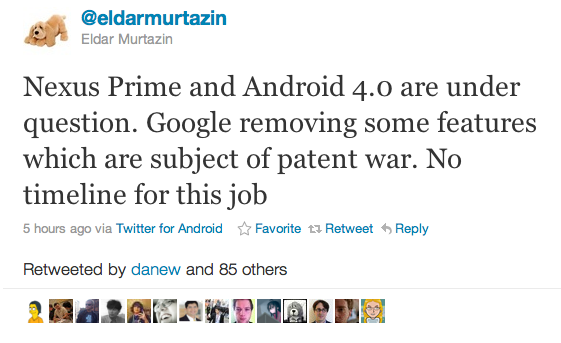
But according to often (but not always) correct blogger Eldar Murtazin, there are patent issues at hand which need to be addressed before the devices and OS  ship.  Specifically, Google is slicing out features which may be subject to Apple’s Patents…

See Steve Jobs introducing multi-touch in 2007 below, saying “Boy have we patented it!”.  More coverage at 9to5google.com
Expand
Expanding
Close

Samsung and Google delay launch of Ice Cream Sandwich/Nexus Prime out of respect for Jobs

Site default logo image

[youtube=http://www.youtube.com/watch?v=Py9TfZGie48]

Here’s the official statement from Google and Samsung:

“We believe this is not the right time to announce a new product as the world expresses tribute to Steve Jobs’s passing,” the companies said.

They are likely to make an announcement on the launch late next week.  The new Google phone is built by Samsung and is rumored to have a 4.65-inch, 720P display with dual core 1.5GHz Samsung processor, NFC, 1GB of RAM and other speeds and feeds.  It will likely be one of the stronger competitors the iPhone 4S faces this holiday season.

More at 9to5google.com
Expand
Expanding
Close

Samsung offers Apple a secret deal in Australia

Site default logo image

According to the Wall Street Journal, Samsung has offered Apple a secret deal to sort out the mess surrounding the Galaxy Tab 10.1 tablet launch in Australia. The report has it that Samsung proposed a cunning solution that would allow them to release the device in the country next week. Apple’s legal counsel Stephen Burley allegedly told Justice Annabelle Bennett that Samsung’s “inconvenience would be diminished and we would be comforted” if the deal was accepted.

What incentive Samsung might have in store for Apple in exchange for releasing its tablet in Australia as early as next week is anyone’s guess. I asked patent expert Florian Mueller, who runs the FOSSPatents blog, about this. He responded on Twitter that Samsung “might promise not to infringe certain patents, make a payment, and perhaps also procedural concessions”.


Expand
Expanding
Close

Apple vs. Samsung is about ecosystems, not tablets or patents

Site default logo image


Apple has made its concerns official. The iPhone maker fears Samsung tablet will lure consumers away from the powerful iTunes ecosystem. Apple’s been successfully leveraging iTunes to tie people to the platform through app and entertainment content sales.

The heated Apple vs. Samsung legal battle over who’s copying who is really about the ecosystem rather than the hardware or the patents. That’s the gist of today’s hearing before the Federal Court in Sydney related to an Apple-requested ban on sales of Samsung’s Galaxy Tab 10.1 tablet in Australia. According to Smh.com.au, lawyers for Apple argued that the launch of the Galaxy Tab 10.1 could take away iPad 2 sales so quickly that buyers may be “seduced” from the iOS platform.

It’s all about the apps and the broader ecosystem, Apple’s legal team told Justice Annabelle Bennett, arguing the Galaxy Tab 10.1 “is vastly the one that is going to be targeting the iPad 2”. IDC numbers released today suggest that that tablet shipments to Australia and New Zealand doubled sequentially in the June quarter, which the research firm attributed to an influx of Android tablets recently released into those markets.

Apple’s lawyers then resorted to the “fire hose” metaphor to make their case:

This is going to be launched on the market with the velocity of a fire hose and it is going to just come in and take away iPad 2 sales so quickly that by the time we get to final hearing the full impact of the patent infringement will be to the detriment of Apple and to the benefit of Samsung.

And this bit about the battle of ecosystems:

They’ll then be Android people and the investment in the apps that they make to purchase on their Galaxy Tab will be something they can’t use on an Apple product.


Expand
Expanding
Close