Tech Industry

See All Stories
Site default logo image

Would Apple ‘confirm’ iPhone event if screen low yield rates were going to affect delivery schedule? (Also AAPL splitting, and buyouts)

After iMore broke the September iPhone event news, Apple, through its channels, confirmed to not one, not two, three, or four, but at least five different publications that the iPhone event would be Sept. 12 with a Sept. 21 launch. If you do not think these are Apple PR confirmations, I have a nice bridge to sell you.

[tweet https://twitter.com/jdalrymple/status/230324873451417600]

With that information in hand, we are pretty certain Apple is on track for a September iPhone announcement.  …But wait.

Digitimes has some bad news for us today.

Low yield rates of in-cell touch panels might disrupt new iPhone delivery schedule and shipments, say rumors

LOL!

In related news, Bloomberg reports that an Analyst says Apple will split its stock so it can join the Dow Jones Industrials—something that has always been on the top of Apple’s priorities list. Sound familiar?

Joining in, the NYTimes suggests that Apple buy US Carrier Sprint, RIM, Twitter and Path. 
Expand
Expanding
Close

Site default logo image

Samsung Chief Product Officer talks patent wars and rectangles

After execs from both companies could not come to terms in an attempt to settle, both Samsung and Apple take the stand in a San José, Calif., court room this week. Apple and Samsung will face off for allegedly stealing each other’s patents. Apple also claims that Samsung’s Galaxy devices “slavishly” copied its beloved iPhone and iPad. The same type of trial already played out in many countries across the pond. It will be interesting to see where this all goes, especially after the injunctions against Samsung’s products we have already seen.

Samsung Chief Product Officer Kevin Packingham recently sat down with the folks at Wired to answer a few questions on the recent legal matters, shedding more light on Samsung’s view of the whole legal fiasco. First off, Packingham answers a question regarding the separation between Samsung’s component business that supplies necessary parts to Apple and the product team that Apple thinks is a bunch of copycats. Packingham answered: “There are times when I’m absolutely appalled that we sell what I consider to be the most innovative, most secret parts of the sauce of our products to some other manufacturer — HTC, LG, Apple, anybody…But you know, we also use Qualcomm components, and we source from other component manufacturers as well.”

Apple, of course, gets a ton of parts from Samsung, and it even partnered with Samsung on a factory in Texas to make A4 and A5 chips for the iPhones and iPads.


Expand
Expanding
Close

Site default logo image

Gas leak at (Dell, RIM, HTC &) Apple MacBook casings manufacturer Catcher injures 5

A chlorine gas leak at one of Apple’s Chinese supplier plants reportedly killed one person and left four others in comas late last night.

According to The Financial Times (via Xinhua Net), the deadly accident occurred at a Catcher Technology factory in eastern China. The company manufactures MacBook casings, as well as product casings for HTC, RIM, and others, and it confirmed late Thursday that the gas allegedly leaked during wastewater processing.

“The accident happened at the waste disposal facility and is not directly related to any manufacturing process, factory, or materials,” said Catcher Vice President of Corporate Finance James Wu in a statement to Reuters.

Another Catcher plant in Suzhou temporarily closed in October 2011 due to local residents who complained about bad odors emitting from the plant. The factory resumed processes within 10 days, however.


Expand
Expanding
Close

Broadcom announces BCM4335 chip that will likely power 2013’s iPad and iPhone to Gigabit ‘5G’ Wi-Fi

Site default logo image

Broadcom just announced its next round of portable device wireless chip, the BCM4335, which includes the ability to connect to the superfast 802.11ac networks. Apple exclusively uses Broadcom chips in this family for its iOS devices (and a different family for its Macs). The current iPad and iPhone use the Broadcom BCM4330 802.11a/b/g/n baseband/radio with integrated Bluetooth 4.0+HS and an FM transceiver—and the xxx5 is just a minor step up.

We found some code that indicates the next iPhone will use the Broadcom BCM4334, which adds the 40nm process and Wi-Fi Direct capabilities (perhaps opening some Airdrop capabilities too).

The 40nm chip will continue to deliver Bluetooth 4.0 and FM, but its 802.11ac networking could save some power using the new standard. It also features the “industry’s most advanced idle power consumption performance, which significantly extends a mobile device’s battery life.”

Sample chips are already available with a full production expected to be delivered in Q1 2013, just in time for next year’s iPads.

The press release follows:
Expand
Expanding
Close

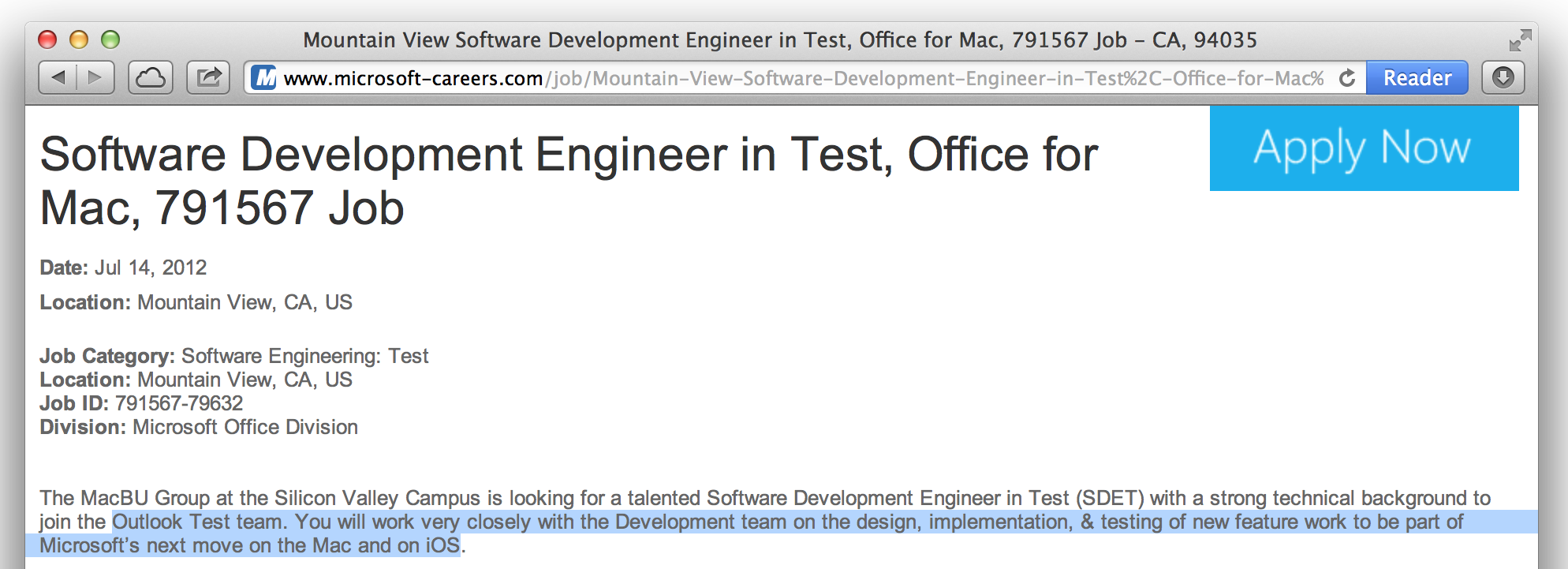
Microsoft job listing hints at Outlook and Powerpoint for iOS, perhaps other Office apps

Site default logo image

.

We had a few hints in the past about Microsoft possibly preparing an iOS version of its Microsoft Office suite of apps. In May, The Daily posted an image of a supposed early build of the software—demoed by a Microsoft employee—rumored to launch in November.

Another hint that Microsoft could have iOS apps in the works comes from a set of job listings posted earlier this month. It looked for a software engineer on the Outlook Test team to work on “Microsoft’s next move on the Mac and on iOS.” Another was on the Powerpoint Test team.

This is not solid proof that Office is coming soon, since Microsoft does have several other iOS apps, such as SkyDrive, OneNote, etc. that could benefit from office integration, but the job listing specifically looks for someone to test Outlook/Powepoint on Mac and iOS.


Expand
Expanding
Close

Site default logo image

Collapsing Nokia may have had Apple-like hardware in development in the 90s

…but horrific corporate management has it in a place where it may be forced into a patent firesale.

Interesting article on Nokia in the Wall Street Journal last night. It starts with:

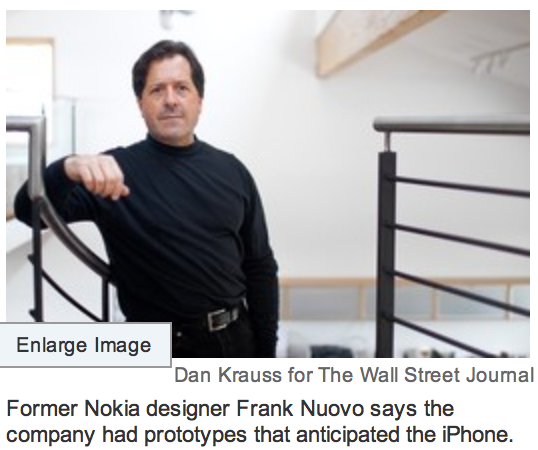
More than seven years before Apple Inc. rolled out the iPhone, the Nokia team showed a phone with a color touch screen set above a single button. The device was shown locating a restaurant, playing a racing game and ordering lipstick. In the late 1990s, Nokia secretly developed another alluring product: a tablet computer with a wireless connection and touch screen—all features today of the hot-selling Apple iPad.

“Oh my God,” Mr. Nuovo says as he clicks through his old slides. “We had it completely nailed.”

Hardware is a key element, but, as we saw with Apple’s 2002 iPad, software, marketing, ecosystem and maybe most of all timing also play important roles when determining the success of a product line. When the time was right and the opportunities presented themselves, however, Nokia failed to execute.

“What struck me when we started working with Nokia back in 2008 was how Nokia spent much more time than other device makers just strategizing,” Qualcomm Chief Executive Paul Jacobs said. “We would present Nokia with a new technology that to us would seem as a big opportunity. Instead of just diving into this opportunity, Nokia would spend a long time, maybe six to nine months, just assessing the opportunity. And by that time the opportunity often just went away.”

Anecdotally, I have a friend who worked with Nokia in advertising. He would say the same thing: The company was gridlocked by politics and poor leadership. Different product groups treated different parts of the company as competitors and not compatriots.

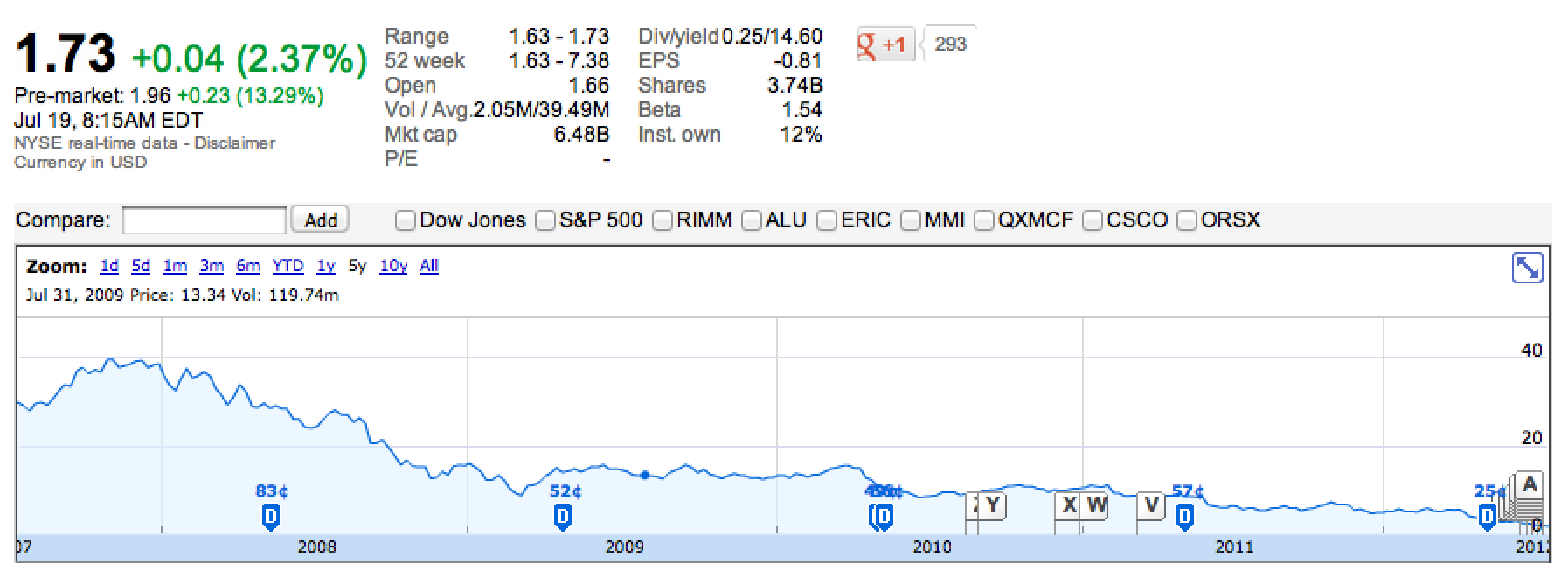
And, five years after the iPhone unveiled, Nokia is in a tail spin. This is causing a cash crunch so huge that it will likely be forced to sell off a lot of those early patents that are valued around $6 billion—which is just slightly under Nokia’s current $6.5 billion market cap. That means investors have very little confidence in the firms ability to succeed. In fact, had Google waited, Nokia might have been a better patent purchase target than Motorola.

Nokia still is struggling to turn its good ideas into products. The first half of the year saw Nokia book more patents than in any six-month period since 2007, Mr. Elop said, leaving Nokia with more than 30,000 in all. Some might be sold to raise cash, he said.

“We may decide there could be elements of it that could be sold off, turned into more immediate cash for us—which is something that is important when you’re going through a turnaround,” Mr. Elop said.

It is pretty sad that a company like Nokia is not worth more than the patents it holds.
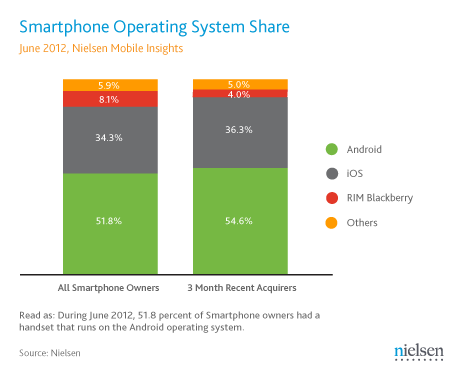
Nielsen: Android and iOS are over 90 percent of US smartphone market, and growing

Site default logo image

…For the first time ever, two-thirds of new phone acquirers are buying smartphones.

Smartphone use is exploding in the United States, while PC sales are dropping. If 66 percent of mobile phone buyers purchase smartphones, and 36.3-percent of them get the iPhone, then that means almost a quarter of all phones bought in the U.S. are iPhones. That also means 36 percent of the purchased phones run Android OS.

More from Nielsen, including the incredibly skewed graphic, is below—which gives Symbian, Palm and Windows 7 devices almost the same amount of “fill” at 2.8-percent as Apple’s 34 percent.


Expand
Expanding
Close

Site default logo image

Congress considers forbidding sales bans related to essential patents

Reuters reported today that Congress is set to discuss whether companies that hold patents considered essential to an industry standard, “such as a digital movie format,” should be allowed to request bans on infringing devices. A hearing will take place this Wednesday with the Senate Judiciary Committee, and Federal Trade Commission officials are expected to testify:

“If they (smartphone makers) had taken the conservatively $15 to $20 billion dollars they’ve spent on this fight, imagine how much better a place the world would be,” said Lemley.

Site default logo image

Casting for Jony Ive role, others announced for indie Steve Jobs biopic

We previously told you about the “jOBS” biopic staring Ashton Kutcher as Steve Jobs that is currently in production, and we brought you some early images of Kutcher on set. The film was previously confirmed to star Josh Gad as Steve Wozniak and Matthew Modine as John Sculley, but a new report from HollywoodReporter announced more additions to the cast including Giles Matthey (pictured right) as Jony Ive:

Kevin Dunn and J.K. Simmons have joined the cast of Jobs, the biopic about the late Apple co-founder Steve Jobs, starring Ashton Kutcher. Also rounding out the cast are Elden Henson, Lenny Jacobson, Giles Matthey, Ahna O’Reilly and Victor Rasuk… Dunn, who recently co-starred in HBO’s Luck, will play Apple chairman Gil Amelio. Simmons, known from his nine seasons on Law & Order, will appear as venture capitalist and Apple investor Arthur Rock. Among the other additions to the cast, Henson plays computer scientist and Macintosh developer Andy Hertzfeld; Jacobson portrays Apple engineer Burrell Smith; Matthey is iPod designer Jonathan Ive; O’Reilly plays Jobs’ girlfriend Chris-Ann; and Rasuk is Apple’s first employee and user interface architect Bill Fernandez.

The biopic is now shooting in Los Altos and Los Angeles, and it is expected to release later this year. Other cast members previously confirmed include James Woods, Ron Eldard, John Getz, Lukas Haas, Dermot Mulroney, and Lesley Ann Warren.

Site default logo image

Google to pay $22.5M settlement in FTC’s iOS Safari privacy investigation

The last time we updated you on the Federal Trade Commission’s investigation into Google’s method of bypassing the default Safari browser settings on iOS devices, reports claimed the company was facing possible fines that could reach tens of millions. Today, The Wall Street Journal said Google is close to reaching a $22.5 million settlement with the FTC, according to people close to the negotiations:

The fine is expected to be the largest penalty ever levied on a single company by the U.S. Federal Trade Commission. It offers the latest sign of the FTC’s stepped-up approach to policing online privacy violations, coming just six months after The Wall Street Journal reported on Google’s practices.

While the fine likely will represent only a tiny portion of Google’s revenues—last year, the Internet giant raked in that much cash roughly every five hours or so—it counts among a series of negative reports about Google’s privacy practices that could undermine users’ trust in its services.

iOS 6 code points to integration of Apple Maps on Intel-based Macs

Site default logo image

Since Apple unveiled its new in-house Maps app for iOS 6, we have discovered bits and pieces of what it has planned for the final release this fall. Apple already showed off Yelp integration, turn-by-turn navigation, and the 3D flyover mode, and it appears to be utilizing a new Avenir typeface. Today, Techpp posted a code dump from the iOS 6 maps app courtesy of developer Cody Cooper who found some interesting evidence of potential Maps integration with OS X:

Our developer friend, Cody Cooper has now stumbled upon an interesting code dump in iOS 6 maps application which hints at the possibility of Apple Maps coming to Macs in the near future.

During his routine investigation of Maps app, Cody found some interesting bits in the file altitude_manifest.xml

In this XML file, there is a reference to a set of Intel based graphics chipsets for which certain features like Shading are disabled.

While this is not solid proof that Apple is working on a full-blown Maps app for Mac, it could hint at possible integration between core apps and features in Mountain Lion and Maps on iOS. For example, location features in iPhoto could integrate with iOS Maps. As noted in the report, the code refers to shading being disabled for older Intel chipsets, which Cooper guessed could likely not support the app’s shading features. We will do some digging, and then update you if we discover anything new. The public release of Mountain Lion is scheduled for this month.
Expand
Expanding
Close

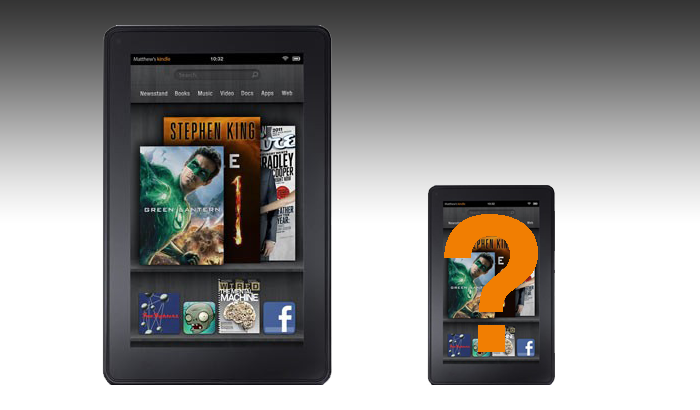
Amazon is building a phone to compete with iOS and Android

Site default logo image

According to Bloomberg, Amazon is developing a smartphone to go head-to-head with the iOS and Android handsets. Amazon is reportedly working with Foxconn to build the device, the same manufacture for many of Apple’s mobile devices including the iPhone and iPad.

In order to prepare for the launch of their phone, Amazon plans to build up a wireless-related patent portfolio, according to the report. Amazon already sells the successful Kindle Fire with a 7-inch display, a device that demonstrates the firm’s aptitude for building a high-quality, customized mobile operating system (based on Android).

Amazon has its own series of content and distribution channels, including cloud services for downloading media like movies and books, making their Amazon phone an obvious competitor to Apple’s iPhone and its portfolio of media content stores like the iTunes Store and iBookstore…


Expand
Expanding
Close

Site default logo image

Avid sells off its consumer M-Audio brand and video editing apps

Avid is best known for its Pro Tools software, the music industry’s leading DAW used by pros worldwide, and it is the biggest competitor to Apple’s Logic Pro, but perhaps just as popular among Mac musicians is Avid’s consumer M-Audio brand. It offers midi controllers, keyboards, audio interfaces, speakers, and DJ gear.

Today, Avid announced that it will sell off its consumer audio and video product lines to focus on “Media Enterprise and Post & Professional customers and to drive improved operating performance.”

Avid will sell M-Audio to inMusic, the parent company of well-known gear makers Akai, Alesis, and Numark. Its video editing apps, such as the recently launched Avid Studio for iPad, will be sold to Corel Corporation:
Expand
Expanding
Close

Site default logo image

Former Mac OS X chief Bertrand Serlet working on cloud startup with ex-Apple colleagues

In March 2011, Apple officially announced that Mac OS X chief Bertrand Serlet would leave Apple after 22 years with Steve Jobs at NeXT and Apple. At the time of the announcement, Serlet said he wanted “to focus less on products and more on science,” but we did not have any other information on what was in the cards for the man Apple credited with the “definition, development and creation of Mac OS X.”

Today, BusinessInsider reported on what Serlet has in the works:

Business Insider has learned that Serlet has spent much of the time since his departure from Apple working with at least two other former Apple employees to launch a cloud computing startup in downtown Palo Alto called Upthere

Some of these job postings also allude to the fact that the startup was founded by high-profile ex-Apple employees.

We have since learned that this is a reference to Serlet (the brains behind Mac OS X) and Roger Bodamer, a former VP of product operations and development at Apple who previously worked at Oracle.

Based on the job postings we’ve seen, it’s clear the startup is looking to rethink the way people store files in the cloud, though just how this service will compare to options like Dropbox or Apple’s own iCloud feature remains unclear.

Site default logo image

T-Mobile signs AWS spectrum agreement with Verizon

T-Mobile just announced plans to exchange and purchase spectrum from Verizon Wireless in a deal the carrier claimed would improve its “spectrum position in 15 of the top 25 markets” that covers 60 million people. T-Mobile said the spectrum would help enhance its 4G network and advance the rollout of its LTE service. The agreement includes spectrum that Verizon planned to acquire from several cable companies, so T-Mobile will first have to wait for the Federal Communications Commission and U.S. Department of Justice to approve the deal:

“This agreement will provide T-Mobile with critical AWS spectrum, enhancing both network capacity and performance and allowing us to meet the growing consumer demand for 4G mobile broadband,” T-Mobile CEO and President Philipp Humm said. “This is good for T-Mobile and good for consumers because it will enable T-Mobile to compete even more vigorously with other wireless carriers. We anticipate FCC approval later this summer, in time for us to incorporate this new spectrum into our network modernization and the rollout of LTE services next year.”

We recently updated you on the rollout of T-Mobile’s $4 billion 4G-network plan, including its plan to rollout 4G HSPA+ in the 1900 MHz spectrum to iPhone users “in a large number of markets later this year.” T-Mobile mentioned a few of the cities that would benefit if the agreement goes through:

T-Mobile will gain spectrum covering 60 million people — notably in Philadelphia; Washington, D.C.; Detroit; Minneapolis; Seattle; Cleveland; Columbus, Ohio; Milwaukee; Charlotte, N.C.; Raleigh-Durham, N.C.; Greensboro, N.C.; Memphis, Tenn.; and Rochester, N.Y

Site default logo image

RIM to be split into handset and services, sold off piecemeal?

TheVerge reads behind the Sunday Times’ firewall:

The Sunday Times reports today that RIM is considering a plan to split its handset division and messaging network into two separate companies, and will sell off the struggling BlackBerry hardware business. The British paper doesn’t cite any sources in the report, but it says that Facebook and Amazon are both “potential buyers.” As part of this plan, RIM could keep its enterprise-friendly messaging and data network (including BBM and BIS) in-house and license them out.

BBM and BES only run on Blackberry now, and that platform will have a market share heading toward zero by the time RIM gets all of this organizational structure sorted. So keeping that a separate business makes little sense.

The other option is selling out piecemeal to Microsoft for parts and people. I imagine that by then, the price of RIM will get so low, even Apple and Google would be interested in picking up the parts (patents, people, and tech). Microsoft is probably already lining up some cash to buy the remnants of Nokia as well, so it is less likely to pick up RIM (although it made several attempts to pick up RIM in the past).

Moreover, RIM’s QNX/Blackberry 10 might have some value for companies like Dell, HP (which recently fumbled WebOS), Lenovo, Toshiba, Acer, or ASUS due to Microsoft now building its own tablets and scaring OEMs.

That split could also see Cisco or Oracle taking the backend stuff.

Any way you look at it, on the fifth anniversary of iPhone, Blackberry —as we knew it— is almost over.

Site default logo image

Microsoft unveils Windows Phone 8

Microsoft’s Windows Phone Summit is happening now in San Francisco with Microsoft Vice President Joe Belfiore giving a demo on eight of the big new features to be included in Windows Phone 8. Some of the notables, as highlighted in the images above, include: a new SIM-based NFC wallet experience that will initially launch on Orange (and it appears to include iOS 6 Passbook-like features for third-party cards, etc.); Nokia Map technology for offline maps and turn-by-turn; and, an updated customizable home screen. During the presentation, Belfiore also showed the slide above (via CNET) of SunSpider benchmark results showing IE 10 on Windows 8 beating out the iPhone 4S (running iOS 6 beta—Developer NDA be damned) and Android devices.

Perhaps the most interesting thing about Microsoft’s strategy is that it is—yet again—totally refreshing. That means no single Windows Phone 7 device will upgrade to Windows 8; all current devices are orphaned. For consumers, the company did this same thing with Windows Mobile. The only difference is that Windows Phone 7 looks like Windows 8. It is a completely new ballgame underneath, and the device is actually running an entirely new OS that gets its roots in Windows NT. For developers, things are easier due to the shared libraries.

Chevy Sonic, Spark to be the first cars out of GM to sport Siri’s ‘Eyes Free’ feature

Site default logo image

During its opening keynote at the Worldwide Developers Conference, Apple announced Siri would gain an all-new “Eyes Free” feature as part of iOS 6. Eyes Free lets automakers include a button on their automobiles that allows drivers to initiate Siri for sending messages, making calls, setting reminders, launching apps, and accessing a slew of information from inside of the car without picking up the device. Apple revealed nine automakers will adopt Eyes Free, but it gave no more information. This evening, GM Authority reported that GM would be one of the first to include the technology in its automobiles. The company is starting with its Chevy Spark and Sonic, which are two compacts with a budget in mind. The publication could not provide an exact date of arrival for the technology in GM’s vehicles, but it should be available within the next year.

The Spark and Sonic now feature Chevy’s MyLink that allows drivers to connect their car with any smartphone. It has roughly 60 commands, which is not that much, but Siri could definitely add a long-list of commands for those who have an iOS device.

Eyes Free should resemble how other hands-free packages work on automobiles. An Eyes Free button will be included on the steering wheel, so users can activate and speak to any iPhone or iPad that is connected over Bluetooth. Siri will do all the processing work.

The other nine automakers announced as partners include BMW, Mercedes, Land Rover, Jaguar, Audi, Toyota, Chrysler, and Honda. We will look out for when more information becomes available over the next year. (via CNET)


Expand
Expanding
Close

Site default logo image

Google accelerating development of Siri competitor for Android

The Wall Street Journal reported that Google is accelerating its plans to launch a competitor to Siri. 9to5Google has the full story:

We have heard several reports in the past that Google was working on various evolutions of its Voice Actions platform for Android. Back in December we heard of “Project Majel”, which according to reports is the codename for a new voice-controlled assistant app similar to Siri. In March TechCrunch reported on a similar project dubbed Google Assistant. According to a new report from the Wall Street Journal, Google is accelerating its plans to launch a competitor to Apple’s Siri…

Site default logo image

Verizon announces ultra-high speed FiOS ‘Quantum’ service, up to 300 Mbps for $210 a month

Verizon announced tiers for its new high-speed Internet FiOS “Quantum” service today. It ranges from $65 to $210 a month, and it is available in double or triple-play bundles and stand-alone plans. Verizon will continue offering its entry-level $65 15/5 Mbps service, but it will introduce new plans including: 50/25 Mbps, 75/35 Mbps, 150/65 Mbps, and 300/65 Mbps. The company noted they are “by a wide margin the nation’s fastest, mass scale residential Internet speeds.”

Three of those speeds ¬¬ 75/35, 150/65 and 300/65 — are twice as fast as those previously offered.1 In addition, Verizon will continue to offer its entry-level speed of 15/5 Mbps… The two highest downstream speed offers – 150 and 300 Mbps – and the new 65 Mbps upstream speed are by a wide margin the nation’s fastest, mass scale residential Internet speeds available. By contrast, the fastest Internet speeds offered by cable-company challengers top out at 105 Mbps downstream and 20 Mbps upstream. (This FiOS Internet speed grid shows specific examples of the benefits of faster downstream and upstream speeds.)

Verizon noted existing customers can upgrade free, but they will on-average pay $10 to $15 more per month. The company also outlined the different pricing options for new customers:

For new customers, prices of triple-play bundles of 15/5 Mbps FiOS Internet, FiOS TV and FiOS Digital Voice unlimited calling will range from $99.99 to $144.99 per month, depending upon which FiOS TV package is ordered. The packages are: Prime, with more than 200 channels and more than 50 HD channels; Extreme, with more than 290 channels and more than 70 HD channels; and Ultimate, with more than 380 channels plus premium movie channels, and more than 110 HD channels).

Double-play bundles of the 15/5 Mbps FiOS Internet and FiOS TV range from $84.99 to $129.99 per month. Stand-alone 15/5 Mbps service costs $69.99 per month on a month-to-month basis, and $64.99 per month with a two-year contract.

Triple-play bundles of the 50/25 Mbps speed range from $109.99 to $149.99 per month for new customers. Double-play bundles with FiOS TV range from $94.99 to $134.99 per month. The stand-alone version costs $79.99 per month on a month-to-month basis, and $74.99 with a two-year contract.

Triple-play bundles of the new 75/35 Mbps speed range from $114.99 to $154.99 per month for new subscribers. Double-play bundles with FiOS TV range from $99.99 to $139.99 per month. The stand-alone costs $89.99 per month on a month-to-month basis, and $84.99 with a two-year contract.

Triple-play bundles of 150/65 Mbps speed range from $169.99 to $174.99 per month for new FiOS customers. Double-play bundles with FiOS TV range from $154.99 to $159.99 per month. The stand-alone costs $99.99 per month on a month-to-month basis, and $94.99 with a two-year contract.

The new 300/65 Mbps tier, offered as a stand-alone only, costs $209.99 per month on a month-to-month basis, and $204.99 with a two-year contract.3

Will Microsoft try to take on Apple by manufacturing its own tablet?

Site default logo image

Microsoft is allegedly prepping to directly compete with Apple in the tablet market

The Redmond, Wash.-based Company scheduled an event in Los Angeles on Monday to make a “major announcement.” AllThingsD reported earlier this week that the event would unveil Microsoft’s tablet plans:

  • After signaling for months that it would attack the market only through its traditional hardware partners, Microsoft has decided to enter the tablet business more directly. […]
  • Sources say that Microsoft concluded that it needs its own tablet, with the company designing both the hardware and software in an effort to better compete against Apple’s strengths. Microsoft’s tablets may include machines running ARM-based processors as well as models running on traditional PC processors, sources said.

Perhaps more interesting: The Wrap claimed Microsoft will self-manufacture the device, which is an assertion that AllThingsD supports. The move is certainly plausible, because Microsoft snatched a 17.6-percent stake in Barnes and Noble’s Nook eReader business last month for $300 million. One could speculate that Apple and Amazon’s dominating presence in the market causes companies like Microsoft and Barnes and Noble to join forces.

[tweet https://twitter.com/harrymccracken/status/213653354117738497]


Expand
Expanding
Close